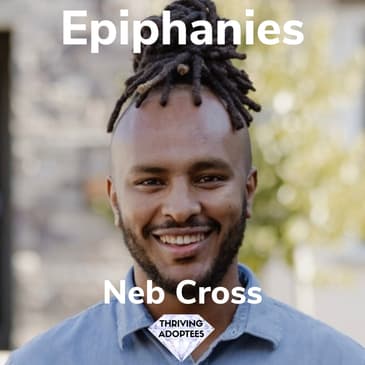
Is unprocessed grief eating you up? It did for Neb. But how on earth can a 2 year old handle the death of their mother? Neb's challenges continued...moving from home to a children's home and then a new home with an American family 9000 miles away from his homeland - Ethiopia. Neb blamed God, until he didn't. Listen in as he shares the epiphanies that got him back on the rails and thriving.
Connect with Neb here theethiopiancowboy11
More about Neb in the book by his mother https://www.amazon.com/Not-Forgotten-Wendi-Cross/dp/1637972210
Listen in to the interview with his mother https://thriving-adoptees.simplecast.com/episodes/faith-is-bigger-than-fear-with-wendi-cross
Guests and the host are not (unless mentioned) licensed pscyho-therapists and speak from their own opinion only. Seek qualified advice if you need help.
Want to learn more about thriving for you, your kids, your families or your colleagues? Pick a time to talk here
[00:00:02] Hello everybody, welcome to another episode of the Thriving Adoptees podcast. Today I'm delighted to be joined by Neb, Neb Cross. Looking forward to our conversation today Neb. We've been talking football, sorry soccer if you're in the States before we hit record. Because Neb's a soccer fan, that's your thing right? Yeah, yeah definitely.
[00:00:25] Yeah. So Neb was adopted by the Cross family from Ethiopia and listeners may recall that I interviewed his mum Wendy Cross before Christmas, a great lady. And so I'm looking forward to a great conversation with her son. So Neb, big question right? What does thriving mean to you?
[00:00:56] I think thriving has a few meanings to me. I think for me thriving is living the dream that I dreamt as a kid. Now look at myself right now.
[00:01:13] I have two kids, my wife. I'm blessed to have a house and a job and those things right? And my relationship with God obviously within that is thriving and having a really healthy relationship with my parents and my friends. That's kind of like thriving in the community aspect. Like I have community that are around me and that makes, I think that makes a formula for thriving really well.
[00:01:39] If you have people around you and community around you because that helps you to thrive and that helps you reach your goal and dream and there's no, you know, despair in that. So that's kind of like my definition of thriving. People who are around me, my family, my wife and children and all the people that help me get there. So that's kind of like what I think of when I think of thriving. Yeah. How old are your kids now?
[00:02:04] I have one just two months old. Yeah. And then another one who is Aliana. She's four. She's four years old. She just turned four in April. So yeah. So yeah. Yeah. Yeah. Is she playing soccer? She will be. Yeah. We'll be signing it up and here is the Starsom Fall, which is in August. So we have some time. So I've been, I've been taking her to a park and practicing with her here and there. Yeah. Yeah.
[00:02:33] Is she, is she getting her dad's skills? Is she going to be, is she going to be tackling you? Is she going to be running rings around you with the ball? Oh yeah, for sure. Yeah. She loves running and she just run around and all that. So she loves, she loves it out there at the park when we play. Yeah. Yeah. I always want to do that. So yeah, definitely. Yeah. She will be, she will be, she will be good. Yeah. She doesn't go anywhere. She runs everywhere. So. Forrest Gump. Yeah, exactly.
[00:03:00] And then she got you wrapped around her little finger as well, right? Yep. Yeah. Yep. Yeah. She'll be telling me what to do sometime, you know, and then running around. So, but no, we love her. She's a sweetheart. And so it's a blessing to have that and to be a father, obviously.
[00:03:19] And yeah, something I never dreamed of before, a long time ago, but now being in the position, being married and being half kids, that's a blessing that I never thought was possible. So. Have you always felt blessed or has there been tough stuff?
[00:03:37] Oh, no, definitely. There's been a lot of tough stuff as I grew up, you know, as I lost both of my parents at a young age. I lost my mom when I was two. And, and my dad, we used to work far away and he would be gone for the day and coming back on night only time. And so throughout the day, me and my sister were, you know, out there trying to figure life out. I was four years old and trying to like, you know, fetch for food for myself and all those things.
[00:04:05] So there's always, it's always been a struggle, you know, always looking for scraps for food or whatever it might be. But at the same time, I had like a really good, like group of friends that we kind of like play soccer the whole day. So we kind of forget our problem until we were hungry and so we're hungry and we're like, oh, sure, there's no food. And so, yeah, it's definitely had, I definitely, yeah, me and my sister definitely had hardship in the beginning before I got into the children's home.
[00:04:30] Like we have gone like three days without eating food and all those things because we just didn't have any. And so there's definitely been some challenging time and some difficult time as I grew up in Ethiopia and all that. And so, yeah, nah, but like I said, and nah, I still, I have friends and stuff like that we play with. So it makes it, it made it easier when you were a kid. You don't think about those things.
[00:04:53] But as I got older and as I look back, I was like, oh yeah, you know, life was rough. But at the same time, it led me to this moment and led me to this point. So, and I try to look into the brighter side of time too, when I had my, you know, my friends, we play soccer all day. We play tag, go, go to the lake or whatever it might be. We didn't even know how to swim. We just go to the lake just to play with the water and stuff like that. So that made it easier. But yeah, I definitely had a difficult time also.
[00:05:24] And what about adjusting to life in the States? Because you didn't speak any English, right? You were 11 when you came to the States or something like that? Yeah, I was 12. 12. Yeah, I was 12 years old when I came to the States. Yeah, definitely. I think it was a little bit, like you said, I did not speak English. So I did not understand anything that was going on around me for, I mean, a month worth, like when my brothers and sisters, they were going to school.
[00:05:52] I was at the house just doing Roar Without a Stone so I can learn English. And I didn't go out to school. I didn't go to school right away. I just had a time block. But I want to be in school so bad, like just like subbed between a computer and did Roar Without a Stone for hours and hours until I learned good enough English where I can go to school. And yeah, I was definitely there were a culture shock here, obviously, that America is so diverse, right? Definitely in California, I was even more diverse than other places.
[00:06:22] So there are people who speak Spanish. And then I was on a soccer team. What didn't help also is like I was on a soccer team who was fluently speaking Spanish. And it was just me and my brother who did not speak Spanish. So it was a little bit of a challenge not speaking English and then going to soccer. And they're speaking a different language. Soccer too, yeah. So those things were a little bit challenging. School, I didn't have a hard time making friends because my brother, me and my brother were close. So his friends became my friend because we played soccer.
[00:06:51] So that made it easier. But yeah, definitely those little bit of hiccups that happened in the culture. Like that was a little bit of a culture shock to me. Like I said, not learning English, not communicating with my family. That was difficult. Yeah. And I think you told me last time that the first time that you saw white people was when your mom and dad came to the children's home, right? Did you say that?
[00:07:20] No, we have people, American coming in and then like Americans come through there to our children's home a lot. All right. It must be. Yeah. My friend got adopted and stuff like that. But yeah. And like I said, when I came here, I was a little bit of surprising to see like how, I mean, not in a good way, but like how diverse it was. And then the only thing is, I think the difficult part when I came here is, like I said, like not speaking the language and then also not having a community here that spoke the language that we knew.
[00:07:49] We only knew one person and then like my mom would call him and if I have a question, I'll talk to him and he would translate it back to my mom over the phone. But that was a little bit of a difficult thing because I didn't have like in the beginning, I didn't have connection for sight to people with the same language that I did. Yeah. You mentioned God at the outset, like your relationship with God. When did that start? Wow. Yeah.
[00:08:19] So I was so when I when I was a kid, my parents both were Muslim at the beginning and they passed away. And I was never really into religion when I was a kid because I would just go to any religion that had food, to be honest. And me and my friend would just go any holidays. You know, the Muslims had a holiday. We go there. The Christian holidays, Orthodox, whatever it might have been. We just go there for the food aspect. But when I got into the children's home, as it was a Christian children home, and that's when I got introduced to Jesus.
[00:08:48] And and, you know, they told me about everything else. And so that's when I accepted Jesus to be my Lord and Savior. But later down the line, when I got into the state, when I got older, I blamed God for a lot of my upbringing. And I had a lot of questions of why, you know, God, why do you take my parents, my mom away, my dad, my grandma and all those things.
[00:09:08] So that kind of I yeah, that part and then also where I want to be belong with my friends who are doing things that was not welcome in our house, led me into a path that was straight as straight away from everything I knew to be. I was I was rebellious. I was doing things I was not supposed to.
[00:09:28] And so definitely even my relationship with God, I kind of have left it behind until, you know, until God kind of gathered me back in and healed a lot of those things that I had questioned since I was a kid. And yeah. So, yeah, my relationship with the Lord is like the big aspects of my life now, because I know what he has healed so many part of me and he has revealed like so many things. And and my perspective has shifted because, you know, I used to ask God, like, why do you do take all these things away?
[00:09:58] And when I look back and I like, oh, yeah, all those things got taken. But I also have a new family and new mom and your dad and your grandma and your grandpa and new siblings. Not everybody get those opportunities. Right. So it's like, wow, I'm actually like God. Yeah, those things happen, but God actually restored it even in the time better than what I can think or even imagine. So it's been a blessing. So, yeah, my relationship with God is like the utmost thing that when I think of thriving as that, that is one.
[00:10:28] Yeah. So when when did the when did the change start to happen? So you strayed from the path, got into some. Yeah. Some stuff that you would do that you shouldn't be doing. And then you said that God God brought me back in. I think. Yeah. Those are the words. So what did that what did that look like? What was that? What was that? What started that process for you?
[00:10:54] So, yeah, I think, like I said earlier, a lot of I have a lot of friends who might like in soccer and also in school. And also, I think for the longest time, I always ask God, like, why, why these things happened? And, you know, and never really dealt with with the reasoning or with the loss. I never like I said, my mom died. I never cried. I was I mean, I was two years old, but I never cried. My dad died. I never cried. My grandma died. I never cried.
[00:11:23] I kind of like accepted death to be part of life, which it is. But I accepted it to be like, oh, this is what it is. Everybody's going to die. I don't want to get anybody close to me. So once I got older, like once I got older and I start processing those things, it became a little bit more difficult. And so I start having friends who are not doing things, you know, partying, drinking, smoking and all those things. So I was like, oh, maybe I'll just try that. And that would just silence some of the things that I was going through.
[00:11:53] Maybe that can be self-medicating, you know, in a little bit and a little bit aspect. And so when I was in middle school, like I kind of started doing like a little rebellious stuff. Like I would I was on the track team and then like instead of practicing track track, I will be going over there playing basketball. Totally different thing than I was supposed to do with my friends. And then like that's kind of like a little bit how it started.
[00:12:14] And then once I got in high school, I kind of went full on doing doing crazy things like smoking, drinking, going to parties and stuff like that. Getting sneaking out, you know, all those things that was not good. And then and yeah, by my junior year, I was doing all that stuff. And what brought me back was actually after I graduated high school, I went actually for some reason. My mom always asked me, like, since I came here, do I want to go back to Ethiopia? Do I want to go back to Ethiopia? Every year she would ask me that question.
[00:12:44] I said, no, I don't want to go back there at all. I just don't want to do anything to do with it. But once I graduated high school, I was like, oh, I want to go back. I want to go back and see how things are and all those things. That's where it kind of like the shift happened, I would say, because once I went back to Ethiopia and I realized it's like my friends are still living in poverty and like still in the same place when I left. You know, they're just older and they're just kind of figuring their life out.
[00:13:12] And then like seeing where I grew up, the house we were living in, it was like in the slums almost. And and seeing all the even the people that poured into me, like the whole village. I mean, me and my mom had a video on you, like the whole village of the women at the market were coming, just hugging me, kissing me, like thanking God that he kept me safe. Like because they didn't know what happened to me. And so they were really excited and stuff like that.
[00:13:38] And that's kind of when like stuff to get removed and it got started doing work in my heart because I was like, oh, my goodness. Wow. All these people have prayed for me to have these things. And then the thing that any of them would say have for their kids and a blessing that is to be a new family in a new country in America and all those things. Yeah, I'm over here complaining, not just complaining, but like totally going off the rocker and do my own thing. So that's kind of when the shift starts to happen.
[00:14:07] And that's one kind of when my heart starts to soften towards that when I was like, oh, yeah, I might have lost a lot in my life, but I have gained way more. I have gained twice as much. So it's like I was like, well, I should probably not probably I should be thankful for all the things God has done in my life and not to overlook or to belittle what I've gone through. But at the same time, it's like what I've gone through is already I already gone through and already came out of it. And it's like, OK, now can I look at it in a different lens?
[00:14:37] So when God gave me that different perspective, different lens is when it kind of like things start to change for me. So you were not familiar with the years and the freshman year. So you were kind of off the rails for four years or something. Is that right? No. Yeah. So freshman year, I was not as bad. So freshman year, so I was you'll be I'll be 17, 16, 17, 18. And I graduated 19.
[00:15:04] I graduated a little bit older because I got when I came to the language. Yeah. Yeah. They held me back one one year. So, yeah, I was I was I was yeah, I was doing stuff for like at least two and a half years. Yeah. Yeah. But that the trip started. Yeah. The trip started. It was the start of the change. Yes. Yes, definitely.
[00:15:26] I mean, I still came back and did those things, but I wasn't I wasn't when I came back when I was still doing the smoking and stuff like that for the party. I wasn't because of pain, if that makes sense. I was more of because of like, oh, my friends are doing it now. Like, yeah. And then like, oh. So and then a lot of the reason I did it in the beginning was like as a punishment to get back on God for the thing he did to me and my perspective at that time. So and now when I came back, I was like, oh, OK.
[00:15:52] And then like, you know, I got caught up into work and to stuff and all those things. So I started mingled with those things. And then that's when I met my wife, because me and her start talking before I went back to Ethiopia to talk because we grew up in the same orphanage. And she went back a year or a month prior to me going. So I was asking her, what do the kids need and all that stuff? So we kind of started talking at that point. And then obviously she's a big part of that.
[00:16:21] Also, the big part of the change that kind of happened in my life. And in 2019 is when everything changed. When God kind of set me free from the smoking, drinking and all those stuff. And then came back into a new life where I don't do those things anymore. Yeah. Wow. Yeah. So it's kind of like a redemption story, I guess, is it? Yeah. Yeah, definitely.
[00:16:50] Yeah. Yeah. And so what does life look like going forward now? Yeah, life now for us looks, I mean, obviously being a present father to my children now. And then my hope is, our hope and prayer as we consider is to help the kids back home in Ethiopia.
[00:17:18] And that's kind of like our dream to do that. Not just that our dream is to go back to Ethiopia and help kids who are grown out of the orphanage. Because there's not adoption anymore in Ethiopia. Like Americans can't adopt or anybody can't really adopt unless you're Ethiopian. So the opportunity that me and my wife had is not to be had anymore. So a lot of kids are not getting adopted or unless they get adopted, it is by Ethiopian in Ethiopia.
[00:17:44] So we kind of want to go back and see if we can make impact on kids who grew out of the orphanage who are 18 and 24, whatever age range might be to kind of like bring forth impact and kind of training them and discipling them and teaching them life skills so that they can actually thrive in their country.
[00:18:06] And helping them whatever, whatever an aspect of helping them start a business, whatever it might be to kind of to go alongside of them and teach them how to do that. So that's kind of like our dream and want and desire that we both have to help the children back, the young adults and the children back home in Ethiopia. So what will the lessons be that you're sharing with them?
[00:18:32] I think one of the lessons I learned and that is when you are in a fire or when you are going through a difficult time, that is only you think there is no light at the end of the tunnel. Because, you know, when you're inside the tunnel, you don't see the light outside of the tunnel. So it's very dark. But I think one of the lessons I learned is it does get better.
[00:18:54] It does get, I think, perseverance and putting your hope in God and putting, honestly, like trusting in that will work out at the end is a key aspect of my journey. Because I think for me, for a long time where I talk down on myself a lot of the time and then kind of like blame myself for my parents' passing.
[00:19:17] Like, well, I was not emotional enough or if people get close to me, they will die and all those things where I allow like false belief to come in and kind of like get a hold of my life. And so my advice to them is like, don't believe the lies that your life will always be like this because it won't. If you actually go through it, your life will not be like this. If you persevere, your life will not be like this. If you put the work in your life, it will not be like this.
[00:19:45] And God will work it out at the end. It is easier to say it now for me because I'm looking back at it and my life has worked out. But I think a lot of the time, when I look at my story, a lot of the time, if I didn't persevere, if I didn't have people. And then also my other advice is like getting connected to a community. I think that's a big part of thriving. And if you're not connected to a community, a community that knows you, a community that loves you, a community that can challenge you and, you know, call you up.
[00:20:14] Then it becomes really difficult to do it alone because I think sometimes, at least in myself, when we go through the situation, we think we can do it alone, that we don't need anybody. And I think that's not true. That's a lie. Nobody does anything alone. And so I think getting connected to a community is a big aspect of thriving and a big thing I will also give them advice on because when you have community, life becomes easier. Even tough time becomes easier because then you can encourage one another.
[00:20:44] Yeah. It's interesting because you mentioned the word beliefs and we're talking about rather than belief in God, we're talking about the beliefs ourselves, right? I guess. You don't hear the word belief mentioned a lot in the kind of the trauma world. In the trauma world, it's more about being angry. You know, you've talked about being angry at God, for example.
[00:21:11] We think of you talk about going off the rails for a couple of years. We think about behavior. Yeah. We don't think we don't talk as much about our beliefs for some reason. Yeah. I don't know what the question is there, but why is that? Should we?
[00:21:36] What should we be talking about in terms of beliefs? What are the beliefs that can help us thrive? What sort of beliefs should we be instilling in ourselves and others to help them thrive? Other than the hope and the light of them? Yeah. I think there's two sides of belief, right? You either can believe that you're, you know, you're no good.
[00:22:03] Like you're only as best as your trauma or what you went through or you're a victim to these things. And you are, you were a victim at a certain point, right? And being in that, or you can drown in it. Or do you can believe that, oh, life actually can get better. Like, yes, those things happen. And it's like, but I'm still here. I'm still existing. There must be a purpose for me. And there must be a thing that I ought to do. And so it's like, I think there's both sides. I was listening to this psychologist.
[00:22:30] He was talking about a lot of the time because, you know, people who grew up in an environment and can blame their parents and blame all those things that happened to them. And then actually holds them back from actually going forward and moving forward. So if we, we have two options. We either consider near and blaming. I think because a lot of the time we don't talk about belief and, and, and these things and we sit in a trauma because I think a lot of the time it is, I don't want to say easier in a sense, but it is easier to be because it's familiar to us.
[00:22:59] It's familiar of the thing that we went through. So it's like, oh, I know that thing. It's almost like, you know, a pacifier in a way that kind of keeps us smooth and stuff like that. But it takes another type of belief to move forward because, because you're saying it's like, oh, I'm going to believe that it can get better. But I know that if I believe it can get better, there's also an opportunity that can get hurt. There's opportunity that can go through a same type of trauma again.
[00:23:25] So I think people a lot of time are scared to talk about it because of those things, because there are an opportunity to get hurt. There are, there might be, there might not work out in a way that you think, because you actually don't know if it's going to work out or not. But I know that I know for a lot of my friends and stuff like that, it has worked out for them because they took that step of faith and in a sense and believing in that it will work out.
[00:23:49] So I think it's, yeah, that's probably why I think it's easier to, sometime, sometime it is easier to stay in that place. And, and, and, and also it is hard to let go of the old belief and old system because it was hard for me, you know, to let go of that old belief and old system at times because, because I feel like that's who I am. And to get a different perspective, no, actually, that's not who I am. I can get better. It's totally different. Yeah.
[00:24:17] So what do you think changes that perspective then? Well, I think I was lucky enough to have a space where I can go and see where I came from. Not everybody can have that opportunity, obviously, and also helped that I was in a healthy environment where my parents were, I mean, they had, they had a nonprofit going. So we were really involved in serving the at risk and all those things.
[00:24:42] So I think a lot of the time as people who've been through those situations are really good at helping other people who are in that situation. And I think in some, in some way, um, that, like I said, I was like, like, you know, to have an opportunity to go back home and kind of like have a, uh, uh, perspective shift. I think you have to surround yourself for people. It's like, you also have to surround yourself with people who challenge those perspectives that you have. It's like, yes, those things happen to you.
[00:25:10] Who does it with being sympathetic towards you, but also has not let you mourn and soak in those things. Who can almost pull you out when you're drowning or throw you a life vest. And so it's like having an opportunity, I think for people to, um, to, uh, uh, be in a place where their perspective can be challenged and shifted. Now with like, you know, people who are, if I'm sitting with people who are like a bunch of trauma and we all just talking about it all the time. And that is all we talk about.
[00:25:39] That's not helpful for us. Right. Because not healing. We just trauma bonding in a sense. And so it's like pulling yourself out. And like I said, I think like we, there's a workplace I used to work at. We used to say it's like the opposite, the opposite of addiction is connection. I think it's all go back to connection and community. And when you have finding a thriving community, it might be in a church. It might be in your family, or if you don't have good family, it might be in friends or whatever.
[00:26:07] It might be finding that good community that is helps you. I think that is a big part of things. Like, I think for me, it was having that community also helped me. That can challenge me. My mom been there. It's like, Hey, do you want to go back? Do you want to go back? And when I was ready to go back, having that person, my mom went with me to Ethiopia to, um, go. I didn't go by myself. I went with her. So I was like, because this stuff is a culture shock, right? Going back and kind of going back for the first time in eight years, whatever am I been, it's kind of hard. So, yeah. Yeah.
[00:26:37] And I'm guessing she didn't know what it was. She didn't know how it was going to impact you. How could she have known? Yeah. I don't. Yeah. I never really. Yeah. I never really asked her. Yeah. I think. Yeah. I think she knew it was hard for me in the beginning. I think a lot of. Yeah. I noticed some of my friends who have been adopted don't want to go. Wouldn't want to go back to Ethiopia for a good amount of time. Some of them.
[00:27:01] But yeah, for me, it was kind of like, I think I had a lot of like disappointment and a lot of things that happened where I kind of like don't want to do anything to do with it. So she was encouraging me to go to go. So, yeah. I don't know. Maybe she did because maybe she did because they do. Like I said, my mom has a nonprofit in Uganda. They do a lot of mission work. And she has seen the impact of mission. People who go to a mission mission trip. Yeah. It's really impactful. And yeah, that's another advice to the people is also like they've been going.
[00:27:31] It's like going go somewhere else who has less than you and go there and serve and see how people are and how how they respond. Even though they're in hardship, how they respond really helped help me shift it because going back there, seeing the kids who are in the street, like, you know, me playing with them was like it was their day was made. It was because they were so excited and happy. So I think going on a mission trip or whatever it might be, that's also helpful and impactful.
[00:27:59] And I think my mom, yeah, I think my mom knew it can have impact because because she'd done so many mission trips by then and people have been impacted by their mission trips. Okay. Yeah. It's a fascinating, fascinating thing that you talk about challenging, you know, challenging beliefs and trauma bonding.
[00:28:22] And, you know, that you that this this this what's the word you're putting together these two these two kind of contradictory ideas, you know, connection and addiction.
[00:28:41] And as you were talking about challenging and trauma bonding, I was thinking about like the difference between being challenge, challenged and being validated. Yeah. And how I've got I've got this thing for for me, validation is kind of double. It's a double edged sword. Yeah.
[00:29:05] So on on on on one level, it's kind of the validation feels good to. Well, it feels good, but and I'm not the only one. Right. Yeah. So when I think about it from my own perspective. But on the other hand, that that validation can keep us stuck.
[00:29:28] And I haven't done a lot of therapy, but I've done a lot, you know, as a as a client. Right. So I've probably done maybe 10 hours therapy. Yeah. Maybe 20 hours somatic experiencing. But I've done thousands of hours of coaching. Yeah. Yeah. As I've been the recipient of coaching. Yeah.
[00:29:56] And and a coach is always trying to in the nicest possible way. The coach is trying to invalidate your beliefs. Mm hmm. Yep. So you've got this juxtaposition. Yeah. It's a bit of a complicated. I don't I don't usually use words like that. You've got this contrast. Right. You've got this contrast between validation and challenging. I'm wondering how you see you see that. Yeah, definitely.
[00:30:24] I love the the coaching thing you used because this coach I used to meet with, I used to say, you know, the job of a coach is to know your dream. And he uses the biblical story of the Israelites when they got out of Egypt. You know, you have a dream. You're out of Egypt now and you're in the wilderness and and your coach is supposed to know where your promised land is.
[00:30:51] And when you are going to the promised land and you get stuck and you're like, oh, my gosh, I don't you know, just like the Israelites. I want to go back to Egypt. I want to go back to my life. I don't want I don't care about my dreams, stuff like that. And the coach is supposed to challenge you to remind you and to push you to go towards that. And in a way, validate you to be like you said, like, you know, question and give you like ideas and give you a thought provoking idea for you to come up with your own solution and stuff like that. So it's like, yeah, I think. The question. Yeah.
[00:31:20] That and that part is, like you said, it is a two edged sword. Right. You want to be validated at that time and when you're going through, I think you can I feel like you can also do both validating and challenging in the same sense in the same. Like, at least if I was a person talking to a person who's going through those situation, I'd be like, dude, yes, I gone through that thing. Yes. I you know, whatever you're experiencing and stuff like that.
[00:31:44] But at the same time, it's like, you know, sitting in those things is not going to do you any good because it has harmed me in this way in this way. So it's like the same time I'm validating it, but I'm also challenging that belief. It's like, no, that's not true. That's not who you are. Obviously, you don't want to do it to anybody that you don't know. You want to have I think just people has to be people who are close to you and who knows you and how you take and how you click. So because I think we have too many people also on the other side where they just want to challenge you, like get out of that mindset, get out of that mindset without actually knowing the story.
[00:32:13] Right. And and so, yeah, it is it is sometimes hard and challenging to be to be feeling the need to be validated. Also, the need to be challenged, because that's when we only we only grow when we are going out of area of comfort into uncomfortable.
[00:32:30] Right. When you are uncomfortable and when we are challenged and the same thing, when you go to the gym, when you were lifting, you you're going higher, heavier and heavier and heavier every time you work out, because why you want to grow that muscle on the same thing. You want to be challenged. You don't want to be having to start and having this belief and just be stuck in that rather than actually being challenged. And you're like, oh, yeah, I can see it. And you can try it. It might not work. You're like, oh, it didn't work. But at the same time, at least you want to do the hard thing, the scary thing.
[00:33:00] And and when you do, the more you do them, the more comfortable in a way you get and the more farther away you get from the old belief in all things. Yeah. You thought like for me now I can do those things that I used to be scared of. Like like I said, like I used to have a belief that I'll never have a family. I'll never be married. I'll just be alone. And that was my belief that I have. But now it's like it's the opposite of that. I'm married. I have kids. I have family, have community that are around me.
[00:33:25] And so because, you know, you take small steps. My small step was going to Ethiopia. And then it's like that step led to me meeting me and my wife talking. And then that step led to be married. And that step led to, you know, getting my degrees in social work. That step led to each steps that I took led to where I am today because I just didn't stay in that space because I had people challenging me.
[00:33:50] One of one of the one of the vivid thing I remember was me and my dad that got challenged. My idea was by my dad when I was actually like I told you earlier, we were supposed to be in track. Like I was in middle school and I was supposed to be in track. And I said I was I was playing basketball instead of doing that because I just don't want to run and circle and track practice because I was I was fast enough where I didn't really need practice at that time. So me, my friends and all of us were hiding, playing basketball.
[00:34:19] And the coach caught us and the coach caught us. And then they call they call my parents. They call our parents. But I try to beat my coach from before he called my parents. And I told them, I was like, Dad, I can't believe you can't believe it. This this coach is so racist. He's he's making me run twice as much. He's making me run laugh because I'm black, this and this and this. And then my coach, my coach already called my dad and is like, Neb, what happened? And then I was like and then eventually I told him the truth. I was like, I'm playing I was playing basketball, supposed to run.
[00:34:49] And he's like, don't do that. Don't use don't use a card or don't use a victim mentality to get out of trouble. Own up to the thing that you did and go and run that mile because it is not the coaches. You know, not after me, I'm the one who made that mistake. Right. I'm the one who played basketball and been disobedient and rebellious in a way. But I try to use this belief of like, oh, because I'm black, he's after me in a way. So that kind of like started like a little bit of an example of challenge.
[00:35:18] My dad's like, no, you have to take responsibility where you did wrong and be able to actually. Be a man enough to kind of like accept the consequence because you play with fire, you're going to get burned right in a way. And then it's like being able to have that conversation. And so that's what it's like. That's one of the one of the first challenge I got. And I was like, oh, man, am I actually like. Using things that is true also and then being able to validate my my stupid mistake or stupid thing that I did.
[00:35:47] I was rebellious after. So, yeah, that's one example, I guess. It's I've been challenged and kind of got me to rethink a lot of ways. Yeah. Wow. Yeah. Feels like a goodish place to bring things in. Yeah. Is there something that I've not asked you about? Is there anything I've not asked you about that you'd like to share?
[00:36:20] I don't know. I think one thing I realized in this, like I said earlier, is like in this journey is. People who have gone through tough time, like I said earlier, have often time have the desire to help people who are who are going through the tough time and and and we are the one who are equipped to help those things, those people who are going through tough time. Right. And because we can actually relate.
[00:36:44] And I think at the time, one thing I've learned is oftentimes people want to be heard and sitting down and listening and being able to ask questions rather than actually throwing assumption is one of the big part. And and and and just sitting there and being in the ear and being able to actually like, OK, and being able to understand where the perspectives are coming from. And then after that, once you have a relationship with them, you get an aspect of challenging.
[00:37:11] But also, I think, yeah, I'm on big on like I'm big on like I think on community, like I said. And also, I think one of the thing that changed my life is like when I was sitting in my English class and I was going for a construction management degree in college. And then and this thing flashed to me and I feel like a guy was telling me, like, you didn't go through all of that to just to become a construction management because I was going for the money.
[00:37:38] And then it's like, no, you need to change your major to go into social work so that I can impact people who have gone through me because I'm all about, you know, giving people hope and giving people like, no, your circumstances does not define define your future. And and and and because circumstances are circumstances and how we respond to those circumstances really matter. And helping these young kids or young adults to kind of see that the greatness that is in them and calling that out of them because they're all of us have purpose.
[00:38:07] And, you know, and I really believe that people who are going through hard time and difficult time have actually, you know, diamond that is hidden and hidden in them and being able to actually like find that diamond in them and being able to call that out. So it's like, yeah, that's kind of like my passion is that like to help young adults to see like, hey, life doesn't always have to be like this. We can we can it can get better. You can hope you can dream.
[00:38:34] I think a lot of the time we get caught up in survival where I never dreamt when I was a kid because it's like I'm always been in that space of survival. And so like when I have when we give people when we take them out of place of survival and give them an opportunity to dream, they can dream the most wonderful thing. So, yeah. Brilliant. Yeah. I was going to ask you, right? Yeah. That must be a purpose. You've clearly found yours, right? Yeah. Yeah, definitely.
[00:39:06] Cool. Yeah. Yeah. Yeah. My goal is to get people, yeah, closer to the Lord and then closer to their purpose. And both of those two things go hand in hand and being able to get them out of that place of whatever dark place they feel like and kind of get them into that light of the tunnel to see. Cool. Yeah. Thanks, Neville. Oh, yeah. No problem. Thanks, listeners. We'll speak to you again very soon. Take care.
[00:39:35] Bye-bye. Bye-bye. Bye-bye. Bye-bye. Bye-bye.