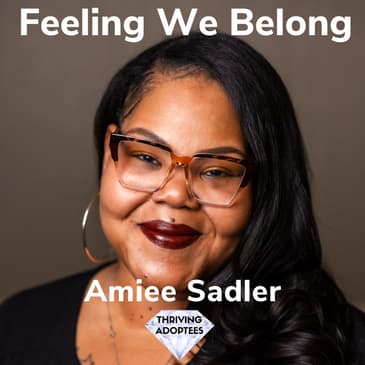
Do you feel you belong? Do the ones you love feel they belong? Listen in as we explore belonging, grace and the power of unconditional love. Profound and poignant. A conversation we both hope you love.
Amiee earned both her Bachelor’s and Master’s degrees in Social Work from the University of Tennessee. She also has a Master’s in Conflict Management from Lipscomb and is a Certified Nonprofit Profesisonal.
https://www.facebook.com/miriamspromise
https://www.instagram.com/miriamspromise/
https://www.linkedin.com/in/amieemsadler/
Guests and the host are not (unless mentioned) licensed pscyho-therapists and speak from their own opinion only. Seek qualified advice if you need help.
Want to learn more about thriving for you, your kids, your families or your colleagues? Pick a time to talk here
[00:00:02] Hello everybody, welcome to another episode of Thriving Adoptees Podcast. Today I'm delighted to be joined by Amy, Amy Sadler. Looking forward to our conversation today, Amy. I am too. It's exciting to have this conversation and really talk about what we can do in the world of adoption. Yeah. So, Thriving. Before I do that, just to introduce you listeners to Amy. Amy's the Executive Director of Miriam's Promise.
[00:00:32] Down in Nashville, Tennessee. So, just a bit of context for you. Thriving. What does that mean to you, Amy? To me, thriving means, I mean in the most simplest form, living your best life. Right? Doing the things that make you happy. Being happy with who you are and if you're finding things that you're having trouble reconciling,
[00:00:57] How do we get to a point where it's not just surviving. It's doing things that make you happy, that make you feel whole and that make you feel complete. Make you feel whole and complete. Right? Okay. There's plenty there. Yeah. There's plenty there. Maybe we'll have even more. Right? But if we narrow it or broaden it out, right, to thriving adoptees, what does that mean to you? Is there any difference between the definition?
[00:01:25] I think the difference, I think the difference lies with being comfortable and confident in your story. As adoptees, there's a lot of stigma and a lot of misinformation. And so when we think about thriving in the context of adoptees, it's knowing where you're from, knowing where you're going and knowing where you belong. Yeah. Yeah. Yeah. I like that. I love the breadth of your description there.
[00:01:56] Is there one out of those different things that you said that you just love? You know, like you talked about knowing the road and story. You talked about where you go in. You talked about wholeness. Is there anything, is there anything that, you know, that you, is there any part of what you just shared that you just think is the most essential part of that?
[00:02:28] I think the most essential part of that is the belonging piece. And I think belonging can look different depending on who you're talking to and what your personal definition of that is. Because for some adoptees, I think the belonging piece comes from knowing that the family that chose you, that you were chosen into, supports you wholly.
[00:02:50] So for some people that belonging piece is knowing that birth parents made a choice out of love and maybe not out of desperation or the desperation of love. Like it's, it's different for each person. But I think the belonging piece is the most important part of that. Just knowing what that means to you and having the resources to figure that out and the people to ask questions to.
[00:03:18] And sometimes the professionals to help you figure that out. Yeah. So if I can make it personal for a minute, I mean, so I can't wait. You've, it's, is it a couple of years you've been exact director of Miriam's promises? How long is it? Not even a year yet. I started on October 2nd and October 2nd of 2024.
[00:03:42] And one of the first, very first conversations I had was with an adoptee who was adopted through our organization about 30 years ago. And the organization has been around for 40 years. So for, for context, one of our long standing adoptees. And the conversation was, I know you're new to the organization and I'm not, but I want you to know that Miriam's promises always made sure I had what I needed to know where I belong.
[00:04:11] And that is somewhat been the centerpiece of what the work I do is, whether it's with birth parents, whether it was hopeful families. What, what does it mean for someone to belong to your family? What does it mean for someone to belong to Miriam's promise family? Um, and so in a very short window of time, uh, I figured out rather relatively quickly, um, that to thrive, you have to know where you are. Yeah.
[00:04:40] And what, what has, what has built, I mean, I know it's a different context, right? But it, you know, it's, it's still belonging. So what, what has belonging meant to you in terms of belonging at Miriam's promise?
[00:04:58] Um, it, it means that from the moment that someone reaches out to us and that someone can be an adoptee, it can be a birth parent, it can be a hopeful family that they know that they are now part of our definition of family. One of the first things I did, uh, when I started, I made shirts for our staff that says, uh, family doesn't only happen genetically.
[00:05:23] And I wanted that to be kind of the centerpiece of what my work and my values that Miriam's promise are. Um, it doesn't matter the origin, right? Um, it doesn't matter the journey, it matters the outcome and that can shift and change, but no matter where you are in that journey, no matter where your journey takes you, you know, that you have somewhere to come home to. Yeah.
[00:05:50] And what about your own feeling of belonging at Miriam's promise? Um, you know, in full transparency, it was hard to feel like I belong to an organization that had been around so long. Um, the organization has existed longer than I have. Um, I won't be 40 until next January and we just celebrated our 40th birthday.
[00:06:15] Um, and so coming into an organization that has helped create the sense of belonging for so many families coming from the outside, I, I wasn't sure what that was going to look like for me. Um, and over time it's, it's been the same thing that I do with the people and the families we work with is figuring out what that place is and what that means.
[00:06:43] And for me, that means every birth mother I talked to feels like, you know, they have a new aunt. Um, every child that has a placement always knows that they have Auntie Amy. Um, the families that I've done placements with know that they have a friend, a sister or cousin, whatever they want to see me as, um, as someone they can always turn to. And I get text messages at random hours and phone calls in the middle of the day, just because they want the one to talk to.
[00:07:11] And they, they have that piece of belonging with me, which makes me feel like I'm part of something bigger than me. Yeah. That's beautiful.
[00:07:20] And, you know, and the fact that the belonging, I think, I don't think there's any accident that, you know, you picked belonging as the big theme, um, from the breadth of, of what you shared in terms of the definition of thriving and thriving adoptees, because it kind of, it echoes back to that, perhaps that first conversation with an adoptee and, uh, an adoptee that was, uh,
[00:07:49] uh, placed through millions of promise 30 years ago. Did you say? Yeah. Mm-hmm. Yeah. And that says something because I don't, I don't think a lot of adoptees feel, or, you know, I don't think a lot of adoptees would be getting in touch with the agency 30 years afterwards. Or they wouldn't have stayed in touch for that duration. So something must be going on there.
[00:08:18] And I think part of it is that a lot of older agencies that I've seen and that I've researched, it was like, okay, there's a placement, there's a finalization, and you're done. And for me, each placement, um, each person is a real person.
[00:08:39] It's a child finding a home, a birth parent, being able to have the dignity of family growing in love. Right. It's, I think, what is a third? Sorry. Um, we're having a few, we're having a few problems with the, with the zoom, um, uh, listeners.
[00:09:07] Uh, Amy, could you switch your, switch your video, switch your video off? Yeah. I've switched mine off. So hopefully that'll work, um, that'll work better. So we didn't, I couldn't hear what you said last time. Um, so could you repeat it please, Amy? Of course.
[00:09:30] Um, I think for a lot of organizations, especially what I've seen historically is it was a placement, a finalization, and then a disconnect. And for me, each of those placements represents a real person, um, a child finding a forever home, a birth parent being able to make a choice with dignity and support and a family just being able to grow in love. Like that is what I feel like the heart of Miriam's promise has always been.
[00:09:58] We want to make sure that children and families, um, are nurtured and are nurtured. Yeah. So what, what do you think gets in the way of us feeling that sense of belonging? Um, I think sometimes it's in the best way possible ignorance, right? Um, and not willful ignorance, not the, Oh, I don't want to know. I don't care.
[00:10:27] It's there was no one to teach me. Um, and for adoptees, I think part of that is not knowing their story and for hopeful families or adoptive families, not knowing how to tell a story. Um, it's the idea of, well, we chose you. So you should be thankful that you've been chosen, not this is a choice that we've entered into with love and understanding and knowledge so we can support you.
[00:10:55] And I think that, you know, one of those things that makes a big difference is knowing how to love someone because just wanting a child and wanting a family isn't enough. Right. I think a lot of us think that, but we don't know how to find it. Right. We don't know how to find what the, the, the sense of belonging. What, what do you mean? So we don't know how to find, you know, what is, how do we love someone?
[00:11:25] Right. Um, you know, I, I think of it in just the context of relationships in general, just because you love someone the best way, you know, how does it mean that they feel love just because you create a family the best way you know, how does it mean that somebody feels like they're part of that family. And so that knowledge of how do I, like, how do I work with my family to create a space where everyone feel like feels like they belong?
[00:11:54] Um, how do I work with a child who has been chosen and loved and adopted? Um, but who doesn't feel it? Like, how do you love someone the way they want to be loved? How do you teach someone the way they want to be taught? How do you interact with someone the way they want to be interacted with? Um, and I think that is the thing that creates belonging is someone seeing that maybe their way isn't the best way and changing it to make sure that it fits what you want and what you need. Yeah.
[00:12:24] So it's, it's putting the other person first then. Absolutely. Yeah. How to love. It is not easy. It's not easy. It, it's the felt sense.
[00:12:43] And so, um, what, what I, what, what I come to around this space is about, about thoughts and beliefs about and about insights. So I, I, I came up with this a couple of years ago.
[00:13:08] There's no, there's no such thing as a second hand insight. We have to, we have to have them for ourselves. Right. Absolutely. We, um, and I think maybe I came up with this a couple of days ago, right? It's an, it's an in felt, right? Rather than an insight. You see what I mean? Oh, absolutely. And 100%. Yeah.
[00:13:36] So it's almost like. Belonging is in. It is in the heart of the belong. Absolutely. Because you can, in your mind, do everything that someone should theoretically need to feel like they belong. But if they don't feel it, it doesn't matter. It doesn't matter what you do if it doesn't feel that way to the person. Yeah.
[00:14:06] So is it about, is it about attunement? Absolutely. Um, being like, you know, I'm, this is going to show my age, but we used to cut on the TV and like, it would all be static and you had to shift and move antennas and do all these things. You have to do the work to get the image on the screen. Um, and I think when we think about the families in general, whether they're, you know, biological or adopted or chosen or whatever, you have to do the work.
[00:14:36] You have to move the antennas. You have to be, you know, conscientious about who you're talking with and who you want to create that sense of belonging for. And if you see something that's working, what can you shift to make work better? What do I need to change? What do I need to say? Um, and sometimes it's just asking what makes you feel loved? What makes you feel like you belong? Um, and then doing that thing. Yeah.
[00:15:03] It's a tricky one for this because we're talking, we're trying to ration, you know, we're talking about, uh, rationale. We're talking about logic and we're talking about head stuff. And at the same time, we're talking about hard stuff. Right. Um, and you know, head and heart don't always, um, don't always match up. Right.
[00:15:29] Um, but I think if we can lead with our heart and listen to our heart, our brain is easy, easier to follow. Like, one of the things I always say is you can't apply logic to an illogical person or situation. And a lot of times the situations we find ourselves in when it comes to love comes to family. It's illogical because if I am here, I'm providing, I'm doing all the things. And why don't you feel love?
[00:15:56] Like the logical next step is you have a, so why don't you feel B? Realistically, you can have a, B, C, D, and you still don't feel anything. Right. Because you need L M N O P. Um, so it's, it's being in tune to what people are saying and what people are asking for.
[00:16:15] Um, and not letting ego get in the way and not letting, you know, the logical part of your brain say, you know, well, no, they should do this or I need to do that or I've done this already. Um, and just giving people space to feel the things, even if they don't necessarily make sense to you. Yeah. So, uh, it, it, it's about attunement.
[00:16:38] It's about, uh, reading, not reading the room, reading the response that we get from, from, from others. And if in this sense, uh, an adopted parent, they're reading the response that they're getting from there. Um, from there, from that kiddo, from that team, from that. Absolutely.
[00:17:04] And even from an infant, like we, one of the things that we teach in our pre-adoptive training is how do you respond to your child responding to you? Um, as early as, you know, a week old, if you say things in a certain tone, you know, the baby might not know what you're saying, but they feel some kind of way because of how you said it.
[00:17:30] And if you can tune into that early, um, just like with any child, it's easy to shift the way you speak. So you get the response you want from your child, right? Um, if you're saying no, no, no, don't touch that. Um, and you know, maybe it's just being a baby and blowing their arms around, um, you know, say no, no, no, you know, just changing the tone of how you speak can help aid an attachment can help.
[00:18:01] And so when the child is, you know, 13 or 14 going through, you know, the war that is being a teenager, they can remember that tone. You know, dad said no. And he said it with firmness, but kindness or dad said no. And, you know, I felt super chastised and not protected. Um, and it's interesting for me, like in the context of like an abuse survivor, I see it on Facebook all the time.
[00:18:31] You've never been abused. If you don't know what it looks like to have someone fold a sock or wash a dish angrily in your direction. Right. It's so, it's so dramatic, but it's true. Right. Someone can do something benign and it feels like an attack because they aren't responding to how you are perceiving them. Yeah. Um, and I think that's the same, the same theory can apply to so many different things in our lives.
[00:18:59] How are people responding and receiving what we're doing? Yeah. So what, what can we take from this in terms of our, uh, our relationships as, as adults? I think the, you know, it's the adage that a lot of us probably heard in childhood of you have, you know, one mouth and two ears so you can listen more than you speak.
[00:19:29] Right. You also have two eyes. So more than responding immediately, it's being aware, like the situational awareness. Um, if I'm doing something or saying something and someone seems to be shrinking or shutting down, what am I doing in that moment that is making this person feel like they can't be their whole self? What am I, what tone of voice am I using that is making this person respond the way that they are? What do I see?
[00:19:58] What do I hear? Do it go from a full conversation to one word answers and maybe not badgering, but saying, Hey, I noticed the shift. Can you tell me why you are responding that way? Or what feeling did that make you, you know, have in the moment? My partner always says, you know, if I look like I'm sad or look like I'm thinking too hard, she'll go top three.
[00:20:26] And in that moment, it's the top three things I'm thinking. And that gives her insight into what is happening with me. Right. Um, and I think that is like the type of thing that we can integrate into all of our relationships, maybe not specifically, you know, give me your top three thoughts right now. But she notices that I've changed and my responses have changed. So she responds to me differently that way. And I think that's something that we can do as partners, as parents, as friends.
[00:20:55] Um, is this person responding to me differently now? Um, and how do I get them back to who I know they are and not who they feel like they have to be in my presence? Right. So about the, that them being authentic. Right. So you said something a couple of minutes ago about, I think, was it, uh, what's their response? What, sorry. Did you say what's our response to their response? Did you say that? Uh huh. Yes. Yeah.
[00:21:25] Can you unpack that a little bit for us? I mean, sure. Um, you know, when, uh, I think a good example is in one of our classes with helpful families. I said something during a training that didn't really resonate with me in any special way. It was just something.
[00:21:44] And two of the people in the class immediately like shut down and you could see them going from bright and open and willing to engage to gone. I lost them in that moment. Um, and had I just kept going, I don't think I ever could have truly recovered from that.
[00:22:08] Um, and I think that's the idea is being aware that if someone says something and I make a facial expression or if I, you know, do a deep sigh or I'm just like, oh, whatever. Like my response is. Their response to me lets me know how they feel about me in that moment or how they feel about how I've responded to them.
[00:22:37] Like if someone is super open and sharing and I, you know, and verbally saying, oh, okay. But physically I'm just like, whatever. Can we move on to something else? They're going to shut down. Yeah. Yeah. So, is what you're talking about here what some people might call self-awareness? Absolutely. Yeah.
[00:23:02] Um, I think that is maybe the cornerstone of relationship building is not just, oh, this is what I'm doing and it is what it is. Um, and this is what I'm doing and this is how this person is responding to me. Being aware of the reaction you're getting can make a huge difference. Um, and it goes back to, does this person feel like they can be them without judgment?
[00:23:33] Yeah. Without, you know, an obligation to make me happy in that moment without a feeling of I'm not okay with who I am. Um, at a training recently, we were talking about, um, an adult adoptee whose adoptive parents completely would shut down whenever they mentioned reaching out to their biological family. Um, and of course, verbally they're like, of course we'll support you.
[00:24:01] But like, it was almost like you could feel the offense rolling off of them. And even if saying, sure, I'll help you, but your physicality is don't do that. Why would you do that? It can create a situation where people don't want, like, they know they're not going to have support and they don't want to do the thing anymore. Whatever that thing is. Yeah.
[00:24:25] Um, I, Amy, you strike me as a really kind of intuitive, natural people person. Um, have you done a lot, this stuff that we're talking about here in terms of emotional intelligence, does this, uh, come fairly natural to you? Is it an area that, you know, you've put a lot of time into? What can you paint a picture of that for us? Absolutely.
[00:24:50] Um, so I am a social worker by education and an empath by birth. Um, so I, I've always been perceptive of how people are responding, um, and anticipatory of people's needs. Um, and I think part of that is one work, self-awareness. My, it's funny, my parents were very opposite. My dad was hugely self-aware.
[00:25:19] My mom, not so much brilliant, wonderful attorney, all the things, but lacked what I, as an adult, what I would call self-awareness. Um, and because I saw how people responded to her, I wanted people to respond to me differently. I wanted people to respond to me the way I saw people respond to my dad.
[00:25:38] And so that took one, a lot of, as a young person, just observation, but then as an adult education, um, I teach emotional and that, well, not so much anymore, but I used to teach and train on emotional intelligence. Um, and the aspect of, like diversity, equity, and inclusion. Um, I was a DEI trainer for about a decade. And that was one of the biggest things for me is people would say things and other people would respond.
[00:26:07] And I would watch that interaction and be able to point out, this is the point where the other person did not feel safe anymore. And so how do we correct our behavior or our actions or our words to create that sense of belonging, to create that space where people feel like they can be themselves. And it's lots of reading, lots of research, lots of people watching.
[00:26:33] Um, because like, if you, if you don't look, you don't see, and I know that sounds so simple, but it's easy to say, oh, well, you know, I didn't see that happen, but it happened right in front of you. Yeah. Yeah. I, I, um, I had a conversation, we, we, we touched on self-awareness with, uh, I interviewed an adoptive mom, uh, and author, children's author last week.
[00:27:00] And we, we got on to a point about self-awareness and something that's going on for me at the moment is, is the self-awareness as we've been kind of describing it now, which seems to be about being aware of our own behavior.
[00:27:27] And it is also, it's that part that you mentioned, you know, about noticing our response to their response. So noticing their response first. So being attuned and, and clearly as you, you know, you talked about being a, an empath by birth.
[00:27:50] So there's, there's being incredibly attuned to their response and also seeing what's going on within us. What's our response to their response. And so self-awareness to me seems to be a lot about behavior, their behavior and our behavior.
[00:28:16] So what is called self-awareness could be perhaps more accurately called something like behavior awareness. I think, I think that it's both, right?
[00:28:36] Like, how do you like, what, what are you doing in that moment and being aware of your physicality, being aware of your tone of voice, being aware of what your face is doing. I mean, I joke all the time, even if I don't say it, my face will. Um, and knowing that about yourself. So that like, that's part of self-awareness. Like, what are you feeling? And how are you expressing that feeling?
[00:29:03] I think is like the root of it, right? Like knowing what, what you feel and how you express it. Yeah. It's amazing because we, we clicked off the video, right? Just because it was glitching a bit. And if we, if you drop, if we switch off the video on, on zoom, both sides, uh, then the zoom is only working on the audio and it doesn't glitch.
[00:29:30] But you, uh, you, you, you talk straight to that. Um, but we can't see each other anymore. Right. So there must be something going on within our tone. Uh, do you see what I mean? Oh, absolutely. I feel like, like your, your tone hasn't changed, right? Uh, it doesn't feel any different to me.
[00:29:59] You, it's, your words aren't clipped. Your tone hasn't pitched up or down. Like I, I, I can feel, or I feel that you're not going to change. I feel like you're just as open as I could see as you were when we were on video. And I think that's part of it is, are you attuned to how people are responding? Not just what they show.
[00:30:25] Um, and you know, it's a, it's a running joke. If anyone, anyone who's ever worked in the call center will understand this. They always tell you to smile. Um, when you're on a call because people can hear the smile in your voice. Yeah. And I thought that was just such an absurd thing to say until I realized you absolutely can. Yeah. Like if I'm smiling, my, my words are fuller.
[00:30:50] If I'm frowning and have a really, this negative feeling on the inside, you can absolutely tell that when you talk to somebody. Yeah. Yeah. Um, smile before the dial, start smile before you dial, I think was the thing, wasn't it? Yep.
[00:31:07] So where I was going with that self-awareness piece was it, it's an incredibly powerful part of our, uh, as our communication of how we create belonging, how we, we help the other person feel like they, they belong. Uh, 100%.
[00:31:37] Uh, and as I do, I came up with, I came up with, uh, uh, another view of this or a question came off the back, you know, but what is the self that we're aware of?
[00:31:57] That, ooh, I think that's, that's the question that people don't like to get or probably don't know how to respond to. Because I think we can often present ourselves in multiple ways. And sometimes it's, um, I joke that you meet someone's representative before you actually meet them.
[00:32:18] And that representative is the person who, like, it's the person who they want to be maybe, or who they feel like you want them to be. And, and, and, you know, a perfect world, people are just who they are and know that, that that's okay. And they don't have to mask. They don't have to put on, um, as my mom would say, airs, right. To feel like they're part of it.
[00:32:45] Um, I do a lot of work with nonprofit boards. And when I first go into a room, I have to consciously decide that I am going to be me. Um, and the places where I feel like I belong the most are the people who welcome that. The people who don't look at me differently because, you know, I haven't had 30 years of experience or because I haven't been part of this club or this organization.
[00:33:14] Or, and like even a family scent, it's when I go to like a family reunion is that people are welcoming me for me or welcoming me as somebody's daughter who just has to be there or someone I just happen to share blood with who I don't really, you know, care about. And they're not who I want them to be. So they're not part of this group. Um, and I think it goes back to the whole idea of being able to belong.
[00:33:42] Um, are you able to belong as you and not as your representative? Like that, I think it goes back to the whole core of thriving. You can thrive best when you're your, your, your best self. And if your best self is not, you know, a representative of you, but it's actually you, that may be the better definition of thriving. So did you say mask? Yes. Top of that conversation. Yeah.
[00:34:12] Um, I heard something the, the other week and I think it was, I think it was the persona is, is, is that it comes from the Latin for mask. I think that's what it was. And even if it doesn't, it sounds quite right. Doesn't it?
[00:34:35] But they, you know, the, the, but the, that, you know, these days we have, um, you, actors often put on a load of prosthetics, don't they? To, to act. Uh, I'm thinking about Jim Carrey. I'm thinking about Jim Carrey. In, well, it's mask, isn't it?
[00:34:57] That's so, so they, so they, they put on prosthetics and then they've got, uh, they have got, uh, special effects now as well. So it's a kind of combination of all those, uh, combination of those, those two things. But in Roman time, you know, I think about Julius Caesar or some, you know, that, that, that era when they, they, all they had was a mask.
[00:35:24] It was literally a mask that they held in, held in front of their face to, to play a part. And, you know, it, it was a smiling mask for a happy person or a, you know, like a downturn, a downturn mask, um, downturned mouth for an angry person or something like that.
[00:35:46] And, and, and, and that's where persona comes from about putting on a, about putting on a mask rather than showing up, um, authentically. So how does, how does, and you maybe have just asked, answered this to an extent. I just want to understand it a little bit more.
[00:36:16] How do you see, uh, uh, authentic, us being authentic and belonging? How, how do those two things correlate, relate to one another, mix up? How do you see that? How do you put those two things together in your, in, in your view of the world, Amy?
[00:36:38] I think that when someone truly belongs or truly feels like they belong in a space, in a relationship, in a family, in a whatever, they don't have to have a persona, right? It's who they are. And it's not the mask they wear. Like they don't have to, you know, hide behind a smile when they really don't feel it.
[00:37:00] They don't have to, you know, hide behind, you know, the downturn expression when they are really happy about something. Um, and I think we create belonging when we allow people to, to take that mask off. When we allow people to drop the persona and just be, um, this, this morning, we, my partner and I had to fly, um, had to fly at like five o'clock.
[00:37:29] Um, to a different location and the flight attendant asked the question and my immediate response was, oh, that name sounds familiar. I think that I know that person. Um, and my partner kind of laughed and she was like, so you always want to be the hero. And my immediate response to that was, I have embarrassed her. I've done something wrong. And she stopped me. She said, Hey, I want you to be you, whoever you are, whatever you are you.
[00:37:58] And I was like, well, what if I'm embarrassing? She's like, so you are embarrassing, but you're not embarrassing to me. And like, that is that reminder that I needed in the moment that I belong as me, not as who people want me to be. Um, like the persona would have been, let me sit here and be quiet because I think that's the right thing to do. The belonging is I can, you know, overextend myself. I can ask questions.
[00:38:25] I can do the thing that, you know, I can say the quiet part out loud and it's okay. Right. I don't have to be anybody in particular other than just me. And like, that is what creates that belonging. Um, and like, it was a, it was a moment that I didn't expect to have at 5am. No, no.
[00:38:50] Um, what, what landed for, for me, Amy, uh, was the, what you were, what your, what your partner was communicating was her unconditional love for you. Unconditional love and acceptance, whoever I, whoever I am, whatever comes natural. Um, it's, it's okay. And it's not just okay.
[00:39:20] It's celebrated. And I think that's the other piece of belonging. It's not just, oh, well, I'll tolerate it. It's I accept it and I value it and I love it. Um, if you, if you've ever been the person who felt tolerated, there's a huge difference between being tolerated and being celebrated.
[00:39:41] And I think maybe that's another piece of belonging is you are celebrated for who you are, whoever, whatever that is, whatever questions you have, whatever, you know, quirks you have. We love it. Bring it all. Bring you, whoever that is. Right. And you don't have to fit anybody's mold or idea. It's you're you and we love you. Yeah.
[00:40:10] What the thought that popped into my head there was. And what about what, I mean, some, some people, I think not some people, I've just come up with this. I just come up with this idea and I'm getting goosebumps about it. So that, that usually means it's a good one.
[00:40:31] So it was seeing grace as unconditional self love. Absolutely. One of my trademark phrases is we create space for grace and growth. Right.
[00:40:56] And I think the grace piece is, is integral to creating belonging. I'm sorry. I'm getting a little emotional. We don't always know someone's story. We don't always know what someone has been told about who they are.
[00:41:17] And when you extend grace to let people make mistakes or be themselves, you are signaling to them that it's okay. Like grace is so important. And I think we lose that, especially in some of the ways like society has shifted. We don't give people grace. We want to cancel people. We want to demand answers. We want to demand all these things without any grace.
[00:41:47] Now that doesn't mean you let people, you know, run amok, but you, you go from this place of, I want to assume you had a positive intention there. I want to give you grace to not assume the worst immediately. Right. And I think that's the other piece of belonging is, I don't think you meant to cause harm.
[00:42:14] So let's get to maybe what was harmful or what might have needed to change. Or what did you do that wasn't, you know, what I expected, but I'm okay with it anyway. And what, what about great, what about grace for ourselves? What about, um, what about that?
[00:42:41] I, I, humans are fallible and we make mistakes. And if you strive for protect perfection and work in responses and whatever, you'll never get to where you need to be. Um, and part of that is giving yourself grace. Um, uh, go back to working with hopeful families. What if I mess up? Okay.
[00:43:10] You messed up, but you don't have to keep messing up because you messed up that one time. You accept it, you acknowledge it, and then you give yourself grace to do it again. And maybe you'll make another mistake and that's okay too. Right. And I think that is applicable to all the things, um, in, in my work as the executive director. I have to give myself space and grace, right? I'm going to make mistakes. A lot of this is brand new to me.
[00:43:38] And if I continue to beat myself up about the, what if I don't have any space for what's next. Um, and I think that goes back to, if you can give yourself grace, you have more grace. You can extend to others. Yeah. Yeah. I, um, I came up with an idea last week.
[00:44:05] I was looking at, you know, the, the, the opposite of grace in a sense. I was, I was looking at the, you know, the, the negative, the negative voice in our head. The negative voice in my head. Mm-hmm.
[00:44:27] It could, it could, it could be one of those chicken and egg conversations, right? So what came first? The voice, the voice in the head, the, the negative voice in my head or the one that hears it. Mm-hmm. So is that, is that chicken or egg? And yeah.
[00:44:56] Does, does it feel like chicken and egg to you? Or does this sound like a really weird, wacko question? Nope. Um, no, it, it definitely feels like, you know, what, what part, what part, maybe not even came first, but hit the hardest. Um, I, I tell people in training work and therapy work in all the things that you're not responsible for your first thought.
[00:45:26] You're responsible for the second thought and your first action, because a lot of times we've been trained to automatically go to the negative. And that's always our first thought. The second thought is going to be, wait, do I believe that? And if your answer is yes, I believe that, then you act accordingly. If your answer is no, I don't actually believe that thing about myself, about this person, about the situation. What am I going to do because of that? Right.
[00:45:55] And I think it goes back to the idea of grace. We give ourselves grace to make mistakes. We give ourselves grace to, you know, go with our gut instead of our brain or go with our brain instead of our gut. Like whatever, like you said, chicken or egg, whatever comes first. Yeah. But if, yeah. I, I, I, I love that. That, that, again, goosebumps, right?
[00:46:24] Um, we, we're not responsible for our first thought, but we're responsible for our second one. Mm hmm. So the answer, the answer that I came to, you know, on, you know, is this, is this chicken or egg? Was we're, we're born hearing, but we're not born speaking.
[00:46:56] So the, the, the, the, the, the, the, the, the, the hearer comes before the speaker. It's, it's not, it's not chicken and egg. Mm hmm. The one that hears the voice in the head came first. The voice in the head came second because we're not born speaking. We're not born with the ability to... We're not born with language.
[00:47:25] We're not born with speaking. But we are born listening. And you talked earlier on about the tone of... Talking to a seven-day-old baby, right? So the baby can hear the tone. And so it doesn't really... It's not the words.
[00:47:55] It's the tone that the baby picks up on because the baby hasn't got language. Right. The baby is born hearing, not speaking. So hearing becomes... Hearing is... It's not hearing and voice as chicken and egg. It's hearing first, voice second. Absolutely.
[00:48:24] You know, I don't remember where I heard it or saw it, but, you know, our message sometimes gets lost in our mess. And, you know, it's sometimes it's the delivery, right? Like, it's not what was said. It's how you said it. Yeah. And like you said, babies can't respond verbally to what we said, but they absolutely can respond physically.
[00:48:55] They can respond contextually, right? And it's not necessarily the word because they don't even know what the words are, but they absolutely know how they felt when they heard it. Yeah. That tone. That tone. Wow. Wow. I don't know where to go next.
[00:49:23] Part of me was going down that disconnect. You know, I was thinking about the fact that babies... I was thinking the fact that, you know, fetuses and unborn babies... Mm-hmm.
[00:49:49] ...allegedly are familiar with their birth mother's words, right? They're familiar with the voice. And maybe there is a disconnect in our sense of belonging as adoptees
[00:50:13] because our primary caregiver's voice has changed. At 100%. 100%. So it's so funny you said that I had a family who I worked with from placement to finalization, and they had a really good relationship or have a really good relationship with the child's birth mother. And they were all in a space together.
[00:50:40] And the chosen or adoptive mother was holding the baby, and the birth mother was in the room and was speaking. And the baby was not even a month old, but was, like, trying to turn to the birth mother's voice or the sound of the birth mother's voice. And we had to have a conversation about how that is,
[00:51:09] one, natural and, two, healthy for development because this is the only voice you've heard for, you know, nine-ish months. And then you don't hear that anymore, and there's an internal longing for that. And, you know, I'm sure there's a science behind it. I don't know it, and I don't claim to know, like, how that works.
[00:51:34] But I can imagine hearing something for so long and then it just being not even, not taken away is in the right word. But it's not there anymore. And maybe always searching for that. I saw something on social media that someone hadn't seen their birth mother in 20-plus years,
[00:52:03] was blindfolded in a room, heard their birth mother speak, and immediately knew who it was in a room full of, like, 15 voices. And I can absolutely see that loss being something that, you know, you hold on to. Or, like, if you're in a crowded room or in a space, even if it's unintentional
[00:52:29] or unconsciously seeking confirmation, like, this was the voice. This was my comfort. This was my security. This was where I belonged. And then I didn't have it anymore. And that created a void that we don't have, people outside of the birth mother don't have a way of feeling.
[00:52:57] And so I'm not an adoptee. So I don't have that firsthand experience, but I've seen it. And I think it goes back to the conversation, the quiet part that people don't like to talk about out loud is, even in all the beauty of adoption, there's still grief and there's still loss. And I think when we think about
[00:53:27] how do we create belonging, how do we acknowledge and affirm that that's part of it? And it's okay that it's part of it and it's supposed to be part of it. And it doesn't make it right, but it makes it okay, if that makes sense. Yeah. What I'm thinking about,
[00:53:55] we're talking about pre-verbal, pre-memory, pre-logic, pre-conceptual, all these things, right? All the pre- Right. And one thing that's becoming clearer and clearer to me is that in this vacuum,
[00:54:23] in this space of not knowing, or a space of, yeah, not knowing, in this space of not remembering, in this space of not having words for, our creativity and our imagination can have a complete field day on this. Mm-hmm.
[00:54:51] And we can make the molehill into a mountain and we can make the mountain into a molehill. 100%. And if we've got, if we're around a lot of people who are building this up,
[00:55:20] then it's going to become bigger for us too. Oh, absolutely. Absolutely. I think there are, there are times that people want to support us, but don't know the best way how to, and just mimic what we're saying or what we're doing. And that molehill becomes a mountain because someone has just affirmed to you that, oh, this is right
[00:55:49] without any, you know, confirmation, without any conversation, which I think goes back to the, the informed piece, right? Because you can feel something and something can absolutely be real, but it not be true. And sometimes we need that, you know, as the agent of reality to say, that's valid. Your feelings are valid because they're yours. However,
[00:56:19] as real as that is, is it true? And without someone maybe to give us that check, we can let things just balloon. Like it's the, the idea of this magical reality that we create with or without confirmation. Yeah. Wow. I mean,
[00:56:49] we're, we've, we've covered so much in an hour and we're, we're kind of coming up, we're coming up on time. Is there anything that you, I don't want to start another, I don't want to start another thread, right? We're going to have to have you back on in six months time to talk about some more stuff. Is there anything that, that any reflections or any reflections that you want to share on, on, on our conversation
[00:57:18] or anything that I've not asked you about that you want to share with the listeners? Um, I think the thing that has resonated with me from this conversation the most is your, your statement about giving grace to ourselves is how we learn to give grace to others. And if we want people to be able to
[00:57:48] thrive, they have to belong. And for them to feel like they belong, they have to have grace to be themselves. They have to have space to be themselves. Um, and to give someone else space to be themselves. Sometimes we have to give ourselves space to be ourselves. Yeah. And then we start meeting representatives and meet people. That's a great, that's a great, um, nugget of that. What,
[00:58:16] what was going on for me in, in that part of our conversation was in terms of self-awareness to, to look at, to, to look at how much grace we give others. And cause that, that might give us an indication of how much grace
[00:58:45] we give ourselves. Absolutely. And vice versa. Look at it, to look at it both ways. 100%. So the, and the context for that is I, I really, you, we talked, you mentioned call centers earlier on, didn't you? Cause we were talking about smile before you dial. Um, me and call centers
[00:59:15] don't have a great relationship. Um, it, it, it's, it's, something, it's something that is getting slightly better, but there's still room for improvement on. And I'm just, I'm thinking about my, I'm thinking about that as a better indicator.
[00:59:48] So I'm, I'm more, I'm, I'm more aware of the grace. I'm giving more grace to call centers, to call center people. absolutely. I, I stopped being angry and hanging up. I speak nicely now. Yeah. And, but, but maybe I'm less aware of the grace I'm not giving myself. Hmm.
[01:00:18] I don't know. Does that make any sense? Yep. It absolutely does. And you know, that, that made me think, I give more grace to call center people when they call me because it's their job. Then I give myself grace for, I don't know, making mistakes. And maybe like you said, I should, I should think about that. Yeah. Wow. Thanks. Thanks Amy.
[01:00:47] And thanks listeners. Thank you so much for having me. It was a wonderful conversation. And I would love to come back another time. Yeah, cool. Do you want to put your video on? Absolutely. I think we're, we're over, we're over the glitch. Thank you. Thank you listeners. And we'll speak to you again very soon. Thank you.