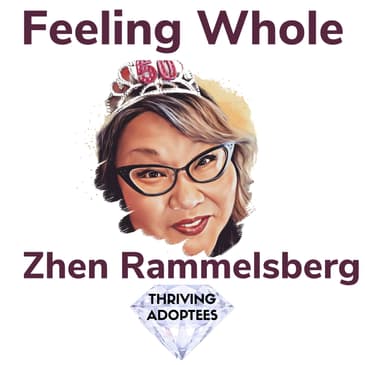
Have the most popular ways to heal left you still feeling wounded? Perhaps it's time for a different approach. Listen in as Zhen shares what has helped her feel whole. A conversation full of healing nuggets.
Here's a bit about Zhen's first interview:
Are you a transracial/transnational adoptee with a complex relationship to your birth country/culture? Listen in as Zhen shares what she's learned navigating that complexity. Highly empowering.
Here's a link to Zhen's first interview https://thriving-adoptees.simplecast.com/episodes/zhen-rammelsberg
Zhen E Rammelsberg is a Korean American adoptee and new playwright and has had her Heuer Play Canst Thou Hearest Thee Now produced and performed in multiple states. She has traveled to a few of these states to see the productions. Her newest play loosely based upon her adoption story called Black Box: An Adoption Choreopoem is yet unpublished but has been performed in Chicago at an all Asian American Playwiting festival and was most recently performed in Cedar Rapids Iowa at the Underground Playwriting Festival where it won 3 awards Best Youth Performer, Best Ensemble and Runner Up for Best New Play. Zhen E resides in Marion Iowa with the Spock to her Kirk of a husband Robert and her 2 cats Toulouse and Pip. The Rammelsbergs split their time traveling from Iowa to Milwaukee to visit their son and also to Korea. As well as being a part time playwright, Zhen E is a part time massage therapist, part time Wedding Official, part time wig and make up technician for several local theatre and opera companies, and Full Time lover of Hello Kitty and a Student of Life and Philanthropist.
https://www.facebook.com/zhen.e.rammelsberg
https://www.instagram.com/zhenerammelsberg
https://www.linkedin.com/in/zhen-e-rammelsberg-03448021/
Guests and the host are not (unless mentioned) licensed pscyho-therapists and speak from their own opinion only. Seek qualified advice if you need help.
Want to learn more about thriving for you, your kids, your families or your colleagues? Pick a time to talk here
[00:00:02] Hello everybody, welcome to another episode of Thriving Adoptees podcast Today I'm delighted to be joined by Jen, Jen E. Rannelsberg You got that right didn't I? You did! Yes! I didn't have time to listen to last time you came on
[00:00:17] To make sure that I did it, I was... I didn't listen to it either don't worry You didn't listen to it You know, when I was a kid I used to really hate the sound of my own voice
[00:00:30] I think we all do, I think we all go through that Yeah, but now... Yeah, I don't listen to myself because I'm hoping to listen to somebody else's wisdom rather than my stuff, do you know what I mean?
[00:00:45] I want to learn from somebody that's been ahead, you know, ahead of me on the curve So, healing Yes The trillion dollar question Yeah What does healing mean to you, Jen? I mean in the adoptive world, healing, you know, it's multi-layered right
[00:01:08] And it's constantly going on and constantly evolving right So there are times in my life where I had thought I was very much doing what I needed to be doing
[00:01:20] And maybe at that point in my life I was doing what I needed to be doing to be healed as I thought Because I was always very self-aware, I was very much into making sure that I always did checks in with myself is what I thought
[00:01:40] I was doing holistic things, taking care of my emotional well-being And then one day it all came to a head right So then all of a sudden I had to deal with things And so I thought up until that moment I thought I was
[00:01:56] And so in this portion of my life I've been doing a lot of other things to kind of, I guess, get back to that point of healing again But I feel like I've been doing a great job
[00:02:10] One of the things that I do regularly is I'm part of an Adoptive Voices Writing group And you'll have Sarah Easterly on your advocacy panel And that has been probably the biggest thing for me because always in my life
[00:02:31] Something that always helped me heal and center was always arts or music related or both So whether it was theater, whether it was writing, whether it was music, whether it was dance Things like that Painting, arts and crafts, all of it
[00:02:51] So this has been great for me because I've always loved writing But I also like sharing and hearing other people's stories And so within that just having a community that you can discuss this stuff with
[00:03:09] And you don't have to keep explaining your story to or you don't have to think like Okay, are they getting it that we're adoptees? Because people that are not adoptees try to act like they're understanding
[00:03:25] But then there's always a point where you can see that there's a wall And they don't quite get where you're coming from or they see what you're doing Is that they think you're whining or they think that you're ungrateful Or all the words that are programming
[00:03:41] But being in a community of people that are sharing our stories and we all understand even just little things are adoptee related Correct? And how we, you know, that's the big overarching thing of how we view the world So that has been very helpful
[00:03:58] Therapy has been very helpful all the time But like I said, being in, I feel like having some sort of arts outlet and creativity has always been very helpful to me And what I love is in our writing group there's people that don't feel like they're good writers
[00:04:14] And they're sharing and they're writing amazing things So even if you don't feel like you're artsy, you're like, well, I'm not an artsy person I feel like it's important to do it and to tap into that Okay, so you gave me lots to dive into that
[00:04:36] Yeah, can I take you right back to the start because you said it's multi-layered It is multi-layered What for you make up those layers, Jen? I think for a lot of years I felt guilt and obligation
[00:04:57] So there's different, like I don't, I'm a people pleaser and I'm finding out Through like the different adoptee conferences that I go to and the different workshops that I do That people pleasing is a trauma response
[00:05:12] So for me, that was my response to trauma was to make sure that I just made everybody happy But not necessarily made myself happy But made everybody else happy So there's always that I didn't want to disappoint the parents that had adopted me
[00:05:28] I didn't want to seem ungrateful Right, so and there was a lot of guilt in that I should be grateful That's the narrative we've been taught forever And so a lot of times I felt like I wasn't worthy of having feelings
[00:05:47] I wasn't worthy of being healed because I should be grateful and happy that I was adopted And taken out of this like other circumstance that was whether it was true or false, correct? And so that was a lot of it
[00:06:01] So just being true to myself was hard because there's guilt in that I felt a lot of guilt if I was being selfish or You know and just being okay with that that I was like you know there's a point where I just have to say
[00:06:15] effort to everybody else and say like I need to do this I need to heal to be a better person for myself and for everybody else around me I can't be living this lie, I can't be feeling this way
[00:06:26] I can't be shoving my feelings down to make you feel better all the time So there's that And you know what is healing look like for each person? I can't say that my healing is what everyone else needs also
[00:06:39] But I think a lot of it is that feeling of guilt We need to be okay with that I guess To start the healing because that was it because I was always thinking like oh I'm I am doing what I need to do for myself
[00:06:53] But really what it was is it was another layer of people pleasing To make it easier for everyone, right? So there was guilt was the guilt at the idea That you weren't whole was there was there did you feel guilty about
[00:07:14] Yeah, I would feel guilt about everything I would feel guilt that I had these feelings I would feel guilt that if I even thought about doing birth family search I would feel a little guilt about that because you know
[00:07:28] You don't want to hurt your family that adopted you right Also once I was married and had my son You felt like I felt like am I opening up a can of worms that's also going to You know impact their lives right
[00:07:48] Because maybe we're gonna find uncover stuff that isn't gonna be good And also the emotional journey I was gonna have to go on Was I willing to put them through that so there's also guilt But I also had to realize that I had to trust that I had
[00:08:04] The right people in my life you know that I had chosen the right spouse And then I had a son that was understanding and loving of me But you also wonder am I messing him up because you know as he's watching me
[00:08:16] Go through these things am I messing him up what's that like for him right So were you guilty about feeling guilty? Of course I always felt guilty because I always feel that because again I'm a people pleaser so I feel like if I if I'm feeling guilty
[00:08:34] Then I must be doing something that other people are uncomfortable and I don't want to do that But I've gotten to the selfish part of my life
[00:08:43] I call it the selfish part of my life and I say it proudly because it used to be that was a terrible word Right selfish being selfish that's a terrible word But I've gotten to a point in my life where I'm like you know what
[00:08:53] I have a voice I have a right to speak my voice And I have a right to have my feelings And it's gonna be okay and I tell people that I straight up tell people that before I would kind of backtrack
[00:09:07] And I'd be like oh and I'll acquie I'd be the first one to acquiesce Like I said people pleaser but now I'm unapologetic and I will say you know what
[00:09:18] I have the right just as much as you to say what and to feel what I feel and say what I say So in my mind that means that I'm Getting closer to whatever healing looks like because I am
[00:09:30] Strong enough to say that and mean it and I stick to it Because before like I said there was always that feeling of guilt or feeling Bad that I've hurt somebody else's feelings Put somebody else before me and I realize you know what I have this right
[00:09:44] I have earned this And I have every reason and right to feel this way And do what I need to do It's um I don't know if I felt guilty about feeling guilty but I definitely would I definitely worried about worrying Yeah
[00:10:05] I think it's the same kind of thing Yeah kind of I mean so my husband and I are kind of wired differently And um recently I got him into doing therapy to you because Up until then he's always been you know I'm the strong man
[00:10:20] I don't need to do this but it was getting to be like This cycle that he was repeating kind of telling me and I was like okay You need to tell me somebody else and so that person had told him
[00:10:30] That he worries a lot about things in the future My worry is probably more things Now like I'm worried like what am I saying now that's gonna Piss somebody off And you know where it's like I'm not worried about the future as much
[00:10:48] He's more always in the future and it's stuff that hasn't happened yet And stuff that since it hasn't happened yet You kind of still have control over a little bit right So um so yeah That's what to me when you're saying you're worried about worrying
[00:11:03] That sounds like it's kind of more about future stuff Yeah I think so Guilt is now Yeah And guilt is now or the past right So I'm 57 now I think probably the last 10 years have been Perhaps more More worried, more guilt about the past actually Okay
[00:11:37] About stuff I have done You know trying to I had some money from the sale of my old business And I have blown it all I'm trying to make a living by making a difference And I've had money from the old business To put in human
[00:11:59] But and so yeah So one side of me is You've wasted all that Money Simon Well this is the thing right This is the thing The flip side of that would be What would the opposite of that be Well I should be Grateful for having that money
[00:12:35] To be able to Invest to make dreams come true But I've only got to that bit Or something feeling like that Baby steps forward So you're at least getting there So I would say that Traditionally I've been more About worry about the future Than guilt about the past
[00:13:06] But recently has been a little bit more guilty Like you just said a big thing there That you've gotten to this step Give yourself time to be Happy and proud of that Are you one of those people that
[00:13:24] I have a list of tasks and if I don't complete the whole list then I failed I'm interviewing you I'm not a task guy But I'm just saying would you take time To be proud of that little moment And celebrate it Sometimes So that's kind of a no
[00:13:50] I guess I give myself A little bit more grace So I think that I saw some Post yesterday It was about Worrying being the Ingrained habit Of scaring ourselves with our imagination Oh yeah that's good So that's Forward looking But I think we can also
[00:14:32] The guilt might be the same thing The ingrained habit of looking Backward and something hit me Today actually That just because the Belief has gone It might still hurt a little bit So if I look at a bank balance Yeah yeah no I'm over You know It's depth
[00:15:12] I used to think that understanding Or belief busting Was a one or a zero I understand this Yes or no Simon do you know Do you understand that Five times five is 25 And it's a one or a zero It's a binary Whereas
[00:15:45] If we look at kind of something like Beliefs Or they have Infinite depth They have Infinite depth And I love I worry people like my husband And I probably worry people like you Because he's very binary too It's either yes or no
[00:16:20] And I like to live in the gray area A little bit Not all the time Well I was going to bring it around to your creativity I was like out of the blue Out of the blue But before Before we go on to that What do you think
[00:16:48] I love the way that you The way that you said it was You were kind of closing in You used the word well I used to be like this And kind of closing in Yeah so when I was younger I believed that I was very healthy emotionally
[00:17:09] And that I had dealt with But again part of that was when I was in the Adoptifog And those of you that know Adoptifog That you'll know what the Adoptifog is And so I believed that everything was wonderful and great
[00:17:24] And I was dealing with everything like I was supposed to What's interesting is on the way Driving here to do this interview I was listening to this poet read one of her poems On public radio And her poem Was about how she
[00:17:46] Worked really hard to make herself very small Okay that was most of her poetry That piece was about how she tried I've worked really hard to hide in plain sight So that if I was the funniest In the room, if I was the loudest
[00:18:04] In the room, if I was the most vibrant In the room, I have bright colored hair I wear crazy clothes Then everyone would believe that I was okay Including myself So I realized that was a way of hiding You know, she doesn't want people to notice her
[00:18:26] I was the opposite So everyone probably always thinks that This wild put together crazy Not crazy but like just outgoing, vivacious Have it together person But really Even I convinced myself that I was very healthy and happy And emotionally where I needed to be
[00:18:50] So when I was at the house of cards falls You have to deal with it That's what I'm saying is now I have really made sure That I am really truly doing The work that I need to do And not just saying it
[00:19:11] And not going through the motions of it So it seems like on the outside I have the right to say this I have the right to act like this It's not to make you happy It's to help me As you were explaining that
[00:19:33] The metaphor that came to my mind Was this The idea of putting our own oxygen Mask on first But nobody would Or everybody gets the sense of that Nobody would Nobody would say that's a bad thing Nobody would question you That was selfish Nobody would do that for
[00:20:06] But then we feel guilty that if we take that metaphor And do that in life And that's what we're talking about And I think that a lot of it is on ourselves I don't feel like the outside With social media I suppose people are very critical
[00:20:24] Easily but I think most of it Is the guilt as comes from how I was perceiving That people would see that That's why before I was somebody who was not afraid to speak up To feel where people were getting upset about things Or if I could sense
[00:20:45] That maybe people were feeling bad About me taking a little more space Or taking time Or acting like a jerk Because in healing you have to go through bad stuff You can't just always be up here and positive And sometimes you have to take time
[00:21:06] Now I'm not afraid to do that. And, but I'm still kind about it. I'm not like, I'm not complete. So it sounds like coming out of the fog was pretty, a pretty hard landing. Yeah, I mean, I think it is for most people, right?
[00:21:26] Because because up until then you believe that everything's this. And a lot of it is just like, you know, just the stories were told. And even if there is an adoption story in a movie or something,
[00:21:38] it's always a happy ever after ending that their family has been looking for them. And they had a wonderful reason why they gave you up. And, you know, and, you know, when you're finding out the reality of the adoption industry,
[00:21:53] you know, when I when I write, I write very bluntly that it's it's human trafficking. And I've had people even in the adoption community tell me that that that's jarring for them to hear and that that's hard for them to hear.
[00:22:06] And and I said, well, that's my truth. So and I'm unapologetic of it because, you know, you're buying a person from another person and so on. What is that as human trafficking? Right. But I think it's because people think human trafficking is is sexual or drug oriented.
[00:22:22] But you're buying a human from another human. That's your trafficking a human. And then finding out that, especially in the case of Korean adoptees, that there were letters from the government saying you're not keeping up your quotas. So we were a product, right?
[00:22:42] So finding out that some of us weren't even really orphaned. So then that kind of dispels that. Adoptive, orphan myth of like, oh, you know, your mom had to make this hard decision and she did this beautiful thing to better your life.
[00:22:58] And you're finding out that's not even true. Is is the or to what extent do you think the the the guilt stuff is the clash between how we feel and how other people tell us that we should feel? You know, obviously with me, you're going to
[00:23:25] I'm going to feel guilt if I have an emotional connection to you. If you're somebody that I don't really have an emotional connection to, I'm not going to feel guilt about about speaking my truth to you. But it's more, yeah, like you're like I said,
[00:23:39] you're an adoptive family, you feel guilty that you're like if I if I go on this journey of self discovery, are they going to be hurt that, you know, you weren't grateful or that you're trying to not
[00:23:54] you're not happy about the adoption, which, you know, there was a point where I I realized a lot of truths about my adoption family that they were my adopted dad was very emotionally abusive. My brother was very physically and sexually abusive to me.
[00:24:10] So but they had swept that under the rug and and just made sure we weren't together a lot. So then there was a point where I'd kind of suppressed it and forgotten about it. And then it came to a head when it all came flooding back.
[00:24:27] And then when I brought that up with the family, then they were all like, oh, no, that's, you know, that was so many years ago. And then they try to poo poo it right. So for many years, I felt like I was the one that had to
[00:24:41] be the one that like would acquiesce and make sure that everyone was happy in it. And then I realized, you know why I have the right to be angry about this and you have the right and I I have the right to make you admit to me that
[00:24:54] you that you that my feelings are valid and that what I'm saying is real and that how you handled it when I was a child and I came to you was not was not good because your one job if you adopted me was to take
[00:25:08] was to protect me, right? And you didn't do that. And then just other things happened because I had had a child, you know, as a young person out of wedlock. And then I was shunned by the family. But then my adoptive brother or I was adopted one.
[00:25:28] He's their biological son had abused me. But that was OK. So that was a very confusing message to me. But I realized later it was because what he did was not obvious to the outside world, whereas what I did
[00:25:43] was obvious to the outside world that we were not a perfect family. So and I don't know how much of it was, whether they consciously or subconsciously realized they would treat me different maybe because I was adopted.
[00:25:58] They said a lot of times it was because it was a difference between a boy and a girl. But I can't imagine that some of it didn't play because I was adopted. Because I think in their mind they thought,
[00:26:12] well, it wasn't too bad because they're not biologically related. Right. Yeah. It's still a horrible thing and it shaped the rest of my life. And. And they don't. They did finally. I did finally get them to acknowledge it.
[00:26:28] I have talked about that at a lot of adopte conferences that there's a point because your your parents are aging, right? Because we talk about that, that our parents are aging. So we're kind of running out of time to have these deep conversations with them
[00:26:41] and actually have it make some impact. Because then there's a point where you're just kind of it looks like you're just yelling at an old person, right? There was a point where I did get my mom to really understand and acknowledge where I was and how I felt
[00:27:00] and how it really impacted me and it changed the course of my life. And then now she's at the point where she's starting to show dementia. So I don't even bring it up anymore. But I did have that window and I was able to
[00:27:16] I had gotten myself to a point where I could actually talk to her about it. And that's that's the hard part is getting to that point where you feel like you can do it and not feel guilty and not feel that was like a I don't know.
[00:27:29] I don't even know if I answered your question. Yeah. But like I said, most of guilt for me is if it's people that probably it's emotional blackmail because it's people that I have an emotional connection to so they know that they can manipulate me emotionally.
[00:27:48] So it's so that's where I feel guilty. But then now I realize they don't have that hold on me anymore. I've gotten to a place where I see those I see those traps that I put myself into
[00:28:03] because I get emotionally attached and and then they like I said, they can manipulate me emotionally. I don't allow that to happen anymore. Horrific stuff. I know. Yeah. They were bothered about the optics. Correct.
[00:28:23] It was always about how we had to appear that we were the perfect family on the outside, even though inside there were, you know, no family. I know 100% no families perfect because it's made up of people right. And but the again kind of like the adoptee fog.
[00:28:46] I had convinced myself that I had a very strong deep relationship with my family because my mother and I were able to discuss everything. We really were but then I realized it truly wasn't everything because it was everything to a point right as long as
[00:29:08] because there were things that might be so might like I said, my father was emotionally abusive to all of us, even though if you ask my mom, she'll she'll deny it and my and their son same thing.
[00:29:19] But he was and he would do these just horrific things and and I think just because my mom was just so used to it. She just she doesn't think he was emotionally abusive. She just thinks that's just how your dad was right.
[00:29:38] But but even like later in later years, so he died. And so when I was at the visitation, I remember having a conversation with somebody and they said and I said here's the here's a thing he was. I called him the beach armor because he could charm bees.
[00:29:55] He really could he could grab he could grab the queen out of a hive of bees taker and then the hive would follow it right because he could turn bees.
[00:30:03] He could be just being horrible and saying just the most horrible God awful things to us one second and then the phone would ring and he would be an opposite. It was like a switch went off and he would be Mr. Charming to whoever was on the phone.
[00:30:18] So that's how a lot of people saw him. But it was interesting that this other person was like, oh yeah, I would see that too.
[00:30:24] And these things that he would do and I was like, okay, so it wasn't just because you know they would make me believe that I was that I was exaggerating or that these things weren't real.
[00:30:35] And I was like no, I clearly remember this and and the abusive things that he would do to my mom. So and that was a lot of it. I didn't enjoy that but we were never allowed. I never discussed that with my mom.
[00:30:48] So like I said, we were able to discuss everything it seemed like but really so I was lulled into this belief that like, oh we talked about everything. And so everything was taken care of or managed and then I realized no, there was only like two a point.
[00:31:05] Yeah, real Jeff on hide character. Oh for sure. He's a he's a Gemini. Yeah, I don't even know what that means. Well, they're supposed to be split personalities. As as what people will say in North of England.
[00:31:25] I don't I was gonna say I don't want to I don't want to lose your your people that are listening that yeah or be like now. No sugar and shine. Yeah. North of England. The the one that came to me the idea of what's that House of Cards.
[00:31:44] Yeah, yeah. Because that the main character. Well he was he called the main actor House of Cards Kevin, Kevin Spacey Kevin Spacey. Yeah. Yeah. Well he was accused wasn't it.
[00:32:02] Oh yeah by my friend actually my friend is Anthony rap that accused him of and I know and I know for a fact he did. He did assault my friend but um but yes.
[00:32:16] Yeah, so I but you know whether he he did not get like he didn't get convicted of it but it was enough to You know what he was reputation and Hollywood.
[00:32:29] Yeah, he blew the reputation was blown long term a long time before the court case but I the as you say he didn't he didn't he got did he get acquitted or did he get not guilty or something I can't remember.
[00:32:41] Yeah, it was because they there wasn't enough. There wasn't enough that he said it's a he said he said right so yeah. Um, I was. I was brought up really honest and sometimes too honest thing. Same.
[00:33:00] And so watching that House of Cards it was fascinating to me that the guy could be so jackal and hide you know for sure for sure. He can be the beekeeper.
[00:33:13] Yeah, yeah, just organize just ring somebody and say kill that guy you know yeah and not even think anything of it. Nothing can really. Yeah, yeah that's what I was saying. Yeah, that's that's that was that was that was my father.
[00:33:31] Yeah, so it was I never had a good relationship with him. Um, weirdly on a you know it starts when you're a child especially when you're a child of adoption. I'm so children know on a basic carnal level.
[00:33:50] If they get along with somebody or not right that's just part of being a child right.
[00:33:55] I knew the minute I met so I was two and a half when I was adopted so I knew the minute I met my mom that I fell in love with her instantly.
[00:34:02] And I knew this was a person that was going to keep me safe is what I thought and love me.
[00:34:08] I knew the minute I met my father that I did not like him, I would scream and yell at him but there was other reasons to it sounded like I did that with any males because there was probably something traumatic that had happened before I was adopted out right.
[00:34:24] And so instead of understanding that he was one of those people that most animals and most children loved him right away.
[00:34:32] So the fact that I did not set the course for our relationship early on, but being part of this adoptive voices writing group, people would write about how like, you know they like their new adopted mom and would hold them and it didn't feel right it
[00:34:49] didn't feel right at all. But then we're taught this lie that we have to we have to perpetuate right that that because they keep saying well these are your parents these are your parents these are your parents they love you they love you they love you, you have to be okay with them.
[00:35:03] So even that initial feeling we are told is wrong right so and then we have to like awkwardness to be like oh yeah these are our parents and we love them and we feel safe so but even in the back of my mind I might always be thinking like
[00:35:18] I never liked this guy but I'm not allowed to have that feeling right. I'm not allowed to say that out loud and not allowed to express that or show anybody that that's how I feel because these are my parents and I have to.
[00:35:31] And so, even on another level I was supposedly had another name when I was so I don't know if that was a name that my biological parents have given me I don't know if it was a name that they had given me so that I could be adopted out in I have no idea.
[00:35:45] But my original name.
[00:35:47] And it's hard for me to say and it's because I again I have guilt about it because my adoptive parents that said, do not tell anybody your Korean name. They said it more so that I wouldn't be made fun of but I've embraced this name but it was so my you know in Korean culture we say the last name first and then the first first name so it'd be
[00:36:07] Yoon would be my last name and then Son Young. So it took a while for me to be able to tell people that my name is Yoon Son Young, right and when I tell Koreans now they go such a pretty name and I was like well I don't feel like it's me because I was never called Son Young.
[00:36:23] And I wrote a piece about the death of Son Young, because we never mourned her. Suddenly like a dog that you adopt from a kennel it might have another name but you give it another name and then everyone goes along with this lie.
[00:36:40] So from that moment I was Jenny, but spelled with a J E and and why at that time. And I stood on the carcass of Son Young so that I could be Jenny right so I could.
[00:36:51] And it was like nobody ever like and then you wonder whatever happened to Son Young what would have happened to Son Young if she would have been able to be Son Young and grow up as Son Young right.
[00:37:00] And it's in that was a guilt for me too is that like I said just speaking the name and telling people that was my original name. But it was one of my names, you know obviously because when it because it's in my adoption papers and blah blah blah.
[00:37:13] But, but isn't that weird that you think about that's part of the adoption thing is that you never mourn the death of this other name, right? You're all of a sudden this other person because they've decided we want to we want to daughter named Jenny.
[00:37:29] And you wonder why that's allowed. Because I know other but then I named myself Jenny and I spell as Z H E and E.
[00:37:41] And there was power in that when I when I got to the point where I was strong enough to be like I'm going to name myself, and I'm going to name myself and spell it how I want to and I'm going to deal with all the ramifications of people not understanding how to put out of the pronounce my name.
[00:37:54] But, but it was my choice and I did it.
[00:37:58] And I took a lot of strength and ownership in that. But, but I'm also so part of why I spell it Z H E and E is because in Korean writing the Z is a sound but it also is how you would spell.
[00:38:16] It's related to son son young so it's a little bit of a mix of the two.
[00:38:23] Because I never felt like son young, like if you called me that it wouldn't feel like that's me. That would be like if I did find out my birth story and they were like this is your birthday now I'd be like that doesn't feel like my birthday because I've always celebrated it for 52 years.
[00:38:38] And I'm not going to celebrate it in January right so that's why you know when I say I don't understand genealogy because I'm actually kind of weirdly fascinated by it because I have no idea when my birthday was probably given a birthday. I have no idea.
[00:38:57] When I tell people that that aren't adopted they're like what everybody knows about it and I was like I. I don't know when we celebrate my birthday but I don't actually know what my birthday is. So the, the validation is huge in the group is the kind of.
[00:39:20] Well it's it's got to the valid but it's validation almost as if it is just the validation consume the guilt somehow I'm thinking a little bit a little black man.
[00:39:34] You've got this guilt about this you got the girl you know when you said standing on the carcass that really sent shivers down my.
[00:39:44] Yeah, yeah and you know and I like I like to put words like that in my pieces because it's in phrases like that that are kind of a little triggering and a little shocking just because it kind of.
[00:39:56] So if I do read these poems to people that are not in the adoptee community it's enough to shake them up to realize this is not this like lovely story that we've all been told it's not Moses and the.
[00:40:08] Rushes like you know the first Bible story we're all taught is about option and you're like really.
[00:40:15] Yeah, you know all this but that's why I put phrases like that in there because truly that's what it feels like I've been doing is I've been stating on the carcass of this person and just ignoring that she's there.
[00:40:29] But obviously she's there when I look at myself like right now I'm seeing myself on zoom.
[00:40:34] I see this is also son young really just she doesn't get any recognition that she even ever existed there was no like I said there was no death there was no morning of her there was no. Talk to me about the easing.
[00:40:53] You know what you're supposed to poet so what would you in my non-poetry way, you know I would say that I've described validation as being like a like Pacman eating the gill right. Yeah, yeah. But I did a word that comes to mind was easing.
[00:41:21] So the guilt is. Yeah, because I don't know anything's ever going to truly get rid of the guilt right but easing of it yeah I feel like that's that's more of a correct word because yes it does. It does. So it's a diminution. Is that the way?
[00:41:41] Yeah, yeah sure. Yeah, diminu I don't know I've never used that word before. It's it's like. That's we are talking healing there. So I've been talking to people about healing asking them similar sorts of questions, you know for the last four months or so. But the word healing.
[00:42:08] Implies process. As you said, yeah, for sure. Not an endpoint right so absolutely not talking about wholeness.
[00:42:21] We're talking about in this sense we're talking about we're talking about healing like the diminution of which is a you know like fading from black to gray and you yeah maybe this is why you were talking about playing in the gray space.
[00:42:41] I live in the gray areas because you know there's black and white and then the gray is in the middle and I live in the gray a lot. Have you heard the term vignette? No vignette vignette vignette. Oh vignette yeah I know.
[00:42:59] Yeah, I was gonna say in theater we use vignettes all the time yes. So, so what does vignette mean in theater. Vignette is more of like a, goodness, now you're making a mistake. I don't know.
[00:43:14] Like when we do a vignette it's more like well Tableau and vignette are kind of the same thing it's kind of how we like group like how you want the picture to look and then you kind of take that little section and it's a vignette because it's like a little
[00:43:28] story that kind of emphasizes that yeah like that like that unit that picture what do you want it to look like.
[00:43:36] So vignette means I've heard it like a snapshot isn't it like a case study or it was in graphic terms in graphic design what vignette means is it's a fading out so you'll have a vignette like from a dark room.
[00:43:55] This isn't that kind of where it's like dark on the edges and yeah but it would usually be kind of like a it would be darker at the top.
[00:44:04] Yeah, it's in lighter and then getting lighter as you're getting lighter and then you go lighter but it wouldn't go to white so if it was black at the top it wouldn't go to white it would just fade so that that's the kind of the
[00:44:21] that's the metaphor that's coming to my mind as what's happening with the guilt and the reason I'm eagling the reason that I'm eating so much out of this and being so specific about it is because maybe there's some people like me that think it's healed to hold.
[00:44:41] Yeah, so I was gonna you know because you had kind of said that and I was going to say something about that I feel like I don't know that necessarily at least for my journey I don't know that those two things are in the same plane, like healing is like you said is a process right, but I still feel whole, which is a totally
[00:45:03] healing. And so I, so maybe in your process, your endpoint is to get to this destination called whole right and so you're using healing as your way to get to there. Mine is necessarily they're not in the same plane like so they're never going to intersect
[00:45:21] right. But I do feel whole. I do feel like I'm very complete in half like if, if something were to happen today and then my healing process had to stop absolutely right now.
[00:45:33] I would still feel whole. Does that make is that the understanding like in my journey, I'm not saying that that's for everybody. But in my journey, I would feel whole. But I also don't feel like there's an end to my journey of healing, because it's always constantly a process
[00:45:52] but for me, but I'm not trying to get to this magic destination either. Does that make sense? Yeah, so let me let me play mine back to you. This is when I when when you said multi layered at the top of the conversation.
[00:46:11] I agree. Multi layered. Yeah, for sure. I would say for the simplification let's say simplification. I would say what we are talking about is that there are two layers, two layers, right? Just a simplification. Yeah,
[00:46:31] So I would say, let's call one layer in emotion, emotional stroke psychological. Okay, right? The second layer, spiritual. Okay. Okay. So what I would say on this, and I'm only clarifying my point to so we can, yeah, we can swap perspectives
[00:46:57] right? Yes, saying that I'm right. But of course I am. No, I mean, I would say, right? I would say you said you feel whole. So I would say I am whole. That's the spiritual.
[00:47:16] Okay. And, and then I would say I am still healing. That's the psychological versus emotional. I would take a little I get my biggest juice right? I get my biggest juice from who I am, rather than what I think, or how I feel.
[00:47:46] Okay, so that makes sense because yeah, because like I said, I'm more a be how I feel. That's how I have to that's how I know I am in a good place is how I feel is is good. Okay.
[00:47:59] Um, a story is coming back a little example from my life coming back is about four years ago when and it's the opposite of validation right? So I care more about who I am than what I think. Okay.
[00:48:20] I care more about who I am. But how I feel. Okay. So thoughts are less important to me than identity. Yeah, gotcha. Somebody was was in a big hotel room and there's like 200 people that and they somebody asked a question about and thought the importance of
[00:48:45] thought. Right. And, you know, and so for simplification, let's just say because I can't remember exactly what happened but I remember how I felt afterwards. Somebody said who doesn't think that thought is important.
[00:49:06] That's a deep that's a deep question actually. Anyway, you know, I'm simplified it right? Yeah, yeah, yeah, yeah. And I put my hand up and they all looked at me like I was effing mad. Right. Yeah.
[00:49:19] Yeah. I'm more interested in who I am a more interested in who we are. Yeah, yeah. Then what we think our thoughts come and go they're not. Yeah, essential to us. I think the stupidest of thoughts. We all do.
[00:49:42] Yeah. And so but if anybody tells me, you know, like, and I think I used well, I used to one of the reasons I used to worry about worrying, right, was because I came from this world of business and self improvement where you know the only thing we have to fear is fear
[00:50:02] itself. Yeah, you know, manifestation thing right now, yeah, think about thoughts. You can have a bad life. And this kind of demonization demonization of thoughts.
[00:50:16] And I'm not, I'm not saying that I, I'm like this all the time but I am, you know, but the but the force of me putting my hand up and everybody thinking that I was mad. I didn't pull my hand out. Right. Nobody really gave me chance.
[00:50:33] Did he give me a chance to explain? Did he ask me? I can't remember. But it's an interesting counterpoint to that, to that validation, the validation of the group and that easing your.
[00:50:51] But see, I love people like you that like go against what everybody else in the room is doing. Because I'm not saying that the other people didn't also believe that but whether they were afraid to be the outlier, right?
[00:51:05] Because obviously the way it was phrased and the way that everyone was in that room, they want you to all kind of think and think the same way, right? Or, you know, okay, even though you're like thinking has nothing to do with it.
[00:51:20] But it was just interesting that you were willing to be the outlier. Well, I just, I just put my hand up. It was, it was a response. I had to look, I didn't, I didn't wait. I didn't look around the room.
[00:51:32] No, I know but it's a simple act of defiance and you didn't even realize you were doing it. Well, yeah, I didn't realize I was doing it. But yeah, but the whole thing was, yeah, and I don't think he, did he ask me a follow up?
[00:51:44] It is a bit of a nut. It's a bit of a nut so thing, you know, but I think everybody talks about mindset and not everybody, but in the personal development and the kind of like the business kind of space.
[00:51:57] It's a different, it's a different, it's a different vibe. It's a different vibe. We're in a far more emotional space.
[00:52:05] Yeah, yeah. But like I said, that's, I know that I am, I know how healthy I am with how I feel that and even like when I meet people, I know how they make me feel and I know I can tell I can
[00:52:23] Really, I guess just assess out quickly what kind of person they are and I'm pretty good at that if I if I don't let other things block that.
[00:52:34] Same thing with being in a job you know like my husband, he can work in a job and he isn't worried about like does this job make me happy.
[00:52:43] job, it'd be happy for me to be in it for longevity. And then that actually makes it harder for me because seeking something that probably isn't going to happen with some of your jobs that are out there.
[00:52:58] Right? Indeed. Can we go back to the easing thing? Okay. So just want to like, how does guilt ease? What causes guilt to ease? What has caused your guilt to ease? Do you think is it anything that can be put into words or is it?
[00:53:19] I think, like I said for me, and I'm not saying this is for everybody, but for me, I stopped, I started putting myself first and not feeling guilty about that. Like I said, I think I let other people emotionally blackmail me.
[00:53:41] So and it was a lot of it is because you know there's that parent-child relationship that starts from when you're a very young person so you don't know that you have a voice against this, right?
[00:53:54] And I was also raised what I'm impressed with and I've said this to other people that are now in this generation. I said what I'm impressed with is I was raised in a generation where
[00:54:05] I was made to feel guilty if I spoke up, if I showed dissension about things. So for 50 years, you know, I was in this guilt and so now I'm starting to speak up and I still have that
[00:54:21] where I am like, oh, I shouldn't be doing that because I was taught not to. But what I'm impressed with is this generation, whether people like it or not, they don't have to overcome that
[00:54:32] and then speak up, right? They are already raised that they're like if I don't like it, I'm going to tell you I don't want to do it. I don't like it. I'm not going to do it. So a lot of people
[00:54:40] see this generation as like well, they aren't willing to work hard and they aren't willing to do this. Well, they're not having to overcome this stuff that the society has put on them because they weren't raised in that time, right? So I'm actually impressed with them that they're
[00:54:56] they might actually move the needle forward quicker because they don't have to overcome this other thing before they start actually doing stuff. They will start like I said, they kind of like the tick-chock generation is what I call them. They're not afraid to be like, okay,
[00:55:14] politically we don't like you. We're not going to vote for you, you know, or they're they're not afraid to say like, you know, we're tired of this. You haven't been taking care of us. So
[00:55:24] we're going to do it. Whereas like I said, I'm from a generation where I was like there's processes that have to happen. You have to like kind of live through a certain amount of crap before you're
[00:55:35] allowed to speak up, right? You have to work your way up. You probably did that in business. You have to work your way up. So you're kind of given the shit jobs as when you start
[00:55:44] this generation is like, you know what, we don't have to if we don't want to work, we're not going to work. We're not going to put up with working our way up. We want to get
[00:55:52] the job we want to get. So because of that, I feel like they're also not afraid to ask for salaries they want, jobs that they're willing to put up with. Whereas like I was like okay,
[00:56:04] I'll do this grunt work, get the horrible hours until I can get to a point where I can say blah, blah, blah. So that's how I've kind of got I realized okay, I put that on myself. Society
[00:56:20] put that on me too and I got ingrained in that right? So now I'm like there is nothing wrong with me saying I'm not going to put up with this. I'm okay. I need to be given a certain amount of time
[00:56:33] and leeway to deal with it how I have to deal with it and process it how I have to process it. You're going to have to deal with like you know me being an ass for a little bit maybe or
[00:56:45] maybe just unreasonable for a little bit until I come out the other side and just be supportive of me. And so I'm not afraid now to do that and I put myself first and I don't so I've kind of
[00:57:00] gotten rid of the guilt because really the guilt that I would feel I'm not even sure was really coming from these other people I think it was what I was afraid that I was going to
[00:57:14] disappoint them right. I was going to hurt their feelings I was going to disappoint them. I would not seem like the perfect person to them anymore. And so I just kind of went away with
[00:57:26] that because I was like you're going to think what you're going to think about me regardless so why do I care what you're thinking about me right so that's kind of how I used that.
[00:57:35] Yeah. So you said move the needle. Yeah. What does it say above the needle? Well you know like so I think things differently now that I'm also a grandmother I have a granddaughter
[00:57:55] and so here you know on our side of the pond we've gotten you know Roe versus Wade got overturned. Yeah. So there's a part of me that I worry about the future that my granddaughter has now inherited
[00:58:10] and what I'm impressed with is this generation will probably not put up with it for as long as we did before we were able to change to pass Roe versus Wade right. So I'm hoping that because
[00:58:24] then they can like you know like I said that they're willing to move the needle and quicker and say like you know what we are not we are not willing to not have health care for women and
[00:58:38] you know equal pay for women right. So so I say does it say like equality or freedom on the needle. Yeah. Definitely hopefully hopefully we're getting closer to parity right. I would like to say that we're going to get equality. It's sad. And freedom of expression
[00:59:03] is another thing that could be on your needle as you've expressed it. Yeah I mean but you also have to realize there's two sides to that coin right because you have your people like your Donald Trumps right because technically he's exercising his freedom to express
[00:59:16] whether he's telling truth. Yes or not yeah. Yeah you know so there's that so you have to kind of be more specific if you want to keep it in a certain area but you also realize freedoms mean two sides
[00:59:32] to every coin right good and bad. Well the other thing that struck me is that we haven't really explored is the creative part. You talked about arts music poetry. To me it strikes to me that's the
[00:59:55] freedom of expression bit that you kind of relish what's the word. I mean I do I do I do I feel like that is it like I said I feel like that kind of is very helpful and therapeutic for
[01:00:15] anybody to despite what your abilities are. I had studied occupational therapy assisting for like a little bit and one of the things that's huge in that is arts and crafts and when it had
[01:00:28] first started it was for soldiers that had come home from wars and at that time they called it I think nervousness or something like that but it's we know it's post-traumatic stress
[01:00:42] but a lot of times they would rehabilitate them by having them do arts and crafts because it gets you out of your head and out of like what's going on in your body at that moment because you're
[01:00:50] concentrating on something else right putting together a puzzle you know like sewing baking anything like following a recipe so that's a lot of the stuff that we would do skills to get to get people back when with occupational therapy but like even during the pandemic
[01:01:11] when everything was shut down what were people doing they were doing a lot of like artsy things right they were doing puzzles and they were doing like they were drawing and you know painting
[01:01:21] and doing music online and things because yeah we need we know we need that to help ourselves feel you know healed and emotionally express ourselves and be therapeutic so so yes every time I've done anything kind of very creative it's really helped and so
[01:01:42] and I feel like like I said it's it helps no matter what your ability you don't have to be like this amazing amazing artist we have all types of writing abilities like I said in our
[01:01:52] writing workshop some people will say I don't know how to write and they'll literally just read like some phrases that they had jotted down and they're not in a indeed form yeah but it's not
[01:02:04] like an English lesson where no it's we're not grading your paper but sometimes they'll say some the most beautiful things in the simplest shortest form the one thing I cannot do is brevity
[01:02:17] brevity is not my friend um and but did you give us a longer answer on that yeah can I yeah can I yeah on why brevity is not my friend oh my gosh um but they they'll write these like just
[01:02:34] like one phrase and though it's it's perfect and it's beautiful and I'll say that I'll say like you know I know you think you're not a writer but that was your truth and you spoke it
[01:02:42] you know it's beautiful that's the difference isn't it um uh it's a slightly strange um um parallel but I used to be in the scouts right and um the like the boy scout and you know they
[01:03:01] taught you how to read a map or you know you were doing learnings from um and then I so I thought well that's the way that you talk this stuff and it there wasn't a lot of detail
[01:03:14] there wasn't a lot of thought there wasn't a lot of explanation there wasn't a lot you know it was just not great let's call it that um a couple years later I went on when I was about 22 I went on an
[01:03:26] outward bound course where you pay to do things like you know instead of paying 50 pounds to go on scout camp for a week you know you pay whatever like 500 pounds to go on an outward bound
[01:03:41] yeah but it and so but they treat you like an adult rather than yeah yeah and they treat you like they treat you like an adult as you are one uh well those adults I can be um
[01:03:54] but the whole kind of the culture around the learning and the transference or the transference of knowledge and skills on the same stuff like um you know map reading for example it's completely different absolutely completely different absolutely
[01:04:13] completely different and so much more rounded so much more empowering and you know and I was and they made for a completely different experience of learning yeah and a completely different impact of the learning i.e. it sunk in for me and a completely different out
[01:04:34] because so I didn't get lost as much right because I'd been you know the the education with them and it struck me that that's the same thing as you know like if we look at English
[01:04:44] um you know an English classroom you know you American English or I don't know I don't know I'm assuming it's the same sort of vibe right everybody's obsessed with grades so you know you're talking about you're talking about it doesn't matter what the
[01:05:03] writing it doesn't matter of the standard of writing it's it's more about the the sharing of ideas rather than the ability to write a sentence with a you know a noun a verb
[01:05:18] an object and put it in the right order correct up on the end and get the apostrophe is right you know yeah yeah no well so by some kind of teacher and my husband still like
[01:05:32] we're kind of on opposing sides of like why why this was done and he doesn't think that it should have been done this way but um they didn't want the children in in in this elementary class
[01:05:44] to be hung up on not telling their story because they were worried that they wouldn't spell the words correctly so they said just try and spell the words however you can don't worry
[01:05:54] about that don't worry if it's misspelled just tell the story right so to this day my husband's like yeah our son can't spell because of that and I said but they were trying to not
[01:06:05] stifle his creativity because if he was worried like I don't know this word then I'm not gonna do the sentence right um and so I said I appreciate that because there was more about
[01:06:15] just having him tell a story right so um but I also realized that maybe it also extended his his spelling um but but I appreciated that that they didn't want him there was more about
[01:06:28] the creativity of the story as opposed to you know the spelling incorrect grammar um but he was also a child so um and the teacher would you know would would write above it how you spell the word um
[01:06:42] but I just I appreciated that because then he was being taught to be creative um so the the the the moral of the story is if you are if you're interested in writing or you're interested in just getting ideas out there then you should check out what
[01:07:02] Jen and the and Sarah are doing at oh for sure so um I think it's time to bring it in uh it's but I want to check is there anything else that you'd like to share no I think we've covered everything
[01:07:17] yeah yeah it's been a great it's been a great hour I've loved it it's been it's been a fantastic hour and I actually I I just want you to know that I appreciate that you um you do you
[01:07:29] have this outlet for those of us adoptees during our journeys and that you you've even adapted kind of your um your subject I really appreciate that you do this Simon so thank you yeah that's landed for me
[01:07:42] thank you thanks lessons we'll speak to you very soon take care