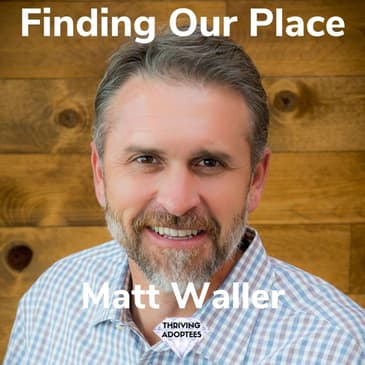
Finding our place - our home and our place in the world - is profound. Listen in as Matt who's fostered and adopted shares his learnings on self worth, relationships and much more...deep and highly empowering.
Matt Waller, MS is the Director of Community Impact for One Accord for Kids. Matt and his wife, Jen, founded The Attic Foster Network, a Permian Basin based nonprofit that serves children and families of the local foster system and invites churches to do the same. Matt moved to Midland, with his family, to teach for Midland Classical Academy. Prior to that, Matt worked in Christian Camping. His emerging career in child welfare is a direct result of the West Texas grassroots movement to see the local community care for local foster children. Matt earned his undergraduate degree from Baylor University. He holds a graduate degree in nonprofit management and leadership from Walden University.
https://www.linkedin.com/in/matt-waller-aa2b6819/
https://www.facebook.com/oneaccordtx/
https://www.instagram.com/oneaccordtx/
Guests and the host are not (unless mentioned) licensed pscyho-therapists and speak from their own opinion only. Seek qualified advice if you need help.
Want to learn more about thriving for you, your kids, your families or your colleagues? Pick a time to talk here
[00:00:02] Hello everybody, welcome to another episode of Thriving Adoptees podcast. Today I'm delighted to be joined by Matt Waller. Looking forward to our conversation today Matt. Yeah, me too. Thanks so much for having me on. You're welcome, you're very welcome. So Matt was just spotting, we have a lot of Texans on there. A lot of people from Texas on the pod. It's a hotbed for really great guests I guess. And a big state. Huge.
[00:00:29] How many Texans are there? How many people live in Texas? Oh gosh, I couldn't tell you. I don't know. I know that I remember at one time I lived in Wisconsin for a little bit. And there's four million people in Wisconsin and I remember there was four million in Houston alone. So gosh, the population of Texas must be much more than that. But yeah, I'm reviewing the list. You've got some friends too. That's really kind of, you know, those Texans recognize they're all my friends. So it's great.
[00:00:59] Cool. So this is Matt's an advocate for foster. You've also fostered yourself, you and your wife have fostered. And he's also the chair of, is it the founding chair? Is that how you call it? I think. Yeah. So founding chair. One accord for kids. Yeah. Right. That's right. So a great mix of lived experience and stuff that you've learned over the years, looking forward to diving into that.
[00:01:27] So I'd like to start with this question, right? Thriving. What does thriving mean for you as a human being? Right. What does thriving mean for you? Yeah, I think this is a great question. I think it's, I love it that I've, you know, and I get to hear the different definitions from my, from the podcast.
[00:01:48] And I think it's, it's excellent to remember that thriving is, is, it's kind of, I guess the goal where we want to be so much of us when, you know, we're just surviving or we're just making it through. Um, thriving is where we find our place where we have our, um, we're not, um, we're not concerned about, you know, just the day to day, but we're able to like work on ourselves and grow through that.
[00:02:16] You know, it's not, we're making it through an illness or making it through some, something that's come up, but we're able to, to have some growth in there. Yeah.
[00:02:26] And I guess finding our place, you can do it quite literally, right? You could think about finding a place, finding our place as a, as a young person, as somebody who has been placed or is available for adoption or somebody who is in the, in the care system and finding a place, finding a place to live with a, with a foster parent, short term and longer term, if that changes that way. Yeah, absolutely.
[00:02:53] Absolutely. So it's, you know, finding that place. I remember even, um, I'm, we're actually doing a foster dot Q and a tonight, um, uh, here in West Texas. And so I love the question that we always get. What if I get attached?
[00:03:07] And, uh, uh, I love my, um, we have this. So it was one accord for kids. We say that we're a community development organization for, we say child protection and adoption. Um, and, uh, we always get the question. What if I get attached to a foster child? That's coming in.
[00:03:28] And our, uh, uh, network of child placing agencies, foster agency, adoption agencies, well, I'll tell you, we hope you get attached. We, that's what the kids need is they need that attachment to, to come in and feel comfortable enough to, to be themselves, to make mistakes. Because that's what kids do. Um, and then also just to have fun. And so, um, we, we hope they get attached. We hope that they, that, um, that the foster parents can, can, um,
[00:03:59] can lean into that relationship. And when the foster parent, when the adult leans in, the child's going to lean into, and when the adult can be hearty, uh, the child is, that's when the child can start, um, just being a kid and just enjoying themselves. Uh, and I think thriving happens then we have, we forget that kids are kids and, um, you know, they're, they're working out how to, how to, how to be in the world. And so a lot of that comes with just little mistakes or it comes with also just fun and playing.
[00:04:27] And milk spilling and, and just enjoying, enjoying that. Yeah. Yeah. When, um, I was thinking, when you mentioned about this, getting this question, uh, what, what, what if I get attached? Uh, as you were talking about it, I thought they will. Yeah. You, you, you will get attached that, that, that is, uh, and you're saying, well, that's the aim. Yeah. Right. Um, I mean, just like,
[00:04:57] just like you and me are, I mean, we've got some kind of connection and it's, you know, through, through a device and all that you're, you're going to, you, it is, it is natural and is supposed to happen. God made us to have these, have these, this connection. Um, and, and I, you know, in order for, if we've been, if we've been broken or we've been hurt by relationships, it's going to take relationships, it's going to take relationships to heal.
[00:05:22] And so we're, we need, um, we need those, uh, willing adults to step in for that healing process to happen. And, and, and I, I don't want to, I want to be clear on, um, hurt by relationships. Um, I never want to paint, um, uh, by the biological parents as, um, as the ones that is, is evil or as wrong.
[00:05:46] Uh, just as, you know, it's a, it's a community coming around the community and community coming around people that are just, you know, that are struggling. Um, and I hope it's always that, that foster care is the, um, the purpose of foster care is to reunify kids with families to help, um, help, help families thrive in the situation they're in so that then they can be reunified with kids. Yeah.
[00:06:15] One of the things that I'm seeing more and more clearly is like, we're putting the, we're putting the kids first. We want the kids, kids to thrive. If the, if we want the kids to thrive, the, the parents, the, whether adoptive parents or resource parents or biological parents, right? They, they need to be thriving too. If we want them to thrive, then the, the professionals that are supporting those organisers, supporting those caregivers, they need to be thriving.
[00:06:41] And, and, and for those professionals and volunteers in some cases to be thriving, then the people that are leading the, the organisations, those organisations, they need to be thriving too. So it's like a, like, is it a golden thread or something? It's, we're, we're all kind of, we're, we're all being impacted both, both by one and one
[00:07:05] another. And that's how that, I don't know, is it, is it golden thread? I don't, what, what does it look like for you? I know. I love that. I love the, the analogy of a golden thread. I've been recently, I spoke at a church recently and we talked about the shalom of the city and shalom is peace. And so the, the peace and the welfare of the city, if, if the Israelites would seek out the peace
[00:07:31] of the city, then that peace comes back to them as well. And so the idea that, that thriving and, and that, that welfare, that, that kind of love for your, your neighbor, if we kind of enact that, if we are actually doing that and loving our neighbor, then that comes back
[00:07:54] to us. And I think, I think what, I think what I also think is, is part of that is, and I haven't broken it down, so I don't, I'm just kind of thinking about things in my, on my own, is that I think a part of that is just giving grace to each other, right? Forgiving for the, the hard things that happen. You know, even this morning, you know, I have a thing
[00:08:21] with one of my kids and we had to show grace for each other because we just didn't react in the right way. And so I think there's, there's an element of grace and just understanding that we're all, we're, we all just make mistakes. And so we all have a genuine appreciation for each other
[00:08:43] as well for it. Yeah. Yeah. Peace is big. And, and, and to, you know, when, when I think about foster care and it's, and why the, the stuff that kids have been through, right? The, the kids with the adverse childhood experiences have been through. I think about how rare peace
[00:09:12] may be in their life, how infrequent that may be, how short lived that peace may be. And I, and I also think, but I also, you know, when you relate, relate this back to a church or shalom or synagogues, right? They are places of peace as, as well. So I don't know what you make
[00:09:39] of all that. I, you know, I think you bring up excellent points that, you know, we, we work and operate and serve in a big system, you know, um, the state of Texas, the foster system is relatively centralized. They're trying to decentralize it to put it into some, some terms. Um, I'm, I'm reminded of a, of a quote from, um, mother Teresa that said, if you want to go home,
[00:10:09] if you want to change the world, go home and love your family. Um, and I, I think, I think we can do what we can do for the system and we work hard for it, but realize our control, um, is, is limited and that the peace that I can really bring, um, to my world is the choices I make, you know, choices I make that who I trust. Um, um, those are the big, big, big parts of it. Uh, and you know,
[00:10:37] the things I maybe choose to believe. I think too, I've, I've, um, one of our former board members, um, she adopted a, you know, she's, she's adopted, they've adopted three kids. And, uh, one of the things she said is when they brought them in, she says, we just make their world small. And I think there's something beautiful to like realizing, Hey, let's, you know, if you're struggling with some
[00:11:02] peace, like just making your world small for the kiddo, um, pulling them in and just saying, Hey, we're, we're just going to hang out at home, you know, and making that, making that world just real small for them as, as far as just, um, gosh, you know, limiting decisions and give it by giving them agency within that, those decisions, um, and, um, close interactions and, you know, not,
[00:11:28] not going out, you know, I'm sure, I'm sure, I'm sure the UK is no different from the U S and that you just, there's always got something going on, right. You're always bouncing from one thing to the other. Um, but I think we, there's been times where we're just say, Hey, we're, we're, we're pulling all that in and we're not going to do those things. And so making those decisions to just make, make their world small is, um, is a, is a powerful thing. And I, and I, I feel for there's,
[00:11:58] there's, there are people out there that just can't do it. You know, it's too hard to make their world small. And so they have to thrive in that go, go, go atmosphere and decide, figure out for themselves how to, how to do that. Um, I was thinking as you were describing that something popped into my head and I don't know where I got it from. I think it was from a leadership guy, but I can't remember or a leadership woman for that much. I can't remember who it was,
[00:12:26] but something like, um, slowing down to speed up. Yeah. So I was thinking if you, if you make the world smaller and you slow down your, the, the adoptive mom, right? She, she is creating a, she, she's making the world small because she's got more
[00:12:51] chance of peace, having a peaceful house, peaceful household, a peaceful home, home than, than, than with all the chaos going on out, out there and slowing down to speed up would be slowing down in the amount of what we're trying to do in that space to speed up the relationship process, building process.
[00:13:18] So I was thinking that how strong a metaphor that would be for, especially for foster parents as well too, but that's kind of my take on it. And I'm looking in from the outside. Yeah. What about you from your lived experience having, having fostered? Yeah. Yeah. So we, um, I, you know, we've had a, we've had a great journey. Um, we actually,
[00:13:47] when my wife and I started, um, the foster journey, we, um, we were struggling to have kiddos, um, and took that as a sign to say, okay, let's start looking outward towards, uh, this foster care and adoption, but it really was adoption at the time. And then we learned of the foster system that it was, um, there was some, that there were families out there that struggled that just needed
[00:14:13] help. Um, and the help to give was just to take kiddos for a little while. And we understood that, uh, in that regard. Um, and so we, and then with the potential that sometimes just doesn't work out and that you adopt. And so we, we went to, um, went through the training and, and learned a lot about the foster system, but then jumped into, um, we actually lived in a pretty rural place, more rural than,
[00:14:43] than, um, where I'm at in Midland. Um, and just never got a kiddo in until finally somebody picked us basically to take this little boy. And, um, and it was that it was, you know, we had to make his world small. He was, he came to us on, um, like two days before his first birthday. And, uh, so we, we got him a cake and it was my daughter's birthday the next day too. So they
[00:15:08] have back-to-back birthdays, my other daughter. Um, and, and we had this, um, so we had to come down with a party. And so we had, it came up with a party for him and celebrate his first birthday. And so that was, that was a big world. But then when everybody left, we had to get back to a small world. And the idea was just that we can, we can make things slow and make things predictable for him. Um, and it was really, it was really valuable. And we even see that today, you know, um, I've gone
[00:15:35] through several trials throughout our times with him. He had a major back surgery. He's had, you know, we just kind of, you just slow things down a little bit, uh, for him too. And then through the foster care process, um, we, when we moved to Midland, we had, um, a couple of kiddos that came through, through foster cares. We can continue to foster. And, um, we were, you know, some that came from
[00:16:01] really, really terrible trauma. Um, and some that came from, um, just a rough household. And so, you know, in both those instances, it was just slowing down, slowing down life and, um, you know, just keeping things, um, really, uh, controlled and really, um, really put together. Um, and so,
[00:16:29] um, it was, uh, I think about, uh, Karen Purvis and her, um, her teachings, which she talks about having high structure and high nurture. And so we just elevated both those very much so. And, um, and had great time with the kids that we had through come through. Yeah. What did you learn about parenting them that translated into the way that you parent your biological kid?
[00:16:58] Yeah. Um, gosh, uh, a lot of things we, um, I think there was the importance of, of, of, um, so when you get a foster kiddo in or an adoptive kiddo, you really have to make, or when you adopt, I think, I think in my experience is that we had to make a choice to love. And so you, you start,
[00:17:24] you start strategizing, how am I going to fall in love with this child? Or how am I going to, um, create an atmosphere that, that starts to create connection and bonding in an appropriate way that this child is comfortable as well as that, you know, really that this child is comfortable. And so there was things that Karen Purvis had talked about in her writings that we, that we used where it was
[00:17:52] just giving, um, giving choices. And, um, I mean, even at a young age, uh, and then talking through everything at a young age, um, for them to help give them words as they went. But then also we, we would, um, you know, I would, I would use glancing eye contact with them because maybe eye contact was hard. I had, remember we had one kiddo that eye contact was difficult. So I just would kind of look at them and then look away. And I was, the idea was just to get them a little bit
[00:18:21] comfortable with it. Um, or, um, they've talked about nurture groups. And so during dinner, I would, there was times where I would feed them with my hand and just feed them. And it was, the idea was just to create a, um, a moment. And it wasn't like I fed everything. It was just one thing, you know, hey, this too. And I would, um, and so I made things very, we made things very, um, you had to
[00:18:47] kind of calculate, how are you doing it? And then, and then work through it in that way. And so now with my biologicals and even with my adopted, my adopted son, um, we do a lot of the similar things. I don't feed them anymore, but I do want to make sure they're, um, they're fed. And, you know, when I noticed things, I'm like, Hey, are you, are you thirsty? Are you hungry? You must be hungry. You just got done with practice. Um, let me, let me help, let me get you a bar where you've got to
[00:19:16] be thirsty. And so I'll, I'll, I'll bring water with me. Um, thinking of those, um, physiological needs and then realizing that that's my opportunity to connect with them by providing it, not just giving it to them, but like realizing, Oh, I get to be their dad and I get to be that provider for them as well. Yeah. So being intentional, being intentional about creating opportunities to,
[00:19:45] to connect, but, but slowly, right. Oh yeah. Yeah. And it's a, it's a tuning, it's an art thing. I think that's the whole thing is people say, well, parenting is, it isn't a science, it's an art, but we were brought up on scientists. You know, if we do this at school, we were brought up, you know, like you, you've, you've got a list of, uh, a list of items that you're going to need equipment for
[00:20:15] the, for this, for the science lab. And you've got a method, scientific method, how are you going to put these things together? But that's that. So we're raised in this, in this, in this space where there are processes and protocols, whereas it's, it's far more about art than it is about science. It is. And it's at the same time, there's a, if you can get curious, maybe not scientific,
[00:20:43] but curious, you know, the scientific method is able to feed our curiosity. I got to teach when I moved to Midland initially, I taught, um, physical science, science class. I got taught literature classes and for the school my kids go to, and, and it's a, um, it's, it's a blend. It's an art and science. It's, you know, you know, there's, there's a, if I can be curious enough about how
[00:21:09] I engage my children, right. And, and try things, you know, smiling more eye contact, um, you know, I, you know, lots of, you know, I toss all their hair. I, I get excited when I see them in the mornings. Um, so they know that they're welcome. We get excited, my wife too. Um, so if we can
[00:21:32] engage in that way, if we can jump in that way, um, well, I, let me say that I, it's an art as well as like the curiosity of the science. How can I change this? What can I do to tweak? I think one of the things they've talked about is being a student of your children. Um, and so just examining them and, you know, we've gone so far as to keeping a diary of what's going on with particular kiddo and they're
[00:21:59] struggling with something. Um, so, yeah, I love this whole thing about curiosity and openness. Yeah. I'm down at the same time, like me and my wife haven't got any kids, but I hear a lot about time pressures. And you mentioned this earlier on, you know, people are always doing stuff,
[00:22:19] how can, how can we make curiosity, um, time and space for curiosity is, is, is, or is I'm asking the wrong question? I don't know. No, I think you're, you're, I think you're right. I think we can, um, maybe it's in the States or maybe it's, you know, West Texas or something where it's like, Oh, rub some dirt on it, you know, and you, you know, child gets hurt. You just rub,
[00:22:46] rub some dirt on it and keep playing. Um, and it can, it almost, it's, it's somewhat needed, but it can also be a dismissive attitude. And I think if we, you know, pull them in and say, okay, what, what really hurts about that? What's going on? Um, we're not dismissing that pain and we're not necessarily, but we're, I rather we're, we're appropriately tending to it. And so I think
[00:23:11] that curiosity for us to say, okay, how come, how can I actually, uh, step into this moment with, with this, this other human? Um, and let me tell you, like, you know, I come from a biblical background. The, uh, the making another human is like, and, and engaging with another human, um, or having a child is something that like that lasts forever. Right. You know, and scripture talks about
[00:23:39] you're going to be married, but you're not married in heaven, but I'm always going to have kids. And so this, this person that I get to, you know, invest in and, um, will one day be a, um, as the CS Lewis says, uh, an everlasting splendor or an immortal horror. And so I think I have the opportunity to see, you know, what can this, what splendor can this child turn into, turn into
[00:24:05] one day. So it's where you're parenting from, I guess, isn't it? Yeah, that's, that's really good. Yeah. It's about a philosophy. It's, I I'm, I'm painting it as something that's kind of tactical. Um, and, and, and you're, you're coming from a far, far more of a, what, what's my mission here? What's my, it's not strategy. It's beyond strategy. It's, it's beyond
[00:24:34] tactics. It's beyond strategy. It's, it's kind of where you're coming from. It's your whole philosophy of kids everlasting splendor. Yeah. Yeah. I think, I think you're, you're really helping me process this. I appreciate it. You're really good at this. Thank you. Um, what, so if, if we, if we shift it
[00:24:59] for a, uh, a moment in terms of obstacles to thriving, if, if, if I'm going to kind of go with what you're talking about here, it's about, so a lack of, a lack of curiosity and being, having a fixed mindset that that's gonna, that's gonna be a barrier to helping our kids thrive. What other barriers
[00:25:27] do you see to, to, to, to this thriving? Yeah, I think, you know, you fixed mindset. I think you're, you're accurate to say that this, this is the way it is, or gosh, my child's smart. And we tell our, we tell our kids a lot, they work hard. Um, um, and that kind of gives them a, doesn't settle into
[00:25:51] a fixed mindset. That's, that's excellent point you bring up, but I think it's also this, we feel like we have to chase, um, something. And, um, it's for such a time as this, this is our, this is, I will not get to be a, a dad of a five-year-old ever again, right? My youngest is five. And so
[00:26:15] this is my last year to be a father of five-year-old ever. And so, um, know that, you know, we have a limited amount of time with these, these, um, these people and eventually we're gonna, we're letting them go. I've got the rare opportunity of, um, next year, my, my oldest will be a senior in high school and my youngest will be in kindergarten. So the two bookends, the end of high, the end of,
[00:26:40] um, you know, I guess primary school, the end of, um, before you go off to college and then the beginning of it all. And so, um, I imagine I'm going to be a puddle of goo for most of that year, but, um, things that will get in the way of that, um, I think expectations, you know, I have this expectation of how my daughter's senior year should go, or I have this expectation of how my, my youngest
[00:27:08] daughter's, um, uh, kindergarten year should go. Um, I have an expectation of a sport my child should play and, and reality is that I just need to enjoy them. I just need to enjoy who they are and, and major on the, on the majors and, and, um, minor on the minors. So expectations, I think that gets into time, how much time we spend, um, on other things and the distractions and calling a distraction
[00:27:37] and distraction, um, rather than, you know, what's going to give me the traction I need, um, in, um, in, with my family and, you know, even identifying within work and within other, you know, other responsibilities I have in life, what actually are in the important things for me to do. Um,
[00:27:58] um, so I think it takes kind of some, some forethought there. Yeah. So just drawing a couple of threads there that I see, uh, perhaps holding our expectations, um, more loosely and, and, and maybe holding our
[00:28:24] beliefs. Yeah. What we see is fixed. Yeah. Or loosely. I mean, I'm talking, I'm not talking about like a belief in God belief. I'm talking about a belief in X has to happen for, for me to be happy or. Yeah. Yeah. I think that's, that's very true. And I think, you know, it's realizing what's,
[00:28:47] what are the important things for me? Um, you know, and, and, and I have to do it a lot. We Midland produces, um, oil, our permanent basin, we more oils produced here than any, and then all of the U S combined. Right. And so there is a lot of, um, a lot of wealth and a lot of, um, a lot of,
[00:29:14] um, just things that come from that. But what I found is the friends that, um, the bottom line, the ones that are happiest, the ones that are thriving here are the ones that value their time with their family and value the time with friends. Um, and, um, wealth isn't the center of their life. Right. And so those are, that's what I found. And then translating that to myself, which obviously
[00:29:43] I'm in child welfare. I don't, I don't have oil money, but realizing that, you know, my, truly the things that will last, truly the things that will, will be great are those, um, are those, uh, those things that are in relationships and friendships as well as, you know, and then primarily realizing in this stage of my life that it's, it's the kids, my wife and I focusing on, on our kids. Yeah.
[00:30:14] Appropriately focusing. Yeah. When, at the start of the piece, we were talking about your, your growth. Right. Um, yeah. We talked about you, we talked about, I'm finding a place, right? So finding a place. And then we went, where I went to with that. What does, what does growth mean for you personally? And I guess as a dad?
[00:30:41] Yeah. Yeah. I think, you know, we, when it, it comes to growth, I think we, um, you know, just getting better. And when I think of growth, but I think, I think that, um, there's a value in getting better for myself and for my, uh, for my mind, for my body, from heart, from my soul.
[00:31:09] But there's also a, um, a great, uh, benefit to my children seeing me do that, seeing me grow. Right. Um, when they see me, uh, thrive and take care of, take care of myself or push myself in a way that is, um, not expected for them to see it, um, you know, then they want to, they'll want to
[00:31:35] implement that too. Uh, we're seeing that with our daughter. She's, um, she's, she's choosing hard things. And, uh, my wife and I are pretty, pretty pleased with the hard things she's chosen. Um, and so I'm, and I can't help but think that's because she's seen her mom work so hard. Um, and because she's seen mainly her mom work so hard. Yeah. Can you give us an example, obviously
[00:32:03] within privacy and those sorts of things? Yeah. Um, so she's, uh, like, you know, my, my daughter really, like, I say she values relationships and so she'll step into hard relationships. Um, she will, um, and, and take on responsibilities, uh, for her, for her, uh,
[00:32:30] classmates and, and, and she, you know, she's a kid, so she'll, she'll voice her frustration, but that, that doesn't change her actions where she still will step in to serve, uh, and to be with. And, and I'll say that my wife, um, my wife is, she's learned that from her where it's just this
[00:32:52] tireless effort to keep the family engaged, um, keep the family going. Um, I'll say that, uh, probably through our foster care journey, we've, our youngest, our oldest daughter kind of stepped through it all with her where we said, Hey, you know, like you're going to have to get a TB test. You have to be tested for tuberculosis. Um, that was just one of the state requirements. And so what does that mean? It means we have to get the draw blood. So you're going to get pricked with a needle. She's like,
[00:33:20] what I have to, and I was like, that's just, and she's like, okay, I'll do it. And so she, she does that. Um, you know, she, uh, has walked through us when, when we moved to Midland, we actually started a resource closet for foster adoptive parents, which really is kind of impetus of what started, um, one accord as well. And, and we, um, and she, you know, I've got pictures of her,
[00:33:48] you know, helping to organize. And so she has seen that not only do we, um, you know, do we work hard in school, but we work hard in, in our, in the, in, in serving our community. And then, and that's now turned into a job, which I'm so grateful for. Um, and so she, she's seen that as well. And so I, I've really loved just being able to, um, go, I call it family on a mission for us to work together
[00:34:17] towards these, um, these goals. I had the opportunity this last weekend, we, we were helping with a, an estate sale, um, that was gonna, gonna benefit one accord. And so we, uh, we had to go and just, we just packed up. So I got my kids all together and we, we did this, um, this serving opportunity together. And so it was, um, that's where I see it. I see if we can sit, if we can do
[00:34:44] things elbow to elbow with our kids and step into, um, step into hard things and they, um, not see it in a way that, that they're burdened by the stress of it, but see it in a way that, um, that, you know, we're just taking responsibility for our fellow man or stepping into a hard spot to help somebody.
[00:35:10] Um, I think that when they see that they're able to, um, just embrace and then carry that over and realize that this is just part of life that we do. Um, we have, yeah. Yeah. Yeah. Perhaps if I draw a couple of things together from that, um, and the growth idea, how, how do you see the relationship
[00:35:36] between, uh, trauma growth, uh, and thriving and obstacles to thriving? How do you, how do you kind of disentangle all that? I, um, I cannot imagine the trauma that children have gone through.
[00:35:58] I cannot imagine the trauma that adults are living with. Um, and, um, so I, I come from a place of humility that didn't kind of don't have, I don't have much of that lived experience. Um, however, I'd say that, um, but having walked through some things with, with the children,
[00:36:26] um, I think, I think, um, I think there's a few things that, that help us with that. Um, some things you can't change. And so it's just accepting, um, when it comes to thriving,
[00:36:49] accepting it, that this is, this is the, the hand I've been dealt and then just stepping into that, uh, that moment. Um, we have a kind of a saying within our, our culture, work culture is, is having a understanding you're here, where you're at here. Um, and you know, that,
[00:37:14] that can be an acquired taste, um, and know that where you want to get is there. And so the path, and part of that path to get there is, um, realizing those emotions you have, right? Those emotions that come up, they're real, but they're telling you something, right? And I, again, I can't, I can't relate to the emotions that come from the trauma of people's lives, but
[00:37:44] those emotions coming up that we also have a thing that we've used with the kiddos that we used at school. I worked at too, is a, it's, um, is feel, think, act that whenever you have that feeling, right? You can think about it. Like, where is it coming from? And realizing that feeling doesn't have to control your actions, right? And, and, and it just does sometimes. And we, we have to give
[00:38:10] ourselves grace and forgiveness for it. I did this morning, had a feeling and I acted, didn't think about it. And I had to apologize. Um, and I forgive myself when I have to forgive my kids, or I have to ask forgiveness from my kids rather. Um, and so I, I think having a structure in place to understand when this happens, if I have a feeling, I'm going to think about it. I don't
[00:38:36] have to act on it, but then also the, the enough grace to say, all right, I'm going to, I can be forgiven for, I can forgive myself for this. Uh, if, if the action is inappropriate or anything like that. Um, yeah. Yeah. Links back to the humidity then I think links back to the cure curiosity.
[00:39:01] Yeah. I think you're right. Yeah. I think you're right. I think it's, you know, and, and, and, you know, uh, I think it's just, you know, I think people try to act as best they can. And so I, I, I, the posture of like humility and curiosity that helps it even if it's fake,
[00:39:27] you know, it, it, it at least can help the situation out. Um, Do you remember when you learned that feel, think, act? It was, um, I think we, uh, we've, we've talked about it quite a bit, the school I was at and we've used it here, uh, the school that I taught at. And then, um, it honestly, it came up,
[00:39:54] we're teaching, we're reading through Plato's Republic, um, with my students and it came up then too, where he talks about it in the sense of, um, of kind of your three parts of the soul. Gosh, you're some philosophy people are going to, you know, bag me for this, but as I recall, it was like, you're led by the stomach, you're led by the heart, you're led by the head. And the
[00:40:19] stomach is your, is your, um, is your, uh, like the things you want and things that you need that you take, um, where it's, uh, those like desires and then your heart is your passion. So your, and then your, um, your head is your, your logic. And you always want to have rightly ordered things where your head comes first. Um, and you, anything that comes from the stomach or comes from the heart is filtered through the head before you do action. So that was, I mean, I, gosh, I was,
[00:40:48] 35 plus whenever that came up and I was like, oh, that's really good. Yeah. So, um, you know, the freedom to learn. It is, it is, it's great. I mean, um, one of the things I'm a big proponent of is empowering our kids to change rather than to, to change themselves, you know, for themselves
[00:41:17] to change rather than trying to get, get them to change. And a simple model like feel, think, act, we can, we can give them that model. We can show, we can give them an example from our own self, from, from our own world. And we can live those examples. And then we, we, we're making ourselves
[00:41:45] wrong rather than making them wrong. So we're learning, we're sharing that we're learning by our mistakes and, and we've got the grace, right? You know, we're making ourselves wrong, but we're giving ourselves grace in that, in, in that wrongness too, which all seems to me to be perfect kind of life lessons and empowerment stuff for kids rather than, uh, you can't see it,
[00:42:13] rather than a finger wagging. Right. So yeah, yeah, yeah. Yeah, no, I think you're, you're right. I think there's, uh, for kiddos, I think it was Karen Purvis that said, and I keep talking about her, and I, I, I hope our listeners are somewhat familiar with, with her. Because she comes out of TBRI, comes out of Texas, doesn't it? Yes, yes, it does. Yeah. And so it's, it's really popular here. And I just learned recently that it's
[00:42:38] more popular here than other places. So I'm, I'm learning, um, myself, but I, you know, one thing she talks about, he says, you know, we're giving more than three or five words in our instructions and we're spitting in the wind. Like you've gotta, you gotta give short instructions. And I think, I think the idea of a mental, mental models and, um, little, little, little bits are so valuable for us to kind of understand, okay, what's going on. Um, and then repeating those,
[00:43:07] uh, I've got a buddy who has coached his son in baseball and I'm just, I just can't get over how good of a coach he is because he just gives the right prompts for a technique of how to swing or how to throw or whatever. And I think that if we can just give those little touches, those little prompts to our kiddos and remind them, you know, just, I think it helps. It's, it's loving.
[00:43:33] It's, it's just a reminder. Um, they can choose whether they want to do it or not, but they'll, they'll see the consequences pretty quick. Um, it just allows, it allows a feedback loop. That's really fast. Yeah. You know, to come back. Yeah. I, um, I swim most lunchtimes and sometimes I see that there's a swim instructor and I don't see him doing this anymore. So maybe he's, he's caught on to
[00:43:59] something that's more appropriate, like your, uh, your, your, your buddy coaching his, his son. He used to video people swimming. Uh, and then I'd see them. I'd see him watching the video with the, the, the adult that he's teaching. And he'd be talking to that adult for half an hour.
[00:44:27] Yeah. And I'm just thinking, like you said three or five words, right? That guy was probably, that's probably giving the guy more like 3000 words. Yeah. Yeah. That's true. That's true. I mean, I, I used to be able to, I was in publishing and I used to be able to proofread and, and edit two, 2000 words in about half an hour. So we can, we can speak faster than we can
[00:44:55] edit and write. So he probably was giving that guy 3000, 3000 words. And you, you gave it up a limit of five, you know, like, you know, we're not saying this is a science listeners, right? We're not saying two, you can't do two and you can't do six. We're not, we're trying to get, you know, but talking at somebody for half an hour. And he's probably just talking about, you know,
[00:45:24] like just break it down. Yeah. Yeah. Yeah. Break it down with a hand. Are your fingers all together or are they all open or are they somewhere between, you know, right? Well try that. How does that feel? Well then come back and, you know, do two, do two lessons. The feedback loop, right? Oh yeah. I think that feedback loop is pretty important, particularly for the kiddos where you
[00:45:49] get it fast, right? I'm not, you're not in trouble. I'm just giving you feedback. Okay. Right. I'm going to go, I'm going to dip in with one of my, uh, favorite distinctions. If I may, Matt, right. Just a little bit of feedback for you. And we sink just a little bit of feedback. Um, some, a mentor of mine talks about this ages ago and it stuck with me. Feed forward,
[00:46:18] feed forward, not feedback. That's clever. Yeah. Yeah. Um, and while we're on that, um, mindset, mindset, right. Mind fluid rather than mindset, mindset, like set is like concrete, isn't it? Yeah. Mind fluid. Yeah. And, but it all goes back to a curiosity thing, right? Yeah. It all goes back to curiosity. And, and, um, if we can like imbuing that curiosity in our kids or at least
[00:46:48] not trampling it down, that's the other way. Yeah. Yeah. That's good. That's real good. How do you, how do you do that? I mean, do you do that? Do you do that consciously with your kids in terms of curiosity and, and, and growth and feed forward? Have you got any, but you, you might be doing it on, I said, do you do it consciously? Cause I'm figuring you
[00:47:17] might be doing it unconsciously. Yeah. No, I think, well, I, I, I think I probably have to do it consciously because I mean, I'm, I'm a human. And so when I get home, I think I'm, I, I think too much about numero uno, which is myself. Um, and so I have to kind of decide that I'm going to do it different. And I think if we put those structures in place, we're able to kind of just do that.
[00:47:41] For example, every night I have, you know, just like there's bedtime routines, right? So I have a saying, I have routines that I go through and the kids love it. And so it reminds me to, to, to engage in those routine things. And so I, um, I've, I have got to have, for me, I've got to have structures in
[00:48:03] place in order to actually do, um, to be good at that. Uh, I think about play very little golf. Um, but I would always, if I brought my nine iron and my putter with me and I, you know, chip, and then I put, I would always leave it behind. I'd leave my, my nine iron behind. And so what I had to do is I had to, I had to set it so that I would step on it. So it had to be between the hole and the cart.
[00:48:31] Um, and there's so many things that I have to put a tripwire up to remember to do, um, to do those. Uh, so, um, so I'll, I'll grab a water bottle before, you know, real early on, put it in my car. Cause I don't want to pick up a kiddo. Um, so I, I, you know, I try and do things early while I'm not in the moment. So it's not conscious. Uh, I know it is conscious. I have to
[00:48:58] think about it. It's just not as frequent as I would like. Right. But it's habit though as well. If it's routine, it's habit. Yeah. There's, there are habits in place. Yeah. It's true. I've got a question, um, on that. Um, but, uh, um, cause you talked about earlier, um, coming from a religious perspective on this, cause I think about habits don't, uh, is it,
[00:49:26] is it monks wear habits or, uh, yeah. Yeah. Is there, is there a relationship? Is there a relationship between kind of what we wear and what we do is the, or is it just a coincidence? Oh, I think, um, I think everything we do, I think, you know, it talks about in scripture that everything we do is, if we render it holy, it's, you know, if we understand that what we're
[00:49:52] doing is for that, for that purpose. Uh, I know that I, I, I think, I believe nuns wear habits as well. And, uh, cassocks is another word I've heard for, for, uh, orthodox. Um, and, and, and I've got a friend that's orthodox and she talks about how everything is, is very purposeful. And I think if we can, I think stepping into that, the, that purpose fullness, I don't want to say
[00:50:20] it otherwise, but it brings value to, to when it comes to raising the kiddos, um, it's our chance to really just, um, yeah. And embrace those habits and, you know, children get a lot of comfort from routine. They get a lot of comfort from habit because then, because, uh, I think I've talked to my child about this. He wanted to run an errand over the, on Saturday. And I was like, well, you don't have time to do that, buddy. I'm sorry. And I was like, it, it really, you know, I got to think
[00:50:49] about it. It's, it's, it's hard to be a kid because you can't do what you want to do. You know, you don't have the money, you don't have the wheels to get there, you know? And so he has no control. And, and by the end of the day, I, with great joy, relented and said, let's go do it. You know, we have a five minute, we have a, you know, 15 minute window, let's go. And so we did it. And so,
[00:51:11] um, it was, it was, um, they, I think they love habits because there's control in those habits. There's control in those things. And we, as adults, we, we can set those structures up in place in our, in our, um, lives to, to, to, to benefit, to do that. Yeah. Yeah. Fantastic. Feels like a good place to bring it in, Matt. Yeah. It's flown by, right?
[00:51:40] Matt. It has. Yeah, it has. You're, I, I, uh, I can't wait to do this again. Yeah. Great to talk to. Yeah. Well, funnily enough, listeners, uh, Matt and I are having another discussion, but in an hour's time, but it won't be for the podcast. Maybe we can do the podcast together as well later in the year. That would be great. It'd be really good. Yeah. Thanks, Matt. And thanks listeners. Uh, take care and we'll speak to you very soon. Take care. Bye-bye. Bye-bye.