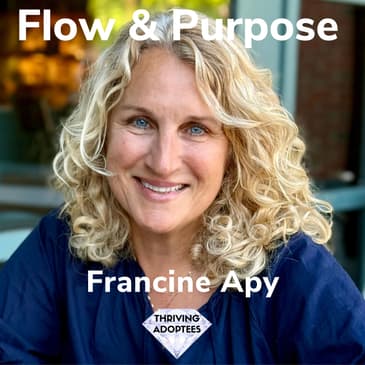
Are you looking for more ease and flow in your life? Who isn't? Listen in adoptive mother and coach Francine shares her insights on flow helps us thrive. We also explore how meaning enriches our lives.
Here's a bit about Francine from her website:
Adoption is a way some of us are called to grow our families, and I’m here to support that journey however I can.
I’m Francine Apy, an adoptive mom of three, a writer, speaker, and coach who believes in the power of encouragement, clarity, and faith to move us forward. SoulFilling reflects not just my story, but a calling: to help others walk their own adoption path with perspective, purpose, and an open heart.
Here's a link to her website https://www.soulfillingadoption.com/
Connect with on social media at:
https://www.instagram.com/soulfilling_by_francine_apy/
https://www.linkedin.com/in/francine-apy-4310b7221/
https://www.youtube.com/@SoulFillingAdoption
Guests and the host are not (unless mentioned) licensed pscyho-therapists and speak from their own opinion only. Seek qualified advice if you need help.
Want to learn more about thriving for you, your kids, your families or your colleagues? Pick a time to talk here
[00:00:02] Hello everybody, welcome to another episode of Thriving Adoptees podcast. Today I'm delighted to be joined by Francine. Francine Apy, looking forward to our conversation Francine. Great thanks so much Simon, thrilled to be here, appreciate it. So listeners, Francine's a mum of three by adoption. They're teens, early 20s and she is also a coach.
[00:00:26] And she's just going to go, she's going back to school to learn some more stuff that you're hoping to bring into the, well not hoping, that you are going to bring into the adoption space. So a lot to dive into, so let's go for it. First thing Francine, what does thriving mean to you?
[00:00:51] Sure. Thriving means to me that you're living in this space that's beyond kind of just status quo, if you will. Like this is, you know, a little bit mundane. You're kind of in a little bit, you're not in, you're in flow, right?
[00:01:12] So if you're thriving, you're in flow. You feel an essence of purpose, you feel an essence of a reason to get up, you know, and start the day. You're looking at it through this lens of opportunity, as opposed to what isn't going right in your story, right?
[00:01:33] And so thriving to me is, is just that living in this state of flow and recognizing that you have, you have the ability to choose the next best step for you. Yeah. So when we, when I hear the, the, the word flow, I, I think of sports people, right?
[00:02:00] And they're, they're in the flow. They're, they're in the middle of the action. They're, their whole space is kind of consumed by what they're doing. They're not distracted. They are effortless to an expect. They, they are responsive. They are fully engaged, right?
[00:02:25] And there's a certain amount of peace with, with that. And I've heard a lot of, I've heard a lot of, I'm not particularly a sports fan, but I've heard a lot of adult, sports people say that when there's no voice in, there's no voice in the head when they're in the middle of the game.
[00:02:46] But the, the, the, the example I've heard is, is from a guy, a British rugby, English rugby player who takes the penalty kicks, right? So the, the, the, the whistle goes, there's been an infringement and it's done. That, that, that guy is going to have to take the kick. And he's, he's, he, he, he, if he's in the middle of the action, he's in flow.
[00:03:14] But as soon as the whistle goes and he realises it's going to be on him to either kick the ball over or, or, or not. And same for, same for women, soccer players and women rugby players and stuff like that. That's, that's when their inner critic goes nuts. Because it all becomes on them. Am I going to get this over? Am I going to score? Right.
[00:03:39] So, so that's, that's what I think of when I hear the word flow. What do you think of? What do you mean by flow? What's interesting that you tie it to sports because the new F1 movie that's out with Brad Pitt, he talks about it flow in race car driving, right?
[00:04:02] There goes a point that you're not really thinking you're just the car, you're just in that car and you're in that state of flow. So a lot of what you're talking about from a sports aspect, it's interesting because they talk about that in the movie in the flow. But, you know, for me, the flow is, it's not so much that you have effortless days or effortless tasks or effortless activities.
[00:04:31] But you feel this sense of calm as you're going about your day, right? You feel this sense of calm, this sense of purpose, this sense of I'm challenging myself. I'm pushing the envelope a little bit, but I'm not strenuous. I'm not like working out of a space that I feel uncomfortable. I'm working, you know, I'm not uncomfortable, right? I'm feeling alive, right?
[00:05:00] So when I think about, you know, spiritual well-being, mental well-being, physical well-being, all those things are in alignment. I'm in flow. And I have this essence of that, you know, life is good and I'm doing what I'm called to do here, right? Yeah.
[00:05:22] So how does flow and parenting, how they seem unusual bedfellows to me? But maybe that's just because I'm not a parent. Me and my wife haven't got any kids, right? So what does flow mean from a parenting perspective? Oh, that's a great question. And I never really thought of it in this way.
[00:05:51] But honestly, I think one of the biggest challenges and opportunities that parents have is helping a child identify their strengths, right? And identify what they're good at. And I help them identify, like, kind of what lights you up, right? What gets you up and excited about the day? Is it a sport? Is it a class? Is it a show that you like?
[00:06:20] Is it a bike ride? Is it whatever? And as a parent, you know, for me, that's all I ever wanted at the core, right? So we have our three sons through the blessing of adoption. You know, I was fortunate to meet all birth moms.
[00:06:37] But suffice to say, whether you have adoption in your story or not, as a parent, you just want your child to find what makes them feel alive, right? And where they feel that they're living their fullest expression. And so you're kind of this person as a parent and looking at three completely different human beings and parenting them accordingly.
[00:07:07] I couldn't parent all my kids the same way. You know, our core values are the same, all those kinds of things. But as a parent, you're constantly looking at each of your children and saying, do I push them right now or do I hold them? Do I push them right now or do I hold them?
[00:07:25] You know, because that is what is the core essence, I think, of a parent is deciding when you push and when you hold. And I think in order for a child, if we're too easy on them and if we don't challenge them, then they may not have the courage, right? To thrive to their fullest expression.
[00:07:53] But if you push them too much, there's this level that the word anxiety and stress and unrealistic expectations we put on them to be something that they were never intended to be. And isn't that silly, right? Isn't that silly? Like, for example, if you come from a family of teachers, you come from a family of medical doctors, you come from a family of athletes, you know, now the expectation should be, well, that's what we do.
[00:08:23] Well, no, it's really not. Right. And so as a parent, you want your children to find their flow. You know, as I just said this to one of my sons yesterday, you know, my goal as a parent is to help you live your fullest expression, whatever that is. Right. And I know we're not here to talk about, you know, my kids, which is perfectly, you know, fine.
[00:08:48] But you asked a parenting question and that pushed me to say, you know, that is my biggest responsibility is to help them figure out how they can live their fullest expression. And whereas, you know, you know, so it's really just helping them find that. Yeah. And asking questions. And there's a great book, The Blessing of a Skinned Knee, and not being afraid to let them fall. You know, not being afraid to let them fall.
[00:09:17] You know, she explains in this book that if we never let our child fall on the slippery rock in the stream, after we've told them many times, you know, you shouldn't run on those wet rocks. You're going to fall. You know, you tell them, but you got to let them skin their knee. Because then they get up and they're like, ouch, my knee, you know, and then the consequences get greater and greater. Right. Before you know it, they're driving a car.
[00:09:45] You know, they're needing to make these decisions and understanding cause and effect. So that all makes me think of flow of this delicate dance between pushing and holding and letting them fail and then get up again, which one of my favorite words is resilience. Right. We can't build resilience if we never fail. We don't hear flow a lot in parenting circles. Right.
[00:10:15] We hear store, you know, and we hear logistics. You know, I think of the friends of ours who have kids and it seems to be it's all logistics. It's rush. It's fall. Yeah. Hold on. Sorry. Sorry. I said it's sad. I mean, it's sad, you know, a little bit to me. People trying to do too much?
[00:10:45] Yeah. Yeah. We weren't intended. Somewhere along the way, sports just became something that instead of it was a good activity to get fresh air and some exercise and be with your friends. Now it's like, well, if you're not in football or you're not playing basketball in a league by the time you're four or five, you know, you're not going to make the team in middle school, which then high school and then your college.
[00:11:12] And I do, you know, there is a lot of money on the line, right? Right. Right. Right. Right. Right. Right. Right. Right. Right. And I think, you know, all of us just want to play the sport because we wanted to have fresh air. So I think it's getting harder and harder to find those casual laid back.
[00:11:39] Can we just play a game of baseball and we're not here to crush it and win the whole league so we all can go on to be professional baseball players? Yeah. What about the what about the storm, though? You know, before we hit hit hit record, you were talking about challenges for all families.
[00:12:02] You know, this the sensitivity towards mental health, anxiety and these things. So nobody's saying that these are the challenges are only in adoptive families. But what about the what about the storm that is that can be raising kids and teens and flow in that in that space? In that in those circumstances, what does that mean to you?
[00:12:32] Yeah. You know, for me, I think it all goes back to open and honest communications. Right. So for me as a parent. You got to have dial open and honest communication with your kids, you know, to the best of your ability. And of course, that changes a little bit as they're evolving, as they're developing and and what have you. But gosh.
[00:12:58] If you if you can have some kind of dialogue with your kids to really understand what's going on in their life. Then I think it's that much harder for them to feel comfortable to come to you when there is a challenge, a true challenge or a true crisis. Right. Or a true problem.
[00:13:20] You know, I think in terms of of times while raising my kids, sometimes it's hard to find the right time to have the tough conversations. Right. Oh, gosh. It's first thing in the morning. We're all busy. We're rushing out the door or it's the end of the day and I want them to have a good rest. And I don't it's not a good time. Oh, they have a test tomorrow. So one of the tactics I use while raising our kids is I would write them a letter.
[00:13:49] Because for me, sometimes verbally having a conversation like we're having is harder to have because you don't know 100 percent where they're at. You know, I may be at an emotional state, so I maybe am not going to word it in a way that I would have wanted to word it. So in writing, it helped me kind of get what I felt I needed to get out on paper.
[00:14:16] I put it in an envelope and I would just put it on their desk. And like when you when you are ready to have a conversation with me about a topic, here's this letter. And I, you know, and you decide when is a good time to open it. But it's something we need to talk about. I think when we are society, we want to move at such a fast pace that we just we just want things fixed. A problem comes up. We want it fixed. We got to move on. Oh, we're too busy. Oh, that's nothing.
[00:14:46] You know, we don't need to talk about that. And I think it's OK to do that sometimes because this is life and we're imperfect humans. And yes, we do live busy lifestyles. But it can't be day in and day out, day in and day out that you're not pausing when you really feel that things there's an energy in the house, that the flow in the house is just not there. Right. We all have that flow in the house when there's tension in the house, you know.
[00:15:12] And for me, it just was always important to call out the elephant in the room and you don't have to talk to me about it right now. But at some point we need to talk about it because elephants don't go away. You know, they get buried and we know what happens when we push things down. Right. And we things can grow.
[00:15:37] And I never wanted that to be something that my kids didn't feel that they could talk about when things got hard. So you mentioned grow there and you talked at the top of the description of thriving. You talked about what was going beyond the status quo. So growth and movement.
[00:16:06] Is that what we're talking about here? Yeah. I think more people today, Simon, are talking about happiness and what is happiness and why don't I feel better? I have all the things. You know, I married the right person. I have the job. I'm comfortable. But is there something more?
[00:16:32] Should I be should I be feeling something more than what I'm feeling right now? So, I mean, traditionally, those were kind of midlife crisis questions. Yeah, but usually the midlife crisis is usually like to me, in my opinion, anyway, something's out of whack. Like something's out of whack. Like I got all the things, but maybe I didn't make the best choices. And now I need to like make up for lost time.
[00:17:02] That to me is more like I should have been younger. I should have enjoyed my early 20s. I shouldn't have taken college maybe quite so seriously. I shouldn't have. And now I did like I did. I followed all the rules. I did everything that was expected of me. And now I'm in this place. To what end? Yeah.
[00:17:28] And to me, that's a midlife crisis as opposed to I think people today, you know, you know, I adore my parents. You know, I'm youngest of four girls in five years. You know, it was a busy household. But I was raised, you know, in the 60s and 70s. And we were a little bit more meant to be seen and not heard and do the right thing. Hey, we showed you the path. So do the right thing. And I respected that.
[00:17:56] You know, there was a respect and an expectation that had to be met. And I think today it's a little bit gone the other way in terms of maybe us coddling our kids a little bit too much and protecting them maybe a little bit too much from real life.
[00:18:16] And so that mindset shift is something that I think parents today are really balancing between, you know, we want a little bit more of a relationship than maybe we had with our parents growing up. Because, again, they just didn't have the tools and the dialogue of what we have today.
[00:18:37] And today, I think, you know, the parent, they want to parent their child, but they also have this incredible desire to have friendship and relationship with them. And I think that takes a real delicate dance, you know, to make that work. Yeah.
[00:19:00] And with that comes this newer age, this newer awakening, I sometimes call it, of like people just like they want it all. They want the job. They want the marriage. They want the financial stability. But then they want to feel that they're living, as you talk about, in this state of thriving and really like at a higher level. Yeah. I want to take you back a bit.
[00:19:26] You talked about sort of this dissatisfaction or you've hit the goals, you've ticked the boxes and it hasn't given you what you thought it was going to do. Right. So they I'll be happy when myth has has been busted. I don't know what the question is there, but is that what you're alluding to? Is that what you're talking about? Oh, absolutely.
[00:19:56] Absolutely. And that's where I think in years ago, people would just like settle and be like, go in their midlife crisis and be like, so this is it. So for the rest of, you know, my life, I'm going to, you know, they'll do their midlife crisis thing, buy the sports car, do whatever they're going to do. And then they, as I call it sometimes, you know, it's it becomes their life sentence. Like, so this is just the way it's going to be. My expectations weren't met.
[00:20:26] I did all the things. I'm a bit disappointed. But I have nothing really to complain about. And I'm going to just live my life. Right. I'm going to live my life. I'm happy enough. Go on some vacations. I have my health, you know. And that's kind of the status quo. Did you have a moment when you felt like that? Well, yeah.
[00:20:56] To a point, and I guess where I was getting at to kind of because you said there wasn't a question there. So what I was getting at, what I think you're finding now is when people get in that space. There's this plethora of like self-help books, podcasts to be inspired. People are, you know, self-publishing books. I think there's so many more outlets. You know, I'm going back to school as a 56-year-old woman.
[00:21:25] You know, I'm going back for my master's. Like, I think people today are not as afraid of reinventing themselves. Like, I love the expression, so what, now what? It's how I ended almost every meeting that I did 25 years of HR work in. Okay, we talked about a lot of great things. We talked about what's going right, what's going wrong, what we need to do. And then I would end every meeting, so what, now what? Like, where are we going to go? You know?
[00:21:54] And I think today we're all called as parents, as individuals, as professionals to ask ourselves, what else is there? And where else can I go to help me identify what those are? I mean, there's more life coaches in the States. You name a topic, there's a life coach for them. Why? Because they're not stuck in trauma. They're not stuck in needing intensive therapy.
[00:22:24] They're not stuck in trying to resolve something traumatic that happened to them. They're in this space of, there's got to be something more. Like, help me find it. Whether it's through fitness, nutrition, adoption, you know, financial success. There's life coaches. And I think for me, that's what we're seeing this influx in today in 2025 and going forward
[00:22:53] of this desire of personal human development and flourishing beyond meeting, you know, your core life dreams and goals of financial stability, spiritual, you know, an essence of spirit, an essence of faith, an essence of your mental and physical health. Like, even beyond when all those things are checked, what else is there? Yeah. Do you put spirit and faith together? I do.
[00:23:24] I do. So tell me more. You know, for me, it's about the belief that there's something greater than you in this world that is here as your guide on this journey called life.
[00:23:48] And so for me, spirit is, you know, something that you feel at a very, very deep level of knowing that there's something greater than me in the universe, right? Faith is something to me that you have to put in practice every day. And faith is something that is more actionable, something you have to practice, right?
[00:24:16] It's easy to have faith when things are going well and you're grateful that your life is in flow. It's harder to have faith when things aren't going well. When you say something bigger than me, are you, do you mean something bigger than the little separate self, me? Is that, are you talking?
[00:24:42] I'm saying God, God, God. God. Um, yeah, I'm saying God, but for me, that can be so many different things for people, right? It doesn't necessarily, but for me, it's, it's God and knowing that there's, there's a greater, there's a greater, um, experience going on. That's beyond our control.
[00:25:14] So it's because the thing I, when you said, when you said beyond our control, um, yeah, I was, we watch a lot of cop shows and there's always a, there's always one cop who's, um, in, in, uh, AA, isn't there? Any, any, any cop show, there's always one cop who's in, uh, our cops anonymous. Anonymous. Um, and they say, let, let go, let, let go, let God. Yeah.
[00:25:43] Uh, which sounds a bit of a cop out somehow, is it? It sounds what? It sounds a bit of a cop out. Does it? I mean, does it like, you've got to do the work, let go, let God, you know? Well, you want to get a little God talk on? You want to get a little spiritual talk? I go for it. Yeah. Yeah. Because for me, in my personal experience, I can't remember a time when my faith wasn't front and center.
[00:26:11] I had from a little girl, raised Catholic, went to church. It was always a place of peace, calm. And I felt extraordinarily grounded there. It was, it was an essence that is been with me for as long as I can remember. And for me, God, you know, when you talk about let go, let God,
[00:26:33] God's not here to come in and sweep up, you know, people who aren't trying their best to do what they need to do. Right. It's not for like, well, I guess I'm not going to try because God is, it's in God's hands. That's not what I think about God. There comes a point in your life. Like take, for example, this person in AA, right? That they're going to wake up every day and sobriety is going to be on their minds. Right.
[00:27:01] But they have to believe that they're not walking that path of sobriety by themselves. That God is going, they're going to let God be with them on that journey to help them on their path. So, and also let God that another path in sobriety is asking for forgiveness, right? Of people and some of those people aren't going to forgive them. Right. So let God handle that.
[00:27:31] You know, don't, don't take on these extra burdens that you have no control over. That's not making your, your story, your chapter any easier. Yeah. So the let God aspect is like, do your work, focus on what you have control over, make the best decisions you can make. And the rest of this stuff, you got to put to someone bigger than you. And in this situation, you're sharing as God. Does that make sense? Yeah.
[00:28:01] Thank you. Yeah. Yeah. I talked about a storm early, a storm earlier on. And, you know, as you were describing your, the peace and calm that you found in church, that's kind of like, you know, I was thinking about the peace in the middle of the storm, because that's what people say, right?
[00:28:29] In the eye of the storm, that there is peace. So you're nodding, you're nodding along to that. You can't, obviously you can't see that on an audio podcast, right? So is that, does that, am I summing it up? Is that, is that what God is for you? Is it that calm in the storm? A hundred percent.
[00:28:59] A hundred percent. You know, I don't know if, if, um, I mean, to use as an example, I can share a little bit, just as one snippet of my infertility story. If, if you think it's appropriate. Yeah. Go for it. Just to, to bring home the point that you're saying. So side by side with having my faith be with me for as long as I can remember, I can't remember a time when being a mom.
[00:29:30] And sometimes I get a little emotional. Yeah. Those two are side by side. I mean, I was raised to be, I was born to be a mom. Um, and so for me, um, you know, I, I committed to do three rounds of infertility IVA. And I had this amazing doctor in Buffalo, New York from Poland, Dr. John.
[00:29:53] He was amazing in his, his percentages were, you know, 0.5 greater than the national average. And everyone who wanted fertility when had infertility went to see Dr. John. No, no 0.5%. No, a little percent, but everyone, because he had that greater statistic. Go to Dr. John because he's, he's better than.
[00:30:24] And so I went in as me, Francie nappy. And, you know, this is my dream. And this is, you know, three rounds. And, and the last one I went in his office and he cried. And I said, Dr. John, what are you, what's going on? He said, um, because I really just wanted you to be pregnant. He said, most women come into my office like you with so much hope in aspirate, you know,
[00:30:51] and I'm here to fulfill this stream of parent motherhood, but I can only help a small percentage. But most of them, part of my English, leave haggard bitches. You're not a haggard bitch. Why? I said, cause God has a bigger plan. He said, what do you mean? I said, Dr. John, I'm going to be a mom. This is not the path. And I said, I've already begun the adoption process and I began to put together my portfolio. And this was October, Simon.
[00:31:22] And November, I got a phone call from our son's first, our son's birth mother. And I sent Dr. John that birth announcement and he called me and he said, Fran, the babies I make, I don't ever see the rarely do I see, but I don't. And that was, you know, then. And then two and a half years later to the date was our third son. I sent him another birth announcement.
[00:31:49] And two and a half years after that, almost to the date, I sent him a third and he called me on all of them. And I said, you know, there's certain things in life where you have to let go and let God. To your point, I tie it back to, I may not have said those exact words to him, but the way I expressed it to him, there's a bigger plan.
[00:32:11] And there's some things in life that I really feel that when you just believe that on some level, you live a fuller life. Because you can push and push and try and do all the things to not get the end result. And then what is it? Then what do you do?
[00:32:41] You know, what do you have to rely on? What do you have to lean on? And for me, my faith was always that space I could lean on. Okay. So if it's not this, then what? Just show me the way. Show me the way. And there's not a doubt in my mind that that's what carried me through my infertility. And that's what carried me through and brought me to the families that I was connected with. And for that, I'll be forever grateful.
[00:33:12] Yeah. So what gets in the way of us thriving? I think our mindset. I think our mind's ability to just be on more of an autopilot of things that haven't gone well. Things that haven't worked well in our favor in the past.
[00:33:40] Of choosing, I believe, in the huge power of choice in choosing one thought over another. And for whatever reason, getting stuck in this narrative wheel of things that haven't gone well. And that's kind of just the way things are then going to go. And therefore, nothing is really terrible.
[00:34:08] But this is kind of the way it's going to be. So you're talking about the inner critic in our head driving the autopilot in terms of what we do in terms of our behavior. Yeah. Yeah. And yeah. And kind of just putting ourselves in the mindset of it's just the way it's going to always be. Why would it ever be any different?
[00:34:36] And instead of putting your mind in the possibility of what if? What if I did talk to that therapist or that life coach or I listened to Simon's podcast and I was inspired to think differently? What would happen if I read that self-help book and I just opened up the door a little bit? Right. Even the window. Forget the door. Just crack the door. I talk about this.
[00:35:05] Just crack the window open and be open to just the possibility of having the mindset change to move you to a better place. What if that happened? So one of the little models that I don't know where I picked up on the way, but I did some.
[00:35:32] It was looking at our actions. Right. So when you said autopilot and you talk about inner critic, I was trying to link those two things together. Right. So autopilot is what we do. Right. So the goal. Yeah. It must have been a business coaching thing that I had. Right. So you look at your goal and then you go back to your actions. Right.
[00:36:01] And then you go back from your actions, you go to your feelings. Right. And then you go back from your feelings to your thoughts. So mindset is right. I can do this. What if I gave this a go? So the thought is, what if I gave this a go? Right. Then the feeling comes off the back of it. I've got a bit more confidence or I'm a little bit less. There's less on the line with my failure. Right.
[00:36:30] I'm a little bit more open to it. So I try. I experiment more. I run. I try more different actions. And because I try more different actions, I get the results. Right. So it's goal. Goal, actions, feelings, thoughts. And then the bit that comes upstream of thoughts. Right. For me, it's the kind of the identity.
[00:37:00] The identity piece. Right. So I'll illustrate this with myself. Right. I am a I'm crap at DIY. Yeah. I'm crap. I'm crap. So I have the identity of a poor DIYer. Right. So the thoughts come into my head. And something happens. I'm going to call the guy. He's going to fix it. He's going to fix that thing.
[00:37:27] And so the world goes on. Right. I never challenge the identity. I never do the what you think. Right. And so there's bigger. I've got bigger fish to fry. So I justify it as well. Yep. So that identity piece. That for me is upstream of mindset.
[00:37:55] I put identity upstream of mindset. But that's just me. Is that just me? I don't know. Do you put identity upstream of mindset? Well, Simon, based on that example. I mean, I think that's know yourself. Right. In the old expression, pick your battles. Yeah. Like if that's not your strong suit. I think that's a sign of intelligence and a sign of using your time efficiently. Right. And a sign of knowing thyself.
[00:38:24] Yeah. Right. So if you're not a plumber and you have no interest in learning of going on a YouTube video and learning how to fix your drain that's clogged. Godspeed. I think that's a sign of intelligence. Make the phone call. Right. Make the phone call and go connect with more people in the adoption community and share your thriving stories. That's your flow. Oh, and that's your.
[00:38:53] So I don't know if that's so much your identity. I didn't think about a good example. I don't know if that's so much your identity as it is the reality of strengths and weaknesses. Right. I think your identity to me is more of your mindset. Like something great happens. And what's the first thing that you do? Are you excited for the other person? Are you, you know, engaged? You want to share? You want to.
[00:39:22] Or if something bad happens, do you automatically stay calm and be like, we've been in difficult situations before. We're going to be OK. You know, and you stay grounded in that thought process of keeping clear in who you are and what you're capable of. That to me is mindset. That to me is mindset would would overtake any of the example of knowing weeks and strengths and weaknesses.
[00:39:51] And I think your mindset is closer connected to your identity. I never really thought about this concept. But off the top of my head, I think mindset and identity. We are very close. Okay. So whilst we're on with mindset, another thing that we touched on before we hit record was this beliefs thing. Right.
[00:40:17] And I said to you, we don't talk a lot about beliefs in the adoption space. Right. It's trauma all the way. That's it. That's the focus. You know, that's the obsession. Never mind healing, never mind thriving and definitely never, you know, mind belief.
[00:40:43] But as a coach, well, as you're a coach and as a guy like me, I've been, I've had a lot more. I've had a lot more coaching than I've had therapy. Right. Right. In the point of the point of coaching.
[00:41:06] Seems to look to a large point to me, to be to uncover unseen limiting beliefs and blow them out of the water. Right. That that's one of the central things that coaches do. Right. I think they do that. Yeah. It's interesting because one of my sons really did not like the whole therapy process. I mean, I offered therapy just as we have new pediatrician. We move dentists, chiropractor, the things. And I called them a talking doctor.
[00:41:35] And I always would let them meet the person. And I would meet them first. And anyway, long story short, as the years went on, one of my sons, you know, went to talk to a therapist a couple times and said, Mom, I got to be honest. I don't I'm tired of talking about the path. Like I don't have anything else to talk about. Right. I've talked and it seems like every time I go in. The experiences that he has, this, of course, isn't all therapists, but I just felt like I was rehashing.
[00:42:04] And for me, you know, in these adolescence, pre early teenage years, you know, he was ready to get thinking about where he was going. And I found this life coach who did just that. You know, his focus was on if you want to tell me something about your past, share it with me. But where are you stuck in one of the areas? You know, my son was stuck in was that he realized was time management. I always think I have more time. I'm not good at, you know, piecing out bigger projects.
[00:42:33] So I think a life coach, when I think about when my son brought this to my attention and the more work that I do in this coaching concept is more on the so what now what? Like, where are we going? Where are we going with this? So, you know, I talk a little bit about, you know, I think therapy does amazing work at looking at looking at your past and really understanding your current behaviors based on past experiences.
[00:43:03] And I think and they certainly help you paint the future picture. There's no doubt about that, of course. But I think a coach starts at more of where are you at right now and where is it that you want to go and what tools do you need to get there? So they're focused more on where you're going as opposed to where you've been and better understand and wanting to understand why your behaviors are the way they are today. Yeah.
[00:43:31] So that's how I see a coach and why it is more maybe appealing, because I think, you know, somebody that's not stuck in needing like true depression or mental health or anxiety, you know, fight or flight situation. But they're in this space of like, I can see where I want to go. I see the finish line, but I don't have the manual. And a coach gets you those tools. Yeah.
[00:44:02] So it's more about, yeah. So it's more about achievement than beliefs along the way. Define for me what you say when you say beliefs. Beliefs. Well, I can't, right? The belief is I can't. I can't do that. I can't do that.
[00:44:28] If you bear with me, I'll give you an adoption specific space thing, right? So there's all these groups on Facebook, right? With adult adoptees in them, right? And these are people that haven't, well, most of them are coming from a closed rather than an open adoption. They're coming from a different space.
[00:44:56] They're probably in like my kind of age range, 40 to 60. They're younger kids, different sorts, different sort of adoption. Different era. And they have come out of the fog. Have you heard that phrase? Come out of the fog, right? So they have become aware of the trauma that they were previously unaware of. And then they believe they're stuck with it.
[00:45:25] And they don't believe that they can heal. And what happens in those groups is that that belief gets reinforced. So the belief is validated. Whereas I see a lot of coaching to be about invalidation.
[00:45:50] Yeah, they're going to meet the client where they're at. They're going to say, well, yeah, people, some people feel like that's for sure. But their fundamental job is to invalidate beliefs.
[00:46:16] You know, whereas what's happening in an adoptee or any sort of Facebook group where people are being validated for their pain. That's going to reinforce their stupeness to me. That's how I see it. If that's the end game, right? So it reinforces it because I think it's important to validate.
[00:46:44] You know, it's like the grieving process, right? You're shocked. You're mad. You're disappointed. You know the steps of the grieving process. But then you have to get to a point and decide, so where am I going to go from here? So I think validation is a very important piece of healing. There's no doubt in my mind of that.
[00:47:05] But for me, where some of these Facebook groups are that you're referring to, what's the end game? So this is where we're just going to agree. There isn't one. There isn't one. There's no doubt. It is most of the time validation. So now I found my people. I found my people. And I'm going to be here. And that, to me, is extraordinarily sad.
[00:47:34] I mean, I could get a little emotional just thinking about it. And it's not just people in the adoption community. I talk a lot about that. Like the human experience. You know, there are a lot of people in that space. And that, to me, is just so sad. Especially in 2025, when there are more tools, more podcasts, more books, more therapists, more coaches,
[00:48:00] to get us out of these darker places of either complacency or true sadness or these limiting beliefs. There are more resources today than there ever have been, I think. And to stay, there's no reason. I mean, even free resources. There's no reason for people to stay stuck in these spaces.
[00:48:26] And, you know, you made me think about a lot in my HR career that I mentioned I did for 25 years. And it never ceased. You know, we were ranked best companies to work for. You know, recruiting and retention. Recruiting and retention. You know, recruiting and retention. Like, you can recruit the best people. But what makes them stay? You know? And a big piece of what I would talk about with my leadership team and my managers and my feet on the street is,
[00:48:55] I can't create desire. I can pay you the best salary. I can give you the best benefits. I can pay for continuous education. I can give you certifications. But if you don't have the desire to want to thrive in your position, and if you don't have the desire to really want to take your position to the next level for us to maintain this status of working for a best company to work for and providing exceptional customer service,
[00:49:26] this may not be the place for you. Because you can throw money and opportunity at people, but if they're still going to look at it as, yeah, it's all right. I mean, it's a job. I'm going to... You can't create desire. And then the magic happens when you hire the person that is just absorbing and eating it up. Like, they can't get enough, right? They're living in flow.
[00:49:55] And people have... Everyone has that opportunity to live in some level of flow. You know, we could get on another podcast, another time, but I think I briefly shared with you one of our conversations. You know, my mom was born in Ukraine. She was struck by shrapnel at five years old. She was raised in foster care all over in different parts of Europe before coming through Catholic charities at 12 years old to this country with her sister.
[00:50:25] My mother is 86 years old. She has every reason in the world to be bitter, to be angry, to be disappointed. She wasn't reunited with her mother until I was born. She lived most of her young adult life thinking her parents were dead. And her parents thought my mom and her sister were dead. And they were. So, you take a situation like that, and there is this human spirit, right? I don't know where it comes from, Simon.
[00:50:55] You know, this desire to not stay stuck, this desire to want more, this desire to make a better belief system. But it exists. And I think it is available to all of us, but we have to want that. And if you don't truly want that, then I don't know how those people can move through their space to a better place if they don't have a desire to go there.
[00:51:25] Yeah. Feels like a good place to bring it in, Francie. Sounds good. Thank you, listeners. Thank you, Francie. We'll speak to you again very soon. Take care. Thank you. Bye-bye. Thank you.