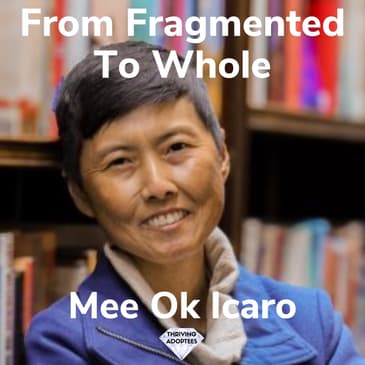
Do you struggle with your desperate parts? Do you yearn to feel whole? Listen in as Mee Ok shares her learnings on healing body, mind and soul. A particularly dramatic episode - she was given just 5 years to live.
Born in Korea, Mee Ok Icaro (pronounced “mēˈōk i’kä’rō”) was renamed “Mandy” by her white, evangelical parents who adopted and raised her in California and Arkansas. After narrowly escaping conversion therapy but unable to avoid sitting next to Sarah Huckabee Sanders in Spanish class, she attended Boston University to study philosophy and the classics, but ended up majoring in partying, sleep, and girls. Ten years later she graduated and worked at Harvard as a research assistant in an office next to Timothy Leary’s old digs, while taking courses in history, film, medicine, literature, and German.
After being diagnosed with scleroderma and given five years to live, Mee Ok was bedridden for three years until she began drinking ayahuasca, a shamanic brew from the Amazonian jungle, which gave her back her legs. She eventually obtained her MFA in Creative Writing, studying poetry, prose, and drama. Since then, she has been writing, pursuing the path of earth medicines, and trying to become the person she was meant to be.
https://www.facebook.com/dasmeeok
https://www.instagram.com/dasmeeok
Guests and the host are not (unless mentioned) licensed pscyho-therapists and speak from their own opinion only. Seek qualified advice if you need help.
Want to learn more about thriving for you, your kids, your families or your colleagues? Pick a time to talk here
[00:00:02] Hello everybody welcome to another episode of the Thriving Adoptees podcast. Today I'm delighted to be joined by Mio. Welcome to the show Mio, looking forward to our conversation today.
[00:00:12] Thank you so much.
[00:00:14] So healing, what does healing mean to you?
[00:00:21] I think healing, well the word comes from the word whole.
[00:00:26] And so much of healing is, I think, you know, from the paradigm that I found most helpful is seeing it from the framework of becoming fragmented or losing parts of ourselves.
[00:00:43] For example, in recovery programs, there's this idea that there's something that there is to recover. And that is kind of the whole self.
[00:00:58] I operate from the philosophy that there is some part of us that can't ever be hurt, that stays pure and innocent no matter what happens to us in our lives, no matter what we've endured or things that we've done.
[00:01:17] There is something, some people call it the witness or the observer, but something maybe of our essence. And so it's sort of trauma or the things in our lives that have hurt us.
[00:01:33] Those things block us from remembering, maybe some people call it the original child of who we truly are.
[00:01:44] And so to me, healing is really doing the work to connect to us the way we really came out.
[00:01:54] Yeah.
[00:01:57] Yeah, I subscribe to that view as well.
[00:02:00] Oh great.
[00:02:01] You know.
[00:02:03] And I think it's kind of hard. It's historically, that's been hard to grasp. Right.
[00:02:17] One of the areas that I think helps crystallize this essential part of us, and by essential we mean our essence, right? The bit that can't be hurt.
[00:02:34] Is this internal family system. Have you come across this? Have you come across this?
[00:02:41] Yeah.
[00:02:44] So, he talks, so he takes, mixes psychology and spirituality for one of a better word or our essence.
[00:03:01] Could you explain how you see that? And that might help the listeners differentiate between our parts and the uppercase S self whole.
[00:03:16] Do you mean in terms of spirituality?
[00:03:21] I mean, in terms of maybe making a better job of describing what Dick Schwartz's work is about than I have.
[00:03:30] Well, I'm not super, super familiar with Dick Schwartz. We did a little bit in my training with Gabor Maté's Compassionate Inquiry and their very close colleagues.
[00:03:41] Yeah, my understanding is that there are different parts of the self and he categorizes them in a very specific way. I think there's like a manager.
[00:03:51] And it's all about bringing those different parts of ourselves into coherence and into balance.
[00:04:03] Especially in our culture, we tend to extract and isolate.
[00:04:09] And so in neuroscience with a lot of the work that I've done with therapists, it's about taking those parts of the brain, those sort of clusters of neuro connectors that tend to isolate when we've experienced trauma and integrating them back into the whole.
[00:04:34] And so my understanding is that internal family systems is sort of that with all of the parts of the self.
[00:04:42] Yes, yeah. What helped me greatly on this last year was differentiating between our maybe psychological healing and essential healing, right? Or spiritual healing.
[00:05:04] So our psychology healing that might go on for ever. That's the bit that keeps on going on.
[00:05:13] But in terms of our essence or looking at spiritual healing, that is always and remains forever whole.
[00:05:26] So until you put into I put sort of psychological healing and spiritual healing together and separate putting those two things together in the set in the same conversation.
[00:05:43] It didn't make it didn't seem to make much sense to either me or anybody else that I that I talked about.
[00:05:53] So we're talking about a psychology that changes and an essential self that never changes.
[00:06:02] And it's not wounded. Our wounds are psychological rather than spiritual.
[00:06:11] Well, it's interesting. And maybe it's a matter of semantics and just the fact that our language doesn't have enough nuance.
[00:06:19] But I have been thinking a lot lately about spiritual trauma.
[00:06:25] And maybe that would be relegated to the area of psychological trauma in the way that you're framing it.
[00:06:33] But just the way that people are raised in certain religions and certain things are conflated for young children and shame and fear and toxic, toxic spiritual beliefs.
[00:06:53] Yeah, I think I think that can be really devastating. And I've seen a lot of adoptees like myself when I was younger really kind of swing the pendulum all the way to the other side and just sort of live life as a as a hardcore atheist because that feels safe.
[00:07:15] I think you've been introduced to a God that is not so friendly and not so interested in your well-being.
[00:07:24] But when I talk about holistic or whole healing, I do include the spirit.
[00:07:31] And I do think that that is something that separates modern medicine from every other tradition that's ever existed on Earth.
[00:07:41] Yeah, I totally agree.
[00:07:44] Yeah, when I say spiritual healing, I'm talking about essential stuff, not any religion or dogma.
[00:07:55] So, yeah, shame would be shame would be perhaps psychological or emotional.
[00:08:04] What we're doing at the moment is what I'm working on, I have been working on for the last three, four months or so, is exploring this healing with fellow adoptees and looking at healing on five different levels.
[00:08:23] So psychological and emotional, biological and physical, which we might come on into a minute given your story, social and relational and then spiritual or essential.
[00:08:42] Or what we're working on a meeting with about 14, 15 or so adoptees this Friday.
[00:08:51] And we are going through my what I've brought together from the conversations I've had from some questionnaires that have been filled in and from my own work.
[00:09:08] And we're looking at the psychological healing of the one of the five bearing in mind, obviously, you've got to look at it holistically as well.
[00:09:20] So we'll look at it holistically and then also break it down into those five healing levels.
[00:09:30] So basically what we're doing is we demystify, we demystifying what healing is.
[00:09:36] That's great.
[00:09:38] Some of what you've experienced with your physical healing and well holistic healing, I'm sure it would, it isn't very easy for our minds to grasp.
[00:09:55] Right. Yeah, the mind is very limited for sure.
[00:10:00] Yeah. So can you talk up because there's some there's a there's a holistic area, but there's a lot of physical healing that you have to have this condition for three years, I think, if I remember rightly.
[00:10:15] So was it a bit longer than that?
[00:10:18] Since 2013 or 2010. Yeah, it's been 13 years.
[00:10:24] Wow. Okay. Maybe. So I was I saw a bit that talked about being bed bound maybe three years so maybe.
[00:10:34] Yeah, it was better than for three years and I was in a very serious wheelchair for about five.
[00:10:40] Wow. Wow. So could you tell us a little bit of that, that story and the holistic, the holistically and look at the physical stuff as well?
[00:10:53] Could you share a little bit about that?
[00:10:55] Sure, I was working at Harvard for a an MD actually who's also a sociologist.
[00:11:03] And one day I woke up in extreme pain and I could barely move.
[00:11:12] And it just stayed that way.
[00:11:17] I was in a wheelchair for years.
[00:11:22] I went to quote unquote the best doctors I was living in Cambridge so I was with all the Harvard hospitals and so forth and for six months, I was being put on medications for things like rheumatoid arthritis and.
[00:11:38] I had heard when those things weren't having any impact except for negative impacts of the side effects.
[00:11:45] But luckily, I had I was a researcher there in some capacity and after six months someone said, you know, you kind of have to become your own doctor is very old, wise and woman told me that.
[00:12:00] And I thought, well, yeah, it's not like I can't do the research and I have access to all these resources.
[00:12:05] So in less than two hours I got I found my diagnosis and I went in and got the blood test and came back and I was right.
[00:12:13] And so after that, and it was scleroderma very serious autoimmune disease and it was so it was so aggressive.
[00:12:23] It was it was sort of supernaturally aggressive and so I was given five years to live but in my body I had probably about two or three.
[00:12:32] And.
[00:12:34] They don't have, they don't know much about it. It's pretty rare. It's in the lupus rheumatoid arthritis sort of family.
[00:12:42] And it hardens your tissues your connective tissue so everything you know your muscles your tendons your skin scleroderma means hard skin in Greek.
[00:12:54] And there's only treatments. There's no cure in the Western paradigm.
[00:13:01] They basically gave me morphine and you know any percocets and oxycodone, you know anything to treat the pain.
[00:13:12] So after years of, I mean I lived in a nursing home I lived in a hospice and went to you know, then I was sent home to sort of just die, die at home.
[00:13:25] And I came across a different way of thinking about what the West called psychedelics.
[00:13:33] It never really appealed to me before. But a friend had me listen to a podcast with a man named Chris Ryan.
[00:13:40] And he's a psychologist, and he recommended to me to drink ayahuasca. And so I did. And I started walking again and started getting better.
[00:13:52] And then I ended up going to an ayahuasca retreat with Godmormate and learned a lot about the mind body connection.
[00:14:01] And that's really when I started making big games.
[00:14:05] Yeah. So what presented as a physical thing became a mind body thing on the back of that.
[00:14:14] Well, yeah.
[00:14:16] Yeah, well you know what was really interesting was that first time that I drink ayahuasca actually it opened up a spiritual dimension for me.
[00:14:28] And when I began to understand my illness as a spiritual illness, which is what these other medical paradigms often do frame it that way.
[00:14:43] That took me in a whole other direction.
[00:14:46] Yeah.
[00:14:48] Interesting, because it's this uppercase S self that Dick Schwartz talks about and which you're talking about here.
[00:15:00] It's something that is more of an experience than it is an abstract concept.
[00:15:09] And we can touch, I think we touch it in different ways.
[00:15:15] So I actually touched, I'm doing some somatic experiencing with that.
[00:15:22] And we're just drinking mint tea, right, when I do the somatic experience.
[00:15:27] But on my second visit, my second somatic experience, I really touched this uppercase S self space.
[00:15:41] And it's a space of openness and tranquility with a bit of a, you know, almost like it was really weird for me who somebody who spends his day with words.
[00:16:07] Right.
[00:16:08] And I don't always get the words out. I sometimes stumble over my words, but before I did this, I was in publishing for many years.
[00:16:15] But it was a break from words. It was a break from concepts.
[00:16:25] It was a place. It was a lived experience for me.
[00:16:31] A lived experience of the uppercase S self rather than an abstract concept.
[00:16:40] And, you know, watching some of your videos and there's links, as always listeners, there's links to Miok's website in the show notes.
[00:16:56] You're interviewed for a Netflix documentary on healing, which I watched.
[00:17:05] And you talked about how that process helped you with adoption trauma and other trauma from your youth, as well as their scleroderma.
[00:17:23] So could you paint a bit of a picture of that for us please?
[00:17:29] Yeah, it's a little bit difficult to, you know, these paradigms take us to places that are sort of hard to bridge with our culture because they're so different.
[00:17:42] You know, you become a bit of a translator saying, you know, this word, it doesn't fit into this other language.
[00:17:50] But I talked with a guy who did early ESP studies for the US government back in the day and that has since been declassified.
[00:18:03] And he was talking about how there are two different definitions of magic.
[00:18:09] There's the magic that means fantastical, impossible.
[00:18:14] And there's the magic that's just extremely advanced technology concepts, science that we simply can't explain.
[00:18:24] And so, you know, we can imagine handing an iPhone to somebody from the 1800s and that would be magic.
[00:18:33] Not impossible, but impossible for that time, but a logical consequence of what unfolds from that time.
[00:18:41] And so when I look at these plant medicines and what they've done for my healing, I really do see them as extremely high level super advanced technology.
[00:18:53] When I just think about their relationship, for example, to light conversion, it is the most efficient transformation of energy that exists.
[00:19:05] I mean, it's very intelligent.
[00:19:07] And so with my adoption, on the level that I think people speak publicly about such things on a therapeutic level, I was really sort of able to come to terms with a lot.
[00:19:22] I received a lot of insights.
[00:19:25] One difference, I think between domestic adoption and transracial adoption is that for transracial adoptees race is the big thing.
[00:19:35] And things like deportation and trying to manage the frustration of foreign governments.
[00:19:41] We don't just get to deal with, oh, I lost my birth mother and all that sort of ground.
[00:19:48] You know, we start in the basement, not on the fifth floor kind of thing.
[00:19:52] And so I think it really revealed to me the extent of my own colonization.
[00:19:59] You know, I mean, I'm on the phone doing a job interview and they call me in and they're looking for some, you know, white person.
[00:20:07] Yeah, I was renamed, you know that happens in colonization and my body.
[00:20:12] And so re-grounding me and re-centering me in my own indigeneity was really significant.
[00:20:21] And also, I eventually went back to my country of origin and felt that real separation again.
[00:20:33] That was probably as deep as the separation from a birth mother.
[00:20:38] You know, I couldn't understand what anybody was saying. I couldn't communicate with anybody.
[00:20:42] But yet getting to that sort of primitiveness of the smells and again that somatic dimension that you were talking about.
[00:20:53] There was a lot of heartbreak there and the support from the plants and the healing that was able to happen there was very important.
[00:21:04] And also connecting with my ancestral bloodline in a way that exists in wisdom traditions and, you know, may sound kind of woo-woo to people in our culture.
[00:21:18] But I received a lot of information from the plants that eventually did lead me to meeting my birth mother.
[00:21:24] And again, it seems very woo-woo but so much information that I was given from the plants in sort of a visionary or perhaps ESP type of way was confirmed when I met her in person.
[00:21:41] And so that's what science is, right? You have a hypothesis and you kind of hold on to it and then you test it out.
[00:21:47] And you're like, damn, that was real. So yeah, I think the wisdom of how to process these, you know, you can't go into battle without any tools or any protection.
[00:22:02] And so I think it really set me up to where I could face some really big truths about how I came to be and really gave me a much more expanded framework and perspective than I was offered by the West that really allowed me to take in.
[00:22:25] And not just take it in but also release it. Just the incredible trauma that led to the biggest break in biology, you know, that between a birth mother and her child.
[00:22:44] Yeah. So you mentioned the word wisdom a couple of times and you mentioned the word woo-woo. We like woo-woo here, right? This is a place where we can do if we want to do woo-woo, we do woo-woo.
[00:23:02] But I guess what it seems to me is you're describing a difference between wisdom and logic.
[00:23:13] And we can understand that in a Western culture, the difference between wisdom and logic. We can't quite put our finger on what wisdom is, but we know what it is when it comes to us, right?
[00:23:31] And it is what I'm struggling for a question here, but let's take a dive into the woo-woo. We're friends here, right? We're not going to fall out about this. You've got four questions to go as woo-woo as you like.
[00:23:53] Can you, can, well maybe you can make that bridge that I can't make. I'm struggling at the bridge between wisdom and woo-woo.
[00:24:02] You know, when you said the word logic, it made me think about how we all know that there are different kinds of intelligences.
[00:24:11] You know, there's like an academic intelligence. There's being very good with your hands and being like craftsman or something like that.
[00:24:21] And there are different kinds of logic as well. There's the logic that you study in college, you know, you take reason and argumentation that you use when you're going to become an attorney or something like that.
[00:24:34] There's also emotional logic, which I think takes actually a more refined intelligence.
[00:24:41] So people who live in that sort of first logic, they often can't understand what people are doing, why people are doing the things that they're doing because human motivation tends to come from the emotions, emotional need.
[00:24:58] And so it's like, wow, they're not acting rationally. And it's just like, yeah, they are. They're just operating from a place of emotional logic.
[00:25:06] And then I think there's sort of spiritual logic as well. I haven't thought about it a whole lot, but these are things that exist in wisdom traditions where they think in terms of multi-generations.
[00:25:24] And they really zoom out and they think of humanity in terms of thousands of years, not 24-hour news cycles. Right?
[00:25:34] And they also don't think of us in a vacuum. They think of us in a web of relations of insects and plants and everything in between.
[00:25:47] Even things that we may think like I am reading about the Druids or when I was in Wales, maybe learning about the Druids and or the Celts.
[00:25:57] I'm sorry. And they talked about how everything was alive. And this is sort of general paganism.
[00:26:06] And so they name their houses and if they bump into a table, they'll apologize to the table because it is a living thing with consciousness and sentience.
[00:26:18] And so when you move into that level of consciousness where everything is alive and it's such a paradigm shift, and I don't want to pretend that I have, you know, even come close to mastering it or even, you know, stepping into it fully.
[00:26:39] But everything shifts. And I think wisdom ultimately comes from having the depth of like, you know, if you could have like the consciousness of like the grandmother of the universe or something like that.
[00:27:00] And, you know, just from that, that ego list place from from that really deeply intelligent space that isn't wed to any particular time or culture to really try to see what underlines everything so that everything can exist.
[00:27:26] But I think that if you are stuck in that, there's only logic and there's only this one particular kind of, you know, rationalization that that keeps people sort of trapped in the West and in what I kind of call sometimes the superiority complex of modernity.
[00:27:46] Then you miss it. And really, it's about looking at the results because who's getting sick and creating all of these crazy new illnesses that are the result of modernity and who's who's well.
[00:28:03] Yeah.
[00:28:06] Well, there's a lot there. When you talked about the different intelligences, I thought back to an interview I did with a lady whose name has just gone out of my brain.
[00:28:22] She's from Harvard as well. Jillian Balty Taylor. Have you come from across there? Jill? No, not Jillian. Jill. Jill Balty Taylor. She is a neuroanatomist and she's not an adoptee.
[00:28:37] But I listened to a book and I thought it was fantastic. So and she came on the show and she talks about left brain or right brain. So she basically she had she had a left brain stroke.
[00:28:50] And left brain is where all our languages. Oh, did she do a big TED talk a long time ago? She did do a big TED talk. Yeah, I'm aware of her. Okay. Yeah, I didn't know.
[00:29:00] She she did. She had a left brain. So all her logic, all her language went, all her logic went and all her. Yeah, all her trauma went because the left brain wasn't operating anymore.
[00:29:19] So different intelligences, one way of looking at different intelligence is a way of looking at left brain and right brain. And we in the it's a mass oversimplification.
[00:29:35] Listen to the podcast and read the book, Whole Brain Living. If you're interested in it listeners, because I'm it's more it's more complicated than left brain or right brain.
[00:29:47] But we won't get into that here. But it's different intelligences. And then as I also thought about another take on intelligence is we talk about so in the in the West, we are dominated by the left brain.
[00:30:04] Thinking, whereas the expansiveness and openness and connection is all found in the right brain.
[00:30:11] Different sorts of intelligence, you know, in the in the West, we, we worship IQ, right? In, you know, we work at we worship intelligent, our logical intelligence quotient when there is also
[00:30:28] emotional intelligence, obviously. And there is people talk about that a lot. People also some people talk about spiritual intelligence too, like you mentioned. And I think there's another one, like physical, physical intelligence to it for
[00:30:47] Absolutely. Which is the somatic stuff. Yeah, high level dancers and athletes and yogis and all that.
[00:30:56] Yeah. So one of the things that adoptees often talk about, and I know that you're involved in writing and you're a writing coach or writing doula, which I thought that was a beautiful question, you know, helping, helping an author give birth to their book.
[00:31:12] I thought it's fantastic. She's a writing writing doula listeners. I've never met one before.
[00:31:17] So, was this? Yeah. So people talk about writing and writing and creativity, their right brain activities, people talk and so that helps people. It's not it's not just the surfacing of all the emotions and getting them on paper or getting them on computer that helps us heal.
[00:31:43] It's actually the right brain side that using the right brain and the creative side helps us heal by writing artwork. And also, you know, when we're using when we're dancing, you know, nobody dances for a reason, do they?
[00:32:01] And I'm thinking that I used to do that in nightclubs, you know, when I was single, but it didn't work right. It wasn't dancing didn't get me anywhere.
[00:32:15] That's right. But again, we're switching off. It's what if we're dancing, we're switching off from logic and we're in the we're in the zone on we were in. We're in the we're in the moment our traumas a million miles away.
[00:32:34] Yeah, I mean the brain is in general the mind is really useful and dissecting and processing but it's always processing in a really specific way.
[00:32:47] And it's impossible to really be present and have a full experience. You know, I mean what's the biggest issue? It's your mind in your thoughts getting in the way.
[00:32:59] And so I think that the order my friend Dan has this hilarious joke where he says as my father used to always tell me when it comes to a murder suicide, the most important thing to remember is the order.
[00:33:15] And I think with I think with the brain and these are also in wisdom traditions. I remember in undergrad we laughed because we were told that the ancient Greeks thought that the brain was in the center of the chest and we were like no stupid that's where the heart is.
[00:33:38] But I since then, I think what they were really saying was they were identifying the most intelligent part of the human. It's the it's the heart is so intelligent and the brain can really own only understand things in terms of it can only really process reality by bifurcating it and having a full experience.
[00:34:01] And I think slowly the West is seeing its intelligence and its power. But the
[00:34:08] it having everything in two camps, whereas the heart can hold space for contradiction. What what may be intellectual contradiction contradiction, the heart can hold all of it and I think slowly the West is seeing its intelligence and its power.
[00:34:30] But the mind really wants to be the horse, but it's the cart. And when it's in service, I think of of the wiser heart. That's when it does a lot of good when it when it tries to take over.
[00:34:48] That's when you get the world that we live in now. Yeah.
[00:34:52] Can you relate this to to the healing question.
[00:34:57] What you've just been talking about.
[00:35:02] I'm sorry, can you remind you, can you relate what you've just been sharing to the healing to the healing question the healing topic.
[00:35:13] On a healing topic.
[00:35:15] Yeah, the way we talked about his whole healing doesn't happen from the neck up. Even if you're struggling with, for example, you know what, what the West will be a mental illness, a pathology of the mental faculties.
[00:35:32] It's always holistic.
[00:35:35] It's always somatic and spiritual, emotional, etc.
[00:35:43] And this is, this is part of where God were spoke to me.
[00:35:51] When you're thinking about the autoimmune system, for example.
[00:35:57] He talks about how when you suppress emotion.
[00:36:01] You are also suppressing your autoimmune system in some way.
[00:36:07] Everything that you do is always happening on multiple levels.
[00:36:12] And again, the West likes to extract and isolate.
[00:36:16] That if you don't service the whole context and the whole web of connections, and only one small little part.
[00:36:29] You're still going to be vulnerable and sick in some way, even if you're functioning, you know, even if you're better.
[00:36:37] And also in indigenous traditions as well.
[00:36:41] Just having that wider view and something that I find really freeing. I've never really thought of it until now in this way.
[00:36:51] What I what I think is so freeing about being in the indigenous model is that there really isn't stigma.
[00:37:02] Within the spiritual realm.
[00:37:06] I always think it's really interesting how, you know, outwardly.
[00:37:11] In the public sphere, if people talk about spirits and prayer and all that, you're, you know, everybody's supposed to say, no science and that's stupid.
[00:37:21] But whenever you actually ask people, you know, when you pull people quietly.
[00:37:27] They do, you know, believe there's life after death overwhelmingly.
[00:37:31] And they do believe that they sometimes that people who have passed, who they loved are communicating to them.
[00:37:38] And so there is this sort of like contradiction again between the head and the heart between like this wiser knowing.
[00:37:45] And, you know, the rationalized sort of scientized brains.
[00:37:52] You know, in that model left brain dominance paradigm.
[00:37:57] So yeah, I find I think that it's very freeing to be able to both talk about things that are really stigmatized spiritually in our culture in the in the indigenous wisdom traditions.
[00:38:14] But also at the same time, not fall into what I would call the blue or something to call it LA shamanism.
[00:38:22] Which is it's really grounded in.
[00:38:27] In something very ancient. It's grounded in a lineage that traces back its trace.
[00:38:34] It's grounded in experience and discipline.
[00:38:38] You know, these these shamans are the most disciplined people, I think, in many ways on the planet just to be able to to do that level of work and hold that level of space.
[00:38:50] But it's not. It is cultural, but it's something that they live.
[00:38:57] I'm moving out of the country, but I don't know if it's possible to live here.
[00:39:04] And I don't even know if it's possible to live in the modern world.
[00:39:12] The I've watched if I bought a bought a course with a bit like a video online course with there was audios as well.
[00:39:24] But they called called the wisdom of trauma. I mentioned it a couple of times on the podcast.
[00:39:29] I think I love that title for a start.
[00:39:32] You know, the wisdom of trauma, you know, when do you ever see trauma and wisdom put together and you're smiling and I'm smiling.
[00:39:38] It's like, no, you know, trauma is the trauma is the big baddie.
[00:39:42] You know, it hasn't got any wisdom in it.
[00:39:46] And I love I love parts of what I heard.
[00:39:51] And, you know, like on your website, you've got a testimonial from a Gabor Marti.
[00:39:57] I thought, wow, this is brilliant stuff.
[00:40:00] Me, I must know really know her onions, as we say in the UK.
[00:40:06] And I loved it.
[00:40:08] But on one level, it seemed to be trauma education rather than healing education to me.
[00:40:18] Yeah, well, you know, God is a doctor.
[00:40:21] He is a trained physician.
[00:40:23] And and I think that we all kind of stay in our lane.
[00:40:28] Right. Like, I mean, I don't read Western philosophy, for example, for solutions.
[00:40:36] I read Western philosophers because I think that there are the great diagnosticians of the West.
[00:40:43] So I think that they're the healing process to me.
[00:40:46] I think of it as a sort of two stages.
[00:40:50] There's one where you need to know someone smart in the prison who can tell you how to get out.
[00:40:58] But that person isn't going to be the person that can help you thrive outside of the prison.
[00:41:05] That takes a different teacher.
[00:41:07] And so there are people who can really help you understand why your life is upside down, why this culture is upside down.
[00:41:14] And God or is so articulate in in that.
[00:41:18] But for me, the sickness is really the West and modernity in many ways.
[00:41:26] It's called what Tico in some way, you know, just the spiritual virus.
[00:41:32] But to actually really.
[00:41:37] Not just to treat or understand your sickness, but to really actually step into healing.
[00:41:42] I really do think we have to step out of this culture.
[00:41:45] It's interesting you say that because as I was listening to you, I was thinking about what you said about the scleroderma.
[00:41:55] Right. You said you had to become your own doctor.
[00:42:02] And is that is that what we have to do ourselves?
[00:42:13] We have to become our own healer.
[00:42:18] I you know, I have this coaching practice and but whether or not I'm working with someone who's who's using plant medicines or writing a book or coming for some sort of transformational coaching.
[00:42:31] To me, the key is always.
[00:42:34] This is the recovery of self that we were talking about where you have to step into your own authority.
[00:42:40] You have to step into your own agency. That's where the healing happens because everyone's path is unique.
[00:42:48] And I think the healing is actually in the uniqueness of that path.
[00:42:52] And we emphasize.
[00:42:56] What I call maps, you know, maps can be I.F.S.
[00:43:00] It can be goblars approach. It can be, you know, all these different.
[00:43:05] It can be Buddhism. It can be Christianity to be anything.
[00:43:09] But the focus is actually fixing your damn compass.
[00:43:16] Because if you have a compass that is calibrated, then all you need to do is walk north.
[00:43:25] And it's not about finding the right map because you can't live anyone else's life and no one else can really live yours.
[00:43:33] It's about really understanding that you have come here to be a cartographer.
[00:43:39] And to have that agency and that support, you find your fellow travelers.
[00:43:45] And that's that's where the healing is.
[00:43:47] You get to find your tribe and you can't find your tribe if you are putting on, you know, false personas and things like that.
[00:43:56] And it's hard to come into your authenticity because you've already sort of built this life in some way by being a false version of yourself.
[00:44:07] And so you lose people, but you also gain people and you also create a natural filter for yourself where when you're being who you really are,
[00:44:19] you don't waste years being friends with someone who aren't really into the thing that you've been hiding.
[00:44:27] Yeah. What I got as I was listening to that, I was you talking about I.F.S.
[00:44:36] And I was thinking because I'm listening to the No Bad Parts book on audio at the moment.
[00:44:44] And it's his Dick Schwartz's uppercase S self is like a wise parent.
[00:44:58] Yes.
[00:44:59] And the parts are there.
[00:45:04] The kids that stuck where they got stuck.
[00:45:10] So stepping into our authenticity, the authenticity is what Dick Schwartz calls the uppercase S self.
[00:45:22] It's it.
[00:45:24] You when we started off, you described it and then you said, and it's known as different things.
[00:45:35] Right. So what the people that there's a saying about this, the Dow that is point out pointed out is not the Dow.
[00:45:43] There's a word like the word is just a metaphor.
[00:45:47] It's a placeholder. We've all got different placeholder.
[00:45:50] So Dick Schwartz's placeholder is uppercase S self.
[00:45:56] Other people would you know, other people might call that consciousness.
[00:46:02] That might be their placeholder.
[00:46:05] Yeah, you're smiling.
[00:46:08] What else people call it?
[00:46:10] What do they call it in that in those Asian?
[00:46:13] It is the Dow, isn't it?
[00:46:15] The Dow that what is the Dow that is spoken of is not the Dow.
[00:46:19] You am I making any sense here?
[00:46:21] It's the ineffable.
[00:46:23] Right. I call it.
[00:46:24] I call it the thing because you know, because it's also not a thing.
[00:46:31] But yeah, and I think this kind of speaks to just how limited the mind is.
[00:46:39] The mind literally can't and doesn't have the tools to go to these places.
[00:46:46] We can only go to them in our hearts and our spirits and our bodies in some to some extent.
[00:46:52] But the mind actually has to take its place.
[00:46:57] Yeah, sometimes it's a place or a space.
[00:47:01] One of my longest standing mentors calls it Humpty.
[00:47:07] Yeah. Yeah.
[00:47:10] And when I hear people talking about the ineffable or the uppercase S or whatever it is, they say it doesn't matter what we call it.
[00:47:23] And I say, yes, it bloody does matter what we call it.
[00:47:26] You know, but it doesn't.
[00:47:28] I think somewhere along the line of I've lost that frustration with the lack of some words are loaded.
[00:47:35] Some words are triggering, you know, to people.
[00:47:40] But yeah, it's the it's really the empty space that we're alluding to.
[00:47:46] Yeah.
[00:47:48] And that that's the magic.
[00:47:52] If Gabalmati is talking about the wisdom of trauma, this is the wisdom of healing.
[00:48:03] It's the wisdom space of healing.
[00:48:05] It's where it's that place of us that's untouched by the psychology.
[00:48:14] Yeah, I you know, when you when you were talking about that, I had this thought about how we tend to frame things as good and bad.
[00:48:28] And I really worship at the altar of complexity, because when you oversimplify that's what you do for children so that they can digest things.
[00:48:38] But again, that's just a placeholder because it's just like, wait, kid, it gets more complicated.
[00:48:43] But but so many of us stay in that place and don't realize it's a placeholder, that it's an empty space where things can evolve.
[00:48:53] And so we do this with plant medicines, right? Like, oh, I don't want to have a bad trip.
[00:48:59] And, you know, we see trauma as bad.
[00:49:02] And it's not to say that it's ethically something that we want to condone or that it doesn't deserve much compassion and empathy.
[00:49:18] But there is this reframing that happens in the healing world where instead of saying something is bad, there's really kind of nowhere to go with with that.
[00:49:30] You can really end up stuck in it.
[00:49:34] And, you know, when you think about abusers and things like that, but if you if you frame it as everything is a teacher.
[00:49:45] You know, because when my illness struck and I'm bedridden and miserable and in really agony, I was really stuck in a place where it's just like, well, I guess this is my life kind of a shitty life.
[00:50:00] And so it would end in a shitty death, like no surprise there.
[00:50:05] But when I started to reframe it and and start to ask.
[00:50:12] You know, what is the teaching here?
[00:50:14] I began to see it as and I see it now in other people that people some people, maybe all.
[00:50:22] At some point, the universe stages an intervention for them.
[00:50:28] In our culture, I think we call it the midlife crisis. Often it doesn't always appear in that form.
[00:50:34] But it's just like, hey, your, your life isn't really your life.
[00:50:40] You're living by a script that somebody else wrote for you and you've never really come into your authority.
[00:50:46] You're not writing your own life from your true place.
[00:50:51] And you can either bury your head in the sand, which a lot of people do.
[00:50:56] And it's not to blame them. Sometimes they just don't have the support.
[00:51:00] And and sometimes it is actually threatening.
[00:51:03] You know, it can be really threatening to be openly gay in certain countries.
[00:51:08] It's not like you can just, you know, it's like Dave Chappelle's when keeping it real goes wrong.
[00:51:13] You know, you can't just keep it 100 percent real all the time.
[00:51:16] You you do have to there are rules to the game and you can break them sometimes.
[00:51:22] But but it's again, it's complex. It's complicated.
[00:51:27] And so the more we can invite complication and the more we can look at everything that happens to us as the potential catalyst for growth, that's where the healing is.
[00:51:40] Because if it's not there, I don't know where it is.
[00:51:43] Indeed. And the Dick Schwartz book is called No Bad Parts.
[00:51:49] Right. It's called No Bad Parts.
[00:51:51] There's also no good parts in my view.
[00:51:57] You know, it's like you say someone's a bad person.
[00:52:00] Well, what does that mean? It means we're judging them by their worst day. Someone's a good person.
[00:52:05] We're judging them by their best behavior.
[00:52:09] But they're actually just people and they're people who are responding to the circumstances of their lives and the beliefs that they were given and what they believe is possible and not possible.
[00:52:23] And some of the quote unquote's worst people are actually the people who deserve our compassion the most because they're actually the most wounded and the most blocked from their true essence.
[00:52:35] And so, I mean, you could also argue that we're all good people in some respect deep down.
[00:52:45] You know, you look at pictures of Hitler as a baby and no one's like, oh my God, we got to get out your pitchforks.
[00:52:52] It's like, no, it's just a baby and people. That's just a person.
[00:52:57] And especially in writing, when creating characters, I mean, this is why actors love playing villains.
[00:53:04] Because they have to play them not without judgment and to go into those roles without judgment and to come into the role of you without judgment.
[00:53:14] That's a great practice. But ultimately, we are trying to embrace the complexity of our fullness that we can be real jerks.
[00:53:24] We can be really selfish and self-serving, dishonest.
[00:53:29] And we can also be very selfless and so caring and really show up for people and ourselves.
[00:53:36] You know, and this is the Dick Schwartz thing where you just you embrace it all.
[00:53:41] Because if you isolate one of them, it becomes a demon and it's not good.
[00:53:49] And it makes other people's lives hard. And you don't get to learn from it.
[00:53:54] You shut it off from being a potential catalyst for growth.
[00:53:59] Yeah, fantastic.
[00:54:03] And we've been talking about healing all the way through, but some people don't like the healing word.
[00:54:11] So growth is another word that people prefer and evolving evolution.
[00:54:19] I just use the healing word because it's the simplest.
[00:54:24] Yeah, I like the word maturing because there really aren't a lot of mature human beings on planet Earth right now.
[00:54:32] Everybody's kind of a toddler and myself not excluded from that.
[00:54:40] And, you know, when I think of healing, I really think of becoming an elder.
[00:54:47] Really becoming an elder.
[00:54:50] Fantastic. So I would urge everybody to check out Mayok's website.
[00:55:00] The bit from the Netflix documentary I loved and the bit from Gabor, I'm talking about you.
[00:55:11] I love that too. Thanks.
[00:55:14] I was also on the wisdom of trauma one of the panels and that's also on my website.
[00:55:19] Yeah, yeah. I'm not telling that bit yet.
[00:55:23] Thanks, Mayok and thanks listeners for speaking to you and raising the ticket.