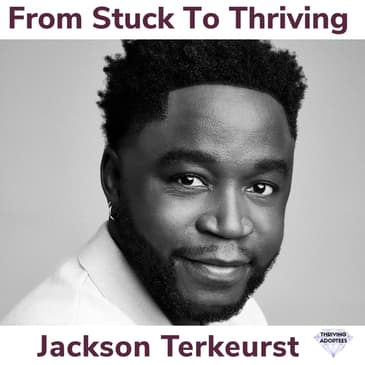
Left for dead in a war zone. Now Jackson Terkeurst is speaking to the world. Listen in as this truly inspirational adoptee shares what helped move from stuck to thriving.
Jackson is an entrepreneur and leader who continues to defy the odds as a first-generation immigrant from West Africa who owns and runs a small business. The adopted son of bestselling author and speaker Lysa TerKeurst, Jackson is passionate about drawing together people from diverse backgrounds to experience authentic community. He lives with his wife and their two children outside Nashville, Tennessee.
https://www.facebook.com/jackson.terkeurst
https://www.instagram.com/jacksonterkeurst_/?hl=en
https://www.jacksonterkeurst.com/
Guests and the host are not (unless mentioned) licensed pscyho-therapists and speak from their own opinion only. Seek qualified advice if you need help.
Want to learn more about thriving for you, your kids, your families or your colleagues? Pick a time to talk here
[00:00:02] Hello everybody, welcome to another episode of the Thriving Adoptees podcast. Today I'm delighted to be joined by Jackson. Jackson, Jackson Terkeurst. Got it right? Yeah, Terkeurst. Terkeurst, right? I'm just going to get the inflection right. So looking forward to our conversation today, Jackson. I'm glad that I don't have to say the surname again, right? I can't get Jackson wrong, right? No, Jackson's great.
[00:00:28] Jackson's great, yeah. Looking forward to our conversation. So Jackson's from Liberia and it's an incredible story. Just reading the summary of it, it's a story in his book Raised in the States.
[00:00:49] But today we're going to talk about thriving and what thriving means to you, Jackson. So what comes to mind when you hear the name of the podcast, Thriving Adoptees? Well, Simon, thanks for having me. It's great to be here. When I think about the word thriving adoptees, I think about somebody like me who has been in a position where, you know,
[00:01:18] they were stripped away, everything they were stripped away from them at a very young age. It could be their family, anything close to them. And then later on in life, they were able to find a way back to God and to find a way in life to where they can make standards for themselves and have goals and have aspirations and then be able to achieve those things and those goals.
[00:01:45] And also be on a healing path to healing. Because we've all dealt with trauma, we've all dealt with different things in our life. And to be a thriving adoptee, that means like you have to do the work to be on this journey of healing to overcome these traumas or these experiences that you've lived through that has been negative in the past for you. So that's kind of how I see it from my perspective, my experience.
[00:02:13] Yeah. Because you were stripped of everything. You lost your family, right? Absolutely. So, I mean, I was seven years old and I lost my entire family. I was stripped away just at seven years old. And I had to navigate life and figure a life from the age of seven until I was 15 years old by myself, living in the streets and in the orphanages and eating through trash cans and hiding from rebels and hiding in the jungle.
[00:02:38] You know, that was my life, you know? So now here I am, you know, sitting in front of you having a conversation. So that's God's, you know, vision of me thriving in life because I would have been dead and gone. Yeah. Yeah. So what do you think gets in the way of us thriving?
[00:02:59] I think what gets in the way of us thriving in life is a lack of desire to want to move forward from our past and choosing to stay in our past and marinate in our past for so long.
[00:03:18] And when we become stale in our past for so long, it takes a hold of us to where we can't move forward and we can't thrive in life because we're so caught up in what happened. We're so caught up in the disappointments. So that's kind of how I see it. Yeah. Yeah. You used a couple of words there that I really like. Like you used the word marinade and you would use the word stew, right? Stew in the past.
[00:03:48] What came to me was a quote that I heard from a mentor of mine, a guy called Richard Wilkins, who says that the past is a place of reference, not a place of residence. Exactly. Exactly. So with the past, you can go back to the past, but you just can't dwell and live in the past forever. Yeah. And I do that. That's not healthy for you. It was not healthy for me.
[00:04:18] I was in a position where I was living in the past and I refused to move forward and I refused to learn and grow. And they had negative consequences on my life and my attitude and the blessings that God had in store for me. But for me to move forward, I had to make some changes in my life because I wanted to be successful and I was tired of being, you know, being still in that place of darkness alone.
[00:04:49] So, I mean, you use a really strong word there. You say you refuse to kind of refuse to move on. And do you remember that? Do you remember that time? Do you remember that where where that that period of your your life and what was happening for you when you, as you say, refused to move on? It seems like it seems really self-critical. Right. You gave yourself a really hard time.
[00:05:14] I do. Yeah. I'm very critical of myself just because I want the best for myself, you know. So I'm always critical of myself and make sure I'm doing what I'm supposed to be doing to reach my full potential, you know. So but back then. When I speak about that, I was in a place where I was stubborn. I was hard headed. I was stuck in my ways and I've seen war.
[00:05:40] I've seen death. I've seen everything else. So in my mind. I don't need nobody else. I don't need nothing else. I've got it. I don't need it. Right. And that's the that's the wrong approach to life. And if you want to be successful. So I spoke about being marinated. So I was marinating in that circle back and forth, back and forth. And because of that, I was not seeing no progress. And I was really tired of just being still with no progress in my life.
[00:06:08] So I made the changes to move forward. Yeah. And how old were you? How long did this kind of marinating last? Was it weeks, months, years? How old were you? Tell us a little bit more about that. Well, yeah. I mean, it lasts for years because, I mean, coming from Liberia and coming to America, I'm having to learn myself, first of all, who I am as a person because I did not have a childhood.
[00:06:34] And there was a lot of things I missed out on with love, affection and having a family around, a father around, having guidance. I did not have any of this growing up. So I rely on myself for those things, you know. So, but I had to really do the work and sit there and be like, listen, I am so tired of just having to be stuck and being, you know, groggy,
[00:07:01] having an attitude and blaming everybody else around me for what's happening when it's not their fault. And I have the power. God has given me the power to use the skills and abilities I have to move forward and to work on these things that is giving me a hell of a time, you know. So from the age of seven, when the war happened until the age of 15, that was a time where I was struggling the most.
[00:07:31] And then even when I got adopted, it got even worse because being adopted into a lovely home, I struggled tremendously to adjust to stability because my life was always chaos and I was used to chaos. And when stability came to my life, I resist because I did not want it and I wasn't ready for it, you know.
[00:07:53] So, but just a couple of years ago, I saw the damage it was doing to my life and my relationship with my wife and my family and my friends. And I decided that, listen, I need to, you know, really pond into what's happening because I want to be healed. I want to get on a healing journey to overcome these things that are holding me back from reaching my full potential, you know.
[00:08:18] And what I did was I went to a therapist, talked to a therapist about those things and then went to some trusted friends of mine. And then I found a community where I was being poured into in a positive way to help me overcome some of these things I was dealing with. Yeah. So the refusing, the marinating went on for years and years, maybe decades today. Decades, would you say?
[00:08:44] I would say a very, very long time, a very long time. I would say a decade probably. Wow. Yeah. Wow. And was the one turning point, was there a series of turning points? Did you kind of like, did you hit rock bottom and bounce back up? What did it, what did it look like for you that, that, that coming out of that decade?
[00:09:09] Yeah. I mean, it was a, it was a, it was a, it was a turning point for me and an eye opening moment that, you know, God just showed me that, dude, I got so much for you in store. I have so much for you, but I need you to do the work. You know, I need you to put in the work, you know, and I was complaining about all kinds of things, complaining about this, complaining about this, complaining about this. It's because I wasn't happy with myself.
[00:09:37] I wasn't happy with where I was in life. And because of that, I complained and argue and had attitude. But then I was only hurting myself at the end, not anybody else around me, you know, and the people who loved me told me and said, hey, Jackson, you're an incredible guy. But listen, there are some things that I feel like if you want to get help for, it'll really help you to reach your full potential, you know? And I took that advice and I really implemented that.
[00:10:06] And I started to see changes in my life, even working at Chick-fil-A at a restaurant, a Chick-fil-A restaurant, you know? I had a lot of trauma. I was shy. I was insecure. But working at this restaurant, it gave me the opportunity to take the focus up of myself for once and put on somebody else to be able to serve another person at a restaurant, you know, giving them meals, smiling, creating conversation, engaging with them.
[00:10:32] That took the pressure off of me and lets me know that, hey, serving somebody else, it do a tremendous thing within your heart. And that's what it did for me, just doing that. Yeah. So it sounds like it's a combination of factors, right? Oh, yeah. Different things. Yeah. But the first thing that you mentioned was God. Was that the initiation of the turnaround? Yeah.
[00:10:59] I mean, yeah, God revealed to me, you know, because, I mean, he brought me from Liberia, from a war-torn situation where I was being chased to be killed. And he rescued me from that situation and took me to an orphanage where I lived and to another orphanage and to another orphanage and to another orphanage. You know, starvation after starvation, hunger after hunger.
[00:11:29] I mean, disease after disease. And then he finally brought me to America, you know, and he said, listen, son, I have brought you to a land of opportunities. You are here now. You can't live in the past anymore. You can go back to the past and deal and confront those things that are traumatic to you. But you can't live there forever because there's so much more that I have in store for you. No? Yeah.
[00:11:58] So, in the blurb for your book on Amazon Jackson, you talk about the book inviting us to view our personal stories through the lens of a literal and spiritual orphan. Yes. What do you mean by that? Yeah. Yeah. So, it just means like I'm a literal and spiritual orphan.
[00:12:25] So, I was orphaned from the age of seven years old, you know, until I was adopted at 15, 16 years old. So, I was a literal orphan living the life of an orphan.
[00:12:40] And the things I went through, the experiences I went through, and the work that I did to be where I'm at today, that's my message that I want people to see my story to be an inspiration to you so you can embrace your own story and to embrace your own journey. And to know that your story matters. And what you're going through right now, this is not the end. This is just the beginning.
[00:13:08] You're going through a process, you know, and you have to trust the process. You have to trust God, and you have to do the work in order to be where you want to be in life. You can't stay stagnant. Yeah. You also mentioned finding your identity in scarcity and trauma. Can you explain a little bit more about that? Oh, yeah. My identity in scarcity and trauma, correct? In trauma? Yeah. Yeah.
[00:13:36] Well, the scarcity, you know, growing up, I was always afraid that I would wake up tomorrow and not have no food, which was typical where I'm from. Some days we'll go without no food. And sometimes we'll eat once a day, sometimes twice a day. Sometimes we will have just warm water for breakfast, for lunch, and for dinner.
[00:14:01] So then coming to America, where there's abundance and everything, my mother took me to the grocery store, and we got some groceries. My brother and I, my adopted brother and I. And we came back home from the grocery store, and I took the groceries into my bedroom and put them under my bed, right? Because I had a scarcity mindset that, oh, my goodness, I'm going to keep this under my bed. Because, you know, if I'm going to keep it here, someone else will take it and eat it, and I'll be starving tomorrow.
[00:14:31] So I had a scarcity mindset, which is pretty bad. And my mom had to reassure me, and she said, son, you're in America now. You are here now. You are with us. You are safe. You don't have to worry anymore about food. You don't have to worry about anything else. Your daddy owns a Chick-fil-A. There's McDonald's down the street right here. So you don't have to put food under your table or under the bed no more. You're good.
[00:14:55] You know, so that was what I identified myself as all the time growing up, that I was hungry. I was searching for something, searching, searching, searching. So I didn't know who I was. And my mom had to reassure me that I am safe. I am home. I have no return policy. And this is where I belong. So I can rest assured that life from here on out is going to be completely different than the past. Yeah.
[00:15:23] So you talk about finding your identity in scarcity. It's no wonder, right? Life was scarce. It was. Life was scarce. Absolutely was. It was scary. I mean, I'm not even. Words can't really express the level of pain and trauma and scarcity that we am. Like it was 500 of us living in this orphanage home. 500.
[00:15:51] And imagine that we're all going through the same experiences every day, all day, starvation, scared. Don't know who we are. All we know is that we are orphans and we are statistics of war and we are homeless. We're nameless. We're barely alive. Those are our identities. That's what we identify ourselves as, you know. But coming to this new life, God has revealed to me that you are none of these things no more. You are blessed. You are chosen.
[00:16:21] You are a leader. You are my son. You know, you belong. You are my son. So those things change my mindset. It changes my perspective knowing that, listen, I am meant for more. And I don't have to live in the past. I don't have to live scared no more. There's abundance of grace, abundance of food, abundance of everything else around me that I can finally let my guard down and know that, listen, tomorrow is going to be a great day. It's going to be a beautiful day. And God has my baggage to provide for me.
[00:16:49] And I don't have to deal with the past or tell myself, oh, I'm still orphan. I'm still poor. I'm still a business. No, that's in the past. I'm in the future now. So I have to live here. Yeah. So really what you're talking about is being hard on yourself for taking time to see that change. Yeah. Yeah. Oh, yeah. Yeah.
[00:17:14] And it's one of those things that I don't have any fellow adoptees you've talked to, but we all tend to be pretty hard on ourselves. Yes. But you seem to have like a particularly turbocharged version of this, right? I have too, man.
[00:17:30] You know, and I think my drive behind that for me personally is that when I came to America and I realized that, oh, my goodness, I'm in the country of my dream. Because to me, America was a mini heaven coming from where I come from. Keep in mind, I was born in a small rural village where I grew up very poor, extremely poor, extremely poor, you know?
[00:18:01] And I am the first kid in my entire bloodline of my family's generation to come overseas, to be in America, to come and finish high school, you know, to go to college, to get married, to have a job, to have his own car, his own house. So, and have his own family here. And there's a lot of pressure that's on me. So, I have to hold that standard. I have to make sure that God called me for a reason to be in this position I'm in.
[00:18:29] I'm not just adopted because I'm adopted. I'm adopted to change the trajectory of my family's generational legacy, you know? Yeah. So, I had no choice but to make sure that I do these things and go to school, finish school, get a job, and put myself in positions where I can help my family in Africa to continue our legacy here in America. Yeah. Wow.
[00:19:01] This constant... A story came to mind, actually, from my own life, Jackson. So, my dad died about... Yeah, not about... He died eight years ago. And he ran his own business. Well, ran a business with his wife and mum, and I went into that business. And about...
[00:19:28] Maybe about 12 years ago, we were having lunch, and I was talking to him about... Him worrying about the future, which he did, but he didn't talk a lot about it, right? But I do remember it being... He was very driven. Yeah. Driven by avoiding... You know, driven by avoiding loss. Yes.
[00:19:58] So, he went... In business, he went from very optimistic to very pessimistic. Mm-hmm. But he was... He was... He was worried about... I remember one time on holiday, he said, I wonder if I'll have a business when I get home. Oh, wow. So, that was one of the rare moments where he shared his worries, right? Mm-hmm. And I was about...
[00:20:27] Maybe about 10 at that time. I know. But anyway, fast forward. I was talking to him about this worry about the future, and said... I was asking about it, and he said, Well, it kept me on my toes, right? If I was worried about the future, then that would stop me doing things that would endanger the business. It kept me on the toes. It kept me on my...
[00:20:54] The insecurity kept me playing at my top game, right? Right, yeah. And I said, Yeah, I can see that, Dad. But didn't it stop you enjoying life as well? Mm-hmm. And feeling secure? Something along those lines. I can't remember exactly what I said.
[00:21:17] And tears came to his eyes in that moment of realisation of how the worry had haunted him, shall we say. Right, right. Yeah. I wonder what... So, I'm pretty tough on myself as well, right? I have the constant thing.
[00:21:47] I have that fear as well, you know, the extreme optimism to extreme pessimism. Mm-hmm. And being hard on myself for my mistakes. So, that's kind of why I feel for you and your toughness.
[00:22:17] And I grew up in a nice, stable home, you know, food on the table. That's amazing. You know, but... And yet, there's still a concern there. Mm-hmm. And I wonder what you make of all that.
[00:22:43] Well, I mean, like, my story, I mean, for me, it was just... It was different, like I said, you know. I just knew that I am the bridge now to rewrite my family's legacy. And coming to America, I had to set a lot of standards for myself. And a few of the things I did was...
[00:23:12] A few of the standards I set for myself. First thing I told myself was that I am not going to be a statistic, you know, of this country. Whatever the statistics are for anybody, I'm not going to be a statistic in a negative way. And secondly, I am not going to have no baby mamas. You know, I don't have time for that. And third... What's a baby mama? Baby mama is like, you know, a guy and a girl gets together and have a baby. And then they separate from each other. Yeah.
[00:23:42] So in America, it's called baby mama things. So I didn't see things that way because I was born to a family where my parents were not married. You know, so... And like I said, my goal has always been to change the trajectory of everything my family has done to a better version. And I was just a boy going through life and just thinking all these things in my head and trying to make all these... Setting high bars for myself. High standards for myself. And high goals for myself to achieve.
[00:24:11] And I went to a university where in most of my classes, I was the only black kid. African kid in my class. So there's a lot of pressure and I had to really compete with other people. You know? But I could have quit and walk away. But because I wanted to change the trajectory of my family's legacy, I pushed myself. You know? I stuck my head in doors and knock on doors and made friends with people. You know? And just to help me achieve those things I want to achieve.
[00:24:41] And your father, man, you know, he sounded like a great guy. You know? But I had to learn to slow down myself to where I don't overwork myself. To where I forget the human in me and just keep going, keep going, keep going. And not really slow down and enjoy the moment. And suck up the moment that is happening. And enjoy the little success around me. Not just the big success. But the little things that's moving around me. And just appreciate life for what it is. And appreciate little things for what it is.
[00:25:11] And that's what I did for a while. And then I started to see changes in my life that, hey, I can still have goals. And still be hard on myself. But in a positive way. And also be able to do life in a way where I'm actually enjoying life in a positive way. Yeah. So what do you mean by hard on yourself in a positive way? Because I think that's the crutch of the matter really here. To me, that's what it sounds like. I don't know. But what does it mean to you? I would say hard on myself in a positive way.
[00:25:38] Again, it goes back to setting a standard for yourself. You know? Saying like, instead of me doing my homework. I mean, if I have a homework. Instead of doing my homework, I go play basketball with my friends. Or I go play soccer with my friends. No. I'm going to be hard. I mean, you know what? Go play soccer. Go play basketball. I'll catch up with you later. But I got homework to do. I have this to finish first. And I'm going to get it done. And once I'm done and I feel good about it, then I'll come hang out with y'all. You know? So being hard on myself.
[00:26:08] Make sure I'm doing these things that I said I was going to do. And keep myself accountable. Yeah. So it's more about action than beating yourself up. It's more about action. Maybe that's the difference. Maybe that's what I'm misreading. Maybe that's what I'm misunderstanding, right? Yeah. It's about the action. So it's more about action than it is about self-criticism. Yeah. Yeah? Okay. Yes, sir.
[00:26:34] So you've mentioned God a couple of times. And you've also talked about going to therapy, right? One of the things, when I stand back and somebody asks me and say, well, what do you think has been, what's been one of the biggest learnings about healing that you've had, Simon?
[00:27:03] Or what you've learned from your guests? I would say that the spiritual side of healing is far more powerful than the psychological side. Or if we're going to say, if we're going to split it, right?
[00:27:32] If we're going to say healing is 100%. So healing is 80% spiritual and 20% psychological. Do you see what I'm getting at? I'm saying by spirituality, in my case, I don't actually mean God. I don't mean Christian.
[00:27:52] However, that's how I see it for myself and for especially the adoptees that I've interviewed. Spirituality is more important in their life and in their healing journey than psychology is. How do you see it? Because that's just my opinion. Yeah.
[00:28:16] I mean, for me, the spiritual aspect of that is very important for me because I'm a believer and I know that I'm made in the image of God. So therefore, he has a plan for my life. You know? So the spiritual part of my healing plays a vital part for sure because in this healing process,
[00:28:38] most of the people that I had conversations with and went to for support were people from church and my pastors or youth group and people along this line. So those are people who I went to help me to understand things on a much spiritual level, to understand my identity and who I am and who God sees me as to be on a spiritual level. So I was able to get an understanding on that.
[00:29:04] And it helped me a lot to really realize like I have so much potential that God has given me despite of my situation, despite of the trauma or the life I had lived. There was so much more I had to offer to the world. Yeah. So that was a spiritual part for me for sure. And I just did the work and I believe that God was going to use my story,
[00:29:32] this testimony he has given me to inspire so many people and ultimately to empower other adoptees or whoever it may be to embrace their own journey or whatever it is they are on. Yeah. Yeah. I question if we kind of draw the two things that you said in the last five minutes or so. I've been talking about this self-critic stuff. Yeah.
[00:30:03] And I'm wondering whether you talked about being made in the image of God. Yeah. I'm wondering if those two things, two things are related in the sense that if we're made in the image of God, then we're less critical of ourselves. We can't help because we will be criticizing God. Do you see what I mean?
[00:30:33] Yeah. Yeah. And I see what you mean, but I mean, we are made in the image of God, but we are still human. And we still have the human abilities and human capabilities to do different things. And the devil is real and everything else is real around you. But being made in the image of God is that, you know, I am his son and on a spiritual level. I am. So therefore, he has a plan for my life, you know.
[00:30:57] So I hold on to that and I cling on to that knowing that despite of everything else around me, because I know that he can use my pain, use my hardship for his glory. Does that make sense? Yeah. So it's, I'm barking up the wrong tree with the inner critic thing. It's actually more about meaning.
[00:31:22] It's about, so we say this in a rather crude way. I've started so I've finished. We turn the shit that we've been to into the manure to help us grow. Yeah. Yeah. So. Is that closer to it? Am I closer to the mark there? Yeah. Say that one more time again. What was it?
[00:31:51] We use the shit that we've been through into the manure to help others grow. Yeah. I mean, like we can definitely use our past experiences to help others grow. For sure. You know, for example, for me, my experience as, you know, being orphaned and being homeless and being all those things, you know, I'm able to use those things, those, that, that pain hurts so bad, you know, to tell that story.
[00:32:19] Like I am now with you to make a positive impact in someone else's life, you know? So that's kind of, that's where I'm going with this. And that's where my goal is for that. Yeah. Does that make sense? Yeah. Yeah. So in a couple of words, it's turning your pain into purpose. Right. Right. Turning your pain into purpose. Yeah. That's it. That's a nice way of saying it without any curse words, right? Yeah. So that's kind of how, see, you know, my, my, my life is turning my pain into purpose and
[00:32:49] it purpose into helping other people fulfill their, their purpose as well. Yeah. You know, because in our pain can be used for a lot of great things, you know, if you see it from a, from that perspective, people use their pain to go to drugs or different addictions and other things and go negative and whatnot. God, but man, I don't know. God did his thing in my life to where he just changed my mindset, my brain, my heart,
[00:33:17] and just gave me this encouragement, this push that, man, I know your life sucked in the past. It's terrible. But imagine, imagine if you can use that painful story to tell Simon about it and get Simon's encouragement about his life and what's going on in his life about your pain and sharing it with him. And it's going to change his perspective. It's going to make his day. It's going to make him see things from a different lens than just a lens he's been seeing through, things through for the rest, for the past years of his life.
[00:33:47] Yeah. And so it's about meaning. Yeah. It's about meaning. And do you remember when that idea, that truth dawned on you, Jackson? Do you remember that happening? Yeah. I mean, and I remember that whenever I went into the orphanage. So in the first orphanage I was in, it was a Christian orphanage.
[00:34:16] And that's where I was taught Christian principles. And we went to church and devotions in the morning and devotions at night. And during this time, we used this time to either give thanks to God through the act of music, singing a song, or simply standing up and saying something that he's done for you that you're grateful for.
[00:34:40] You know, so those seeds are being planted into my heart from a very young age to see things from a different perspective and to have joy and to have peace and to laugh when chaos starts, when chaos is around you, when you're going through pain. You know, just to laugh and enjoy the little moments that you can have that's peaceful. You know? So I embraced that.
[00:35:06] And as I got older, God kept doing some work in my life and kept telling me that, listen, keep doing what you're doing because your pain, your pain is going to be someone else's purpose one day. It's going to be your purpose. You know, your pain is going to be turned into purpose. And my pain now has become my purpose. And that's why I'm sitting here with you today talking about this because I had a painful past. And here it is. I've worked through that.
[00:35:35] I'm still continuing to work through that. And I'm sharing my story now to make that impact on other people's lives who are going through similar situations or worse. Yeah. Yeah. So you bring in hope to other hope to us. Yeah. Yeah. So those seeds were planted really early then. Yes. Very early. Very early. Yeah. Very early in my life. And even when I got adopted, I was adopted into an incredible family where my family have
[00:36:03] really good family standards and morals and all those things. And we're connecting a community with church and small organizations and whatnot and youth groups. So I was able to continue to grow in that realm, in that mindset, in that heart space. And I saw the benefit in that. I saw how whenever I shared my story or just parts of my story, anybody I met, they were so moved and inspired by it.
[00:36:32] And they would comment, why are you so? You don't look like you're an orphan. You don't look like you've been in a war. You don't look like you've been starving. Your attitude is so different. And that was my goal. My goal was to not just sit and drown in my sorrows, but get out of my sorrows and do life and use this story that's been given to me to help other people. Because through that process, myself can be inspired and can find healing along the way from doing that.
[00:37:01] And it helps. It does. And was the, when you were in the, going, doing the therapy, Jackson, was that, was there a religious side to that? Was the therapist a believer too? Did these things kind of come together or were they separate? Yeah.
[00:37:28] I mean, like my therapist was a believer, which I wanted. I wanted a therapist who was a believer and could help direct me and give me some directions as to things to consider and think about through this process as I consider telling this story on this level. But most of my, most of my therapist I had was of believers, which I wanted, which I needed because then that aligns with my vision. That's aligned with my heart.
[00:37:56] That aligns with who I am. And I can get spiritual and impactful messages from them and advice from them, guidance from them that will continue, that will push me to continue on this path that I'm on. Yeah. And what, what did the, what role did the, the therapists play in, in your, your turning around when you stopped identifying with scarcity and, and trauma?
[00:38:24] Well, he just helped me realize that my trauma can be used to inspire other people. And the trauma that I have experienced in life, um, it's terrible. First of all, he acknowledged my, my, my trauma is a terrible, it's bad. Hold on real quick. My computer dying. One second. Oh boy. Boom. Boom.
[00:38:56] Boom. He's done a few technical glitches there. You okay? You're back in. Yeah. I'm back in. My computer was dying. Okay. So the, the, the therapists, they helped, they acknowledged the trauma, which is validating, but they were instrumental in the bigger picture. Yeah. They were, they were very instrumental, um, in my development to be where I'm at today and to help me see things from a different angle, a different perspective.
[00:39:24] And, um, just letting me know that what I've lived through is terrible. And what I've, the life that I lived has been bad, but I have done great by making, by taking the first step to come to therapy. I took the first step to come and seek help. And I've realized that something's wrong that I need support. And I took that first step. So that's what it's all about. You know, when you're going through these things, you have to take that very first step. You don't have to see the end of the road to take that step.
[00:39:54] Just take the very first step and it will lead to different things along the way that's beneficial for your future. Yeah. So again, it's about hope for you. Instilling, instilling hope for the future. Yeah. Yeah. Um, I just wanted to pick on something else, uh, from the, from the blurb on your book, Jackson. Um, it says that, that, that you're booking that it's called, it's, it's got the baseball
[00:40:21] hat pop, uh, cap on ladies and gents, um, with, with the, the name of the book, right. And there's a link as always linking the show notes. So the, the, the book's called the only way forward is back. Um, it's, it's a riveting account of perseverance, sacrificial love and transformative, transformative grace. What, what does the trans transformative grace? The transformative, the transformative grace.
[00:40:50] It just goes to shows that like, like God's grace is enough. You know, his grace to transform into my life because my life was so messy. It was so messy, but his grace sustains. And, um, when I started to do the work and see, you know, meeting people here and getting help here and being put in different directions where I was being poured into, you know, I
[00:41:19] started to see his goodness and I started to see his grace. I started to see that he had a plan for my life and he wanted me to succeed. So his grace, his mercy was being poured upon my life, uh, in a transformative way to where, um, people can see that he was working through me and I was, and I was on his, on his path of healing. And, um, but yeah, that's, I mean, yeah. Does that make sense at all? Yeah, I think so. Yeah.
[00:41:48] It's, it's summarizes. It's a way of summarizing then really what you've been talking about for the last 10 minutes. That's what transformative grace is. And, and, and the title. So the only way forward is back. Yes. I can see the only way forward, but what is back? What's the, is back. So the only way forward is back. That means that, um, God has given, um, like to know who we are as a person, we have to start with who we were.
[00:42:17] So in this case for me, I was a grandson of a witch doctor. I was a son of a town chief, a Liberian often, a statistic of war. I was nameless. I was homeless. I was barely alive. So that was my identity. That was who I was. But then to know who we really are, we have to go back. So for me, as I mentioned earlier, I had to go back to my past. I had to go back to my trauma and phase of this trauma. And I even had to go back to Liberia in my home country.
[00:42:47] Right. And to, and to work amongst some of those places where I was traumatized just to face those traumas, just to face the head off and to do the work because I was tired of living in the past. And the past had a hold of me in a way that was affecting my life in a negative way. Right. And, and, and my goal was to move forward in life, not having that holding me back. Like, so I can't move forward in life and not having to deal with the past. You can't do that.
[00:43:16] You just can't move on and be like, oh, I'm fine. I'm great. No, no, no. You're not. You have to deal with that first because if you don't, it's going to come back and haunt you later on in life. And I, and I didn't want that. So for me, the only way forward is back. This is my personal story of having to go back to identify who I always see myself as in the eyes of God, his son, loving, chosen. And I was not an orphan. I was not adopted. You know, I am his son. You know, the situation was just different.
[00:43:43] So I'm just grateful that he allowed me to go back to deal with some of these things I was dealing with to, to be able to move forward in life to where I'm at today. Yeah. So it's back to who you originally are and always are, right? The child of God.
[00:44:02] And it's going back, revisiting the past to spring, spring forward from that to kind of heal that, I guess. Is it? Is that what it is? Yeah. Yeah. Yeah. You know, yeah. It's going back and confronting the past and confronting some of those things, some of those demons that I held you back, holding you back, or continues to play in your head over and over again, telling you that you are not enough. You are not smart. You don't deserve this. You don't deserve that.
[00:44:32] You're at this. And you have to go back and confront those thoughts. And you have to deal with those thoughts. You have to deal with those emotions to truly move forward. Because you can't move forward in life feeling that way, most especially in my situation and what I've seen, what I've lived through. And I'm a father now. I'm a dad. I got two kids. And if I never did the work right now, I would be screaming at my kids. I'd be yelling at them.
[00:44:58] I would be probably doing something weird, you know, because I never fully took the time to learn myself or do the work to be a better person. You know, because if you don't do the work, then that past childhood trauma, you don't have to be from a war trauma. It can be from your family's dynamics. It's going to follow you for the rest of your life until you put your foot down and say, you know what? I am tired of this. I'm tired. I'm tired of living like this. It's time to make a change. And that's why I came to.
[00:45:28] So is it a new perspective on the past? Yeah, it's a new perspective in the past. Like knowing that my past had a hold of me. But I also had a power over my past because I can always go back and deal with that past. I don't have to live in that past, but I can go back there and deal with that past, have a conversation in that past and get help out of that past and spring forward to my full potential self. Yeah. And what does that mean?
[00:45:58] Potential? Because it's a great word. Yeah, my potential self means like who God has already prepared me to be and who God sees me as and the potential that he has for my life, for the things that he has for me. So, but I have to do the work to be able to get that. Sure. So, yeah. So I'm guessing in terms of looking forward, the big things are going to be around your family.
[00:46:28] Yes. Around this inspirational speaking work and inspirational part of your life. What else is there? I mean, because you're an entrepreneur, aren't you? As well. Yeah. Yeah. So is that, are they the three main parts of your, the important parts of your future? Or what does the future look like for you in terms of this potential?
[00:46:54] Well, right now, I'm just being present where I'm at and taking advantage of the opportunity God has given me to write this book and tell my story. And like I said, I'm a father and a husband and I have a small business to run, but the future, the future is in his hands. I don't have control of that. And all I can do is to continue to do the work and to prepare myself for when the opportunity comes my way. Because he sees, he sees the work I'm doing.
[00:47:24] He knows that and he knows what I deserve, you know, and what he has in store for me. So, but the future is completely in his hands. It's not in my hand. I just have to be obedient and do the work that he has called me to do. And he can bless me in the future, whatever he thinks I deserve the best in his eyes. And by the work, you mean the inspirational stuff, do you? Is that? Do the inspirational work and do the internal work, you know, within my heart. And I am not fully healed.
[00:47:54] I'm not, you know. So, so I have to continue to strive to work on myself every day, all day, you know. So continue to strive, continue to serve other people, continue to have to spend time with him, continue to share this message of hope and resilience with my brothers and sisters and continue to be obedient, you know, to him. And what does the work on yourself look like now in terms of healing stuff?
[00:48:25] So I would say right now, it looks like, you know, I'm in therapies right now. You know, I'm still in therapy. You know, I'm in therapy myself and my wife's in therapy and we do couples therapy together to get that professional support and help we need to continue to work with myself. And I also go to the gym, you know, three, four times a week. I go to the gym four times a week, four hours, four times a week. And, you know, I also serve at the church and do other things at the church.
[00:48:54] You know, just things to put my heart and my mind in the right space, in the right place to where I don't have to dwell on the negative things in my life in the past so much, but dwell on the hope that God has in store for me. Yeah. Yeah. That feels like a good place to bring it in. But before I do that, is there anything else that you'd like to share that I've not asked you about, Jackson?
[00:49:22] Well, yeah, I just want to really, from the bottom of my heart, extend my deepest gratitude to any adoptive parents out there or people who are thinking about adoption. You have no idea what this means, you know? Like, God has called you in this role. It's not an easy task. It's very, very difficult. It's very, very hard.
[00:49:44] But you saying yes to such a crazy, unpredictable assignment, that makes you strong. That makes you unique. That makes you special. And man, I thank you personally from the bottom of my heart for opening your heart and your home to my brothers and sisters to where they can have a place they can call home and they can have safety.
[00:50:07] And you're creating a space for them to have the hope of healing one day and pursuing their own dream, pursuing their own purpose in life and pursuing whatever it is God has going to do and fully seeing the potential like God has done in my life, you know? And I want to be a motivation and inspiration in a way possible. So thank you for all you do. Thank you for who you are. I never mentioned before, but I thank you from far. So thank you. Yeah.
[00:50:36] You're very welcome, Jackson. It's been a great conversation. And thank you, listeners. We'll speak to you again very soon. Take care. Bye. Bye. Bye. Bye.