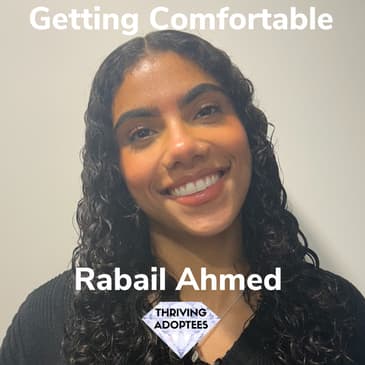
Do you feel comfortable in your own skin? Being adopted can feel distinctly uncomfortable. Whether that's due to others or ourselves. Listen in as Rabail shares what she learned coming through tricky teenage years and out of the other side.
Find out more about Rabail here:
https://www.adoptionmatters.org/podcasts/exploring-transracial-adoption/
https://www.linkedin.com/in/rabail-ahmed-0b3038336/?originalSubdomain=uk
Guests and the host are not (unless mentioned) licensed pscyho-therapists and speak from their own opinion only. Seek qualified advice if you need help.
Want to learn more about thriving for you, your kids, your families or your colleagues? Pick a time to talk here
[00:00:02] Hello everybody, welcome to another episode of Thriving Adoptees podcast. Today I'm delighted to be joined by Rabail Ahmed. Looking forward to our conversation today Rabail.
[00:00:13] So Rabail and I met at a conference in London a few weeks ago and she's did some advocacy work and helping, yeah, a lot of work in transracial, helping in the transracial adoption space, helping people understand what that means.
[00:00:34] And Rabail's a little younger than the average guest that we have on. So I'm hoping to freshen it up a little bit rather than old parts like me all the time. Rabail's a different generation with a different take on what's going on. So Rabail, what comes to your mind when you hear this, the name of this podcast, this Thriving Adoptees thing?
[00:00:59] Well I think it's a lot to do with the fact that adoption has sort of a, sometimes can have a bit of a negative connotation attached to it. Whereas actually a lot of adoptions, they do help you thrive because you've got a family, you've got people looking after you. So that's what comes, that's what springs to mind that actually, you know, you've got a family and you've got people looking after you.
[00:01:29] We are thriving as adoptees a lot of the time rather than, it's not always bad is what I'm trying to say. Yeah, yeah. Is it more like a mixed bag? What do you think? What between thriving and...
[00:01:48] A mixed bag. So some people talk about the complexities, the complexities of adoption. So I'm interviewing a lady later in the week, the names just escaped me, but her book is called The Adoption Paradox. Mm-hmm. So she's, she's exploring the complexities, the good stuff and the not so good stuff. Right, yeah.
[00:02:19] So it's, it's that paradox. It's, it is, it is a bit of both. Or is it? What, how do you see it? I mean, like, it depends on what your story is, what your background is. I mean, I'd say it is a mixed bag, yes, because not everybody does have a good adoption journey.
[00:02:46] But it can be, like, from my adoption, like, I've had a brilliant journey with it. So, yeah, I think it just depends on your background and what's sort of gone on within your adoption. Yeah. For me, the two things, there's obviously the, there's the relinquishment stuff, there's the loss of our birth mother. Mm-hmm.
[00:03:13] And then it's how, and it's, but there's also the factor of how we are raised as well. Yeah, exactly. And those, sorry. Sorry. No, I was just going to say, like, I have had a real, like, I've had a great time with my adoption. But like, like you're saying, it is hard when, with birth, birth family side of things, and obviously a lot of people that are adopted have that issue within their journey.
[00:03:40] So, yeah, like, even, it's not just a mixed bag in general, it's a mixed bag, even just with one story, if that makes sense. Yeah. Because it's good and bad. Yeah. But I'd say it's more good than bad. Right, yeah. Yeah. Because I think how we're raised has a big, has a big influence on how we feel about the loss. Yeah. Of the birth mother, right? Yes.
[00:04:08] So, the more emotionally intelligent, I guess, the more open our adopted parents are, the less that other stuff impacts us? Yeah, no, I agree to that.
[00:04:27] Yeah, because if you've had, if you, if you've been adopted and you've not had the greatest bringing up, you're going to maybe think about, I don't know, I guess you'd think about what, how your life would have been if, if you wasn't adopted. Yeah. And whether it would have been better or worse. So, yeah, definitely. Yeah. What sort of questions have you had growing up? Has that, has that been on your mind a lot, a little?
[00:04:57] What, what's it been like for you? I've had a lot, I don't know if it's just me, but I've, I've had a lot in my mind growing up with wondering who the birth mum is, where, you know, like, why, why it all happened. And so, yeah, I've definitely had a lot of questions. I feel like that's kind of normal though.
[00:05:27] Yeah. One of the things, this is a massive gender simplification, right? But what I found interviewing adoptees is that it's, that women seem to question more than guys. I don't, but that's just kind of my, that's my take on it.
[00:05:51] I know you've been around in other groups, like you've met other guy adoptees that, that we met at a conference. Yeah. Have you got, have you had that, have you had that, that thought as well? Or is that, what, how do you see, do you see, do you see gender as an issue around the questions?
[00:06:18] I'm not sure 100% because the only other adopted person that I know very well is also a female. So I do know two males that are adopted, but I don't know them very well. Not well. I wouldn't know if they have asked. The score is, yeah. I would, I would love to have a conversation with them about it to see, to, to determine. Yeah. Yeah.
[00:06:43] I have a little pet theory about it, that it's something to do with maternal, maternal instincts. Right. Yeah. That, that they're, that obviously it's a, it's a very different thing, paternal versus maternal instincts. And that's kind of why I think, but I have no proof of that whatsoever. It is literally just, just a theory.
[00:07:09] So you mentioned the word story and life. Have you done much exploration in terms of, do you know much of the, the, the story behind the adoption or? Um, so I have tried. Yeah. So like I've took DNA tests. I've took a few. Um, I've also, um, working with long lost family. Right.
[00:07:36] Um, they're sort of searching for any answers. Yeah. Has been going on for about two years now, but it can take a really long time. So yeah, I've done two DNA tests. So I found out where I was from. Um, then, and it, and apart from that, I've not. No. I've not really known what else to do. It's, it's vague.
[00:08:01] They can't, there's no tracking back of in files or anything. Um, so I did actually, when I was done at 18, I did actually, um, access my adoption file. Um, but I already knew everything that was on the adoption file. There was no names, no nothing, but I already knew that there would be. So, and without a name, it can be very difficult. Indeed. Indeed. Yeah.
[00:08:27] Cause I had a, when I got my first bit of paper, it had a name on it, had my birth mother's name on it. Uh, and it had my, the, the name she gave me as well. I haven't really been expecting, expecting that. I just expected, nobody said, oh, when you get this, you realize you might have, you might've had a, before you, before you signed him then, you might've been somebody else, right? You might've had a different name. Did your, did your file have a different name?
[00:08:57] It did. Yes. But I already knew, um, before that, that I had a different name. Ah, okay. Um, so I, I had that and nothing else. And then I sent off, I didn't, I sat on that information for, I don't know, a long time, maybe two years or something like that before I, before I, uh, restarted. Yeah.
[00:09:22] So did you find, did the DNA, uh, identify any matches with cousins or anything like that? Yeah. So, um, when I did it, it came back with very distant cousins. This is the issue. So it was coming up with like cousins, like second cousin once removed or something like that. It was like really, really distant cousins, um, that I tried to get in contact with, but got no reply.
[00:09:49] So it depends as well if you're on the app as well, cause with, uh, 23 and me, you get an app and you can sort of dive deep into. And they want to sell you a subscription to help you do that. Right. I think, is that one of them? I, I was, I paid for the, I paid for the DNA test and then you pay the one-off fee and then they try and sell you a monthly, a monthly fee so that you, you know, you, you're, you've
[00:10:17] got to, to keep on using the tool you've got to pay. Yeah. And that's that kind of their, their, their revenue model. But yeah, I had a couple of collections with first and second, um, first and second cousins. And then eventually that led to some, a couple of conversations with those two people. Help me fill, help me fill in the story. So my, my cousin remembers my biological father.
[00:10:47] Wow. Um, and she told me that the city he lives in. Right. And with his name and the city that helped me find, find him. Yeah. And then I, I think I've probably told this listeners before on this, I'm not told you, but then I rang him totally out of the blue. Yeah.
[00:11:11] Um, and given it was like 57 years after he'd signed a little piece of paper saying he wasn't interested in the unborn baby, right. That he was giving up his wife. Um, he still wasn't, he still wasn't interested 57 years later on. So, so that was, uh, but then, but, but it is, it is the, the combination of the two
[00:11:35] things and putting, putting the, putting the findings from different, different routes together led me to that conversation. So if I hadn't done the DNA, I wouldn't have known that. And if I hadn't done the file, then I wouldn't have had, wouldn't have his name. You see? So he was putting the stuff together. Yeah. So, um, what, why do you think this, you mentioned this negative connotation.
[00:12:04] Why do you think that happens? What do you think that's about? I think it comes from, I don't know how to explain. I think it comes from like. Society view. Is it, is that what you're saying? Yeah. Yeah.
[00:12:28] Like the, the adopted person, the adopted child isn't biologically yours. I feel like there's such a huge, like worry around that, but it's not really about the blood. It's more about being part of a family. Yeah. So you're talking about the stigma for, for parents there. Yeah. Parents and children. Yeah.
[00:12:54] Because you sometimes think, I'm not even biologically related to my mom. Like that's crazy or vice versa. Like, like this isn't as horrible as it sounds. This isn't like my actual child in a way. Do you know what I mean? Just obviously it is your child, but biologically. Yeah. So the idea that biology is better.
[00:13:20] I, I, I guess because, you know, you, I don't know, genetics and all of that, like, it's just, in a way, but I don't see it as that. I see it as that. It's, it's, it's who, it's who raised you. Like my, my mom has raised me since I was eight months old. So like, that's my mom. Like, there's no question about it, whether we're related or not. Yeah.
[00:13:51] Me too. That's how I feel. It is real. I guess what people may be getting at is it's not the norm, right? People don't, people, systems are set up for the norm. You know, when I, when I hear about the stuff that adopted parents have to go through to, to, to get support, right?
[00:14:18] If they need, if they need some extra support or, or to raise issues with, with schools, it's, it's, they find it tough. And they find it tough because those bureaucracies are set up to deal with the norm. They don't like, it's not, they're not set up for outliers. It's not, and we're, we're not the, we're not the majority. Exactly.
[00:14:41] Um, and, and so does it, does it then, so, but that, but then for, for them to realise that it's not personal, it's more about the system, um, yeah. Takes a bit of, takes a bit of a load off somehow.
[00:15:09] But with Beyond Biology, we're talking about reality. And your connection with your parents. Mm-hmm. Yeah? Yeah. So it's without question, is that? Yes, because, because, like, it, it's not, it's, there's a different, I always think, I've always said this, I think there's a difference between a mother and a mum.
[00:15:39] Like, a mother is someone, you know, like, nurtures you, like, raises you, like, has brought you up. Like, that's, that's a mother. But, birth mum, like, yes, she gave birth to me, but I don't know who she is, she doesn't know who I am. Yeah. So, it's like, yeah, there's no question about it at all.
[00:16:04] It, it, you, I feel like a mother is who, who actually raised you. Yeah. So, what, I mean, what, what would you say to adoptive mums listening in terms of this, this stuff and what, what's worked?
[00:16:27] There are, people often ask it, if I, so if I'm doing a training, right, adoptive parents will ask me for advice. Right. What advice would you give to adoptive mums listening in terms of what you think works and what, what creates that unquestionable bond that you're talking about?
[00:16:56] I think allowing your child to express how they're feeling about their adoption at any point, whenever they want, because sometimes you just need to talk about it, because it is such a heavy, it's such a big deal, like, especially if you don't know much. It's kind of, it's always weighing on your shoulders in a way, it's always in the back of your mind.
[00:17:21] So, just allowing your child to speak about it freely, not getting offence, like, I know it must be hard, like, I'm not an adopter, but it must be hard, like, if your child's coming to you wondering about their birth mum, dad, their family, why did it happen to me? Things like that, like, you could take offence to that, you know, in a way of, you know, like, or like, they don't want me in a way, like, but to know that it's, just know that it's not.
[00:17:51] It's not to, it's not, like, meant to come across as offensive, it's more of a way that you just, you're thinking about it all the time, so you just want to talk about it and get it off your chest in a way. I feel that, that's how I felt anyway, I know some people will just not want to talk about it at all, and that's also fine. And just deal with it in your own head and in your own space, but for me, definitely. So, like, just, like, you need to work out, like, almost, like, what your child is like.
[00:18:20] Are they a person who doesn't like to talk about it, or are they a person who really actually loves to talk about it and it makes them feel better? Just sort of work that out as well, because, and ask them even, like, is this something you want to talk about to me? Yeah. So feel free to talk to me at any time, and if you don't, then that's also okay.
[00:18:38] So what I'm getting is that, from you, is that you didn't, and you don't question your mother, right? You don't question her. The questions that you have about your birth mum have got nothing to do with the relationship that you have with your birth mother. Sorry, with your adopted mother, with your mum. Exactly, yeah. So, yeah, no, it's nothing to do with her. It's more about what I'm thinking in my head.
[00:19:09] Yeah, it's, yeah, exactly like you said. Yeah. Because there is something quite profound about that, right? Yeah. Because the fact that the two sorts of, you know, you can have that bond with your mum, but still have questions about your birth mother. Yeah, it is weird. It is weird. You wouldn't think that those two things could exist in time. I haven't thought about it like that, actually, before. Yeah, no, I do. I have.
[00:19:38] And I think it is strange because other people might see it as like, well, if you're so content with your adoptive mum, why are you worrying? Why are you bothering so much about your birth mum? Well, that's how someone could see it if they don't understand. Yeah. So, yeah, I can understand. Yeah, I get how it can come across as quite a bit, actually, because, yeah. And that's why I guess adoptive mums maybe do feel offence to it if they're thinking of it like that, like how we've tried. Yeah.
[00:20:07] I guess it goes back to that complexity thing, isn't it? I think we are, we like simplicity rather than complexity. And so the fact that those two things can sit alongside each other, not questioning your mother, but questions about your birth. It's not questioning your mum, but questions about birth mother. Yeah.
[00:20:32] That, that, that those two things can exist side by side and it's, but we're kind of craving complexity. So people will say to me things like, so are you, are you pro, are you pro adoption or are you against adoption, Simon? And I'll say, well, I'm, I'm for whatever's in the best interest of the kid. Yeah.
[00:20:56] And that requires a deeper dive rather than a simple, oh, I'm pro adoption or I'm anti adoption. It's, it's not quite, people are looking for simplicity somehow and any, any part of complexity than, they're not after that. It's definitely about the best interest for the child and the adoptive parents.
[00:21:24] It's like, I think sometimes we do forget about the adoptive dad as well. We talk about birth mums and birth and adoptive mums, but we don't sometimes forget what it might, what it feels like for an adoptive dad. Yeah. Yeah. What, what do you think is important around that? I don't know. I feel like having a male figure in your life is really important.
[00:21:50] Um, so yeah. And then, you know, I don't know, like it's, it's so easily forgotten. I feel. Yeah. Like, I wonder what, I mean, I've never really asked dad, like how, how he feels. Yeah. That sounds horrible now. Wow. Yeah. Yeah. I've never asked like, you know, about, but then I've never asked my mum either.
[00:22:19] Like, well, they haven't, I don't know, like we've, you don't really, about how they feel about adoptive. Yeah. Um, so, but do you know what I mean? It's just. Well, when it's been, since you were eight months old, right? It's a given, isn't it? Yeah. It's a given. It's the norm. So why do we talk about the stuff that is the norm? Yeah. That's part of it. That's it.
[00:22:46] It's just like, we've never, I don't, that obviously spoke about adoption, but not about like how they found the process is what I'm saying. Yeah. I'm not asking how they feel about that, but obviously like, like we've spoken about adoption with each other. But then again, like, like you said that it's what I've known and what they've known. So you just don't seem to really speak about those. Yeah.
[00:23:18] One of the things that came off for me off the back of the conversation with my biological father would be, I'm glad that that guy didn't raise me. Mm-hmm. Because what I figured out, because they'd been dating for like five, five months, according to the file anyway. They'd been going out for five months. And when she was, when she told him that she was pregnant, he was like, how can I be, how can I be sure it's mine? And sort of strange stuff like that.
[00:23:49] And so he obviously didn't love her because if he loved her, he would have married her. So what if he'd married her despite the fact that he didn't love her?
[00:24:03] And then I'd grown up in, in that household with him seeing me as somebody that caused him, that changed the, the, somebody that caused him to do something that he didn't want to do. Yeah. Right. So he could have resented me forever. Also, the way he was on the phone with me. So one of, so let me just go back a bit.
[00:24:31] So one of the questions I'd had in my head was, could I have done what he did to her in 1966? Right. And I could never really get a kind of instinctual, I didn't have, I didn't have an instinctual answer to that question. And nor did I get a question, did I get an answer to that question after considering it. Right.
[00:24:59] But I, I had a very strong instinct to, would I have been like he was to me when I rang him up out of the blue? And I wouldn't have done, I wouldn't have been like, I wouldn't have been like he was to me. No, no way. So is this guy, is this guy somebody that I respect? Mm-hmm.
[00:25:26] And the answer is, or would want to be like perhaps, who would want to, and I was, it would be a definite no. Definite no on them. Yeah. So what have you, you've obviously been getting out and about, you were, you were on that, you talked to that conference that we, where we met down in London like a couple of weeks ago, three weeks ago, wherever it was.
[00:25:55] So what, what have you been learning from that, from that process, from getting out and about, from the conference and the other work that you've done? Oh, well from the conference I think, I didn't realise actually how much research is going on behind the scenes about all different types of stuff adoption.
[00:26:20] Um, so yeah, it, that, it kind of reassured me in a way. That's what I've, I've, in a nutshell, learnt from that. Um, and, but doing work with people, so like I've worked with prospective adopters in their training and, um, like spoke to them just, just, just because even if they're not in training. Yeah.
[00:26:45] Um, and, I think from that I've learnt that, just that everyone's, everyone's situation is so different. Um, but like, I, like you, everyone sort of knows that, but more in depth now I think I've, I've realised, um, how different everyone's life is and how different, you know. So, yeah.
[00:27:13] Yeah. I think for me it's like that bit where you kind of, you realise it, but then you realise, you realise the same thing at a deeper level. Yes. So it's not just a yes. I, I used to think, um, understanding was a yes or no thing. Where it's far more, it's got far more depth to it so you can see the same things at a deeper, deeper and deeper level.
[00:27:39] And kind of, um, you get it. So I, I talk about getting stuff. We can get our stuff in, we can get stuff in the head, we can get stuff in the heart or we can get stuff in our bones. Right. That's, that's, that's, so it's kind of baked, it's baked in. Yeah. Baked in. And that's, that's the deepening of our, of our understanding. So what sort of, what sort of things you've been doing with prospective adoptive parents in the, in terms of the training?
[00:28:08] So they've been, so they've just sort of been in their training. I've not trained them, but like, um, I've come and spoke to them for a couple of hours, you know, just here and there. Um, and with another, um, one of my friends who's adopted, um, with her as well. We've just sort of allowed them to ask as many questions as they want.
[00:28:31] Um, and, or, and it's not just prospective adopters that have been there sometimes. Sometimes it's just been a group of people that are adoptive parents. Yeah.
[00:28:43] Respective adoptive parents. Um, so just speaking to them because I feel like, I think I said at the conference, we forget that like, it's not just one single process. There's, it, it goes on for life. Like, I don't think there's enough training for what you do when your kids are teenagers.
[00:29:05] Cause they change so much. Like you do change, like your behaviour, the way you think everything it's, it's so there needs to be some sort of training, like how to cope with when that kid does become of an age where you start to understand like how crazy your adoption actually is.
[00:29:27] Yeah. Um, cause I know for me, like, I think I was like, when I actually started to understand like my life, I think I was like 12. So like, that's when you're like, that's when I sort of changed in a way because you just start to think about the unknown and everything.
[00:29:48] Well, it depends on your story, doesn't it? But like for me, like the unknown. Um, but yeah, so yeah, I'd definitely love to help them more, um, with how to deal with someone that's a teenager, an adopted teenager. Cause it's different from dealing with a child, like a child, like a five year old.
[00:30:11] A lot of people will say this, that the teenage years are tricky for everybody and especially tricky for, uh, for adoptees and obviously their parents.
[00:30:24] Um, and during that, during that phase, we can, uh, adopted parents like we can do, right. As adoptees, we can drive ourselves a little bit mad thinking this is me actually. I said, we, right. But, um, is, is this a human thing? I, I, I, is this part of human suffering or is this part of human joy, right?
[00:30:54] But is this a human thing or is this an adoption thing? Yeah. And we'll never know, right. It's, it's almost as if. I had, I had one of the mentors on the podcast ages ago, um, coachy type lady. And I, I, I was having a conversation with her once and, and I'm talking about this and she said, well, you'll never know Simon.
[00:31:22] Like, cause all this is all wrapped up and presented in just one person. So we can't, you're going to kind of, you're going to be, have to be okay with not knowing whether this is an adoption issue, whether this is a human issue. Right. And because trying to figure it out is a complete waste of time.
[00:31:49] It's like a rabbit hole. We disappear down that, we disappear down that rabbit hole. You just get so distracted from it. Like you won't be able to carry on with your life if you actually sat and thought about, like try to work it out for ages and ages. Because, yeah, yeah. Yeah. It's just not worth it. It's not just worth it. Yeah. We have to kind of deal with what's in right in front of us. Yeah. And it's not just even teeny. I feel like there's a few stages. There's that younger stage where you don't kind of know what's going on.
[00:32:17] And like, yes, like for me anyway, like I keep saying we, but I don't know. No, we don't know. So it's like with growing up, like I'm sure people can relate there is up to say like 10. Like my parents have always mentioned the word adoption, adoption, adoption to me, which is definitely very, that's a good way of dealing with it.
[00:32:42] A good way of, yeah, it's good. So, and without that, I think I wouldn't have thrived as we, as we, as we're saying. So it's like, so that you know what's going on, you know what adoption is, but then you hit an age where your parents think you're old enough to maybe understand. They tell you, and that's normally around, that's it. You know, proper sit down chat when you can understand it's probably around preteen, teenager.
[00:33:12] Then you, then you've got that whole phase of trying to work yourself out who you are and all the rest of it for years and years. And then you get 18 and then you, and then you're an adult and you're thinking, right, adoption file, DNA test, blah, blah, blah. So there's the, there's like almost like, and then the fourth stage, I'd say, if I make this theory up. The fourth stage, like, which I've not reached yet, but that's maybe like into your proper, proper adulthood, like after 25, you know.
[00:33:40] So like, there's quite a few stages and that's why we need more, not just focusing on the adoption itself. We need to focus more on how to, how, how to deal with all the emotions that come along with it afterwards for years and years and years until, yeah. So, yeah. Yeah. Having children is quite a big landmark in that.
[00:34:11] As I understand, like me and my wife haven't got any kids, so I wouldn't, I wouldn't know, but that's what they tell me. And going back to something that you said about using the word, a friend of mine who's been on the podcast a couple of times, a Jude home adoptee from, from the States, her mum told her, used the adoption word, the first moment that she held the baby in her arms, when Jude was held in her arms.
[00:34:40] So, and she felt that if she didn't tell her then, then she would never have told her. She wouldn't have had the courage to tell her. So she had to kind of like get, get, get it out there first before they can understand the, the word. Yeah. I think that's a really, really good way of helping yourself and it would help the child. Yeah. Because if you've already heard the word, it's not a massive shock.
[00:35:09] And I can imagine it can be very difficult to tell your child that. Yeah. That must be crazy. Like, I, I don't know, but yeah. And like you say, like with, that's like another stage of life, isn't it? Like you could say that as the fifth stage, having children of your own or adopting a child of your own. That must be really hard to wrap your head around. Yeah. Certainly. Yeah.
[00:35:34] So what, what about, we, we started off with this idea of thriving and the negative, the negative connotation. We talked about negative connotation that some people have, the fact that we're not like the masses who are biologically related today. Kids. What, what does, what does thriving mean to you now?
[00:35:57] Kind of personally in terms of, you know, your life stage, your, your relationships, your family, education, whatever. What, what does, what does it mean? What does it mean for you now? Like personally? In relation to. And, and what's, I guess you're at university, right?
[00:36:20] So in, in terms of your taking a, taking a, an overview of, of, of, of where you are at the moment. What does. Considering all. Considering, yeah. Like a helicopter view, like a helicopter view. So you could, it could, that helicopter view could include your family. Could you include your friends, your education, your career aspirations, where you are now.
[00:36:46] I definitely think at this stage and at this, at this point, it's the most sort of, I've, I'm thriving the most out of what considering beforehand. Um, because I'm at a stage now where I'm kind of comfortable with the fact that I'm adopted.
[00:37:10] So I think as soon as that, as soon as you go through that, you do thrive more because you've, it, it sat with you right now. Like before, I think when it was really fresh, like it's took, like I'm 20 now and I was like 12, 13 when I actually started to understand it.
[00:37:35] So it has took a while and I'm definitely not all the way over it yet, but like seven years. So like for it to actually be finally comfortable with it, otherwise I wouldn't be speaking about it. Do you know what I mean? Yeah. Yeah. I definitely think at this stage in time, I'm thriving. And I'm at a place now where I've done my DNA. I've got over it, like understood it because I was 15 when I did my first DNA test.
[00:38:00] So it's proper sunken and I'm at a uni where, and a lot, most, like every uni, I'm sure, they, they're quite helpful. Like, and not that I've accessed it yet, but if I ever needed to, there is a help for care leavers and adopted people and things like that. And it's becoming more and more apparent that these things are around.
[00:38:24] So it, yeah, I definitely say now I'm thriving the most because I'm comfortable with it. Comfortable. Yeah. So were there any particular moments on that journey to feeling comfortable? Like, I mean, some people talk about being comfortable in their own skin. You talked about being comfortable with being adopted. What, any particular moments come, come to mind? Yeah. Yeah. Definitely.
[00:38:54] Yeah. I think when I wasn't, when I wasn't comfortable was when it was really fresh and, and you're growing up, you don't know what's going on. You're trying to understand it. Um, and you speak to a friend about it, say. Um, and sometimes with school and friends and stuff, it can get around that you're adopted.
[00:39:22] And I think I had a period of time in my life where it was all a big jerk that I was adopted at school. So it, that was when I was very uncomfortable because. So, you know, there's people that will make you feel uncomfortable about it. Um, I can't remember what time in my life that actually was.
[00:39:47] I was, I must have been, like, I don't know, like really early secondary school or end, very end of primary school when it sort of went around. And then, yeah, it makes you feel a bit uncomfortable that everybody knows because it's quite private to you. And at that time, I did find it really private. Um, and didn't want to speak about it because I was, I guess, ashamed about it and embarrassed, which absolutely should not be. As I know now.
[00:40:15] But before I was very ashamed about it. Yeah. So that's, that relates back to the kind of negative connotation that you, you, so that's how it kind of, that's how it was when you, you, you talked to somebody in confidence and it, and, and the, the stuff went, the stuff got out that should have been kept private. Exactly. Yeah. So that's, that, that's kind of what I meant at the beginning when I said about negative connotations. Yeah. That's what came to my head.
[00:40:46] Yeah. Um, people making fun about it. It's because like, barely anybody was adopted in that school. Yeah. So it's just kind of like, you, you, again, you're not the norm. You're not the norm. It's a norm. Whatever normal is. Yeah. Like you, you just, cause you're, you're just a bit different. And for some reason, that's a reason to pick on someone. Yeah. Yeah. So I think the word is that people, some people use is othered.
[00:41:15] They make us feel other. Yeah. And one of the, well, I did a lot of work in, in schools, actually in primary schools or elementary schools for people that are over the other side of the pond. I did a lot of work before I came to the adoption space. I did a lot of work on kids, happiness and confidence, anti-bullying and happiness.
[00:41:40] And what, what I found that was the biggest, the biggest cause of kids upset was being, being othered, being, being bullied, being bullied for being different. Whether that's having red hair.
[00:42:08] Like me, I was bullied for having teeth that stuck out. Like, um, all, all that. But I'm, it's just landing for me here, right? In terms of the depth, the, the, the, the depth of the pain, you know, the depth of the issue. Right.
[00:42:30] So being bullied for, being bullied for wearing glasses is completely different from being bullied from, for being adopted. Yeah. It's a lot, it's a lot deeper. It's more. Yeah. It's kind of more, more, more profound. Yeah. But it's. Especially when you're trying to get your head around it at that time as well. To then, it's like, well, I don't even understand it. So why am I getting. Yeah. It's tough for this. Um.
[00:43:00] Yeah. It's tough.
[00:43:34] It's tough. Like, and it, it, it just sometimes happens. I don't really know why. I've never really spoke to anyone who has, who else, whoever. I've never really spoke to anyone who also experiences, but like, you just all of a sudden get this like urge and it's like, right. I'm ready to find, find out what's going on. And then you, and you do try and search and then you get nowhere.
[00:43:59] Um, so yeah, those times I felt quite like not comfortable about it. No. Like, am I not getting anywhere? Especially, it's like, where do you even start? Because like, if you don't have a name or things like that, it's just, it's just hard. Cause it's like, well, you don't even know what you, what you do. And, and that, to be fair, that I have sometimes, I have found things on the internet.
[00:44:25] Like I've looked in newspaper archives and things like that and found articles about me or like, I think I even saw a picture once of myself in a newspaper, in a newspaper archive. So yeah, like some, some internet searches do find you things. Um, and then you're like, right, this is great. And then you thrive in and then some, some days when, or like weeks that you have where you're like, right, I'm ready to find out. And you don't find anything.
[00:44:54] You can really not thrive. Yeah. So yeah. So you're talking about frustration, is it? In a word, is that what it's about? A hundred percent. Yeah. It's, it's, it is so frustrating sometimes. And, and yeah, there's, there's been some turning points for you that haven't, haven't there? Cause you've kind of, uh, so this is a bit of a tongue twister, right? So not too twisted, but it's a, a mind bender thing, right?
[00:45:26] This coach of mine, Liz, she says, if, if we're always okay. If it, yeah, no, she's, I said, see, I can't, I can't say, I can't say, if we're okay with not being okay, we're always okay. Okay. Right. If we're okay with not being okay, we're always okay. So in this sense, it would be, if we're okay with not knowing, we're okay.
[00:45:56] Yeah. So there's a kind of, um, uh, resignation, you know, like, uh, resignation, acceptance. Yeah. Resignation sounds a little bit tricky. Except there's, there's an, an, an, an exception. Sorry. There's accepting the, accepting our frustration or accepting the lack of answers,
[00:46:22] accepting the, the constant questions, accepting the fact that we might never know. And then it's kind of, it's all right. Then is that what it's, is that what it's like for you? Yeah. Yeah, totally.
[00:46:47] Um, like for me, I'm, I've not accepted. Um, that I'm not happy with, I've, I've not tried everything yet. Do you know what I mean? I still think, I don't know what I've not tried, but there's stuff that I've not tried yet. And so it's like, there must, there must be something else I can try to, to find out something. And I'm not, I've not accepted that this is it.
[00:47:13] Like, I'm like, I'm totally ready to find out. Yeah. And like, I'm waiting with, waiting on Long Lost Family at the minute. So it's, yeah. But you're okay with that? Yeah, yeah. Um, well, it depends on the day. Yeah, it depends on the day. Yeah, it does. It does. Yeah. It's like, like today. But largely. Yeah. Yeah. Largely.
[00:47:41] Like, I'm accepting of the fact that I am just waiting. Like, it's been years and years, but I'm still waiting. And we've been through this with Long Lost Family. Like, this, it could be 10, 20, 30 years. Like, you just don't know how long it's going to take when something comes forward. You know, someone, a new person puts, new person that is related to me puts a DNA in, sample system. Boom. That's all of a sudden you found something. But that could be years.
[00:48:10] It's literally a waiting game. It's luck, really, at the end of the day. And how are you? Yeah. How are you with, how do you feel about the waiting game? Like, it is so frustrating, largely. It is so frustrating. And you just want it to hurry up and you just don't have the patience. But then it's like, it will all be worth it in the end. So, yeah.
[00:48:38] But then, like, I've accepted that it is going to take a while, but I've not accepted that I'm done here. Like, there is definitely work, more work that can be done. Like, if this doesn't work, I'll try something else. Like, but we'll come to that when this doesn't work. I'm going to stay positive and hope that it does. So, when it comes to it, we'll cross that bridge and get to it. If it doesn't work, then when I don't find anything through Lauren's family, then I'll try something else. Yeah.
[00:49:06] And I feel like that's the same with a lot of people. If you don't know your background, you're going to want to try everything. If you're looking that way, if you want to find them, if you don't want to find them, then you're accepting it, then you're okay with being okay. Yeah. I think the stop-start nature and progress, no progress, stop-start nature of the progress, sorry, stop-start nature of the process,
[00:49:36] it is what most of us go through. Yeah. And frustration and lack of frustration and acceptance of where we are in that process. That varies on a daily rate, on a daily basis too, yeah. I think about it every single day, every single day. I think about adoption, the unknown.
[00:50:07] But some days are just easier than others. Easier than others. You talked about being reassured about the research that's going on. That was one of the things that you learned from the conference. Yeah. Have you done much reading around adoption stuff? Have you read many books about adoption stuff? No, not really, no.
[00:50:38] But I think, I don't know, I think I find it more valuable for me anyway, speaking to people. Yeah. Life stories. I feel like that's almost research in itself because it's like real life, you know? Yeah. Rather than sort of textbooky stuff. Yeah. I'm not much of a reader to be honest. Yeah.
[00:51:08] What about podcasts? Listen to podcasts? You're not a listener. Yeah, yeah, yeah. I've listened, like, because I've done another podcast with You Can Adopt. Yeah. I've listened to a few of those. Yeah. And what have you learned through that process? Or what surprised you about that process? I mean, me doing...
[00:51:38] You're doing... So you talked about the fact that you have felt uncomfortable, and now you feel largely comfortable about it. You're comfortable enough about it to be talking in public about it, which is a big thing. Like, you know, what would your 12-year-old self say? Oh, God. Yeah. Yeah, exactly. Yeah.
[00:52:07] No, I think that doing that process for me, like, I know that there's a podcast out in the open, and, like, anyone can listen to it. But, like, I've just not really thought that's a bad thing. Because, like, what... It's, like... I don't know. It's always... I'm not saying it's a bad thing. No, I know. I know. But I just feel, like, in general, like, in life, like, it's always come across from people as if it's, like, something you need to keep quiet.
[00:52:35] Like, behind, like, everything, there's always that, like, like, oh, but you don't have to say anything that you don't want to. Or you don't... You don't feel like you need to tell your story. It's, like, it's almost as if someone's saying, like, don't. Like, don't speak about it. It's really personal to you. But if we don't talk about it, then how is it going to help people? If we don't talk about it, then how are people going to feel comfortable about it? Because they're going to say, oh, right, well, nobody talks about it, so, like, we can't talk about it.
[00:53:05] But so it's, like, yeah, like, it's... But then that's what's kind of been given, like, growing up by... I don't know from where, but there's this, like, vibe that's come about that it should be kept secret. But I don't know why. And, like, now that I've, like, spoke about it and stuff in the conferences, in the youth forum, with Adoption England,
[00:53:33] and in podcasts, in front of people. Like, there was a... We did a Youth Voice event in October in Leeds, and that was in front of, like, a few hundred people. So, yeah, it's, like, it doesn't make me feel uncomfortable anymore. It's, like, it's the norm to me, so... Yeah. Yeah.
[00:54:02] Yeah. That feels like a good place to bring it in. Unless, is there anything that you would like to share that I've not asked you about, Rebeel? No, I think, I think, yeah, I think we've covered... Yeah, a lot of ground. Yeah, yeah, we have, and, yeah. Cool. Thank you, listeners, and thank you, Rebeel.
[00:54:33] We'll speak to you very soon. Take care. Bye-bye.