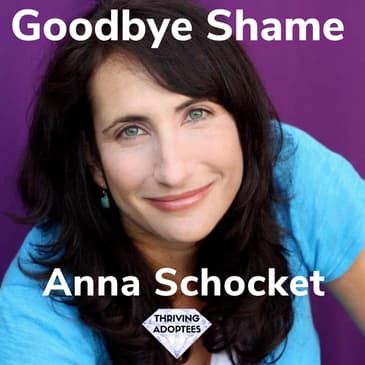
Guilt is feeling bad about what we've done. Shame is feeling bad about who we are. And it's the feeling that fuels imposter syndrome. What if there was another way? Listen in as adoptive mother Anna talks about owning our own story WITHOUT shame.
Anna Schocket, a single adoptive mother, embarked on a heartfelt journey to pen this book as a way to open a dialogue about adoption with her young daughter.
With a career as a senior executive in Talent Development, Anna leveraged her learning background and her belief in the power of teachable moments to create a meaningful resource for other adoptive and nontraditional families.
Anna and her daughter thrive together in Oakland, California.
Here's the link to her kickstarter
Find out more about Anna and her book here:
https://www.linkedin.com/in/annaschocket/
https://www.facebook.com/profile.php?id=61575153751146#
Guests and the host are not (unless mentioned) licensed pscyho-therapists and speak from their own opinion only. Seek qualified advice if you need help.
Want to learn more about thriving for you, your kids, your families or your colleagues? Pick a time to talk here
[00:00:02] Hello everybody, welcome to another episode of the Thriving Adoptees podcast. Today I'm delighted to be joined by Anna, Anna Schocket. Looking forward to our conversation today Anna. Likewise Simon. Yeah, so listeners, Anna is an adoptive mom and she's also an author and we're going to talk a little bit more about that later in the conversation. But let's start with the biggie first, right? So thriving, what does thriving mean for you?
[00:00:32] Yeah, I put a lot of thought into that Simon, because thriving is so important to me just, you know, in my own daily essence. Yeah. And I really do think that it has to do with owning your own story without shame. Meaning, knowing who you are, acknowledging the great things, hopefully with joy.
[00:00:58] Acknowledging the not so great things or the things you wish you could change with just openness and owning it, you know, and not being ashamed of who you are. I think that's super important. Yeah. And this shame has been a big thing, right? Oh, yes. Your adoption is a 25th, sorry, 21st century adoption, right?
[00:01:27] Right, right, right. It's a 2020s adoption. So it's a recent adoption. Yes. And shame was so put upon the birth mothers in the 50s, 60s, 70s. Yeah. Yeah. Well, unfortunately, also, too, I think, I have to assume that that shame that was put upon the birth mothers also translated into how adoptees felt about their own experience, that there was something wrong.
[00:01:56] And that, to me, is sad. That's sad because, you know, people take cues from others. Yeah. And if there seemed to be shame in the experience somewhere, it sort of, it gets internalized.
[00:02:10] It does. It does. And that is what the percentages are. I don't know how many. One of the biggest challenges that we have as middle, like I put myself as, call myself a middle-aged guy, right? In late 50s, 58.
[00:02:31] Right. One of the biggest challenges with 46-year-old adoptees is this fear that we're not good enough, that we're not good enough. And it's not a conscious decision. It's not a conscious choice to feel like that. It's something that takes root somehow, you know? Right. Right.
[00:02:59] Again, how many adoptees feel like this, we really don't know. Yeah. But openness can only be a good thing in terms of having less shame around.
[00:03:19] I agree wholeheartedly. I mean, that's, you know, that is the key, is knowing and owning your story early on. And the only way you can do that is to understand it early in an objective and joyful way. You need to hear about your story early often and without that stigma that implies some form of shame.
[00:03:48] Yeah. Well, hearing it, talking about it, being open, like, you know, being open in our conversations, never mind open generally, you know, versus closed adoption. It's, it all comes down to that. I agree. Communication piece.
[00:04:12] So, I want to explore what it means to you, because, you know, like, so far we've been, I guess we've been talking about when we get into shame, we get into this historic stuff. Yeah. What, what does, what does thriving mean for you as a, as a human being, as an adoptive mom? What, what's it about for you?
[00:04:39] Yeah. Well, I mean, as I think about an adopt, being an adoptive mom and being a parent, I have been searching for ways, you know, to make sure that my daughter hears early and often that she's adopted and that there's some pain associated with it, but also joy associated with it.
[00:05:03] But, but that it just is, that it just is, and it's her reality and it's her story and she should be proud of it. But, but, you know, the way to do that is always hard. I, I, I'm a big fan of teachable moments. So, I use books a lot. So, you know, when we were getting ready to go to the dentist, I used a book.
[00:05:24] When I was, when we were getting ready for her to start her first day of preschool, we used books and read it often and often and, and, and used it as a platform to talk about her own situation. Similarly, I think for adoption, I wish there were more books out there that allowed for parents to talk about joyful adoption. There are some, you know, and, and I know we'll, we'll talk about it.
[00:05:51] The reason why I wrote one is because I didn't find one that met my reality. And so, wanted to make sure that that was something that was in the universe. But I just think it's really important to start talking about it very early. It's as early as you can, even earlier than you think you should.
[00:06:12] If you can read stories about, you know, about fairy tales, about princesses, about why not read a story about adoption? I think it's a parent's self-consciousness, feeling like it's a deep topic to not start early. When in fact, again, if you treat it like just the reality that it is without shame, why not start talking as soon as or even before a child can speak? Yeah.
[00:06:42] A friend of mine, Jude, who's been on the show and interviewed me, her adoptee, her, she's similar age to me, a little bit younger. I don't know. Sorry if you're listening to this, Jude. But she talks about her adoptive mum, her mum, mentioning the word adoption to her, telling her on the day that she first held her in her arms or whatever.
[00:07:10] I'm not sure, like single figure days, first couple of days of her life, you know, straight from hospital. Because she felt that if she didn't tell her then, then she would never, she would never tell her. So tell her before, before the child has got a clue, you know, and at five, two days old, five days old, clearly nothing's going on. I want to just flip it, the conversation slightly.
[00:07:37] So what's, what's your daughter teaching you about you? Oh my gosh, so much. And all the parents out there who are listening, I'm sure know that parenting is not for the faint of heart, right? Teaching me that, you know, actually the older that I get, the more patient I get, the more I feel like I'm able to pause and be curious.
[00:08:09] That, you know, there is so much joy. She's making you more patient. She is. Because you have to be. Because if you don't, you lose it. She also finds so much joy in the littlest of things. We were walking around or scooting. She's got a scooter. We went scooting around the neighborhood the other day and she needed to stop at every flower and smell it.
[00:08:36] And it took us forever to get around that neighborhood loop. But my goodness, that was so lovely. It's, I mean, it was just, it was, she was stopping and smelling the flowers, right? Smelling the roses. Yeah. You know, it was lovely. That's the thing. That's the thing. People say that. Absolutely. But it is a thing for your daughter. It is a thing for her. She loves flowers.
[00:09:01] But also, I think, you know, I watch her, you know, after having talked about adoption and I've heard her talk about her story to other people, especially associated with our book. And she seems proud of it. And there is no shame that I'm seeing in her, which is amazing, even though I'm looking for it, hoping that it's not there.
[00:09:26] And I just get a little tear in my eye every time I hear her talk about it, which is amazing. Yeah. And she's three and a half. So, you know, that's a wonderful, a wonderful start. I'm really happy about it. Yeah. What did you learn about yourself going through the adoption process? Oh, gosh. It was one of the most humbling experiences, I think, of my life. I think resiliency.
[00:09:55] I think humility. Right. Just being open. Curious. You know, also recognizing that as an adoptive mom who is putting herself out there to hopefully be the parent of someone's child, because today, you know, the process is you get chosen through private adoption by the birth parents.
[00:10:23] You know, it's humbling in terms of putting yourself out there, hoping to be that person that they're interested in putting their child with. And then when you're chosen, it's humbling to feel that you have been sort of blessed and honored by that parents or family to take on their most precious asset, their child. Yeah.
[00:10:49] So, I mean, it was just a very humbling experience. Yeah. You mentioned the word resilience, which is a word we like here on Driving Doctors. What does resilience mean to you in this context, Anna? It's a couple of things.
[00:11:09] I know there was resilience as it related to the extensive process to be approved, to adopt, and all of that. So, just continuing to go through the motions and not being deterred by things that were extremely intimidating or intrusive. Then resilience to go through what was a humbling process.
[00:11:37] You know, I jokingly tell my friends that it's like online dating times 20. Because whereas online dating, you put together a little profile through the adoption process. I had to put together an eight-page glossy brochure with articles. I found myself hoping to seem compelling to someone as an adoptive parent.
[00:12:03] And then, of course, you know, going through the process through the courts of getting the adoption process finalized and things like that. And then just the resiliency of being a parent, which I don't think I have to tell anybody who's bearing on this, you know, this call that, you know, that it's a thing. It's a thing. It's a daily challenge.
[00:12:28] And, you know, you're learning to regulate your emotions regularly, to be creative, to, you know, make sure you have high energy as you work with your own kids. Yeah. Yeah. There's a lot of talk about that in the parenting world that we can't regulate a child if we're not regulated ourselves, I think is the sorts of things that people say.
[00:12:55] So what have been your learnings in that space? You know, I can't remember the theorists that I read, but I realized that, you know, I react often to things that she does that seem like she's trying to get the better of me. When, in fact, I need to pause and be curious and think, what is it that's going on for her?
[00:13:25] So I do often, when she's throwing a fit or being frenetic or something, pause and say, wait a second, wait a second, Lily, what's going on for you? Please use your words. And that's like a mantra of ours. And she'll pause and take a moment, and then she'll say something that often has nothing to do with the circumstance in the moment. Like she's angry at me for being distracted on my phone or that I was having a conversation with another adult and wasn't paying attention to her or something.
[00:13:55] So it's fascinating to pause, be curious. And then you get to some deeper things that are going on that, again, I just, if I hadn't sort of gone through this process and I think learned from this theorist that that's a really good practice, you know, I wouldn't have done it. Certainly in my normal adult life, I probably should do that more.
[00:14:21] I always think about presume good and tense, you know, when I get frustrated, but, you know, you have to do that with your kids as well. Yeah. So what have been the teachable moments for you then? Yeah. Gosh, teachable moments. It's like every day is a teachable moment, Simon. Well, in terms of, are you thinking in terms of parenting or in terms of the adoption journey?
[00:14:48] I'm thinking about the more significant, more kind of profound stuff. I'm not, I mean, I'm interested in the depth stuff, wherever that is, whatever part of your life that is. Well, one of the things I think is, it's sort of back to what we talked about before, lean into your truth, lean in.
[00:15:11] Like, I know when I realized that I wanted a family, you know, and have for years, and it just wasn't happening the way I wanted it. And I just decided one day, that's it. I'm going to make this happen for myself. I know I can create an amazing home for a child.
[00:15:35] You know, with my amazing found family of friends and family, you know, network, you know, this would be an amazing place for a child. So I decided to put myself out there. You're doing this on your own. You're not. I'm doing it on my own. Absolutely not with a partner. In fact, interestingly enough, I had a partner before this who's still an amazing friend of mine. And he's still very much involved in my daughter's life.
[00:16:03] And she sees him a bit like a father figure. But he just wasn't in a place where he wanted to be a parent. And he owned it, which was lovely. And so I said, OK, I understand that. But I do. And he said, I think you should. And so I did. So what have been you talked about this curiosity? Yeah. Yeah. And patience.
[00:16:34] What else have you learned? Are you learning about raising your daughter? You know, it's interesting. I think one of the things that has been super important for me is continue to give really good messages, really positive messages.
[00:17:02] She hears a lot from other kids at school. And even some of the messages that she gets from just, you know, mainstream media, books, stories, you know, shows, et cetera. And I just want her to be a good person. And so, you know, the other day she was like, I look beautiful. And I want her to have amazing confidence and be very proud of herself.
[00:17:29] But I said to her, you know, beauty, beauty is it comes from inside. It's so important that you're a good, kind, you know, lovely person. And then you will be beautiful no matter what you're wearing or what you look like, you know, and trying to start early with those kind of messages. Has been also, you know, an interesting, an interesting experience for me. Yeah. You know.
[00:18:00] What did you, you started the definition of thriving, talking about owning our story without shame. Yes. What did you learn about your own story in going through the process, you know, doing the eight page brochure, et cetera? Oh, my gosh. Going through that process, my own story. Well, of course, I'm human. And it's just like everyone else.
[00:18:29] So I felt very self-conscious putting it together, you know, thinking, am I good enough? You know, am I, am I compelling enough to someone else? Can I be a parent? You know, am I going to be a good parent? You know, I felt in my heart. I could. I could. But, you know, it's a little unnerving. It's a big life change, you know.
[00:18:51] So, you know, I went through my own version of fighting any form of shame, you know, especially as a single parent thinking, gosh, am I going to be able to adopt? Is anyone going to want to put their child with me?
[00:19:07] I later learned from, you know, a friend and even some adoption professionals who said, gosh, a single mom who has means for some women is more comfortable than a couple, especially if that birth mother has been burned by men in the past. And that was reassuring, at least for me and my situation, because I thought, okay, there is hope. There is going to be someone who will be interested.
[00:19:35] And in my own situation, interestingly enough, the birth parents were together and married at the time, but planning a divorce and very young. And it was the birth father who chose me, interestingly enough, because I was the most like his single mom, which I thought was amazing. Yeah. So just, just really interesting. Yeah. And you put the word fighting with shame.
[00:20:06] That's an interesting combination. Yeah. Yeah. Why, why, why is it fighting shame? Why does that? I think shame is that specter that crawls into your life at various corners when you least expect it. I think it happens.
[00:20:25] It's, it's that, you know, that imposter syndrome, that feeling of inadequacy that I, I anticipate everybody has at some point in their life. Some of us more than others. But you're laughing about it as you, you're laughing about it as you're describing it now. I am. I am.
[00:20:48] Well, with all this talk about, you know, fighting shame to that point, it's like my head knows it, but it's so, it's so deeply ingrained, you know, and it comes from a deep, dark place in all of us. It's, it's hard not to go there. But you have to overcome it. It's the being curious. Pause. Take a moment like I do with Lily. Why am I feeling this way? Use my words.
[00:21:17] And, you know, try to figure out how I can move past it. Right. Yeah. And overcome it. Isn't there a danger of this thingification? Have you had a thingification? I don't even know if I have. Explain it, would you? Well, we, we, imposter syndrome. Yes. So it's a thing. We make it a thing.
[00:21:43] So for me, imposter syndrome, kind of, you know, it's a manifestation, to use a fancy word, of shame. Yeah. It is. Oh, it so is. But we've thingified it. Right. We've, we said, oh, I didn't even, I didn't even know that that was a thing. And then it becomes a thing.
[00:22:13] And it. I actually think that's a good thing. You think it's a good thing that it becomes a thing? I think it's a good thing to thingy because it calls it out. It calls it. It names it. Once you name it, you can address it. Otherwise, it's something you just assume you're the only person who's dealing with it. It's a good thing.
[00:22:56] And it becomes this thing that festers. It is a thing made of shame. But yeah, it is. The feelings of shame come and go. You know, sometimes you're thinking that you're not good enough. And then sometimes you're thinking that you are. And therefore we, we, the thingification for me is kind of a danger because we make it seem like it's realer. It grows legs. It has more validity rather than something that is fleeting.
[00:23:26] I mean, I see why you have that perspective. I can see where you're going with it. I think the reason why it has value in my mind is that there are a number of, you know, speakers, theorists, people like Brene Bren, who I think is fantastic, who then talk about it. Whereas I think otherwise it doesn't get talked about. And once it gets talked about, suddenly you feel like you're not the only one.
[00:23:56] Yeah. Like, oh, gosh, it's a thing. Well, then I can overcome this because other people are talking about their journeys to overcome it. I don't know. Somehow I feel like that's, that's reassuring for a lot of people who otherwise would just do and feel self-conscious. Because, yeah. It's calling it out. Yeah. Putting it out in the open. Putting it out there. I think it probably cuts both ways, right? Yep. It might.
[00:24:24] So I can see your point with it reassuring and that realizing that we're not going mad, that other people have felt that way before. Absolutely. Yeah. Yeah. Yeah. And that it's normal. Yeah. Sadly. Sadly. Yeah.
[00:24:48] So the process has been fairly, you're smiling all the way through this. I, yeah, I was really blessed. Must have been some dark stuff, right? I did have, I mean, there were bumpy administrative issues, crazy things. Like when Lily was born, her birth certificate was incorrect.
[00:25:38] Correct. My child and wouldn't be taken away, you know, to, to formalize things like a social security number, formalize around my taxes. That wasn't done for about at least two years, which is a long time, you know, to be sitting in the courts. To leave the country, I had to get a special judge's permission because of the delay that had taken place. So. Wow. Tricky stuff. Yeah.
[00:26:08] Bureaucracy. Absolutely. So what, what's, um, what's gets in our way of, what gets in our way of our thriving other than the bureaucracy and the hiccups and the imposter syndrome? I think, you know, the well-meaning individuals who keep poking at you.
[00:26:31] What I mean by that is, um, you know, when I walk into my daughter's school and one of the little three-year-olds runs up and says, you know, why wasn't Lily, my daughter's name, grown in your belly? It's the first thing in the morning, I'm trying to get her settled and what have you.
[00:26:56] And I'm answering this really deep, but legit question to a three-year-old and wanting to make sure that I'm, again, speaking in a way that demonstrates, you know, pride and not shame about our adoption story.
[00:27:11] And, um, you know, it's, it's, you know, it's the, you know, I have friends who have children, adoptive children who are, um, of a different race, you know, and it's the, the, um, tactless older lady on the bus who wants to ask the story about your relationship with the child. You know, it's, it's the constant, um, uh, questions that maybe catch you off guard.
[00:27:40] That, um, you think you've, you've got a good, a good progress going and you're, you're mitigating shame and you're talking about everything with joy and what have you. And then suddenly you get these questions that kind of undermine what you've been trying to do. And you just have to keep going, stay the course, continue to make sure that you communicate. Cause that little kid's not going to go away until you've answered the question. Exactly.
[00:28:08] And, and he's, he's not going to be the only one in her life, you know? So yeah. So it's just, um, it's a daily battle. Um, but it's important to just continue to stay the course. And again, own your story without shame. Yeah. Stick to it. So let's talk about the book. Yes. Why did you create the book?
[00:28:37] Why did you write the book? Well, as I had mentioned to you before, I am big on teachable moments and I use books as a way to normalize things in life. Right.
[00:28:46] And so as I looked at books about adoption, um, and was searching for the best books out there, I just found so many of them had, you know, two parents, uh, talking about, you know, mommy and daddy, um, in the context of the story.
[00:29:09] And so here I am trying to talk about a very deep, serious topic, you know, with my three-year-old, my two at the time, probably two-year-old, um, and start introducing something. And then, you know, needing to modify the story mid story or talk about this. It just brings up a difficult subject in the context of another difficult subject that kind of undermines what you're trying to do. And that was frustrating for me.
[00:29:34] So I thought, geez, I jokingly said to friends, uh, you know, this makes me crazy. I should just write my own book. And, and then I did, which is amazing. Um, that's been another humbling process altogether. It's called the heart that found you.
[00:29:50] And it's for children that my daughter's age, age three to five, and it's, and it's purposefully, um, non-gender, non-race oriented. So really anyone could you, and it doesn't exclude two parents' households, but for single parents or even, you know, LGBTQ couples, you know,
[00:30:14] it allows for a discussion about a parent's connection to a child that they've adopted and, uh, gives them some context for that story. Yeah. And, and why was the, that process humbling for you? Oh, uh, being a book author in a space where I've never done any book writing at all.
[00:30:36] So, so, uh, once again, putting myself out there with a, with a book, hoping that someone thinks it's worthy of any form of publishing and then finding a, uh, a hybrid publisher that was, uh, willing to work with me on it. And, uh, you know, and getting excitement from them in the process and, and from the entire team in terms of producing it, you know, and then putting it out there, you know, to the world.
[00:31:05] I, I just actually announced, um, to my entire network, many of whom had no idea I even adopted a child. Um, uh, so my professional network as well, that I launched a Kickstarter and, uh, to help raise funds to, to market the book and really get it out there to families who might need it. So, um, yeah, the whole thing has been humbling. It's all new.
[00:31:31] So there's, there's been a big smile on your face all the way through our, uh, uh, interview. And it seems like there's underneath, there's some steel there. Oh, well, you'd hope. Yes. Yes. I mean, generally a strong person, I fight through it all the time. So even if I feel self-conscious, even if I've never done something before, I usually take the perspective of one step at a time, one step at a time. It feels overwhelming.
[00:32:01] We'll figure it out. So that's what you got to do. So when did, when did that become a teachable moment that landed for you? Oh my gosh. I think I did that. That was an early on. That was a, you know, a childhood thing, I think, which is, which is great. And I don't know if I necessarily got that from my parents or if I've just always been that person, but yeah, I've always wanted to take things on.
[00:32:29] And especially if I see things that I think are an issue, you know, sometimes big things, you know, an issue in a larger, larger context, organizational or community wide, or, you know, in this case, you know, um, sort of a broader cultural statement, if you will. You know, I, I often lean in and want to take those things on in my own way. Yeah. So. What do you mean by leaning in?
[00:32:59] Well, it's a big deal to put yourself out there to write a book and, you know, announced to the, to the, you know, the broader, um, the broader world, you know, Hey, I'm a single adoptive mom and I'm, you know, I've written a book and, and what have you. So, you know, it's just a humbling thing to sort of as a private person, which is what I generally am to just be out there with my story in my life.
[00:33:26] Um, but I figure you got to take one for the team and it's an important story to tell. And so that's why I'm doing it. And what does Lily make you? Oh, I, she loves the book. She loves the book. She considers it our book. We read it. We read it as soon as the advanced reader copy came out. We read it during family week at her preschool, which was amazing. Um, sorry.
[00:33:55] I still, still remember it. And, um, no, she, she's really proud of it. She's proud of the book. She's proud of me. She, she's proud of her in the context of it. And she, bless her, can tell the story of her own adoption, uh, story through because of that book, you know, and she explains in her own words, what's going on in the book as it relates to her own story. Yeah. Yeah.
[00:34:27] Is there anything that I've not asked you about that you want to, oh, there's links to the Kickstarter in the show notes and the, and, uh, Anna's website as usual. Listen, um, that'd be great. Thanks. Is there anything that you'd like to share that I've not asked you about? Gosh, I don't know. I think just reiterating. Don't, don't hide.
[00:34:54] You know, it, it makes me very upset when I hear people haven't told their children that they're adopted. And as they get older and older and older, I think it's the worst that it gets. It's, it's nothing to be ashamed of. Even if there's trauma in the context, there's always a way to tell the story and, and to just make it be your reality.
[00:35:13] And so, um, yeah, again, if my little book does anything to help parents tell their own story and make sure that their kids know their story, then I've done what I needed to. Yeah. So I'm excited to get it out in the world. Fantastic. Thanks, Anna. And thank you listeners. We'll speak to you on very soon. Take care. Bye. Thanks, Anna. Bye.