
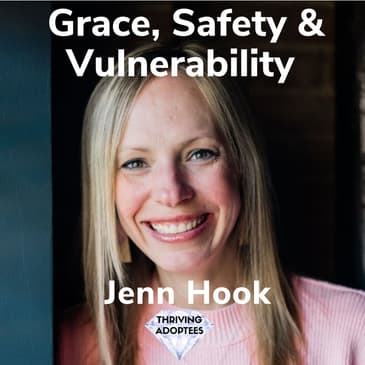
What does thriving mean to you? Everyone has a different definition. One that feels authentic to them. Giving ourselves grace, feeling safe and being vulnerable help us see our true self and being true to who we truly are. Listen to a lovely, deep dive into authenticity.
Jenn Hook, MA is Founder and Executive Director of Replanted Ministry
Jenn received her Master’s Degree in Clinical Psychology from Wheaton College. She previously worked as a trauma therapist for children and adolescents in foster care. She speaks frequently on topics related to adoption and foster care support, mental health, and trauma. She is the author of Replanted: Faith-Based Support for Foster and Adoptive Families, and Thriving Families: A Trauma-informed Guidebook for the Foster and Adoptive Journey. She lives in Dallas, TX with her husband Josh and 2 children.
https://www.instagram.com/jennranter/
https://www.replantedministry.org/
https://www.facebook.com/replanted/
https://www.instagram.com/replantedministry/
Guests and the host are not (unless mentioned) licensed pscyho-therapists and speak from their own opinion only. Seek qualified advice if you need help.
Want to learn more about thriving for you, your kids, your families or your colleagues? Pick a time to talk here
[00:00:02] - [Speaker 0]
Hello, everybody. Welcome to another episode of the Thriving Doctor's podcast. Today, I'm delighted to be joined by Jen, Jen Hook, from Replanted. Looking forward to our conversation today, Jen.
[00:00:13] - [Speaker 1]
Yeah, me too. Thanks for having me.
[00:00:16] - [Speaker 0]
So, Replanted does a whole load of different things to support foster and adoptive families, including an annual conference. And I noticed you've got Isaac Atta talking at this year's conference in October, which is great to see he's been on the show a couple of times, a real great guy and a change maker in the adoption space. So as always listeners, encourage you to look at the show notes and find links to the guests, and to the websites and their socials so you can find out what's going on there. So we'll dive in with the kind of the usual question that we're starting with at the moment, Jen, is thriving. What does thriving mean to you?
[00:01:01] - [Speaker 1]
Yeah, that's a really good question. I mean, I think it looks different for me and for everybody, specifically in the foster and adoptive journey. I think thriving means your family, you've got a good enough level of support around you where you feel like your family is doing okay and you're not just trying to survive. I used to work as a trauma therapist in the foster care system here in The US and just so many of my families felt really under supported, isolated, alone, and my kids felt that way as well. And part of that was just a really big lack of trauma informed awareness for churches and support systems, the school, all of the above.
[00:01:48] - [Speaker 1]
It really left our parents fighting hard for their kids. Then also, sometimes just really unsure how to meet their needs, kids with trauma histories. There's just a lot of unique elements to the adoption and foster journey that you're navigating. When you don't really feel empowered or certain with how to go about those journeys, can be really hard. So I think for me, thriving is really about a family.
[00:02:18] - [Speaker 1]
It doesn't mean everything's going perfectly. There's no behavioral or emotional issues. That's unrealistic. Mean, all of us struggle in various ways with things like that, right? But I think thriving means, you wake up in your day and you feel empowered, right?
[00:02:33] - [Speaker 1]
You feel like, okay, I've got the skills, I've got the knowledge and I've got the support system to come alongside my family, my kids, myself, my spouse, to really help us get through the day in a way that's loving and full of grace and helping our children heal from what they've experienced. So, yeah, that's what I would say for that. I think it looks different for every family. Every child's needs are unique, and there's a varying degree of needs and where kids are at in their process with their stories and things like that. I think that's something that's deeply personal as well.
[00:03:09] - [Speaker 1]
What does thriving mean to you as a parent, to your children, as a family, as an ecosystem, you know?
[00:03:17] - [Speaker 0]
Yeah. So, nice and broad ranging topic, nice and broad ranging description gives me lots to dive into. I guess just looking down on where you said you've got that internal side to thriving, the knowledge and the skills that we have as individuals. And you've got the external aspect as well in terms of the support that we have for ourselves and our families. So clearly Replanted is all about that support, about being that support, the wraparound.
[00:03:59] - [Speaker 0]
People use that word, don't they, a lot at the moment, wraparound. So yesterday I did a podcast and I actually touched on Grace and that you mentioned that as well today. So I thought that would be nice little topic to kick off from within the broad description that you've given. What does grace mean to you, Jen?
[00:04:31] - [Speaker 1]
Mean, Simon, this is the backbone of Replanted. You know, I was working as a therapist in the foster care system, I saw a lot of churches encouraging families to foster adopt and rarely did they show up and say yes to supporting families on that journey. I just saw so many of my families hurting and kids feeling misunderstood or labeled as defiant, bad kids, willful, you know. I think what grace is, and this is really the pillar of our replanted. So for replanted we do replanted groups, and the three pillars for those groups are grace, safety, vulnerability.
[00:05:09] - [Speaker 1]
And for me, means you are loved no matter what. No matter how messy your life is, no matter what your circumstances are, whatever your background is, whatever situation you find yourself currently in, that you are loved no matter what. I think that's a beautiful reflection of the gospel, right? Like Jesus loves us no matter what. There's nothing we can do to be separated from his love.
[00:05:30] - [Speaker 1]
As Christians and just as people in general, how beautiful would it be to show foster and adoptive families that are maybe in the thick messiness of the journey, kids that have maybe really significant emotional and behavioral issues because of their experiences to say, It's okay, I love you. We're here for you, no matter what, you can't push us away. Going to keep showing up for and loving you and checking in on you. I think that's just a beautiful experience. In our replanted groups, one of the things that we want our families to experience is saying here moments.
[00:06:07] - [Speaker 1]
Really what that means is when you share your story with somebody, maybe I'm talking about how challenging this journey has been, or parenting my daughter has been extremely hard, someone says, Same here. I'm in that situation. I've been there too. Right? A lot of times they're just like, Oh, you see me, right?
[00:06:26] - [Speaker 1]
We're best friends now. There's something really bonding about going through a shared experience, but having that spoken language, right? And so you get that with your community, like at a replanted group. So when there's a shared experience, it's easy to give each other grace because you know how beautiful it feels and you know how to give that empathy because you've been there. But the grace goes beyond that, right?
[00:06:49] - [Speaker 1]
And that's really where our support systems and our churches need to come in instead of saying things like, well, you chose this journey or, you know, you signed up for this or, you know, your kids behaviors are too big. We can't support them in Sunday school to say like, We love you no matter what, you are always welcome here. What can we do? What can be our role to help support your family and your children better? I think that's really what we see Jesus do at this time on earth, right?
[00:07:18] - [Speaker 1]
It's just like loving us no matter what. And so, grace for us is just something that's really, really important. Remember we had a woman come to one of our support groups. She was thinking about relinquishing the rights to her teenage daughter because they were just in such a pain spot, significant safety concerns in the home. They had to lock away knives and she had just felt like she had done everything.
[00:07:48] - [Speaker 1]
It was in this place of desperation and came to a replanted group. I think a lot of times when we hear that, there's situations where we're like, Oh gosh, that sounds really hard, and then a lot of times we are we don't wanna see families broken apart, right, too? And so we what can we do to support you? Or how you know, we wanna try to stop that from happening. I said to our leaders, I said, the first thing we need to say to a parent that's in that situation is we love you no matter what, and you are always welcome here, whatever you decide.
[00:08:18] - [Speaker 1]
Right? That's grace. Right? Like a family that's in that position, that's not something you a decision you make flippantly. It's not a decision that you're like, yeah.
[00:08:27] - [Speaker 1]
Actually, this is too hard. I'm just gonna throw on the towel. You've been in a really painful spot for a very long time and you've gotten to this place where you feel totally desperate and feel like that's the only way out. When you can understand that place of vulnerability for a family to come in, and there's shame around that. Even thinking that for a parent a lot of times is like, I have failed.
[00:08:49] - [Speaker 1]
I have let this child down. There's so much shame there. Right? But when you can step in and say, We love you, right? And meet that shame with grace, I think it's just the most beautiful expression of love.
[00:09:02] - [Speaker 1]
I think it's an expression of Jesus' heart. And it's my hope that foster adoption community will just embody that in a more whole way, especially support systems and churches and schools coming around our families. That grace would always be a pillar.
[00:09:18] - [Speaker 0]
Yeah. One of the things I touched on in interview the yesterday was kind of grace for one another, but also grace for ourselves. I think that can be, I don't know, can that be tougher? It kind of seems to me to be tougher, grace on ourselves is tougher than grace for Yeah, us
[00:09:48] - [Speaker 1]
I think because of probably our past experiences too, right? And I think sometimes, I grew up on a farm in Canada and we didn't talk deeply about things. And I think there is this element of you need to earn, If I'm a good Christian, things will work out for me. There's these platitudes and things that aren't true that we really do start to believe. I think it is hard to give ourselves grace.
[00:10:17] - [Speaker 1]
I think it's easy to hold on to the shame or the ways that we've failed, instead of saying, like, it's okay, you know? I think it is sometimes easier to give other people grace more than it is ourselves. Anne Boothcamp, I'm not sure if you guys are familiar with her. She's a Canadian writer and she has this quote that I love, she says, shame dies when stories are told in safe places. And I think that's how we give ourselves grace, is to be fully vulnerable.
[00:10:47] - [Speaker 1]
A lot of times we don't experience grace fully because we only go so far with our story, right? Our story is too big, we don't want to overshare, it's too much for people, and sometimes because it feels almost embarrassing, right, our stories, but when we can share fully our story and receive grace from others, I think it's easier then to give ourselves grace, right? I think that's the beauty of community. We're not meant to do this alone, and so I think when we're wrestling with the inability to give ourselves grace, getting it from people that you trust and care about and can care for you well, can be a good model of them getting yourself to a place to allow yourself to give it to you and receive it.
[00:11:33] - [Speaker 0]
So, it's a bit like, is it a bit like Other peoples see our strengths before we do. So if they give us grace, then maybe we'll give ourselves it easier. It comes from outside first, is I guess the question or the suggestion. Yeah.
[00:12:05] - [Speaker 1]
I think I think it can be that way. Right? I think that's the power of, like, a church community as well. Right? When you can be this, like, the hands and feet of Jesus to one another, I think that's where you can experience a lot of grace and have that modeled to you.
[00:12:21] - [Speaker 1]
Then I think it's a little easier for you to internalize that and to try to give yourself grace in situations. Because, you know, the day to day parenting, right? We're not going to do it perfectly. There's times where I've responded to my daughter. I've got a five year old and a two year old.
[00:12:38] - [Speaker 1]
And goodness, they have so much will at that age. So there's times where, even as a therapist, I will respond to my daughter and I'm like, I can't believe I did that. I never thought I'd be a parent that would say or do these things. And I've found myself in this place of anger and just yelling, right? And I'm thinking to myself afterwards, I know better.
[00:13:03] - [Speaker 1]
Like, I've got some decent amount of tools. I used to be a child therapist. I think Grace, And I mean, you can catch Grace in those moments too. Grace looks like repairs, right? To say like, Hey, Autumn, I didn't handle that very well and I'm so sorry.
[00:13:21] - [Speaker 1]
I don't wanna yell at you. I was feeling frustrated, I shouldn't have taken it out on you. I think when you can kind of step back and then realize, God gives that to us all the time. Saying like, Hey, it's okay. We get readers in life all the time.
[00:13:41] - [Speaker 1]
We get to do repair and forgiveness and reconciliation as part of our relationship. And I love you no matter what. I feel that way with my children. Right? And so if Jesus is giving that to me and I can give it to my family, why can't I give it to myself?
[00:13:57] - [Speaker 1]
Right? And so I think that takes a level of vulnerability, right? And a willingness to say, Okay, I'm gonna receive that, and sit in the discomfort. The push in too, I think, a therapist, right, I worked with a lot of birth parents who were trying to reunify with their children, and they were coming from really sometimes very messy backgrounds, substance abuse, domestic violence, various things. As I heard their background and their stories and the pain that they were coming from, of course, feels hard.
[00:14:35] - [Speaker 1]
Sometimes we think we deserve it. We deserve what we get and the outcomes that are happening to us, or I'm not a good enough Christian. These are just lies, I think, that just get us off track. I think stepping into why does grace feel hard for you to receive? Why can't you give yourself grace?
[00:14:55] - [Speaker 1]
Exploring that more deeply is an internal question that we need to really dive into and come to terms with to see what that block is about. Yeah. Is it something you just believe? Is it something you were taught? Like, you know, maybe as part of your religious upbringing, you know, what kind of what is that source and unwillingness to receive grace?
[00:15:18] - [Speaker 1]
I think when you can shed light on that, then you can start to move forward.
[00:15:23] - [Speaker 0]
Do you have a name for that gap between what you know and what you do?
[00:15:31] - [Speaker 1]
I don't. Do you Simon? Yeah.
[00:15:36] - [Speaker 0]
Me neither. I
[00:15:42] - [Speaker 1]
think just being a work in progress, right? Think all of us are a work in progress and it's kind of awareness, right? When you can bring maybe something that you're resistant to or feel reactive to, when you can identify it, you've brought it into awareness. And when you're in that awareness phase, that's really where growth can happen. Right?
[00:16:05] - [Speaker 1]
That's really the launch pad. And so, yeah, I don't know if there's an official name for it, but yeah.
[00:16:16] - [Speaker 0]
This is an unusual one, it came to me. What's the opposite of grace?
[00:16:29] - [Speaker 1]
Good question. I would say judgment, shame, embarrassment. Yeah. Do you have any any ideas you have to ask or any words that came to your mind?
[00:16:47] - [Speaker 0]
As you were thinking, I was thinking being hard on ourselves. And then, and you said judgment, which is one word for my four, so that's great. And as you said judgment, you know, I was thinking about the, know, is it do people call this, it's the old testament version of God as angry, Yes,
[00:17:23] - [Speaker 1]
exactly. Yeah.
[00:17:25] - [Speaker 0]
And you talked earlier on about this shouldn't be happening to me if I'm a good Christian something like that. Is the New Testament version of God or a more modern version of God or Jesus that's less judging? Where's the shift? Why do we think of an Old Testament version of God as wrathful and angry and judged. Where's life moved on from there?
[00:18:10] - [Speaker 1]
I think it's with the death of Jesus. God didn't send Jesus back to the earth because he's like, hey, you guys all pulled it together good enough that I'm gonna do this for you, this significant act of love for you, right? Like Jesus showed up regardless and said, Hey, I'm gonna die for you. And it's the biggest act of love. And I think in that too, we experience God in a more human way, right?
[00:18:41] - [Speaker 1]
Because we see a God who experienced the fullness and the range of emotion that we, in made in his image, experience, right? Like, with the death of Jesus, you see, you have a God that's gonna experience the most pain that anyone could experience with the death of his son more significantly than the pain he'll ever experience, right? And then with the resurrection of Jesus, we have God experiencing the most beautiful reconciliation and joy of redemption with his earth and creation. And that joy is probably more full and complete than we could ever experience on earth, right? And so I think there's a, in the New Testament, we see more of a humanity God and being made in his image, I think.
[00:19:34] - [Speaker 1]
But I will say, like Simon, I think, I grew up like, I better not do anything to tick God off, right? He's gonna judge us and he's gonna be mad and don't do anything wrong. And so when I did something wrong, it felt terrible. And I think as I've matured in my faith, that has shifted. And I think the ways that I can give myself grace more is because I want my kids to be able to do that.
[00:20:06] - [Speaker 1]
And my kids are gonna model what they see, and so if I'm gonna give them grace but I can't give it to myself, they're not gonna do that either as they grow up and transition into teenagers and adults, right? They're going to internalize and be hard on themselves, right? In the same way. And so I think it sometimes kind of pushes me, right? Even if I feel like, ah, deserve this or grace feels hard.
[00:20:33] - [Speaker 1]
It's like, need to continue to be open to it. I want my kids to see that and have it modeled to them that we serve a loving God and there's nothing that we can do to be separated from him. If they see me modeling that in the most painful moments of my life, what does that look like when they experience painful moments? Because those are coming their way, we can't avoid it.
[00:20:58] - [Speaker 0]
Yeah, the modelling word was at the back of my mind about three seconds before you said it. And my wife and I haven't got any kids, so I'm sometimes reluctant to dive in to the parenting aspect of adoption and podcasting. However, on this occasion maybe I can ask a question from somebody that is a mum, that is a parent. To what extent is parenting about modeling?
[00:21:42] - [Speaker 1]
Oh, I think that's almost all it is. Yeah. No. I mean, it's it's a lot of modeling. You know, I think we're all just, we typically raise our kids based off of how we were raised as kids, right?
[00:22:01] - [Speaker 1]
It's kind of our default, right? And there was really great things that my parents did as parents that I love and I hold onto and I wanna instill that into my parenting. There's things that I hated and didn't enjoy or wanted to do better or that were just totally lacking in their parenting repertoire. I think part of that was modeling vulnerability. My parents were very stoic.
[00:22:25] - [Speaker 1]
You don't show emotion. The deepest conversations we typically have are talking about the weather. That was something that I We have a lot of fun together, though. My parents, we have a great time. Fun is a big part of our family dynamic, but with my kids, I said, okay, there's elements of things that I enjoyed about my childhood and what my parents showed me.
[00:22:54] - [Speaker 1]
Then I also want to show them more. I think kids learn through modeling, right, and connection, and seeing and looking to the people they trust. If I can show my kids, hey, if I mess up, it's okay for me to say that and to own it and to seek a repair. That was something, when I was a kid, I didn't experience a lot of. My parents rarely apologized.
[00:23:18] - [Speaker 1]
I almost would dare say never apologized when they were in the wrong and it was kind of you just moved on and pretended it never happened. For me, it's really important that I model what it looks like to own a mistake and to apologize. I've been doing this to my children as early as they understand words, when I feel like I could have done something better. I think modeling, I want them to see how I interact with peers and friends and how I talk and communicate. They're watching, right?
[00:23:55] - [Speaker 1]
They're very impressionable. When they're young, especially, you're their world, right? And they trust you the most. And so you have a really strong influence on what that looks like. I think with modeling, it means having integrity around who you are as a person what values your family holds that you want to be aligned with.
[00:24:20] - [Speaker 1]
Right? But I think it's a lot of modeling. Modeling. What
[00:24:29] - [Speaker 0]
does in the crisis moments, in the meltdowns, the moments that we're finding it hard, We're finding it really, really tough to keep calm and carry on. Do remember that meme before? I think it was before the pandemic, wasn't it? Keep calm and carry it.
[00:25:03] - [Speaker 1]
In
[00:25:07] - [Speaker 0]
crisis moments where things are really going off.
[00:25:15] - [Speaker 1]
And
[00:25:18] - [Speaker 0]
we wanna be that peace. We want to be able to not react to their reaction.
[00:25:35] - [Speaker 1]
Right, yeah. That's hard to do. Yeah.
[00:25:40] - [Speaker 0]
What have you learned around that?
[00:25:43] - [Speaker 1]
Yeah. That's a really
[00:25:44] - [Speaker 0]
good point. For ourselves when we lose it, I guess.
[00:25:48] - [Speaker 1]
Yeah. I think I mean, I've been on both sides of that equation. You know, I I'll tell you I'll tell you a couple stories. When I was still working as a trauma therapist, I had this little girl, she was seven years old, that came into care. Her parents were abusing substances.
[00:26:08] - [Speaker 1]
She really wanted to go home to them. They were missing visits all the time because of their drug abuse and they were just really struggling. She was placed with a kinship placement with her four siblings. And then it was just too much for that kinship placement. There was a lot of children in the home as a result and they said, We
[00:26:32] - [Speaker 0]
can't
[00:26:32] - [Speaker 1]
do it all. We would love to, but we can't keep all four of the kids together. And so my kiddo got separated from two of her siblings. So when we look at these are all trauma experiences for a child, right? So she got to this place where she moved into a stranger's home with one of her siblings, got separated from two of her siblings and one of them whom she was very, very close to.
[00:27:00] - [Speaker 1]
So it was a traumatic separation for her. At this point now, I'm the only person in her life that's been around for a year. Everyone else is new in her life. She just spiraled. It makes sense when we understand our kids, their brains and bodies aren't ready for big things like this.
[00:27:26] - [Speaker 1]
I can barely handle really hard grief experiences as a 41 year old adult that has a fully developed brain and the ability to understand how to cope and use my skills. And so imagine a seven year old that's put into all these situations and experienced all this grief and loss in her life, and of course she's not doing well. And so she spirals into It was really heartbreaking. She got into a really, really bad place. And I was working with her and I remember this one time she came to my office for counseling and we had our session and then it was time for her to go home.
[00:28:10] - [Speaker 1]
The caseworker came to pick her up to take her back home and she just was refusing to get in the car. So I'm using all my therapeutic tricks, right, to try to help her. Giving two choices, we use a lot of trust based relational intervention over here, which is a really great resource to help kids with trauma heal through relationship. We finally agree that I can carry her to the car and put her in the car. Now, one thing that's important to know is she had earlier taken off her boots because they were hurting her feet and it was the middle of winter And so she didn't have shoes on.
[00:28:48] - [Speaker 1]
And so I get her to the car, I'm holding her shoes and I brought her to the car and we open the car door and she loses it. And she starts hitting me and kicking me in the face and she's wailing on me. I can't put her on the ground because it's covered in snow and she's got just socks on. So she continues to wail on me until we get back into the building and I put her down and then she runs into my office and gets under my desk. Just being fully transparent, I was not happy.
[00:29:19] - [Speaker 1]
Right? I've just been assaulted, you know? And I'm literally shaking at this point. And the last thing I want to do is help her. So I had to take a moment where I stepped into another therapist's office and I had to take some deep breaths because I knew I was going to have to reengage with her but I was feeling so frazzled by what had happened.
[00:29:46] - [Speaker 1]
Then I had to remember she is seven and with her trauma, she's functioning at more of a three to four year old level. She's experienced some of the hardest things a seven year old could ever experience. Her getting into a car is another separation from somebody she cares about and trusts, which is me. That's a trigger, Cars take me away, I might not see people I care about again. So when I could reframe what was going on there, I was able to walk back into my office.
[00:30:21] - [Speaker 1]
She was hiding under my desk and I just crawled under the desk with her and I sat there with her. I validated her feelings. Sounds like you're having such a hard time and you don't want to go home. I wonder what's going on there. Reminding her, I'm here for you.
[00:30:39] - [Speaker 1]
You are going to come back here and see me again in a week, you know, just trying to give her as many affirmations as we could and help her cope and deal with her feelings. And that sometimes is hard to do, right? You know, I've had situations with my daughter, right, where we she blows up and then there's part of me that's like, I know you've got the skill set, right? And you're just refusing to do something or something you're capable of, and this is super frustrating. And so there's times I think where, as a parent, can model trying to cope and deal with our feelings or to vocalize it.
[00:31:15] - [Speaker 1]
Like, mommy's starting to feel really frustrated that you're doing this. I need to take a minute to calm myself down, and showing kids what to do with big feelings. And I tell my daughter too, like, it's okay to feel really mad. It's not okay to hurt somebody when you're mad, right? Mommy feels mad too sometimes and try to model that.
[00:31:38] - [Speaker 1]
But one thing that I've gotten in the habit of is when I do lose my cool and I get really frustrated with her, for me, I feel this responsibility of like, I'm the adult in this relationship. You know, like she's still doing imaginative and creative play and thinks like maybe she could fly if she put on set of fairy wings, right? So like, it's, you know, we're not, she can't, you're not gonna be like, Oh, I'm gonna use a coping skill and take a deep breath right now. Like that's not always gonna happen. And so as the adult, I feel the responsibility to do the repairs with my kids.
[00:32:12] - [Speaker 1]
So I'll come in and say, with my kids, especially when they've lost it, I don't try to do any coaching or teaching. So one of the things we know and as a therapist, I know like when child gets deregulated, the only goal at this point is to calm them. They are not going to hear you, any threats, any consequences that you're going to try to dish out, it is not going to matter because that part of their brain is shut off. It's in the frontal lobe, higher level executive functioning, it's where their language skills are, all of it. And so their amygdala has taken over.
[00:32:47] - [Speaker 1]
At that point, as a parent, you've got to just stop and realize you've got to help your child co regulate. It's what we do with babies, right? A baby cries and we go and we rock them and we coddle them and we tell them they're beautiful and we tend to their cries and we sing their songs. We still need to do that with a four, five, six, seven, and sometimes older, right? Especially kids with trauma, they're not a 14 year old.
[00:33:11] - [Speaker 1]
Trauma cuts the age at half by about seven. So your 14 year old looks 14, but is functioning more like a seven year old, right? What would you do to help co regulate a seven year old? So in those moments, a lot of times I'll do re dos with my kids once they've gotten calm, like, Hey, we had a hard time with that scenario. Let's try it again and then end on a high note.
[00:33:31] - [Speaker 1]
And I'll do that with myself. So I'll come into my daughter's room and say, hey, sweet girl, you know, I think mommy needs a redo. I did not handle that very well and I wanna try again. And I show her that and it's, Simon, I will tell you, it's some of the funniest things. My daughter now will come if we've had like a break or she was having a hard time doing something and totally melts down.
[00:33:56] - [Speaker 1]
Once she gets calm, she's actually come to me and said like, mommy, can I try again? And like she's, because we've done it and rehearsed it as a family, it's language. Part of And like as a three year old, one of my, the sweetest moments I had with my daughter, she's having a really hard time going to bed, refusing to put on her pajamas, like do all these things. And like bedtime for a lot of kids as a separation, it's really hard, right? And the meltdown was unbelievable.
[00:34:21] - [Speaker 1]
And I was even trying to co regulate her and she was just not having it. And we were, it was rough. It lasted for about forty five minutes. And then we got to this point where she was able to calm down, and then I was like, Hey, sweet girl, can we talk about what just happened? And then I just said, Hey, and we had just had Caleb come into our family, and so I was like, I wonder if you're feeling a little bit jealous because Caleb's here and you're wanting more time with mommy.
[00:34:50] - [Speaker 1]
And we started talking about stuff. And I'm telling you, was the best conversation we've ever had. And then as a three year old, like she's been talking for less than a year, right? Says to me, Hey, thank you so much for talking with me about that, all of that. You're the best mommy.
[00:35:12] - [Speaker 1]
It just was so meaningful to her that once we were able to do a repair and talk about it all, that connection had been reestablished. And so, I think it looks different when our kids are in the biggest meltdowns of their lives. Sometimes as parents, we're able to recognize what's going on and try to hold it together and take care of ourselves to step into our child's calm. I will say a deregulated parent is not going to calm down a deregulated child. That never ever, ever in the history of the world will work, right?
[00:35:42] - [Speaker 1]
A calm parent can help calm a deregulated child though. And so sometimes we can do that, right? And then sometimes we've had a rough day or this is our tenth meltdown of the day and we're fried and we don't handle it well. And I think that's where, what are those family rhythms that you thought? Like, do reduce and we do repairs and now I see it.
[00:36:04] - [Speaker 1]
Now that my daughter's five, she initiates this, some of this stuff, which I think is just so cool. So it's not perfect. Please hear, there's no judgment for me on this side. There's been times where I'm like, I nailed it. That was really good parenting.
[00:36:19] - [Speaker 1]
I just did. And there's other times where I'm like, I can't believe I'm a parent. I suck. Like, you know, I feel that range.
[00:36:26] - [Speaker 0]
There's a lot of humor and you can probably hear the smile in Jen's voice, right? You can probably hear that. There's a lot of humor in your grace.
[00:36:41] - [Speaker 1]
Yeah. That also might be a defense mechanism maybe. But yes.
[00:36:48] - [Speaker 0]
It doesn't feel like a defense mechanism. Maybe a therapist would say it's defence mechanism. It doesn't feel like a defence mechanism for being on the receiving end of it.
[00:36:59] - [Speaker 1]
Yeah, well that's a kindness. Thanks Simon. I appreciate that.
[00:37:04] - [Speaker 0]
Totally. Yeah, we're not very good at taking compliments, are we? Giving and taking compliments.
[00:37:13] - [Speaker 1]
Yeah, true.
[00:37:17] - [Speaker 0]
I've got a little story for you on that. It's nothing to do with parenting and nothing to do with adopt or anything. But we were talking about holidays before, sorry, vacations as you would call them.
[00:37:30] - [Speaker 1]
Oh no, I call them holidays because I'm Canadian. Live in The US but yeah, I wear, at Celsius holidays. I've got you. Yeah. Okay.
[00:37:37] - [Speaker 0]
I I didn't know Canadians did call them holidays. Oh, there we are. Mhmm. Yeah. Yeah.
[00:37:43] - [Speaker 0]
We we met some people on holiday, and we'd seen them during the day, and then we saw them at at night. And this woman had a dress on, I said, I love the color of that. Love that dress, love the color of it. And she was like, what? Well, I had a shirt similar color to that years ago.
[00:38:13] - [Speaker 0]
It kind of reminded me of it. I bought that shirt because it was a nice color, seeing that color there, I think it looks really great. And she was like, the look said, are you for real?
[00:38:26] - [Speaker 1]
Right, yeah.
[00:38:30] - [Speaker 0]
And I had another go and then I gave up, I just thought that she's not gonna feel that. She's not gonna receive this. She's not gonna receive this compliment. The barrier was up and
[00:38:47] - [Speaker 1]
yeah,
[00:38:50] - [Speaker 0]
it's yeah, a dress. It was in a nice colour. One of the things that I sometimes talk about when I'm doing training for parents on how adoptees feel, right, so I'm not telling them how to parent, I'm just sharing some of the wisdom that I've learned along the way from other adoptive parents, and one of the themes is not taking our kids' trauma personally. Go further than that, if I'm talking to a doctor parent, trauma isn't your fault. Your kid's trauma isn't your fault.
[00:39:40] - [Speaker 0]
It's not. It before you.
[00:39:45] - [Speaker 1]
Right.
[00:39:46] - [Speaker 0]
It happened before you.
[00:39:50] - [Speaker 1]
I think too, that's what's so tricky. A lot of times parents are addressing trauma that they did not create, but there can be some significant emotional and behavioral responses from kids as a result of those experiences. And then, what I see is sometimes the hardest is when parents anticipate kind of the classic parenting skills to be effective. Like, you know, I was kind of raised as like compliance is the goal, right? Like, if my parents say something, I need to do it, you know, and if I didn't, then there'd be a consequence, right?
[00:40:27] - [Speaker 1]
And that's great for a child that's grown up in a kind of classic or standard environment that didn't experience a rupture relational trauma. But for kids who have that, that doesn't work, right? It just turns on their amygdala, their fight, flight or freeze response to their brain. Phil Simon, like that example of that girl, she's punching me and kicking me now. Could have got her back into the office and then just then like, that is unacceptable.
[00:40:55] - [Speaker 1]
You do not treat people that way. And I put a railed on her, right? And it wouldn't have done anything. It wouldn't have helped her heal. And because I didn't, I needed to understand what I was responding to, right?
[00:41:09] - [Speaker 1]
Like this isn't a bad child. She's a precious child and she's had some really hard experiences in her life. And when they can understand what was triggering her, it wasn't about me. I know she didn't wanna hurt me. She cared about me, you know?
[00:41:24] - [Speaker 1]
The amygdala took over and off she went. Are you familiar with Karen Purvis? Is that a name that's familiar? You're bearing Karen Purvis. So, I got to be trained by her in 2014, I think, or 2015.
[00:41:50] - [Speaker 1]
We're the lady of all time. Was like, I wish you were my grandma. But one of the quotes I love that she's got is like, we can be in such a hurry to give a child consequences and forget we're teaching them to do life. And that's something I really hold on to is like, especially as I kind of have that narrative in my mind, and I don't fault for this, right? It's normal, right?
[00:42:16] - [Speaker 1]
You're the parent, you're in charge, and you want your children to grow up to be constructive members of society, right? And you're trying to set them up for success. Like this all makes sense to me. And our kids are coming to us with really big hurts, like, when we step into that space with them, you know? Yeah, Simon, I'd be curious to hear more about what you what you encourage parents or what what Yeah.
[00:42:41] - [Speaker 1]
You know?
[00:42:43] - [Speaker 0]
I'm trying to get them to an insight.
[00:42:51] - [Speaker 1]
I
[00:42:52] - [Speaker 0]
think until we change, nothing changes, right? One of my things on this is that people say time's the greatest healer, but if there's no change over that time, there's no healing. It's not the time that does the healing, it's the changes, it's the insights, it's the things that we see differently. So I'm to create a space for insights. But I can't, there's no such thing as a secondhand insight.
[00:43:56] - [Speaker 0]
We have to have them for ourselves, it just doesn't work. Can't force somebody to see it, to have an insight, whether that's an adult that we're talking to, I couldn't force that woman to see what I said as a compliment. She thought it was a Mickey take, to put it politely. She thought it was a criticism, I was playing fun, I was making fun of her, I was criticising her, whatever was going on. I couldn't make her see my compliment.
[00:44:38] - [Speaker 0]
She saw a criticism. The shift has to be internal. Time isn't the greatest healer, insights are. And you talked about validation earlier on, and in that space with that little seven year old girl that was losing it, it was all about the validation. You shared the teachable moments for a later date.
[00:45:27] - [Speaker 0]
And your wisdom told you what to do in the moment. There was a little, And you talked about setting in a, stepping into another office. I remember a thing that happened to me in lockdown. I sensed, I overreacted to something from my wife and then I think I overreacted again. And then I just thought, okay, I've got to get out of here.
[00:46:02] - [Speaker 0]
And I just went off for a walk. But that's wisdom in the moment telling you, it's a just in time thing, wisdom, it comes to us in the moment and so when we're doing all this planning, we don't have the benefit of insight in the moment, we don't have the wisdom in the moment, and when we know what to do, That is the wisdom that's going to get us through. We can't plan wisdom. Like we can't plan an insight. People, I come up with these really strange questions, you know, and parallels, okay, so I hear healing, We're always, some adoptees, adults, adoptees, some people don't like the word healing, but it's kind of the best that we've got.
[00:47:10] - [Speaker 0]
So, okay, so where are we wrong? Where is society wrong? Incorrect, right? It's incorrect in saying that time is the greatest healer. No, not at all.
[00:47:26] - [Speaker 0]
No, it's change. So if we're brought up to expect, know, we're brought up by parents to expect compliancy, and then we model, we try to teach our kids from who have had it at ACES, you know, and advice charting. If we expect from them. So we have to it's got to be about a change our expectations.
[00:48:02] - [Speaker 1]
Yeah. Well, and like another Karen Purvis quote, we can't bring a child to a place appealing we've never been ourselves, right? Like, if we're not willing to do the work and identify our rough edges, right, it's gonna be really hard to get our children there. And that's true for attachment as well, right? It's like, you're not a securely attached adult, it's hard to raise a securely attached child, right?
[00:48:25] - [Speaker 1]
It won't happen. And so there is an element, right? There's always this tension, I feel, right? Because I get, I work with parents a lot and I do talks on defiant children, especially from a trauma lens and trying to help them understand it's deficit, not defiance, right? And there is an element, I'm sure, as a parent, right, where maybe some of you are listening right now, I'm like, I've been doing strategies all the time with no change.
[00:48:53] - [Speaker 1]
I just feel like it's my parenting now. Like there's something going on with me, right? That we're not seeing change. But it's a both end, right? There's also like growth that's happening for your children and for you and it's not linear, right?
[00:49:15] - [Speaker 1]
I think we always expect this like, grief, loss, trauma, we're gonna see it's gonna go up into the right on a regular basis and that's just not real life. And it can be two steps forward, 12 steps back. Think it's just being in it together. But yeah, there is an element too where it's like, okay, what's mine to own and what's not mine to own? Like, you gave a compliment, that's a kindness, right?
[00:49:43] - [Speaker 1]
But there was a block for the person receiving it, right? And we call it sharp music, right? Like what's going on in your head where you interpret things kind of in a negative light, like all your experiences come through this filter of like your shark music playing, right? It's like if you attach shark music to a shark theme, that makes sense, right? Or maybe if you have shark music to a beautiful scene of a campfire with friends, right?
[00:50:07] - [Speaker 1]
That's a bit of a mismatch, right? And so there's stuff, right, where it's like, you gave the compliment, but there was a block for her and that's more about her stuff and not yours. A lot of times we take it on as ours as well. And so, I'm not even sure where I'm going with that, but I think, I love personal growth. I'm a therapist, I did my own counseling for years just because I think it's good work and good practice to do.
[00:50:35] - [Speaker 1]
Makes me a better spouse and mom and friend and leader. But yeah, it's hard. Hard work.
[00:50:48] - [Speaker 0]
Yeah. Feels like a great place to bring it in, Jen. Yeah. Is there anything else you'd like to share?
[00:51:01] - [Speaker 1]
No, I can share some of our resources finally, would that be helpful?
[00:51:05] - [Speaker 0]
Think Well, they're all on the website, if you wanna
[00:51:07] - [Speaker 1]
They're on the website, great.
[00:51:09] - [Speaker 0]
If you wanna point anybody at anything particular on the website.
[00:51:13] - [Speaker 1]
Yeah, I mean, we've got our two books that I think are really helpful, Faith Based Support for Foster and Adopted Families, and then A Trauma Informed Guidebook. And what I love about the Thriving Families book is it's not just trauma, it's all the other uniquenesses about the journey that families might encounter, being a transracial family or navigating birth parent relationships. How do you talk to your child about their story? So it's like a holistic approach. But one invitation I would love to extend to any listeners is we have this conference that's more like a retreat than a conference, that's specifically to support foster, adoptive, and kinship families.
[00:51:51] - [Speaker 1]
We have voices of adoptees, and foster alum, and birth parents, and it's just a really nurturing conference that also has lots of practical tools. If you're also listening, like, how do I support my child or help them through their experiences? There'll be a lot of that in it as well, but you'll also just get lots of emotional, spiritual support. Obviously, we hope that in The US, so you're probably thinking, Well, I'm not gonna come to The US, which is totally fair. But we simulcast it, so you can sign up to watch the virtual event and access all of the materials that way as well.
[00:52:24] - [Speaker 1]
So, if that's something that would be helpful, we'd love to have you participate.
[00:52:28] - [Speaker 0]
Brilliant.
[00:52:29] - [Speaker 1]
Yeah.
[00:52:29] - [Speaker 0]
Brilliant. Thanks, Jen, and thanks, listeners of speech conditioning. Okay. Bye bye.