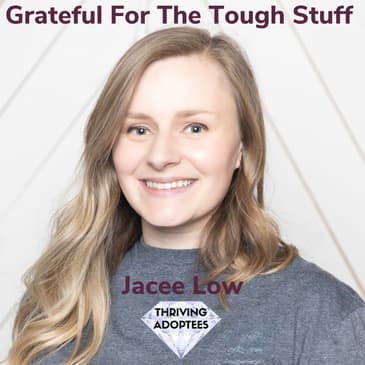
Tough stuff feels, well, tough. But with hindsight it becomes clear that the tough stuff prompts our biggest learnings. What if we could see the gift of the tough stuff earlier? Be more grateful for it when we are in it? Listen in as adoptive mom Jacee shares her insights on grace, grief and learnings. Powerful.
Here's the interview with Jacee's mother.
https://thriving-adoptees.simplecast.com/episodes/our-spirit-isnt-traumatised-with-dana-hargus
Guests and the host are not (unless mentioned) licensed pscyho-therapists and speak from their own opinion only. Seek qualified advice if you need help.
Want to learn more about thriving for you, your kids, your families or your colleagues? Pick a time to talk here
[00:00:02] Hello everybody, welcome to another episode of The Thriving Adoptees podcast. Today I'm delighted to be joined by Jacee. Jacee, I'm looking forward to our conversation today, Jacee? Yeah, I am too. Fantastic. So, Jacee's mum came on the show a couple of months back, Dana, and so there'll be a link to that in the show notes if you want to find out more about Jacee's mum.
[00:00:27] So, Jacee grew up with adopted siblings and you're also an adopted parent, right? Yes. Yeah. So, lots of depth and lots of different perspectives to explore this subject of ours from today. So, when you hear the word thriving, what does that mean to you, Jacee?
[00:00:55] Um, thriving would, for my house, would just be peace. Everybody's doing well and we're not having any major, major problems. I just think thriving for us would just be like everyone's doing really well. Yeah.
[00:01:19] And we've just been, we're recording this on the run up to Christmas time. Uh, I'm imagining like, it's not going to be that peaceful at Christmas time for you. Well, You've got a nine month old. Yeah. Yes. Yeah. I, um, I don't mind loud. That wasn't, I guess when I said peaceful, I don't mean quiet.
[00:01:41] I just, um, everybody is getting along and nobody has any major problems that we're trying to work through. Um, or we've maybe been able to deal with a lot of those major problems. I don't mind the noise. People are astonished at the level of noise in my house. But that actually, I do pretty well in that environment. I guess I'm just used to it with there's five boys in my home. So.
[00:02:09] Right. Yeah. That is going to be noisy. I'm, I'm, we're not used to that. Right. So I'm not used to that. So I'm the guy that, you know, when I'm reversing, you know, I'm reversing the car, I turn the radio down because it's. I do that too, though. Do you? Yeah. I have to tell everybody to be quiet for a minute.
[00:02:31] Right. You get over, maybe we both get over, over stimulated. Right. So five boys. That's, yeah, that's a handful. It is. That's a handful. They're pretty wild. But Peter, so you're, you're at peace with a little bit of wildness. Yeah. Or a lot of wildness.
[00:02:51] I think you have to be in order to enjoy your children. I think you have to be okay with it being not always crazy, but to be able to be okay with it being loud, or maybe messy, which I do struggle with sometimes with the messy part. But if it's like if you don't accept that as part of having kids, you don't enjoy them as much.
[00:03:18] No. No. And was it, was it loud growing up? No, it wasn't. No, I, my home was very quiet and my husband's home was extremely loud. I remember one time his mom telling me, so he, my husband plays the drums and his brother plays the guitar. And his mom told me one time that he was playing the drums in his room. His brother was playing the guitar in the other room.
[00:03:47] And his dad had the TV turned up so loud so he could hear it. And the walls were shaking and a picture like fell off the wall. So we were two different worlds growing up, even though we both had a few siblings. My home was very quiet. Yeah. So I, I will, I've grown accustomed to the loud. Yeah. And how, what, I mean, you just, was there a turning point? Was there a turning point?
[00:04:16] You thought I'm just going to have to accept this or what was the, I mean, you didn't, not all, not all the boys arrived at one time, right? Right. No. So talk us, talk us through how the family formed, because it's an interesting one, right? It is kind of interesting, a little long. I'll try to shorten it as much as I can.
[00:04:37] So after my husband and I got married, we began, I was 19 and he was 20 and we began helping care for a close family friend's daughter who was two. And there's some negative experiences in their family. And then finally, she was taken into the DHS custody.
[00:05:03] And we knew that we wanted to take care of her because we had already, we loved her and we'd already been taking care of her. So we worked to get approved, our home approved, and we were able to take her. They normally don't approve that for people under the age of 21. But since we had already cared for her, they allowed us to go ahead and take her. As a foster, as a foster. Yeah. Mm hmm.
[00:05:31] And as soon as we turned 21, they called us. As soon as I turned 21, they called me to take more kids because they couldn't give them to me before then. So the little girl eventually heard her family kind of got things together and she was able to go back home and be with her family. And the like few days after I turned 21, they brought me to children, which are two of my children now. Yeah. And we began taking care of them, a boy and a girl.
[00:06:01] Um, they were three and four at the time. Um, and through that experience of, um, just, we had already had the experience of, of loving somebody else's child. And, and I feel like we did a pretty good job. I really feel like my mom helped me a lot. Um, but it just, it went pretty well.
[00:06:27] And as time kept rolling on, we had a few other kids come and go, um, through foster care. And then we got our oldest daughter who was 10 at the time. And a lot of people told us we were crazy for that because we were so young. Um, but we just really had peace about it. I, I prayed about it. I'm a Christian and I just really felt a lot of peace about that.
[00:06:54] And, um, she, she came to our home and it just, it just felt like it was how it was supposed to be. And right after that, I found out I was pregnant. So we went from zero to four in less than a year, um, or I guess about a year because, and my, my son was born the following summer, my young, my at the time, youngest son.
[00:07:21] Um, and then the year after that is when all three kids got adopted. Then we had one other child who lived with us for a while after that. And then that was kind of the end of our foster and adoptive journey. Yeah. So I want to take you back a bit. So you, you're, um, you've taken in this two year old, uh, girl who, uh, to fostering and then she's reunited.
[00:07:50] So how did that, how did that impact you? I mean, had you, had you thought that, that it was going to be a reunification or do you thought that it was going to be a fostering? There were times that I did not think so because of things that were happening and things that, uh, the Department of Human Services were telling me, like, there was just different things going on that made me think that there was a chance that she might stay with us.
[00:08:21] And when she left, it was very, very hard for me. I, I, I, I believe it was hard for my husband as well. But, um, the time that we had her and the time that we had the other two kids overlapped. Right. So we just already had a lot going on. So we didn't, we did not really grieve it the way that I think looking back, we probably should have.
[00:08:49] And then it was just really, uh, emotionally scarring for me. Um, but I didn't really know that I was, I kind of went into a little bit of a depression. I didn't realize it at the time. I was able to look back and see that. Um, one part of it that was so hard is that we, uh, weren't able to see her for a long time. Um, she is in my life now, actually.
[00:09:18] Um, her father allows us to be apart. And how old is she? How old is she now, Jessie? Thirteen. She's 13. Yeah. And she's doing good. Great. But I guess with two other kids, you didn't have time to grieve, right? Your house is so full. Because it's not a traditional loss. It's not like somebody died. And so you don't think I need to allow myself to grieve this loss.
[00:09:45] And looking back, I realized like I, I should have allowed myself cause I took it so hard. And the, and the other part that made it hard was that nobody else thought it was hard. Like no, nobody looks at that as like, well, you, that people say things like, well, you knew that would probably happen. You know what I'm saying? So people like put off the, the hurt of it and kind of said, well, this is that that's possibility when you do this, you know? Yeah.
[00:10:15] So it's not, it's not recognized. Um, when that, you know, there's a, there's a, a gazillion, I don't know, that's probably over cooking it. Um, there's a lot of adoptees out there who, adult adoptees who feel that, that their loss hasn't been understood or not understood or even recognized. Yeah. Yeah.
[00:10:41] That, that, that, that grief, you know, you were just a baby, you know, you should have got over this. You should be grateful. And there's a, there's a whole load of, a whole load of stuff that goes around there. And when we feel that invalidated, uh, it's, it's tricky because it makes us feel, you know, if you were in, if looking back, you're in depression, like we're feeling low already.
[00:11:08] And then, and feeling alone and the absence of other people's recognition of our loss makes it even worse. Yeah, for sure. Yeah, for sure. For sure. Yeah.
[00:11:25] I felt very like my feelings were very discounted and just sort of like I wasn't allowed to grieve almost, which I, I don't even know if I knew I needed to grieve in that time, but I definitely didn't feel like I had permission to. Yeah. It's tricky, isn't it? Yeah, it is. It's tricky. It's tricky. It's tricky. Um, now you mentioned, uh, you know, I'm going to be a little bit of a, you know, I'm going to be a little bit of a, you know, I'm going to be a little bit more. Yeah.
[00:11:53] And, and, and praying and peace. To what extent does God bring you peace? Um, well, I would say that, um, through the Bible, through his word, I gain a lot of comfort.
[00:12:12] One scripture that comes to my mind and something that my husband and I have always held on to is it says, um, God works all things together for the good of those who love him and are called according to his purpose. And so even when my life is a disaster, even when I'm at my lowest, I know that he's working all things for my good.
[00:12:36] And it's really, um, it's really amazing whenever you can get past something and then you can look back and see how he did work that for not only my good, but for the other people's good that are involved in this situation.
[00:12:53] Like there's just been different things that I've been able to look back and see, even though this wrecked me, God still was able to use this for my good, for my betterment to make me a better person, a better mom, to make my life better. Um, to show me how to help other people. I feel like some of my losses and hardships through my foster and adoptive journey have helped me to help others.
[00:13:22] So it's not just about my good, but also about the good of others. Yeah. That landed really profoundly for you. I think. Yeah. I asked quite, I asked quite a naive, open question. That's okay. I'm a very emotional person. So you can ask me anything and I might cry. Yeah. Well, maybe the good tears are. Mm-hmm. Yeah.
[00:13:49] I, I, my tears are probably, um, a mixture of joy and sorrow. I feel like a lot of my life is a lot of that bittersweet. There's a lot of really great things in my life and there's been a lot of really hard things in my life. Um, but that is, um, those are the areas, those, those good places are when I can say, I know God loves me. He, he's working these things out.
[00:14:19] And those hard places are when I can say, I know God loves me because he comforts me. Yeah. I, I had this, um, moment, a moment this week. I was listening to a podcast and an audio book.
[00:14:44] And it was like, we, we, we, we only learn through the tough stuff. Yeah. We don't, we don't learn. We don't learn through the good, the good stuff. Yeah. That's I, there's a, a quote. I cannot remember who it's by, but it has always struck me as so profound.
[00:15:08] And so what I need in certain seasons, it's, um, when life gives me sweet, I say thank you and celebrate. And when life gives me bitter, I say thank you. And I grow. Yeah. Yeah. Uh, an adoptive mom interviewed me yesterday. Um, and she said, so what do you mean by thriving?
[00:15:37] And I, I didn't have a straight answer, you know, and I laughed because I thought, well, I've asked that question like 600 times. You think I'd have my own answer. Right. Yeah. Um, uh, but, uh, the, the thing that came to mind was being. Grateful in the highs and graceful in the lows. Yeah. And that sounds similar ish to what you, what, what, what you just said.
[00:16:07] Yeah. That's good. And then this morning I had a better idea. So maybe she'll interview me again. I don't know. Um, I, I, it, it was, uh, living, living from wholeness. Yeah. That's good. Living from wholeness.
[00:16:30] So what have been the biggest learnings for you then from these, uh, in, in these bittersweet moments? Um, let's see. Do you, do you mean specifically pertaining to with my adopted children, I guess?
[00:16:54] I mean, the most, I'm more interested in, in, in, in you and your biggest growth bits. Okay. Um, your biggest growth bits. So they, they might be, that might be related to, to your kids. That might be related to the kids that you've adopted. That might be related to be something completely different. Just in terms of the most significant, the most profound stuff.
[00:17:20] I mean, we've touched on some pretty profound stuff with, with the, the God stuff already. You know, like I'm, I'm happy to go wherever, wherever you, you, you feel will most benefit the listeners. Okay. Okay. So I would say, um, probably one of the main things that have helped, has helped me grow.
[00:17:48] So, and this may sound like, so simple or like, I don't know, but I've, I feel like I have a habit or a struggle of kind of just letting, getting things done, you know, and letting kind of like the good of life pass me by.
[00:18:10] And I lost my dad, uh, it's been about five years and that, um, loss really brought up a lot for me. Um, but one thing it's taught me, um, is to just cherish this time and to value it and not to get caught up in the, um, mundane task of getting, doing the same thing.
[00:18:37] Cause I do the same thing every single day with my kids and I can be very routine almost to like, it's just like, we're not even having fun anymore. So I really try to be intentional with my children about what I'm saying. Um, uh, I try to make each day, uh, a day to learn.
[00:19:03] I homeschool and I tried to switch from, we get school done from here to here. And then we're done to have a whole day of learning. So I'm, I'm not saying we're doing textbooks all day, but like if we're in the car and I can teach them something about life. I, I try to do that.
[00:19:24] Uh, if something comes to my mind that I think is a good thing to know, instead of keeping that to myself, I take that time to teach them something. If we have extra time to do something fun, I try to take that time. Um, I just try to be a lot more intentional because I was always heard, you know, life is short and things like that. I didn't realize how true that was until I experienced such a heavy loss.
[00:19:54] Um, so that is one of the things I would say has changed about myself in the last several years is intentionality with my kids. Um, another reason I feel like that is true is my oldest daughter that I said came, she was 10. Now she's about to turn 20 next week. Um, it just went so fast and I'm so glad she's doing amazing. Like she's a great girl.
[00:20:24] Uh, she's married. She just amazes me with how wonderful she is and, and how, and I feel like she's kind of great all on her own. Cause she was already 10 when she came to my house, you know, like there, there was already an amazing person there. Um, but I, I was so honored to have that time with her, but I often wish that I could have had longer, um, because it just went so fast. Yeah. Yeah.
[00:20:55] It's, it's, it's funny. The, the, the, the truisms, the cliches that are true, but they don't, we don't realize that they are true until we do. Right. Yeah. Like it's the difference, like it's the difference between theory and practice. Yeah. Yeah. In theory, there's no different. Um, the word was coming up, the word coming up, I think it was kind of on the edge of your tongue was, uh, was gratitude.
[00:21:22] Uh, and I was, uh, when I, when I was being interviewed yesterday, I was, I was sharing a story about gratitude and how, because people talk about it a lot, a lot. Uh, I, I was listening to an interview with a lady who is full, full of awe, right? She's full of awe and amazement. Um, she's, I've interviewed her on the podcast. She had a, like, she nearly died.
[00:21:51] She had a near death, basically a near death experience and a, and a stroke. She's called Jill Bolte Taylor. And she views life with amazement now. Right. And the guy that was interviewing, she, she left me for dead in, in when she, when I interviewed her. Uh, so it was interesting for me to hear her being interviewed by somebody else because she left him for dead as well. And she was talking about amazement and he came back with gratitude.
[00:22:20] He said, I, and, and I just thought this, this isn't in the same, what I think you would call a ballpark. It's not in the same ballpark. Gratitude is a way, way tinier thing than, than, or, than awesome, than truly awesome. Than, or, or than amazement. You know, like amazement is up there with, is up there with awe.
[00:22:51] And gratitude is way down there, way down the ladder. Yeah. I can see what you're saying. I haven't really got a question. I haven't really got a question yet on that.
[00:23:14] Other than the realization that I, I've had recently that I'm kind of, I'm underestimating and underappreciating the universe. Yeah. Yeah. Yeah. Yeah. I, I can, yeah, I can agree with that. And I'm wondering whether, I guess I was brought up in a, I was brought up a Christian, I went to a Christian school, but it didn't, it didn't, it passed me by. Right.
[00:23:43] We, we sang a hymn every morning. We listened to a reading every morning, but it passed me by. It didn't mean anything to me. And I'm, but I'm wondering whether, does God bring awe and amazement into your life? Oh yeah, for sure. Yeah, for sure. I mean, just, you're going to make me cry. I'll try not to. I'm going to, I'm going to say that these are good tears already.
[00:24:12] I'm just going to get my defense in first before you cry. Yes. Well, just like how I've seen him orchestrate my whole life. Yes. Um, yes, I, I am often in awe of God when I see my children that, um, he's given me the ones both adopted and my biological children.
[00:24:36] Um, and I, I, uh, sorry. No, go for it. Just whenever. I think I'm doing a good job making you cry. Well, when I, when I think about things like, like my adopted son, when I think about the day he was born, thanks to social media, I know what I was doing that day because, you know, you can go back and see on this day, this many.
[00:25:05] And I was just a kid, like I was still in high school with me and my husband were, were growing closer together, getting to know each other. And it's just so cool that on that day, there was a child brought into the world that I was going to love. And. I didn't even know it, but it was just, it was such a profound day.
[00:25:32] And I was just spending time with my husband, who was my boyfriend at the time. And, um, and then just all these years later, he, he comes into my life and, and he's just a part of my, my family now. And then this is kind of crazy. My oldest son was born on the same day as my, my oldest biological son was born on the same day as my oldest son.
[00:26:01] And so their birthdays were together. And I just thought that was just so special. It may not be special to them because they have to share a birthday, but it was so special for me. Um, just seeing how he's brought me all these people. And whenever the day my son was born and I didn't know him yet, God had me in mind to be his mom. I believe that.
[00:26:26] I don't think that he didn't, God didn't want those things to work out for his family. But I also think he knew the choices that his parents would make. And because of those choices, he allowed me to be. Yeah. His mom instead of, you know, anybody else. And because of that, my life's better. Yeah. Because I have, I have amazing, amazing kids. Yeah. Um, and just, I always am so thankful for my parents.
[00:26:56] Um, just those are the kind of things that I just think only by the grace of God was I given these good things. Yeah. Yeah. But isn't, isn't the, isn't the awe and amazement kind of the antidote to the mundanity? Yeah. Yes. Yeah.
[00:27:20] Whenever I am having a hard time, I feel like think sometimes it comes to my mind. I'll just say, look at what you have. You have so much amazing, like great things. Especially when my kids are all asleep. I know that sounds like, but when they're all asleep in bed that I am just like, oh my gosh, I have all these beautiful children. It's the only time I have to think about it because they're all being quiet. Yeah.
[00:27:48] But, and when my daughter, when we go on vacation and my daughter and her husband comes and we're all sleeping under the same roof and our little, uh, Airbnb. Um, I just think, man, this is the best. This is what it's, this is the best thing ever for me because we're all together. Yeah.
[00:28:07] So how do you think growing up with adopted siblings kind of feeds into what you've done or has fed in or is it totally? I was born and they were already there like when I was born. So they came first. Yeah. Um, so you never known any different. No, no, some ways that was just like, that's how it was.
[00:28:35] But in other ways I feel like, and maybe this is partially just my mom's personality and how she raised me. But I've, I do feel like that through having adopted siblings, um, I've learned a lot of compassion. Um, and my mom's a very compassionate, very, very giving person. She's one of the best people I know. Um, but my oldest brother, he has some disabilities.
[00:29:05] And because of that people, there were different times in my life where people were not always kind to him. Um, and my mom taught me to stick up for not, not that I should stick up for him. Like basically she's just taught me you do the right thing when other people aren't.
[00:29:25] Not that it was my job to be his defender necessarily, but I wasn't long before I took it upon myself to be his defender and my other brother too, because my, my brother, who's just a, about a year and a half older than me. He was very quiet, very shy. Um, so I just felt the need to stick up for him and to talk for him and to do anything he needed me to. Yeah. Yeah.
[00:29:56] And presumably is one of the reasons that you, that you adopted because your mom had. I do think it played a role. It wasn't, it never was my intention to start a family that way. Um, it wasn't my husband's intention either. Um, and he has an adoptive sibling as well. Um, but. We.
[00:30:25] Just were what, like I said earlier, taking care of, uh, family, friends, daughter. So it just kind of naturally happened. Um, but it wasn't what I was playing. Like I didn't plan that. No. Well, I guess you'd say that was God's plan, right? Yeah. I would say that. I do believe that. One hundred percent. Yeah.
[00:30:47] It's amazing how things work out. It is. It's you, it's you talking about peace. I'm just leaving a little bit of peace. Yeah. I appreciate that.
[00:31:19] Yeah. And also you, you, this, you're, you're in spitting image of, uh, uh, uh, some of our friends, their daughter, you look just like her. Oh, really? I keep on. Yeah. And the smile is exactly the same as well. Um, uh, so that, that keeps on coming back to me in, uh, in, uh, in, in floods.
[00:31:41] So you've talked about, um, not grieving that loss after the little girl moved out of the house and the re reunification. That's clearly been one of the toughest times for you. Yeah. And presumably that there was some tough stuff growing up when there was this sense of, uh,
[00:32:11] unfairness and that these, these, um, these people were picking on you older, older brother. Yeah. Yeah. What are the, what are the tough, what, what's, what are the other tough stuff that you've been through and learned from and grown from? Well, I mentioned the loss of my dad. That was probably the hardest thing, um, I've ever gone through.
[00:32:43] Um, uh, my parents being divorced was very difficult for me. Um, I definitely feel like that both of those situations taught me, um, or helped me to know for myself, um, I am going to love everybody no matter what, like my family.
[00:33:11] Um, so, cause there was just like, not horrible, but just different, different family members, different aunts and uncles, some grandparents that there was just unforgiveness towards each other. And it was almost like you kind of had to choose that as per which person you were going to agree with or something. I don't know. And I remember at a young age, like maybe 13, I just decided I'm not choosing.
[00:33:40] I'm just going to love everybody. And I really believe my mom, like instilled those values in me. Like she, that's the kind of person she is. And, um, because, because of that, I, even as an adult and with my dad's loss, there was just a lot of drama and pain in that came out in anger and people. And sadly that caused division in our family.
[00:34:09] And I just decided I'm not doing this. I'm not, I'm not going to not be kind to people. I'm not going to be loving to people. I am going to, um, I'm going to love everybody. I'm going to be kind to everybody. And I will, I will not let people be unkind about others to me. I'm not going to take that, but I'm also not going to write anybody off either.
[00:34:36] So I feel like those situations I'm, I often am thankful that my mom really strived to teach me those values because I can see how other people, even in my own family have allowed these differences and problems to cause so much division and hurt and unforgiveness. Yeah. It's quite a big stance to take for a 13 year old. I'm surprised at myself. Honestly, I wasn't.
[00:35:06] The most amazing child ever or anything, but I just remember making that decision whenever there was some, uh, hardships in my, my family. Yeah. And how has that served you? That decision? I feel like very well. I can't say that I've never struggled with having unforgiveness, but I've always had the desire for things to be good with everybody.
[00:35:32] So I feel like even if I'm hurt by somebody, I still have that underlying motivation to, to kind of make things right. Yeah. And I guess, uh, is God for you is like, uh, an emotional safety net as well. Is it? Um, how would you describe it? That's my metaphor. How would you describe it? Emotional safety net. I've never thought about that. Um, hmm.
[00:36:03] I, I do believe that, um, that I can trust God with my emotions and talk to him about my emotions and rely on him for help. Um, I, I do pray a lot. I feel like God, my relationship with God is every part of my life. If it flows into everything, it's how I make my decisions.
[00:36:28] I would say that, um, you know, God doesn't desire for us to have unforgiveness. So that is a motivator for me to want to forgive others because I, I know if God wants that for me, then it's what's best for me. That's what I believe. Um, uh, I, yeah, I, I'm not a hundred percent how to answer your, your question as far as
[00:36:54] the emotional safety net, but I, I guess, um, I do. Maybe it's more of a safety net than an emotional safety net. Yeah, sure. I could, I would definitely say that. I, I feel like I can always fall back on my relationship with him. He, um, comforts me. He guides me. Um, I trust him with my life. Um, I'm not saying I'm perfect at it.
[00:37:20] I definitely struggle, especially when I don't, when I see something going on and I don't understand it, um, hardships in the world or hardships to my own life. And I don't understand. I do struggle with those things, but I do believe that what I said earlier, that he's always working for my good and for the good of, of other people as well.
[00:37:43] And, um, I do, I guess I can find peace in knowing that even if everything is not going well. Yeah. Do you, cause you talked a lot about the strength, the strength of the, of the family and the, the sense of peace and, and, and oneness when everybody is asleep and when then being loud
[00:38:12] as well, which is, don't mind. Yeah. Peace. Yeah. At peace with the, at peace with the noise, you know, if I was going to try and sum it up. Um, what, what about, um, what about church? Does that, how does that, you know, going, going to church, how does that kind of group dynamic work, work for you?
[00:38:40] Does that bring you, does that further strength, bring you further strength? Yes. The, the communion and work, you know, the, the oneness. Yeah. I'm thankful for, uh, a church full of people like me and my husband. We have, there's so many young families in our church who have lots of children.
[00:39:04] Um, so it's a nice, um, it's nice in that we have people that we're doing life with together so we can encourage each other and lift each other up. Um, so something that maybe I went through a few years ago, uh, another family might be dealing with, and I can encourage them in that area or vice versa. There could be, you know, another couple who has a child dealing with some of the problems that we're having.
[00:39:31] And so because of that, they can give us some advice and encourage us. And another thing is that there has been a lot of adoptive and foster families through the years come and go on our church. So that has been, uh, encouraging for us at different times. And there's been times where we've been, you know, the encouragement for others. Yeah.
[00:39:57] And what would you say that, what form has that encouragement taken and the, and the learnings from them? What, how's that been? What have you got from that? Um, one thing just immediately came to my mind. Um, there was a woman who from our church, she, their, their family isn't at our church anymore, but, um, we're, we're, we're still good friends with them.
[00:40:25] Um, or I shouldn't say good friends, but we didn't have any problems or anything. Um, they're an older couple and they've adopted two kids who are grown now. And I don't know what was said. I don't know if maybe my mom said something, but, or I, I'm not sure if anything was said, uh, but she gave me a book and she said, she felt like I needed, she needed to give that book to me.
[00:40:52] Um, and it was, I can't remember what the book was called, but it was a book about how to respond to your children and without being angry. And I really needed that in that time in my life. And there's nothing that I said to her. So hopefully she didn't see me yelling at my kids and thought, Oh, I got to give her that. But I think that was that for me, this may sound silly.
[00:41:19] I don't, I don't know, but I feel like when those kinds of things happen, where you receive something from somebody else that maybe they didn't even know you needed, they just felt that urge that's God putting that upon their heart to do something for you that you need. And that's what I felt like that was. Um, maybe she did see me yelling at my kids.
[00:41:44] I don't know, but, um, it was an encouragement for me. And it also just made me feel like somebody saw me and thought I want to do something nice for, it was just like an encouragement in that way as well. I want to do something nice for you. Yeah. And then there's another time that comes to my mind, um, of a very dear friend who has
[00:42:14] a lot of adopted children. She's a wonderful woman and she is just such an encouragement to me. Anytime there, I remember one time, uh, we were fellowshipping and it was a time of prayer and she just came and prayed for me. And it was, it was a prayer that I needed to have prayed over me. It was a time of struggling with one of my children.
[00:42:41] And, um, she just prayed such encouraging things over me and, and things that I hadn't even talked to her about. She was praying for me about those things. So those are the kind of things that are going on, uh, when somebody is struggling or hurting when I'm struggling or hurting that fellowship is how we lift each other up and encourage each other.
[00:43:10] And I feel so blessed to be in a community that is operating in that way. Cause I know it's not like that everywhere. So that community aids your thriving. Yeah, for sure. Yeah. I feel like it, it would be a lot of a different dynamic in my family without that.
[00:43:38] What, what gets in the way of your thriving? Do you think? Hmm. Um, disrupting my peace. No, um, uh, I would say that I often feel like I'm somebody who's spinning plates, you know, like the trick where you spin all the plates at the same time and you have to keep them all going.
[00:44:04] And if, as soon as you get them all going, it's like this one's starting to fall. So you get it back up and then you turn and you think it's all good, but then this one's falling. So it's kind of like, I feel like I'm trying to keep everything going smooth. Um, and sometimes, um, that to me, if all the plates are spinning real good, that's when we're thriving, that's a good way for me to put it.
[00:44:31] But that's just not reality because as soon as one kid kind of, we deal with this problem and we're all doing good here, this kid has a problem. And so, um, just whenever I, I'm not, whenever I'm not doing well, whenever I'm not, um, when I'm distracted, I guess that's a, that's a big one for me right now is being, being distracted
[00:44:56] by other things, whether I'm, you know, on my phone too much or, um, I'm, I'm being maybe, I don't like to even say this, but maybe I'm being lazy about something or I'm not, I'm not taking care of something the best way I should. Like, I'm just kind of brushing it off and not really dealing with it. That gets in the way of us really thriving.
[00:45:25] When I was reflecting back on, um, I was reflecting back on, on, on the, this interview, when I was interviewed yesterday, I came up with this idea of, uh, living from wholeness, uh, as a, as a summary of what I think thriving is. The, the next question that came off the back of that for me was, well,
[00:45:53] so I'm, I'm living from the opposite from living from, uh, from wholeness would be living from trauma, right? That, that was the kind of thing that popped into my head. The idea that popped, because I often think in quite black and white terms left, left and right, you know, what's the opposite to what this, um, and I'm, and I'm wondering how you
[00:46:16] see the relationship or the, is, is trauma an obstacle to, to thriving? Um, how, how do you see the relationship between those two things, trauma and thriving? I would agree with you that trauma can definitely play a role in a child or an adult, even thriving for sure.
[00:46:45] Um, thinking about my children and some of their traumas, um, even my adult daughter who's doing amazing. I know that there are still things like trauma wise that she has to work through, um, that she's still dealing with. The, the, the great thing is, is she's willing to, you know, she wants to do better, um, and be better than what she came from.
[00:47:15] Um, we still know her family. They're in our lives, uh, to some degree. Um, we've, we made that decision, um, because of how old she was and kind of going off of what she wanted at the time. Um, and, uh, they're seeing the difference between, you know, her and, and the choices that they're making. It's so obvious that she is thriving.
[00:47:42] There are little things that will come up and I'll say, Hey, it seems like, you know, you need to deal with this or that. And thankfully she's like, yeah, you're right. I do. And she tries to, um, to, um, either talk through those things or deal with those things herself. Excuse me. I'm sorry.
[00:48:06] Um, and then like with my younger two children that are adopted, um, I'm seeing things as we go along where we have good seasons and then we have harder seasons where something will come up. Something might be a trigger that kind of brings up some old past traumas and it kind of pulls them back from that place that they were in, where they were doing really well. Yeah.
[00:48:41] Yeah. So apart from as best you can, how, how do you handle that stuff? Um, I would say the biggest thing is, or the, or maybe not the biggest thing, but like that first thing that I do that is so important is really identifying where the problem is coming from.
[00:49:11] And sometimes you can't pinpoint that, um, exactly, but you can, for an example, like, is this coming from something from before you lived with me or after you lived with me, you know, cause if we can kind of narrow it down, they may not even be able to answer that question, but I may be able to kind of ask enough questions to get to the root or at least close to the root of this issue.
[00:49:38] Um, did, did one of your siblings offend you? Is that why that you're angry with them and you continue to be upset with them? Um, or, um, are you having a hard time with this because, you know, something somebody said to you, or is it, or we need to go back further? Um, so if we can identify and kind of, even if we can't pinpoint it a hundred percent or,
[00:50:05] or, you know, it's not necessarily the exact situation, we can kind of dig down and find out what's going on. And once we pinpoint, then we can go at it, um, through logic, you know, I know you feel this way about me, like that, you know, I'm not trying to like, like one of my children sometimes kind of feels like I don't have their best interest.
[00:50:35] They wouldn't just flat out say that, but it's obvious because of how they respond. So now we can talk about that. Now that we've identified, you don't feel like I have your best interest at heart. Now we can talk about that. And I can kind of use logic with you to help you see that even though you feel this way, we know that this is really true. Is that a good answer? Yeah. Okay.
[00:51:04] I thought that was a long answer. Sometimes even short questions need long answers. I was kind of processing it while I was answering. Um, I guess we're coming up on, on time. So my question for you, is there anything that you want to share that I've not asked you about, JC? Oh, I don't know.
[00:51:32] Well, I, I guess, um, Hmm. I, I really like what you said about thriving, about being grateful for the highs and gracious and the lows. And I think that's really, um, a good way to kind of sum up what I think would, would go a long way
[00:52:01] for most people who are adopting, um, or fostering. Um, so a lot of times people step into something and think, I'm just going to take this child and they're going to be so grateful and they're, and we're going to be a big family and that expectation is not met. Um, but if you can go into it, looking at it from a different lens of this is a hurting person who
[00:52:29] needs me and, and kind of follow that of what you said of being grateful when things are good and really enjoying those times and just having grace for a hurting person when it's not good. I feel like there, there would be more success and, um, more healing, uh, for families who are fostering and adopting.
[00:52:57] And, and, you know, a lot of adult adoptees hate being told that they should be grateful. Oh, that's terrible. I think that is just horrible. I, I, when I think about people who, who are adopted and who have had bad behaviors or even people who've been in foster care, my thought is if you knew the reason behind that behavior, it would probably break your heart.
[00:53:24] You know, like somebody might say, well, they just need to be grateful instead of acting this way. But I try to, and I'm not perfect at this at all, but I try to always think, I wonder why they're acting that way. What happened that could make somebody respond like this, you know? And that helps me to have a lot of compassion for people. Um, even, even people who are just in, that I have contact with that are, that are struggling
[00:53:53] or hurting, um, or maybe not treating me very well. I just remind myself, wow, this person must have been really hurt to, to feel the need to treat me this way. And compassion for others, um, I feel like can go a long way. Even if you don't know what happened, you can assume that it was probably hard and, and it
[00:54:18] can help you to not be angry or hurt, or maybe even say something terrible. Like they should just be grateful. I just, that is crazy. Yeah. There's a huge difference between spontaneous gratitude and being told that you should be grateful and, um, it, it, it's, uh, I think it's a fact is quite deep amongst adoptees who
[00:54:48] feel like that. So they almost become, uh, unable to be grateful for anything. Yeah. Yeah. Cause this single point is so, it, it, it's, it, it's the, there's such bitterness around it.
[00:55:08] Um, and, uh, and it goes back to that, that grief not being recognized. You know, when you, when you've been looking after that little two-year-old girl for a while and then she, when the, when there was the reunification and people didn't, didn't feel
[00:55:36] that your grief was warranted or didn't see the grief or didn't, you didn't recognize it. That that's exactly the same thing that, that goes on for, uh, for adoptees or did go on for adoptees in the past and it's still haunting them 20, 30, 40 years later. Yeah. Let's hope that adoption has kind of moved on.
[00:56:03] Let's hope as our emotional intelligence has moved on, you know, one would, you know, would hope that that's not very, um, thriving and to, to the conversation. Whoops. Whoops. I don't edit it. I don't edit anything listeners, as you can probably tell. So it goes as it goes. Thank you, JC. Yeah. Thank you. You're a star.
[00:56:33] Thanks listeners. Sorry. As a thank you for the piece. Oh, you're welcome. I've enjoyed our piece together. Thanks listeners. We'll speak to you again very soon. Take care. Bye-bye.