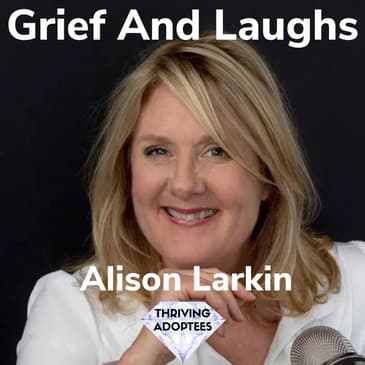
What if we could laugh at grief? Even though that grief is darkest part of our trauma? Wouldn't that lighten our emotional load? Listen in for a contrary take on grief and trauma that brings hope before diving deep to touch that part of us that's unwounded...
Alison Larkin was adopted at birth in Washington, D.C., by British parents and raised in England and Africa. After graduation from the University of London and the Webber-Douglas Academy of Dramatic Art, she became a regular on the British stage with appearances on Broadway, a ubiquitous voice-over artist, and a successful stand-up comic. Her internationally acclaimed one-woman show, The English American, was a highlight of the London Comedy Festival. For more information, go to https://alisonlarkin.com/
https://www.facebook.com/alison.larkin.944
https://twitter.com/AlisonLarkinTEA
https://www.instagram.com/alisonlarkinpresents/
https://www.youtube.com/channel/UC1y7eVMYgrZfBGrHrF0gJXw
Guests and the host are not (unless mentioned) licensed pscyho-therapists and speak from their own opinion only. Seek qualified advice if you need help.
Want to learn more about thriving for you, your kids, your families or your colleagues? Pick a time to talk here
[00:00:02] Hello everybody, welcome to another episode of the Thriving Adoptees podcast. I said that a little bit louder than they usually do, I think Alison. Welcome to the show Alison, Alison Larkin. Well, thank you so much. I'm so excited to be here, Simon.
[00:00:16] Yeah, so Alison's actually a comedian, so you don't have to put up with my crappy jokes, right? We're going to have a professional. She's doing a tour, she's going to be coming to Harrogate as part of that tour in September, October time, isn't it?
[00:00:37] This year, so we're filming this in 2024. So yeah, we're going to meet up, you know, I'm going to be one of her groupies. Or I'll be one of yours. Isn't it amazing to be able to laugh at trauma, right?
[00:01:02] Yes. I mean, and somebody said to me once when I was developing as a stand up comic in New York, if it doesn't hurt to write it, it's not going to be funny.
[00:01:17] And I think that's true. And when I first arrived in America, I mean, I had just found my birth mother. I was raised in England and East Africa by loving adoptive parents. And I'd never really thought about being adopted.
[00:01:32] And then I went to America to find my birth mother because I noticed that whenever I fell in love with someone, I was absolutely convinced that they were going to go off with someone else usually by going off with the waitress if I just went to the loo.
[00:01:50] And I knew it was illogical because no one ever did leave me. I left them before they could even think about it.
[00:01:59] And I began to wonder if maybe it had something to do with the fact that I was adopted and maybe if I found out that it wasn't so much that my birth mother didn't want to have me, but that she simply couldn't.
[00:02:11] Maybe that would free me up to live and love like other people. So I met her and then when I found her in Tennessee, I moved to New York and became a stand up comic because what else do you do? And I didn't know anyone.
[00:02:27] So I would talk about what had just happened with audiences and I'd say things like, I think everyone should be adopted because that way you can meet your birth parents when you're old enough to cope with them.
[00:02:41] And the key to dealing with the fear of abandonment is to date people you don't like. So if they do leave it doesn't matter, but you know and I know and a lot of your listeners know those weren't just jokes. That was coming from a real place. Yeah.
[00:03:02] Yeah. And the reason it's a tonic for me is we've got all there's so much doom, right? The crime or wound. You know, The body keeps the score.
[00:03:17] If it was a movie, the body keeps the score and it's going to sneak upon you and settle that score with you. You better have your wits about you. Simon Ben and Alison Larkin. That's deep.
[00:03:29] You know, and it does make it somehow slightly less scary if we can laugh about it. Well, yeah, but I mean, I think I think I think we laugh. I mean, look at the people who came out of the concentration camps who had the best sense of humor.
[00:03:47] The people who survived were the ones who could laugh at the most painful things. And I think that, you know, there's a lot that's funny. That is also painful. And I agree.
[00:04:01] I'm picking up from what you just said that you share my resistance to the adoption movement element that says you're doomed because I don't think as adopted people. We are doomed at all.
[00:04:22] And in fact, I think we're in some ways in an enviable position because we don't really owe anything to our birth parents because they gave us up for adoption.
[00:04:33] And if our adoptive parents are great, then we're going to choose to, you know, spend a lot of time with them because we love them. If they're not, well, you know, we can go off and find our birth parents.
[00:04:46] And then if we don't like them, we just meet other adopted people and they become family. But we're very much on our own as an adopted person. You know, we're born alone. We're given away. That happens right at the beginning.
[00:04:58] And while it is traumatic and there are elements that can affect us for the rest of our lives, there's also some good things about it. And I know a lot of very independent adopted people.
[00:05:10] And I get really pissed off actually with the way that adopted people are portrayed in commercial and popular fiction as eternally damaged victims at best or serial killers. Because while it is true, but son of son, you are a serial killer. Well, don't tell anybody.
[00:05:30] But it's that son of Sam was a serial killer. But so was but he was adopted. Right.
[00:05:35] So I think that was Moses and Walt Whitman and Edgar Allan Poe and Renny Zellweger and President Ford and Nancy Reagan, not, you know, but there's a lot of people who've done a huge amount of Steve Jobs.
[00:05:47] I mean, you know, and we always hear about the ones who, you know, cause the trouble, but there are there are adopted people who've changed the world.
[00:05:57] I don't know why the focus doesn't go there as much as it goes, you know, on the on the rest to me adopt people are heroes actually. Yeah, every single one of them. You heard it here. Listen, you heard it first.
[00:06:15] So I'm thinking if you were in New York, like, when people say New York to me one of the first things that pops into my head is Woody, Woody Allen, the Allen. Yeah.
[00:06:30] And and and neurotic therapists, you know, and non neurotic therapists and therapists and in over here, you know that people will say, oh, you've got you're going to see a therapist. Haven't you got any friends? Whereas, yeah.
[00:06:48] Whereas in the in New York, if you haven't got a therapist, then you're not part of the gang, right? You know, it's it's this high maintenance thing.
[00:07:02] The people that have got all that money, the investment bankers and the Wall Street Titans and all these all these mega rich people thinking like, what's the name out of sex in the city? Not Carrie, but the other one and they the sex mad English woman.
[00:07:23] Yeah, yeah, yeah, I am not. They've all got loads of money so and they're still unhappy. So they so they they they're not like the people that haven't got much money that think money will get them will bring them happiness. Right.
[00:07:40] They have got all this money and they're still not happy. So then therefore they need some some therapy. So did you have did you find some good therapists in in? Did you see anything in New York?
[00:07:52] Did you did you have any good therapist in your I have any therapy? Well, not not to begin with no. I mean, I just went on this great whim. Actually, that's not to I had a therapist in England before I went for two years.
[00:08:09] And at the end of two years, she suggested that maybe it might not be, you know, maybe if I found my birth parents, I was very different from my adoptive family who were very, very tidy and organized and good at maths.
[00:08:23] And I was untidy and pretty, you know, sort of all over the place and bad at maths. And I think this counsellor's belt, but she wasn't an official therapist. She was sort of more of a counsellor.
[00:08:39] And she said she felt that if I found my birth parents that it might validate who I was, I was extremely creative and really different from everybody I knew. And in fact, that was very, very good advice.
[00:08:53] When I met my birth mother, however, I didn't have a therapist and I wish I had done because it was incredibly overwhelming and confusing. And so I didn't really have a therapist who knew about adoption for eight years until eight years into reunion.
[00:09:12] And the person that I have to give credit to was Nancy Verrier because I was in Los Angeles and I was about to star in my own sitcom. And I thought she was giving a talk on adoption. I thought, oh, I'll just go just out of curiosity.
[00:09:28] And she did talk about, you know, this whole, the primal wound theory, which I think has some truth to it.
[00:09:37] So and I suddenly woke up and I suddenly thought, oh my God, maybe the reason that I married a man I didn't love and avoided love was because linked to the fact that I was taken away from my birth mother in, you know, immediately.
[00:09:55] And also I had found out that I had had a twin who had died, which nobody told me until I found my birth mother. I didn't know about that.
[00:10:05] So she I then said to her, you know, can you help and she said, well, there is a therapist in Los Angeles called Dr. Marlowe Russell who was also an adopted person. I was thinking of having kids at the time.
[00:10:19] And I was a bit nervous about that and this woman had also had kids. And I went to go see her.
[00:10:25] And at the time I had a one woman show about finding my birth parents in America and I was not going to do it because I didn't want to upset anybody. And she said, what about you? What about telling your story?
[00:10:38] And I realized that as an adopted person and this is apparently quite common. I was so busy protecting everybody else's feelings. Oh, I might upset them if I say that or I might upset them if I say that.
[00:10:52] And as a result, wasn't expressing my experience as an adopted person being raised in a loving adoptive family but being completely different from them.
[00:11:02] And they really did not understand me and and they were extremely critical of the essence of who I was not because they were bad people, but because they didn't understand it.
[00:11:11] And then when I found my birth parents, it was like, whoa, how do I integrate these very American people into my sense of who I am? And I had no support. I'd had no help.
[00:11:24] So up till that point, I'd done it alone and I was carrying a lot with a fellow adoptee who was a therapist. I got free enough to say, yes, sure, I'm going to do my show.
[00:11:38] And I did my show and it helped a lot of people and then it evolved into my novel The English American, which became a bestseller in the United States and helped change some of the archaic laws in America that consistently prohibit adopted people from having access to their original birth certificates.
[00:11:57] The adoptive parents names are put on the birth certificates in most American states. And so what was happening was they were sending my book to these legislators who didn't really get it.
[00:12:09] And then they saw why someone from a really happy adoptive family might need to find the truth about the people she came from. And I was also beginning to talk about what happened when my son was born.
[00:12:24] There I was in the hospital and, you know, very, very pregnant and my doctor said, is there anything you can tell me about your birth? And because I had been able to find my birth mother, I was able to call and say, were there any issues?
[00:12:47] And she said, oh yes. There's a certain kind of hemophilia that runs in the family.
[00:12:55] And I told my doctor and after my son was born, he told me that if I had not given them that information, there's a strong chance that neither my son nor I would be alive today.
[00:13:10] So anybody who thinks that adopted people should not have their own medical information, to me it's a human rights issue. So back to the start and the prime will wound, right? And you know, the theme of the podcast is healing.
[00:13:32] And some people are saying, well, healing doesn't resonate with me because it just doesn't feel right. And Nancy Berry was an adoptive mum, is an adoptive mum. So she's giving a third party view. She's given a non-adoptive view of it.
[00:13:56] And it has certain, to some people it has certain religious connotations that don't work for them. Does the term healing, does that work for you? Does that, to what extent, does that resonate with you? I think that adoption is wrapped up in a package.
[00:14:24] When the adopter is born, they're handed to the adoptive parents and told to be very happy. The adoptive parents are told to be very happy because they couldn't have their own child but now they've rescued another one.
[00:14:36] And the birth parents told to be very happy because, oh look, your child is now going to have a really nice life. Where I think Nancy Berry has it right is in pointing out that all three parties are actually grieving.
[00:14:54] The adoptive parents are grieving because they couldn't have children of their own. The baby is grieving the loss of her mother or his and the birth parents is grieving the loss of their child.
[00:15:09] So I do think it was important that somebody stood up and said, this is a croc, everybody. The reality is that at the beginning this random pairing of this child with this family came as a result of loss.
[00:15:30] And so with the bonding and the love there was also loss. So I think in that sense Nancy Berry was right.
[00:15:38] And I do think that there's a lot to be said for having lifted the veil over that where I take issue with Nancy Berry and I have done so to her in person when we've given keynote speeches at conferences and so she and we've sometimes met in America.
[00:15:55] And I said to her, I just totally disagree with you about the tone and the implication that adopted people are eternally doomed because I just don't think that's true.
[00:16:08] I think there are challenges and that the only way to grow and heal is to be extremely honest with yourself and really look at it.
[00:16:22] But I also know many adopted people who are not only healed, but are thriving and like yourself, channeling their energy to help other people who may maybe struggling with similar things. So if your question is, do I believe adopted people can heal and in the word heal?
[00:16:48] The answer is yeah 100%. I count myself as one of them because here I am about to go on a world tour of my new show which is called grief. A comedy.
[00:17:04] What's it about? It's about an adopted person, i.e. me who avoided love her entire life because she was so afraid of loss and of the worst happening. Then she in her fifties, she finds it.
[00:17:24] And then when the worst does happen, instead of wanting to hide under the bed and never come out again, she finds that she wants to live and love more fully than ever.
[00:17:38] And when Archbishop Desmond Tutu found out about what happened, this all happened to me, he said you need to go back to comedy and you need to tell this story as widely as possible because it will bring hope.
[00:17:55] So did I heal enough to be able to fall in love? Yes, I did. Am I open to falling in love again even though I lost the love of my life in the most tragic, sudden way? Yes, I am.
[00:18:12] So that kind of answers the question not only is healing possible but transformation is possible and I know it's possible and I think it's a choice. So what does transformation mean to you then? To me? Yeah.
[00:18:33] I think for me looking at myself from the outside and going oh my God in the olden days if I was on a date with a guy, I was literally, I would have literally adrenaline running going is that easy going to go off?
[00:18:48] Is it easy? Does he like her better than me? Nobody knew it because I was always joking but I had this internal anxiety. Now it's gone.
[00:19:01] It's just gone. All that has gone and why I don't know but I think, I think, I do have this theory and I talk about it in my show. When Bhima my beloved fiance who was actually from South India, he'd also immigrated to the United States.
[00:19:19] I came to find my birth mother in my 20s. He came to do a PhD in chemical engineering in his 20s and we both kind of got stuck in America really.
[00:19:28] I mean, and so and we met 30 years later and when we met, you know, I didn't actually believe in love at all. And then something and then something happened. And I fell in love with this. He was just such an extraordinary person.
[00:19:48] I think perhaps the fact that I had children helped because, you know, when you as an adopted person as you know for well have children, you suddenly living with genetic relatives and you get them, you understand them on an animal level. You know why they're crying.
[00:20:12] Then you know why they're laughing? You get it right? So I think maybe I had to have children in order to know what love could be like. And then I was free to fall in love.
[00:20:24] But at the end of my show, after being a dyes, I say something that I do firmly believe to be true. And I and it's this, I think it's actually quite useful to have had early trauma or loss of some kind so that when the worst happens again,
[00:20:42] there's a part of you that goes, Oh yes, I remember this sort of like a muscle that you haven't used in a long time. That is familiar when you start using it again.
[00:20:56] So I know it sounds odd, but I think this is a perk of being adopted that yeah, not only we had lost early on and we survived. So if you've done it once, you can do it again.
[00:21:10] And I think that it's sort of like having a vaccine, I suppose. You know, you've had it before and you know you'll survive it again. And there was something it was honestly the trauma of meeting my birth mother was incredibly traumatic. I went numb for two years.
[00:21:29] It was it was the worst time of my life. It was the scariest time of my life, but I got through it. And so when Beema died, I knew I would survive that too.
[00:21:43] And then the advantage and the gift that comes with the tragedy of losing somebody suddenly is that you know life is very, very short. And it can go just like that.
[00:21:55] So what happened to me was that I suddenly thought, you know, I was waiting for the despair to come when the numbness ended after about, I don't know, three months. I was waiting for the despair and it didn't come.
[00:22:10] And then I found that instead there was a kind of extra energy and a deep joy. And I did not understand it because as an adopted person, I'd spent an entire life avoiding love because I was afraid of it.
[00:22:25] And suddenly, instead of like wanting to kind of hide under the bed and never come out again, I was filled with with a kind of love.
[00:22:34] And I the only thing that was like it in my experience was what happens after the pain of childbirth, which is the most excruciating pain in the world. But without the pain, you wouldn't have the kids. And I couldn't understand it.
[00:22:51] I kept thinking about what Archbishop Desmond Tutu said to me when I met him 15 years earlier and he had said to me, remember something Allison. I can't control what happens to me, but I can control how I respond to it.
[00:23:07] And our mutual friend said you've got to email him and tell him what happens. So I said, I can't bother Archbishop Desmond Tutu. He's a busy guy.
[00:23:16] And she said no, no, he loved you and he kept tabs on you and he loved your first show and he read your book about finding your birth parents. So I thought, oh, so I make myself write him this email.
[00:23:26] And I say, I avoided love my whole life because I was so afraid of the worst happening. And then in my fifties, I found it. And then when the worst did happen instead of wanting to hide under the bed and never come out again,
[00:23:41] I find I want to live and love more fully than ever. What is that? And he wrote back right away and he didn't answer my question.
[00:23:51] But he did say, first of all, I want you to know that I've had a word with God and I've asked that now you've lost your man. You find another soulmate and God said she is on the case.
[00:24:11] But first, I want you to do everything you can to make sure this story is told as widely as possible because it will bring hope in a world that badly needs it. And I'm going, oh, God, I said, I don't want to write another book.
[00:24:25] He said so tell jokes, go back to comedy, whatever, but tell it. And you can't say no to Archbishop Testament Tutu. So I'm on my own in the pandemic in my house where I'm in right now in Western Massachusetts.
[00:24:42] And I started to write and then it all evolved suddenly. It's at the Soho Theatre in London and now it's going to the Edinburgh Festival and now it's going on a UK tour, then Australia and New Zealand and America and every preview is sold out.
[00:24:58] And then you can get a ticket, which is very exciting. And I feel like there's some purpose to it all somehow and that makes it, it makes it all very different. And then perhaps that's, you know, as adopted people, I don't know.
[00:25:16] I mean, obviously we're all as different as each other as anybody is, but I don't know. For me, the secret to happiness and joy is doing whatever you can to help other people. It's that's the, that's the irony.
[00:25:33] If you're constantly thinking about yourself all the time and whatever you focus on grows, right? So if you're going, oh my God, I had this terrible thing happen to me a long time ago. And that's all you're thinking about.
[00:25:46] Then you will go like this, you know, you'll shrink. But if you go, okay, maybe there are other people who suffered. Maybe there's something I could do to help them. Maybe I could connect with them.
[00:25:56] Then that takes you out of yourself and then suddenly you're with other people. And that's what I love about the adoption community. You know, we've all been through something pretty unique and pretty hard. I mean, like, I don't know you, but I feel like you're an old friend.
[00:26:11] Like I could spend, I know we have a lot in common. I could spend so much time with you. It's like family.
[00:26:18] And I think that especially, you know, in today's age when we're, we're very disconnected, you know, we've got a world right now, but it is so keen to divide. Oh, I hate this and I hate that. And this is wrong. And we disagree.
[00:26:32] But what's so important is that we find our common humanity. And where is our common humanity? Love, loss, renewal. And with adoptees, boy, do we have a lot in common. And so I always say, well, let's just get together and have a pint, shall we?
[00:26:49] And talk about it. And that's what one of the reasons I'm really excited about bringing grief for comedy to England because I haven't, I haven't been in England since I left to find my birth parents in America.
[00:27:02] So I've got like my parents are now no longer, but I've got great friends. I've got brothers. I've got old mates from university. And when I left, it was like, you know, I had a great life. I was an actress living in London and I was 28 years old.
[00:27:20] I had a boyfriend. Then I found my birth mother and the shock was so intense. I moved to New York and became a stand up comic because what else do you do?
[00:27:29] And then I kind of, my career took off in America and then suddenly way led on to way. And I, yeah, of course I've been back to England to see my parents and my family, but I haven't come back for this amount of time.
[00:27:40] And now I arrived on July 27th. We've got two previews in London, which is really exciting. And then we're then I'm in Edinburgh for the whole month. And then I'm on tour all over the UK, including Harrogate until October 24th.
[00:27:55] Then I'm on tour again in the UK in the spring. So I'm going to be back in England, you know, reconnecting with who I was raised to be.
[00:28:05] So in a way, I feel, and I've never thought this thought until now, I went to America to find my genetic roots and who I was. And now I'm coming back to England to reconnect with those roots.
[00:28:19] And I think now it's, it's a case of integrating identity perhaps. So there's a strong theme of sort of counterculture, fountain the norm coming out from you.
[00:28:34] You know, you started off with on this comments, you know, it is challenging this, this norm or this perceived view that we're doomed. Right? You've, you've talked about grief, grief, a comedy. Yeah.
[00:28:49] I think you might like this title if you've not heard of it, but I don't know if you heard it or not. Do you follow? What's his name? Oh, it's just gone completely out of my head. The trauma guy, not Bessel van de Kolk.
[00:29:07] I don't really, I'm not really up on all that. I'm sorry to say. Gabba Marte, have you heard of Gabba Marte? No. Well, his one of his recent programs is called the wisdom of trauma. And a new with a grief, a comedy.
[00:29:25] And it strikes me that the strong part of what you're doing is challenging the norms and you go in against the perceived wisdom. Yeah, I think I am. You see, I'm questioning things. For example, you have also since, okay, so I wrote the show.
[00:29:50] And then I started writing a book, which is also called grief, a comedy, which starts six weeks after Beemer, my fiance died when he showed up at my kitchen table, determined to help me find love again.
[00:30:05] What I'm challenging is, I don't think when someone dies that the relationship ends. I think the body goes away, but I think the connection remains.
[00:30:21] So it just there's just a shift and I'm, and I do ask in the book if this maybe has something to do with the fact that as an adopted person from a very young age, I was used to connecting with people who weren't there because I believe all adopted
[00:30:39] people are connected to their birth parents, whether or not they've met them. Well, they've got their DNA for God's sake, but there's also a connection. So when I met my birth father, for example, we found out we had of course so many things in common.
[00:30:55] When I met my birth mother, I found out when I was in Edinburgh as a 19 year old drama student. I would say meeting an American and being really, you know, thinking it might be my long lost birth mother who'd come to find me. Okay.
[00:31:11] Well, of course it wasn't. But when I met my birth mother, I found out she was in Edinburgh at exactly that time. And she remembered seeing a play about a very clumsy bee. And guess what? I was in a play about a very clumsy bee.
[00:31:32] I believe that we can connect in ways that we cannot intellectually understand and perhaps as adopted people who were cut off from our birth family. That ability is perhaps greater than in people who were not. I think, do you know what I'm trying to say?
[00:31:52] So yes, so I'm challenging. I'm challenging quite a few things actually. I also am saying that I think we have a choice and I think Tutu's right. I really do believe we can't control what happens to us. Of course, none of us. We were adopted.
[00:32:11] We were given away. We were baby. We were completely powerless. But I'm not going to let what happened to me then affect me now. I mean, I have to go through it. Look at it. That's why I think therapy can be very useful.
[00:32:28] I think programs like yours are essential because we're sharing thoughts, we're connecting, we're looking at it. But we don't have to be defined by something that happened to us a long time ago. We get to define our own lives, who we are. And so I don't...
[00:32:47] So I challenged Nancy Verrier and I said to her, no, no, you don't tell me and other people. Tell me and other adopted people that we are doomed, that we are never going to be able to have whole and vibrant lives. That is my choice.
[00:33:05] And I will and I'm just as capable of having a life I love and creating a life I love as anybody else. Where I think it can be challenging is adopted people are so used to being chosen that they forget that they can choose.
[00:33:22] But the moment you get it, you go, wait a second. Wait a second. Other people have been defining me. Adoptive parents define me. Birth parents define me. But who am I? I get to define myself.
[00:33:34] And as Abraham Lincoln said, I think most people are about as happy as they make up their minds to be. So when people are running around saying, you're doomed. You're not going to be able to have a happy life. I say, well, something unrepeatable on this program. Yeah.
[00:33:55] Yeah. There's a few different ways I could go on that. Let me go to the connection. So can you talk? You say the connection remains. The loss of Beemer. Beemer's body has gone. But your connection with Beemer remains. Right. And you also talked about connection with birth parents.
[00:34:25] Can you share a little bit more about that? Because that piqued my interest when you said that. Well, I think when Beemer died, I had a strong sense of him being around. Like I knew what he would say in any circumstance. I had all the memories.
[00:34:56] I had all our texts and emails and a enormous number of photographs. And okay, I'll give you two examples. When I met my birth mother, I found her, you know, I was actually living in London and in real life.
[00:35:16] The first time I spoke to her was over the telephone. And the first thing she said to me was, did they tell you you had a twin? And I said, no, no one mentioned that. Well, you did. You had a twin only he died in the womb.
[00:35:36] Elvis Presley had a twin who died in the womb, so you're in good company. And when I put the phone down, I mean it was enough as everybody listening who's had a reunion will know to have spoken to my birth mother for the first time.
[00:35:51] But the twin stuff really threw me. And I remember shaking and being pretty much unable to move. And the next day for reasons I do not know to this day, I reached under my bed and I pulled out a box.
[00:36:07] And in that box, there was a play I had written when I was 19 years old. It was kind of like, you know, a half play. And I opened the file and there are it's a comedy, of course. And there are two characters in the womb.
[00:36:24] And one of them dies. And the last lines in that play are the boy dies. The girl cries. The eggs continue rolling down the hill. So that's a connection. I knew but I didn't know. Sorry, you've written the comedy. So I was 19. Exactly nine years before. Yeah.
[00:36:56] So sorry for being a bit thick there. No, you're not thick, not at all. Quite the reverse. So then this is sort of, I guess, why not tell you? I mean, so it's in my book anyway. So Beamer died. And he was from India.
[00:37:18] It was from South India. And I had it. I just, I didn't know where he was. You know, I didn't know what had happened because it was a sudden death. And I didn't know where he was. And I had a dream. And there was Beamer.
[00:37:38] I dreamt that we, that I was with his Indian family in his house in Vermont. And the wall to the house opened up. And there was this world that was just full of light and radiance and incredible music and color.
[00:37:56] And there was Beamer dressed in this beautiful golden robe with an Indian woman who was young and I have to say rather beautiful. And I'm sitting there going, oh, that didn't take you long Beamer.
[00:38:10] And they come down this path and I realized that it's not a romantic connection. And that he's working for her or something like that. They come into the house. They turn right. They stare at the fire.
[00:38:26] And I have this absolute sense of utter joy that he is somewhere far away. And where he's needed. And that he has transformed that there's something much very spiritual. I don't really know what it is. And then they go and I tell his sister about the dream.
[00:38:48] And about the woman and she says, oh my God, was it this woman? And she sends me a photograph. And I say, yeah, well, and she said, that is Durga. I said, who's Durga? She goes, she's a Hindu goddess. And I said, what?
[00:39:08] And I beamer's family said, oh, well, yeah, he's with Durga. They were Hindu. His family, he wasn't Hindu. He was an atheist, but they were Hindu. And apparently when Beamer was young, they used to go to the Durga temple in India.
[00:39:26] And I said to his brother, what I don't understand is why did they keep staring at the fire? And he said, well, because in Hindu tradition, the way that the gods and the goddesses communicate with humanity is through fire.
[00:39:42] And Beamer's mother said, well, we know it's a message because Allison doesn't know a damn thing about the Hindu religion. And he came to her. So now we know where he is now. Oh, no, it was a dream.
[00:39:59] But there's to quote Hamlet, there is more in heaven and earth ratio than is dream top in your philosophy. Who knows? But I'm not close to the possibility. I mean, of course, like, oh, it could just be wishful thinking. It could be true.
[00:40:19] It could be something in between. But if we are spiritual beings having a human experience, then doesn't that change everything? It changes our perspective on everything. And perhaps as adoptees, I mean, if you think about it, Jesus was adopted.
[00:40:39] I mean, God was his birth father, if you believe that stuff. You know, Moses was adopted. People who've been cut off and abandoned are often gifted in ways, especially intuitively. I don't know. So that's sort of, you know, I'm not saying this is true.
[00:40:58] I'm just saying it could be. So the spiritual being having a human experience quote that came up yesterday while doing an interview with him. Hello adoptee yesterday. Interesting. And I use one. I thought I came up with it and she agreed with it, right?
[00:41:19] So but the way it's one spiritual being. So it having seven billion or nine billion have money that was it's one spiritual being having seven billion human experiences. I never thought of that. That's very interesting. I've always thought, I don't know, I haven't really thought it.
[00:41:50] I mean, it's just new to me. Perhaps you should talk to you at length more offline. But yeah, that's fascinating. So but you've said the connection remains, right? It seems to me that, you know, your connection with Beemer remains. Well, the love doesn't go anywhere.
[00:42:16] The love doesn't go anywhere. The love's right here. And the love, you know, it's right here. It'll always be here because there was so much of it. It seems like that can that connection is evidence of oneness to me. What is oneness? Well, one being.
[00:42:39] What some people call God, you mean? Well, some people call it God. Yeah. So, you know, for me, so like you've referred a little bit about earlier 10 minutes about this not being, you know, logical and understandable by the brain and all that stuff. Right.
[00:43:02] So when, when we spoke last month, did I tell you about my moment of connection with my birth mother? I don't think you did. Can you tell me now? So I'm sorry listeners if you heard this before, but Alison hasn't right.
[00:43:17] So as I read my adoption file eight, 10 years ago, as I went through it, I found a letter from my birth mother to the social worker. Yes. Yeah.
[00:43:33] And as I read that letter, I felt her, I felt her desperation in this letter to the social worker, the desperate circumstances she was in to have to place me for adoption. I felt her, I felt the power imbalance. Right. Between her and the adoption people adoption.
[00:44:05] But most of all, I, I felt, I felt connected with her. It was like, you know, like when empathy becomes an experience. So I often explain this with the metaphor of a swimming pool. Right.
[00:44:25] So in round Christmas time, my swing pool shots, I go to a big swimming pool somewhere else. It's 60 yards, 50 meters long. Right. And halfway in halfway down this swing pool, there is a big plastic wall that rises out of the bottom.
[00:44:48] The bottom of the swimming pool, right, to make one big swimming pool into two little swimming pools.
[00:44:59] And in that moment as I read the letter from my birth mother, it was like the wall in the swimming pool collapsing into the floor and the two separate pieces of water becoming one. Right. So that's my metaphor for connection.
[00:45:21] So what I'm the theory that I'm putting forward to you is that until, well, we in that moment I saw the evidence of our connection being my birth mother.
[00:45:39] In your stuff with in your, in your dream and your, your memory of Beemer, you saw evidence of a connection remaining. And that those two things put together are a, are both a taster of us being one shared spiritual being. That's what I'm putting forward.
[00:46:17] That's really, really interesting. And I, I'm fascinated by it. And I don't know, I just, you know, you just as you were saying those words, I was thinking, you know, there's always a gift that comes with, you know, something track tricky.
[00:46:38] And I was thinking about you as an adopted person and everybody listening and me. You know, we started, we were disconnected. We were born, then we were disconnected from our natural animal family.
[00:46:54] And we grew into another, you know, in another family and then we are wherever we are. We more than anybody know the importance of connection.
[00:47:07] And I think we're probably needed right now in a world that is very disconnected to connect with people at the coffee shop to connect with our families, with our friends, with our colleagues, with each other in this kind of a way.
[00:47:26] Because we know what it is like to be isolated and disconnected. And so we can use our energy as you are in this podcast to bring people together in a divided world. And I think that's a very good use of us adoptees, don't you? Yes, I do.
[00:47:50] And the disconnection is physical. Right. It's not spiritual. Right. The disconnection is psychological. Right. Bingo. It's not spiritual. Bingo. And that's why it is so important that while acknowledging the trauma and the difficulties, Al-Anansi varié, we also acknowledge that we absolutely have a choice to connect spiritually.
[00:48:25] Somebody said, if you think you can or you think you can't, you're right. Maybe that was Henry Ford. Yeah. And I'm kind of fed up with adopted people being told that they're doomed because we're bloody not. And I say, you keep doing the work you're doing.
[00:48:39] I'll keep doing my work and everybody listening keep doing theirs. And let's connect with each other. By the way, I've got to go in five minutes. Well, it's a brilliant place to bring in unless you'd like to share anything. No, I'm so enjoyed talking with you. Me too.
[00:49:01] But I think, I mean, I guess what I'd like to do is to invite all your listeners to go to AlisonLarkin.com with one Ellen Allison and all the lists of all the places I'm going to be touring grief for comedy are there in the UK.
[00:49:17] And reach out to me. I'd love to see you after a show. I'm talking a lot about being adopted and about love and about finding love as an adopted person. I don't care what people think I never have.
[00:49:32] So I go up on stage and just tell it like it is and whatever, you know, and it's called. Yeah, Alison Larkin grief for comedy and we're going we're going all over the UK and I would feel thrilled to meet other adoptees on the road. Yeah.
[00:49:49] And are you touring in the US as well? Yeah, we will do after Australia, New Zealand, I think Mumbai, India then probably in the fall of 2025 will be coming to the United States probably to New York.
[00:50:02] Cool. So, um, yeah, you hopefully have some shrinks there, you know, maybe Woody Allen. I have a joke about Woody Allen in the show. It's this.
[00:50:15] The whole adoption agency thinks a bit of a lottery. You never know who you're going to get as parents or what will happen as a result of it. I got lucky. Then again, if I'd been adopted by Mia Farrow today, I could be married to Woody Allen.
[00:50:32] Indeed. Indeed. Thank you very much, Alison. Thank you listeners. And always like this, as always, I don't have to say this every episode, but there's check out the show notes. So you may be driving, you may be walking the dog, you may be an ironing.
[00:50:50] Those are the three times that I listened to podcasts. And if you are, check out the show notes and you'll find a link to Alison's website. And we'll speak again very soon. Take care. Bye bye. Yeah. Great. Bye.