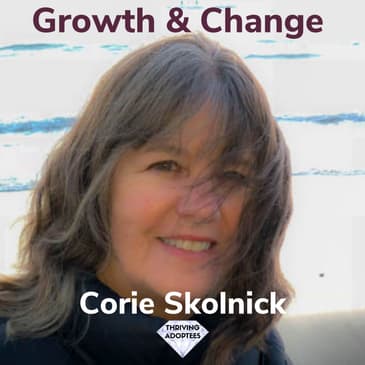
We only have to heal if we've been sick or damaged. But what if this perspective is off? Listen in as therapist and teacher Corie shares a fresh perspective on growth and change.
Find out more about Corie and her book at:
https://www.facebook.com/corieskolnick
https://corieskolnick.com/orfan/
Guests and the host are not (unless mentioned) licensed pscyho-therapists and speak from their own opinion only. Seek qualified advice if you need help.
Want to learn more about thriving for you, your kids, your families or your colleagues? Pick a time to talk here
[00:00:00] What are we going to do to know? Hello everybody, welcome to another episode of the Thriving Adoptees podcast. Today I'm delighted to be joined by Corie Skolnik, looking forward to our conversation, Corie. Really, you're such a lovely lady.
[00:00:14] As am I, I'm looking forward to talking with you this morning. Yeah. So, this word healing, does it, to what extent does it resonate with you, Corie? You know, I would say less and less. Oh. As time goes on. Yeah.
[00:00:35] And I don't know if that's idiosyncratic or if it's just wisdom with age or experience. But sometimes as a therapist and as a teacher, I think healing, the word can be used so pejoratively. It means it implies sickness, it implies damage. And there's something about that now.
[00:01:09] I mean, I used to take that as a matter of force. If you're coming into see a therapist, there's something wrong. You need healing. And I think as I get older, maybe more experienced, I choose my words more carefully and I try to think of a therapeutic encounter.
[00:01:35] I like to use the word growth and change as opposed to healing. And it's, I think of it almost as a subliminal shift that if you take on the role of patient or you take on the role.
[00:01:59] And I think to a large extent, that is why the therapeutic community made a shift a while back, quite a while back to seeing patients as clients. And some of that was a function of the medical profession kind of being ousted from therapeutic,
[00:02:20] psychologically therapeutic endeavors and moving into family therapy domain and social work domain. So patients were not always seeking medical care or even psychiatric care. There were sometimes just thinking some kind of help for a problem.
[00:02:42] And because I was a family therapist and my training was mostly in family systems theory, we started to use the word client. And you only use the word patient for somebody who had good medical insurance. So you would make that shift automatically.
[00:03:00] If you were talking about a patient, it was somebody you knew had, you were going to file insurance claims on them. And clients were people who were coming in to get some wisdom from you for problems in their family or problems with their relationships.
[00:03:19] So it's kind of a subtle shift. And it probably is in part a little bit of bullshit, but I think it's, I don't know. I don't know. I'm on the fence. I'm in a transition period myself with all this.
[00:03:39] And I think some of it is because I'm retired now. I'm not seeing patients. I'm not seeing clients in a practice. But I still have a lot of friends that are, and we still talk about the issues.
[00:03:53] And I still read a lot and talk to authors that a lot of people who are writing books about adoption especially will ask me to review their books. And so I do a bit of that. And in that world, I think healing still dominates.
[00:04:11] The idea of healing still dominates. Yeah. I would agree with you. Most people still, most people that I speak to when I ask them that question to what extent does healing resonate with you? They will say yes it does. It resonates with me. That would be the majority.
[00:04:38] But every now and again somebody says it doesn't. And that's great, right? Because for me, it's broadening out the conversation, it's broadening out the focus. It's broadening out the metaphor, right? Healing is a metaphor that goes with the wound metaphor.
[00:05:00] And we've gone, Nativaira didn't write the book until the early 90s or publish the book until the early 90s. Until then, nothing... She caught people's imagination with this ominous titled, ominously titled book that scares the SH1T out of people I think. So yeah, healing is a metaphor.
[00:05:35] So you prefer growth. What does growth mean for you then? Well this is the BS part. It's probably the same as healing. But it has a slightly more, I think a slightly more hopeful tone to it. So if you consult a professional because something...
[00:06:08] You perceive something is wrong. Let's use the car. You take your car and I don't know what's wrong, but I'm pretty sure something's wrong. It makes a noise. It's not running like all the other cars are running. So can you look at it?
[00:06:27] You have some expertise with cars. Can you drive my car around? Look at my car. Tell me what's wrong with my car. So nobody comes into therapy because everything's peachy. So there's a given that somebody's complaining about something.
[00:06:46] In a family therapy practice, I would say more than 50% of the time somebody's complaining about somebody else. Something's wrong with my family. Something's wrong with my parents. If it's an adolescent, something's wrong with my mom. I'm fine. I'm fine. But something's wrong. Can you fix this?
[00:07:09] So in a therapeutic encounter with a family, I think it's a good idea to think of the growth model as opposed to the healing model. Because if you're approaching a family from a healing model, that means somebody's sick.
[00:07:33] And that implies that there's something wrong with a certain person. And I guess you could say, OK, the system is sick. And usually it is. It's a systemic problem. Everybody's rigid in their functions and their roles. And growth means everybody takes a look at the whole system.
[00:07:59] And everybody can grow out of the rigid patterns and the ruts that they're in to perform kind of stereotypic roles in a family. And if they grow out of those roles, even one person in a system can make profound change if they grow.
[00:08:22] Ask any adoptee who has, quote unquote, come out of the fog. When they come out of the fog, there are profound changes in their circle, their intimate circle. So I've been using the term coming out of the fog, I think in the same sense as
[00:08:46] you, as in we become aware of the impact of adoption on us. So you nodding, yeah, that's because other people say come out. That's a piece of it though. That's a piece of it. OK. Yeah. So what's the other pieces? Because that's kind of an intellectual piece.
[00:09:11] You're aware. You have awareness. Yeah. Oh, gee. Probably impacted me pretty, pretty severely. Oh, gee. I never thought of that. I never addressed that. Oh, now I see. But that's an intellectual piece.
[00:09:26] The other piece which is emotional is I hurt from this and I have been hurt by this and I have chosen in response to how I feel, I have chosen things, I have chosen behaviors because of that.
[00:09:48] And when you come out of the fog, that means you grow into different behaviors. Different choices. Yeah. Yeah. So in all three things, to make profound change in a life, to heal if you want
[00:10:04] to call healing, to grow, to get better, any verbiage you want to use for that I think requires addressing all three functions, all three human functions. You have to change intellectually. You have to know better and you have to feel better or you will feel better when
[00:10:27] you change what you do. What you do is better, more productive, more healthy for yourself and for the whole system. Yeah. What about the identity bit part? The identity. Yeah. So you've talked about thoughts, you've talked about feelings and you've talked about behavior. What about thought?
[00:11:04] Sorry, what about identity? Well, I think identity is the centrifugal piece of that, right? So your identity is formed by your thoughts, your feelings and your behaviors. Yeah. It's the center. It's your core, it's your identity and from your identity everything else emanates.
[00:11:34] How you think, how you feel, how you behave, those functions are flung out from the core of your identity. So if you stop calling yourself damaged, and I'll tell you this is just a little aside,
[00:11:56] there are two people in my historical, the history of my private practice that taught me a lot about this and how identity and how you talk about yourself impacts everything, impacts your whole life.
[00:12:13] And both of those people had profound disabilities and neither one, when I first started seeing them as therapy, and they were both students so they were in college already. And just to get to college, can you imagine you have a profound physical disability? You cannot walk.
[00:12:41] You're in a wheelchair. I can't even imagine the difficulty. I couldn't find parking sometimes and went home. I can't imagine what it would be like to be able to, every movement you make is confounded by let's say cerebral palsy or some other kind of paralysis.
[00:13:05] And if these people persist and they both in both cases achieved graduate degrees, went on in school, one of them drove a car. They did things that are difficult for able-bodied completely quote unquote normal.
[00:13:31] And so what I saw in them, what I learned from them was they did not see themselves as disabled or unable. And they didn't talk about themselves that way and they really hated the, you know, there was a disability center on campus to assist them.
[00:13:51] And they hated that. They hated the idea that everything about them to the outside world, to the so-called normal world was colored by that word, by being disabled or unable and or challenged in that way.
[00:14:10] And they didn't see themselves that way and they didn't want other people to refer to them that way. And I think partially because of that, because at the same time I was doing this, I was
[00:14:21] doing a little bit of work with veterans and that world cleaves into veterans who speak about themselves as a damaged and, you know, disabled veterans, damaged and traumatized. And what's the other word?
[00:14:43] I can't think of it now, but if you think of yourself that way and that's your language about yourself and that becomes your identity, you automatically do less. You feel less capable. You don't do things that are hard.
[00:15:04] You kind of, you know, you give up to that identity, surrender to that identity. And in both of those instances working with people who had challenges, real significant challenges and in the veterans world, what I saw was how important it was to use
[00:15:23] language that was comfortable for the patient or the client to see themselves. So I would not use the word disabled ever with these people because they responded to it and it taught, it told them that I was not honoring the identity that they wanted.
[00:15:45] And it was, and that's a profound thing between a client and a therapist. You have to see who they want you to see, who they believe they are. Because if you don't as a therapist, then who's going to?
[00:16:04] This is one of the most profound experiences of their life in terms of interpersonal relations. They come in, they give this total stranger a lot of information about themselves. And if all that information is clouded in language of disability and trauma
[00:16:24] and hurt and illness, it will change how much they can change and how much they can grow. And if you're not going to therapy to change and grow, what are you just going into? You can say you have a witness to your whining. What's that about? Yeah.
[00:16:44] And I don't think there's a lot of therapists out there that are less active, you know, less. I always assumed if somebody came to me and gave me money at the end of an hour, they wanted results. They wanted to change. They wanted to grow.
[00:17:03] And they didn't want to just sit and whine and have me listen to them. They didn't want a friend. They weren't buying a friend. So I was kind of a hard taskmaster when people consulted me. And it isn't a good match with everybody.
[00:17:20] Some people do want to kind of just want to whine, but I'm not the therapist for them. So what did you see amongst us adoptees then? Intensive identity stuff. You know, that's a very complicated question because you and I talked a little
[00:17:41] bit before about how important I think it is for a therapist to really listen and not just to adoptees, but we're talking about adoptees now. So when I started out in practice, I think I confessed to you how ignorant I was.
[00:18:04] And I think in those early days, the 80s, everybody was ignorant about adoption. It was taboo. You didn't talk about it. And I don't remember if I told you about the family I was seeing and I was seeing them for months and wherever you are, I apologize.
[00:18:23] But months went on with this family. They had a troubled teenage boy misbehaving, you know, acting out the usual kind of kind of a normal consult. Months I saw this family before anyone said the word adoption.
[00:18:44] And finally they told me he was adopted and Simon, it was like somebody hit me with a two by four because even though I was still ignorant, I really didn't know. And anything, you know, I really was dumb. I wasn't informed. I hadn't read there weren't any books.
[00:19:01] Like you said, Nancy Berry, her first book didn't come out until the 90s. So there wasn't much literature on it. There was no training, no professional training in adoption at that time. And when they sent this in session, I was like, wait a minute,
[00:19:19] you've been coming in here week after week and nobody told me he was adopted. Don't you think that's meaningful? That's something I should know, you know, and they didn't. They honestly did not think. I don't think it was that they didn't think it was important.
[00:19:37] I think it was to be hidden. It was something they they were hiding it for his benefit and they were hiding it for their own benefit. And you know, as an adopter, you know that oftentimes in adoption, they're shame. People are ashamed. They're adopted. Parents are ashamed.
[00:19:55] They couldn't have their own children and they had to adopt. You know, it's tainted. It's it's it's colored by by all of that. So to get to drill down into your question with with adoptees, the language has to be the adoptees language. We have to blend with them.
[00:20:21] We have to join with them. And and maybe what is necessary for them in therapy is to is to spend a little bit of time sitting with what it feels like to suddenly confront the feelings that you you said you called you called coming out of the fog.
[00:20:46] And especially because that's that's when people generally think about going into therapy. They're out of the fog. What's the next step? Well, I I'm messed up. I need help. So they go see a professional therapist.
[00:21:01] And back in the eighties and nineties, I think they didn't get much help. And and what I think was probably didn't hurt anybody because even back then I knew to listen to the listen to the person, listen to the individual
[00:21:16] here really hear what they're saying and really let them know that I get it. I understand. I I hear there's pain there. I hear there's there's confusion, there's frustration and there's stuff that could go better in their life. And a lot of times it's around substance abuse.
[00:21:36] That's what brings them in the door. But that is, you know, the tip of the iceberg. So so I think I think the short answer would be to to listen to each individual person because as you know,
[00:21:54] being an adopter yourself, your story is very different from the next adoptee story. And yeah, there's some universal notions, but nobody can tell you how to feel about your being adopted and nobody should tell you how to feel about it. At least of all your therapist.
[00:22:19] And at the heart of so many of these people's lives is a a wounded narrative. You know, I took to the thing I do. I think I shared this with you. I didn't believe that I was primarily wounded till I read The Primal Wound.
[00:22:47] Right. Now that makes me different, but we're all different. Right. I see for me with the primal wound, I I saw it first as a diagnosis, which was a relief. Right. And then I thought this is a this is a prison cell. Yeah, I'm stuck with this.
[00:23:15] And luckily, I wasn't hanging around with people. Yeah, well, luckily, I was hanging around with people that were more open, open to change and maybe open to growth, to use your words. And and then I realized that this wasn't this I realized that this wasn't a life sentence.
[00:23:47] The and that came to me, you know, and in an insight. So one moment I was sunk. The next minute I was floating again. Yeah, because I mean, I guess you changed your language and your language. No, I didn't change my language. This is the thing, right?
[00:24:12] I did change my language. My language changed for me through an insight. Right. So we've all we're brought up in the Western world to think that we changed stuff. No change changes stuff. It's when we have an insight, I don't make the insights.
[00:24:39] I don't make the insights happen. And I'm not I tried that affirmation bullshit, you know, looking in the mirror. Right. Nothing worked. I don't I think it's like an old mentor of mine says, you listen like a rock with ears and listen for an insight
[00:25:04] and don't beat yourself up when you don't have an insight. Don't don't get up. Don't get jealous about somebody. Don't get epiphany envy. Right. Don't don't get you're in a you're in a group situation. Right. And somebody has just had this. Aha, Charlton Heston moment.
[00:25:23] This changes this changes everything. Right. But and then you're sitting there and thinking, Oh, I can't have the insight that he had. Or why can't I have the insight that she had? I don't make I didn't change my language.
[00:25:37] My language changed on the back of an insight that I had, which is why I interview people around their insights. I try and interview people around the insights that they've had. You had an insight where you went from, OK, I.
[00:25:58] I used to I used to think this this healing metaphor was was a good one. And then you went to you had an insight and you realized that, no, I don't I don't like I don't like that healing word as much as I do.
[00:26:21] I don't want to what's the word? I don't want I don't want to pathologize adoptees. I don't want to say that they're wounded. I don't want to say that there's something wrong with them. I don't want to think that way
[00:26:36] because what you saw with those two clients with the who bought the system, who got so cheesed off about being about, you know, even the term disability. Yeah, I don't I don't I don't I don't make change happen. Change has happened to me when I have an insight.
[00:27:04] That's kind of the way I see it. Well, let me let me go back a little bit for you. Please do. Do you think that there's a gender difference? In in how adoptees are permitted to experience. Adoption as impactful. I don't know.
[00:27:37] I've never I've never considered that question. I don't think I do. I do know that I do that know that 80 percent of the listeners to the show are women. OK, so I would say statistically that indicates that there's a there's a gender difference.
[00:27:54] It would. But yeah, whether it's exactly how you set out the question. Well, I'm not sure. So no, our methodology sucks. But but I think in social science, social social psychology research, there's there are gender differences in in almost everything, especially in Western culture.
[00:28:21] We really were we are you can see what's going on now. We are really uncomfortable with the idea of femininity and masculinity being on a continuum. We're really uncomfortable with that. We like the binary Western culture likes male and female and nothing
[00:28:43] nothing cloudy in between. That's that's OK. And if you're male. A lot of times Western culture prescribes masculinity as I always used to say in lecture, we allow men to feel two things. Men men can feel in public. You can feel angry and you can feel horny.
[00:29:08] And that's it. Try to feel something else and somebody's going to call you a sissy, whereas women we get all the feelings. But we're punished if we feel if we're if our sexuality is revealed, if you were if we get pregnant as a teenage girl, we're punished severely.
[00:29:31] And we're not allowed to feel angry if we're angry. We're a bitch. So we have, you know, our culture and our societies cleave the emotional experience in two depending on your identified gender. And I think that is very often for male adoptees,
[00:29:56] they experience a prohibition about even addressing the topic of adoption. They can't they can't say, you know, you know, they might be able to say the reality is yeah, I was adopted when I was a baby. But they can't say I was an adoptee.
[00:30:15] And I always felt I always felt a little odd. I always felt like I didn't belong. I always felt like my siblings were they were different than I was. I was different. And yeah, somebody is going to say everybody feels that way.
[00:30:28] That's not a that's not a function of adoption. You hear that all the time. But and OK, yeah, yeah, everybody feels weird and different sometimes, you know. But adoptees feel something completely different in their weirdness. And I believe that I believe when they say I always felt different.
[00:30:52] It's and oh, this is a great story. I love the story. I've I've heard from adoptees a million times this thing about the first time you look at the face of somebody that you're related to by blood, you know, what is the genetic mirroring?
[00:31:13] Is that the experience? OK. Yeah. And and I've heard that for years and years, you know, how powerful that experience is. I have a good friend who's adopted and she said the first time she saw her sister, her blood, her her full blooded sister.
[00:31:30] She said it was amazing. They just sat with each other for hours and moved their hands around and blinked at each other. And because it was for her, it was and her sister had a similar experience because she had always known about this lost sister.
[00:31:45] That's a whole other kind of, you know, experience. But if you haven't had it, if you don't know it, you really don't get it entirely. But a couple of summers ago, my cousin's daughter brought her triplets out to California to visit.
[00:32:08] And we went to a restaurant with these little kids and I'm thinking they were about six, six years old. And the little girl was just looking at me, just like staring at me, staring at me. And I couldn't, I couldn't understand.
[00:32:22] You know, OK, you know, I don't know what's going on here. But and then her mom came over and her mom said, El, what do you see? What are you looking at? And she said, Corey has blue eyes. And her mom said, oh, yeah, that's right.
[00:32:39] Yeah, Corey's your cousin. And her eyes lit up and she she just she had this molecular shift. It was amazing to see. And her mom said, she you're the first person that she knows she's related to who has her eye color.
[00:33:01] Every other person in her family and her extended family had brown eyes. She happened she happened to have been artificially inseminated with a sperm donor. So but everybody had brown eyes. She was the only one who had blue eyes.
[00:33:17] So obviously, the sperm donor had blue eyes or somebody in his line had blue eyes, right? But she had gone through her six years of life. Very short life, experiencing something that made her alien to herself. Because because she and she her mom said,
[00:33:37] yes, she noticed and stuff like that. But this moment of genetic mirroring with she and I, I felt I'm sure a tiny fraction of what it's like for the adoptee to feel. But it was so powerful. I mean, it shook me.
[00:33:53] This little kid just rocked me a little bit. I thought, oh, that's that's what the adoptees are talking about. Holy cow, that's something. It's amazing. It's powerful. Did you feel that? Well, when I got a photo of my birth mom, I didn't I showed it.
[00:34:17] I looked at it and it didn't it didn't do anything. It didn't resonate with me. She didn't. But then my wife said, no, that you can tell about. And when I look at it now, I can see that we've got the same nose.
[00:34:39] But I've had that photo for, I don't know, eight, ten years now. For a long time, I didn't I didn't see. I didn't I didn't feel that. I didn't feel that genetic mirroring. But to an extent, I do.
[00:34:53] Yeah, I think it's different if you're with a live person. Yeah. Yeah. I've heard a therapist who's an adoptee. Gake or Deli at Driscoll's being on the show. He was blown away by it. You know, we did we did an episode basically,
[00:35:13] and that was that was a core part of it was the genetic. We was genetic genetic on genetic mirroring. I'll put a link in the show notes. Listeners, and then you can you can check it out with Elliot.
[00:35:27] And I'm quite proud of myself because four four hundred and eighty interviews in fact that I can remember that was Elliot and for the genetic mirroring because most of the time when I when I'm thinking about that, I can't I can't remember the name of the person.
[00:35:45] Can I bring you back to this identity thing? Yeah. So what's it all about? What's the whole that the identity? What's what's the thing? What's the thing? What's all about that? They know that is it this wounded identity? Is it is it looking?
[00:36:14] Is that is that one of the lessons? One of the insights that we're talking about here? If you if you. Think you're wounded, then you're going to. Yeah, if you think you're wounded in your essence, if we if we think that we are wounded at our core,
[00:36:32] then if we believe that if we if we Jude has been on the show and did a guest co-host, she talks about the trauma bound identity. Right? So if our identity is trauma bound, then surely that's going to get in the way of our healing.
[00:36:53] Yes, yeah, it is. I would say the short answer is yes, that will get in the way. That's the end of the way. So what are we doing? What are we doing here? We're we're surfacing. We're surfacing. We're bringing beliefs to the surface.
[00:37:11] We're bringing insights to the surface to say this is what Simon learned. This is what Corey learned. This is what Jude learned. Does that does that resonate with you listeners? Does that spark an insight for you? Is that a catalyst? Is there something there that you can like
[00:37:35] that you've that's going to give you some wiggle room? You know, so like, you know, when kids if we think if we think a tooth, right, usually a metaphor for I don't know how I came up with this. Right. But if we think a belief, right,
[00:37:50] or a way of seeing ourselves, right, if we say that that's a tooth, right, it's a baby tooth. So we we wiggle the tooth at some point becomes loose. It starts to wiggle in its little holder in the gun. And then you can put your finger on it
[00:38:11] and you can kind of wiggle it around and then it pops out. Right. And then you hopefully you get well, in my day, it was five P, you know, you get five. You get you get five P or you get ten P or you get twenty P
[00:38:26] because the tooth area is being right. So that's the reward for the tooth for the tooth going. What we're doing here, we're we're wiggling around with a belief. So I'm saying this all the time at the moment and sorry, listeners, but it's a big one, right?
[00:38:47] Gabba Omate says the feeling of not being enough is not a feeling. It's a belief. Right. So if it's a belief, can we hold that belief up to the light and and and and see it? See the belief differently. See through the belief. So see through the belief.
[00:39:10] Can we create a bit of space amongst ourselves? Sorry, that's a bit of space between us and the and the belief. Can we get can we distance ourselves a little bit from our trauma bound identity?
[00:39:26] Can we wiggle the tooth with the belief to see if it's if that if that belief is firmly rooted and sooner or later, the belief goes when we say it's not true. What's what's what's what's the difference that makes the difference in these.
[00:39:47] Perspective changes in these belief busting moments. Well, I think what he's saying is I wouldn't say it's untrue. I wouldn't say it's inaccurate. I like it. I'm attracted to it. But I would also say it only goes so far. Because some some features. Are they are their reality?
[00:40:18] So you can't you can't say I've you know, let's let's let's say skin color. You know, I can't I can't believe. I guess I guess he would say, well, you you can believe that that's not what's impacting your discrimination.
[00:40:39] You can believe you can believe that you can't believe that you're not a certain skin color. But you can change your belief around how your skin color impacts your life. So there's it's a little bit more complicated than just you know, changing a belief.
[00:41:04] And then and then your behavior will change and your feelings about it will change. And I would disagree with him on the feelings part that it is it is a feeling because we human beings. Are we are feeling organisms? And a lot of what we call feeling is
[00:41:27] it's invisible. It's psychological. It's emotional. It's in the you know, it's physical in the sense that it's it's a it's a product of neurons firing in the limbic system in the brain. That's where our feelings are seated. So it's physiological and it's physical to that extent.
[00:41:44] But you can't really see a feeling. I could sit here and be feeling a lot of stuff. That nobody knows. If I don't express it behaviorally or speak it verbally. So feelings are very mysterious, funny little things. But. And I'm coming at you as a therapist.
[00:42:09] People come in to see me because of how they feel. They don't come in to get insight. I have to convince people that insight is important. And I'm a big fan of insight. I love insight. I think insight is huge fun. But not everybody likes insight.
[00:42:30] A lot of people don't want to be bothered with insight. And a lot of I would say more more of those people are men than women. So I'm going to go back to the old gender gap thing. But it's just insight because insight can hurt. Insight is painful.
[00:42:49] And the most powerful instincts human beings have are one to avoid pain. That's that we don't survive if we don't avoid pain. Pain is our indicator that something's going to hurt us and maybe annihilate us. So we have to avoid pain or the species dies out.
[00:43:09] And the other most powerful second, I would say second is to belong. To attach to a group because also survival. That is where our survival lies. We are safer in numbers and that's that's all creation, right? Not just humanity.
[00:43:28] So if we sense that we don't belong, if we sense there's something wrong with us or we've been, if you have the identity of being adopted, you sense that you were rejected or you know you have, you know,
[00:43:43] if somebody told you the reality is you were rejected by your mother. The person that our culture tells us is the one individual on the planet in your whole life, the course of your whole life who was supposed to love you,
[00:44:02] keep you, want to protect you and you were not. And I think that is that's the traumatic belief in a lot of adoptees, right? It's not necessarily something that and this is probably congruent with what you're. Gabor was that who you quoted?
[00:44:28] If you believe that you were rejected because there's something wrong with you. Or you're not lovable or whatever. If that's your belief, that is going to hurt and you're going to act on that belief.
[00:44:44] You're going to do things with that belief that probably make you less likely to be acceptable to other human beings. So it was a very profound moment for me when the tears were streaming down my face.
[00:45:13] Reading the letter from my birth mother and realizing that she loved me. So that was a very emotionally loaded insight. Yeah, what were the tears? What did it hurt? Were you hurt by it? I was hurt by her. Her hurt hurt me. Her hurt hurt me.
[00:45:49] Her pain hurt me. Her powerlessness hurt me. Her desperation hurt me. I got her. I got her at. I felt connected with her and I realized I had an insight about how wrong I'd been. But it was all wrapped up.
[00:46:17] It wasn't, it wasn't, you know, it was a logic bedded in emotion. It was embedded in the emotion. There was a huge emotional shift. I was breaking down to, I was breaking down to break through looking back on it. It's like eight, ten years ago now.
[00:46:47] So it wasn't, it wasn't like, it wasn't like an insight. Oh, I realized there's a shortcut to get to the swimming pool. Why have I been going this silly way? It wasn't like that. It was profound. It was, it was a profound shift and it was a shift.
[00:47:06] And it was a realization that I'd had two little spells of time, 20 seconds or so where I was afraid of her when I believed that she rejected me. And I think what makes it easy, easier for me is that those past periods have been so short lived.
[00:47:36] So it was like my belief wasn't. My belief was just concrete, not concrete with reinforced with steel. Yeah. It didn't have cable, do you call it? I don't know. You've got the belief wasn't as, as it wasn't a constant theme in my life.
[00:48:03] The feeling wasn't a constant theme in my life. It was shorter, shorter lived. Well, I don't know about that. Who knows? Yeah, who knows? I want to bring it back away from me. I want to I want to bring it back away from me because I know that
[00:48:26] I just did a recording just before we hopped on, right? With an adoptee Stephanie. Flores Coolish. I hope I remember that right. The name right with the right one, Coolish Forest. And she she talks about. One of her most profound moments happening when in her mid 20s,
[00:48:53] when she realized. In a therapist's chair, that. Actually, the problem lay. In the mothers, not in her. She. She'd. Taken the problem made the problem internal. When it wasn't it wasn't in her. And that opened everything up because the therapist said, well, you've been and you've been emotionally.
[00:49:31] She said emotionally abused or something was the word that she's. And she was talking mainly she was talking about her adoptive mothers. How much emotional trash? How much emotional baggage. The her adoptive mum had had so that she couldn't. She didn't have the emotional intelligence.
[00:49:54] She didn't have the she couldn't she couldn't attune to a daughter. Those are sorts of things that I came off the back of it. So. It's in those profound moments.
[00:50:06] That's why I try to ask people about the profound moments when the shifts have happened in the hopes that the shifts that we. Discuss on this podcast catalyze shifts within the listeners. Listeners. That's what I'm.
[00:50:26] That's what we're trying to that's what we're trying to do and and this this big shift like how we see ourselves. How we see our core, how we see our identity, how we see our essence. As adoptees. Seems to me to be the difference that makes the difference.
[00:50:46] But she's century. Was the word you centrifugal centrifugal centrifugal. Yeah. So it's all about the self. Image, the self identity. So the question is what what what shift that what what have you seen.
[00:51:09] That shifts that bearing in mind because that's going to knock on to the thoughts, feelings and. Behaviors. So some of some of what you're talking about I believe and I can be wrong but I believe that insight. And to some extent emotion too. Is bound up in development.
[00:51:36] So for instance, your revelation, your experience reading your mom's letter. If somebody had given you that letter when you were 16 how I don't know how old you were when you saw the letter. 48 ish. Okay. Okay.
[00:51:54] Do you think 16 year old Simon would have had the same mate been able to make the same empathic leap over to her mother your mother's pain and your mother's experience. I won't know. Yeah, I like the other gas. Highly unlikely.
[00:52:15] I had a I had a kid who in her childhood. I had a kid who in her teens.
[00:52:28] Had been she had been adopted raised by a little kooky a little crazy but loving doting parents adoptive parents and she's spoiled rotten you know when 16 got a brand new Volvo that kind of spoiled rotten. But so but she had some torment.
[00:52:47] And I asked her if she ever thought about trying to find her birth mom and she said it just curiously said at her you know I know I shouldn't say the F word on here but at her.
[00:53:03] I was like whoa wow okay because you know I could feel the rage you know she was really angry now I never want to know her I never want to see her and nothing about her. That woman is now almost 40 years old.
[00:53:17] And I spoke with her a little while ago. Guess what she found her mom she went and found her mom.
[00:53:25] But when she was a teenager who she was and part of it is identity because your identity is not even beginning to form yet you know me you're working on your identity in your teen years.
[00:53:41] You're trying to have one and you need one but you don't really get one if you're lucky if you get one as you divide as you develop and when you're an adult when you're a full blown adult then you have some identity.
[00:53:55] When she got her identity when she knew who she was then she felt she was able to confront this other individual and find out all about her.
[00:54:07] But she could not do that and this was a this was a woman who would have told you that she was not hurt by her adoption. So she was quote unquote in the fog right drank the Kool-Aid all the. All the analogies.
[00:54:24] But but ultimately she did and she she did say to me it was out of curiosity but. I don't know that's that curiosity.
[00:54:39] I don't know not for me to say if she wants to believe that that's fine but I like what you said about knowing that it's super important.
[00:54:58] It's super important for an adoptee to come to the realization that this thing that happened to them when they were an infant or even a small child that they had no power to do anything about. It's not their responsibility.
[00:55:19] It had nothing to do with them people big people were making stuff happen and to come to some conclusion to come to a conclusion about yourself who you are to believe that that's who you are.
[00:55:43] I think the insight that you're talking about is the realization that oh geez that's not that's not about me at all. It has nothing to do with me. I was I was just there.
[00:55:58] I just happened to be there and happened to be vulnerable and happened to be dependent because all children are. And but but you and you have probably seen encountered some adoptees who have taken on the identity of that child in perpetuity.
[00:56:20] They will always be the dependent child in every relationship they have they become a you know in psychological terms it's called the dependent personality disorder. They never grow they never mature they never become an adult. No amount of insight works with them because their core identity is dependency.
[00:56:43] Do you have you met adoptees like this. I don't know whether I've met them but I've I've seen them surely say yeah. Okay.
[00:56:54] So here here we have somebody who takes that latches on to that idea that notion that belief I was I was you know faultless blameless wasn't me. I'm not unlovable. You know I got rejected by people who did something to me. It's not because of who I was.
[00:57:14] And the relief of that realization becomes a new religion for them and they become utterly dependent. And they don't you know and I mean that's.
[00:57:29] So you used the word lovable and I think I read it listened to a couple of audio books by a guy on that subject. And for me if for me the the the the learnings on on seeing our own loveability right and gain clarity on identity.
[00:58:09] What's helped me the most is actually going outside the adoptee or the community to see that. I've loads. The the expert sharers of the loveability message. Are I maybe I've just not found them in the adoptee community. Maybe they're there.
[00:58:43] No examples coming to my mind in terms of loveability that so a big enough name but if we look at vulnerability.
[00:58:53] Yeah maybe loveability with Brene Brown she's she's a big she's a big deal on humility vulnerability recovering perfectionism recovering perfectionist that these gifted people give us a way to see things.
[00:59:20] They describe things to us in a way that makes them different and and prompts insights with an other. Going outside because whether you are an adoptee or not. I know I know a lot of people that are not adopted that don't see themselves as well. Yeah.
[00:59:48] Yeah no the the the issues of. I mean just basic being alive and trying to trying to do this thing called life. They're not all that different for adoptees. You know but but if your whole identity is wrapped up during that one experience you had.
[01:00:13] True it was it was an experience that affected everything else profoundly and it was an experience that happened. Early. And was frustrating or traumatizing if you want to use that word.
[01:00:29] Yeah but one thing and I'm going to say this and it's going to you're going to get a lot of bad messages about this. Sorry sorry in advance Simon. A lot of. I won't say a lot. A few adoptees I have known and met.
[01:00:47] Have a blindness about universal human experience. They think or their their belief is that everything bad has come to them because of adoption because of their own. And that some of the stuff that like this the doctor you were talking about who had insights about her adoptive mother.
[01:01:13] Well. Everybody's got a mother that's a little fucked up. You know because because I'm just going to say as a mother I screwed up with my kids I made mistakes I did stuff that hurt them. I did stuff that wasn't great for them. Sorry kids but.
[01:01:28] If you if your whole frame is no no no no that's just because I was adopted. They you know that becomes their their identity and their role as a mother.
[01:01:41] And they fail to extend any kind of sympathy or courtesy or understanding to somebody who wasn't and they get very tribal. Am I going to piss people off with that. I don't know maybe. Yeah.
[01:01:58] I think it's a little bit of a shame that I'm not going to be able to say this. So I'm going to say that. But I don't want to say that because I think it's just somebody who wasn't and they get very tribal.
[01:02:14] Yeah am I going to piss people off with that. I don't know maybe. Yeah so be it. So be it. I just want to share a bit about. Because. Mainly it's adoptees on the show listeners at the moment.
[01:02:37] Too modest to talk about to for our for our cause I haven't asked her about it.
[01:02:43] She's done an awful lot for our cause and so she noticed that there was this massive gap in her own education as a therapist and as an educator and she brought lived experience adoptees birth mothers.
[01:03:02] Into into the UCLA was UCLA was that no is Cal State Northridge site Cal State Northridge.
[01:03:10] So she she brought in these lived experience people with lived experience of adoption to hopefully well to to broaden the narrative to ensure that a gap in their curriculum that was missing was.
[01:03:28] Was addressed to some point to some extent but she also written a great book called often which is redemption tale. And it's on audio as well so makes it easier for for for busy people to listen when they walk in the dogs and stuff.
[01:03:49] And you describe this as your gift to us adoptees. And you use the word subliminal right at the top of our conversation because it is this edutainment stuff show so Corey is in California and edutainment is different.
[01:04:16] In California and edutainment is did did somebody from Disney caught a coin that term right so it's education and entertainment some mash up between education and entertainment right so they call it edutainment right you get you.
[01:04:35] You give people what they want a great story and you embed some subliminal learnings along the way. And you you give us a gift. You give us a gift now what what is it that you were I know what I got out of it.
[01:04:56] Oh I would love to hear that. So I got I just got the redemption and the hope thing this so the hope stuff and the despite whatever no matter what no matter what.
[01:05:21] And there's hope you know this this hope of growth this hope of change this hope of a shift in our feelings and a lessening of our tough emotions.
[01:05:40] And a and then also the it's not I think it's our response to our emotions that's the that's the more challenging thing. It's so for me it's worrying about worry or being angry about anger you know it's trying to squash the feelings it's trying to.
[01:06:10] Suppress the feelings it's trying to stuff the feelings it's trying to avoid the feelings it's all that stuff which is. A losing battle. We never we never win that we never what we resist persists.
[01:06:28] And so that's kind of what I got out of it and hope what what was the gift that you were hoping to give or were you hoping that everybody was going to get a different thing out of it. I that was a long time ago.
[01:06:48] That was a long time ago when I read the book and it's still valid today. I listened to it last month right. It's like I was talking to adoption agency person like adoption has changed but human emotions happen right. It doesn't. That's true.
[01:07:08] I will say that the elevator pitch would be that a child who has experienced the worst that life can throw at you. Can still put you in a position where you're not going to be able to do anything.
[01:07:26] You have experienced the worst that life can throw at you. Can still flourish and grow and thrive and find find hope and succeed. And they are not hopelessly.
[01:07:54] Consigned to a traumatic event and even though they keep coming right these traumatic that's part of being alive that you know in the book the professor. Starts one of his lectures talking about the vicissitudes of life. Well oh my God that's so overwritten and so overwrought.
[01:08:20] But it's true. It's true we every day we wake up something good could happen something great could happen something bad could happen some horrible thing could happen. I last night I went to bed and I couldn't stop thinking that an earthquake was going to happen.
[01:08:36] I started obsessing about an earthquake. I woke up in the middle of the night and I said did you feel that there was no earthquake. But any day living in California we could have a massive earthquake.
[01:08:49] And yet we all carry on you know we all just today I'm going to do this. But what would happen I've lived through the 94 earthquake when that happens. Well everything stops. Everything stops. Look at 2020 everything stopped the world stopped the world came to a stop.
[01:09:09] And and yet here we are all of us are back to doing what we do you know as if it didn't happen. And I think that's part of the message of the book is that's what we do. We pick up we carry on we go on.
[01:09:23] It's just part of our adventure living life as a human being is adventurous. I want to go back to what you're saying about is this human or is this a human thing or is this an adoptee thing. Right.
[01:09:41] So I interviewed a mentor of mine a couple of years ago on the show and one of the things that I got on that point. I mean right. So X has happened is is X due to adoption or is X due to being a human. Right.
[01:10:06] And something that I got from her was I'll never know. I'll never know. And trying to figure it out whether this is a human thing or an adoption thing is essentially a futile. A futile question because I will never know. I will never know because I am me.
[01:10:34] I'm an adopted human. So it's all it's all my experience that are all wrapped up in in my life and it's impossible to identify which is what. So and then but we'll never know. Well, what if I'm OK with that? What if I'm OK with not knowing? OK.
[01:11:02] So what if I'm so it's like an acceptance of ambiguity? OK. So yeah, I'm beauty. And then I think well. What does it mean if this is a human thing that I've been through if this is a human thing rather than adoptee thing?
[01:11:23] Does that give me more choices? And I feel it. I feel it does. I just because I guess it means that I can.
[01:11:34] For example, read, read books, watch videos, listen to audios, listen to podcasts from the best explainers in the business, the best insight catalysts in the business, the best pointers. The best educators, the best. The most.
[01:12:01] Gifted communicators in the business because if I if I if I'm looking for a shift, if if I'm conscious, if I'm looking for a shift, I want to have the best people on my team.
[01:12:20] And that makes it that that gives me a better choice about a better chance of growth and change going forward. Can I can I add something to that?
[01:12:43] I think it was Aldous Huxley in Brave New World, I think, who said that one of the one of the reasons why this is going back to the 50s and 60s, the prohibition against divorce. And we're starting to see this here in the States.
[01:13:08] I don't know if you're watching what's going on in our politics, but this Project 2025 is all over the news.
[01:13:15] There's a certain faction, a certain group of people, right wing people who want to take us back to the 50s and 60s reduce women's rights and make it impossible for women to get no fault divorce and so forth.
[01:13:29] And this this writer I think it was Huxley said that one of the reasons why children are traumatized by divorce. It's not because divorce hurts them, you know, plenty of, you know, plenty of people were getting divorced.
[01:13:46] What is its society's attitude toward family broken families our language about it was was all wrong.
[01:13:56] And I think this this is true in adoption to that and that's and it's shifting a lot of the because of open adoptions and because people are with DNA testing people are finding their birth parents much earlier.
[01:14:13] The secrecy is gone, you know, the end to some extent the taboo is gone taboo about talking about it. It's all shifting in the adoption world. So if we start looking at adoption differently, if society as a whole stops seeing it as a trauma.
[01:14:33] And it's just like in some communal societies, if a mother dies or mother, you know, is insane or can't take care of her child, the community wrap gathers around and they take care of the child and the child grows up, you know, perceivably with no trauma because the society doesn't doesn't put the child in a position where they're not going to be able to take care of their child.
[01:14:53] And so we have to apologize the child because his mother happened to be ill or passed away. And maybe that's what in some, in some way, we should be working toward that in a societal manner to change how society views adoption.
[01:15:13] It's not a bunch of poor, unlovable or undesired kids who you know some really decent generous person is going to come in the savior model right it's going to come in and rescue this child.
[01:15:27] And I keep hearing adoptees I have heard a lot of adoptees get furious when they're called lucky. Oh, you're so lucky that they adopted you.
[01:15:39] And I had an experience myself with that at a wedding shower when the young man was there for the very first time with his extended family is extended birth family and he's watching this, this baby shower go on.
[01:15:53] And, and I said to him, what are you thinking? Are you thinking about all the years that you lost everything you missed because this is big happy boisterous family right Irish. And he said no I'm thinking about everything they lost. Oops.
[01:16:12] And he was right. You know what a dumb thing for me to say right. So, I don't know. And what if we're okay about that. What if we're not knowing.
[01:16:27] So the books called often listens and I put a link to it in the show notes and it's, it's hopefully going to be made into a film. Yes. Yeah, it's probably next year now it's looking like next year. Brilliant.
[01:16:46] So when it comes out to come back on the show. I will I would definitely do that. Thank you. Thank you. Is there anything else that I've not asked you about that you'd like to share Corey? No, he's been very thorough.
[01:17:00] And I thank you so much for this conversation. I forget that you're taping I'm wiggling around. So it'll be what it'll be. Okay. And you are so lovely and lovely to put up with my technology difficulties and my flights of fancy.
[01:17:20] Thank you so much. You're an indulgent man. Thank you Corey. Thank you listeners and we'll speak to you again right? Okay.