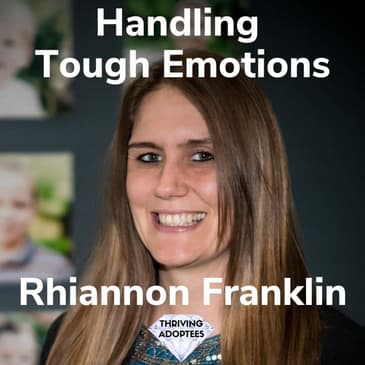
Handling tough emotions is human's biggest challenge. And it's particularly tough for adoptees and adoptive parents given the complex emotions around adoption. So what helps us do this? Listen in as we dive deep and explore powerful learnings...
Find out more about Rhiannon and her organisation at:
https://www.facebook.com/FosterandAdopt
https://www.instagram.com/cmfcaa
https://www.linkedin.com/company/cmfcaa/
https://www.linkedin.com/in/rhiannon-franklin-b498ba239/
Guests and the host are not (unless mentioned) licensed pscyho-therapists and speak from their own opinion only. Seek qualified advice if you need help.
Want to learn more about thriving for you, your kids, your families or your colleagues? Pick a time to talk here
[00:00:02] Hello everybody, welcome to another episode of the Thriving Adoptees Podcast. Today I'm delighted to be joined by Rhiannon Franklin. Looking forward to our conversation today Rhiannon. Yes, me too. Brilliant. So this is possibly the longest organisation name that we've ever had on the show right? So it's CNFCAA which stands for the Central Missouri Foster Care and Adoption Association.
[00:00:31] That's right. That's correct. Yeah, and Rhiannon is... It is a mouthful. A mouthful, yeah. And Rhiannon's in the Ozarks so we would be talking a lot about Ozarks and how that is filmed in the summer. And clearly Central Missouri is cooler in the winter than it is. Very cold. It can be very cold. Very cold, yeah.
[00:00:58] So, thriving. What does thriving mean to you Rhiannon? It can mean several different things. But thriving to me just means that I am able to learn and grow and, you know, get the support that I need to be able to, you know, live my day to day
[00:01:24] and still be a happy, well-rounded person. And sometimes thriving, you know, means something different if you're going through, you know, something hard in life. Recently, you know, I had had some medical concerns with my daughter. And so, thriving during that time looked a little different.
[00:01:50] It meant, you know, I was thriving with no sleep and lots of doctor's visits. And so, I think thriving means differently in different seasons of life. And what do you have to help you thrive during those moments in your life and how you can adapt and thrive through them? Yeah. I love the breath there. I love the breath.
[00:02:18] Because if I ask that question and somebody just says one thing, it means it kind of limits, it limits my scope for the conversation. Yeah. Right. So, I love the breath. You know, the kind of learning and grow. I've been distilling down what I've learned over the last five years since I've been doing the podcast.
[00:02:42] So, for the last 18 months or so, I've been distilling that down and fine-tuning that, what it looks like, what thriving looks like. And learning and growing are one of the major themes from the, from the whatever 640 odd episodes that we've done so far. That's a lot. That's a lot. Yeah. That's a lot.
[00:03:14] So, I was reflecting back on the reason I, I do the podcast. And it came from a painful moment. And I think I've been aware of that for quite a while that we often learn in the toughest. Yeah. In the toughest stuff.
[00:03:43] So, do any particular moments stand out for you in terms of learning from the tough stuff? Yeah. In terms of learning and growing and how that, how the tough stuff catalyzes that learning and growth.
[00:04:03] So, I would say two moments that are reflective in my life that, maybe three, but really, so I was around seven when my parents got divorced. And obviously, that's a huge change in your life. Um, and so, we relied on my grandparents a lot. And I, um, you know, they were probably the most stable in my life during that time.
[00:04:31] And so, even now as an adult, there are lots of times that I lean on them, um, quite a bit. And then, um, you know, when I got into college, I actually went to college to, um, do something totally different than what I'm doing now. I went to college to become a physical therapist and I was playing sports. And I, um, put myself through college. So, I knew I had to have a job.
[00:04:57] So, those two options were not an option then, um, about a semester in. And I was like, I have to have a job. I can't pay for my bills. Um, and so, I quit sports and I went to just a general education for a while, um, and took some psychology classes and, and started learning more about myself and ways that I, you know, was struggling through some of that old, you know, younger me.
[00:05:25] Um, and so then I chose to do, um, a double major in psychology and criminal justice. Um, and then years later, 10 years later, to be exact, I went on to be, um, get my master's in early childhood and family development because I really wanted to hone in on why, um, those early years of children's lives are so important and how it affects our brain later in life.
[00:05:51] Um, and then fast forward to now, my oldest daughter is seven and she is the exact age that I was when my parents got divorced. And some of the thing, the, the emotions that I see, I'm like, oh my gosh, why is she so sensitive? And why is she crying over this? And I reflect and look at myself as a seven year old.
[00:06:14] And I realized that there were times where I, um, you know, did not, did not, was not able to have those emotions because of, you know, what my parents were going through and being emotional during those times where they're dealing with their own emotions. You know, I don't fault them for anything, but they definitely could not have handled my big emotions during that time when they were having big emotions themselves.
[00:06:42] And it's taken me 30 plus years to figure all this out, right? And my own daughter and her own, um, emotions for me to reflect and then reflect with my therapist about why I'm feeling this way of her big emotions.
[00:06:57] And so, um, we reflect a lot in our house about, um, emotions and worry and, um, you know, why maybe we, we, we, the big emotion is okay, but why we, you know, can try to have steps to move through the emotion. Um, if it's really not something that we should worry so much about.
[00:07:20] Um, but I know reflecting that it really, it was like those kinds of pivotal moments in my life that I reflected on and those were big moments. Yeah. So a seven year old suppressing emotions because her parents are having big emotions. Yeah. Seems. Like big, right? Yeah. And, and kind of. Beyond you.
[00:07:49] Beyond what a seven year old should have to do. Right. Yeah. And. I guess it, it's also. It kind of reflects a fear, a fear of our. Fear of emotions. Yeah. Yeah. Yeah. I was. Honestly, I can say that I was not a real emotional kid until I had my daughter.
[00:08:16] Um, and that was probably the first time that like the floodgates opened and I was like really emotional. Um, and it was probably because they were suppressed for so long. You know, I mean, not saying I never had emotions, but like, I never let myself feel as much as I did until that point in my life. Yeah.
[00:08:41] I was, uh, in one, I was talking to, uh, an adoptive, adoptee, um, who's a, who's a mom. And she said that actually giving her giving birth was the first time that she really felt everything. Yeah. Yeah. Similar to you. It's, it's, uh, it's an emotional time with the whole, just the hormone changes. Right. As. Yeah.
[00:09:09] As, as, as well as the stuff that we can't, the stuff that we, that's happening within the body is. Yeah. Yeah. Yeah.
[00:09:21] One of the, one of the things that kind of popped into my head about a, you know, a potential, a commonality really between what, uh, what adoptees think and feel and what kids whose parents get divorced feel as well.
[00:09:45] Is that kids whose, whose parents get divorced can sometime think it's their fault somehow. Yeah, of course. And did, was that, did that happen to you? Yes. Well, yes. And there was like another piece of this where I have an older sister who does not have the same dad as me. Um, and I did not know that, did not know at all that we had different dads until my parents got divorced.
[00:10:16] So there's further destabilization, right? Yeah. Yeah. Yeah. Because then, you know, she, she sometimes visited, um, but sometimes did not go with us. Um, she's six years older than me. So there's a little bit of an age gap and it was, it was just a really weird time to find out, you know, that, oh, your dad is really not the same dad. And why haven't you seen your dad? And where is he?
[00:10:44] And, um, you know, she also was going to be adopted by my dad, um, and then wasn't. And so there's a piece for her of, you know, a little bit of now I don't have a dad. Um, I didn't have that and now I really don't have a dad. Yeah. So I, I go back to that piece.
[00:11:09] Um, you mentioned adoption, but you didn't know that you, you, you didn't know that your dad, your dad was going to adopt your. No, not until she told me. Um, and I don't think I knew that right away at seven. I think I knew it late, like later we had talked about things, you know, that had happened when we were younger. Yeah. Um, all three of us that I have a younger sister too, who's almost four years younger than me.
[00:11:39] We were spread out. Yeah. Um, and we talked about things, you know, that had happened in our life and, you know, people that, um, we had stayed with or lived with through kind of that time of my parents just trying to figure it out. Right. Like, I don't, I've come to a point where, you know, I, I can have conversations with both my parents and not feel like angry with them or anything like that. Now, seven year old me, teenage me. Oh yeah. Yeah.
[00:12:09] It's definitely an angry, angry. Um, like, why can't you guys just be together? Why do you have to, and back then, um, I knew of other people's parents that had gotten divorced, but no one like really in our immediate family. So it was just, we, it was just different and weird. And why can't we have birthdays together? Right. Why can't we have Christmas together? So it's that whole back and forth.
[00:12:35] And so for me reflecting forward and the work, um, you know, that I do, I feel like that's probably how a lot of, you know, adoptees or foster children feel is that they're, they're taken. And now why, why can't I have birthdays or Christmas with my family or where are they? And, um, you know, why don't they want to come see me or all those emotions, you know, and how, how do you deal with those as a kid?
[00:13:05] You don't. Or not well, or they come out in big emotions. You know, I don't, I don't like saying behaviors. I like calling them big emotions because it really is emotions that you're dealing with that sometimes as a kid, you don't know how to, how to project that or how to say it. And so it comes out in an emotion. Yeah.
[00:13:30] What about the fact that your daughter's having similar emotions, but she's not going through the same experience? Yeah. So, um, it's, it's, I asked myself that question a lot. She is such a sensitive kid and, um, but also very, very smart. Um, and so it's really hard. I don't, I don't know.
[00:13:58] Um, I would assume, you know, all normal kids or what is normal, right? But all kids probably go through big emotions, right? And how to, how to regulate. And it depends on, do you have an adult who can help them through those emotions? Cause they do learn from us, right? And so how do we handle emotions? And I can say that there hasn't been times in my life where I've handled big emotions properly.
[00:14:27] But in our household, we, you know, if, if we don't do something right, we talk about it and we apologize. Um, because I feel like, you know, we're all human. We're all learning. We all make mistakes and it's okay to make mistakes and learn from them. Thank you. Thank you.
[00:14:49] Because one of the big things we come across time and time again is as humans, we, we want to see the cause of our emotions. Yes. Yes. And adopted parents, they often want to know, is this a human thing or is this an adoption thing? Correct. And to some extent, it doesn't matter. Right.
[00:15:20] But, you know, I was having a conversation, this similar sort of conversation with somebody the other week and said, well, actually it does matter because we need to know what they need. And I've reflected on that afterwards. And I thought, well, yeah, we do need to know what they need. That's for sure. That is for sure.
[00:15:44] What, what is it, what, what is it that, what is it that these big feelings are telling me that I should do as a, as a parent? Right. Right. That's one thing. And that, that is completely, well, to me, it, it seems separate to, to the causal factor. Absolutely.
[00:16:09] And so as I started to say that sentence, I was pretty sure of myself, but then I wanted to kind of give you a little bit more latitude. And what, what, what, what do you make? Do you get my logic here? Yes. I mean, I, I get that question. So previously coming to this agency, to CMFCAA, I was a juvenile officer with the state.
[00:16:35] So it's, it's, it's in Missouri, we have a really weird system where we are, our juvenile office and juvenile court proceeding stuff and children's division are two separate entities. Um, so the juvenile office, um, is the one that kind of takes children into care. So away from, um, family of origin and places them into foster care.
[00:17:02] And a lot of times I would sit with foster parents and, or adoptive parents and they would be like, is, is this normal behavior of a child or is it that? And, you know, a lot of times it was normal behavior, um, or emotions that were just normal of that age and, or that development of that child. And we all know that everybody ages and develops and, you know, does things differently throughout different timelines.
[00:17:31] There's a scope that they may do it, but there is a scope that we know that if kids have had trauma early on in their life, they're delayed a little bit. And so you may have a 10 year old who has bigger emotions at 10 than when they were at six, because they are delayed in that, and that response to that emotion, um, or learning. And so I, I do think sometimes it is different.
[00:18:00] I, I, I've seen, you know, um, foster kiddos that I worked with that were being placed in a pre-adoptive home and they challenged that family, right? They challenged like, are you going to love me through anything I throw at you, um, and still be there and still love me no matter what I do.
[00:18:21] And, um, you know, I did sadly have families that could not handle the emotions of the child and, and would not keep placement. But I did have families where I had a mom and a foster mom and dad sit in the room with me and the child and say, look, no matter what you throw at us, we're not giving up on you. We are not giving up no matter what we are going to love you through any challenge you place at our feet.
[00:18:49] And so, um, you know, kind of like, it would just be a lot easier, you know, if, if you just worked with us instead of against us kind of thing. Um, and they really, I mean, that family I think of, they really, um, you know, hit every challenge head on and they did different types of therapy and different types of family bonding and went to family camps.
[00:19:15] I mean, they truly stayed with that kid through every season and did an up adopting and it's, you know, not, it's not for everyone. It's not. Um, and later in life, if, you know, they had that conversation with, with that adoptive youth, that if he wanted to see his family or know his family, that they would be there to help him through that. Yeah.
[00:19:41] I'm hearing quite a lot of this recently, well, quite a lot, probably overstating it, but I'm, I'm seeing a brilliant clarity around these, around these parents that are very honest with their kids. Um, yeah. Yeah.
[00:20:08] So, you know, just laying it on the line, we're going to love you no matter what. Right. So, or I heard another one, a foster mom that I interviewed a couple of weeks ago. She's, she often fosters older teens and she'll say to them, look, uh, nobody's, I'm not going to deny your trauma. Right. Right. But you've got a choice here. You can either succumb to the trauma. Right.
[00:20:37] Or you can rise above it. And, and I think that takes such bravery to, to be that honest. So on one level, I think that that's so brave. And, and another level, I just wish that everybody could see that choice. Yeah.
[00:21:04] Because I see so many people who don't see a choice, who feel that they are destined to be, to be stuck with their tough emotions forever. And they, they don't, they kind of like, they can't see their way out.
[00:21:32] And as I say that, I'm realizing why this is so big for me. It's because I thought after reading the primal wound, I thought that there was no healing. I, I, I didn't see the, I didn't see the option of rising above the trauma for, for a while. I thought I was stuck with it.
[00:22:01] And then, hey, presto, I realized that I wasn't, you know, it's a magic thing. Right. It comes, it almost comes as a magic. There's no, I didn't look at myself in the mirror. Um, you know, and write five affirmations down saying I must rise above my trauma. That's that it wasn't a mindset thing.
[00:22:28] It wasn't, it wasn't a thing that I made an insight that I made happen. It just happened. I agree. It just happened. Yeah. And, and, and because it, it just happened, it's very hard to explain the process. Yeah. Yes. It is very hard. I agree with that.
[00:22:57] It, there, I started, I would say after I got divorced, um, cause I was married and then got divorced, um, I'm, I married pretty young. Um, we were high school sweethearts and, um, we got divorced and it was pretty amicable, but I feel like after that, I did a lot of soul searching and, and you're right. It does. It just happens.
[00:23:25] And it's like, you can either choose to, you know, be in this negative mindset every day, or you can choose to learn and grow. I can tell you at 22, I was not the same person. And I'm like, I don't need to learn anything. I know it all. But, um, you know, every day I, every day I try to look at something that I learned like every day. What did, what is one thing that I learned from today?
[00:23:52] And I feel like if everybody did that, they'd probably see they, they are learning something new every day or a different way to do something every day. Just to be clear, your seven year old is with your second husband, right? Yes. Yes. I had no, no kids, um, with my first husband. Um, and I honestly did not think I could have kids. Um, okay. So then I got married. Um, I've been married.
[00:24:22] We've been together, um, almost 10 years. No, it has been 10 years. It'll almost be 11. Um, and together we have four kids. Um, he had two older boys and then we have two girls together. The older boys are, um, 20, going to be 20 and going to be 17. And then we have seven and two. Right. So there's a big range of like, okay, seven, like the seven year old Gwen, we're like, okay,
[00:24:52] we're going to have, um, an adult conversation with Nate Noah. So I need you to go to your room real quick. But it's a lot of juggling, you know, different conversations and different, um, ways to say things, especially if they're all together. Yeah. So. I just want to refer back to something that you said about the parents, the pre-adopted
[00:25:18] parents who then went on to adopt this, uh, this kiddo out of, um, out of foster care. And you said that they tried lots of things, right? Yeah. So they, they were all in for that kid. Yeah. All in. All in. So I, I think that's one of the ways that we have insights. Mm-hmm.
[00:25:47] So we don't know which, uh, activity. Right. Is going to work or which modality is going to work. Yeah. Or we don't, and you're talking about lots of different ways. Yes. To tackle the same thing. So I'm keeping on going. So for me, it's, it's about creativity.
[00:26:17] It's about persistence and just sticking with that, sticking at it. And our kid, the kid knowing that we're going to stick at, we're going to stick with them. They're going to be, we're going to be stuck to them. They're going to be stuck with us. And we're going to stick at it in terms of, we, we're going to find a way that works, that, that catalyzes the magic.
[00:26:48] Yes. So persistence is the way that. Yeah. It is the way that the, maybe that the mindset, the mindset shifts, the idea shifts. We, um, this kind of goes along with that a little bit.
[00:27:11] So our agency usually does two conferences for foster or adoptive or kinship families. And we're combining them into one to look more like a, like family camp style, um, conference where they will still learn some things.
[00:27:28] But we really want to build, um, this conference around like family, like almost like team building, but it's family building where they do activities together and they, um, learn and grow together. Especially if they have older youth in their home. So, um, one thing we talked about and it came from us talking as an agency about our different communication styles.
[00:27:55] And I, I know this in my own home, um, is, you know, we all communicate differently and we all learn differently. And so we talked about, could we have someone come in and teach that family how they communicate and how they're different, their different styles and how, you know, if, if you have, I'm just using myself an example, but like, if you have what I would call a driver, right. It's like, they're more going to take charge and, and lead and do the conversation.
[00:28:24] And then you have somebody who's more, um, like the caboose and they're just going to go along with the driver. Well, sometimes the driver can really mow over the caboose, right. And, and the caboose could really get their feelings there. And so how can we have both, both these come together and communicate effectively because we, we see that even in, in, you know, our own families. And, and so that's one thing that we talked about.
[00:28:53] And I, I just think about like some of the families I've worked with throughout my career is if we had really set them up with the tools in their tool chest to know how each other communicate, wouldn't that be a wonderful world? Because we would know, okay, if I say it this way, it's going to upset them or they're going to take this as, you know, I'm, I'm saying it as an insult when I'm really not. I'm just trying to be direct.
[00:29:21] Um, so that's one thing that we're looking at other things, um, is just a lot of family bonding and, um, tools for them in their toolkits to take home, like to leave our conference and take home to have in their, in their tool. But both parents and youth. Yeah.
[00:29:44] I want you to take you back a step to, you talked about the ability to handle emotions and I, and the context was the adoptive parents' ability to handle their kids' emotions. And I'm wondering what light you have to share on that.
[00:30:11] Because I, when I think about, when I think about what the most, the most impactful things that adopted parents have shared with me, they talk about realizing that raising adopted kids isn't about fixing them. Yeah.
[00:30:41] It's about growing their capacity to not take their kids' trauma personally. Yeah. And ability to handle our kids' emotions is very similar to that. Um, so what's, what's, what's that about?
[00:31:06] What, what can you share with us about growing that capacity? Well, I agree with everything you just said. It is about, um, you know, learning how to help them and not, not try to mold them into what you, you know, what you feel they should be. It's just, um, you know, embracing everything about that child.
[00:31:33] Um, but like, I think as any parent, right. And especially adoptive parents, we have to reflect on our own emotions and how we self-regulate, um, within, um, we have a program here. There is called, um, we call it the three Ps, but it's placement preservation.
[00:31:55] Um, and basically they're going into the homes where, you know, you may have a disruption based on, um, some emotions and how, how we're regulating those emotions. And so one of the like tools that we teach both the kids and the adults is we use some open, it's called open mind by Dr. Monica Jackman.
[00:32:18] And it's really reflecting on how we deal with the emotion ourselves and self-regulate before we can deal with the emotion that is being presented in front of us. Um, and it takes a lot, a lot of patience within yourself. Um, a lot of patience and persistence and calmness, you know, like pause, take the 10 seconds before you respond.
[00:32:45] Um, and it's okay if you don't get it on day one, day two date. It's just, can't, can you reflect enough within yourself to, to make the want to, to do the change? And it's okay if you don't at first and it's okay to say sorry, um, for not being self-regulated yourself. Um, but it's a lot of, a lot of self-regulation. Yeah.
[00:33:12] When we get near this, I often reflect back about reading an emotional intelligence book years ago and how I don't, and how emotional intelligence, it's all about us first. And then it's like other people, right? So it's self-regulation rather than, you know, it doesn't start with how to regulate our kids. It starts with how to regulate ourselves. Regulate ourselves. Yes. Um, and I also reflect that I, I don't see a lot of that around.
[00:33:43] Yeah. I don't see it. Well, no, no, I mean, sorry. I mean, I don't see, it is hard. Yeah. Um, but I don't see a lot of use of the word emotional intelligence. Oh, I agree. And then, like, has it gone out of fashion? Like, has somebody created something new? Because it's a bit like diets, right? Yeah. So if you, there's just like several and you just try.
[00:34:13] Eat less. Yeah. Eat less, move more. How hard can it be? And yet we have this gazillion dollar stroke, pound stroke. Yes. You know, whatever, euro stroke. We have this money that, that, that kind of, you have to, you have to kind of promise somebody new. Mm-hmm. Mm-hmm. Promise, offer somebody, offer something new to somebody. Yeah.
[00:34:41] Before that, before they, they're going to buy it. Because they said, I've tried everything else. Yeah. Well, like, why don't we say, like, this emotional intelligence stuff, um, why does it go out of fashion other than marketing employees? Right. Exactly.
[00:35:08] Are you, we talk about emotion and, um, have you ever read, um, Brene Brown? A bit. Or listen to any of her podcasts. So she talks about this sense of belonging. And, you know, I, every human being wants to belong, you know?
[00:35:27] And so I think that goes along with that emotional intelligence and, and knowing, like, if you feel loved and you feel like you belong, your sense of self-worth is so much better. Yeah. Yeah. I'm just, I'm just riffing off the back of one of the things I've been thinking about, talking about here. Because you, you can take an emotional intelligence.
[00:35:58] Yeah. Test, right? So one of the challenges that we have is that we live with ourselves 24 hours a day. Yeah. Or we, you know, it's hard to see the pictures when we're in the frame as a, an old mentor of mine used to say. Like, um, and that's how doing a, an emotional intelligence test can help us see things that we have not seen before.
[00:36:24] And, and we can do these for free and they don't take a lot of time. They're just a multiple, multiple choice quiz. Yeah. And it can point, can break, uh, point us to some stuff that we can't see ourselves.
[00:36:44] So what, what other suggestions would you make to, to, to listeners who want to become, want to regulate themselves better and they want to grow their capacity to handle their kids emotional stuff? Well, I, I mean, and this is just speaking for my own self, but like, I think pausing and not, not automatically reacting.
[00:37:13] So take the 10 seconds count in your head. And especially if the, if your child's having the big emotion, because just taking that pause and the deep breaths will help you regulate within yourself to be able to respond. Um, I mean, I'm, I'm still learning and doing that myself because it is, it is practice every day to do that. Yeah. It is.
[00:37:44] And, you know, learning something new, you know, learning, reflecting on back or something that we've learned every, uh, every day. We're coming in on time here, Rhiannon. So I just wanted to ask you if there's anything else that you'd like to share that I've not. I don't think so. I've enjoyed being on here and being able to talk to you. Yeah. I've enjoyed it too. And we hope you've enjoyed it too, listeners.
[00:38:13] And, um, we'll speak to you very soon. As always, check out the show notes, um, and find out more about where, what, uh, the guest is doing. Thank you, Rhiannon. Thank you. Thank you.