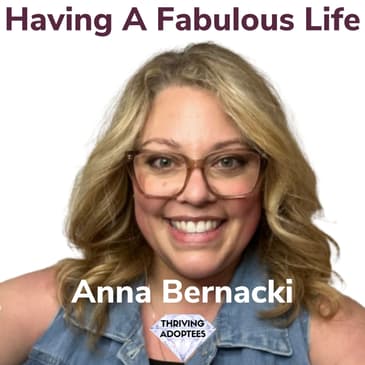
What if we could have a fabulous life, whatever our story? Thriving doesn't look like an option for some. But what if it is? Listen in as adoptee, adoptive parent and adoption professional Anna dives into doing the work, empowerment and much more.
Here's a bit about Anna from her website:
"I’m an adoptee, raised in a loving family, and I grew up knowing there was more beneath the surface of my story than anyone talked about.
Like many adoptees, I learned how to be grateful, how to be “fine,” and how to keep the harder questions quiet. It took years to understand how much adoption shapes a person’s sense of identity, safety, and belonging. Not just in childhood, but across a lifetime.
Today, my husband and I are parenting four children, all adopted through foster care. Our family story includes joy and deep connection, but it also includes trauma, mental illness, grief, and seasons that look nothing like what we imagined when we said yes to adoption.
Parenting children with complex needs has changed me. It has humbled me, stretched me, and forced me to let go of easy answers in favor of deeper understanding."
https://www.facebook.com/profile.php?id=61557459094817
https://www.instagram.com/anna.bernacki/
https://www.parentingdifferent.com/
https://www.linkedin.com/in/anna-bernacki-048a50387/
Guests and the host are not (unless mentioned) licensed pscyho-therapists and speak from their own opinion only. Seek qualified advice if you need help.
Want to learn more about thriving for you, your kids, your families or your colleagues? Pick a time to talk here
[00:00:02] Hello everybody, welcome to another episode of the Thriving Adoptees podcast. Today I'm delighted to be joined by Anna Bernacki. Looking forward to speaking with you, Anna. Anna interviewed me yesterday and today I'm interviewing her so it's just an interview fest. Right, we're learning all about each other.
[00:00:19] Yeah, so not only is Anna a podcaster, she is a fellow podcaster, she is also a fellow adoptee, but she is also an adoptive mum. So you've got, you and your husband have got four kids through adoption. Yeah, and some special needs I think if I'm remember.
[00:00:40] Yeah, yeah we have quite a, quite a mix of special needs in there. Some prenatal exposures and then some other mental health struggles as well. Right. So I don't know how you do that all right? I'm not sure I know either. It's just day by day. You just keep going. Yeah. So the first question is the one that I kind of always like to ask especially fellow adoptees.
[00:01:06] So when you hear the name of the podcast, Thriving Adoptees, what comes to mind for you, Anna? I would think of an adoptee who has really done the work and gone through their history and their struggles and where their insecurities are.
[00:01:27] Someone who has embraced who they are, whether their, you know, whether their adoption story was positive or negative, or whether they just feel, you know, that middle ground. Sometimes it can be both like it was hard, but also, you know, and I think that's where I fall. I wish I didn't have to be adopted, but also I'm thankful that I wasn't raised by my birth parents. So I think I'm kind of in that, you know, middle ground there.
[00:01:57] So I think a thriving adoptee, I would say someone who has overcome and become a healthy, successful human who is not bound by their story. Yeah. So free, free of the story? Well, I think the story follows us to a certain extent and it does impact different parts of our lives.
[00:02:21] So I don't, I wouldn't necessarily say free of the story, but free of maybe the burdens that the story can carry or the narrative that sometimes the story can put on us. Yeah. Yeah. I think what I was coming from then, when I said free from, I was also thinking freedom with or freedom despite the story. Yes. That would be a perfect. Yes.
[00:02:51] Yeah. So there's a, I guess there's a turning point there. Was there a turning point for you when you became free despite your story? Yes. I had a very profound couple years, really. I think growing up, I had always, like, I always knew I was adopted. My younger siblings were also adopted.
[00:03:17] None of us were biologically related, but it was just a part of our home that we were adopted. And it was just kind of a fact. It wasn't really, it wasn't made into a big deal. It just was. And as I got older, I really longed for that biological connection, especially through my teen years. I think, I mean, it started very young, but through my teen years, you're already an angsty teenager.
[00:03:44] And so now you have the complexity of being an angsty teenager and you're adopted and you're searching for your identity and who you are. And you just assume, or at least I did, I just assumed that all of my problems would be solved if I met my birth parents. So I had a completely closed adoption. I didn't know anything growing up. And I created, I mean, in the adoptee world, I think they call it the ghost kingdom. And let me tell you about my ghost kingdom.
[00:04:13] Like it was elaborate and very extensive. I have a wild imagination. And my birth parents were like these incredible people. It was all an accident that I was separated at birth. I was going to meet them and live happily ever after. And there would be an immediate connection. I mean, it was extravagant. And this went through my teen years where I truly believed that once I met them, everything would be explained.
[00:04:42] And I also really believed that my adoptive parents didn't understand me because they were my adoptive parents. Not because I was an angsty teenager and just going through what teenagers go through. So I put a lot of weight on my adoption then. But then I met my birth mom when I was about 21. And my world came crashing down because she was not anything that I had made her out to be.
[00:05:10] And so I had never even considered the fact that she wouldn't be who I had created in my head. And I don't know why, looking back, that's so ridiculous that it was never even a consideration. Because it was so outlandish who I had created her to be. But I just genuinely had never considered that she wouldn't be that. So meeting her, like, I had put expectations on her that nobody would have ever been able to live up to.
[00:05:37] And same, I think she thought the same thing with me. She had put expectations on me that I couldn't live up to. And the relationship imploded very quickly. And partly, I think, because I was young and I didn't understand boundaries. And there's a lot of things I would do differently now. But at the core of it, it was this huge disappointment because I had created a false narrative.
[00:06:03] So then fast forward, I got married in my late 20s. And we started trying to have kids right away. Now my way to have this biological connection was going to be through having biological children. And that was going to be my happily ever after. And that didn't happen. So we put adoption on the table. And I was like, well, I'm an adoptee. So I'm going to be a really amazing adoptive mom because I know everything.
[00:06:33] Was humbled very quickly and realized I do not know everything. That was real wild. But once we had the kids in our home and we had gone through the adoption process for the first two. So we have two sets of siblings. So the first two were adopted in 2019.
[00:06:52] And shortly afterwards, as I'm watching them heal and I'm watching them go through missing their biological parents and struggling with their identity and trying to navigate the newness. Even though they had lived in our home for a while, the adoption just made things permanent for them and really changed things. So all of a sudden, I'm sitting there going, oh my goodness, I feel this way too.
[00:07:20] Oh my goodness, that's why I struggled with this. And it ripped open a wound I didn't even know I had. So I had all this grief and struggles and longing and all of these things that I genuinely had never considered. So now I'm like raw and emotional at the same time with my kids, which was real wild for a while. But we were able to kind of process and heal together.
[00:07:48] They were older at the time, which made it really beautiful because we were having very open and raw conversations about things that I don't think a lot of adoptees would have raw conversations about. Like missing our parents and the what if and I wonder what they're doing today. And so that was kind of going through that process, ripped everything open. But it also was when I started putting the pieces back together.
[00:08:16] And that's kind of when I really had that big turning point in my life. So it was. I think you talked yesterday, like there was a time in your life, too, where you didn't even know it was there. Then it got ripped open and you kind of piece it back together. So, yeah, that that is that is our story. I think as adoptees, we have that first big moment of coming out of the fog. Yes.
[00:08:45] But. You could. You were aware of the emotions. In the fog. So I wasn't aware. I wasn't aware of my emotions when I was in the fog. I think was yours more like connecting the dots thing. Yeah. Do you get what I'm saying? I think maybe.
[00:09:16] I think there was. I mean, definitely when I was in the fog, there was definitely a lot. I think there was a lot of misplaced emotions. So the emotions were there and the struggles were there, but it was all misplaced. So I think that played a huge role in in kind of that fog. And now then coming out of that, I was able to place those emotions in the appropriate. Like what they actually belong to and process through them. Okay.
[00:09:45] So like by you mean like an assigning. Yeah. Penning the tail on the right donkey. Is that what you mean? Yes, exactly that. And I think like the grief, like that longing and desperation to be connected with my birth mother as a teenager was really, I was grieving the fact that I didn't have a genetic mirror and I couldn't, I saw something in my friends with their parents that I didn't have.
[00:10:13] And so I just assumed that my birth mother would be that for me. So I was assigning and I wasn't realizing like, this is a grief thing. You have to process it. You have to work through it and not allow it to define your life. And I just allowed it to define me for so long and not considering that this was actually grief. It was grief of what I had lost, what I had grown up without. And that's okay.
[00:10:41] You know, I think that was the piece that it's okay to not have that. Yeah. Because as you were talking about raising the first sibling set, you talked about their grief and healing together. And what I was going through my head was almost like a validation. The three of you were validating, were validating it.
[00:11:11] You were all, you were three of you were making it okay. Yeah. Yeah. We're all, we're all feeling the same stuff. So it's not, it's not nuts. Right. And it allowed it to be external. You didn't have to hide it. I think there was a lot of now what I would consider my grief in my adolescent teen years, I would consider that grief now, but at the time I wasn't considering it as grief.
[00:11:42] So it was just, what is this? Why do I have all these big emotions? And I hid a lot of it. I didn't talk to my adoptive parents about it because I didn't want them to know how desperately I wanted that connection because I was afraid of hurting them. So having that open conversation in the home, even with my kids being allowed to say the
[00:12:03] hard things to me was almost healing in a way too, where I got to see, even though I didn't experience it, I got to experience it through them of what it would look like to be able to say those things and have those difficult conversations out loud and not just hold it in. And that healed a piece of me too, I think. Yeah.
[00:12:27] So what was the shift then about moving from anger towards your adoptive parents and realizing it was grief for your biological parents? Is that how you? Yeah. Yeah, for sure. Yeah.
[00:12:54] I can see what, did you use the word misplaced? Yes. Yeah. Okay. Right. So that's what landed for me. I guess, and maybe one of the things I was struggling with is I had, in our conversation, right, is that, or the differentiation that I was making is that I didn't have anger towards
[00:13:18] my adoptive parents, nor did I have seeking for my birth parents. Yeah. Neither of those things were things. I mean, I had some slightly tricky stuff with my dad, who was an only child, my adopted daughter, who was an only child and not the most emotionally intelligent of guys, you know.
[00:13:42] But occasionally I was, I bought him some anger for some of the things he did, but it wasn't wholesale anger. It was just the odd moment. And I, so stuff perhaps about, he seems to spend too much time at work or why is he, why does he do that? You know, why does he, why does he do that to me? He used to, he didn't like the fact that I had, I've got slightly rounded shoulders and
[00:14:10] he used to kind of walk behind me and try and pull my shoulders back to his train of me, you know, but like slightly freaky, slightly freaky things, right. But anyway, I'm sure my mum doesn't listen to these podcasts, but why are you talking about your dad like that? Anyway. So expectations then were the, you talked about two occasions, not two occasions, two passages
[00:14:37] of your life where your expectations were off in terms of your, the expectations from your birth mum and then your, the expectations that you had about becoming a mum through, through adoption. Yes. Did you beat yourself up a lot about those expectations when they were dashed or was it, was it like that or was it completely different? Um, I don't think I really did.
[00:15:03] I think probably more so becoming a parent because I think becoming a parent is just extremely humbling anyway. Um, regardless of how you become a parent. And I think all good parents beat themselves up to a certain extent. Um, so yes and no, I think I didn't really fully process and understand how, how much my
[00:15:31] expectations were the root of the problem when meeting my birth mother until many more, many years later. So I think that was kind of a, that was a component I hadn't really, like you said, the tail on the donkey that I hadn't placed yet, that that was the reason why that relationship imploded so quickly. Um, so that was a kind of a hindsight thing. Yeah. And then, yeah, becoming a parent. Yeah.
[00:16:01] I definitely, I don't think it was necessarily because I was adopted and had different expectations. It was just the reality of being a parent was very, very different than what I expected. And that's okay. That wasn't necessarily a negative thing for me. It was just wildly different. Yeah. So how do you see the, the, the role of expectations and that being an obstacle to our thriving?
[00:16:31] Hmm. That's a load of questions. I think it's so important to, I mean, I've really shifted since then. And actually about two years ago, I met my birth father and I walked into it with zero expectations and almost tried to make it a self-fulfilling prophecy the opposite way. Um, because I, yeah, I was so determined not to have any expectations there, but I think the reality is we always do, right?
[00:17:01] We always, we always do. So I think it, I mean, yeah, expectations didn't definitely get in the way of that. Because especially if we're not able to adjust and pivot. And I think that's the most important thing is to really, you have to learn to be flexible and your expectations may be wrong, but that's not necessarily a reflection of you as a human.
[00:17:29] That's just a reflection of our mindset. And then you can shift and change and adjust and become exactly who you need to be in that, in that scenario. Yeah. What else do you think gets in the way of our thriving? I think ourselves a lot of times.
[00:17:52] And I think we talk about expectations of others, but also sometimes expectations of ourselves. Like I'm going to be more resilient. I'm not going to let this bother me. I won't let this affect me. And sometimes we have to acknowledge and just say, I think there's so much power in acknowledging and just letting it go.
[00:18:20] Because if you hold it and don't acknowledge it, then it just sits there and eats you up. But if you acknowledge it, then you can let it go. And so sometimes it's acknowledging like, ooh, that hurt because of my abandonment wounds or my struggle. And just acknowledging that and being able to acknowledge and move on and not necessarily sit in there and allow it to cripple you. So there's that balance, right? And sometimes it's hard to find that balance.
[00:18:44] And I think that can really hinder us from thriving is, yes, you have to acknowledge it, but you don't want to sit in it and allow it to cripple you. So, yeah. Have there been, well, do you remember when you saw that? Do you remember seeing that for the first time or is that kind of lost in there? I'm not sure. Yeah, I'm not sure there was necessarily a time when I remember that.
[00:19:10] I mean, I know even just in the past couple weeks, I've had situations within work and professional relationships where, you know, I kind of go, ooh, that decisions were made. I'm like, really affected. Why did that bother me so much? Why is that eating me up? It shouldn't bother. This is a professional relationship. This shouldn't bother me so much.
[00:19:35] And so then just kind of processing through it and saying, okay, I'm feeling abandoned by this person. There's a reason for this that doesn't define me and I'm okay and I can move on. And so I think it's just kind of almost that self-talk through it that I've learned. Yeah. So space between you and the decisions or the space between you and the incident. Yeah.
[00:20:04] And really, right. And not putting myself, not making myself feel guilty. Like, wow, you're way overreacting. Like, I'm not making myself feel guilty. I'm acknowledging it. And then I also can acknowledge that I'm bigger than that. And I'm not defined by that. And while that touched a wound I didn't like, I can overcome and I can move forward. Yeah.
[00:20:28] So you said that there was two years that were particularly profound for you. What was, were those the years after adopting the kids? Is that? Yeah. I would say the years after adopting the kids and then, yeah, processing through that.
[00:20:55] And then we also got our two babies during that time as well. And so over the course of those two years. So we got the two siblings, older siblings, and then our little baby girl all within five months. And then two years later, baby girl had a brother. Right. So we got him two years later. And that was in May of 2020. So the world was shut down. And now we had a brand new little baby. And he didn't sleep.
[00:21:24] He didn't, I mean, it was, he was colicky. It was awful. Like, absolutely awful. It was a very, very dark time. And looking back on that though, like, yes, it was hard. Our family was struggling. Relationships within our family were struggling. It was just post-adoption for the older girls because they were adopted in 2019.
[00:21:51] So, I mean, everything just collided and happened all at once. And so that was definitely very, very difficult. But coming out of that, I think there was, as I came out of that, it became very freeing. Was there a turning point, Anna? Yeah. Was there a turning point? Tell us about the turning point. I was so incredibly lonely. Like, so lonely. Nobody understood my life within, you know, my circle.
[00:22:21] And so I looked to social media and that sounds crazy, but I was like, I need to know that somebody else out here feels the same way that I do and is struggling with the same things. And so I turned to social media and I started following creators that were interesting or shared, you know, different adoptive moms or other adoptees and started kind of developing these relationships and I would comment on their things.
[00:22:49] And so through that, I developed some beautiful relationships that turned into real life friends. And that really pulled me out of that. And it validated so many things that I was struggling with. I wasn't a bad person. Other moms were struggling with these things too. Parenting kids who are adopted is hard and it's very different than parenting, you know, your biological children. So, and that's okay.
[00:23:19] And it was, it gave me permission to struggle and be human. And then coming out of that, it also lifted me up and built me up and they spoke life into me. And that was really when I started having that turning point was meeting. It was so crucial for me to meet other people who lived a similar life while we, none of us have identical lives, but living similar lives and realizing like, okay, this is okay.
[00:23:49] We can get through this. And that was a huge turning point for me. And I'm presuming that these were largely adoptive parent, fellow adoptive moms that you met. Is that right? Yes. I would say that started, that started it. Now I've developed relationships with so many incredible people all through out adoption. So adoption professionals, other adoptees and birth moms.
[00:24:18] I have a whole crew of birth moms that I just love and adore. So there's, yeah, it's a wide, it's a wide range of them now. Yeah. That's fantastic. And I, the reason that I kind of like assumed it was more adoptive, fellow adoptive moms that was the, that was the catalyst for this stuff, this, this turnaround, because I,
[00:24:43] I see, I see a lot of valid in, in adoptee groups, I see a lot of, a lot of validation, but I don't see a lot of hope. Yes, I would agree. Or for, let's call it forward momentum. Whereas you seem to, your connection with the adoptive parents, adoptive mom, parents and adoptive moms community,
[00:25:14] what was the catalyst for forward motion for you? So they didn't just validate you, they helped you move forward. Yeah, for sure. And I think in the adoptee community, you're absolutely right. There are so many, I mean, we joke about the angry adoptees, right? And yes, some have very valid reasons to be angry and some have horrific stories and have been wronged. And I think it's important to acknowledge that,
[00:25:42] but also you can have a horrible story and go live a beautiful life. And so I think you're right. There's that lack of forward momentum. And I just, I'm not the type of person that's going to sit in that. I'm just not. And so for me, I have met other adoptees who are on a similar path of moving forward. And that was really where I needed, that's where I felt most comfortable because I didn't want to sit in that.
[00:26:12] I didn't want to sit and become bitter or angry. And so I, I made the choice to, you know, I definitely set boundaries with people close to me and said, Hey, we're going to talk, we're going to acknowledge this, that adoption starts with loss. We're going to talk about some of the hard complexities about it. We're not going to say that it's all sunshine and roses, but that doesn't mean I'm going to sit in those hard things. There is the both.
[00:26:42] Yeah. Yeah. I mean, that was a great line. You said, uh, you can have a horrible story and still have a fabulous life. Mm hmm. Yes. And I've seen so many people do it. And so many people with, I mean, horrific stories and they're living very fulfilling, successful, beautiful lives. And so it can be done.
[00:27:13] So what do you think of the factors, the determinants, the drivers? What was is, what are the differences? I'm not going to say, I'm not going to be as simplistic to say, what is the difference that makes the difference? I'm going to say, what are the differences that make the, make the difference? What, what, what have you, what have you seen there? I mean, for one, you have to have the desire to move forward. Like it comes within yourself, right?
[00:27:42] You have to have the desire to move beyond and not sit in that. Anger and bitterness towards your story. And then it's who you surround yourself with. Are you going to surround yourself with other people? Yes. Yes. It's very validating. Absolutely validating to have other people who understand your story. And I have found that to be very healing, to have people validate my story.
[00:28:10] But are we going to only sit there and talk about the negatives? Are we only going to validate that part? Or are we going to move forward? And how can we do better? And one of the big drivers for me, at least is, okay, I didn't like how this went for my life. Well, then I'm going to do something about it so that other adoptive parents are educated and will raise their adoptees in a different way than how I was raised.
[00:28:39] And so that's how I can make a difference and I can move forward. I'm not going to sit in the past and be angry and bitter about it, but I can make a change and move forward. And so that's been a huge driving source, I think is one self-motivation and then also who I've surrounded myself with. Yeah. I think for me, you know, we talk about desire and choice and options.
[00:29:05] And one of the challenges I see in the adoptee space is that thriving isn't even seen as an option. Yeah. So often, right? There is no choice. There's no desire. You talk about a desire to move forward. That option just isn't seen. Yeah. It isn't seen that. And something,
[00:29:33] I don't know if I've mentioned this before to you or not. It's something that's landed for me very big in the last couple of weeks. I interviewed a mum who fosters and she's like a kinship, kinship, adoptive mum as well. Okay. And she says to, she, she has, she's had some older teens that she's fostered. And she said, she said to them, look, I'm, I'm not denying your, this is,
[00:30:03] this isn't the first day that they arrive at the house, right? This is after trust has been built. Right. She's like, like, I'm not denying trauma here, but you, you, you've got, I, cause she'd had, she grew up with a family. A father was an addict and she, she was with a guy for 13 and a half years who, there was, there was domestic violence going on between. Um, so she's had a, she's had a tough time. And when she says, look,
[00:30:32] I'm not denying, I'm not doing it. There's no, I'm not going to deny, sit here and deny the trauma, but you have an option. You have a choice here. You have a choice here. You can either succumb to the trauma or you can rise above it. And I've never heard it. X. I've never heard the, the choice, the option. I've never heard that expressed so clearly. with kind of zero BS. Yeah.
[00:31:04] zero, no, no, no sugar coating, but laying it right on the table. And I, and the reason I think I'm talking about it so much is because I don't think we, many people haven't been given that option. Right. Right. They haven't. And then, and they've been, they've been stuck and they just haven't seen stuck.
[00:31:33] They've been stuck in a rut and they haven't seen that a way out of the rut. You know, that just the, the whole world. And then you go on social media and everybody validates the rut. And if anybody talks about a way out of the rut, then they're shot down in, in flames. Right. Right. Yeah. And I think I always tell my kids similarly,
[00:31:57] like you can either allow the trauma to define your life or you can use it to propel you. And I think it's always going to be there in some capacity. We don't just get over the trauma. That's not, I think that's also very false to say, well, you just need to get over it. That's going to be a part of you. It rewires your brain. And that's scientific, right? Like it's going to be a part of you,
[00:32:25] but are you going to use it to propel you forward? Or are you going to use it to define every part of your life? Yeah. Do you remember seeing that option for yourself? Do you remember the moment when you saw that option for yourself, or is it kind of more like hindsight? I think a lot of it was hindsight. I remember sitting,
[00:32:49] I was at an adoption or foster an adoptive conference with some of my friends that I had met online. And, you know, you talk about your stories or whatever. And we were sitting in the back of, it's this huge convention center. And my friend and I were in the back of the room and she goes, you know, you have a really incredible story. You're going to be on that stage someday. And I just laughed. I'm like, ha ha. Yeah, whatever. She goes, no, you have a really cool story. You need to share it. And so little by little,
[00:33:19] I started kind of sharing my own story on social media and things. Well, exactly two years later, I was on that stage. Fantastic. And it was one of those full circle moments where I went, oh, like having that encouragement, those positive people in my life, encouraging me to use the story to propel me forward and not hold me back. Yeah. Okay. So I say it's been more of a drawing together. Yeah.
[00:33:48] Drawing together of the, of the different strands and to be able to summarize them as clearly as possible to, to, to your kids. Right. And so, and, and how old, how old were you? How old were they when you were laying this, this option out to them? Um, I mean, we talk about it repeatedly. I don't know when the first time was probably my oldest is 18 now.
[00:34:17] So probably 15, 16. Right. Okay. Um, and then, you know, my, her younger sister is now 14. So probably 12, 13, somewhere in there in the last year. Around there. Yeah. Yeah. Okay. Um, so me and my missus haven't got any kids. So like I, whenever, when I'm talking to kids, I did, I did a lot of work in, in elementary schools before I came to, to the, the thriving, to, to the,
[00:34:47] the, um, adoption. And I would always, when I started off, I was, I was very cautious about whether I was, talking down to them or, or, you know, like being patronizing to them or expecting too much of them. And I, and I had a, a big thing about trying to meet them roughly where they were at. Right. Sure. Um, to, and I guess that's, that's, that's what's behind the, behind the question. Um, not that,
[00:35:17] okay. When my kid gets to 12, I will tell them this. Look at you. Right. You know, it's not about that. It's really, I don't know. Just, just being, because we talk, people talk a lot about, um, age appropriate language. Right. And age appropriate topics and stuff like that. And, and that, that's got to be tailored. That's got to be. That's an art. Because we have different developmental ages too. I mean, I have,
[00:35:47] my 18 year old is not developmentally 18. My 14 year old is academically way older, developmentally and emotionally way younger, you know? So it's, you really have to tailor it to the individual child and where they are at. Maybe not in, I don't know what the word, a human age, um, but like their developmental and emotional age is where you have to tailor that to.
[00:36:17] Yeah. Yeah. And you know, your children, you know, when, yes, when the time is right. When the time is right. Um, so you talked about a desire to, to, to move forward, uh, and the other people that we surround ourselves with. Are there any other factors that you see as the key drivers of us turning things around, having that,
[00:36:46] having that fabulous life, despite what our story has been, I think find joy in every single day, like find moments of joy and really focus on that because that can shift our whole perspective and really change our internal view of life without necessarily like trying to work through the trauma or processing big things. It can be little things. It can be little things.
[00:37:12] And I actually keep a note on like in my notes app on my phone and I'll go through there and just add things to the list. And so sometimes it's a hug from a friend. Sometimes it's the sunshine. Some days are really hard and it's like, well, I woke up today. It's real basic, but it's demanding that your brain find that joy every single day or some moment of happiness.
[00:37:37] And I think if you can look back at your day and it's not all negative and it's not all tragic and it's not all horrible and you can find that. And then you can read up your list too and find other days and be like, oh yeah, it was better then. It will get better again. And having that watching the cycle and being able to see like the positive, I think that just changes our brain chemistry and how we process the world around us so tremendously. Yeah.
[00:38:07] And what have you learned from doing the podcast? What are the key things you've learned from that? I guess you can make it a bigger question. What have you learned from the community? Because what have you learned from engaging with others? You talked about birth mums, for example, that you, your close friends are birth mums now. So what have you learned most from the, from the community?
[00:38:34] I think that every single story is so unique and we can't just put labels on everything. We can't just say adoption is this or foster care is this or being a parent. Like we just can't. And every story is so nuanced and so unique and they're all valid. They're all valid. And we process things differently. And so it's really important to have that open mind. And I've just,
[00:39:02] I've learned so much about resilience and healing and overcoming. And actually the whole idea of the moments of joy on the notes app came from a birth mom friend of mine. And so that was something that she did when she was really struggling and going through a hard time. So I think we learned when you're open minded and you listen to the stories of others and you hear things, sometimes you're going to see yourself in them and sometimes not at all. Because it's so wildly different.
[00:39:30] But being open and accepting of their story and hearing their journey is just so, it's so rewarding. Like I love, I mean, the podcast is one of my favorite things to do. I just love it. But then also in like the personal relationships too, it's just really given me a bigger view of the world and broadened my horizons.
[00:39:58] And given me so much more compassion for everyone around me. Yeah. So is the, is the compassion, the key thing from the bigger view? Yeah, I would say so. Yeah. Just compassion for others and empathy towards others. And so you mentioned resilience and healing. What, what, that's, and I think you said there was a third one that I was too slow to write down. So let's, let's just go with,
[00:40:26] let's just go with resilience and healing. Let's, which ones do you want to look at, dive into first resilience or healing? Uh, let's go resilience. Okay. Let's go resilience. So what, what's that about for you? And, and what, what have been your key kind of moments of learnings and your key insights that, that you have found? What, what do you want to talk about? What, what do you want to express on the, on this topic of healing? Let me lay it out and keep it open for you.
[00:40:55] I think with resilience, it's so nuanced to every single person. Again, we can't just slap a label on it and say, this is what resilience looks like. It is so nuanced because everybody comes from, comes to it with a different perspective and a different history and a different worldview. So we can't just say, this is what it's supposed to look like. What's your view? What's your view on it?
[00:41:23] I think being able to be resilient and is part of that, accepting the story, overcoming it, not maybe not overcoming. That's probably not the right terminology to use. I would say using it to propel you forward rather than sitting in it. That is really what has, I think, come to define resilience for me. Yeah.
[00:41:54] Because a lot of people talk about PTSD, right? And a lot of adoptees talk about CPTSD. Yeah. Complex post-traumatic stress disorder. But not many people talk about PTG. Have you heard of that? No, I haven't. Well, that's because nobody talks about it, right? Right. It stands for post-traumatic growth. Oh, yeah. And for me, you know, that's what happens after,
[00:42:25] you know, after we, we hit rock, we hit rock bottom. And then there's a, there's a, you not, then we, there's a period of growth after that. That's, that's, that's the bit where the, the post-traumatic growth comes from, or that's what defines, you know, the, the, the bouncing back. Yeah. And, and no, you know, like I, I heard it first time.
[00:42:54] And I'm probably two, maybe two years ago. And I thought, why have I never heard that before? Yeah. I've never heard that either. And it's so, I think you can even have PTSD. And the growth. I think you can have both. And I think that's a space. It's how you handle it. Are you going to sit in? And because again, trauma does rewire our brains. And so you can have the growth and still struggle. Occasionally.
[00:43:24] But I think, I think there is space for both, but you don't want to just sit in that PTSD without the growth. The metaphor I can't have come up with recently, because we have to talk about coming out of the fog as a once and done thing. And I, I don't, for my experience anyway, I don't, I don't think it is either. You know, like it's aware. So the metaphor that I came up with this for this was, you know,
[00:43:53] like the spring loaded plate stacker, you know, you go into a canteen. Oh yeah. Yeah. And you take, you take a plate off and you put it on the, on your tray. And then the next plate comes up. Right. So that's what coming out of the fog for me feels like, you know, you become aware of the stuff. Absolutely. Yeah. And you keep on coming aware of it. So today I got into a conversation with a friend of mine, I see down the swimming pool.
[00:44:23] And I've known him in a long time, but that's the only time I've spoken. It was five, five minutes here and there on the swimming pool. But I found myself getting kind of a bit of righteous anger about a topic. It doesn't matter what the topic was, but on the way home, I was thinking, yeah, that I, I was, I was, I was ranting there.
[00:44:54] I was ranting there. And I also thought maybe that ranting, maybe some of the ranting could have been construed as criticism as well. And so you kind of become aware of it. Right. Right. Become aware of it. Like, do I want to do that? Is that something that I should be doing less, less of?
[00:45:22] So resilience and bouncing back. What, what about healing? What does healing mean to you? I always kind of, I have such a wild imagination. So everything is like very visual for me, but I always view it as it's not just putting the bandaid on the wound. It's nurturing it and giving it what it needs to truly heal. And that can be therapy.
[00:45:50] It can be relationships, whether that's positive relationships that you're filling your life with or cutting out the negative relationships. And just really take it. What does, what is it going to look like for this to get better? And for me to live a life that is, what is it going to look like to live successfully? And then how do I get there?
[00:46:20] And really like breaking it down and going through that process, because you can't just jump. If you jump or just slap a bandaid on it, you're not going to actually heal. And so it's really taking whether, yeah, therapy, whatever that looks like. It's because it's so unique for each individual, but it's really making sure that you're taking the proper steps to what would
[00:46:49] you do if you had a broken leg or got a really bad cut? What would you do? And those, you have a very specific steps and we wouldn't question those steps to healing a broken leg. Like, but then we jump all this, we try and skip everything or not do the steps to healing our emotional wounds. And so it's really kind of going back to the basics and saying, okay, what is it going to take? And let's follow those steps. Yeah. But we see that afterwards, right?
[00:47:19] Do we see that afterwards? Does it make sense looking back on it? Do we see, do we see it lying ahead of us? I don't know. I mean, I think there is. Me neither. That's why. Okay. Maybe a little of both. You know, it depends of how aware you are at the time, you know, and how in tune you are with what, what the wound is. And then I think as you go through that process, especially, I mean, for me,
[00:47:50] I don't, we're a big therapy family. So we're all in therapy. And that's been very helpful to have someone guide, kind of guide us through that and say, this relationship might not be helping things out right now. So let's talk about that and break that down. Or where can you find more of this? Let's get more of that in your life. And really like, especially even when it comes to,
[00:48:16] and I know so many adoptees struggle with self-worth and feeling worthy of, because again, abandonment or are growing up thinking with the narrative that our parents didn't love us. And that's why we were, you know, given away. And so I think that that is a deep internal wound. And so it's okay. No, I am worthy of love. I am. I don't need to prove myself. I don't have to perform. And so it's,
[00:48:42] sometimes it's just processing through those narratives and how to come out on the other side too. Yeah. Have you stuck with the same therapist yourself or have you had different ones? What? I went through, I think the one I have now is my fourth. I went through four pretty quickly because when I had to explain to them, like what adoption was and one of them asked me what foster care even meant. And I was like, okay, you are not the right fit.
[00:49:12] So, but the one I've had now, I think I've been with her four years, maybe. Yeah. Longer. Even I've been with her a long time. So she's moved like three offices and I followed her. Yeah. That's great. Yeah. She's fantastic. So, um, is there anything that you'd like to, to share that I've not asked you about? I know. We covered a lot today.
[00:49:42] We covered a lot today. Yeah. Yeah. I can't think of anything off the top of my head. Uh, just one last question. I haven't asked this for a while, so, um, I'm going to ask you because of your creativity, right? Oh, okay. No pressure, no pressure, whatever. No, but like, I, I do think that, you know, our creative brains, if we are more creative and flamboyant as you, you know, you clearly are, right?
[00:50:11] Um, we can, we can make mountains out of molehills and molehills out of mountains, right? That, that's, that, so I'm talking about myself here, right? Oh, but same for me. I don't think I'd call myself flamboyant. I don't know. Um, uh, I guess it's a scale, right? Um, have you, do any ideas come, come to mind about what to call, this,
[00:50:41] this episode of signing adoptees? Ooh, you're going to make me really think here. Yeah. I don't know. I think thriving. I mean, we talked all about what thriving means and I think, man, what would we call it? You're really putting the pressure on here. Well, I can relieve that pressure for you. If you like,
[00:51:10] I can read that pressure for you and give you a word, a phrase, sorry, use one of your phrases back to you and see, see what you think of that. Yeah. I mean, if I was to think, I don't know if we're on the same track here, but I, I think if I was to choose, I would say something about, are you going to let your trauma define you or are you going to use it to propel you? Okay.
[00:51:39] I'm looking for something a bit shorter than that. Well, yeah, that is very long, isn't it? So the, the, the words that you gave me that really stood out for me was, um, uh, horrible story and fabulous life. Right. So I thought maybe having a fabulous life. Yeah. I love a fabulous life. And then put, because horrible story, I don't have any of them like that. That's too long as a title. Right. So, yeah.
[00:52:09] Well, and I don't want people to think that my story is horrible. Cause that's not, that's not necessarily my story. So, yeah. Indeed. So we'll go with having a fabulous life. I love that. Alan. Thank you so much. Thank you listeners. We'll speak to you again very soon. Take care. Bye. Bye.