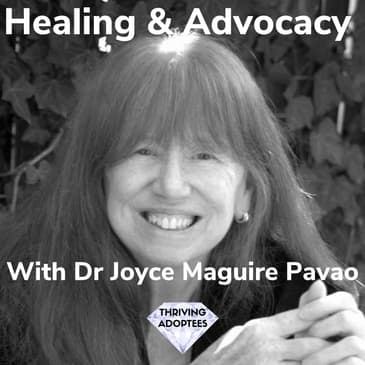
How does healing help us advocate? How does advocacy help us heal? Listen in as we explore how the intersection of two crucial parts of our lives.
Here's the link to Joyce's previous interviews
https://thriving-adoptees.simplecast.com/episodes/joyce
Here's a link to a replay of Advancing Your Advocacy For Adoptees https://www.youtube.com/watch?v=4y-8Id3NajI
Dr. Pavao has done extensive training, both nationally and internationally. She is a lecturer in Psychiatry at Harvard Medical School, and she has consulted to various public and private child welfare agencies, adoption agencies, schools, and community groups, as well as probate and family court judges, lawyers, and clergy. Additionally, she has worked closely with individuals and families touched by adoption, foster care, and other complex blended family constructions.
She has developed models for treatment and for training using her systemic, intergenerational, and developmental framework, The Normative Crises in the Development of the Adoptive Family, and her book, The Family of Adoption (Beacon Press), has received high acclaim.
Dr. Pavao has received many awards and honors, including the Children’s Bureau/U.S. Department of Health and Human Services Adoption Excellence Award for Family Contribution (2003) and the Congressional Coalition on Adoption award for Angels in Adoption (2000).
http://www.pavaoconsulting.com/
https://www.facebook.com/Dr.JoyceMaguirePavao
https://twitter.com/GetKinnected
https://www.linkedin.com/in/kinnect/
Guests and the host are not (unless mentioned) licensed pscyho-therapists and speak from their own opinion only. Seek qualified advice if you need help.
Want to learn more about thriving for you, your kids, your families or your colleagues? Pick a time to talk here
[00:00:02] Hello everybody welcome to another episode of Thriving Adoptees podcast. Today I'm delighted to be joined by I think our first third time visitor Dr Joyce McGraw-Pavo looking forward to our conversation today Joyce.
[00:00:17] Me too, but I always do Simon we have great conversations.
[00:00:21] We love it, we love it. So we're going to be talking a little bit about advocacy or a lot about advocacy on the back of the panel that we ran last month that Joyce was on and added as I knew she was going to do massive value to that.
[00:00:42] And I think there's also want to kind of explore the links between healing for want of a better word and advocacy.
[00:00:57] And I just wanted to say healing for want of a better word because I was talking to Jude, a fellow adoptee who doing some work with and we were talking about narratives.
[00:01:13] And the word healing it's based on it presupposes it necessitates the fact that there has been a wound.
[00:01:31] And the primal wound that phrase was coined by Nancy Varrier in the 90s and she was an adoptive mum or she isn't an adoptive mum.
[00:01:49] And there's a sense, there's a sense among some adoptees that it's a third party view. It's a third party narrative is not enough that the word wound is an adoptee's adoptive parents narrative or summation of our trauma.
[00:02:11] And is it is it valid? Do is it time for us to you know what what what metaphor are we living our life by do we want to live our life by a wound and therefore the need to heal or do we do we want to do we want our own do want to live our own narrative and I just wanted to start off with that and get your take.
[00:02:42] On this well absolutely I think using the word narrative and using it to apply to our story is extremely important and how we tell the story to ourselves.
[00:02:55] And how we tell the story to others makes a huge difference in how we build our self esteem and our view of ourselves and our identity.
[00:03:07] I think that you're absolutely right. The word healing.
[00:03:14] It's a pathology based, although it's good it's about getting better quote unquote.
[00:03:21] It is pathology based. And one of my works, one of my advocacy is in life has in the mental health field and not to pathologize adoptees because most of the things that we're accusing them of having most of the labels most of the diagnosis are are not
[00:03:48] indigenous to them, they're indigenous to the fact of adoption.
[00:03:54] So not all of them some things are definitely you know, there, some things are definitely part of who the actual person is, but a lot of it is is part of the narrative of adoption and what that has done in the process of building this person.
[00:04:14] So, I think it might be helpful for us to learn new language as you suggest, and to think about this as integrating.
[00:04:31] We're, the narrative gives us a new identity and asks us to play a different role. And in the process of growing and changing.
[00:04:42] We look back and learn something about our original identity, and the work then is integrating all of the stories all of the narratives of our life, and finding out who that makes us we can.
[00:05:00] There's a sadness and a loss in that you can't go back and be who you might have been, but you can certainly find the traits, the important pieces, the facts, the story of that person of who you would have been of where you came from, and integrate that into who
[00:05:23] you are, who you become and who you want to be. So I think, you know, I used to do a lot of narrative therapy there. There was, I'm getting so old I forget names but there was a gentleman from New Zealand David White, I think his name was, who did a lot of interesting
[00:05:41] work around family therapy and I forget, I'll be happy to send you this afterwards Simon. But narrative therapy really works with adoptees also at Harvard I studied with Sarah Lawrence Lightfoot, who was a professor there, who
[00:06:03] was very interested in this couple of books that she's written on portraiture, sort of psychological narrative portrait of a person and how that stays with them.
[00:06:20] And I think that's how it can change over time. Yeah, the narrative therapist that I mentioned, I think David White. One of my favorite quotes of his is that narrative therapy rescues the telling from the told.
[00:06:37] And I love that because what it means is when you're told something, it's written in stone this is your story. This is who you are. And it's told it's done. There's no, there's no feeling that you can work on it because it's just a matter of fact.
[00:06:57] What narrative therapy does it pulls you out of that. And it shows you that the telling of the story can change over time. It doesn't mean the facts change, but your view of the facts change.
[00:07:12] And if you're coming immediately out of a trauma, you have certain feelings visions about that that are very set.
[00:07:23] As you grow and change. And if you want to use the word heal in the process of working on that trauma, one of the things that helps you most is to begin to change the story not to change the facts. You were traumatized someone hurt you.
[00:07:41] We're not trying to fluff that up or make them feel better in any way. We're trying to have you see that you are not your trauma. You are more than your trauma that's a part of you, but it's not the whole. So that's a very long answer. I'm so sorry.
[00:08:02] Now, there's so much so many gems of wisdom in that.
[00:08:08] You know, I remember you talking about the pathologization of adoptees on our on our first, but first conversation. And that has stuck with me.
[00:08:21] And but means somehow means a lot more. You telling that sharing that word again now. In fact, I'm getting goosebumps as as I think about it. So that's that's huge. We
[00:08:38] the
[00:08:44] it makes it makes perfect sense when we I realize I realize why I'm so I'm having a physical reaction to it.
[00:08:54] Because I think the the primal wound is a pathologization.
[00:09:02] It is that and it felt like that to me when I read the book 1012 years ago, and I thought I was stuck with it. I thought I was stuck with it.
[00:09:17] And I love your point about separating the telling from the told. And as you were quoting that David Whitechap, the view I was taking on it is it's separating the telling which is the narrative from the person who is told.
[00:09:42] So it's separating us from our story. And and that is huge.
[00:09:54] When for for many years we might have been telling ourselves that there's something wrong with us.
[00:10:01] We feel that there's something wrong with us. We feel that there's something missing.
[00:10:09] And then we read the primal wound and it confirms, yes, there is something missing.
[00:10:21] And and then we're the next question is how do we heal if we, you know, well, the next question. The next thing I next point I got to was I'm stuck with this.
[00:10:36] I can't hear that. That's that's where I was for a few days after reading it. And and then something happened, I don't know.
[00:10:47] And I moved out of that moved away from that place of hopelessness to a place of OK, so how do I heal?
[00:10:56] And and then I read the I read the book, the second book Nancy's second book coming home to south.
[00:11:03] And it was.
[00:11:07] Part two complex and totally psychological.
[00:11:12] And as we know, healing for want of a better word is is a holistic thing.
[00:11:19] It's it's not just about our psychology. It's not even just about our psychology and our and our emotions.
[00:11:27] It's it's bigger. It's bigger than that.
[00:11:30] So, you know, we we it's the somatic. It's the somatic stuff as as well.
[00:11:39] Obviously, Basil van de Kolk and his body keeps the score.
[00:11:42] We're looking at the physical reactions that the trauma that's stored in the body.
[00:11:47] And the the other side, another way of looking at this is the the internal family systems model, which Richard Schwartz, which is taking it's looking at our parts.
[00:12:05] But it's also looking at the uppercase S self, which is more of a spiritual take.
[00:12:12] So he's he's got a spiritual, not religious, a spiritual and a psychological thing.
[00:12:20] And we as I explore this healing framework and get feedback from yourself and lots of other fantastic adoptees and funnel that all in.
[00:12:31] We're looking at a holistic thing here.
[00:12:34] We're looking at a holistic healing or a holistic integration, if we're going to coin coin your word.
[00:12:43] And integration that that metaphor of integration is about stories, but it's also about it.
[00:12:53] That also works for me with that part parts model, because as Dick Schwartz says that the book, the name of the book title is no bad parts.
[00:13:04] So we are not, as he would say, we're not kind of pushing away the the exiled when exiling the shamed, the shamed little confused adoptee that can't, you know, wants to know where his birth parents were.
[00:13:23] So if gone or wants to know where her birth mother has gone, whatever it is, we we're bringing we're integrating everybody together.
[00:13:32] We're not rejecting any of the parts because those parts have kept us safe.
[00:13:45] Absolutely.
[00:13:46] I also think it's important to figure out which parts are are oneself smallest and which parts are, you know, imposed upon us.
[00:14:02] I don't know if you've spoken yet with Sue Harris O'Connor.
[00:14:07] I have spoken with her but I haven't done the podcast with her yet.
[00:14:10] She did a wonderful model that's really based on on race and the perception of race. She as a transracial adoptee felt that was an important piece, but there are five different stages or ways of looking at oneself and I'm not going to go into it.
[00:14:33] It's spectacular and people should read it, but it also applies to adoptees or in race adoptees in some ways because really there are these different parts of self.
[00:14:48] And some of them are imposed.
[00:14:50] Some of them are not are not indigenous there and they're not growth parts there. They're sort of as you as you described the primal wound, that's more of an imposed view of what's wrong with the situation and frankly most people want to know what's wrong because they don't feel that if they don't have a diagnosis.
[00:15:20] They can have a cure. The problem is if you get the wrong diagnosis, you can't treat it properly and the diagnosis often isn't that of the adoptee it's that of the system.
[00:15:35] And I think that birth and adoptive parents and professionals often get frightened by that because they feel it's accusatory that you're saying something's wrong with them.
[00:15:49] And I don't believe there are certainly cases where there's something very wrong with certain people in certain situations but in general, I see this as a very systemic problem.
[00:16:02] And it's very important one of the pieces of healing is growing and in developmental psychology when you reach adolescence early adulthood, you're supposed to be in a stage of individuation.
[00:16:21] Individuality is very hard for adoptees, because they already lost one family at least maybe many. And now they're, they're being moved away from this family.
[00:16:37] Now they can either do that by acting out and completely negating all of that, sometimes for very good reason and sometimes self sabotaging.
[00:16:49] And I think that individuation piece is one of the integration pieces that we need to focus on, because that's where the adoptee now has the ability to do reflective thinking to see themselves and to choose themselves to look at their parts and to see which ones are theirs and which ones are not theirs.
[00:17:11] They just got stuck there. They're not attached, they're just lying on you. And how do we manage that and grow into ourselves? And some people can do that pretty well and some people it takes years and some people it takes a catalyst of some sort.
[00:17:34] But it's, you know, there's a lot that I think we can learn if we pay attention.
[00:17:41] Yeah. Looking at this holistic approach, holistic approach to healing, healing circles.
[00:17:50] One of the outer layer of that, as I've developed it so far is the cultural piece. And the cultural piece for a transracial adoptee or an internationally adopted person is that displacement and the clash between the culture of the place that they are.
[00:18:20] And where they were born and the culture of the place that they're being brought up in. That could also be, you know, the culture might be a difference between different cultures with that are to do with different races as well.
[00:18:39] And also the culture for us, you know, for me when I'm talking about transracial adoptee, you know, our culture of white privilege in the UK and the US.
[00:18:57] And also that cultural piece that you're talking about in terms of the what's wrong in the system and also what's incorrect in the system and what's incorrect in the culture and that piece around how should we put it, the fairy tale view, the rainbow and unicorns view of adoption.
[00:19:25] And that, that's part of our healing too is looking at that. Looking at that cultural, the culture in which we have been brought up and those non indigenous parts perhaps that you're alluding to others.
[00:19:44] And that perhaps that lens that leads us into the next, the other phase of the conversation today.
[00:19:52] In terms of advocacy. Sorry.
[00:19:54] One little tiny thing and then I forget.
[00:19:58] I'm thinking about culture and and I've spent a lot of time thinking about it writing about it, etc. And it is absolutely imperative that we pay attention to the vast differences in culture in terms of transracial and international adoption. Absolutely.
[00:20:19] But I think every family has a culture.
[00:20:23] And when I'm doing family therapy, I spend a lot of time looking at the cultures of the grandparents and the parents who are raising this child, because the parents for instance come from two very different cultures.
[00:20:42] Maybe different religions, maybe different starkly different cultures. But maybe they're both, you know, from the same ethnic background, maybe they're from the same religious background but their families had family culture, the way they did things and what they believed in, and how that was infused into each parent,
[00:21:06] and how that plays out in their relationship impacts there are so many different cultural issues impacting this child.
[00:21:16] And I think it's very important that sometimes we look at the minutiae, and we really see what the little details are with the what the messages are that are coming.
[00:21:28] I just worked with an adoptee who's adopted parents. The father has no connection to his family and never did. He left to go into the army or something when he was 18, and he never reconnected with this family doesn't say a lot about why just isn't very connected.
[00:21:49] And believe me, I've tried to get him to talk about it.
[00:21:53] The mother is enmeshed with her family. She is overly connected to her family, and he doesn't mind that because he has no family so he goes with the flow.
[00:22:05] And now they have this child who is married and had their first child, and doesn't want the enmeshment and doesn't want the alienation wants to create some new kind of relationships.
[00:22:23] It's not going well. And this is adoption, but this goes on in all families. And I think it's important to acknowledge it because the impact of that, especially on the adoptee who's already struggling with who am I, where do I come from, where did this come from, where you know, it's huge.
[00:22:45] So I won't take any more time to tell you.
[00:22:48] I think, as you were talking about the difference between the mothers and the fathers families, I was thinking about my own mum and dad. And so my dad is a or was a an only child. My mum's had eldest of four.
[00:23:04] They had very different the cultures of the families were very different. One was, so they both stay at home moms. But you know, one was a what one was like part of a family business and one was a manager in somebody else's business, and they had completely different views of life and
[00:23:27] different takes on fun. So and people get stuck between the two. Yeah, as they say.
[00:23:34] So the, so the question, the kind of the next question I had for you really was how does how do you see the we're going to use healing, but we could also use the word integration. How do you see healing and integration, healing orientation and advocacy where
[00:23:59] do you see the, the links between these two.
[00:24:04] Well, for years and years and years when working with adoptees when working with all people involved in adoption and, and people in general. I think that one of the ways to get to a place of integration of insight is to look outside.
[00:24:27] And so I think that, especially in the case of rage and anger, which is very appropriate in many instances. But there's an arc to where it needs to be and where it needs to flow in order for one to not get stuck in it and hurt by it.
[00:24:50] So, my work with people has been to help them to see where to project that anger. And one of the best ways I can think of is advocacy.
[00:25:02] You know, you're fighting for something if you're, you know, fighting for injustice and you feel very strongly about this. You are going to make an impact on others and on yourself, and you're not going to necessarily hurt yourself or others in the way that you might
[00:25:20] feel like you're going to use to just aim that at an individual. Sometimes, and this isn't always true at all but it's, it's something that's true. So there's a quote by Pablo Picasso that I like the meaning of life is to find your gift.
[00:25:36] The purpose of life is to give it away.
[00:25:40] You can find the things you care about, the things you want to change, the things that you're passionate about.
[00:25:49] And you can really find those. That's the first step and the second step is to give them away to do it through teaching through advocacy through, you know, being a therapist or being a being a nurse being a lawyer, be advocating for the rights of
[00:26:09] people that you identify with and feel aren't being cared for in the proper ways.
[00:26:19] It's, it's really profound that and kind of, I think if I was to hear that, I could perhaps underestimate the profundity of what you said, because when
[00:26:40] as I see the profundity from it, it's about, it's not about me anymore. It's about we, it's about us. So we are, we are connecting with a force bigger than us.
[00:27:00] We're connecting with a group of people bigger than us. And it's no longer Paul, Paul, little me.
[00:27:10] It's like I'm shifting the focus on it was that this was at this in American was this JFK said don't ask what your country can do for you ask what you can do for your country was that yeah.
[00:27:27] So it takes it gives us an X it gives us an expanded and it gives us an expanded vision.
[00:27:36] And it kind of lifts, it's lifting us up and it's taking us place. It's, it's a, I'm going to ask you about the arc that you talked about mentioned, but it's kind of, it's like somebody's pushed a button on our empowerment.
[00:27:57] A button called empowerment or perhaps I'm trying to think of something from the matrix you taking the blue pill from the matrix you're actually opening up a bigger opening a bigger perspective.
[00:28:12] So we're connecting with a bigger group of people than ourselves. It's no longer about us. It's about somebody else. And will we do more?
[00:28:28] We'll do more for other people.
[00:28:31] And for ourselves one.
[00:28:34] I think it's about us. I mean we can't, we can't not have it be about us but it's also it does expand the vision in many cultures there is no I there is definitely we and that's how that and that's how people talk about themselves.
[00:28:52] It's it's in our culture and this day and age that's very independent. And you know and then the goal in life is to be independent in every way and to be, you know strong and powerful as an independent being.
[00:29:12] And the reality is human beings are not independent they're interdependent. You can tell by an infant I mean the you know failure to thrive is because there's not that interdependency it has to be there.
[00:29:28] And the reason why some children were raised by people other than the parents who gave birth to them in many cultures and in many times.
[00:29:38] When it wasn't in a system of adoption it was just the way things were done. It was done to protect that child because if the birth mother died or didn't have any milk or something someone else had to step in.
[00:29:52] And that was we and and the we would help to raise the child and there was no secrecy there were no changes of labels, there were changes of roles.
[00:30:03] And I think that that we're not going to change the fact that some people for the rest of time will not be raised by the people who gave birth to them.
[00:30:15] But that does not mean we need to make it into an industry and change names and make falsified documents and lies and secrets.
[00:30:27] We can do it and have it be completely appropriate. It's how we take care of our own, and our own becomes larger the more we expand and the more we include other people.
[00:30:41] Yeah. The you mentioned the I was going to ask you about the art you took you mentioned an art. Can you can you explain what the arc is about.
[00:30:53] But arcs. I once had a, I've had many names of things that I've started in my advocacy work and the arc, the adoption resource, small R e large source was center was one of the places that I had in the 1970s.
[00:31:13] And I did a summer intensive training course called archaeology. And I really believe there should there are arcs things go certain ways but the problem is if they stay stuck at some level of that arc, they're not going through the process that needs to happen.
[00:31:34] And I was talking about that in terms of anger. I think anger is very productive, very important, very real.
[00:31:44] But if you get stuck in anger and that's what you become at that part of you is what shows up only and always.
[00:31:55] It's not in your best interest. And it's not it any kind of stuck place that isn't flowing is holding you back from the integration and the growth that you need. Yeah.
[00:32:10] I am. I'm just clicking around on my computer because I found a, I found a quote.
[00:32:21] And I found a quote this week which I kind of think is a lovely counterpoint to that to that anger point.
[00:32:33] So if I can find it on my computer. Oh yeah, okay.
[00:32:42] So this is a Mark Twain quote. And it's forgiveness is the fragrance that the violet sheds on the hill that has crushed it.
[00:32:57] And I just thought that that's a beautiful counterpoint to anger.
[00:33:05] And I think of my own anger with stuff and how my own anger with stuff. It's me that's suffering.
[00:33:15] Mm hmm.
[00:33:17] But if you can't it's not the problem is people want a pill, they want something to fix things right away and and every human being has a different pacing and a different way of going about things.
[00:33:33] What what I see in therapy with people is it's important to be with them while they're going through that but it's also important to let them know that is this really where you want to live.
[00:33:47] Do I live in anger.
[00:33:49] Or would you like to visit it on occasion when it comes up.
[00:33:54] What what how do you see yourself in this situation.
[00:33:59] How what's going to be most beneficial for you.
[00:34:03] Yeah.
[00:34:06] It is the it's the integration then the.
[00:34:12] The integration of anger and for example it does that mean or the integration of the angry angry part means bringing that part in rather than pushing it pushing it away is.
[00:34:29] I'm trying to you know what does integration what does you know what does integration what is your your take on integration what has that got to do with anger what's I do those two things.
[00:34:41] Well, you know I mean.
[00:34:44] I was speaking much more generally using the word integration but you could use it in a smaller way. And I think in order to go through something you have to accept it.
[00:34:56] So, of course, pushing things away or diminishing them which often adoptees are taught to do.
[00:35:03] It's a lot to do really doesn't help you to get through it. You need to confront it and anger is an interesting emotion because as you as you know, it doesn't stand alone it's usually covering sadness or guilt or shame.
[00:35:21] It if you dig deep enough in anger it's a it's a cover and and it underneath that is what you need to get to to integrate yourself or to heal yourself.
[00:35:35] So it's, it has triggered something in you that causes that anger which is a protective mechanism to keep you from I had so many clients say, I don't want to be sad because I'll never stop crying.
[00:35:52] I could see myself just crying for the rest of my life. And I would rather be angry. Well there's a stage where that's important, but there's also a stage where you can slowly examine the sadness and figure out what it's about and think about what you can do for it and think
[00:36:14] about who you can advocate for that might experience something similar that might give you strength and might change the way you feel about yourself and about others.
[00:36:26] Yeah.
[00:36:28] Again, I'm getting the feeling that you've shared that with me before the anger hides shame.
[00:36:36] That's some of what you were saying. It's, and so you're kind of you're you're lifting the bonnet or lifting the hood I think you'd say in the States, you're lifting the hood on the anger and you're finding the shame or the fear underneath that that's that's the cause.
[00:37:01] That's the hidden, the hidden bit that's the hidden bit that's hidden under the staff.
[00:37:08] Do the thing about anger and advocacy. They're not really good bedfellows are they so maybe I'm sorry the wrong expression but
[00:37:21] they're good to the anger can motivate you but if you vent only with the anger you're going to turn people off and you're not going to get the result that you want.
[00:37:31] So it's important to figure out what your goal is.
[00:37:35] And I was watching a newscast the other day.
[00:37:40] There are tons of sit ins and 10 cities at all the universities here around the pro Palestine situation, and I don't want to get into politics we're already talking about deep enough subjects.
[00:37:54] But what I did want to say is there was a young woman who was a spokesperson that was being interviewed.
[00:38:00] And she was very angry, rightly rightly so.
[00:38:04] Her family, many of her family has died.
[00:38:08] And but she was screeching in that and she was so angry and so screechy that you couldn't really hear her heart you could, you could see her pain and her anger.
[00:38:24] But I think to advocate, you need something that's going to get the attention and draw people in not push them away.
[00:38:35] So the first thing is to use your anger and or any of your feelings or any of the things you need to heal the trauma.
[00:38:46] The first thing is to figure out what you can do with that to help others. And in fact, that will help yourself.
[00:38:54] The next step is to figure out how to do that and how to do it effectively because you don't want to go into something and and not be able to empower people and to make the change.
[00:39:09] I have no not everyone's going to like you at all in any, I mean, you know, you're you're definitely going to get vilified by certain people, even if you do it the best possible way.
[00:39:22] So you also have to develop a bit of a thick skin so that you can, you can walk right past all of that negativity and keep in mind what your goal is and why you're doing it and figure out how to make that happen so that you can make change.
[00:39:44] Yeah, I think the first thing I heard about advocacy from a fellow adoptee was an adoptee from the UK and trans racial adoptee.
[00:39:59] And she was saying that if it's perfectly okay, this is in the UK or in London specifically, it's perfectly okay for politicians to get angry in amongst themselves.
[00:40:19] But if you're a non politician, you're an advocate and you're going into their space, the political space of politics, and you present to use your word of present, present any anger, then you get cancelled.
[00:40:35] So I love the distinction that you drew between using your anger to propel yourself forward and focusing on what it is that you want to achieve what your goal is.
[00:40:57] Because I'm focusing on how you best to achieve that goal because if you are presenting anger, then it's unlikely in London anyway, in those circles that you will be, that people will listen to you.
[00:41:15] So it's a self defeating emotion whilst in those circles we have to be able to, I don't know, whatever, remain calm as best we can.
[00:41:33] I think, well, I don't think you need to remain calm, but need to remain aware of what your goal is, what you're doing, and how egocentric the people you're presenting are.
[00:41:47] So what are they going to get out of it? What are you going, I mean, they need to get something to even listen to you.
[00:41:56] So it's important to figure all of that out. There's a huge amount of strategy in advocating that, and I have to say most of us adoptees have been propelled by very strong feelings and weren't always thinking about what we were doing.
[00:42:16] Even in the case of, you know, when I'm working with an adoptee who's searching for their birth mother, for instance, and they're about to figure out how they're going to approach their birth mother.
[00:42:31] You know, I've had adoptees go to the door and ring the doorbell. That is such not a good idea when you pull back and think about it.
[00:42:40] Really, you're prepared to do this but that person isn't prepared to receive you.
[00:42:46] Really, what is your goal? Is your goal to lay eyes on that person once in your life? Then you might ring the doorbell and see them and that's it.
[00:42:56] But they, the chances are pretty good they're not going to want to talk to you at that moment in that shock, in that situation.
[00:43:04] So how do you help people to really carefully think about what is your goal and how are you going to get there? How are you going to make that happen?
[00:43:14] Because the success of that is what's going to feed you. It's going to really, you know, it's a reciprocal situation.
[00:43:24] And if you just stomp around and scream about what you hate, there are some people who are going to join you and stomp with you.
[00:43:34] But are you going to have any effect? Are you going to make change? Are you going to advocate for a simple situation that you want to see done differently?
[00:43:46] I don't think so. I don't think that's going to work. So let's figure out what is going to work.
[00:43:52] So there are stages and those stages, they look a certain way. But under those stages is a lot of therapy that's going on without without even calling it that.
[00:44:07] Because you're having to slow down, you're having to look at yourself, you're having to, you know, use all the organic things, the meditation, the thoughtfulness, the mindfulness,
[00:44:21] the awareness of what's going on in your body. How are you feeling? How is this feeling going to be translated into something that will really work for you and for others?
[00:44:36] Yeah.
[00:44:38] I wish I'd had this conversation last September because I rang my birth father completely out to the blue and, you know, 58 years, you know, and I didn't have a good reception.
[00:44:49] So maybe I should have been a bit more intentional about it. That was the word that I was coming to my mind to kind of sum up where you were being about being intentional.
[00:45:00] There was another comment on Facebook regarding the post of the advocacy panel and the replay.
[00:45:14] And it was something about an adoptee being petrified, petrified of rejection.
[00:45:22] So the sense that I got was that that adoptee couldn't advocate, wasn't, wasn't, couldn't advocate because of a fear of rejection not being listened to or something holding that person back.
[00:45:46] What would you say to that?
[00:45:50] It's, you know, I'm going to say something, but it's not really fair because I would need to know them and to know how fragile they were or what was going on.
[00:46:02] I wouldn't just, but in service of this conversation, I'll tell you what I think.
[00:46:08] Petrified is a great word because, you know, it's fight, flight or freeze.
[00:46:15] The frozen person is the petrified person. So this person is frozen and unable to move. And the fear of being rejected is, is that worse than the fear of having been rejected, which is how he or she may think about themselves for having been in the
[00:46:37] situation of adoption. And, and is that worse than the current situation? Is that worse than not knowing? Are there things you could get from this that aren't just acceptance or rejection?
[00:46:55] Is there information that you need and that you want and that you deserve? How can you look at this differently? And you're you, how can you feel comfortable that you're not going to lose yourself in the process of having someone decide to like you or not like you?
[00:47:18] Yeah. So perhaps a dialogue, a dialogue to have rather than something on your own, something to think on your own. And as I say that, I'm thinking about your comment about this being unfair.
[00:47:43] And I'm also thinking about how people react on social media, you know. And it's perhaps a tricky, tricky one.
[00:48:01] It is. Well, you know, you'll get people who will think our conversation is useful and interesting. You'll get people who think it's bullshit. You'll get people who I mean, that's okay.
[00:48:14] People are at different stages and different pacing, and they have different experiences. And they're seeing this in different ways. And all of those ways, it's what we call multiple realities.
[00:48:27] We think we're saying something. And that's what we're saying. That's not what everyone's hearing. They're hearing even as you heard some of what I said, and then you filtered it through your own experience to make sense of it and to talk about it further.
[00:48:43] That's a very common way of processing. And, but everyone has different ways of processing. So it's, you know, you can't do anything about that. You can't really, you can only keep moving.
[00:48:58] You know that what you're saying and doing is for the good of people, not you're working for good, not evil. And that's your intention. Then how people take that is really nothing you have any control over.
[00:49:15] Yeah.
[00:49:20] I was think we've quite a JFK I was going to quote Churchill.
[00:49:27] I think he said something like my reputation is not my business.
[00:49:33] Exactly, exactly.
[00:49:37] It's speaking of which have you interviewed his granddaughter who was adopted.
[00:49:43] No.
[00:49:44] Oh, I'm going to send you her interesting story.
[00:49:48] Yeah.
[00:49:50] Very interesting.
[00:49:52] So what else, what else is is there in this? Well, what else is there on this healing arc or healing journey and advocacy? What are the cross links do you see between between these two things because they kind of they seem different, don't they?
[00:50:15] But they are.
[00:50:17] But they intersect.
[00:50:19] And I think it's, you know, it's just important to this is all bringing things to awareness and then what people do with them or how they process them as I said is really their own thing.
[00:50:34] I think that we had a very good conversation, but I don't think that we talked enough about the nuts and bolts of advocacy.
[00:50:44] So sometime way later when you feel like it, let's go through some of that just see what people think about this and let's go through some of that and look at the developmental issues and advocacy because you start advocating at birth.
[00:51:02] You advocate for your food.
[00:51:05] It's time to eat. It's time to, you know, you learn to advocate very early on.
[00:51:11] Yeah.
[00:51:13] As you were saying that I was thinking about how if I wanted something I'd ask my mom and she'd say no and then I'd go and ask my dad the same thing.
[00:51:23] This is this is trying to get what we want from an early stage. Yeah.
[00:51:29] So the way and the we've got some more advocacy panels coming up and we're looking at different areas.
[00:51:39] And I see it as a theme to bring more people together. So we will maybe maybe the one that we do in July, June, July will be more about nuts and bolts.
[00:51:53] And I think the other one that we're looking at doing is the legislation stuff so advocating for young adoptees, then one for adopted parents on advocating for your adopted child or children and then some legislation and maybe some nuts and bolts stuff as well.
[00:52:15] Can you give us because you talked about before we hit the record button, you talked about the changing and the changing advocacy over our lifetime.
[00:52:30] Is that something that needs a bigger space because we've been on for what about three quarters an hour or so.
[00:52:36] No, it does it need does it need more space for it? Have we reached a natural end for the conversation today?
[00:52:43] I think we I do need to end our conversation now, but you know, think about a time when you want to plug in some more discussion about about the details of what goes on in a life and how it can how it can really give you some markers to figure out what you're doing.
[00:53:07] I don't think people give themselves credit for advocating. Sometimes when what they're doing is advocating.
[00:53:15] Yeah, and when we when we started talking, Simon you mentioned that you had just gotten off the phone with a group from another country, and that they were interested in having you work with them.
[00:53:30] And, you know, you might have thought, oh, that's great. I'll go do some teaching. I'll go do a talk.
[00:53:37] And you're doing that, but you're also advocating your, you know, the way you have filled yourself with different views from so many different adoptees you've done an amazing job of interviewing people over the years and really figuring out things and agreeing or
[00:53:55] figuring and putting things together. You have a great overview and sharing that with people is advocacy.
[00:54:04] Yeah. Thank you. And that is, you know, when you were talking about the gift, you know, learn your stuff and then give it away, you know, that that's what I'm trying to do.
[00:54:19] Wonderful.
[00:54:20] Yes. So, listeners going to put some links in the show notes to the previous episodes that Joyce has been on so you can especially I think the this the one about pathologizing adoption and particularly
[00:54:37] significant to me and we'll also put a link to the advocacy panel that Joyce added so much to last time and Susan Paris, I'm on a who was introduced to me by my choice as well.
[00:54:50] So we've got a lot to thank Joyce for in this in this area. So thank you very much Joyce and
[00:54:55] you're very welcome. Have a beautiful sunny day.
[00:54:58] You too. Thanks a lot Joyce. Thanks listeners. We'll speak to you soon.
[00:55:01] Thank you.