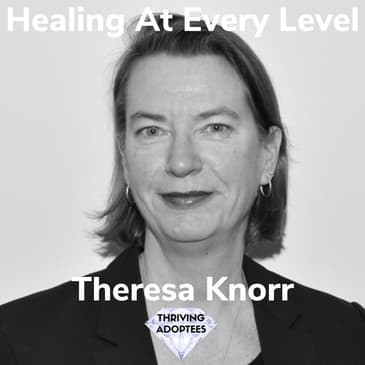
Trauma can wreak havoc at every level. Psychologically. Emotionally. Sociologically. Biologically. Spiritually. Theresa's body knew she was an alien but she wasn't told that she was adopted until 19. Listen in as she shares a lifetime's insights into healing at every level.
https://www.instagram.com/theresaknor
https://www.facebook.com/theresa.knorr/
https://www.linkedin.com/in/theresa-m-knorr-carc-243543b/
https://www.tiktok.com/@taichi4recovery
https://tknorr12.wixsite.com/wellnesseducator
Guests and the host are not (unless mentioned) licensed pscyho-therapists and speak from their own opinion only. Seek qualified advice if you need help.
Want to learn more about thriving for you, your kids, your families or your colleagues? Pick a time to talk here
[00:00:00] Alright. Hello everybody, welcome to another episode of Thriving Adoptees podcast
[00:00:07] and today I'm delighted to be joined by Teresa Teresa,
[00:00:09] and now looking forward to our conversation today Teresa.
[00:00:12] It's so cool to be here, Simon. I love what you do.
[00:00:16] Yeah. I love it too. Good.
[00:00:21] It puts the right energy right out there then.
[00:00:25] What's the right energy? Yeah.
[00:00:27] So, what does healing mean to you?
[00:00:36] Yeah. Healing is a process and that's one of the things that I've been thinking about a lot lately
[00:00:46] that every time I think I've found it, you know, the method, the insight, the aha moment,
[00:00:55] there's always something else later, you know, that we are healing on a continuum.
[00:01:01] That one modality that we're using at one point in time will leave me to another one.
[00:01:07] That it's not linear.
[00:01:11] It's not contiguous and you can go back and forth.
[00:01:16] Something that worked for you can stop working for you, and then maybe later you pick it back up
[00:01:22] and it works again. So, I mean, it's messy. Healing is messy.
[00:01:27] That's the other thing. Like life is messy and healing is messy.
[00:01:33] Yeah.
[00:01:36] Yeah.
[00:01:39] So what are the steps in the process then? If it's a process.
[00:01:43] Well, so I think for adoptees we do have to go through that, you know,
[00:01:49] and I used to call coming out of the fog moment, you know, where like it hits you like a ton of bricks,
[00:01:54] like OMG, oh my god, I'm adopted. I mean, I actually went through that because, you know, I'm on LDA,
[00:02:04] late discovery to adopt team, which means, you know, I found out that I was adopted when I was 19.
[00:02:10] So I was super in the fog from, you know, person 19.
[00:02:17] And then at age 19, I, you know, walked around for about six months after I inadvertently found out that I was adopted.
[00:02:27] Going, oh, who are you? And, you know, being confused and angry and,
[00:02:33] and then I promptly suppressed it for another 40 years. Literally.
[00:02:41] People would ask me, you know, like, do you ever think about finding your biological family?
[00:02:46] And I'd be like, no, so that tells us something right there. You know, the, how emphatic I was about how I know it's not,
[00:02:53] it's a non-issue. I mean, even I was went to therapy and therapist would ask me, you know, like,
[00:03:00] do you think being adopted is an issue? And I'm like, no, I'm pretty well adjusted with that.
[00:03:04] Now, I don't have any curious. Oh, really?
[00:03:09] So at 58, when I, when New York State opened up their adoption records and I got my OBC.
[00:03:22] So I mean, you know, like that was the volcanic eruption of emotion was, you know, when I actually got an email from my biological sister
[00:03:33] after I had searched for her saying, we've been looking for you for 40 years. And that ripped the scab off.
[00:03:42] So I had to go through those emotions, you know, and they were volcanic.
[00:03:48] I mean, literally, I thought I was having a psychotic break. I remember just feeling like I was out of my body.
[00:03:55] You know, being in the shower, sobbing and just looking in the mirror going, you're adopted.
[00:04:02] And the weight of that was enormous. And I feel like that was part of what started my healing.
[00:04:14] So you came out of the fog at 19 and then jumped back into it, do you think?
[00:04:19] Well, I mean, I wouldn't say that I jumped out of the fog at 19. I found out I was adopted at 19.
[00:04:25] My, my adopted brother came to school and said I was at way of college. And my brother had found our birth certificates. He needed his birth certificate for something.
[00:04:38] He's like, you know, these aren't real birth certificates.
[00:04:41] And I was like, well, you know what? You're crazy. You just, you know, you're just unhappy. You don't like our parents. You want to think, you know, he's like, we're adopted. I'm like, no, we're not like this.
[00:04:49] You just stop, you know, like literally I'm like thinking he's lying. Right? You know, you're just making this up. My brother had a lot of mental health issues and, you know, whatever, just in and out of institutions for most of his life.
[00:05:02] So I thought he was just looking for something. And I didn't really know why we didn't have much of a relationship. So why he came to my school to tell me this.
[00:05:09] But that was real to him, but I didn't believe him.
[00:05:13] So I confronted my mother. I didn't even confront my mother. I shared it with my mother. And I'm like, yeah, you know, my brother was here and he said we're adopted.
[00:05:21] And I'm like, you know, and she's like, oh, I meant I wanted to tell you.
[00:05:27] She starts crying telling me, oh, I wanted to tell you what was your father who didn't want you to know.
[00:05:34] And I'm like, excuse me. What? What? What then being the good adoptee that I am because she was crying. I promptly started to take care of her.
[00:05:48] You know, like because she's crying. And so it's like, oh, it's all right. And you know, and then we, I think we maybe had one more conversation about it in our lives.
[00:06:00] I think we had maybe one. I think I asked her, you know, like my story and I wanted to know like if there's any background information and you know she told me some things but
[00:06:10] so I mean, I don't think I really fully came out of the fog at 19. I think that I just found out I was adopted at 19 and the enormity of that.
[00:06:19] I mean, like I said, I walked around for six months. I boycotted St. Patrick's Day because I'm not really Irish.
[00:06:25] You know, like that was the extent of my rebellion about being adopted.
[00:06:29] But you know, but I didn't really come out of the fog.
[00:06:34] No, but you came out of the fog at 58 then what do you say?
[00:06:42] Yeah, so I had been on retreat with Dr. Gabar Mate in the jungle of Peru and we were, I don't even remember exactly how it came up in conversation but you know, Gabar's story, right?
[00:07:00] So, you know, Gabar had kind of mentioned it to me in our compassionate inquiry processing that I might want to see what kind of impact that relinquishment had on me.
[00:07:13] And not only that, but, you know, he was like, I think you got a double whammy because not only, you know, where you relinquished at birth and you have that trauma, but you were lied to for most of your life.
[00:07:28] And that betrayal, you know, quote unquote, betrayal or, you know, that dishonesty.
[00:07:37] I mean, that gets into like, how can I, because my body knew right? You know, my body knew I was an alien knew that I was not part of this family.
[00:07:48] I always felt different and like I didn't fit in whether it was with the family or with school or whoever it was.
[00:07:55] And like, so I knew that something was off, but I didn't know what it was. And so I didn't trust myself.
[00:08:01] I didn't, I never developed that trust of myself because, I mean, literally, not only was it a lie of omission, there were things that, you know, my family said to confirm the lie.
[00:08:14] You know, you have the bump on the back of your head like your grandmother or you inherited this, you know, trait from whoever.
[00:08:23] Yeah, so that's so after that experience with God more that was in 2019.
[00:08:31] I started, you know, thinking about it and then of course, you know, the universe lines up right? And so New York state and their infinite wisdom in 2020.
[00:08:41] And so I opened up adoption records and you know, in the past I had searched a little bit. I had gone on some of the, you know, websites to see if I figured, oh, and I was on the New York state registry, adoption registry.
[00:08:53] I thought if they're looking for me, you know, I put my name in there.
[00:08:57] If they're looking for me, then I'm looking for them and will be matched up and it never happened. So I just figured it wasn't my time, you know, to meet them. And I had done that probably in my 30s.
[00:09:08] I had the adoption registry and no one ever contacted me. So I just let it go.
[00:09:13] Was curious on my birthday. I wonder if my birth mother's thinking about me because you know she was there for that. And, you know, that's impactful to have a child.
[00:09:23] So, but then when the records were opened up, I applied. So January 15 2020 myself and 15,000 other New Yorkers hits 10 12 15 a.m.
[00:09:38] And you know, paid my 50 bucks and waited and waited and waited and got my OBC maybe about a month later.
[00:09:48] And that was easy. Right, you know, so as soon as I got the OBC, it's still like ripping off the scab, you know, was not like what happened when my sister emailed me.
[00:10:00] This was just like, you know, I had some feelings about it. I saw the OBC. So I was pissed off because my name wasn't, my name was Christine and Smith.
[00:10:09] And I was like, Smith. She had to give me a generic name. You know, like why didn't she give me, I was mad. Why didn't she give me her real last night? Well, actually that was her real last name was Smith, but that was her first husband's name.
[00:10:23] So the sheet to have her first husband's married name. I thought I saw her name was and I thought maybe you know, like I should have had her name, but it was actually her first husband's name. But anyway, so
[00:10:37] get the OBC, find her name, click Google search, found her obituary. Right, you know, so easy these days to find people. So in her obituary is where I got
[00:10:54] my sister and my aunt and her two children. And so I just Google search them and then, you know, found a couple of emails sent off an email and then got that email back from my sister.
[00:11:10] And that's what really started my healing was experiencing.
[00:11:15] And the moment when I got that email from her saying we were looking for you for 40 years, it was like every hope, every sense of sadness, grief, horror, relief.
[00:11:36] I mean, there were so many emotions that erupted and literally I was like hyperventilating sobbing on my bed in a way that I didn't even know was possible.
[00:11:47] So all of that crap's been inside of me for all these years.
[00:11:56] Yeah, back to healing. That's what starts the healing is getting that up and out. And I think it's different for everyone, you know, what rips that scab off or, you know, whether it's in a volcanic eruption or whether it's little tiny spurts here and there.
[00:12:13] I think it's, you know, it's, it's different for everybody.
[00:12:18] So I mean, I'm intrigued because I know you would do this work in Tai Chi or in recovery.
[00:12:29] And I'm thinking, you know, if the body keeps the score, which it does.
[00:12:36] Yeah, then basically we then healing could be taken to be the alleviation of the other.
[00:12:57] That's the word.
[00:13:01] The departure of that stuff out of the body.
[00:13:05] Yeah, yeah. And the Tai Chi for recovery or you know, most, whether it's my form or Tai Chi in general or yoga or much of the somatic work.
[00:13:17] Trauma releasing exercises. There's all kinds of things that people can do to move that energy through the body.
[00:13:26] And I've seen it in my work with recoveries, where people will do a particular Tai Chi move, especially ones that are related to the heart.
[00:13:40] Because in Chinese medicine, Tai Chi is based on traditional Chinese medicine and so each of the organ systems is correlated to a different emotion.
[00:13:52] I was working with a woman one time and she was doing this move that was correlated with the heart and the lungs and the lungs store grief.
[00:14:00] And the heart is either anxiety or joy. So there's a positive and negative emotion for each one of the organ systems, but she was doing this move.
[00:14:09] All of a sudden she just started crying and she was so shocked by the emotions that were released from her body, just in doing this simple move because well she was someone who had been in recovery only for a short amount of time and sort of had fell out of touch with her own body.
[00:14:30] And that's you know, Gabo or Matay talks about that a lot that recovery is returning back to recovering our true selves, recovering who we really are getting back in touch and inhabiting our actual physical body because oftentimes through trauma.
[00:14:46] We are suppressing our authenticity, you know who we really are which comes through in sensation and emotion.
[00:14:56] And oftentimes people are just divorced from how they really feel and what's going on inside of them they just either push it down which I think I did for decades especially on this topic.
[00:15:08] I always felt like I was with it, you know, like I wasn't touched with my emotions. I can cry. I can, you know tell you how I feel but there were certain topics that were off limits. But yeah so the healing definitely for me is biological psychological emotional social.
[00:15:32] You know, I mean we're multi-dimensional and spiritual don't forget the spiritual you know like we're multi-dimensional beings. And so trauma affects us on all those levels. So our healing has to incorporate all those levels.
[00:15:50] So my my Tai Chi for recovery form does incorporate all of those things actually we try to do it in groups. So it's sociological we there's a recovery concept that corresponds to each one of the moves so there's a psychological component.
[00:16:08] It certainly you're moving so there's a physical component and it's moving Chi which is energy that moves through the body and so and so it moves emotions that are correlated to each one of those movements and organ systems. So there's an emotional component.
[00:16:24] I mean, you know, I think healing has to happen on all of those levels.
[00:16:29] So the did you say four or five? I've got biological psychological emotional and spiritual.
[00:16:35] What was the other one that I missed sociological of sociological.
[00:16:41] And yeah, I mean with that would another word for that be relation.
[00:16:49] Yeah, so that was just like it yeah relational. Yeah, we are interdependent beings and and yeah and our trauma is relational you know I mean think about our trauma right you know being an adaptee totally relational.
[00:17:10] We were separated from the person that we should have had the most intimate relationship with in our lives.
[00:17:19] So of course, we're going to have issues related to that in our lives.
[00:17:26] I can't just throw a strange thought that I've had that I've had on this subject in.
[00:17:34] And it's and it's not meant to demean or criticize your answer to that to any question whatsoever. I just want me to clear that right.
[00:17:46] I just want to say that I've had a strange thought came to me. What if what if everybody has a everything everybody's unbilical cord is cut.
[00:18:01] Yeah, that's true.
[00:18:03] If that is the primal wound in another it.
[00:18:10] Well, what if that is the first primal wound and then on billacle cord cut.
[00:18:17] And because that's a separation and then we have we have another cop which is obviously that physical because it's you can talk about you can talk about physical stuff like physical separation.
[00:18:32] And our physical separation is clearly far more extreme.
[00:18:41] Yeah, not.
[00:18:43] Yeah.
[00:18:46] Yeah, so I mean, I think a lot of people have birth trauma.
[00:18:51] You know, whether it's the everybody's got their unbilical cord cut and we all need to differentiate from our parents from our mother at some point and separate from our mother.
[00:19:02] But it's a gradual weaning away.
[00:19:06] I mean, I just you know like.
[00:19:09] So when we talk about trauma and healing.
[00:19:15] I don't I mean, I've been through enough healing programs that I don't think any ones trauma is any worse than anyone else's you know like I have a friend who used to say the worst pain is the one you're having.
[00:19:25] Right, you know, like we were all married to our pain in some way shape or form right.
[00:19:31] But I think with because and you know, we were talking about this earlier about the thriving adoptees.
[00:19:37] The way that we need to learn how to thrive and get theirs to at first and foremost acknowledge what our trauma was because for me, especially it was pushing it down and not even acknowledging it or not even knowing that it was trauma.
[00:19:51] I've been in and out of therapy from most of my adult life, 12 step programs, residential programs.
[00:19:58] And no one ever addressed relinquishment trauma.
[00:20:02] No one ever touched it with a 10 foot pole and everybody asked you are adopted.
[00:20:06] You know, like does your adoption bother you but then it was like no one ever educated me about that or had anything to say.
[00:20:13] So acknowledging that that is the core issue. I mean, I thought it was I'm codependent my grandparents were alcoholics my brother was abusive and mentally ill you know like I had all these layers of things that I thought were quote unquote wrong with me.
[00:20:30] And come to find out that the you know, the base of all of it is this relinquishment trauma. That was so freeing for me to go I finally understand.
[00:20:45] You know myself and what my issue what the core of my issues are.
[00:20:53] So that you know, everybody has to come to their, you know, understanding of what their core issue is.
[00:21:00] For us it's relinquishment trauma and you know I don't want to say ours is worse than everybody else's because everybody has got their own thing.
[00:21:10] But for me, understanding that was part of the key to my handling.
[00:21:16] And going to space is talking about sociological or relational healing, going to spaces where everybody else in the room understood that and are bobbing their head up and down when I'm talking on a zoom meeting.
[00:21:30] I attend adoptees and addiction on Saturdays and it's I found my tribe.
[00:21:37] These are people who are shaking their head up and down and go and get me when I'm talking about whatever it is that I'm talking about.
[00:21:45] And that is healing, feeling understood, accepted.
[00:21:51] And there's a huge, my relief was in a different environment but it was just on my own.
[00:22:01] It was reading the, that's a very book and there was a relief in the diagnosis.
[00:22:08] Yeah, relief in the diagnosis and then a sense of being stuck with it.
[00:22:20] And that's the problem.
[00:22:23] And being stuck with it and I often when we get close to this subject, what I, what, what scares me is I did a, I wasn't in the adoptive community at that time.
[00:22:43] But if I had been, would that have kept me stuck longer with the diagnosis have been, the diagnosis would have been more pronounced.
[00:22:56] I will, I will, I will never know because we were talking about this before we had recorded.
[00:23:05] How many would, would that people listen to a podcast called thin people?
[00:23:11] You know, and would, would people in pain?
[00:23:15] Listen to, would adoptees in pain?
[00:23:18] Listen to a podcast called thriving adoptees and they can not can identify with it.
[00:23:23] And I'm thinking, ah, so there we are.
[00:23:28] Hopefully get people to get past that, some people get past that, that's name issue.
[00:23:38] Yeah, well, I think that whatever language is powerful for sure and that, you know, what we call something certainly has, has an effect.
[00:23:50] What I loved about my adoptive community, which is very specific to addiction is that we're all about recovery.
[00:24:01] That you know, whether it's a 12 step model or fitness model or whatever mode people are striving to thrive.
[00:24:09] That they don't want to stay stuck in their diagnosis, whether it's being addicted or being relinquished or whatever your diagnosis is.
[00:24:19] We're motivated to change, we're motivated to move out of that.
[00:24:24] And you know, I started this conversation with the acknowledgement of the pain but the goal is to move past the pain.
[00:24:32] And in my community, I see people growing and moving past it.
[00:24:37] And I do see people in other adoptive spaces staying stuck in it.
[00:24:42] And so to go back to your question about, you know, if you had been in the adopted community, you know, when you read Nancy Verona's book, would you have stayed stuck longer?
[00:24:52] I guess it would depend on which community you found, you know. And I have found wonderful shining examples of people who are thriving in their lives, whether it be in recovery or from addiction or from relinquishment trauma or whatever your recovery from.
[00:25:12] I mean, take Daniel Godets wonderful work. You know, like God bless her. She is just the shining example of someone who is thriving as an adoptee and helping other people along but a part of her method too is about acknowledging where the person is at and not moving them beyond that until they're ready. You know, you have to you can't be somewhere else, you know, until you acknowledge where you are.
[00:25:40] Whether that's in the fog or in pain, you know, wherever you are. And then we move beyond it. You know, so yeah, I know back to what you want to call it moving towards thriving, striving to thrive. I like that.
[00:25:59] Have you read the follow up book Nancy's follow up book?
[00:26:04] Which one? What's the title?
[00:26:06] It's called coming home to South. I think it is.
[00:26:09] I have it on my bookshelf somewhere, but I have not I read the primer wound and I have coming home to self. I think I started somewhere and then I don't know for whatever reason.
[00:26:21] I didn't finish. I have a lot of books like that on my shelf that I start and don't finish.
[00:26:26] But why do you ask?
[00:26:29] Because it has far less reviews on our numbers.
[00:26:39] So the numbers are huge and I can't remember them, but I think it's something like I could just check.
[00:26:52] I think the whole thing about what we title something. So the primal wound, you know, it's actually a very sexy title, right? You know, like we're intrigued by that. We want to know, you know, what is that about? And I have the pyrimal wound and I relate to that.
[00:27:09] I think sometimes we do get addicted to our suffering, you know, and we want to acknowledge that pain. But then it's really hard to move beyond it because it's all we know. And when I say addicted to it, I don't mean like, you know, we love it in terms of we love our suffering.
[00:27:26] We get neuro pathways carved in our brain. It's a survival response, right? How we think and it may be a negative thinking is actually a survival response.
[00:27:38] And so we get stuck there because our body thinks and our mind thinks that we're doing something for ourselves. When in fact we're just kind of ruminating and staying stuck in that pathway.
[00:27:49] So did you find it? The book, the primal wound has got 1700 reviews. And the follow up book coming home to self has a 195.
[00:28:01] Oh my goodness.
[00:28:04] So what struck me is so I've read them, I've read them both and the follow up is pretty much purely psychological in my opinion.
[00:28:19] And it's also about 10 times thicker. It's not something that I feel that I don't know. It's at least five times thicker.
[00:28:28] There's five times as many pages to read. Maybe that's why I didn't get through it.
[00:28:34] Maybe, but it is psychological. It definitely doesn't do the biological stuff.
[00:28:41] It definitely doesn't do the physical stuff because it's reading your Tai Chi is somatic, ealing in a different format.
[00:28:52] Is it? I don't know. That's what yeah, absolutely. And I you know like I said earlier, I completely believe with my whole body mind and soul that you need to heal body, mind and soul.
[00:29:07] And so it's really funny because in the class that I teach, I teach a Tai Chi for recovery class for for coaches, you know six hour class for credits for recovery coaches and clinicians and social workers.
[00:29:21] And the first thing that we talk about is, you know why is talk therapy and mutual aid meetings not enough for healing from addiction.
[00:29:31] And I was asked the same question for relinquishment trauma, talk therapy and mutual aid support is not enough. It's a good start.
[00:29:40] And we can see each other and we can bob our heads and we can say yes, I know I understand. But you said it earlier the issues are in our tissues right the body keeps the score.
[00:29:50] So our trauma is biological so we need to be doing something to address that and everyone's going to find their pathway whether it's fitness yoga Tai Chi.
[00:30:03] I mean, I've also do one of the most healing things I've ever done for myself in this is by neurofeedback.
[00:30:13] I mean, I am singing the praises of neurofeedback because it so it's basically monitoring your brain while you're, you know, breathing and it's monitoring your brain waves.
[00:30:27] And when you get into the optimal alpha brain wave state, when you lower your beta so beta high beta is that anxiety overthinking right you're in high beta and you're overthinking and worrying and anxiety.
[00:30:41] And if you lower that into beta and you bring up the alpha which is, you know much calmer brain wave.
[00:30:48] The machine gives you a beep gives you a little reinforcer so your body goes, oh I like that. You know I like that and so it learns how to bring your stress level down just by listening to these beeps.
[00:31:03] And so I did alpha beta training and now I'm doing alpha theta training which is training my brain into almost a meditative state.
[00:31:12] So theta is more that in the hypnagogic when you get into the right theta brain wave state, you're in sort of hypnagogic or hypnopompic that state right before you fall asleep or right when you wake up in the morning and you're not really awake.
[00:31:25] And you're not really asleep.
[00:31:27] And that's where creativity comes from and that's you know like a meditative state.
[00:31:32] And in 20 sessions of neurofeedback, I got a 56% increase in neuroplasticity which I think also because I've been meditating for 30 years that that's why I got such an average improvement as they said like 25 to 35%.
[00:31:54] But that and it looks so now I recognize it when I'm starting to ruminate when I'm starting to go into panic when I'm starting to get into that emotional state of anxiety.
[00:32:04] And I can lower that myself now. I know how to bring that down with this with you know breathing which is somatic breath actually my next incarnation, I think I'm going to get a breath coach certification is teaching people how to breathe properly because you always have access to the breath easy right you're here with me right now you can breathe I can teach you some things you know to bring your anxiety level down and regulate your stress hormones.
[00:32:33] And get you to calm down that's biological.
[00:32:37] It's hard to do that with talking and I mean you can some people can you know regulate their emotions with talking and certainly hugging but that's body you know like bit increasing your oxytocin level and being around people has been shown to you know really help regulate people's emotions as well.
[00:32:57] But it's not one thing it's all of the above because we're not one thing right I'm not just a head walking around you know walking and talking and I have a body I have emotions.
[00:33:10] I'm interconnected with other people in the world we have to have that holistic approach to healing.
[00:33:20] Yeah.
[00:33:22] I know.
[00:33:23] And so what's wounded?
[00:33:29] Yeah right so what's wounded the body it's certainly not the soul which I know you you know you talk about a lot like so what's wounded is the body the emotions the mind which is not who we really are anyway.
[00:33:44] It's part of who we are because we're here right physical body I'm actually in and I can feel it I can tell you I'm here I'm on the physical plane temporarily.
[00:33:58] You know spiritual being having a physical experience.
[00:34:03] So I have to contend with all of it but what's wounded is those things the body the psyche.
[00:34:09] But not my essence not who I really am not that spiritual part of me and that's what other modalities so like through meditation and did I tell you I went to a Joe dispenser retreat.
[00:34:24] I think you might have done yeah.
[00:34:26] Yeah so I just came back from a week in Cancun with Joe dispenser and he talks about when you regulate your brain waves to the point where you reach gamma.
[00:34:37] So gamma wave is what the mystics describe as a mystical experience when someone is out of their body you know they're their personality they're beyond space and time and they are connecting with source.
[00:34:53] The source of who I really am that's never wounded that's completely whole that's completely happy and there's nothing you can't touch that so to you know through what whatever mode you're in.
[00:35:06] You use to get there prayer meditation mindful walking I mean I feel like when I'm walking on the beach I'm in touch with God go to an early direction nature higher power whatever you want to call it.
[00:35:20] That's where a lot of my healing takes place as well because that part's not wounded.
[00:35:26] Yeah so I had the yoga means union either way.
[00:35:32] Yes yes union with what?
[00:35:36] Exactly but my favorite teacher says that there you know that well he's a non dual teacher so he's saying that we're all one.
[00:35:57] So if we're all one you can't be a union right.
[00:36:03] Well we have an illusion of separativity because we're in a physical body and we're on the physical plane there's the illusion that we are separate from the one.
[00:36:15] So yoga wants us to reunite us and religion too relegare right that's from the word to you know of reunion you know it's religion is.
[00:36:26] Reunite us with God yoga is trying to reunite us with oneness or wholeness or whatever it is.
[00:36:35] But isn't isn't that a lot easy you're going from I don't know I will check and put this more precisely and.
[00:36:45] You've seen through the illusion takes you from two to one.
[00:36:49] Yeah yeah seeing through the illusion takes you from two to one.
[00:36:55] So I haven't used this metaphor for a while but used to use it all the time.
[00:37:05] So I'm a swimmer and around Christmas time I often go to a different swimming pool because my knees shop for cleaning and it's a it's a 60 yard 50 meter pool right.
[00:37:19] And it's a big one so it's got 12 lanes and it's an Olympic pool.
[00:37:25] And there is a at the base in the in the floor of this swimming pool is a wall that comes up to divide one people into two little pools.
[00:37:41] And then the press the button and then it goes down.
[00:37:46] Yeah yeah it's one pool it's one pool but that is a that is a so I'm using a physical metaphor to describe a non physical thing like an insight and a feeling.
[00:38:07] So my big moment was your big moment was one of your biggest moments was reading this I get this email from your from your biological sister.
[00:38:18] My big moment was one of my big moments was reading this letter from my birth mother and it in as I read that moment as I read that letter I cried like you tried reading that and yeah.
[00:38:32] And reading letter from biological sister and it was a kind of breakdown to break through moment.
[00:38:37] Yes.
[00:38:38] And I felt I felt at one with her.
[00:38:48] Wow beautiful that just gave me chills yeah.
[00:38:53] Yeah that's right and I wasn't just but looking back on it I wasn't just at one with her I was at one with everything so we've just had the.
[00:39:06] So we're recording this day after Patrick's day some Patrick's day and that was a Sunday this year and on the Saturday was the last of what's called the six nations rugby and competition.
[00:39:20] So each year the six nations so England Scotland Wales Ireland France and Italy they play each other over a couple of months.
[00:39:35] I've been I'd be to watch these a few of these events and when they're seeing the national anthem.
[00:39:46] I try and feel at one with everybody and as I'm thinking about this I'm thinking about American equivalent and you know and so in we're doing this obviously in March in February of the Super Bowl and in Super Bowl they have a superstar undone to sing it so it was was it reanna last year or something like that.
[00:40:09] It was this year but there is a union.
[00:40:14] There is a moment that touches us.
[00:40:22] Yeah at the back of the net where we feel.
[00:40:28] At what that is what the song that's what the song catalyzes within us I think yeah.
[00:40:37] So you never told us that.
[00:40:39] Well and the thing that is it's not even I mean it might be partly you know nationalism and your psychologically somehow attached to that song but I think it's actually deeper than that I think it's vibrational.
[00:40:51] I think that when people well there's evidence right when people move in unison or when they are singing together.
[00:40:58] And we harmonize literally we harmonize with the people that were singing with and when we you know feel that in our bodies we I remember being I was in a monastery once and I and we would be like having chores and conflict during the day and then at night we would sing together and it didn't matter what you know how mad you were with each other during the day.
[00:41:22] And then when you were singing together and saying all of that fell away you just fell in love with people because you were singing with them.
[00:41:30] You were harmonizing literally so there's something about movement synchronistic movement and singing with people that brings us together and I you know when you're talking Sam and I was like isn't this what we all want so I feel like you know people who have trauma who have the connection survival style.
[00:41:51] You know if you've read you know about the different survival styles there's connection stuff survival style is a you know a pretty common way that we want to we're striving to feel connected you know to each other but I think all humans want to feel connected and one we want to feel that oneness that's why we have all of the methods that we have that try to bring us that whether it's religion or yoga or.
[00:42:20] Movement or you know like look at people do the wave at the yeah the right you know like whatever it is we we want you know dancing together moving together drumming together.
[00:42:34] We want to feel that connection with each other because there's this illusion of separativity that we know is not the truth.
[00:42:44] And that's what we have that feeling of separation is clearly not unique to adoptive right.
[00:43:00] We just have it amplified amplified yeah times a lot but until we feel it.
[00:43:18] It's not a seeing thing it's a feeling thing to feel it to heal it.
[00:43:24] Well the feeling is the healing yeah we allow ourselves to feel it.
[00:43:33] Well it's not allowed you know you talked about is it nationalism okay so at these rugby matches well I was watching Scotland because my wife Scottish versus France.
[00:43:53] I'm not French I'm not Scottish and I'm not French and I still feel that thing so it's not a nationalism thing.
[00:44:05] And it and it but it's it's a space that takes us to you know like like you said it's the tuning forks you know the tuning forks yeah.
[00:44:20] But it's a I don't I don't allow myself to feel that I just feel that but that's that's the end that's love is the felt sense of oneness.
[00:44:35] Yes but unfortunately or and unfortunately there are a lot of us that have a hard time tapping into that.
[00:44:46] And so that's why I use the word allowing because I think sometimes we have to recognize that you know there's there's a letting go or appealing of the onion or whatever you want to call it that we have to move into that deeper space within us.
[00:45:03] And that's sometimes is scary.
[00:45:06] You know people have a lot we have a lot of defense mechanisms out there in the world so you know I work in the addiction world so.
[00:45:15] You know not feeling is a big thing you know that Gabar talks about you know not don't ask why the addiction asked why the pain because using substances is incredibly effective at killing the pain at not feeling.
[00:45:34] And not feeling bad or good things you know people numb out with substances and I think there's lots of ways that we numb out.
[00:45:43] That's what the drugs are designed to do I'm talking about not the I took around the prescription drugs drugs as well as the as well as the non prescription drug but that.
[00:45:57] So what's the going back to the swimming analogy swimming pool analogy right.
[00:46:06] What's that I told you about that the wall yeah what's the wall what's the wall.
[00:46:15] So the wall could be any number of things for people I think so no you've got a different that just coming into creation is the wall you know no keep going.
[00:46:27] You're shaking your head at me Simon what do you know what's the wall in one word.
[00:46:36] In one word trauma okay yeah so as I read that letter the tears the tears put away I used that volcano you you talked about volcano.
[00:46:56] Volcano volcano volcanic eruption of emotions I in that moment my tears stop stop the eruption they they they like it was like you know when they.
[00:47:17] When they put out a forest fire I had a cocktail come overhead with the big with a big canvas bag of water right and then and they dropped the water on the forest fire yeah so and the fire if they've got if the zone is not too big and there's enough water it works it it puts it out right.
[00:47:46] The water extinguishes the fire the tears extinguish the trauma wow yeah that that was my felt experience.
[00:48:01] Experience.
[00:48:06] Re rethink rethink about eight years after it happened on the back of the conversations that I've had with fellow doctors in the conversation with you.
[00:48:18] Yeah tears are incredibly healing and necessary in this journey and so let me ask you when you when you felt that.
[00:48:30] Immediately you know when you were reading that letter and and the tears came.
[00:48:37] So that does that wipe the trauma out completely like the trauma is gone now or is that you know the beginning of a journey.
[00:48:50] I would say you started off by saying this is a process I would say it's a big step on the process yeah.
[00:48:59] Agreed and so same thing for me that when I read that letter from my sister you know like and the volcanic eruption of of of motions was a big step.
[00:49:12] But I still you know we're coming you know full circle so that it is it's a journey it's a process that I keep finding more and more things to look at and methods to heal and new insights and yeah the volcanic eruption of emotion was the beginning of that.
[00:49:36] Catharsis has its place to but you know I certainly it didn't erase the trauma it uncovered it which is the beginning of the healing.
[00:49:54] Do other any of the big healing moments come to mind.
[00:50:02] Well like I think tapping into that connection to source is for me and connecting with my heart.
[00:50:13] So just recently this is you know my new kick is you know heart mine coherence and tapping into gratitude.
[00:50:24] And I know adoptees hate that word but gratitude is yeah absolutely has the highest vibration and is part of my healing that I tap into my gratitude every day.
[00:50:42] Now for an even for things that haven't happened yet you know like things that I want to manifest in my life I'm going to be grateful as if they have already happened and I'm going to call it into my life.
[00:50:55] So walking on the beach in cancun I literally tears you know what's interesting because the dispenser retreat you have your headphones on and you're listening to his voice in this music and you do a walking.
[00:51:11] Meditation on the beach and I couldn't the first day I did that and I was kind of walking around on like this is being judgmental and goofy and like this is stupid I don't want to do this and I was looking at people what are they doing blah blah blah.
[00:51:24] And I was like not all that into it the second day I went to do it and my technology wouldn't work.
[00:51:30] So I actually walked the beach without the music without the instructions just watching everyone else having their experience and connecting with the waves and connecting with the trees and connecting with the sand under my feet I was being mindful and present.
[00:51:45] And at one with everything and everyone I and I just like was watching people in the tears were coming and I was sending out love to my partner and to everyone in the universe.
[00:51:57] And really felt that was a very powerful moment of feeling for me to experience that feeling of oneness with the people on the beach with the nature with my higher power with myself and just let that in let that flow.
[00:52:18] If you've done a parts work on the top therapy stuff side the parts work.
[00:52:24] I am familiar with parts work and I think the spiritual tradition that I follow does a lot of parts work but I haven't done the formal internal family systems work I'm familiar with it but yeah that's definitely sounds like something I'd be interested in looking more into.
[00:52:46] The reason I was asking is you meant that you mean the uppercase as self when you said self connecting with yourself exactly in the upper case as self you mean the essence of who we are not.
[00:53:04] Right, that's beautiful because all those traumatized parts and coping mechanisms and defense mechanisms those are not who I really am.
[00:53:14] I need to recognize them I need to know about them I need to find out what they need and you know move through that but yeah connecting to uppercase as self higher self essence whatever you want to call it.
[00:53:34] Brilliant brilliant I love that.
[00:53:37] I knew this was going to be a really cool conversation.
[00:53:42] Yes, I've enjoyed it immensely thank you for inviting me.
[00:53:46] Thank you listen, speechy and listen, take care.