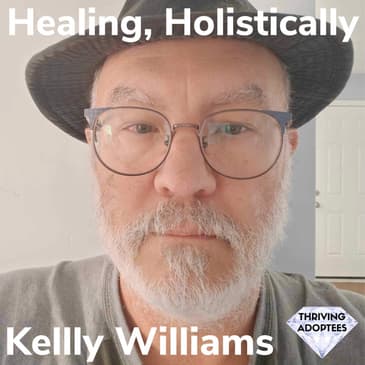
Do you sometimes feel you're getting nowhere fast? Like you're treading water instead of making progress? I don't know about you but I've gotten stuck a lot of times on my healing journey. So what's the catalyst that moves us on? A shift in our perspective. Seeing the bigger picture. Spotting things we haven't noticed before. Kelly explores how curiosity on what he's NOT seeing has driven progression.
Connect with Kelly on https://www.facebook.com/profile.php?id=61552376577563
Guests and the host are not (unless mentioned) licensed pscyho-therapists and speak from their own opinion only. Seek qualified advice if you need help.
Want to learn more about thriving for you, your kids, your families or your colleagues? Pick a time to talk here
[00:00:02] Hello everybody, welcome to another episode of the Thriving Adoptees podcast today. I'm delighted to be joined by Kelly, Kelly Williams. Welcome to the show Kelly, looking forward to chatting further with you today and discussing healing, right? Digging right into this healing stuff.
[00:00:17] Yeah, yeah, happy to be here. Hopefully there's some nuggets that I can throw out there that will help somebody else. Brilliant, brilliant. That's exactly what we're trying to do is we're trying to hold those nuggets together.
[00:00:31] Hold those nuggets up to the light and kind of point at those, point at those as best you can on something that is about an audio rather than a visual media. And see if those nuggets, those hard one nuggets that you've come across, whether they help other people.
[00:00:55] So as we were, before we connected on Facebook, I spotted this funny thing that we've actually born the same year.
[00:01:07] So there seems to be a lot of people come on the show around the same age as us and maybe we're at a similar kind of stage in our life. So what does healing mean to you, Kelly?
[00:01:24] Oh, it depends on my mindset at the time to be honest with you. Because there's physical healing, which I've come to learn that trauma actually can change the human, you know, change your biochemistry.
[00:01:58] So, yeah, the idea that the human body is just what it is without responding to external stimuli is like, nah, that doesn't work. Then there's the emotional level, which also impacts your physical level.
[00:02:20] Then there's mental, which, because let's face it, a lot of times our emotional responses are to how we think about things, you know. And then you also have the whole spiritual, you know. So depending on what's going on, it's, shall we say a multi-lens thing.
[00:02:54] So I try the best I'm able to approach it from a holistic method, you know, holistic level of trying to look at the whole picture instead of just, you know, just focusing solely on the emotional, solely on the mental, solely on spiritual, solely physical.
[00:03:19] Because we don't live like that. Yeah, you know. I think that's been one of the great detriments is the reductionist ideas that's got handed to us from quote unquote science. We're not machines. We're not.
[00:03:42] We've got, you know, I mean, we're not talking about Newtonian mechanics and being able to predict, you know, planetary motion or anything like that. So for me, healing is me actually working towards a better state in all levels going forward.
[00:04:28] And this is just a personal belief of mine. Because we have this force. Every living thing has this force that knows how to put stuff back together. As an analogy, you break your leg.
[00:04:54] Do you have to think about knitting that bone back together? Do you have to think about the what cells need to be activated and in what and what sequence and all that for healing to happen for that bone to men. You don't. So, my personal belief is
[00:05:23] the same force. You can call it spiritual if you wish. That actually formed us guided our growth is still there. And it knows what health is. It knows what each individual being, you know, called optimum. And so I've settled into that.
[00:05:58] I've settled into that idea that as long as I do the work, there is, you know, that force called spirit called universe called whatever. Gaia is actually wants us to be in as healthy as possible. For as long as possible. Because, you know,
[00:06:39] I don't think we're here by accident. I really, I don't believe that. I think there is a call it something called whatever you wish that is guiding and also trying to help as best as as best as possible. We end up getting in our own damn way. So,
[00:07:18] and this may be kind of reductionist after saying all that but if something hurts mentally physically emotionally. That means that I'm not, I'm not in health.
[00:07:36] And so I need to take, I need to take a look at that and I need to know I need to see where I'm getting in my own way. Because you also got to think about programming. You know, how did we learn to be human?
[00:07:55] How did we learn about, you know, the society, how did we learn how to behave? And so I started thinking about the assumptions behind that program.
[00:08:12] And, you know, because let's face it back when I was adopted single, you know, a single mother was like, ooh, no, you don't know.
[00:08:26] And now, yeah, single motherhoods, you know, may not be celebrated in all areas, but it's kind of the idea that it will be at least more beneficial for the child than, you know, being being placed somewhere with strangers. You know, so
[00:08:55] kind of a long way around to describe what healing is to me. Do any particular healing moments come to mind, Kenny? Oh, there's been so many. So many. Let's see, my adopted dad. And I remember this clearly. When I finally, when it finally got through the separation trauma
[00:09:53] that here's this person not related to you know, because as a child, you think like a child that actually loved me except me just for the being that I that I was no reservations, no holdbacks, no he loved me period. No questions.
[00:10:24] And when that happened, you know, he became my person. He was my person. You know, as a boy, your father's usually a hero, right or the father figure.
[00:10:45] And he was more than that he was more than dad he was more than a hero he was, he was my friend. You know, he has everything all wrapped up into one. And that's, you know, is like, Holy spit is, you know. And that was that.
[00:11:13] There was the school teacher. Sorry, can I just take you back to that one? Sure. Yeah. So you said when the when they when the attachment trauma ended. You saw this is that is that would that be a what is that what you're saying. Okay.
[00:11:42] Multi, you know, multiple things going on all at the same time, just like life. So, yeah, I was still dealing with the trauma. You know, being separate because preverbal. How does preverbal. You can't adequately express these emotions and words. Right. So that was so there.
[00:12:12] But it was mitigate why my bond to my adopted dad. And it's to be honest with you, that saved my life really did. When did you when did you first kind of feel that. I mean, the first memory that I have of that.
[00:12:48] I was probably three years old somewhere in there. And I had, you know, I've been on a crying Jag. Because of, you know, just the pain, right? Being separated from mom. And he didn't tell me how to feel. He didn't.
[00:13:25] You know, basically he gave me validation as like, and, you know, he's like, I don't know why you're crying. But obviously if it's hurting that bad that you got to cry, that's fine.
[00:13:42] Go ahead, cry it out. And then after I got, you know, after I got to that stage, you know, where I'm done crying but my breath is still ragged. He goes, let's go ride a motorcycle. And he goes, let's go. Go out. He fired up a motorcycle.
[00:14:13] He's standing stride it. He leans over grass me throws me on the front and you know in front of him. In a way we go, you know.
[00:14:29] And that was, he was a non verbal way of showing me that he accepted me that he cared that he was concerned about me. And that's when it's like, okay. And then the child had the whole.
[00:15:01] Yeah, I've got all these feelings and stuff like that but at least here's an adult here's somebody that I can count on. And I mean, there was so was there, you know, he was my refuge.
[00:15:25] And so I could be having an emotional thing I could be mad, I could be sad, it could be whatever it was. And just being around him gave me a sense of peace. Gave me a sense that it'll be okay.
[00:15:53] You know, and just keep breathing and just write it out. That was the to memory. That was one of the biggest times that I could, you know, and then he was consistent to there was no variation that wasn't one of those things were.
[00:16:23] Oh, he had a bad day and so he didn't want to deal with me or he was just. He was my rock man. I still miss the old guy. Yeah, I lost him as a traffic accident. The year I turned 14.
[00:16:45] Oh, which which is a long time ago now. And, but yeah that rock that he is. I still rely on to this day, you know. And so I know subcrit some crib mates don't have that.
[00:17:12] But I think the universe will put people in your path that will be that consistent. You know person. But I think sometimes we get so wrapped up in our own crap that we don't see it. You know, or we only see it in retrospect. So did you.
[00:17:43] It's amazing memory and it must be amazing that. It's very, it's goosebumps for me. So what I what the hell is going on for you at the moment? I don't know. Is.
[00:17:59] Were you were you aware at three that you were adopted where you kind of consciously aware of it. No, that happened about four. I was one of those curious kids that always like to dig into stuff and find stuff out and all that.
[00:18:19] So I was for already reading. Way way advanced with my of my age. And I would just gone through. I was going through this storage area. They had in the house and just gone through papers, all that kind of good stuff and here's the paperwork for my adoption.
[00:18:47] And that's kind of how I found out, you know, consciously subconsciously. There was always that kind of not fitting. You know, where, because you know, with families. Typically, you'll have a special among the kids, you will have like a shared laugh or shared interests or something, you know.
[00:19:23] But I never that really wasn't there. You know, so consciously as well, I guess as four years old found the paperwork. Then I got the then I got the quote story. I swear the lies that that were abounded in society at the time.
[00:19:58] That's why I wish we, you know, if I had a time machine, it'd just be nice to go back and start slapping people. I mean, seriously, is like how dare you. But it is, you know, it was what it was.
[00:20:18] And it's only now in retrospect that I can see how the universe would put me in a position that gave me the best shot at actually turning into a decent human. Then if I would have stayed, you know,
[00:20:47] if I would have stayed with my first mother, you know, because again retrospective. Yeah, she didn't come from very good background as far as family dynamics. And I mean, I've had my fair share of battles with addiction. Primarily alcohol.
[00:21:26] And that, you know, genetically it seemed like both sides of my genetic code have got that weakness. And yeah, it's like chasing that just trying to put the pieces together trying to get that mosaic of what the who that I am or at least where I came from.
[00:21:56] And there's strengths there, but there's also the weaknesses just like everything. Yeah, you know, everything's a double edged sword, at least in this realm. Yeah. Yeah, come on. Can I take you back to the you were about to share a kind of another healing moment. Yeah.
[00:22:18] Can I take you back to that what was the what was the other moment that was coming to to mind is well. Going through public education and now in the US. Again retrospectively, there was a teacher that just somehow or another would get me.
[00:22:49] And there was some kind of a connection, there was some kind of a understanding. Because as a kid, having an adult having someone in authority, believe in you and we present that they have no doubts about your abilities about your skills.
[00:23:26] You know that's life affirming, that is such an affirmation to go. I can actually starts in the mind to start thinking like, wait a minute. I'm thinking this, I'm feeling this type of way. Usually not good.
[00:23:51] And then here's this person in authority, a quote unquote expert if you will. That is showing me differently. So am I white. What am I missing. And that you know through, I guess it'd be primary school. We call it elementary.
[00:24:26] And don't get me wrong, there were years that the teacher was not good. But then there were years that the teacher would just got me and actually would push to go now you can do better.
[00:24:40] You can do better at this so you can do better at that you know. And even to this day, being in my late fifties, I still remember every single name of every teacher that I had that did that.
[00:25:07] Um, you know, um, and so over the 12 years as in public education. There was a good eight, eight teachers. Out of that 12 out of those 12 years that they just somehow or another, again, going back to the universe going back to spirit.
[00:25:43] Um, encouraged me, pushed me, and it just accepted me. As I was that hell of a mess of a kid. Um, but still saw the good. Still saw the potential still saw the being worthy of their time, their attention, their concern. And dare I say, love.
[00:26:40] I had a funny feeling you were going to say love. Yeah. Well, that's me my definition of love has undergone so many different modifications refining over the years. Um, but yeah, I can look back now and go. My high school English prep English teacher phenomenal. She loved me.
[00:27:24] And there was a connection there. And I didn't really realize it at the time. And you know being a messed up kid, you know. And so trying to figure out it's like, okay. Where in the hell did my ears come from? You know,
[00:27:48] where is my where you know, where does my viewpoint on this blah, blah, blah, you know, where did my physical capabilities come from, you know, just that wondering of being, being unamored, you know, beings being adrift and not really having anything that
[00:28:17] the genetic connection the family history to tie you into the chain of humanity. The, you know, going back in time, it just wasn't there. You know, but even despite all that, there were still people
[00:28:43] at certain places certain times that gave a damn on even when even when I wanted to be Mr. Spock from Star Trek, you know, logical being able to push all the emotions, you know, still feel them but push them aside control them walk them down.
[00:29:18] But to still have that connection to another human in a position of authority to give you that message that you are valuable. You are wanted. We care. I care. It was just, you want to talk about a gift. An absolute gift.
[00:30:01] And looking back through my life, there's been the times that I was just where I needed where I needed an adult. I needed an other to step into the breach. So to say, to kind of fulfill those roles, that role of being the encourager
[00:30:41] being the you can do better come on. I know your skills. I know your abilities. Come on, you can do better. And still be able to relax with a better term. Love you in the mess that you're in at that time. It's just phenomenal.
[00:31:09] For me personally, it's just absolutely phenomenal. And I just lost what I'm going to say next. You clearly had a deep, deep thinking and a deep feeling. You talked about that sort of the questioning thing. You did think a deep question. You talked about
[00:31:43] when there was a disparity between what you were thinking and what your teacher was thinking. And you were kind of like, in the moment being wise enough to say, what am I missing here? So how I understood that is where has my teacher got it right
[00:32:12] and where am I seeing this wrong? So there's that turnaround, that turnaround piece. So there's going to be a turnaround in your perspective. You're kind of like, okay, so what am I missing here? What would you say have been the biggest things that you've noticed as present
[00:32:53] on the back of that self-inquiry? The biggest thing that I've noticed present? Wow. What's the biggest shift in your perspective? Or what have been the biggest shifts in your perspective? What shifts of perspective, sorry, what shifts of perspective come to mind
[00:33:32] when you think about how your perspective has changed? How my perspective has changed. Let's see. Over the years... Oh, mercy. My perspective over the years have changed in that I... Maybe it comes from the idea of, like you and I can see the same instance.
[00:34:30] Say a person with a wheelbarrow that's loaded full of pumpkins going down the sidewalk. Well, we're going to attach different emotional contexts to that same event. And it's not like that your context is wrong or my context is wrong. It's...
[00:35:11] There's an event and each person has their own process to attach meaning to that event. And because the meaning of the event is that that's where, at least in my experience, that's when you start... That's where it can either be beneficial or a negative, as an example.
[00:35:49] And it's taken me a while to get to this perspective. My mother, you know, she came from basically a family with some really not good behavior patterns. And as you know, kids absorb behavior patterns from their parents. It just absorbs into them, right? Because that's the way humans...
[00:36:36] Just as a species. Because a kid is learning how to be a human from other humans and typically that's mother and father or siblings. And I just lost it. Give me a moment. I know it's there. I'll find it. So in a kid,
[00:37:19] a child basically has to learn how to be human. And so it's that whole inner dynamic among parents to kids and then not only between parents and kids but also the wider society. And a lot of that programming, I'll use that term,
[00:37:49] just gets embedded and kids start thinking that a certain way of being is just... That's the way it is. And I guess I've been fortunate enough to realize that I was made aware of that fairly early on. And just to try to figure out how you respond,
[00:38:31] how you cognitate to use that term on a particular level. Because as an adoptee, there's a lot of crap you got to navigate. You have that maternal loss that you have to deal with that a lot of times is preverbal and it's like, how do you express that?
[00:39:08] How do you quote, heal from that? I don't know if you ever do really heal. But at least you can get to a point where your daily life can have enjoyment. You can look forward to the future.
[00:39:34] I've always been one of those people that have always been interested in like, what is real? I remember this clearly back when I was four years old. What is reality? Is my reality the same as your reality?
[00:40:05] Well, if your reality is different than my reality, then what's really reality? And then, so I've always had a kind of an inviting interest in that. And so, you know, and that also leads to, you know, what really is reality.
[00:40:38] You know, is reality is whatever mechanism that's inside of us that assigns meaning to events. You know, that's part of who we are as humans, right? We attach meaning. We attach emotional meaning to events.
[00:41:05] So, but who's to say that the emotional meaning that you placed on that event was the correct emotional meaning? Who's the arbitrator of that?
[00:41:15] Is there an external, you know, is there some sort of external thing that you can point to go, hey, this is what you, you know. And I guess part of that comes from the dynamics in my adopted family.
[00:41:32] Because like my adopted father, he just, he accepted me point blank, or it's an all didn't care. He may stake this claim I was his kid. He didn't give it to him. And he would fight anybody to the death is that he said anything different.
[00:41:59] My adopted mother on the other hand. There are some weirdness there. So, knowing that we assign meaning to events based off of our expectations are emotional state at the time. You know, our definition of reality is individual. And so what's
[00:42:36] as you can tell I spent a lot of thought on this. So, but it's the emotions that you have during an event or any, you know, you're recalling a memory that actually gives meaning to life. It gives meaning to our existence.
[00:42:58] And, but depending on your emotional state at the time, depending on how, you know, typical thing, like you're happy. Everything's good. You're driving somewhere and some jerk cut you off. Well, in that moment because you're happy. Yeah, no big deal.
[00:43:29] But then you can be in an absolutely foul mood. And then somebody cuts you off and then suddenly that triggers the this whole emotional reaction and it's like, so it's just the emotional sides. You know, and I'm not saying the emotions are unimportant. They are very important.
[00:43:51] But a lot of times are emotional. The emotional context doesn't match the events because you're more what you might let me see if I can explain the emotional your emotional state will frame events in a particular context, even though they're the they could be exactly the same.
[00:44:29] And emotions are a lack of a better term. They're kind of a guide, actually, you know, there I think we've the universe. The, you know, evolution if you wish or whatever. It gave us a emotional white GPS for lack of a better term.
[00:45:06] And we as humans have the choice to see events in either a positive light or a negative light. And which then depending on your viewpoint will drive your emotional context, which then brought feeds into your memories and all that.
[00:45:37] And so I can tell you this much that where I'm at right now.
[00:45:42] I can look back the examined memories that I've had when I was four or five with the loss, you know, because kid kid is looking for a mom, you know, because that's without a mother how does the child survive right.
[00:46:03] But it's the emotional context that gives the depth and flavor to our experiences. And I think at times, we don't pay enough attention to the emotion, the emotional context, you know, what's driving what's driving the emotional reaction.
[00:46:27] And I learned this way back, you know, because I grew up on a working dairy farm. And there were times. Okay, we need to go get hay, need to go get alfalfa hay for the cows. Okay, great.
[00:46:47] And you can be out there and picking up bales of hay. And trying to get them loaded on a flatbed truck. And it can either suck, you know, or it, you know, you know, the emotional level, because it's hard to support.
[00:47:16] Or it could be just something that you got to do. And so then you can kind of separate, you know, then you can start laughing, joking, messing around with the people that are there helping you load hay on the truck. And that changes the emotional context. You know,
[00:47:42] I was going to ask you, as the meaning that you and the emotional context or the meaning that you attach to being adopted, has that changed over time? On balance. Yes, it has.
[00:48:06] Because it's, you know, I did the DNA testing, trying to find trying to find genetically related individuals that kind of stuff. And then just kind of getting a big overview of people place situations that kind of stuff.
[00:48:35] And then kind of seeing the whole start trying to look at the emotional context. Because one thing that I've learned as an adoptee is the, the emotional context that you in what you place things will drive whether, whether your basic assumption about an event
[00:49:06] is good or is not good. You know, and for me, with doing the DNA testing and all that and actually doing the deep dive plus actual in person experience with members of my birth mother's family, I can see why in a bigger scale
[00:49:42] some of the reasoning behind the universe is saying about like, no, let's get this let's adopt this kid out. Let's have things situated to where he's at least got a chance.
[00:49:58] Because I've gotten into, again, with the genetics, you know, with ancestry and all that, and just accessing records and whatnot. I've concluded that the universe has got a reason had a reason for me to not grow up in that
[00:50:28] in the environment that have been that would have been in place if I would have been with my birth mother. I'm very, very dysfunctional. I mean, yeah, I mean, I'm not, don't, I'm not saying that I'm the best out there by any means. I know I'm screwy.
[00:50:58] But yeah, there are substance to, you know, there was addictions and not just addictions that would say like to Nick team. Yeah, yeah, long term that's going to definitely be detrimental. But you know, that kind of that'll keep in a whole family dynamic that's like, no big deal.
[00:51:23] But when you get into, you know, hardcore substance abuse, alcoholism, that kind of stuff. That's, you know, that can be very detrimental.
[00:51:35] Have you heard, have you heard this quote from Einstein something like the biggest question we the most the biggest question we'll ever ask ourselves is, is the universe for for us for us for me for you. Or is it again, we heard that.
[00:51:55] I haven't heard that quote, but I can understand. I can understand where he was coming from. I can. That's what you said to me before we hit record.
[00:52:09] And you've alluded to it just now again, that you know that the universe, the universe was facing you placed you for adoption to place to place you out of a certain harms way really. Yeah. I can believe that.
[00:52:32] I can believe that it's, I mean, I don't know about you personally but I myself have had situations to where miraculous things have happened. You know, certain events certain people certain places certain I mean and as.
[00:52:58] And a lot of it, I think we kind of throw off as oh that's just for instance. But when you start stop to think about how many separate actions had to happen in a particular sequence for and for the event in question to actually come about. Okay. Yeah.
[00:53:30] You know, there's a sense that I heard this express really well couple of weeks ago. This stuff doesn't happen to us. It happens for us. Yeah. Yeah, I can. Well, I think, I think that would depend on how you take it. Right.
[00:53:57] Because humans assign emotional meaning to events to situations. That's how we're built. And so we can either look at things as the universe, quote unquote is working for us. Or the universe is working against us. Yeah. And then if you drop into quantum theory.
[00:54:30] This is where it gets really spooky. Your, your expectation actually of actually affects the quantum level of what we know as reality right now. Our expectation is changing the quantum level used to say that that that doesn't keep, you know, the whole domino idea.
[00:55:07] And then it gets passed through all the way up to observable, what we observe what we feel and all that. You know, my favorite quotes is that we are spiritual beings having a physical experience.
[00:55:30] And we're just, we're just here trying to, you know, we're just here trying to figure it out as we go. And, and but yeah, it's, you know, it also I think comes down to the whole idea of, do you see the universe as a friendly place.
[00:55:55] Trying to work with you trying to provide you with what you need. Or is the universe cold sterile just mechanical. Or, you know, and so your outlook, I believe, will affect what you get back. Because it's been proven that thought can change physical reality.
[00:56:34] Have you ever watched the series? What the belief do we know. Yeah. Okay. If you get the quantum edition. It will really was like, okay. So it's just been a thing of how do you for me personally, how do I move from seeing things as negative.
[00:57:12] Seeing events, people all that stuff in a negative manner to actually seeing it. Seeing things as an attempt by forces unknown to provide me with people places events and everything for my continued well be so how do you start that up with the the emotional
[00:57:51] heartache stuff that you've talked about. Well, okay speaking emotions emotions are, in my opinion, they're kind of a very, very generalized navigation system.
[00:58:32] You know, so kind of like the kind of like the load stones from way back where, you know, you have something that float and a load stone on it and you just kind of basically it would always point north. And you were using that for navigation.
[00:58:53] I've come to the, I've come to the beliefs that are emotions, not only tell us. Okay, there is a deficit of some kind. There's a lot going on inside, but also that events and situations
[00:59:15] can happen. We have an emotional response that a lot of times we don't even question it just, oh my emotions are there. Okay. Well, just be based off my own experience.
[00:59:32] A lot of the emotional context gets placed on events after the event has happened. So it's retroactive. It's not the emotions that were present at the moment. So, and our emotional context gets filtered through bunch of crap was let's get real.
[00:59:58] Prior experiences prior emotional context that we attached to certain memories. So, it's a, you know, our emotions I believe are kind of a very, very, very bad, very loose and rational system to drive us to things that we should be, I'll put it that way, should be beneficial.
[01:00:44] Because cognitively, I mean you guys have to think about this. So several, several bell and only can process about 1000 bits of information a second where the rest of your brain is working at about 1000 times more data throughput. So, is our several. So our attention is like a spotlight.
[01:01:27] But everything else is going underneath going on underneath is why 360 degree radar that's going on all the time. Most of the time, our attention is on this spotlight. And then events happen we assigning emotional context to them.
[01:01:53] And then that's how it gets stuff gets encoded in the memory. Well, I've been, I've gone through series, I've gone through several series of being hypnotized. And yeah, you want to talk about something brave. They actually let somebody go in there and rummage around inside your own head.
[01:02:21] Um, but so any event that happened. And then that memory gets encoded and then the emotional context also gets encoded along with that memory. But once you can take the juice. So for lack of a better term the emotional intensity out of that memory. Then
[01:02:55] it just becomes another memory, you know, kind of like taken high definition color photograph. And then you can by changing the emotional context, you know through introspection through sitting with the emotions because our emotions are a type of guidance. Okay.
[01:03:30] However, they're framed this guidance system was formed during a time in our lives where we most folks were not really aware of them, you know, not or aware of the way that, you know, emotions work.
[01:03:55] And so, by revisiting, you know, highly charged emotional events and being able to reframe into a different, you know, different viewpoint. Because who's to say that how you remember something is actually reality.
[01:04:17] You know, so by going back and doing some reframing and some other stuff then you take the emotional charge out of it. And you take the emotional charge out of it. A lot of times that allows healing. You know, like my experience.
[01:04:40] Where I'm at now what I know now. Compliments of, you know, genetic testing. I am thankful that I did not. You know, I'm. Is there the genetic desire to know people that share my genetic code. Hell yeah. Definitely.
[01:05:11] But at the same time, if I had been raised in the environments afforded by those people. You and I would not be having this conversation right. Point blank. Because I know myself well enough that if I've been raised in that environment. I would either be dead.
[01:05:42] Or I would be addicted to whatever substance is out there. Or I would be firmly incarcerated within the prison system. Now, it may sound like I have, you know, excluded a lot of the other opportunity, you know, other possibilities.
[01:06:16] However, I was in contact with my, you know, my birth mother's family. And even then. And I've been in contact with them for several years.
[01:06:38] And it got even a screwed up as I was, I mean, I was fighting, I was fighting a alcohol addiction at the time, with a small child. And being divorced. That there was this like, you know, yeah, I'm screwed up.
[01:06:59] I admit I was at the time I was not good. But they were worse. So, yeah. And I'm not talking worse as in people, I'm not talking worse than that, that kind of stuff but just the their approach to living their life, you know,
[01:07:26] you know, it's like personally any substance. And there are a lot of them. Not to mention, you know, meditation techniques and stuff like that that you can actually you can alter reality, no problem. But when that starts when altering reality through substances or whatever.
[01:07:52] Stars becoming a detriment to living your life. Sorry, I can't do that. And so, I can see how events played out now. I'm not going to lie. It's been a long hard road for me to get to where I'm at right now. It has been hell.
[01:08:28] But I can see now. How things have played out for my highest and best good. And so that me that tells me that there is going to a little spiritual on him. That I actually have a purpose here.
[01:09:01] Whether it's just actually asking the checkout person how they are and actually meaning it. You know, but there, there's a purpose here for me to do in this realm.
[01:09:25] And if I had been raised differently, if I had not gone through the pain, the loss, the full spreading events. That I've been through. I wouldn't be the person I am today. You know, I'd be, I'd be one of those guys that would be, you know,
[01:10:03] so and so, so and so was rested for. You know, because I do have that. I do have that tendency. I'll sink my teeth into something whether it's for good or ill and not let go until some kind of result shows up.
[01:10:30] And it's been a, it's taken me a few decades but I think I finally got that under control to a point where now I can sink my teeth into something. And generally speaking, it's all for good. You know, to be uplifting to be helpful.
[01:10:48] Because that's one of the things I've learned to in my path is, you know, we're here to help each other. We're not here and I'm not just talking financially. Because the Lord knows lots of people like to take advantage of that.
[01:11:09] But the kind word, the small considerations, you know, whether it's male or female. It's like, as an example, post-H is at the post office the other day and gentlemen coming in carrying a lot of packages. I held the door for it. Just, you know, small act of courtesy.
[01:11:40] And his reaction was such that he was swore I just handed him, you know, $100 bill. He was like it made his day. You know. And so, you know, it's like, where I'm at now. I'm not going to lie.
[01:12:10] There's still tender areas. Not gonna lie. There are certain things that still, you know, are tender, for lack of a better term. But I can kind of see the longer term pattern.
[01:12:34] And after a lot of work on my part, I've actually got to a point where I like myself. You know, I love myself. I can be kind and considerate to myself. Where as an adoptee, you know, that at times can be hard one. You know,
[01:13:04] I feel like you matter to feel, I mean, because you think about the thought process of a small child. You know, they're not. I mean, it's basically just pure emotion, right. And so, but now I can actually look back
[01:13:30] and see if I had been, if I had not been put up for adoption, chances are with probability. My own, my own innate being chances are you and I would not be sitting here having this conversation at this time.
[01:14:06] I have to say that, you know, I haven't been through my fair share of crap. You know, I have. But I'm finally at a point where I can see some of the reasoning. You know, I have to believe that there's a higher intelligence that I have to
[01:14:30] because there are things there have been events situations in my life that worked out where there was no way there was nothing that I could have done. There was nothing I could have said there was no action that I could have taken
[01:14:53] to have the situation work out the way it did. Not to say that some of these situations, some of them were painful, you know, hello painful. But at the same time, you know, I can see some of the why
[01:15:24] behind going the going through the events that I've gone through. Which leads me back to a greater intelligence than I has got something in these. There's a plan there. And if that plan is just me being a good dude, right.
[01:15:50] And being able to go to the you know, the checkout person and legitimately you know, not just polite conversation but actually mean. How are you. Are you doing okay. To actually show that that little bit of kindness consideration to another human.
[01:16:16] Which you never know that could have been that one little thing could have prevented them from doing something stupid. You know, maybe that one little thing that small moment of kindness and consideration.
[01:16:35] Maybe that's the domino that gets flicked to have them, you know, go into their, their best life. You know, how do I know I don't. Wow. And that's not to say that yes there are times that I do get stern.
[01:16:59] I'll use that term, but usually I become stern after another human has expressed themselves in such a way where it's like whoa wait a minute what. Now I I didn't do anything to you man I mean come on. You know, check yourself. So, overall,
[01:17:29] I'm, I'm all right. I'm not going to say that I'm where I'm where I need to be. Because there's a higher intelligence out there that's kind of orchestrating all this stuff. But I can say that even right now in my life.
[01:17:56] Even after, you know, desolation of marriage and all that stuff. I'm pretty all right. Yeah, I, I, I find enjoyment. And the quote unquote coincidences that come in. While I'm enjoying my life now just amazing, just absolutely amazing. But then again, I look for them.
[01:18:34] You know, I look for the kindness I look for, you know, coincidences I look for how, even though you just got to do your best at the time, how things. If you're willing will work out. For your for your best good. You know,
[01:19:07] kind of like, kind of like this. It's like, I'm not going to lie, I was nervous. Some trepidation, you know, but then it's like well if me working my jaw speaking to another kind human. And that gets out to somebody and they can actually get solace.
[01:19:35] They can get some help. Maybe something I said, or the way I phrase something sparks something and then they can see see something in a different light which adds to their, you know, adds to. Sorry listeners. We've lost Kelly is completely frozen.
[01:20:10] Thank you for thank you for listening. I think it's going to come back. Thanks for listening. Some some great stuff there from Kelly and we'll speak to you again very soon.