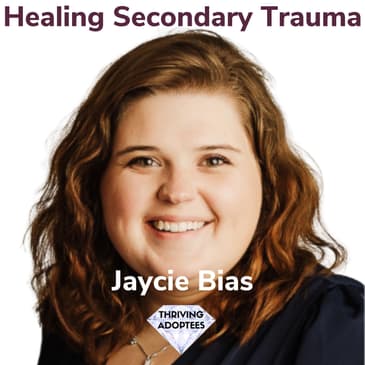
Secondary trauma can build up within us without us noticing. Even veteran therapist Bessel van der Kolk who's the author of the bestselling book The Body Keeps The Score wasn't aware of his secondary trauma until very recently. And secondary trauma is common amongst adoptive parents. Do you want to heal for your kids? Be triggered less often? At peace more? Listen in as adoptive mother Jaycie and Executive Director shares her learnings on healing secondary trauma, choosing love over grief and much more.
https://www.linkedin.com/in/jayciebias/
https://www.facebook.com/WVFosterParents/
Guests and the host are not (unless mentioned) licensed pscyho-therapists and speak from their own opinion only. Seek qualified advice if you need help.
Want to learn more about thriving for you, your kids, your families or your colleagues? Pick a time to talk here
[00:00:02] Hello everybody, welcome to another episode of Thriving Adoptees podcast. Today I'm delighted to be joined by Jaycie. Jaycie Bias, looking forward to our conversation today Jaycie. Thank you. All the way from West Virginia. West Virginia Fostering Together is an organisation that Jaycie is the Executive Director of, right?
[00:00:23] And she is also a mum through adoption, so you have one child through adoption and you're in the process of adopting the other one who you're fostering, is that right? Yes, yeah. My daughter was adopted in 2021, I'm sorry, 2022. We got her in 2021 from foster care and adopted in 2022.
[00:00:46] My foster son is currently in an appeal process, but he will hopefully be adopted soon and we've had him literally, it'll be two years, it has been two years ago today. Yeah. We've had him for 2023. Yeah. Fantastic. Fantastic. So you're right in the middle of this stuff, right? Oh yeah. I live and breathe. I live and breathe this world. Yeah.
[00:01:08] You live and breathe this world. Yeah. And, you know, we, because as a guy adopted at birth, well not at birth, I was five weeks old, right? We often hear these challenges around adoption from foster care being a bigger challenge, right? Because there's, there's been, there's been other stuff going on. It's not just the relinquishment trauma. Yeah. So yeah, in the midst.
[00:01:39] Yes, in the midst. Yeah. It's funny that you say in the midst, because I was literally at the psychiatry office yesterday with my five year old. And that has, you know, been particularly challenging and something that had not happened until after adoption with her.
[00:02:01] And the thing with that had, the part that had been challenging for us in that is, how do we navigate this system as adoptive parents where there are really no post adoptive services for children out of foster care? I mean, the state of West Virginia does a really great job of providing stipends until they're 18, which is really wonderful. They also provide health insurance until a child's 18.
[00:02:26] And then even honestly further if they continue their education, however, or work. However, when she's five, she doesn't really even know what's going on. I don't know what's going on. So we are, we are walking through this step by step, not even in my own home, but also in the families I serve. Yeah. So you, your, your empathy for them, right?
[00:02:56] Yes. Oh, yeah. The sense of being, not being alone at this tricky stage. Yeah. Yeah. So this support page is West Virginia fostering together support page. Um, even at its inception, um, which we became a five Oh one C three nonprofit organization, um, and 2023, but it had been around since 2018.
[00:03:19] Um, so we're about, you know, seven or eight years, I guess into this, it started was started by a foster mom. Um, and so we, it was kind of the way of, I share the same, of course, mission and vision that she did, as I kind of took this over after she had relocated. But sharing the same mission as nobody knows better than a foster and adoptive family and how to take care of a foster adoptive family.
[00:03:46] Um, and when I say foster, of course, in our state, that kind of goes hand in hand with kinship. Um, because in West Virginia, there are so many kinship families, um, grand families, um, and in that way too. So nobody knows better how to take care of us than us. And so that's really how fostering together was born and, um, how it's doing so well, I think to this day.
[00:04:14] Yeah. Um, what I've, one of the things that I heard early in the podcast from an adoptive mom, uh, was this, uh, the truth that it's, it's about, it's not about the kid. It's not about the kids. It's about us as, as, as parents. Uh, and she said, unpacking our own emotional baggage.
[00:04:46] Absolutely. Yeah. So I can a hundred percent speak to that is because it literally is what I'm living through today. Like every, every single day I'm doing this. So one of the things that I really have taken upon myself as a mother is, um, I'll heal for you. Um, and that's one of the things that I really have, um, gone through in this year.
[00:05:10] Um, you know, what about me needs to heal for my kids? Um, because unfortunately my kids and a lot of, I mean, the majority of kids that enter foster care or become adopted through foster care may not be at the place in time that they're ready to, um, heal themselves.
[00:05:30] And so, um, what can I do to better myself so that you have a better life? And for me, I'm typically a mom who, um, is quick and, um, I tend to get frustrated easily. I don't have a great, um, patience span, I guess is the right way to say it.
[00:05:50] And so in doing that, you know, in, in seeking my own therapy and trying to heal myself and, um, expand my patients levels and things like that, I have made it so my daughter has had an easier time on her own to heal from her own things. And, you know, we'll continue to do that. She's only five. And so she'll continue to do that as she gets older and more, um, understanding of her life and her situation and her own personal story.
[00:06:16] And so, um, if, you know, as somebody who goes hard for my kids, goes hard for the kids in West Virginia, um, uh, I've said this before, but I totally mean it. I don't care to be a force. Like I'm unrelenting about my kids and these kids in our state. And if that means that I can change myself to help them, I'm so willing to do that. And that's what makes a good foster parent truthfully. It does. It helps to make a good foster parent.
[00:06:45] Yeah. So we're just over 600 odd episodes in now of this podcast. And I, I started the, thank you. Yeah. Um, I started the, yeah, I go hard like you, right? Yeah. Yeah. Just a little bit on a, on a good day. It's a passion, right? On a bad day. It's an obsession, right?
[00:07:06] That's, that's, that's, that's true. Yeah. Like the, the manageability of these kids, like how can I manage this better for them? I just met me, the podcast. Well, yes, that, I mean, but that's how, that's how passion is. And like, but look at, in my opinion, look at what you're doing. Like right now it's indirect for children and truthfully, West Virginia fostering together is indirect for children.
[00:07:31] We, me and you, Simon and JC are caring for parents, giving them a place of understanding, um, a place of, I, I can understand this because look what somebody else has gone through that I'm similar to. Um, and that validates the feelings of foster or adoptive parents and kinship parents or grandfamilies and maybe gives them one more day of saying, I can do this today.
[00:07:57] Yeah. That's just how I feel about it. I, I don't deal with children directly in my work. Um, but I take really good care. And, um, of right now we have almost 2000 foster adoptive and kinship families in our state that belong in our support page. And I take really good care of them. I feel like I do. And I feel like they think I do too. So, um, that's, that's passion though. Caring for people that are caring for the kids. Yeah.
[00:08:23] So when I started four and a half years ago, you know, all the questions were about thriving. Uh, and then, then we did for a while, we did all the questions. The focus was purely, uh, on healing. And then we kind of went back to the beginning and talked about thriving. Right. Um, but you've mentioned the healing word. Uh, so what, what does healing mean to you?
[00:08:48] When you said that right off, the first word that came to my mind was loads of effort. Um, just making the conscious effort to do better and be better for other people and for yourself. You can't, of course you can't heal for other people. Like you can't heal because somebody wants you to heal. You have to be ready and it has to be on your own time, but you also have to put a load amount of effort into it.
[00:09:17] Um, because if not, sometimes it's not successful and that's really a disservice to the work, to any work that somebody's put in or to any of the history or trauma or anything that you've experienced. Yeah. For me, the, the, the word that came up was, as I was listening to your question, thought your answer, I think you, there's, there's gotta be an intention first. Yeah.
[00:09:46] Right. It's gotta be intentional and then it's gotta be effortful. It's gotta be focused and it's gotta be about, um, it's gotta be about doing the hard yards. Yeah. Yeah. Doing the hard yards. Absolutely. And what, uh, and, and so that to me is, and I might be splitting hairs, JC, just tell me if I'm off right. No. Um, that, that seems to me about process. Yeah. Right.
[00:10:13] And it's, it is essential, right? We, we can't like, I've been, I've been on my healing journey for 18 years now. Right. So I came out of the fog, right. Which is, I became aware of the, of the trauma that was going on for me with the teddy bear. Um, that's 18 years. So, and I'm still intentional. I'm going to a retreat. I'm going to retreat tomorrow for seven days, for seven days. Right.
[00:10:43] So I'm, I'm still putting in the, I'm still putting in the, the, the yards and that'll, but that's only probably the third full retreat that I've been on in OJS. Anyway, but what, what's, what, what's the, what's the goal? What's the, what's the definition? What's the, what's the space? What, what, what is healing? What's the, what, where are we, where are you trying to get to on the process? What, what's healing about rather than the process to healing?
[00:11:13] Yeah. I think that when we have things that happen to us, um, traumas, experiences, negative experiences, that takes something from us. I mean, it really does. It gives us and our children and the people who have experienced trauma, um, in any capacity. It, it, the visual of it just like leaving holes of you. Like it just takes holes of you and you just don't feel complete.
[00:11:41] To me, healing is being willing to put yourself back together. Um, go through it. Grieve. Um, I think that's a big one. Grief for me has been a big, um, factor of my healing personally and the things I've gone through in my life. Um, and not just grief of a person, of course, but grief of a situation and grief of expectations.
[00:12:07] And so getting through all of that in order to patch myself up, um, and to know, of course, acknowledge that that's still there. Because even if you heal, you're not going to become a complete person again. You know, like if we're using the visual of a person with holes in them, you know, you can patch, but you're never going to look exactly the same way again.
[00:12:28] Um, and so healing to me, the end, the end goal of healing, the end game of healing is to put, learn how to put those parts of yourself back within you and put them in a healthy way so that you are a full and complete person at the end of this. Yeah. Can I take you back to the grief word? So you talked about grief of expectations. Would you, would you, I mean, if it's not, if it's too intrusive, just tell me to, to back up.
[00:12:58] Um, the, the grief of the expectations of what, what, what was it for you? So, um, one specific thing that I'm really thinking. Oh, you've, you've just gone mute. Sorry about that. Ladies and gentlemen. Um, I lost JC's voice and then my internet went unstable and it never does that. Right.
[00:13:27] And it knew that because we're getting to the best bit. The best bit of the interview is JC's, uh, JC's tour, uh, talking about the, the, the loss of expectation, the grief of expectation. So what, what was that about for you, JC? Yeah. So one thing that I really think about when I'm thinking about the grief of expectation is the, um, as a foster parent, the grief that we take on as a child who has been through trauma.
[00:13:57] And so I personally have had children in my home that I've had to grieve the fact that their parents, their biological parents, their biological family members, or whoever was caring for them at the time did not treat them the way children should be treated. Um, that they gave them this trauma.
[00:14:20] And, um, unfortunately with the, the giving of this trauma and then this child ends up in my home, I have to, as the adult who's caring for this child, I have to put that on my shoulders. I have to say, you know, I am the keeper of this story. I don't, this story of your, of my child's trauma does not belong to me, but I keep it.
[00:14:44] And it's my responsibility of all they don't understand while they're not willing or they're not able to understand their story or know their story. It is my goal and my job as your foster or adoptive parent to keep that for you and keep it safe. And so because I'm having to do that and I'm having to digest with these children at the same time as them, all the things that they've been through. And truthfully, if I adopt them, I'm going to have to tell them what happened to them.
[00:15:11] I'm going to have to tell them all of these horrific, awful things that they should never know about themselves, but it's their story to know. And it's their story to own. And so as my due, my due diligence as the keeper of a story, um, and actually I actually had heard that at a training recently and it opened up so many doors for me, but, um, it made, it just made so much sense.
[00:15:35] But my grief of expectation for the person who was caring for this child, now that I'm having to go through the awful healing process with them. I still, to this day, cannot fathom the fact that these children have gone through so much. And I expected an adult to act like an adult and a parent to be a parent. And unfortunately I have to grieve the fact that they were not a parent.
[00:16:03] And I think that that's so hard for me, Simon, because I know what they lost. I know what a biological family has lost when they lost their child, because they're in my home now and I get to love them. And I get to be that parental figure at the moment or eventually, you know, their adoptive parent or whatever that means. That to me is what I'm having to grieve.
[00:16:31] I'm having to grieve that this child has come into my home so hurt, um, traumatized, et cetera. And that it was the hands of somebody who claimed to love them. That's the hardest thing for me as a foster parent that I have to swallow. Wow. Wow.
[00:16:51] I've never heard it expressed as devastatingly eloquently as that, Jason. I mean, yeah, well, thank you. I've done this for four years. Um, the average in our state of West Virginia for fostering is less than six months. Um, if somebody is going to foster, um, I think at one time I heard 90% of foster parents in West Virginia quit after six months or less. And I've been doing this for four years.
[00:17:20] So of course it's like a lifetime for, for a lot of people in this area. I mean, I've taken breaks here and there, so I can't say it's been the entirety of four years, but my house has been open for four years. And, um, I have had to get the medical records that taught me exactly what happened. I've had to go page by page, hundreds of medical records, binders full of medical records and ball my eyes out.
[00:17:50] Because I have just learned what happened to this child in my home and what they're going to have to overcome. I think that's so weird to me. It feels like this, not a time traveler so much, maybe like a fortune teller mentality sometimes of like this little four year old or five year old or six year old or whoever's in my home. I actually take, I'm younger. So I take younger children.
[00:18:18] Um, so these children who don't even know how to tie their shoes yet when they're older, I know exactly what they're going to have to go through. I know because I've healed myself and I have not healed from nearly egregious things that they've, they're going to have to heal from, but I'm good. I'm going to have to be there and hold their hand through that. But right now I have to teach them how to tie their shoes. Like that's so hard for me to fat, like to fathom that, like this little baby doesn't know anything, but I know everything.
[00:18:48] And I don't, what a burden for a foster parent to carry. The, the image that was, well, that's full of picking and popping into my head as you were explaining that was like, you're kind of like caught in somebody else's horror story. Yes, exactly. That's exactly what we're doing. We have to keep this child safe. We have to keep their story safe. We, you know, are human, of course, and we are angry. That part of, part of healing is anger.
[00:19:17] Of course, part of grief is anger. We are angry that these, um, whoever the perpetrator of the abuse was, had done this to a child. But we still, to the face of a child, your mom and dad are trying their absolute best to get you home. Your mom and dad love you so, so much. Um, and I love you too. And I'm so glad you're in my home and you're safe. And your mom and dad are trying to make it so safe for you so you can come back.
[00:19:47] I have to do that to, to the face of a child. But behind my head, I'm screaming, Simon. I'm screaming because that child does not understand. And maybe we'll never understand that what happened to them should have never happened to them. So it's, it's like an assault on your belief system, really. Yeah.
[00:20:14] You know, like when, when you set expectations, I thought you were going to go somewhere. Yeah. I, and I thought, cause I've, I've heard, uh, another adopted mom that, uh, I interviewed a few weeks ago. She talked about the, the, the loss that she was grieving the loss of her dream of how, how fostering was going to be, how fostering, fostering to adopting was going to be.
[00:20:39] But she didn't go anywhere into, into the space that we, that, that we, we've gone today, that you've gone so bravely today. But it's like, it's, it's like the, the, no child should have to do this. And no child should have to go through this.
[00:20:59] And it's like a fundamental, like a fundamental, uh, assault on your kind of belief system seems to be too small a world. But you know, what a mom should be, what a dad should be, you know, it's, it's a, it's a fundamental clash. And, and instead of it being beautiful, it's been a, it's been a horror story for these, for these youngsters. Exactly.
[00:21:26] And truthfully, a lot of it too, and it's the other side of the expectation on a foster parent. Um, like, so we as foster parents have expectations that of course didn't come through in terms of the people who were caring for the children in our home prior to them being in our home. Um, to maybe where abuse or neglect or whatever took place. So that's an expectation.
[00:21:48] And then also there's an expectation of the system on a foster parent to love them as hard and as fast as you can, whether in your home, get too attached. You know, that, that is a huge thing that people say here is to get too attached. And I completely agree with that. Don't you think the child needs you to be too attached to them? I mean, don't you think they need that capacity of love from you? Absolutely.
[00:22:11] They do, but there's also the, there was also the expectation of love them as hard and as fast and be a force and be real unrelenting about these children. But if I take them from your home for any reason at all, you have to be okay with it. You need to be able to bounce back. That's not fair. How that is one personally, this is personally, I don't understand how we have dehumanized a foster parent. Because that's how it feels.
[00:22:39] And this group that I am in charge of and all of these things, we expect foster parents to have all of the emotions, all of the time, be there for your foster children. But when they're not there anymore, feel nothing. That's impossible for a human. It is. And that's how, something else I've said too, is there are not that many volunteer positions in this world that you can go to and leave traumatized.
[00:23:09] I would put in that category first responders who are, you know, on the front lines. People who volunteer to go into the military. I would also put foster parents, you know, scarily in that same category. We have volunteered to take on the children who are in the state's custody. And we are all leaving traumatized because we feel the emotions of the kids. We know what the kids have been through. We love on these kids every single day.
[00:23:39] And they may not stay. And we have to be okay with that. Because reunification is the goal. Children are less traumatized when they go back with somebody that loves them, that's part of their biological family, somebody they've grown up with. That's a proven fact. But also part of my job with West Virginia Fostering Together is how am I going to love a foster parent through this process? Because nobody's loving a foster parent at all.
[00:24:07] Well, we do here on Thriving Adoptees. Yes. Well, yeah, of course. I promise. We're sending the love. We're sending the love. But, yeah, on this subject, like we've got to be in this together. I saw something on a birth mums group. And wait, it's not a birth mums page. I'm not, obviously, I didn't pretend I was a birth mum and joined a birth mums Facebook group. This was the post.
[00:24:37] But the birth mums were having a go, criticising adoptees. And I just thought, no, we've got to come together on this. And then I thought, I hope I haven't said this in a recent podcast that I might have done, right? But then I realised I'm criticising them for them criticising us. So I'm doing the same thing. Yeah.
[00:25:04] And we have to come together. I mean, there's no other way. It's a crazy train. And it feels like, I mean, so the birth family is mad at, or the bio family is mad at the adoptive or the foster family who's mad at the system. And the system is upset with the courts.
[00:25:34] And there's just a big crazy train. And, of course, in the middle of this crazy train is a child. And somebody has got to jump off. Like, somebody has, a foster parent can't be, in the same way a foster parent can't, like I just said, we hold a lot of grief about expectations of an adult and of a parent of these children in our home. But we, in turn, have been angry with a biological family. You know? And that part of the grief of expectation.
[00:26:04] And so, anyway, regardless, this big crazy train of system and people and care and love. And love makes us do crazy things for a kid. But this child is in the middle and they see every single bit of it. And they feel every single bit of it. And that is, again, a detriment to the child. When at the end of the day, if we could all and would all come together and be what the system was created to do, is to care for these children well.
[00:26:34] Imagine how much more help we could be doing and how much less trauma there would be on a child. Yeah. I'm struggling to know what to do next because a less empathetic podcaster or somebody that's in cloud cuckoo land, right, would say, well then, what do we do about this? How do you get through this?
[00:27:01] So, I'm struggling to ask a question off the back of that. So, the best I can come up with at this moment was something that you said about the story, right? So, I'm asking your permission for me to share a little bit about my learnings on story.
[00:27:31] Please. Yeah. So, this is a learning from back 18 years ago from the first retreat that I went on. And this was led by two great people, Richard Wilkins and Elizabeth Ivory, Liz Ivory. And I'm going to name check them in case people want to find out more. And there is a book. Liz has got a great book.
[00:28:00] It's called It's Not Your Fault. The book's called It's Not Your Fault. And the week, the five days that we spent together on this retreat was all about sharing our story,
[00:28:23] realizing the story that was in our heads about our story was untrue, right? And separating us from our story, right? So, we are not our story. Yeah. Because that, until then, I'm kind of stuck with the past, right? And as Richard says, and it's a beautiful line, right?
[00:28:52] The past is a place of reference, not a place of residence. So, we're looking forward. If we are, you know, I felt wedded to my story. My story as an adoptee, my story as an entrepreneur that should have been a better entrepreneur, right?
[00:29:21] And all those doubts, all that. A guy who listened to the inner critic rather than calling BS on the inner critic. A guy who thought he was the inner critic. Because the inner critic has got our voice, right? Yeah. So, we think it's us. But it's not. We've picked that up from the world. We've picked that up from the world around us.
[00:29:49] And that has come into the story of us. So, for me, the separation from the story was huge. And as I was saying that, I'm thinking this is kind of like a direct... Well, it's a clash with what you said about story. But maybe there's no...
[00:30:19] Maybe I'm imagining the clash. Or overemphasizing the clash. Or overestimating the clash. But what do you make of that? So, I think that as somebody with like a story of her own, I actually tend to be the same way you are. And something my therapist constantly tells me is, wow, you believe a lot of lies about yourself, don't you? And I'm like, maybe I do.
[00:30:49] So, but also with the identity... I mean, the true identity... The true identity... I can't say that word. True identity crisis that a traumatic history or traumatic story gives. I think that part of the process in understanding that... You are a child...
[00:31:18] You have been a child with trauma or whatever. Is understanding that you maybe are not your story. But your story is part of you. I like the nuance of... It's not a residence. It's a reference. And that really... And my personal life is how I feel we will probably teach our kids about themselves. Nothing to crutch on.
[00:31:49] Nothing to... Nothing to... Like, I call it snug bug in. But I know you probably don't know what that means. It's like snug bug in is just like... Get snuggly and stay there. And just burrow. Burrow and burrow until you're snug. It's not a place for that. It's a place for you to understand. And it's a place for you to be aware.
[00:32:18] It's a place for you to... First to be aware... Of course, aware and understand. But also, like we've been talking about... A place to heal from. Really, the notion of a reference is... Of course, for children who have had trauma... That is the starting point of their lives a lot of time. Um...
[00:32:45] Because we as foster or adoptive parents... Make them feel that way. You had no life before me. Um... And not that anybody would say that to their child. But that's how it can feel. Because... As an adoptive parent... That's our frame of reference. We didn't know them before that. All we know about them is a medical record or in a case file. You know what I mean? And so... Um... It's easy for that to translate that way. Which... Of course, makes it easy for a child as they grow.
[00:33:15] Or as they try to heal. And into adulthood. It makes them feel like that's their origin story. Um... When in reality... Simon's trauma is not Simon's origin story. Simon is Simon's origin story. And so... I guess I would... I mean, I really would agree that it... We should not make a home where... Um... We shouldn't stay. I... Because... Living in trauma is devastating.
[00:33:45] In a crutch. Yeah. The... The... I mentioned this before. Sorry, listeners, if you heard this before. But I don't think JC will have heard this. Uh... Liz... Elizabeth... The lady that... Co-led the retreat that I went to on 18 years ago. Um... She was abused by her dad in every way possible. Like... Including sexually. Right? And she... She wanted to be adoption. She wanted to be adopted.
[00:34:15] Because she wanted out of that home. She went to court. And they... They didn't remove her. So she was... She was stuck with it. And... And I thought... And she had some... Challenges... Uh... Growing up. Um... Bulimia. Uh... And stuff like that. She was functioning in... In the world. She was a hairdresser. And a dance teacher.
[00:34:44] And stuff like that. Um... But she was... You know... She was masculine at all. But she had... She had a big... Like a big epiphany moment. She nearly died in a... In a car crash. And that... Kind of... Um... Changed her trajectory. And... Made her... Far more appreciative of her past. Right. Um... And for me... Like... That... There's the hope. So if... If she can get past...
[00:35:14] That... Then anybody can get through... Past... Anything. Now... But the... The how I'm going to get through my stuff... Is going to be different to the... How she got through her stuff. But I want to bring it back... Uh... Round and... Just try a question on... For size for you. So... You talked about what the... Therapist... Said. And... You've also...
[00:35:44] You've also talked about... We can't heal... Uh... We can't heal... Them. We can only heal... We've got to heal ourselves. It... You know... To what extent? Is our own healing... Seeing through... False beliefs... That we have about ourselves. Um... In my personal...
[00:36:13] Journey of healing... Um... There was a lot of years... Where I was okay... With believing... Things. Um... So... For example... Maybe... Just... Keeping on the same track of... The story of healing... I've been on. Um... Um... Maybe I believe... That...
[00:36:45] My... Child... Biological parent... Abused or neglected... Them... Because they were abused... And neglected. Which is probably true. Statistically... It certainly is. Um... Or maybe I believe... That they didn't have the mental capacity... To care for... This child... Unfortunately... No matter the circumstance... A child should never have been abused... Or neglected.
[00:37:16] And so... Kind of... Even if I'm still in the complex of my own brain... Of I believe these things... Maybe I'm guessing... Maybe I've... Maybe that's the way I've compartmentalized it... Or somebody's compartmentalized it of... Well... They... I don't know... Let's just say... They abused her because they were abused themselves... Okay... Well... Even if...
[00:37:44] They were abused themselves... That doesn't mean that they abused somebody else... Um... And so... That... Filter... Unfortunately... Can... The... The filter of believing something that could or could not be true... If I'm right here... Here's the filter... And my child's right in front of me... And I'm believing through this filter... That they were hurt because somebody hurt their parent...
[00:38:12] That is not giving them the capability of a full healing journey... That's giving... Them... That's... That's feeding to them... Something that could or could not be true... Or an excuse... Or a crutch... Or something... When... In reality... Healing is busting it wide open... And it doesn't matter if somebody has hurt her family... Or hurt somebody who hurt her... Um... Because at the end of the day... While people... Hurt people do hurt people... That doesn't mean they should...
[00:38:42] That doesn't mean they should... That's why we have generational curses... And that's why... Um... We have... Generations of child abuse... And... Um... Generations of... Sex work... And... Um... Etcetera... I mean... Pick out of the lot... You know what I mean? And so... That to me... Is... The detriment... Of putting a filter... In front of you... Maybe to...
[00:39:11] Maybe you're trying to lessen the load for the child... They loved you... But unfortunately... They had been hurt by somebody else... So they hurt you too... Maybe you're trying to lessen the load... To me... That's a detriment... And that's something I've personally had to learn... Yeah... Personally... When speaking to my own children... Yeah... I found out that my biological father had been in care...
[00:39:45] And... It... It... Uh... It explained things to me... Yeah... Um... But... All he did was sign a piece of paper... Right... Relinquishing his rights... So it's not like he... Um... Uh... Hurt me or... Or abused me... And... Yeah... Um...
[00:40:13] But it explained... It... It... It... It... It... Explained things... Yes... I could never really... Understand... I could never figure out whether I would have... Left my... Girlfriend in the lurch... Like he did... I could never figure that out... Yeah... But... I... I... I... I... I... I... Respect the guy...
[00:40:42] After how he was on the phone to me... Hmm... 56 years later... Yeah... But... I... But... But telling... But... I mean... These are... These are... You know... Chalk and cheese perhaps... Um... I... I... Those are our... Realizations that I came to... Myself... Making excuses... Yeah... Making excuses to kids... For the way that their biological parents...
[00:41:13] Um... Are treated them... Is... Is clearly... BS... Yeah... The imaging... At minimum... Yeah... Mm-hmm... It's unfortunate... And... And yet... You're not dissing them, right? No... You... You... You... You... You... You're not dissing them... Because to do so... Dissing their parents...
[00:41:41] Because to do so would be dissing them and... Exactly... Well... And... Truthfully... Especially kids... Especially kids who are old enough to remember who their parents are... Um... That's one thing I think when I... Especially when I'm talking to new foster parents... That I have to try to make sure that they understand... Is... They're still gonna love them... Because that's all that they've known... And it's their family... It's in their blood... And... Um... Can you blame them?
[00:42:11] Can you blame them for loving their family through this? Um... Because that's all the child knows... But at the same time... We as foster parents... Or adoptive parents... Are signing up for that... We need to know that... We need to understand that... Um... And that's something that we're taught... In our system... In our... In our course... Coursework and stuff... But nothing... Nothing teaches you... You can... I could... You could sit me through a million classes, Simon...
[00:42:40] Nothing taught me like the first... That came home... And the first that left... Nothing taught me more than them... Um... And... In fact... Probably... A reason that a lot of people... Stop so early... Into the fostering journey... Is because nothing teaches you like the first... It's... Just too much of a horror story...
[00:43:10] Yeah... And... I'm gonna use the word grief again... Because it's fair... A grief of... Like... Like I said... The grief of the horrendous things... That these people had done to these children... Um... Or the neglectful things... Or etc... Again... Pick out of the bag... Um... It's the grief of the system... The lack of transparency... The fact that... Um... You know... Liz from the retreat... That's a grief of the system... In my opinion... As soon as you said that... I said... Wow...
[00:43:39] What a grief of the system... That they made her go back home with him... That should have never happened to her... Um... It shouldn't have happened to her... To begin with... But then... It's like opening the door... And saying... Welcome in... You know what I mean? So... That... That to me was really... I hate to hear that... Um... About... The system... In... Any capacity... But anyway... The grief of being a foster parent... Is too much of a load to bear...
[00:44:08] For people... Um... But you're... But you stuck with it... I stuck with it... So... Like... Is... Is this... Why? Is this love over... Is this love over grief? It was for me... It was for my husband and I... Um... And it was because... Is that... Sorry... That's a bit reductionist... I'm just asking you... As an open... It's okay...
[00:44:37] If you're gonna have to reduce it... That's the perfect way to reduce it... Um... And it's... It's the choice of... How much am I gonna take on this myself? How much of this grief... Am I gonna take on... Um... In a return... In return for love? Um... And that again... Feels like... Selfishness... It does... Um... But at the same time... Foster parents have to take care of themselves... And so I... Again... I couldn't blame some of these parents for not continuing...
[00:45:06] If it's too much for them... And you're going to... If you are going to be a detriment to the system... Because you can't get any grief... Then you should not be a foster parent... Um... But at the same time... Um... And so I knew that... I knew that they weren't supposed to say that...
[00:45:36] But this little baby is in my arms... And he's three weeks old... And... I believed them... And so we get him home... We love on him... They come to do their 72-hour visit... And... Um... They said he's gonna be leaving on Tuesday... And that was in two days... And I was like... I still remember how I felt... Like I... Like... My mouth was open... But again...
[00:46:06] Like that notion of... I'm screaming inside... Like how could you have done this to me? Like I just... You told me he would stay... You told me he would stay... Um... What happened? What changed? Um... And there was a kinship placement... A very good kinship placement... That was willing to take him... And so because I loved this child so much... And because I did not want him to experience more trauma... I had... I personally... Not that I physically didn't...
[00:46:35] I mean I let him go physically of course... Because I had to... But I... I had to let him go... Um... Because I knew... That even though I loved him... Even though he would have done well in our home... Um... He still would have been more traumatized in my home... Had he not gone to a kinship place... So I loved him more than... I loved the comfortability of just stopping... Um... But I actually called our social worker that night... Um...
[00:47:05] And I said I just don't know if I can do this... I don't know... I was in the same place everybody else is... I said I just don't know if I can do this... And um... She said I could blame you... If you would quit after the second one... But I just don't know if I can blame you... If you quit after the first... Um... And so I said... Okay... We'll try one more time... And we'll see what happens... And the next day she called me with my daughter... And she's been home ever since... And so...
[00:47:34] Imagine I had said no though... Like imagine I just said I can't do this anymore... Then... You know... One of the very best parts of me would not be part of me... And I can't imagine a life without her... Um... And so... That... That to me was the give and the take... Um... I know... That kids are better off in kinship... I know they're better off at home... I might not be better off... But they are... And that's all that matters... I signed up for foster parenting to...
[00:48:05] Have children be better at the end of the day... You know what I mean? And that... It just went... To us... My husband and I... It was not fair to... Not help other children... Because we knew this was a possibility... We knew that... Sometimes love is... Sometimes... The grief of the system... The grief of etc... Is too much... And I can understand... Because I've been through it... But... Also...
[00:48:33] Sometimes I feel like foster parents need a reality check... You signed up for this... You knew it was going to be hard... When you're in the minute of it... Yeah... It's harder than it feels... On... On your... Course classes... When you're trying to learn how to be a foster parent... So... Anyway... That was a long-winded response... But truthfully... I feel... I feel like... You have to be willing to sacrifice something... To do this...
[00:49:02] And if you're not willing... Then... I wouldn't do it... If it was me... Is it hope over grief? For me personally... It is... But I don't feel like it is for everybody... I think because... I've worked inside this system...
[00:49:31] And I hope that it will be better... And I hope that... One of them will get to stay... And be permanent... Have permanency... Um... I think so... But... Unfortunately... In the system of... Definitely not just West Virginia... The system of... Our nation... And our world as a whole... Is so... Hard... And... I think... The... The challenge of that is... Is... This is something else I heard in a training... A different training too...
[00:50:01] We are prone to poke holes in the system... We're prone to say... This is what's wrong with this... We're... Um... I think he actually... Uh... The analogy was a pothole... Like... You're... You're referencing all the potholes... As you drive by... As you drive through... Um... And the effort that you're taking... To verbalize that there's potholes... Imagine... Imagine... The effort you would give... If you would just patch them...
[00:50:31] If you would just patch them... And that's why... I decided that this is what I'm gonna do... So... Yeah... I think for me... It's... At this point... It's hope over grief... Now... Sons adopted... We're finished... Um... And that's because I feel like... At this point... My personal capacity... My husband's personal capacity... Um... Is at max... With our children... We love them... They are our family... But... Um...
[00:51:00] To add another child into our home... Would be a detriment to them... And a detriment to us... As parents... And we don't feel like we could care for anymore... As well as we do the two we have now... So... That's why... But again... With every... Again... When I talk to foster families... You know when you want to... To be a foster family... That's the thing... Like... You don't... You don't just have like this... Whatever... Maybe you have an epiphany one day... That says... I think I could actually do this... And you know you want to do it... But you also know when you're done... You know when you're done...
[00:51:31] So... Yeah... So that brings it in really... Um... We're done for our chat... Unless there's anything that... You'd like to share that I've not... Asked you about... I don't think so... I hope I answered your questions... Well... Yeah... Yeah... I... It's a lot to... It's a lot to carry... Like this whole... Um... Navigation of the system... No matter where you are... If you're in West Virginia... If you're in the UK... Or wherever you are...
[00:52:00] It's a... A burden for whoever is in the system... In any capacity... As an adoptee... As a social worker... As a foster adoptive... Or kinship parent... As a... Leadership... As... Whatever... It's a burden to hold... Yeah... Thank you, Josie... Well, thank you... I've... I really... I enjoy podcasts... I've enjoyed listening to Thriving Adoptees... And thank you for having me... You're very welcome... Thanks, listeners...
[00:52:30] We'll speak to you again very soon... Take care... Bye-bye...