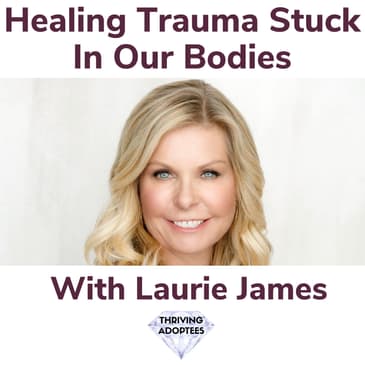
Could trauma still be stuck in your body? Perhaps you've done a lot of talk therapy and yet you're still triggered. Talk therapy has a tough time healing trauma that we can't remember or that happened before we had words. Listen in as adoptee and coach Laurie dives deep into somatic healing and how it reaches trauma other therapies can't get to.
Listen to Laurie's previous interview - Healing Our Feelings here https://thriving-adoptees.simplecast.com/episodes/healing-our-feelings
Sign up for her guide to Somatic Healing
Feeling unwanted is a central theme to many of adoptees' lives. We ache for connection. And it's a deep throbbing heartache that hurts like hell. Listen in as adoptee Laurie and I explore what she's learned to help you heal that heartache.
What does it mean to belong? Laurie James spent most of her life wondering that same question. A lack of belonging and loneliness dictated how she spent most of her life. She rarely shared her secret with others—it was always hidden behind a carefree and can-do attitude.
In her mid-forties, Laurie is sent down an unwanted path after her mother has a heart attack and her husband’s lawyer delivers some shocking news. She suddenly finds herself Sandwiched between caring for her parents, managing unruly caregivers, raising four teenage daughters, and trying to understand the choices of her husband she thought she knew.
Sandwiched is a story about one woman’s struggle to do “it all” while facing the reality that the ideal life and family she believed she had created was slowly crumbling beneath her. As she tries everything to keep her family together, Laurie seeks therapy, turns to yoga, rediscovers nature, develops a strong female tribe and begins writing. As she explores the layers of her life and heals her past, she realizes that she’s the only one who can create the life she wants and deserves.
Sandwiched, is a memoir debut about what it means to let go of the life you planned in order to find the life you belong to.
https://www.instagram.com/laurie.james/
https://www.facebook.com/laurie.james.79219754
https://www.linkedin.com/in/laurie-james-8336a0168/
Here's a another episode on the primal wound
Here's a link to the event on 3 January 2023 about healing the primal wound
https://www.eventbrite.co.uk/e/whole-healing-my-primal-wound-tickets-473258638327
Guests and the host are not (unless mentioned) licensed pscyho-therapists and speak from their own opinion only. Seek qualified advice if you need help.
Want to learn more about thriving for you, your kids, your families or your colleagues? Pick a time to talk here
[00:00:00] Hello, body welcome to another episode of the Thriving Adoptees podcast. Today I would like
[00:00:07] to enjoy the joy of my Laurie and Laurie Jones and James. What are your coolly Jones? I've
[00:00:11] just re-christened you. Sorry Laurie, sorry hey. Hey you works whatever. We're old friends Simon.
[00:00:19] We are and Laurie's been on the show before and so you're in for a treat and listen, Simon.
[00:00:25] I've spoken to you for a while. So I'm in for a treat. Yes, we are and just our little brief conversation
[00:00:31] before I'm super excited about chatting with you today and sharing what I've been up to
[00:00:38] and hopefully help some of your listeners as well. Brilliant. So what does healing mean to you?
[00:00:48] Wow. What does healing mean to me? Well, at this point in my life what I would say is
[00:00:59] healing means to me is really going into the body and paying attention to what's happening
[00:01:08] into our in our body because and I've done a lot of therapy. I've done a lot of various
[00:01:17] healing processes. I've done everything from the Wu Wu energy work to more traditional
[00:01:27] and co-dependency work talk therapy. But over the last five years after I fell very,
[00:01:37] very sick after I left a very tumultuous marriage. I was caring for my elderly parents as you know
[00:01:45] and I was raising my four daughters. I had four daughters that were teenagers. I fell ill to the point
[00:01:53] where I ended up in the hospital not once but twice. I could not feed myself. I needed somebody there 24,
[00:02:02] seven. I left the hospital the first time with a walker. I had all these weird ailments that nobody could figure out.
[00:02:12] I had infectious disease doctors everything. And I have a couple therapy friends or therapist friends.
[00:02:20] And I wasn't in therapy at the time which was a mistake. So if anybody is out there and has multiple
[00:02:28] things going on, I suggest you put yourself into some therapy. But I started working with what's called a
[00:02:35] somatic experiencing practitioner. And so just for anybody who doesn't know,
[00:02:44] Soma comes from the Greek, so somatic comes from the Greek word soma which means body.
[00:02:55] And somatic healing therapies, they fall in the spectrum of the mind body therapies specifically referring to what we consider a bottom-up approach.
[00:03:07] Meaning that we get into the body and we instead of getting out of our head because we can't think through our issues all the time.
[00:03:19] We need to feel, we need to notice the sensations in our bodies. And I've done the training by what I consider the gold standard gentleman by the name of Peter Levine and he's a Ph.D.
[00:03:35] and he develops somatic experiencing. He's been doing this since the 80s and it's really, it's a very holistic naturalistic approach to healing our trauma.
[00:03:46] And for anybody who's listening, if you do not think that adoption is a traumatic experience, I invite you to revisit that thought and that belief because it is when we are removed from our birth parents.
[00:04:05] Or our birth mother. And if you are in anywhere from our 40s to 70s, you were left alone, you did not have that that bond with your parent that is a traumatic experience.
[00:04:25] And going back to the somatic piece, what happens when you work with a somatic practitioner is they help you discharge that energy that stuck in your nervous system.
[00:04:41] And and basically it's a fight flight or freeze response. And sometimes if we don't complete that, it gets stuck in our bodies. And what happens is
[00:04:56] if we don't release it, it builds up, it builds up and it can cause disease in our bodies and disease in our bodies.
[00:05:07] And that's exactly what happened to me.
[00:05:10] So that's a long, that's a long definition.
[00:05:16] So what have been the outcomes for you?
[00:05:21] Great question.
[00:05:25] I lived with anxiety most of my life and I would consider it at times manage, most of the time is manageable.
[00:05:34] At other times not very manageable where I wouldn't sleep.
[00:05:38] I couldn't eat. It would affect my digestive system.
[00:05:44] And I feel a sense of calm in my nervous system that I've never felt before.
[00:05:51] I sleep better.
[00:05:54] I am more in tune with what I need.
[00:05:58] So that way, because I consider myself like an introverted extrovert.
[00:06:04] I'm just certain amount of downtime.
[00:06:07] So that way I can show up for my loved ones, for my family, for my friends, for my work that I love to do and you know chatting with wonderful people like you.
[00:06:17] So it's, you know, it's really getting in touch with instead of our heads of how can I fix this?
[00:06:26] What does my body need? What do I need right now?
[00:06:29] Because our bodies are full of wisdom. We just don't listen to it because we haven't been taught too.
[00:06:35] Yeah.
[00:06:38] So do any particular healing moments come to mind?
[00:06:42] In terms of like what I've experienced in like therapy or things I've done for myself.
[00:06:51] I've asked you about some outcomes, right?
[00:06:54] And you've laid those out nicely for us in terms of a drop off in anxiety, feeling calm, sleeping better.
[00:07:03] And I'm really asking you about any particular moment when you have felt a shift.
[00:07:17] Yeah. I'll do even just take this our conversation.
[00:07:23] For example, I have my own podcast as you know and I've been a guest on yours.
[00:07:29] I talked about my adoption and in my book way back when with you.
[00:07:34] And I used to have this underlying anxiety before I would come on and part of that is I've been doing it more.
[00:07:44] But part of it is I don't like, I feel a little bit of it.
[00:07:51] Like when I get that sense of anxiety because we all get a little bit of it.
[00:07:55] And I just know how to drop into my body and just pay attention to the anxiety and let it dissipate not trying to stuff it or push it away.
[00:08:08] I don't, I don't have it like in my daily life.
[00:08:13] I don't have that I used to get this nying in my head too.
[00:08:18] I don't get that as much anymore.
[00:08:22] You know any type of healing.
[00:08:26] I feel like healing is like an onion.
[00:08:30] There's always another layer. There's always another layer.
[00:08:34] I'm not doing somatic work because I still see my personal practitioner probably every other week.
[00:08:41] I could stop and I would be fine.
[00:08:45] But you don't know what you don't know, right?
[00:08:49] So if you kind of live that way all your life, you feel like that's normal.
[00:08:53] And then when you do this type of work and you realize, oh my god, I don't have to feel like that all the time.
[00:09:02] It's almost you get a, I don't want to say you get addicted but a little bit because you want to keep feeling better.
[00:09:09] Yeah.
[00:09:11] And what's what's you know instead of feeling better with drugs or feeling better with alcohol.
[00:09:18] What if you could just do it naturally and feel better.
[00:09:22] Right?
[00:09:23] And don't get me wrong like I have moments where I'm tired like last week I was just.
[00:09:28] Right? You know, I felt a little drained. I had been really busy and I still get that but it's different.
[00:09:35] Right? I the idea is you don't have as low lows and as high highs because when you learn to heal and learn to work with.
[00:09:48] And then when you're when what we call the window of tolerance, you and I don't know if this is on video or if this is just talk.
[00:09:56] But your highs and lows are less.
[00:09:59] Yeah.
[00:10:00] Right?
[00:10:01] And so you know you're like, oh, I'm feeling a little too high. I'm going to down regulate my nervous system.
[00:10:06] And then oh, I'm going too low.
[00:10:09] Right? And it's it.
[00:10:11] I hope that answers your question.
[00:10:13] So is there also a sense that you less that the lows aren't as low?
[00:10:20] Yeah. And they're and they're not as long and long.
[00:10:23] And right, they might not stretch out as long as they might before.
[00:10:28] Okay.
[00:10:29] And it is the less feeling low about feeling low.
[00:10:36] Yeah.
[00:10:38] You don't go as low.
[00:10:41] Or if you do go low, the idea is you honor that.
[00:10:47] You honor what's going on and set up going, oh my god, why am I why do I feel this way?
[00:10:51] I don't like to feel this way. I want it to go away.
[00:10:54] You sit with it.
[00:10:56] You stay with it.
[00:10:58] And and I have a beginner's guide to somatic healing that we can put in the show notes for people.
[00:11:05] If they give them some very basic exercises, but maybe you stay with that.
[00:11:10] If you're low and you're sad, you stay with that sadness.
[00:11:14] And you feel it in your body like where do I feel that sadness in my body?
[00:11:20] What is the sensation in my body feel like?
[00:11:24] Can I stay with it because if we stay with it and what I say,
[00:11:28] if we need to feel to heal.
[00:11:33] And if we can stay with that feeling and allow it to move through us.
[00:11:41] Then it doesn't, it comes back less frequently.
[00:11:48] And when it does come back, it stays for a shorter period of time.
[00:11:53] It's kind of like your, you know that that relative that you don't really care how to be at your.
[00:12:01] At the holiday parties.
[00:12:05] And you develop a boundary. You're like maybe Uncle Joe doesn't need to be here at Christmas and Easter and.
[00:12:14] Whatever father's day, right?
[00:12:17] He just comes to Christmas.
[00:12:20] One day, one holiday a year.
[00:12:24] So I've got a podcast coming up with a therapist called an adoptee who's also a therapist.
[00:12:31] I called Diego Vitale and he when he was talking to him a couple of weeks ago,
[00:12:37] he talked about the fact that we and it's not just adoptees.
[00:12:43] We've villainized our feelings.
[00:12:48] Yeah.
[00:12:49] So, you know, we make bad feelings the bad guy.
[00:12:54] Yeah.
[00:12:56] Well, this is about making, I don't know,
[00:13:02] is this about making feelings a bad feelings the good guys because they're pointing us towards another layer of feelings.
[00:13:11] I guess that's, I mean, that's definitely a way to look at it.
[00:13:14] And if you can't go to that place where because none of us like to feel bad, right?
[00:13:20] First of all, our society has taught us to not feel our emotions or you know how many time.
[00:13:28] How many times have you heard on a TV show or walking around town,
[00:13:33] a parent saying, oh stop crying.
[00:13:35] It's okay.
[00:13:36] Right. Don't cry about this or a friend who have said, oh don't cry.
[00:13:41] And it's because they don't know how to deal with you crying.
[00:13:45] They are uncomfortable so they want you to stop crying.
[00:13:49] But if we, if we accept that we're human beings,
[00:13:54] we should be able to feel a full range of emotions.
[00:13:58] But that sadness, that anger, that past experience that might have triggered you
[00:14:04] the present moment, it's uncomfortable.
[00:14:08] We might have shame around it.
[00:14:11] We are, we get embarrassed if we're out in public and we're crying or upset.
[00:14:17] And so, and so we have a negative definitely.
[00:14:22] We have a negative mentality towards these harder emotions.
[00:14:29] And the other thing is these emotions, sometimes they actually have physical pain with them.
[00:14:36] They hurt.
[00:14:38] And but if we don't address them and any emotions or feelings that come from adoption,
[00:14:46] if we don't address them, they stay with us until we do.
[00:14:51] And again, they cause, they can cause autoimmune issues.
[00:14:55] They can cause dis-ease anxiety.
[00:15:00] They can cause us to be triggered in certain situations.
[00:15:07] And you know, and when we work through it,
[00:15:10] it helps us to develop better boundaries.
[00:15:13] It helps us to develop basically what it does is it gives us a better tolerance so that way
[00:15:20] when we, if we can feel it, feel to heal and work through them,
[00:15:25] we have a better tolerance to deal with it the next time this thing comes around.
[00:15:30] This, you know, ugly side of us or whatever you want.
[00:15:35] The uncle Joe that we don't want to come visit.
[00:15:38] Yeah.
[00:15:40] So what you're, what you've got me thinking about here really is this.
[00:15:47] You were talking about mum's telling kids to get their acts together.
[00:15:55] Yeah, yeah, yeah, yeah.
[00:15:57] So this is not just an adoptive parent thing.
[00:16:03] This is biological parent, biological thing.
[00:16:07] And this is a broader kind of, well, a mentor of mine calls it a motor phobia.
[00:16:15] So what's wrong with you?
[00:16:18] Right.
[00:16:19] If you're feeling, if you're feeling bad, there's something wrong with you.
[00:16:23] Yeah.
[00:16:24] You've got to put the false smile on you know this whole idea in person development to fake it till you make it.
[00:16:33] Yeah.
[00:16:34] But it wants to deal with a fake.
[00:16:36] Right.
[00:16:37] Yeah.
[00:16:38] What about if we were just honest with ourselves and it's like, yeah, I'm feeling a little sad today.
[00:16:44] Or I'm feeling, you know, low energy or what if you just instead of walking around going, I'm fine.
[00:16:52] I'm fine.
[00:16:53] I'm fine.
[00:16:54] And so this is a societal thing because it is a style of the kids.
[00:17:01] And I'm sensing that this is this, this thing is a bigger thing for adoptees.
[00:17:13] Yes.
[00:17:14] And I'm sensing, I kind of, I'm going to sense for this because this is about if it's about it's the earliest invalidation.
[00:17:27] Right.
[00:17:28] It's, it's that baby in us, right?
[00:17:31] That baby who comes out of the womb and in my opinion on a cellular level already feels abandoned because we are energetic beings.
[00:17:48] We feel each other's energy.
[00:17:50] I mean, have you ever walked into a room and felt somebody who was sad or depressed versus somebody who's like happy and upbeat?
[00:17:59] You can feel that energy.
[00:18:01] So think about being nonverbal and being this little thing, this little creature that just came into the world and already feeling like, oh my god, where's my mommy?
[00:18:16] Where is my mommy?
[00:18:18] Where, you know, I have been inside the womb of this person.
[00:18:27] I feel her energy because I'm guessing just based off of my own experience and talking to my own birth mother about my adoption.
[00:18:38] She wanted me.
[00:18:39] I was born in the mid 60s.
[00:18:41] She wanted me, but our society didn't allow her to keep me.
[00:18:47] So there's all these mixed emotions.
[00:18:50] So I'm feeling that and then I come out of the womb and it's like, there's nobody there to bond with me for three days in the hospital.
[00:18:59] And I get bottle fed by a nurse until finally I get taken home after three days to my adoptive parents and don't get me wrong.
[00:19:10] I, you know, my adoptive parents did the best they could.
[00:19:16] If I can tell a quick story about.
[00:19:20] So I was the third child that my parents adopted.
[00:19:25] My mother had a stillborn her and my parents had a very difficult time getting pregnant.
[00:19:33] And I didn't find any of this out until my 40s late 40s, early 50s, which was also help complete a lot of the puzzle pieces that I talked about on our last podcast.
[00:19:45] And maybe you can link the podcast and the show notes or.
[00:19:50] But if anybody wants to listen, but so, so not only that, so I come out of the womb.
[00:19:57] You know, feeling disconnected, not really feeling like I'm bonding, you know, obviously this is all preverbal.
[00:20:04] And I have no memory of this, but based off of the work I've done and you know, I've been on this healing journey for 10 years.
[00:20:11] And I think healing is something that you continue to do your whole entire life, especially if you're adopted ideally.
[00:20:19] But in addition to that.
[00:20:24] My parents adopted their first adoption was a boy in between their first and second adoption.
[00:20:31] They adopted another little girl.
[00:20:35] So they adopt this little girl and six months into my parents having this little girl, the birth mother decided she wanted this baby back.
[00:20:48] So then I come along.
[00:20:51] So not only did I have wounds, right because I'm adopted and I'm preverbal and I don't know and I can remember being very angry and unhappy as a child.
[00:21:04] Right. But I feel this emotional distance from my mother. I know I'm loved, but I feel an emotional distance.
[00:21:11] And I knew she had lost a baby, you know, a stillborn. She had a stillborn in eight months and I knew she had lost that and that's why she adopted.
[00:21:19] I didn't know about this other baby girl until I would again in my late 40s and 50s.
[00:21:28] And so and it put a lot of puzzle pieces because again, I felt an emotional distance.
[00:21:33] And why wouldn't I? My mother lost a stillborn girl.
[00:21:36] She her second little girl that she brought into the family was taken away from her.
[00:21:41] So her fear was that I was always going to be taken away from her.
[00:21:48] Right. And so she had this natural fear that she probably never really worked through.
[00:21:56] And which is what I make sense out of always feeling an emotional distance, even though I knew I was loved.
[00:22:05] She told me that she loved me and it just when I found that out like I'm like, oh my god, there was a sense of relief of okay, it makes sense.
[00:22:18] And you know, and I had already started my healing journey by that point.
[00:22:23] So it you know, it really helped put some of the puzzle pieces together for me about my adoption.
[00:22:32] Yeah.
[00:22:34] So healing clearly is head on top.
[00:22:38] I'm sorry say that one more time. So healing is head on top.
[00:22:42] You know, head and heart. Absolutely.
[00:22:45] You're talking about my body connection. Yeah.
[00:22:50] Yeah. And another healing moment for me, since we're talking about healing was I won't get into the story about how I met my birth mother because it wasn't.
[00:23:03] I think I talked about it on the last podcast.
[00:23:07] So go back and listen to that.
[00:23:10] It wasn't an ideal situation, but fast forward.
[00:23:15] I'm at a lunch around the holidays with my birth mother.
[00:23:22] And I have my four kids with me there, you know, kind of teenage age.
[00:23:27] And so we go out to, we go out to lunch with her.
[00:23:32] And all my kids at the end of lunch go off to the bathroom.
[00:23:36] And you know, we walked out together and she just said to me.
[00:23:42] Laurie, I need you to know that I did not want to give you up for adoption.
[00:23:50] And in that moment, it's one of those things like you don't know you need it until you until it shows up.
[00:23:58] That was another very healing moment for me, those words, you know, because I am a words of affirmation kind of person.
[00:24:06] But that really like sunk in.
[00:24:10] And that hit my body. I was like, oh my God, you know, and that, and that was a healing moment for me because I could feel it.
[00:24:21] I could feel the truth in what she was saying.
[00:24:25] And I had done enough work on myself to be able to receive that because sometimes like we build up armor and build up wall so we don't feel.
[00:24:36] So I was able to receive that. And that was a super healing moment for me, for my birth mother that I didn't even know I needed.
[00:24:45] No, it's a bit you made, you made a similar comment about the somatic stuff is kind of like we don't know what we don't know.
[00:24:54] Yeah.
[00:24:56] So how can we be curious and a little more inquisitive?
[00:25:00] Yeah.
[00:25:01] That's kind of where it begins and awareness.
[00:25:05] Can we be a little bit more inquisitive and curious instead of afraid of like, oh my God, why am I feeling this anxiety?
[00:25:12] I'm ashamed of it or whatever it is that you might be feeling.
[00:25:17] Let me hide it.
[00:25:19] How can I be curious about it and become more aware of it as part of your healing journey?
[00:25:29] Whatever it is that anybody who's listening might be experiencing.
[00:25:36] So I was a, I recorded podcast with Heidi pulled by the root and Amy Hanson last night as a gas skin.
[00:25:48] And we talked about this idea of, and it's a similar kind of analogy I think to your, to your onions, you know the peeling back the layer of the onions.
[00:26:02] And I think I've also talked about this in brief on another podcast when I've been hosting but look, I've interested in your, your take on it right?
[00:26:13] So the essential idea is that most of us talk about coming out of the fog.
[00:26:21] Yeah, as a once and done thing.
[00:26:25] Right?
[00:26:26] It's once and done.
[00:26:27] But it seems to me that yes, the first one is the biggest one.
[00:26:31] Yeah.
[00:26:32] But I'm not, but that process keeps on happening.
[00:26:40] We keep on becoming aware of more and more.
[00:26:47] If you want to like some people are like, you know what?
[00:26:50] That's enough.
[00:26:51] I don't need anymore.
[00:26:53] Right?
[00:26:54] And some people are afraid.
[00:26:56] I'm afraid of a friend, a girlfriend who you she does she does do some work.
[00:27:04] But she's afraid to get into therapy because she's afraid that and she has literally said that she's like, I'm afraid if I go into therapy and I'm going to explode and I'm going to die because so much has happened and she's held it in so much of what's happened in her life in.
[00:27:25] And she's not adopted, but she had she did not have a great childhood.
[00:27:30] You know, parents were not present was not a good situation.
[00:27:36] And and that fear is real.
[00:27:40] And our brain is wired to keep us safe.
[00:27:45] Right?
[00:27:46] What if you could instead of coming from a place of fear of again curiosity and awareness of.
[00:27:53] And that's the beautiful thing about somatic work is it's very gentle.
[00:27:59] And it's slow, but it's very powerful.
[00:28:04] Very, very powerful.
[00:28:06] And that's the beautiful thing about it is you do it.
[00:28:10] You know, yes, you might start telling a little bit of the story, but then we kind of stop you and really slow everything down.
[00:28:20] So you can really get in touch with your body.
[00:28:24] So you mentioned this Peter Levine guy.
[00:28:26] This is a funny little funny little story.
[00:28:30] Yeah.
[00:28:32] I thought he's book on audio, which one.
[00:28:37] Waking the tiger healing trauma.
[00:28:40] Yeah.
[00:28:41] Yeah, it's a great book.
[00:28:43] It's hard to listen to.
[00:28:45] I've heard I have the.
[00:28:47] I have the.
[00:28:49] You have the hard.
[00:28:50] Yeah, I have the hard.
[00:28:51] Yeah.
[00:28:52] Yeah.
[00:28:53] So.
[00:28:54] I didn't.
[00:28:56] I didn't like it.
[00:28:58] I didn't finish the book.
[00:29:01] I don't know.
[00:29:04] But he's writing a book about healing that isn't about words.
[00:29:16] How can you.
[00:29:19] Somatic is about body, words.
[00:29:23] Right.
[00:29:24] So it's great for our preverbal trauma.
[00:29:28] It's a doctorate.
[00:29:31] It's a doctorate.
[00:29:32] Right.
[00:29:33] Like it talks therapy involves words.
[00:29:35] Right.
[00:29:36] It talks therapy is about words, but if you haven't got words for your trauma, then.
[00:29:43] But here's the thing about.
[00:29:47] Somatic.
[00:29:48] I had a hard time reading that book the first time I read it to and then I've come back around.
[00:29:54] Because I wasn't quite ready for it.
[00:29:57] I hadn't done enough of my own personal work to really kind of grasp the concept.
[00:30:04] But here's the thing healing happens in the body, not in the brain.
[00:30:11] Right.
[00:30:12] And it happens in the in terms of his style of healing.
[00:30:16] It happens in the nervous system.
[00:30:18] The theory is that we hold our trauma in our nervous system because we haven't completed the fight flight or freeze response.
[00:30:26] So that energy gets stuck in our nervous system and the somatic experiencing is a way to slowly release that it doesn't matter if it's preverbal or an a verbal state.
[00:30:41] It's about even if it's an a verbal state and you're an adoptee and you've had this, you know, horrific experience with whatever your adopted parents are your birth parents or whatever it is.
[00:30:55] It's slowing down that process and taking it bit by bit and saying, OK, when you when X happened, what did you notice in your body?
[00:31:09] Where do you feel that in your body?
[00:31:12] Can you sit and stay with that sensation?
[00:31:16] Is that the sensation is the stored energy and when you can sit with it and allow it, the energy to complete and release out of your body.
[00:31:26] That's where the healing happens.
[00:31:28] Does that make sense?
[00:31:30] It does.
[00:31:33] Because talk therapy is only going to get you so far.
[00:31:36] Yes, I was in talk therapy for six or seven years before I started somatic work and started working with a somatic experiencing practitioner and I've had so much more healing and growth in the last five years versus the first seven that I was just in talk therapy.
[00:31:57] It's a theme that we keep on coming back to on this show.
[00:32:01] Talk therapy is not great for pre verbal trauma.
[00:32:06] Yeah.
[00:32:08] But there's a certain irony here with Peter Levine's book because he's writing, he's writing about somatic stuff.
[00:32:18] But somatic stuff isn't about words.
[00:32:22] So there's a fundamental challenge in writing about it.
[00:32:26] Yeah, I see what you're saying.
[00:32:28] I've started.
[00:32:29] Although I didn't like the book.
[00:32:31] Yeah.
[00:32:32] Although I didn't like the book or didn't get along with the book or whatever.
[00:32:35] Maybe maybe it will come around.
[00:32:37] Maybe I'll take another listen at it.
[00:32:40] But I went ahead and spoke to the somatic therapist.
[00:32:44] I'm done working with the somatic therapist anyway because I know like you that it's about the stuff that I don't know.
[00:32:53] Yeah.
[00:32:54] But it's driving my wife slightly mad.
[00:32:57] Because she's like, well, are you ever going to be healed cured?
[00:33:03] No, she didn't use the word heal.
[00:33:04] Are you ever going to be cured Simon?
[00:33:06] Are you ever going to be cured?
[00:33:08] And like you and me, I think we're looking at it from a, we're looking at it from an explorative sense.
[00:33:18] Not a defensive sense.
[00:33:21] Right.
[00:33:22] You know, we're not in a crisis.
[00:33:26] Right.
[00:33:27] Well, and the other thing, you know, maybe a different way to maybe explain it to your wife or if somebody else who's listening kind of feels the same way about somebody or
[00:33:37] because I've had moments of like, oh my God.
[00:33:40] Like what Oprah has said before God don't teach me anything today.
[00:33:44] Right.
[00:33:45] And there are days that's like, I can't take anything but you know from from a, you know, because I'm a coach and I approach it from a somatic place.
[00:33:56] But the important thing, like the important thing I think to realize is we are huge as humans.
[00:34:09] We can either be fixed mindset or growth mindset.
[00:34:14] Right.
[00:34:15] And so instead of looking at it as like, are you ever going to be healed?
[00:34:17] Are you ever going to, or whatever word that she used?
[00:34:20] It's like, I want to continue as a person to continue to learn and grow because when we're in fixed mindset that that's when we get stuck.
[00:34:31] Right.
[00:34:32] And growth.
[00:34:34] Yeah, you have to get out of your comfort zone a little bit.
[00:34:37] Right.
[00:34:38] The fact that you went to a somatic therapist.
[00:34:42] Good for you.
[00:34:44] That you that you want to explore this and learn something new about ourselves.
[00:34:50] Like I come from a frame of mind of growth mindset, and I may not have always been that way but I want to continue to learn and grow because until I'm a, I'm dead.
[00:35:03] And that's where the part of joy of life is of like learning new things and trying new things and being curious.
[00:35:11] And otherwise, like I'm just sitting on the couch watching, you know, family feud or jeopardy or whatever.
[00:35:20] It's like that doesn't interest me.
[00:35:27] But it is, it is scary. It can be scary.
[00:35:30] But if you can just like flip that mindset of be curious and be open and choose to learn more about yourself and about others and about the world around us.
[00:35:50] I'm glad you put it like that because I thought you were talking about me trying to flip my wife's mindset, which I am not going to attend.
[00:36:01] Yeah, no, no, no, no.
[00:36:03] I just meant like if anybody's listening and feeling that way, you know, think about flipping not your wife's mindset but your own mindset right because that's where.
[00:36:16] Yeah, I mean, I want to take you back because to this area of the this early invalidation.
[00:36:28] Yeah, of our emotions because I think that is the resentment.
[00:36:37] Yeah, anger, resentment. Yeah, but the resentment about that invalidation.
[00:36:44] Okay.
[00:36:45] And and I don't know why, but it seems a big thing for me.
[00:36:53] I tried to lay out this is a new idea.
[00:36:57] I'm probably not 100% fluent in capable of talking it talking it through.
[00:37:04] So we're saying that even even bio parents tell their kids to get their stuff together and stop feeling bad right?
[00:37:18] So this is the societal thing and not an adoptive thing, not an adoption thing.
[00:37:25] And yet at the same time, the degree to which the amount of hurt caused through that invalidation to us as adoptive, I feel is bigger.
[00:37:42] Right. So I would agree and what did you have more? Did you want me to?
[00:37:51] Well, I was just thinking maybe you could use your coaching ninja skills.
[00:37:58] You could talk around that. Yeah.
[00:38:00] Yeah. To help people see that because it might people listening might be might be intrigued by that.
[00:38:10] Yeah, so before before I go.
[00:38:13] Go ahead.
[00:38:14] Go go.
[00:38:15] So we're doing this on a Wednesday, doing the recordings on the Wednesday listeners.
[00:38:19] I just want to put in a story that brings this right up today.
[00:38:23] What almost and I'm talking about last Sunday.
[00:38:26] So it was mothering was mothering Sunday.
[00:38:29] Yeah, in the UK last Sunday.
[00:38:33] And I and my my mom wanted reassurance that I'm okay.
[00:38:44] Your mom.
[00:38:45] My mom.
[00:38:46] I'm 57. She's your adopted mom or your birth mom adopted your adopted mom.
[00:38:52] Okay.
[00:38:53] And she wanted reassurance.
[00:38:57] Now, right?
[00:38:59] She's coming up.
[00:39:02] She's coming up 24.
[00:39:04] She's coming up 86.
[00:39:08] But she still wants.
[00:39:10] She knows that I'm doing all this.
[00:39:13] Right. Right.
[00:39:14] And I get the feeling that she's slightly worried that I might it might be upsetting me.
[00:39:20] And she wanted.
[00:39:22] She wanted reassurance for me at 85.
[00:39:25] She's still want reassurance for me that I'm feeling okay.
[00:39:30] So this is a big thing it doesn't go away.
[00:39:37] It doesn't go away.
[00:39:38] Oh, wait.
[00:39:39] They they want this.
[00:39:42] So I'm just wondering if you can talk about.
[00:39:46] So I can talk about that invalidate about invalidation or about that specific scenario.
[00:39:53] Or the pain.
[00:39:54] Well, not about that scenario.
[00:39:58] I think that is.
[00:39:59] That was just an example right?
[00:40:01] That's an example of this.
[00:40:02] Yeah.
[00:40:03] So so two thoughts come to me.
[00:40:08] And one.
[00:40:09] I'll talk about the adoptee.
[00:40:15] Because what happens is if we already come out of the womb.
[00:40:22] Let's just say.
[00:40:25] Below zero.
[00:40:26] So you know, we're in the red.
[00:40:28] So to speak, emo you know having that emotional connection and bond.
[00:40:33] So we're already feeling abandoned.
[00:40:36] And we're already feeling that wound.
[00:40:38] That's kind of our foundation.
[00:40:41] That we are starting with.
[00:40:44] So we're starting in a negative.
[00:40:47] And then you have somebody who then comes along to you, your parent.
[00:40:52] And you look it was our era was our right.
[00:40:57] And our parents were doing the best that they could.
[00:41:00] But then you have somebody that comes up to you and then says.
[00:41:04] I mean, stop crying or I'll give you something to cry about.
[00:41:07] I don't know if you heard that but I heard that.
[00:41:10] So now I'm upset.
[00:41:13] And now I've just been invalidated.
[00:41:15] So I'm already angry and have some resentment.
[00:41:19] Preverbal I can't I don't I don't even know where it's coming from.
[00:41:24] Right because it's preverbal.
[00:41:26] It's it's pre memory.
[00:41:28] But it's just ingrained in me.
[00:41:31] Cause sometimes I want to do those fights and that's what felt like.
[00:41:36] I think your performance by presentment, anger, sadness.
[00:41:40] Whatever emotion it is for somebody.
[00:41:49] And then I had somebody who then Piles on top of that foundation.
[00:41:52] Call it a pile of crap.
[00:41:55] You just felt like you got shit on.
[00:41:57] That's a trigger, right?
[00:41:59] Like that's gonna trigger you even more.
[00:42:02] And then what's that gonna cause you to do as a person?
[00:42:05] It's gonna cause you to be more angry, more resentful.
[00:42:09] You're gonna act out.
[00:42:10] You're gonna wanna leave.
[00:42:12] You're gonna want your flight response is gonna kick in.
[00:42:16] I can remember leaving my household
[00:42:21] and I just wanna get out of this house
[00:42:23] and going down to the park
[00:42:24] and then realizing, which was down the street going,
[00:42:27] oh fuck, how am I gonna take care of myself?
[00:42:30] So then you crawl back with shame.
[00:42:33] Okay now I gotta come back to the house.
[00:42:35] So yeah, I mean I have a picture in my book
[00:42:40] of me, I'm like eight years, seven, eight years old.
[00:42:43] And I got my hands on my hips
[00:42:44] and I'm like, I'm an angry little girl.
[00:42:48] Right?
[00:42:49] I had a lot of anger.
[00:42:51] You know when there were other things
[00:42:53] that were complicated in my childhood too.
[00:42:56] I had, you know, my oldest brother had a lot of dysfunction
[00:43:01] and learning disabilities
[00:43:04] and he had a lot of anger
[00:43:06] and he took his anger out on me.
[00:43:08] And later it got worse when I became a teenager.
[00:43:14] So that's one thought, right?
[00:43:16] Like you've got the foundation.
[00:43:18] You're already coming out in the negative
[00:43:20] and then you've got more stuff piled on.
[00:43:22] So that's important to be aware of
[00:43:27] and for us as adoptees to work through.
[00:43:30] Yes, we, there's another layer there.
[00:43:38] And of course now I forgot my other thought
[00:43:39] around that but hopefully it'll come back.
[00:43:41] That would be nice.
[00:43:42] So this doing the best that they could think
[00:43:46] is a theme that keeps on coming back
[00:43:48] to us on the podcast.
[00:43:50] So, you know, and I, it's almost as if
[00:43:56] we're judging 20th century parenting
[00:43:59] with 21st century knowledge.
[00:44:03] Yeah.
[00:44:04] It's not fair.
[00:44:06] It's not fair for us to do that.
[00:44:09] It's more than this is me really just underlining
[00:44:14] because it's very easy to say
[00:44:16] they were doing the best that they could but
[00:44:19] I get this, it helps me.
[00:44:22] You know, I think about, I think about my stuff as a kid
[00:44:26] and I don't have a lot of conscious trauma.
[00:44:34] As you were talking about running to the park,
[00:44:37] I did run away once.
[00:44:43] I got about 400 yards I think
[00:44:46] and then I went back crying.
[00:44:48] But I don't have a lot of,
[00:44:51] and I can't look at that as adoption.
[00:44:55] Who knows? Who knows?
[00:44:56] It's all, yes it could be all the doc
[00:44:59] but I don't have a lot of conscious memories.
[00:45:01] I wouldn't say I was an angry kid.
[00:45:07] Do you know what I mean?
[00:45:07] Like you said, you know.
[00:45:09] And I wouldn't say that.
[00:45:10] So, but to what extent that,
[00:45:13] to what extent I was just blind to my own stuff?
[00:45:17] You know, we don't know.
[00:45:19] I'm old enough and hopefully what's the word humble enough
[00:45:28] to say that I'm not the best judge of my own stuff.
[00:45:31] Right?
[00:45:33] So, I think we are but we are judging 21st century
[00:45:39] with 20th century, 20th century,
[00:45:41] erasing with 21st century knowledge,
[00:45:44] bustle, bundle, culture, et cetera, et cetera.
[00:45:47] So let me just make a comment around that.
[00:45:50] My parents are doing the best that they could comment
[00:45:52] because I got there
[00:45:55] because I've done the work and I've healed.
[00:45:57] Right?
[00:45:59] I was mad.
[00:46:00] I was angry.
[00:46:01] Like I had a dad who was like another child.
[00:46:07] I took care of my parents for 14 and a half years.
[00:46:11] My two older brothers,
[00:46:13] you know, not daily.
[00:46:15] Like I wasn't there daily caring for them
[00:46:16] but I oversaw their care.
[00:46:18] I took them to doctor's appointments.
[00:46:21] My mom had dementia for 12 years.
[00:46:24] She needed around the clock care for over seven years.
[00:46:28] So, and my two older brothers,
[00:46:31] my oldest brother has addiction issues
[00:46:32] and is on and off of math still to this day.
[00:46:37] And my middle brother, he emotionally checked out.
[00:46:40] So you know, I,
[00:46:43] so what I want to say is,
[00:46:45] I mean, I did have anger towards my dad.
[00:46:47] There were times when my dad would totally trigger me
[00:46:50] with some of his behavior.
[00:46:53] But what I did is like, yes, and I did get angry
[00:46:56] and I was resentful but I allowed myself
[00:47:00] to feel the emotions,
[00:47:02] to feel whatever the emotions were
[00:47:04] and to work through them.
[00:47:06] So I could get to a place where it's like,
[00:47:09] yes, it's a reason it's not an excuse.
[00:47:12] Yes, they were doing the best job that they could.
[00:47:15] Is it an excuse?
[00:47:16] No.
[00:47:18] For invalidating my feelings.
[00:47:21] Does that make sense?
[00:47:24] Right?
[00:47:26] And so and what that does is when you do the work,
[00:47:30] the healing work that we've talked about
[00:47:33] so madically or you know,
[00:47:35] and there's lots of different forms of,
[00:47:38] of somatic work.
[00:47:39] Yoga is a type of somatic.
[00:47:41] You know, that was my first introduction,
[00:47:43] probably 15 years ago to or over 10 years ago
[00:47:47] to my nervous system.
[00:47:49] But that's a little side note.
[00:47:51] But when we do heal,
[00:47:55] we can work through that resentment.
[00:47:56] We can work through that anger.
[00:47:57] We can work through the sadness or whatever,
[00:48:00] we can work through our triggers,
[00:48:02] whatever emotions we're feeling.
[00:48:04] So that way we can feel that inner peace of,
[00:48:07] yeah, it's a reason it's not an excuse.
[00:48:10] And do it for yourself, not for other people.
[00:48:13] Do it for your own wellbeing
[00:48:16] and your own peace of mind
[00:48:18] and your own inner peace and inner freedom.
[00:48:25] You used the trigger word.
[00:48:26] And I've just thought of the different way
[00:48:28] of saying something that I mentioned to you earlier on.
[00:48:32] So is this the wave you talked about?
[00:48:40] We talked about lower lows and shorter lows.
[00:48:48] It strikes me that we're also talking about
[00:48:50] being less triggered, about being triggered.
[00:48:54] Yeah.
[00:48:55] Well, so our nervous system
[00:49:00] is there for a reason, right?
[00:49:03] It's there to help protect us.
[00:49:06] It's to help us give us a adrenaline.
[00:49:08] In the moments we need more adrenaline.
[00:49:12] It's there to
[00:49:15] parasympathetic to calm our nervous system,
[00:49:18] melatonin kicking in so we can sleep and rest.
[00:49:23] So it's there for a reason
[00:49:27] and our nervous system is meant to be
[00:49:32] or to be dysregulated
[00:49:35] and to go up and down.
[00:49:36] We just don't want it to go up too high
[00:49:38] and get stuck there and be hyper vigilant, right?
[00:49:42] That's hyper vigilance where we're constantly on guard
[00:49:46] and we don't sleep
[00:49:46] and we're going, going, going
[00:49:48] and we don't slow down to feel
[00:49:50] or we get too low
[00:49:53] and it goes into what we call dorsal vagal
[00:49:56] and that's where depression happens
[00:50:00] and you can't get yourself up,
[00:50:01] you're stuck down there and you can't get out.
[00:50:04] Which is what happened with me when I got sick,
[00:50:06] my body shut down
[00:50:08] and I was there,
[00:50:09] it took me six months to recover from that fully
[00:50:13] but I couldn't barely do anything for myself
[00:50:16] for over two weeks, right?
[00:50:18] So it's not,
[00:50:20] it's getting in touch with your body
[00:50:23] and noticing when your body does get dysregulated
[00:50:29] so you don't get too high
[00:50:31] and get stuck there or go too low
[00:50:33] and get stuck there where you know
[00:50:35] you're like, okay, I'm feeling a little high.
[00:50:37] I'm going to regulate my nervous system
[00:50:39] and come down through exercise
[00:50:42] or yoga or doing some of the practices that are in my guide
[00:50:47] and again, getting in touch
[00:50:51] with your body and learning
[00:50:54] and developing a relationship with your body.
[00:50:58] So I think I misunderstood your highs and lows
[00:51:02] then earlier on,
[00:51:04] I thought that the scale was happy and sad
[00:51:09] what?
[00:51:10] Well it's that too.
[00:51:12] That too.
[00:51:14] It can be that too but it's you know
[00:51:18] when you're in parasympathetic and you're on a high
[00:51:23] sometimes not always
[00:51:25] but sometimes you can get stuck there.
[00:51:28] Like if you know somebody who's always on the go-go-go
[00:51:30] doing, doing, doing
[00:51:31] and has a really hard time shutting down
[00:51:34] or maybe they're up here
[00:51:35] and they stay high
[00:51:37] and then they just crash.
[00:51:40] So the scale then
[00:51:43] is the high and low scale is more about
[00:51:47] energy than
[00:51:52] let's call it emotional wellbeing.
[00:51:55] It's all of it.
[00:51:57] They're intertwined.
[00:52:00] It can be energy,
[00:52:02] it's energy and its emotion
[00:52:05] yeah.
[00:52:06] And they're intertwined.
[00:52:08] So I'm thinking about bipolar people with bipolar
[00:52:13] and people with bipolar
[00:52:15] and with whatever,
[00:52:18] so I don't have to
[00:52:21] people that have a bipolar,
[00:52:23] I don't know what the PC term is for health.
[00:52:26] Bi-polar people,
[00:52:27] people suffering from bipolar disease,
[00:52:29] whatever it is.
[00:52:31] They're going to be frantic in the highs
[00:52:34] and they're going to be
[00:52:36] slumped in the low.
[00:52:38] In I'm not a psychiatrist
[00:52:41] and I'm not a therapist,
[00:52:43] but I am trained in this somatic
[00:52:47] experiencing practitioner training.
[00:52:51] But yes, that's a really good example
[00:52:54] of what can happen
[00:52:56] in very severe cases
[00:52:59] and somatic therapy can help
[00:53:03] with people who have bipolar disorder
[00:53:09] and if they continue to work with somebody
[00:53:12] in the body,
[00:53:13] it's somatically
[00:53:15] it can help to,
[00:53:17] they can learn to regulate their nervous system better
[00:53:19] so maybe they need less medication
[00:53:23] and maybe eventually get off of it.
[00:53:25] But again, I'm not a psychiatrist
[00:53:27] and I'm not a therapist
[00:53:29] just a bad disclaimer.
[00:53:32] So yeah, so the highs for us clearly would be
[00:53:35] as a doctorate is,
[00:53:36] not just you and me,
[00:53:38] is that hypervigilance in the highs?
[00:53:41] Hypervigilance could be high anxiety also, right?
[00:53:49] Can be that as well.
[00:53:52] And that's where it comes from trauma.
[00:53:55] The sleeplessness would go with that as well, wouldn't it?
[00:53:58] Yeah.
[00:54:01] Yeah.
[00:54:02] And that's, you know, a lot of that comes from trauma, right?
[00:54:07] If we had to be hypervigilant as a child
[00:54:10] and always worrying about
[00:54:14] you know, whatever who's coming into the room
[00:54:17] of like if you had a very angry parent
[00:54:22] or a bipolar parent
[00:54:23] in you or an alcoholic parent
[00:54:25] you didn't know what was coming home.
[00:54:27] You're, you know, as soon as that door opens,
[00:54:30] what does your nervous system do?
[00:54:32] All of a sudden it gets tense.
[00:54:34] Your whole body gets tense.
[00:54:36] What happens if you stay tense like that for 30 years?
[00:54:42] It's gonna have an effect on your body, right?
[00:54:45] I mean, you're looking a bit like...
[00:54:46] You could just see my body tense up.
[00:54:49] Yeah.
[00:54:50] You get frozen like that.
[00:54:52] But the listeners I was gonna say
[00:54:54] Laurie has become a statue.
[00:54:56] That's exactly...
[00:55:01] So...
[00:55:03] So think about being stuck like that.
[00:55:05] Like a statue?
[00:55:07] For 30 or 40 years, it's not fun.
[00:55:10] Yeah, it's like Madame Tussaud's wax works, yeah.
[00:55:14] You've got the wax works in kind of...
[00:55:17] We do in Hollywood, yeah.
[00:55:18] Hollywood, I'm your next.
[00:55:20] Yeah.
[00:55:21] So as you mentioned,
[00:55:25] we'll link to the last episode in the show notes.
[00:55:30] We'll link to the...
[00:55:33] The guide to semantics in the show notes.
[00:55:37] Wonderful.
[00:55:39] I will link to...
[00:55:40] I'll put all your social links in as well.
[00:55:42] Thank you.
[00:55:43] Before we bring it in,
[00:55:45] is there anything else that you'd like to share?
[00:55:48] No.
[00:55:49] I think we covered so much here.
[00:55:52] And I just want to thank you for allowing...
[00:55:55] Having me back on,
[00:55:56] I always enjoy our conversations.
[00:56:00] And for any adoptees out there,
[00:56:03] I hope this resonated with you on some level.
[00:56:08] If they're still listening, it did.
[00:56:10] If they're still listening.
[00:56:11] If they didn't, it not.
[00:56:13] Yeah.
[00:56:15] And I hope you at least consider taking a look
[00:56:19] at the beginner's guide to somatic healing
[00:56:23] because every...
[00:56:27] What I often say to my clients,
[00:56:29] every relationship begins with us.
[00:56:32] And we touched on this.
[00:56:35] It's like if we can all be a little bit more inquisitive
[00:56:39] about ourselves and how we're showing up
[00:56:42] and why we're showing up the way we're showing up,
[00:56:45] then what better gift can we give those who we love?
[00:56:51] Our children, our spouses,
[00:56:53] our adoptive parents,
[00:56:56] our birth parents, whoever it is.
[00:57:00] But yeah.
[00:57:03] Thanks a lot, Laurie.
[00:57:05] Thank you, Simon.
[00:57:06] Thank you, listeners.
[00:57:07] Goodbye.