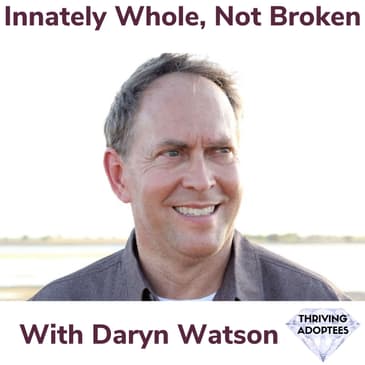
So many of us feel broken. And that hurts like hell. How would it feel to be whole? A whole lot better. Listen in as Daryn shares his learnings from a very counter-cultural take on wholeness from adoptee Sydney Banks. Daryn really stretched me - in a good way - and that helped me to new insights. We both hope it catalyzes new insights for you.
Here's a bit about Daryn from his website:
Hello! My name is Daryn Watson, and I am a reunited adoptee. My adoption reunion journey began in 1995 at the age of twenty-five when I began searching for my maternal family. Less than eight short weeks later, I found my birth/first mother.
Our first telephone call was on October 9th, 1995, which happened to be Canadian Thanksgiving Day. I will never forget that phone call. For the first time in my life, I felt truly whole and complete!
Despite reading several books on adoption, I wasn’t prepared for the overwhelming emotions and experiences reunion encompasses.I would be full of joy one minutes and the next I would feel grief, overwhelmed or angry the next moment.
Adoption Reunions are often referred to as riding on an emotional roller coaster. These emotional up and down swings can last for weeks, months or even years.
Going through my adoption reunion journey made me realize that it’s too much to deal with it by yourself and too difficult to do it alone. Thankfully, I was able to find a support system to help me navigate the emotional upheaval that occurs within adoption reunions.
That is why I started Adoption Reunion Coaching. I really want to be that support system for others who are going through the same journey that I did. I went through this journey, I lived through it, I’ve learned how to navigate the journey and I can teach other people how to do so and make it less traumatic.
I am a contributing author to two books. “The Adoptee Survival Guide” and “Adult Adoptees Anthology: Flip the Script” I was also published in an article for “Adoption Today.” I use my experiences as a reunited adoptee to guide others through their Adoption Reunion Journey.
https://www.adoptionreunioncoaching.com/
https://www.facebook.com/AdoptionReunionCoaching
https://www.instagram.com/theadopteemind/
Guests and the host are not (unless mentioned) licensed pscyho-therapists and speak from their own opinion only. Seek qualified advice if you need help.
Want to learn more about thriving for you, your kids, your families or your colleagues? Pick a time to talk here
[00:00:02] Hello everybody, welcome to another episode of the Thriving Adoptees podcast. Today I'm delighted to be joined by Darren Watson. Welcome back to the show Darren. How long is it since the last one? It's got to be a long time my friend.
[00:00:15] I think it's probably been a year and a half to two years since our first Zoom call. Thank you, I'm really glad to be here.
[00:00:25] Yeah, I'm glad. I'm so glad because you mentioned something that I've kind of dug into this adoptee, this adoptee author guy, a Scottish guy called Sid Banks, who emigrated to Canada, didn't he?
[00:00:48] And he, he, he, he, he was, they call him a theosopher, I think. He's like a, the, halfway between a theologian and a, and a philosopher.
[00:01:01] I think that was one of the ways that one of people described him. And unfortunately he's not, no longer, no longer with us. Do you say he died in 2009?
[00:01:13] Yes, yes.
[00:01:15] Yes.
[00:01:15] Um, but discovering his work and the work of people that teach in his tradition, that was really significant for you on the back of a lot of stuff that you had going on through therapy.
[00:01:32] And, and this, so I think today's really about hope and a, and a, and a different, a different way, uh, for, for people that perhaps feeling a bit stuck or they want a bit more progress on the, on their, on their healing journey, I guess.
[00:01:53] Yes. Yes.
[00:01:55] Yes.
[00:01:55] Yes. Um, Sid Banks, he was, uh, back in 1973, he was with his wife. They went to a couple's workshop and they weren't having a very good successful time at this workshop.
[00:02:11] And they were at the workshop, people were talking, yelling at each other and processing and getting angry. And he wanted to actually leave. And he talked to a psychologist and, uh, the psychologist, uh, was talking, said to Sid, you know, you're not, you're not insecure. You just think you are.
[00:02:37] And Sid had a, basically a, basically a epiphany or a big insight. And he didn't sleep for about three days. And after the workshop, they, he went back to his, back home with his wife and he said, you know, I'm going to, we're going to teach people all over the world. They're going to come here.
[00:02:59] And, uh, they moved to Salt Spring Island in British Columbia. And, and he had all these psychologists and spiritual teachers from around the world starting to come to him.
[00:03:18] Yeah.
[00:03:19] And the three principles, they have a global community now that, uh, there's different groups around the world, um, in different languages.
[00:03:32] And it's really a simplified, um, way of living.
[00:03:39] The, the three principles are universal mind, universal consciousness, and universal thought.
[00:03:50] And basically it, it goes on the premise that we're innately whole inside and we're not broken, but that's not what most of us experience on a day-to-day basis.
[00:04:05] Yeah.
[00:04:07] So it's the power of thought.
[00:04:13] You're not, you're, you're not insecure, uh, Sid.
[00:04:17] You just think you are.
[00:04:19] So this is about us creating our own reality, uh, through this, through this power of thought.
[00:04:30] And so that a change in our thought is, you know, people talk, we talk about this quite a lot on the podcast, the idea that people say time is, is the greatest healer.
[00:04:45] Well, well, it isn't right.
[00:04:46] Right.
[00:04:47] Because if nothing changes over that time, then nothing changes.
[00:04:51] Then if there's, if there's no, if there's no change, there's no healing.
[00:04:55] Uh, the, the idea being that insights are our greatest, are the greatest healers.
[00:05:04] Uh, and an insight is a, is in a change.
[00:05:08] Is a, is a new thought.
[00:05:09] It's a, it's most simplistic term.
[00:05:14] It's simplistic.
[00:05:15] A new thought is an insight.
[00:05:18] And you've had stacks of insights off the back of, uh, being in this community.
[00:05:26] Yeah.
[00:05:26] Yes.
[00:05:28] Yes.
[00:05:29] Um, the insights is, it's not something you can create, but when we get quiet inside, we're, we're all built in with an inner wisdom.
[00:05:41] Um, um, but if we're stuck in our head thinking and we're in what, uh, they call low basement, low level thinking, um, we're not going to have room.
[00:05:55] In our, in our consciousness to, to have insights.
[00:06:00] You can, but it's most likely going to happen when you quiet down and you're, instead of trying to overthink things or going through in our head or story, uh, if we were adopted and relinquished and we're abandoned, whatever our situation was, whatever circumstance.
[00:06:21] Those are things that happen.
[00:06:24] Um, and what keeps us hooked in is our thinking about those stories, looping it over and over again.
[00:06:37] And, and it takes away from the present moment of what's going on right now in front of us or for a word about the future.
[00:06:47] Future hasn't arrived yet.
[00:06:49] So our, we, we know that we're not going to be able to do that.
[00:06:54] The principles work is, are working within us is when we, we feel a presence and right now.
[00:07:03] And we feel some peace of mind.
[00:07:06] It doesn't have to be a big monumental insight.
[00:07:10] It could be thinking, you know, um, you know, maybe someone has road rage.
[00:07:19] They have an issue with road rage and then someone cuts them off and they realize in that moment, you know, I don't have to get mad.
[00:07:28] I don't have to have my day ruined because someone cut me off.
[00:07:33] I can hold my peace right now before this happened.
[00:07:37] It could be very simple things like that.
[00:07:41] Yeah.
[00:07:45] So you, you talked about, uh, before we hit record, you talked about thought, thought stacking.
[00:07:52] And, you know, the word that came to me about this was kind of like a, a, a rumination.
[00:08:00] So we're getting more and more hooked by something that's happened to us, perhaps on the, on the back of the, the adoption stuff.
[00:08:13] And, uh, and, um, uh, a guy called Michael Neal, who I know that you, you, you've mentioned, he's, he's one of the, uh, a guys that teaches, uh, what, uh, Sid Banks came up with in the seventies.
[00:08:32] He talks about becoming a moron, right?
[00:08:35] And, uh, become when we have more on our mind.
[00:08:39] And, and these are these spiraling thoughts that just get bigger and bigger and bigger and, and they can, uh, drive our whole view of the world.
[00:08:52] Right.
[00:08:54] Yes.
[00:08:56] Um, yeah.
[00:08:58] And Michael Neal is one of the really good, uh, three P teacher, three principal teachers.
[00:09:05] And he talks about, uh, looking for a feeling, looking for a warm feeling versus a cool feeling.
[00:09:14] If something comes up and it, it doesn't feel right to us, you're going to feel kind of cool inside.
[00:09:23] You're going to contract, um, the apprehensive.
[00:09:27] Or if it's something that you have a good sense about, you're, you're in a wisdom and it feels warm.
[00:09:37] Then that's something you probably want to explore or pursue.
[00:09:43] Yeah.
[00:09:44] He, the, his story, one of his stories that, um, uh, always resonates with me is, have you heard the story about him, uh, calling the suicide hotline?
[00:09:56] Have you heard that one?
[00:09:57] I don't think I've heard that one.
[00:09:59] So this, what, what we're talking about here, listeners can kind of seem a little bit too highbrow and not very important.
[00:10:10] And yet it is, it's really big, important stuff.
[00:10:14] So this guy, Michael Neal was a depressed teen, right?
[00:10:20] Uh, and as a, at college, he, he suffered from what he calls and what other people call suicidal ideation, right?
[00:10:29] So he was thinking about and ending his life.
[00:10:33] And he talks about going to the, I don't know, the fourth floor of a, uh, of a, of a block of flats, block of apartments, maybe student houses.
[00:10:47] And he, he felt like there was a, uh, a hand looking to pull him out of the window, right?
[00:10:55] He, he, he was backing it.
[00:10:57] He was backing up against the wall because he, he, he was, he thought that it was going to be sucked out of this window.
[00:11:04] That was his, that, that was what was going for him in terms of his, uh, suicidal ideation at that time.
[00:11:10] And the fact that, so he, somehow he, it occurred to him, he had a thought, right?
[00:11:17] Of ringing the suicide hotline.
[00:11:20] And when he did, he got a busy tone.
[00:11:25] And, and he, like, uh, Darren's, uh, Darren's smiling here.
[00:11:31] Uh, in that moment, Michael Neal had a new thought and, and he laughed at, at that, at that, what happened to him, that this, this, this, the, the, uh, the suicidal ideation line was busy, right?
[00:11:49] And then he woke up in the morning and he figured, he realized that, um, he didn't want to commit, he didn't want to commit suicide.
[00:12:00] So this is really, really, really profound, profound stuff that, yeah, when it lands, it really lands.
[00:12:18] Mm-hmm.
[00:12:21] Yeah.
[00:12:22] I, back when I was 23, um, before I got into therapy or things like that, I'd just gone through a really painful breakup with someone and she was in Alcoholics Anonymous.
[00:12:39] And so after we broke up, I started drinking a bit.
[00:12:45] Uh, I pretty much quit drinking when I was dating her.
[00:12:50] And one night after playing volleyball, I went to a Tex-Mex restaurant with some friends and I had three beers and, um, I was really rude to a waiter.
[00:13:04] And, um, the next morning I woke up and I felt hungover and I was really ashamed of how I treated that waiter.
[00:13:15] And I had an insight and it said, you know, I, I don't really want to feel that anymore.
[00:13:21] I'm going to, I don't need to drink.
[00:13:24] And this is back in 1993.
[00:13:27] And I, I quit drinking.
[00:13:30] I haven't, I haven't, I haven't non-alcoholic beer once in a while, but I haven't been drunk or anything like that since.
[00:13:37] Um, and it was a real blessing to have that insight for me.
[00:13:43] Cause I, I know a lot of adoptees struggle with addiction, trying to numb their pain through drugs, alcohol, gambling, food, sex, whatever.
[00:13:56] But to be able to have that insight and realize, you know, I don't need this substance to, to try to live or, or, um, numb my feelings.
[00:14:08] I, it was such a blessing to have.
[00:14:12] Yeah.
[00:14:15] So how did, I mean, this seems to me about taking our thoughts less seriously, like being a bit more flexible.
[00:14:24] Um, like our, our beliefs, I've heard our, uh, you know, our, our beliefs described as, as bouncers, right?
[00:14:36] So that they, they don't let new ideas in.
[00:14:41] This is more about letting the guard, our guard down.
[00:14:45] This is more about, uh, holding our, taking our thoughts less seriously.
[00:14:51] Maybe holding our beliefs more lightly, being more open to change or, uh, uh, a, a, a new thoughts.
[00:15:04] Uh, recognize our wisdom.
[00:15:07] Is it, is it about recognize our wisdom in the moment?
[00:15:09] You know, like people say, well, I want, I want, I want that thought, you know, I want to stop my rumination about stuff or I want to stop my drinking.
[00:15:22] But people, people are looking, always looking for their how, but the insights seem to be more about wisdom rather than strategies.
[00:15:33] Um, it's, it's, the three principles are based on from the inside out and realizing that we are the thinker.
[00:15:44] You know, um, like for example, the holidays, we had Thanksgiving recently in, in the U S and now Christmas.
[00:15:53] So the holidays, I think for a lot of adoptees and maybe others in general can be challenging.
[00:16:03] Um, Thanksgiving, Christmas or birthdays, they all come up every year.
[00:16:10] Those are circumstances and those are facts that are, they're neutral.
[00:16:15] What we think about those things is what creates our reality about it.
[00:16:21] So if I think, well, I'm, I'm not going to be around many people.
[00:16:27] Um, I'm going to be missing out.
[00:16:30] Most likely you're not going to be feeling very enthusiastic around the holidays.
[00:16:37] And it really has to do with what we think about our circumstances outside of ourselves.
[00:16:47] And so this runs completely opposite to the notion of being triggered, right?
[00:16:56] Um, yes.
[00:16:58] You know, we, we can say something happens and we get triggered.
[00:17:04] Um, if we get a, you know, an angry letter from our birth mother, for example.
[00:17:13] Um, when, when that would happen, my birth mother, often, sometimes she would reject me or she would
[00:17:22] have these four or five page letters of things that she thought of in her head that were true.
[00:17:30] And I would read them and just feel devastated for a couple of days.
[00:17:40] And it took away from, you know, my happiness, my peace, my serenity in the moment,
[00:17:48] because I kept thinking over and over again, you know, what, why is she believing this?
[00:17:52] And then I would think, well, I've got to defend myself.
[00:17:56] And so I'd write her back and say, no, this, this, and this isn't true.
[00:18:01] I don't know where you got this.
[00:18:02] And so there's this going back and forth of being, trying to be right with, with each other
[00:18:09] from our own perspective.
[00:18:12] And then at one point I decided, I realized, I think I had insight, you know, I, I could
[00:18:23] choose to want my birth mother in my life versus thinking I have to have her in my life no matter
[00:18:31] what.
[00:18:33] And that, that was a big shift.
[00:18:36] And that was long before I saw it, knew about the principles, but I realized I have a power of choice.
[00:18:43] Do I want this person in my life?
[00:18:46] Is this relationship healthy for me?
[00:18:51] Would, if this wasn't my birth mother, would, would I allow someone else in my life to treat
[00:18:58] me this way?
[00:18:59] Or do I, would I want that person in my life?
[00:19:02] And the answer for most of that time instances where it was, no, I don't want this.
[00:19:10] And, and then finally, after 20 years, I realized I don't need this.
[00:19:15] I don't want to have so much of my energy and value based on a few sprinkles of positivity over
[00:19:30] some, you know, toxic pile of garbage.
[00:19:35] And so I realized after a couple of days back in 2015, I just decided I don't need her in
[00:19:43] my life and I cut ties and I wasn't angry about it.
[00:19:49] I wasn't sad.
[00:19:51] I was just, um, came to a decision in myself that this is what's most healthy for me and
[00:20:02] for my marriage and my, my own peace and serenity.
[00:20:06] And we, and we all have that choice, what, who we want in our life, um, what we choose
[00:20:13] to think or feel, um, about a situation.
[00:20:19] And it's not something you can teach others to do through a process or, or it's, it's an
[00:20:33] understanding inside once we realize that, you know, we're, we're thinking so much and
[00:20:41] stuck in our heads and we're also often our own worst critics.
[00:20:46] Marianne Williamson talks about that in her book, We Trying to Love, you know, we may have
[00:20:52] been bullied by other people in our life, but, um, we're our own harshest critic.
[00:20:57] Yeah.
[00:21:04] So we, but we're brought up to believe that the outside world determines how we feel on
[00:21:15] the inside, aren't we?
[00:21:16] Yeah.
[00:21:18] Yeah.
[00:21:19] We're brought up with it.
[00:21:21] Like I usually go for something really simple and innocuous when I get anywhere near this,
[00:21:27] you know, I talk about miserable weather, right?
[00:21:30] So we have miserable weather here in the UK.
[00:21:33] I'm sure you, you know, like you have, do you have miserable weather in this day?
[00:21:36] You know, like, so we're brought up on this idea that, uh, that the weather determines
[00:21:44] how we feel.
[00:21:46] The outside determines how we feel on the inside.
[00:21:50] We're brought up on that and everybody else thinks it's the world works like that.
[00:21:55] And so everybody else thinks that it goes, the vast majority go along with this idea that
[00:22:03] we are triggered, that, that the somebody, what somebody else does can determine how, how
[00:22:13] we, we feel.
[00:22:14] And we all get very upset about it.
[00:22:20] Yeah.
[00:22:22] We're triggered.
[00:22:25] Triggered or activated.
[00:22:27] Um, and, and I've been there.
[00:22:32] And I think when those things come up, we, we try to avoid the uncomfortable feelings
[00:22:40] within ourselves.
[00:22:43] Um, you know, we, we were traumatized.
[00:22:46] It's, it's in our cells, but our thinking is, I believe what activates it.
[00:22:54] It, it, it, and keeps it going.
[00:22:58] If we.
[00:22:59] It spirals.
[00:23:00] It keeps, it, it, it makes it bigger.
[00:23:02] Yeah.
[00:23:03] It makes it bigger.
[00:23:05] So I, I, you know, when I think about us as, um, you've got the, the, the, the traumatized
[00:23:15] kid.
[00:23:17] You've got the traumatized baby.
[00:23:19] You've got little Simon, a little Darren wondering where his birth mum's gone, right?
[00:23:26] Who's this new, who's this new person?
[00:23:28] Um, but that person isn't, that's, that's, that's a, that's a feeling, um, that becomes
[00:23:50] a thought somehow.
[00:23:52] We, where, where, where does the, the, the, the, a feeling of insecurity somehow becomes
[00:24:04] anger.
[00:24:06] Uh, and, and sometimes, you know, we're, we're railing, we're ranting and we're, I'm lost
[00:24:15] in, I'm, I'm lost in thought.
[00:24:17] I'm lost in my anger about the situation.
[00:24:21] Uh, it, it, it, it just gets bigger and bigger with, with me using this thought tool wrongly.
[00:24:35] Little, little, five week old Simon wasn't doing that.
[00:24:44] Mm-hmm.
[00:24:48] Well, I, I would say, you know, even knowing the principles, yes, I'm still going to have
[00:24:55] days and moments that, um, you know, I'm not going to feel centered.
[00:25:03] I'm, I'm not going to feel present.
[00:25:06] But the, the more I understand this, those moments shrink in time, they shrink in frequency
[00:25:15] and they shrink in intensity.
[00:25:18] When, when we feel uncomfortable, we, if we allow those uncomfortable feelings to pass
[00:25:25] in our body, they usually can go through our body within two minutes or less.
[00:25:32] Instead of, if we allow that, then we, those moments will pass and we're still here.
[00:25:40] Yeah.
[00:25:41] If we don't, then I'm, I might be reaching for a bottle of beer or, or, or a bunch of food
[00:25:48] or something to, to numb those feelings.
[00:25:55] And we, we're talking about perhaps being triggered less rather than never triggered.
[00:26:02] I, I think that that's a benefit, uh, an outcome that, that can happen.
[00:26:14] And over time that will happen with more insights, more, um, creating experiences or living experiences
[00:26:25] where we feel more peaceful.
[00:26:27] Yeah.
[00:26:28] This, and this is, this is an experience, right?
[00:26:32] It's not a theory.
[00:26:35] So the, um, the, the, the book that changed it for me, the, the first book that changed
[00:26:43] it for me, uh, really was Michael Neal's book, The Inside Out, The Inside Out Revolution.
[00:26:48] Um, so we're talking about feelings coming from us, not to us.
[00:26:53] We're talking about feelings being an inside job, uh, being triggered, triggered less because
[00:27:00] it, it works in, it works inside out.
[00:27:03] Life works inside out, not, um, outside in.
[00:27:11] And that, as a theory makes no, makes no impact on us whatsoever, but that, uh, that as an
[00:27:23] experience makes all the difference, right?
[00:27:31] Yeah.
[00:27:33] And, and it, a lot of it, again, has to be real, come to the realization that we are the
[00:27:40] thinker.
[00:27:41] We are the ones creating the reality inside of our minds.
[00:27:45] Um, give you an example.
[00:27:48] A couple of days ago, I was at work.
[00:27:50] Part of my job is unloading boxes, uh, from big delivery trucks onto a conveyor belt.
[00:27:58] And we were near the end of the truck, but I was the only one unloading.
[00:28:04] And I started thinking in my head, okay, um, no one's here to help me.
[00:28:09] I started getting agitated, um, thinking I was getting a little disappointed with my bosses
[00:28:18] not helping.
[00:28:20] And then all of a sudden, um, a box fell on the side of my head.
[00:28:24] It wasn't very heavy, but it was unexpected.
[00:28:27] And I said a curse word and I'm like, okay, it's time to cut the negative thinking out.
[00:28:35] There's nothing you can do.
[00:28:37] I was okay.
[00:28:38] Um, but, so I just kept loading the boxes as best as I could, pushing them down the line.
[00:28:46] And then my two managers came to help me offload the rest of the couple of hundred boxes we had
[00:28:53] left on the truck.
[00:28:54] And so it became a more pleasant group experience, but I realized I was, my own experience was because
[00:29:06] of what I was thinking in my head.
[00:29:09] Yeah.
[00:29:10] And I think the box falling on my head was, you know, wait, kind of a wake up call.
[00:29:15] You know, you need to pay attention to what you're doing or something dangerous might happen.
[00:29:24] So how do you, how do you get, how do you stack up, uh, trauma and, uh, and a three piece?
[00:29:33] Um, I look at it as, you know, it's the separation trauma, um, whatever a trauma you want to call it,
[00:29:46] abandonment trauma, um, whatever label you want to put on there.
[00:29:53] It's, it's something that happened.
[00:29:55] It didn't have, it's not happening to me right now.
[00:30:01] And if I want to go down that rabbit hole into the low level basement thinking, I have that choice.
[00:30:14] And I can do that and sit on my pity pot and act like a victim, or I can not go down that path.
[00:30:29] And realize, you know, I have the choice of thought.
[00:30:33] Um, I can think about, um, I can think about what I'm going to do this afternoon.
[00:30:38] Um, you know, what I'm going to do tomorrow at work, things like that.
[00:30:44] Things that enhance my life.
[00:30:47] Things that deserve my energy and attention.
[00:30:52] I don't, I don't need to go to therapy for five more years and have it all processed out of me because it's not going to happen that way.
[00:31:04] It, my experience is based on what I choose it to be right now.
[00:31:15] Wow.
[00:31:21] And that, that applies to all of us.
[00:31:23] We may not believe it.
[00:31:27] We may not have that understanding yet, but it's possible for all of us to do that.
[00:31:37] What's been occurring for me recently is I've been spending a lot of time thinking about what gets in the way.
[00:31:46] What gets, what gets in our way of us thriving or healing.
[00:31:52] Um, and it would seem to me the belief that I couldn't heal was, was the biggie.
[00:32:13] The, the belief.
[00:32:17] So there's, there's, there's, there's hopelessness there, right?
[00:32:21] Yeah.
[00:32:22] There's hopelessness there.
[00:32:25] Um, we're, we're, we're not, we're not feeling our adoption.
[00:32:35] We're feeling our current thinking.
[00:32:39] About our adoption.
[00:32:42] About our, we're, we're, we're feeling, we're always feeling our, we're always feeling our, our current thinking.
[00:32:49] We may, that, that thinking may be subconscious.
[00:32:52] Right.
[00:32:53] But we're, we're always feeling our current thinking.
[00:32:57] Um, I was chatting to a friend about this a few years ago and he was talking about being afraid of, uh, flying.
[00:33:07] Mm-hmm.
[00:33:08] And I said, well, you're not, you're, you're not on the plane.
[00:33:18] You sat here with me in the garden.
[00:33:22] And I said, so it's not that you're, you're, you're feeling, you're thinking about flying.
[00:33:30] You're not feeling you're flying because you're not flying.
[00:33:34] You're sat on a chair.
[00:33:36] Right.
[00:33:36] You're at ground level, not 35, 35,000 feet above the Atlantic on, on route from, you know, London Heathrow to JFK.
[00:33:47] You're, you're, you're feeling, you're thinking now.
[00:33:50] So we're feeling our thinking all the time in, in the moment.
[00:33:56] And also we're feeling our thinking about when, when we talk about adoption, we're feeling our current thinking about adoption and that that changes.
[00:34:04] Right.
[00:34:06] Yeah.
[00:34:07] Um, and I'll give you a really good example.
[00:34:09] I heard of, um, they, they had a three principles conference in London this summer.
[00:34:18] And they had several people, they were doing a documentary or something that, but they had several people hooked up to biometric monitors, their heart rate and everything.
[00:34:34] And then at each, uh, chair, there was a little glass box and each of the participants were afraid of tarantulas.
[00:34:49] And they, they said, okay, the box is there for when we put the tarantulas in.
[00:34:56] And as soon as they heard that, their heart rate spiked, they got, you know, they got scared as if a tarantula was actually there, even though it wasn't.
[00:35:08] And that was from their thought.
[00:35:11] Wow.
[00:35:13] Wow.
[00:35:14] Wow.
[00:35:18] I just want to jump in with an idea, you know, because the idea for this conversation came off, off the back of something that was, uh, exchanged in, uh, fireside adopters or one of the groups, wasn't it?
[00:35:30] Last week, I think.
[00:35:31] Um, and this idea that if we're going to go on a, uh, if we're going to go on a healing journey, if we're on a healing journey, if we're looking at the trauma stuff or a personal growth, personal development, if we don't like the word healing, that we can work, we can work top down.
[00:35:50] And bottom up.
[00:35:51] So bottom up is the somatic stuff, right?
[00:35:56] Uh, so that's going to the, I think it's because it's the bottom of the brain.
[00:36:00] It's the, is it the reptilian brain?
[00:36:03] Uh, and, and, and, and that, and that we can go top down as well.
[00:36:09] So that we're looking at our, um, we're looking at our thoughts and we're looking at our thought processes and we're looking at our beliefs and we're looking for insights.
[00:36:22] Uh, and, uh, you know, there's, it's both and growth is a growth is about.
[00:36:33] Both, I guess.
[00:36:35] And what, and what works best?
[00:36:38] Um, what works best for us?
[00:36:51] I think, you know, I, I, I've done some somatic therapy through hypnotherapy 30 years ago.
[00:37:01] And that gave me some good insights into when I was born to when I was taken for foster care.
[00:37:12] And in both situations, I was terrified.
[00:37:14] I was, I felt abandoned.
[00:37:16] I felt scared.
[00:37:19] Um, and I'm, I'm grateful to have that knowledge, but it didn't heal me as far as everything else.
[00:37:34] It, it's a realization of my thinking.
[00:37:42] Is my reality.
[00:37:45] My thinking about.
[00:37:48] My adoption, my whatever happened.
[00:37:52] It is my own reality.
[00:37:54] My own creation of what I experienced inside.
[00:37:59] And yeah, you can, you can sit there and analyze all you want, but when we get into our thinking,
[00:38:09] it, it doesn't leave room for being quiet.
[00:38:12] It doesn't really leave room for being in insights as much.
[00:38:20] And we can psychoanalyze our, our adoption and listen to Bessel van der Kolker, Paul Sunderland.
[00:38:29] And, and I, I think they both have done wonderful work, but they're also very, those theories are very complex.
[00:38:38] The, the three principles are very simplified.
[00:38:43] Almost to the point, a lot of people find it hard to believe, but my, my experience is based on what I choose it to be.
[00:38:59] It doesn't mean it's always going to be happy and peaceful, but I have a choice.
[00:39:05] And I know there's, there's a power and knowledge that I have a choice in what I choose to create inside my head for my own experience.
[00:39:16] And we all have that, that power.
[00:39:19] We all have that ability.
[00:39:23] But if we keep looking at psychology through the way it's been traditionally taught,
[00:39:33] we're not, we're not going to have room for the simplicity of their principles.
[00:39:38] Yeah.
[00:39:39] Yeah.
[00:39:40] One, one of the things that struck me being, you know,
[00:39:45] I spent a few years around the principle stuff and I'm, I kind of went,
[00:39:52] I learned some stuff and then I moved on to the kind of non-duality stuff and things like Rupert, Rupert Spira.
[00:40:09] One of the things that really struck me was this innate mental health.
[00:40:23] And also the fact that lots of traditionally, a lot of the people,
[00:40:32] the leaders in the community or the teachers in the community,
[00:40:36] they are traditionally trained shrinks.
[00:40:42] Who have found that traditional shrinking didn't work for them,
[00:40:46] didn't work for them personally and didn't work for their clients.
[00:40:51] And so these people still, they, they, they, they still talk about their qualifications and their,
[00:41:00] and their traditional training.
[00:41:02] And yet they have, they've, they've,
[00:41:05] they've moved on because they've seen the power of this three principles stuff and a more psycho spiritual kind of approach where they're looking at who we are,
[00:41:21] as well as our thoughts, thoughts and, and, and, and, and feelings.
[00:41:27] And.
[00:41:29] That.
[00:41:32] People say, well.
[00:41:36] But they, you know, kids who are, babies who are adopted as, as, as newborns are a blank, a blank slate.
[00:41:47] And, and, and, and that's, that's, that's, that was the perceived wisdom at the time.
[00:41:52] But, but clearly we would say that's not perhaps that we'll, we'll challenge that view.
[00:42:00] And we would say that there's trauma, trauma is on the slate.
[00:42:04] Right.
[00:42:06] But innate mental health is saying that we are the slate before the trauma is written on it.
[00:42:15] Yeah.
[00:42:20] Yeah.
[00:42:20] I, you know, the, the inner wisdom gets covered up by, you know, life experiences, traumatic events, negative, low level thinking beliefs.
[00:42:36] But when we get quiet and we.
[00:42:40] Allow ourselves to.
[00:42:44] Listen to that wisdom.
[00:42:46] Then, then our life can really change.
[00:42:49] And it's not based on controlling what.
[00:42:52] Everyone else is doing outside of ourselves for our happiness.
[00:42:56] It's realizing I can.
[00:43:00] I can choose another way of.
[00:43:02] Experiencing life.
[00:43:06] Judy, Judy Sedgman.
[00:43:08] She talked about.
[00:43:10] She, she grew up in an Italian family.
[00:43:13] She wasn't an adoptee, but her, her aunt said, well, you can only cook with olive oil.
[00:43:20] And Judy was at home and, and she lives in Pittsburgh and she was going to cook something.
[00:43:27] And she didn't have olive oil.
[00:43:29] She had a couple other types of oil instead of.
[00:43:31] She realized I don't have to go to the store and get olive oil.
[00:43:35] I can use canola oil or something else.
[00:43:39] And, and so she just realized I don't have to bind with the belief of what my aunt said about only olive oil is the only type of oil to use.
[00:43:50] That's little things like that.
[00:43:53] And can, can start to begin to show, you know, what else am I believing with my low level thinking?
[00:44:04] What's holding me back?
[00:44:05] What's keeping me from happiness?
[00:44:09] What's keeping me from being peaceful in the moment now?
[00:44:13] And, you know, it could be as simple as turning off the news, not watching news apps on your phone.
[00:44:22] It could be reading a book or just meditating or something going for a walk.
[00:44:30] Connecting with, with ourselves inside.
[00:44:35] Not trying to absorb something more, learn something more.
[00:44:40] Hoping this will be the right thing for.
[00:44:43] This will give me a long lasting peace.
[00:44:46] That's not how life works.
[00:44:52] You know, it's an up and down flow, you know, like waves in an ocean.
[00:45:04] So Dan, is this.
[00:45:06] I'm conscious of time.
[00:45:08] Is there something that you'd like to share that I've not asked you about?
[00:45:14] Um, I, I, I just think, I hope people can realize that we can all have access to, to our own inner wisdom through the principles.
[00:45:33] And, and we don't have to live in our angst and our fear or anxiety or whatever diagnosis label that we've been given.
[00:45:44] And, and whether we've been to therapy or not, or what we listen to other people online.
[00:45:52] I, I used to read a lot of the adoptee stories.
[00:45:57] And there's usually a common theme of, you know, I was born, I was really adopted at whatever age.
[00:46:07] Um, it could be domestic.
[00:46:11] It could be international.
[00:46:13] Um, but what our thinking is, has done is kept us stuck in our story, kept us stuck in our trauma.
[00:46:25] Uh, for example, when, when people, and this is my observation, but, you know, adoptees who are, um, international.
[00:46:38] And they're interracial, uh, multi-racial adoptee.
[00:46:46] So you come from India.
[00:46:51] You, I, I often hear them say, well, I have another added layer of trauma to work through.
[00:46:59] Because I, I, I lost my culture.
[00:47:02] I lost my language.
[00:47:05] Those are circumstances that they're true.
[00:47:11] They happen.
[00:47:13] But what are we going to do about it?
[00:47:15] What are you going to do about it?
[00:47:16] If, if I think this is another layer of trauma, it's just another title to trauma.
[00:47:24] Um, same with our diagnosis.
[00:47:28] If I have complex PTSD or I have anxiety, instead of thinking it that way, think of it as, okay, I'm feeling anxious right now.
[00:47:42] What am I thinking?
[00:47:44] What's going on in my head?
[00:47:45] It doesn't mean it's going to last forever.
[00:47:50] Because I think most of us have moments of clarity, moments of happiness.
[00:47:58] But we, when we go back to our low level thinking, that becomes more the default of our lives.
[00:48:06] And it doesn't have to be that way.
[00:48:13] We have a choice in what, what we focus on, what we think.
[00:48:18] Because we are the thinker in our lives.
[00:48:21] I came up with this a few years ago.
[00:48:27] And I can't, I'm going to try and explain it.
[00:48:31] Um, so the, the event happened in 1967.
[00:48:46] My life has been up and down since then.
[00:48:52] So my life has been variable.
[00:49:00] A fixed event can't determine a variable experience.
[00:49:12] A fixed event, if it, if, if, if it had done, what, you know, if it was down to the event, my life experience, my, my thinking would be, would, would be a constant.
[00:49:36] So I would always be in the basement.
[00:49:41] I would, I would always be, been in basement thinking.
[00:49:45] So there, there is, uh, there is something else at play.
[00:49:52] And the other, the something else that's at play is, is thought.
[00:49:57] Mm-hmm.
[00:49:58] Uh, so if it was hell, then I would have always been in hell.
[00:50:09] But I haven't been in hell every moment of my 50, coming up 58 years on the planet.
[00:50:14] Right.
[00:50:17] So a fixed event cannot cause, cannot be the cause of a variable experience.
[00:50:23] Thought is, thought is the, is, is actually, I'm feeling my thinking.
[00:50:31] My thinking goes up and down.
[00:50:34] Rather than feeling my adoption.
[00:50:37] Right.
[00:50:41] Um, so I want to ask you a question.
[00:50:45] And I want you to point to yourself.
[00:50:50] Well, yeah.
[00:50:52] It's a simple thing.
[00:50:53] Okay.
[00:50:54] So sit up in your chair.
[00:50:58] Who, who is sitting in your chair right now?
[00:51:02] Point to yourself.
[00:51:05] We're talking about body, mind or the essence of who I am.
[00:51:09] Who, who is sitting.
[00:51:12] It's simple.
[00:51:13] Who is sitting in your chair right now?
[00:51:15] Uh, well, Simon Ben sitting in the chair.
[00:51:18] Okay.
[00:51:18] I am.
[00:51:20] I am sitting in my chair right now.
[00:51:25] We know.
[00:51:27] We know pointing to ourselves.
[00:51:28] We know where our wisdom is.
[00:51:29] It's right here.
[00:51:30] It's inside of us.
[00:51:36] It's that simple.
[00:51:40] It's not out there.
[00:51:41] It's here.
[00:51:46] I was trying to be too clever.
[00:51:49] It's okay.
[00:51:52] I, my minister at church 30 years ago showed us and he said, okay, we point to yourself.
[00:51:58] Who's sitting in your chair.
[00:52:00] We all pointed to our solar plexus.
[00:52:03] He said, hold your finger there and look up and down the road.
[00:52:07] Everybody was pointing here at our solar plexus.
[00:52:12] And, and he did a sermon on this.
[00:52:15] And I remember how powerful it was just to have that insight.
[00:52:35] Thank you, Darren.
[00:52:37] Thank you.
[00:52:38] Thank you listeners.
[00:52:40] We'll speak to you again very soon.
[00:52:41] Take care.
[00:52:41] Bye-bye.