Change is hard. Until an insight happens. Whether that's about how we feel, what causes those feelings, our behaviour or anything else. So changing is a seeing thing. Listen in as Steve shares some of the insights that have done the heavy lifting. We hope this interview catalyses some changes for you.
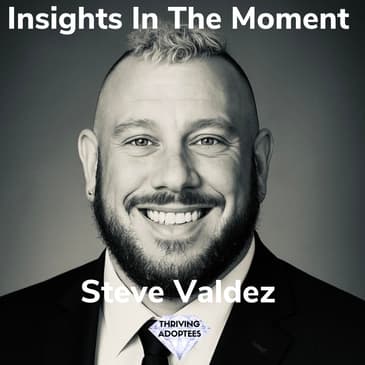
Steve joins the team at Hand in Hand with a background in non-profit organizations, the healthcare industry and higher education. He holds a B.A. in Public Relations, a Master of Divinity, and an M.A. in Psychology, all of which have allowed him to do what he is most passionate about: making a positive difference in the lives of others. Steve heads up operations for Hand In Hand and his outgoing personality makes him a fantastic spokesperson for introducing Hand In Hand to new families and organizations that we partner with. Steve and his spouse have five adopted children. Steve is always excited to share his family’s experience with others to show them the incredible ways that adoption can transform lives. He is an avid sports fan, enjoys going to games and can normally be found adventuring with his kiddos throughout California. Steve is not afraid to go outside of his comfort zone and has even run a marathon in Italy to raise funds for charity! He loves being a father, first and foremost, and enjoys being able to give that experience to other families through his work with Hand in Hand.
Find out more at:
https://www.instagram.com/hand_in_hand_intl_adoptions/?hl=en
https://www.facebook.com/HandInHandInternationalAdoptions/
Guests and the host are not (unless mentioned) licensed pscyho-therapists and speak from their own opinion only. Seek qualified advice if you need help.
Want to learn more about thriving for you, your kids, your families or your colleagues? Pick a time to talk here
[00:00:02] Hello everybody, welcome to another episode of The Thriving Adoptees Podcast. Today I'm delighted to be joined by Steve, Steve Valdez. Looking forward to our conversation today, Steve. I am as well, thank you for having me. Yeah, really looking forward to it. So, so listeners, Steve is an adopted dad and fatherhood's really important to you, right? You've got five kids, so he's got a lot on his hands with you and your partner, right? Your spouse.
[00:00:32] And he also works for his adoption professional, right? So he works for Hand in Hand International Adoptions too. So, so we've got those two, those two perspectives, right? The adoption professional perspective and also the dad perspective. Also, he's got two masters degrees, which sets him apart, right? I just got one bachelor degree. It didn't, I didn't really like my time in that university space, but
[00:01:01] Steve's got from looking at my notes today. He's got a master's in divinity and a master's in psychology, which I think makes for a fascinating combination. Sounds like a fascinating combination. Certainly. So, so I start with the question that I like to start with Steve. What does thriving mean to you?
[00:01:24] Yeah, I mean, that's a great question. I think, obviously it's relative depending on who you ask, but I think, you know, to be considered thriving, one needs to first feel that way themselves.
[00:01:39] I think it's something that comes from inside and not a label that anyone else can necessarily put on you, but it's sort of a claim and a label to, you know, express the fact that you have gotten to the sort of best version of yourself that you can be in that moment.
[00:01:59] Someone who has found pride and achievement in becoming the person that they have become, who is constantly striving still to further that person that they can be. Just sort of, just sort of, if you put joy into the personification of a person, it would be sort of that right in front of you. Yeah.
[00:02:30] Wow. I love that. I love the breadth there. And, and, and I really love the said, you talked about the big, you know, best version of ourselves, which is come see what we all want. Right. But in, in that moment you put that on the end. So this is kind of like, is that about allowing for the, Oh, I'm going to, I've never said this word before, but I've heard it. I don't know if it, I don't know if it's exactly the right word, but it's vicissitudes. Have you heard that word?
[00:03:00] I have not, but that's a great one. It sounds great if it is a word. Sounds great. Let's hope it's, I think what it means is ups and downs, right? Like it's, it's allowing for, it's allowing for the ebb and flow, the ebb and flow life. And it's, it's in that moment. And I, you know, you talked about it being an inside job and not a label that people could put from outside. I remember interviewing an adoptee from the US, Rebecca Autumn Samson.
[00:03:29] And she talked about, she, she didn't think that she was thriving because, and it transpired that she thought thriving was being like full of joy to use your word all the time. Right. So it's not that. Wouldn't that be a wonderful world? Wouldn't that be a wonderful world? Yeah. But we need the highs. We were talking about theme parks, weren't we?
[00:03:57] So you can, I, a roller coaster is, is highs and highs and lows. Yes. It's funny that you use that, that roller coaster imagery, because that's something that I use to describe the adoption journey in general. And I tell everyone all the time, when they're started during, you have to understand that this is about to be a roller coaster.
[00:04:26] And how we communicate with one another is what determines whether that feels like a roller coaster out of control, or if it's a nice, smooth roller coaster that afterwards you're like, yeah, I would get on that again. Because it, it so perfectly illustrates exactly what life is all about. And an adoption journey is exactly that, just a reflection of what life is in general. Some challenges, some joys, and all of the other stuff in between. Yeah.
[00:04:54] A mentor of mine, a guy called Michael Neal, I've learned a lot, a lot from doing a lot of online programs with him. It's not in the adoption space. It's over on your side of the country in the West Coast. But he talks about the emotional roller coaster, but imagine an emotional roller coaster on a massive boat, right? On a massive like piece of, and the boat is gently moving down the stream. So you've got the highs and lows of the emotion.
[00:05:25] Everything else, at a deeper level, everything else is kind of going, going to plan. And row, row, row, row the boat gently down the stream, right? It's about going gently down the stream, merrily, merrily, merrily. Life is but a dream. So for me, that's about being kind of okay with the highs and lows of it, right?
[00:05:51] Not being, we pay to be scared on a roller coaster. Yeah. Like, we pay to be scared in the movies, if we like horror movies, right? So why are we so bothered about being scared in other areas of our lives? I don't know. Yeah, you know, it's something that I see a big difference in people.
[00:06:18] As you can imagine, I talk to lots of people every day from all kinds of walks of life, from all areas of, you know, our country and around the world truly. And it really always seems to come down to two types of people. People who really like adventure and are like, I'm down for whatever. And people who are like, much more conservative than that and say, you know, I'd like to just observe and see what's going on around me.
[00:06:47] And I think that there's value that can be taken. What I think what I've taken from my experience with all of these people is that life fully lived is somewhere in the mix of both of those perspectives, you know, using both approaches when they feel right. And so that's sort of how I've tried to, you know, instill life into my kids and say, hey, sometimes it is important to kind of slow down and take it easy and observe.
[00:07:16] And other times we need to have the courage to just jump into something that otherwise we would be way too afraid to, because otherwise, how do we know? How do we know anything? Yeah. Is that part of that learning thing? You used the word striving. I think you said something like striving to fight, to further ourselves. Words and all. Is that what you mean about that stuff? That adventure? Yeah, absolutely.
[00:07:43] I mean, I think that, you know, as we are growing into ourselves, it's constantly looking for, you know, places where we can challenge ourselves to think differently, to be differently, to experience differently. Even if we always have this place that we come back to, that feels like home. These ways that we challenge ourselves to grow.
[00:08:10] Even if the growth is learning that we don't like something or that's not, you know, an area of our expertise. Constantly exploring is, I think, what I'm talking about, striving for more all the time. Yeah. It can be found in the exploration. It doesn't have to be a destination. Yeah.
[00:08:33] Do you remember when that first kind of hit you as a thought or a way of life? Yeah. You know, sometime in parenthood. Parenthood has a crazy way of doing that to people, I think. Changing perspectives and getting you to see life in a completely different way.
[00:08:54] You know, it was a combination of parenthood and then working with people to become parents or to further their parenting journey here at the agency as well. So sometime in the last six years or so. So, you know, as a person who's getting closer to the midpoint of their life, you can see like I'm a walking example of how you just you can always keep learning and becoming a better version of you are doing that exploring.
[00:09:25] So it's a relatively recent thing for you. Yeah, I would say so. So, yeah, I've always been a, you know, happy person, a person that's willing to try new things. But the I think the sort of philosophy and thinking behind it in the way that I'm living my life now is a little bit different. Thanks to becoming a dad. Yeah. Do you remember that moment? Do you do it or do any particular moments stand out from that, Steve?
[00:09:54] There are a few. There are, you know, a couple of families that I worked with early on when I first started helping families in the adoption process. I've been through a real lot. And becoming parents was something really, really important to them.
[00:10:15] And I remember that feeling that I had as my partner and I were going through the process of figuring out how we were going to build a family. Just that that fear that it was never going to happen and that. Hope that sort of rose above all of that fear.
[00:10:36] And so I think it was in the process of working, you know, with one family in particular, but another one that was really closely afterward. So it sort of like became this whole other way to reflect on the first experience.
[00:10:55] Really helped me see, you know, that when I took this step to become a parent, it wasn't something that necessarily had to happen. It was because of a choice that I made and it was the best thing that has ever happened to me. And I said, if I'm willing to make that big of a choice, I'm helping other families make that big of a choice on a regular basis.
[00:11:21] How can I hold myself back from having other growth opportunities like that? Maybe certainly not as profound as becoming a parent, but, you know, no less magical just because they're, you know, less, less significant than parenting.
[00:11:41] So it was, was it, I think what I'm getting is it was reflecting on your own experience and this family's experience, this couple's experience. And then realizing that, that you needed to open up more. Is that kind of what? Yeah. Yeah.
[00:12:05] You know, I was a person who's always open to, always felt like I was open to everything and to, you know, experiencing the world and different cultures and different places and people and walks of life. And what I realized was I absolutely was open in my mind to all of those things, but I didn't necessarily do things.
[00:12:30] I didn't take action in certain ways, you know? And so that was, I think, the thing that I realized, like, you don't get the time to go back to act very often. And so it made me realize I needed to be more present in the moment and just do things the first time I had the chance sometimes. Yeah.
[00:12:59] So was it like, was it like overriding, overriding an inner critic or just doing it anyway, you know, feeling the fear and or do it anywhere or fake it? You know, it always just comes down to really fighting all of those things inside of us that get us to stop.
[00:13:22] So the fear, the anxiety, the doubt, the, you know, all of those things that can cloud our persona, cloud our personality and make us, you know, act out of something other than joy and excitement and desire for growth. It's stop letting the internal things get in the way, I think. Yeah. Have you heard of Michael, the guy called Michael Singer? I think he goes as Mickey, Mickey Singer.
[00:13:52] Have you heard it come across him? He's an author, Mickey guy. Yeah. He has a philosophy kind of similar to what you're saying. I think it's like a universal yes to everything. Like following, you know, like, I guess there must be. I'm hoping that there are some, but, you know, some caveats to that. But yeah, I would hope.
[00:14:21] You probably saw the look on my face when you said universal yes. And I was like, oh, I'm not sure I take it that far. Yeah. Yes. Something's popped into my head there. But I guess it's saying yes more of the time, right? Yes, of course. But we're like, it sounds to me like it was quite a big moment for you, a big moment of, I don't know what you call it.
[00:14:50] Is it an epiphany moment? It's an inspiration. It's a shift in perspective. What was it for you, Steve? I think it was all of those things. It was just, you know, being open to learning from life. You know, it didn't, I think it found, it became more profound for me as I allowed it, as I allowed myself to sit with it.
[00:15:18] You know, so one of the things that I, that has been really great that has come from parenthood as well is, you know, a deeper level of reflection on life in general.
[00:15:33] You know, I think through how what has happened around me impacts me and my kids and how I can, you know, really turn anything into a teaching or learning moment.
[00:15:49] And I think that it just, you know, that kind of, that kind of desire to have those learning moments over and over and over again is, just opens you up in a way that allows all of these things to, that makes you, that makes you allow all of these things to happen.
[00:16:12] Because I don't want to make it seem like it's a passive kind of, kind of thing, is a choice that I'm making now that I wasn't making before. You know, and it's, it's been transformational for me really over the last several years. Yeah. Yeah. And how's that? How, is this something that you share with your kids? Is this something that you model with your kids? What?
[00:16:43] Oh, absolutely. So a perfect example, right, is I've been an athletic guy my whole life. I played tennis in college. I love sports in general. But for a while, I think when I became a parent, like a lot of people out there experience, I'm sure. I put so much effort and energy and focus onto my kids that I stopped focusing as much on myself. And I wasn't working out.
[00:17:10] I wasn't taking the time to play tennis or, you know, do the things that, that I like to do, like hiking and things like that. And, you know, through this whole experience as well, I realized like, hey, it's me not saying yes to those moments, those opportunities. Me not taking advantage of doing something I know that I like doing. So I found ways to incorporate my kids into it.
[00:17:37] We started by going through, you know, on walks through the neighborhood. And then we started lifting dumbbells together. We started doing the rowing machine together. And so what I did is I just got, I created a new routine for myself that focused on me in a positive way and found a way to incorporate my kids into it. So I didn't have to feel the guilt of being away from them all the time.
[00:18:04] And as a result, you know, I'm in probably better shape than I've ever been. My kids have an understanding of how what they eat and what they do on a daily basis impacts their health. And it's just been this really positive experience for our entire family.
[00:18:20] When, you know, when I just stopped making the kids an excuse and made myself an answer to my own problem, it made the kids life experience that much better and stronger as well. So I hope that example maybe. Yeah, yeah, yeah. It's about the routine. Like people say to me, I unfortunately had to go to a funeral this week.
[00:18:50] One of my friends, mum, one of my friends, his mum died. And I wanted to be there. I hadn't seen his mum like 30 years, but I wanted to be there for him. And I was chatting to another friend of his and I was saying that, you know, I'm missing because it was over lunchtime when I usually go swimming, that I was missing swimming. But I swim like five times a week, five, six times a week. And people say to me, are you still swimming?
[00:19:19] Well, yeah, it's part of my routine. And I'm either in a routine of doing it or not in a routine of doing things. Right. There's no middle ground. I don't know. And I think about the, it is just habit. There's no kind of mindset involved. Not anymore.
[00:19:48] The mindset shift happened ages ago. And I'm just still, I just followed through with it. Like, I don't have to will myself. I don't have to make myself go to it. You know, I had my hair cut this morning and the, Nicola cuts my hair. She's just started a new fitness routine.
[00:20:16] And it involves being in the gym at quarter past six in the morning. And now we're doing this in the summer, right? And I'm, and I'm thinking to myself, are you going to do that in the winter? Are you going to get up at half past five in the winter? And she said, well, the classes are 6.15, 9.15 and 5.30. I didn't, I didn't say anything. Right.
[00:20:40] Because it's not in my, it's not in my place to give her advice or anything like that. But I, but I was thinking to myself, well, you might find it easier or I'd find it easier. Maybe I put it, I shouldn't put it that way. I'd find it easier to do the 9.15 session and do the rest of my day after that. But yeah, are you going to, are you really going to get up at half past five? Are you going to leave, leave your house, drop, leave the house at six o'clock and drive to the gym 15 minutes away?
[00:21:10] That's going to, that's going to be a big ask. But it is, we're either in a habit, we're either in a routine or we're not. How does that, that's kind of my philosophy on routines and habits. How do you see that? No, I mean, I think you're, you're spot on there. The crazy thing is that, you know, when, when we first adopted our kiddos,
[00:21:37] our oldest was in the middle of a process of getting ready to get a kidney transplant. He was born without working kidneys. And so routine was really, really important when he first came home to us. We had to ensure that, you know, his 12 hours of dialysis a day went exactly at the same time every single day. We need to make sure he got his food and his medication at the same times every day.
[00:22:07] So we just became this really regimented family set on routine. And as time went by and, you know, he had his transplant, got healthier and healthier. Additional kids came into the family. We always kept routine because two of the kiddos now, it turns out, are autistic. And one of the things that really helps them manage their day-to-day is routine as well.
[00:22:33] So routine has been this thing that our family has made a priority and we're good at it, you know. And I realized that I just wasn't using it for myself. I wasn't finding time for myself in the routine. And, you know, the, the biggest lesson that I learned in coming into parenthood was you have to take care of yourself.
[00:22:55] You know, that age old analogy, you, you have to put the mask on, the oxygen mask on yourself first before you help anyone around you. And it's, I know that, and it's so easy to know that, but to do that as a parent, I think was challenging for me at first. But then I used routine to help do that. And I figured out a way to make it part of my kid's routine too.
[00:23:21] And, and like I was saying earlier, that's really been the huge difference is we've created a new routine for ourselves now that is even more fulfilling. That is, you know, challenging us in ways like we go some days and play pickleball for a couple hours at the park now. And we're running around and by the time we get back, the kids barely get out of the shower and have dinner and crawl into bed before their eyes close.
[00:23:46] You know, so it's, it's been this really good and healthy and positive thing that is not just about physical activity and, and maintaining our health that way. But it's also about, you know, making sure that we clear the haze and have focus in all of the other areas of our lives too. Yeah. I only swim half an hour. So, but I think I'm, you know, you're doing two hours of pickleball.
[00:24:12] I think I would be crawling into bed for a siesta, right? I'd be having a Spanish siesta if I was two hours. That sounds delightful. So you said clear the haze. What do you mean? What, what do you mean by haze? You know, I, I think all of us are familiar with just that, that layer of grime that kind of hangs over life. Sometimes all of those things that are not as fun, but need to get done.
[00:24:39] And all of the things that kind of bog us down that make life more challenging, more frustrating. Lots of the things that are outside of our control that we really can't do anything about. So they just kind of hang there and you realize, you know, it's up to you to clear it because it's not going to clear itself.
[00:25:01] And so finding things and ways, whether it's, you know, taking time and listening to music or reading or taking a walk or, you know, listening to the birds outside, whatever it may be. And it's different for every person, just finding those things that allow you to get rid of all of those things that can, can fog us over. That can, that can feel like the haze blocking the sun from us. Yeah. Yeah.
[00:25:34] You're talking about stuff outside of our control. And I was, I was, we were having a laugh and a, and a, and a rant, I was having a laugh and a rant about technology and, and the last 15 minutes before we hit chemical. So you talked about, you talked about feelings.
[00:25:56] Being the best version of ourselves in the moment, you talked about thriving, being an inside job and about how we feel. How do you see this relationship between our external world and our internal world? Yeah. I mean, I think that's the battle that we all fight every single day is how do we make sense of our, in our, who we are inside, um, in the world that we live in today.
[00:26:26] Um, and you know, that's the kind of thing where I don't really think there is a finish line there. You know, it's constantly reevaluating on a minute by minute, hour by hour, day by day, week by week basis, you know, year by year basis.
[00:26:46] What, what are the things that I need in life to, you know, keep pushing me to keep feeling this level of happiness, to keep whatever it is, you know, however it is that you want to be, how you, however it is you want to feel.
[00:27:01] Um, and I think that we can't get, you know, lost in this idea that one thing is always going to be the thing that helps us make the internal and the external feel aligned with one another. Um, I think back on my life so far over the past four and a half decades.
[00:27:25] And I think that family, tennis, friends, academics, uh, my faith, all of those things have played really important parts in helping me connect the internal to the external at different times in my life. Um, and, um, I'm thankful that I've found all of those things that helped me connect in that way.
[00:27:48] Um, for me, I think my faith has been a really important part of how I have found a way to connect the internal with the external in my life. Um, that's not necessarily the same for everybody. And I don't think that it has to be, um, I think that we can find parallels to, um, what people can get from faith, um, to what people can get from a lot of different things in life.
[00:28:18] Um, some people find a lot of fulfillment and satisfaction and wholeness that comes from the work that they do. Some people find that from caring for other people. Some find it from a sport or a hobby that they excel at. It's, it's how we can find a way to connect with something and someone larger and bigger than us.
[00:28:42] And if we can, if we can do that, um, then it allows us to see the internal in the internal in the context of something else. And I think that's one of the keys to really making it through life as successfully as you can. Yeah. So how do you, I mean, you, you mentioned one of my key interests, this idea of wholeness.
[00:29:05] Um, and you also talked about, uh, from a faith perspective, connecting with something bigger, bigger than, than us. Where do you see this? Like we've been on for like 30 minutes. I, I wouldn't, nobody's mentioned the trauma word. Isn't that amazing? I'm going to mention it here. So how do you see this kind of trauma and, and wholeness stuff?
[00:29:34] And how do you see the combination from that? I mean, I'm fascinated given, you know, the, the divinity, the, the passion that you have for divinity and the studies that you've done there and psychology. How, how do you see, how do you see, what's your take on trauma and wholeness in those areas? Yeah. You know, so I, I know that there, um, this is a very, very loaded question.
[00:29:59] So no pressure at all here whatsoever, but, um, you know, I have. Sorry, you can ask me a loaded question. Do you think I lost you? No, no, you asked me a loaded question. Did I? Okay. All right. I'm just, I'm just open. Yeah. I'm exploring. No, you know, trauma is something that any adoptive parent, I think has spent more time thinking about and analyzing than, than maybe the average parent ever would.
[00:30:29] Um, and I'm, I'm extremely thankful that I can say that about myself because the very first thing that the social workers did when we started going through our adoption process was, uh, they taught us immediately about trauma and the impact of trauma. And of course, through my studies, I had had some readings and discussions and whatnot on the topic, obviously.
[00:30:59] But, um, it was really, I think in that moment, like 11, 12 years ago that I was going through those parenting classes and it was all trauma informed parenting, obviously. Um, you know, and it, it was just, it put everything in a different context, I think.
[00:31:16] Um, now having already gone through seminary and having, you know, lived my life basically, um, to that point, going to church on a regular basis, um, you know, there's, there's come kind of like this conversation about trauma and, you know, how we pray for.
[00:31:42] Um, and, you know, um, you know, um, maybe less active and more passive waiting for it to be fixed. Um, and then going through the trauma, you know, informed parenting classes and realizing there are so many little things that parents can do to help heal things. Um, and help kids heal themselves.
[00:32:10] Um, and it, it kind of put the idea of wholeness and trauma and the relationship between them in a completely different perspective for me.
[00:32:20] And I was, I'm really thankful for that because as an adoption professional now, I'm able to speak and, um, and, you know, I don't know that I would call it counseling what I do, but the conversations, the real significant conversations that I have with families about, you know, what it is going to be like to parent kids who come from a background of trauma.
[00:32:47] Um, I'm so thankful for the opportunity that I have to do that on a daily basis and to use both of those perspectives of trauma and wholeness that I have. Um, because. You know, I, it, it's such a complex beast that there's, I just don't think that there's a way for the average person like me.
[00:33:15] And I would consider myself a very average person where it's concerned to really like grasp the intricacies and, uh, and the science behind the trauma. You know what I mean? In really, but I don't know, in really intellectual ways. And so, you know, I think we, my approach to it has always been really from an emotional perspective.
[00:33:40] And I realized that that is helpful, but there is a lot of value that comes from a more intellectual understanding of it too. Yeah. I'm sorry. I didn't mean to ask it as a loaded question. Um, and I didn't think I was asking as loaded question, but I've, I figured it, there is a little bit of loading there.
[00:34:03] Um, and what it's to do with is something that I heard somebody say in front of some, a group of adopted kids. Uh, uh, and he, he used the word broken and it, this was set, this was in a religious setting, you know?
[00:34:28] And, and, and I just thought, I love this. I love this guy, but this just, this is this one thing. I, if, if we refer to the kids as broken, if we think the kids are broken, then it's gonna, it's gonna determine some of our behavior towards our kids.
[00:34:58] I think. And if we, if we use the word broken in front of them, then it's not, it's not very optimistic. To put it loudly. And it's, and it's, you know, even more, I think, than using the word in front of them is, is treating them like that's what, that's how we feel.
[00:35:21] Because they, they may not even understand what we mean when we use that word, but they certainly understand how it feels to be treated like they are broken, you know? And, um, it's funny that you mentioned that because my, my son, uh, our oldest one, he loves, um, like all and all like little animal toys.
[00:35:46] Any kind of figurine, uh, rubber ducky kind of toy, anything like that. He loves having and carrying around and he gets obsessed with a couple of them at a time and it cycles through all kinds. Well, he has this one little figurine of a rabbit that he calls Sir Hopsalot. And Sir Hopsalot had a little accident. He fell the other day and broke both of his ears off. Oh.
[00:36:13] And he came to us and he was like, I guess I have to throw him away now. He's broken. And I said, no, come on. If you broke your arm, would I throw you away? No, don't be silly. I said, so why are we going to throw Sir Hopsalot away just because his ears broke off? We're going to try and put his ears back on as best we can. And then we're going to appreciate Sir Hopsalot for exactly how he looks then.
[00:36:39] And, okay, I like Sir Hopsalot. That sounds good, you know? And so it's just like the way that we treat everything in the world is always sending a message to our kiddos about resiliency, about, you know, how to deal with trauma, about how to deal with challenges.
[00:37:03] And, you know, I think that, again, if we are acting as though, feeling as though, treating it as though, it is some kind of broken. It is doing a crazy disservice to those kiddos and to ourselves because we know better than that. We know that human beings are incredibly resilient, that kids are the most resilient human beings walking the face of the planet.
[00:37:33] And, you know, if we do not believe that it is possible to overcome trauma, no matter what level of trauma it may be, then what's the point? You know, and I refuse to believe that there is any situation that is, you know, unmanageable.
[00:37:59] Not unmanageable, but that is not, is unworkable, I guess. Yeah. So was there a point at which you came, became aware of that yourself? Because like you can't share. We can't, we can't teach what we haven't learned ourselves. We can't share what we haven't got. Right. Yeah.
[00:38:25] So I honestly think it's, it's something that was instilled in me by my mom a long time ago. I never really had an understanding of it. Or maybe I've had an awakening to it when I started working in adoptions. And actually that's not true.
[00:38:47] Started having an awakening to it when I went to, we went to the very first orientation for the adoption program that we ended up adopting from. And it was a U shaped table. And we were all the way at the end of the U on one side. And they started on the other side doing introductions. And as we go around the table, legitimately every single family said, hi, I'm blah, blah, blah. We're from blah, blah, blah.
[00:39:17] And we would like the youngest, healthiest possible child, our race, if possible. And as it was working its way around the U, my partner and I keep looking at each other and we're like, are we being punked here? Is this, is this, is this for real? And it truly was.
[00:39:37] Everyone was terrified of having a child that was older than a baby, that was, that didn't look like them, that wasn't healthy because they didn't know how they could possibly deal with any of those challenges. And it's like, that's not the way to head into parenthood. Sorry. But even if you're having a biological child, you have no idea what challenges are going to be associated with parenting that child.
[00:40:07] And so it's like, that was an eye opener. And then starting to work in adoptions and talking to people on a daily basis, new families every day. And hearing so many of them being afraid to adopt older kids. The moment that, you know, they hear that this program or that program has kiddos, you know, only age five and up or seven and up or whatever. It's like, oh, well, you know, I was really looking for, you know, like kid kids.
[00:40:37] And it's, so hearing that over and over again kind of brought up this idea of like, why would anyone, why should we ever treat anyone or look at anything like it is less than simply because it is not the same as something else?
[00:40:57] Because these kiddos and what I've, what I have experienced in meeting kiddos that have come from these programs is that some of the older kiddos are the most well-behaved, well-adjusted kiddos because they've been through it and they've found that they have survived and they have found their ways of dealing with trauma. And now they're just really looking for a family that they can consider home base or forever. That's the thing that they've been missing, you know?
[00:41:26] And so it's just like, it's undercutting kids to believe that after this age or if they're not completely healthy that, you know, there's something wrong with them.
[00:41:38] And so just kind of hearing that over and over again was that, I think, awakening moment where I realized like, wow, we really have to be so careful about the way that we approach or treat or think about these kiddos because it is evident to these kids exactly what adults are thinking and feeling, you know? And treating them that way is just not the way to start helping them through it. Yeah.
[00:42:08] Totally agree. And one of the things that you said about the older kiddos was they've found their resilience. I think if I would sum up what you said in a couple of sentences, you found, you know, because I think it's something that I come back to again and again on when I'm doing trainings is that resilience is something that is found. It's not strengthened.
[00:42:39] It's not strengthened. It's something that we have inside ourselves, but we just don't know until we see it, until we have that kind of awakening moment, until we appreciate it for ourselves. And then it's not resilience isn't a theory. It's a practice. It's an experience. It's an attribute. It's something that we have. Right.
[00:43:09] I think you're absolutely right. It is an action. You know, it is not a... Resilience is, you know, lots of little thoughts and lots of little actions over and over and over again. And lots of different choices. And I think different things awaken it in different people. Sometimes trauma has a way of just awakening resilience.
[00:43:38] You know, I'm sure all of us can think about people that we know in our life that have gone through tremendous challenges or tragedies. And we look at them and we say, how have they managed in such a short time or in such a whatever, you know, to be able to seem that happy, to feel, to be that whole. Some people, you know, have an easier time of finding that resilience earlier.
[00:44:06] And it's born out of necessity in that moment. Other people are, you know, I think take a little bit longer to find it. That haze and that fog we were talking about earlier has an incredible way of getting in the way of resilience. But, you know, I think the important thing is that we're always pushing ourselves forward in some way.
[00:44:32] And I think resilience can come and be born from that too. Just that constant push forward. Yeah. Because as we change our focus to looking forward more than looking backward, I think we realize that life does, in fact, go on. And we can choose to go on with it or we can choose to be stuck in a moment.
[00:45:02] And, you know, everyone makes different choices at different times, I guess. All we can do is support the people around us and ask for support when we need it. Yeah. When you were doing your master's in psychology, did they mention post-traumatic growth to you? No. So I didn't take specialized classes in trauma when I got my master's.
[00:45:30] So that is not one of the topics that was covered, unfortunately. Because it's one of my conundrums, right? One of my... I have an opinion on it, but I like to ask other people's opinion on it too. Because it seems to me that post-traumatic growth is talked about far less than PTG.
[00:45:58] You spoke about far less than PTSD, right? Right. And I remember hearing about post-traumatic growth for the first time three and a half years ago. That sounds a pretty cool thing, right? Why isn't there much more talked... Why don't people talk about that more? Have you got...
[00:46:23] I mean, do you see it the same that PTSD is talked about far more than PTG? Or is it just me? Oh, yeah. Oh, no. You're spot on. And I just think that it's a... I don't know enough about post-traumatic growth. If this is that you're actually introducing this term to me, really. Maybe in that way. Or in that terminology for the first time.
[00:46:52] But I can't wait to dig into this, to be honest with you. Because all of the talk is on PTSD. All of it. And not necessarily about what's on the other side. So if this has anything to do with that, that's a super exciting thing that I'm ready to dive into studying for sure. I'm just putting a word. I'm putting three words. I'm putting an acronym to what you've been describing.
[00:47:21] Yeah. Yeah. That's what it sounds like. We're thingifying it, right? We're thingifying it. We're making it a thing. I didn't know that was a thing. Yes, it's a thing. What did I hear yesterday? Oh, because normally people are making things up all the time. And it's usually bad stuff they're making up. Yeah.
[00:47:53] We have a... I don't know if I've mentioned this recently on the podcast, not for a while. Years ago, I was sitting in the back of a speedboat. My friend's brother was driving. My friend was water skiing. And in the Lake District in England, right? This is not California or Florida. This is cold. You've got a wet suit on.
[00:48:24] Anyway, suddenly the boat almost did 180. And I almost went over the side because I was kneeling watching my mate. And my mate's brother ended up in the other seat of the speedboat, right? Holding on to the throttle, which had snapped. You know, the plastic, right? Oh, no.
[00:48:50] So what had happened to... And I'm like, what the heck? What happened? The cable, like a speedboat is steered with a steering wheel. And it's a cable, right? So there's a cable from one side, downside one side of the boat and a cable from the other side of the boat. And the cable has snapped. And an outboard engine has a natural bias.
[00:49:21] And that natural bias flips it really quickly. And that's why you almost did the 180 degrees, right? So this is my metaphor for the societal negative bias that we have. Right. And I heard something yesterday and I thought, this is so thingifying. And now I can't remember what it was. But we have this happen.
[00:49:50] We have this tendency to come up with negative stuff and make it, to thingify it. And we're treating it... As we thingify... As we thingify stuff, we make it more real. We make it more scary. We make it more kind of anxiety-inducing. We make it more triggering. We make it more solid. We make it like...
[00:50:19] So, well, we can do that. We can do that with all the negative stuff in the world, right? But what if we take, like, post-traumatic growth? And why don't we thingify that? Why don't we make that a bigger thing? And then we'll focus on that. And... Spot on.
[00:50:37] You know, you just made something pop into my head that I think is also probably a large part of what's helped me grow to the person that I am today, too. And that is this class that I took on positive intelligence, actually. And it is, you know, basically just this practice of positivity.
[00:51:05] And it sounds, you know, maybe a little hokier than it is in... I've experienced it to be. It sounds... It is actually way simpler than anything I could have ever imagined. But it's actually had a profound impact on me as well. And I think it's helped me clear the haze and the fog on a daily basis as well.
[00:51:32] And it's just simple practices of clearing your mind by listening to the world around you or feeling the world around you. And, you know, asking yourself, what is actually the thing that you are worried about here? What is actually the worst that could happen from this? Because that's it. And everything less than that is way more likely.
[00:52:02] And you're making yourself flip out for no reason. And so it's just kind of like this practice of, you know, regathering yourself in the moment. Because when we have a clear mind, it's much easier to be positive. We allow all of these external things to, you know, be that fog and that haze. And if we don't actively work to clear them, of course, it's going to be more difficult to be positive about the things around you.
[00:52:30] Of course, it's going to be more challenging to be resilient. And so getting the exposure to and the start of practice in positive intelligence was actually really, really significant for me as well. Yeah. Well, I've never heard of that either. So I'm similarly excited about diving into that. I've been, by people who are struggling, I've been called toxically positive.
[00:53:00] And I thought, well, I'd rather be toxically positive than toxically negative. And people say to me, oh, you're very positive. And I say, well, yeah, yeah, I am. Because I know that we're not our trauma, right? We're not our trauma. So that's why I'm positive. It's not who we are. Right.
[00:53:21] It may be something that, well, to use your metaphor, it may be a haze that blocks us, that blocks our sunlight, the sunlight, the essence of who we are. If we say we're the sun, trauma is a haze that blocks it out. And it can be more than a haze sometimes. It can be fake.
[00:53:45] It can be more like fog or it can be like a big, black, dense storm cloud, right? So that's different. But we're not the haze. We're not the fog. We're not the storm cloud. We're the... That's exactly right. So why I'm positive is because I know that we're not our trauma. It doesn't define us. We're bigger than our trauma. Yeah. And that's...
[00:54:16] You know, you've talked about... I've used a few words like epiphany and things like that. And you've talked about popping into your consciousness and insights and realizations and all sorts of other words that are synonyms for insight. Right. And, you know, the fact that we're not our trauma is, for me, an insight.
[00:54:45] It's not something that's a... It's not an affirmation, right? I tried those affirmations for a while, a few years ago. They didn't do it for me, right? I don't look... I don't have I am not my trauma written on the mirror where I shave every morning, right? I don't think my wife would be very happy about it anyway if I did talk. But I don't leave post-it notes out to myself. I must remember I'm not my trauma. You know, it's not a...
[00:55:15] It's something that I've seen... You've used the word profound a lot. It's something that I've seen profoundly rather than something that I feel like I need to remind myself of. Yeah. Yeah. Yeah. I think... Which is not to say that for those people who use it as an affirmation, that that is not effective and a great practice for them.
[00:55:42] But similarly to you, I think it is more an insight for me, I think, too. And not just for me. I like to remind myself that, you know, it is not for other people either. You know, they are not their trauma either. And so that's really helped me in being present for people.
[00:56:07] You know, I think as they've been going through things, remembering to treat them exactly the same. And be there and support them, but not necessarily treat them like, you know, this trauma that they are going through is something that breaks them, like you were talking about earlier. Or something that I need to fix in them.
[00:56:30] You know, so I can just, I can bring my positivity without, you know, imposing it on them, I guess. Because that can, I have realized that, you know, my positivity can be toxic sometimes because, you know, in the moment, me trying to be so positive or trying to help them through the thing by fixing it or something.
[00:56:57] Is really just making them feel like it's like they're broken or something is wrong that way. And that was, you know, a good thing, I think, for me to bring into my consciousness so that I could be more supportive and meet people where they needed me to be rather than jumping in thinking, you need Mr. Positive, you know? Yeah. Thank you, Steve. Yeah, I did go on a bit of a rant on that. I mean, I'm not my trauma.
[00:57:27] Nobody is their trauma. But thank you for levelling the playing field. I did go on a bit of a rant there. And you came at it with compassion and grace and understanding and empathy. And I think that's big. I think that's really big.
[00:57:53] I also saw something on Facebook yesterday from some adoptees. And they were criticising somebody else's experience. Or no, they were criticising somebody else's mindset, I think. And I just thought, yeah, do I do that sometimes?
[00:58:22] You know, it's one of those learning moments. And you talked about learning moments kind of right at the start. And then halfway through the conversation, you gave us this epic learning moment with Sir Hopsala, was it? Sir Hopsala. And I thought that was gorgeous, you know, the way you did that. That was really...
[00:58:49] Yeah, you know, it's... Being a parent to my kiddos is such an adventure. And full of so many challenges that we really just... We try to... Like everybody else, we try to do the best we can. And sometimes we have an inspired moment. And it works really well and gives us a good story to tell.
[00:59:16] Other times we're like, wow, that didn't go in the way I expected it to. You know, so just thankful for the ones that do turn into being the teaching moments we hope them to be. Cool. So, Steve, is there anything that you'd like to share that I've not asked you about? Nothing comes to mind. I just... I'm really thankful for the opportunity to have this conversation, as always. This is, you know, a topic that I'm super passionate about.
[00:59:46] And that means a real lot to me from my own lived experience. And, geez, if anything that we talked about today helps other people think through things they're going through, then awesome. Yeah. Fingers crossed it does. Thank you, listeners. And thank you, Steve. We'll speak to you again. Bye. Take care. Bye-bye.