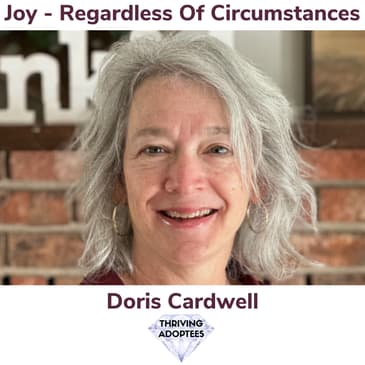
How would your life be if you find joy whatever your circumstances? Joy, and even contentment, were completely alien to Doris growing up. She's one of those adoptees who got very, very unlucky with her adoptive parents. Now 58, Doris shares profound insights on joy no matter what - following terrible parenting, cancer and more. An incredibly empowering episode. I shouldn't have favourite interviews, but this is one because of the transformation it encapsulates.
Here's a bit about her...
Doris Cardwell leads with a heart for foster families and the children they serve. Adopted herself, she believes every child deserves stability and every foster family deserves support. She works to ensure that SDKB’s resources reach the families who need them most, while building trust with partners across the state who share this mission. When she’s not working with her team or visiting churches throughout South Dakota, you might find Doris writing or speaking about the things she’s learned along the way.
Find out more here:
https://americaskidsbelong.org/states/SD/
https://www.facebook.com/sdkidsbelong/
https://www.instagram.com/southdakotakidsbelong/
https://www.linkedin.com/in/doriscardwell/
https://www.instagram.com/justdoriswrites
https://www.facebook.com/whojustdoris/
Guests and the host are not (unless mentioned) licensed pscyho-therapists and speak from their own opinion only. Seek qualified advice if you need help.
Want to learn more about thriving for you, your kids, your families or your colleagues? Pick a time to talk here
[00:00:02] Hello everybody, welcome to another episode of Thriving Adoptees podcast. Today I'm delighted to be joined by Doris. Doris Cardwell, looking forward to our conversation today. Really looking forward to it my friend. Thanks for having me. So Doris is an adoptee or adopted person. Do you have a preference? I don't have a preference.
[00:00:23] Okay. And she's also the Executive Director of South Dakota Kids Belong, which is where I found her name. And the richness of the experience of adoptees who also work in the space just adds a gazillion percent of richness to our conversation.
[00:00:49] So it's something that I really savor. I really love into. And we're similar age, right? I think Doris is just a couple of years younger than me. I'm 57. Yeah. Okay. So I'm 59. It is quite uncanny how many people that I speak to are pretty much my age, especially if it's adoptees.
[00:01:18] So that being said, what does thriving mean to you, Doris? For me, thriving means being okay in my own skin. Being okay with who I am, the experiences that I've had, and not allowing circumstances to define whether or not I feel joy or happiness.
[00:01:45] Wow. So there's quite a lot there. I've got the kind of like the two headings in my world popped up for me, the kind of the identity and self and self-esteem.
[00:02:07] And then there's also the circumstances part as well. And I feel that we do quite a lot on identity. So I'm going to dive into the circumstances part and then we'll explore that. And if, if we have time, then we'll kind of come back to the identity part. As long as that's okay with, with you, Doris. Yes.
[00:02:35] Yeah. So can you say that again? You said not allowing circumstances. That's what I wrote down, but I didn't write down the end of the end of the sentence. Not allowing circumstances to determine whether or not I feel joy or happiness. Right. That's big, right? It is big. Yeah. And it took a long time to get there and it takes a lot of effort to stay there. Yeah.
[00:03:04] Do you remember when you first, did you hear that from somebody else first? Did it come to you as an intuition? When, when do you, do you remember seeing, getting a sniff of that the first time? I think, um, it was a time period in my life where I was in my early twenties and I was, um, going to church.
[00:03:29] So I heard things like, um, I've learned to be content, no matter whether I have a lot or a little. Um, I heard a lot about, uh, contentment and joy and I really didn't know what that was. Honestly, I was tormented inside. Um, so contentment was a foreign word to me.
[00:03:58] And I think that I was hungry for reaching a place that I could understand what that meant. Yeah. So somebody suggested it as a possibility, a possibility and something within you thought this possibility might be a reality, but where, where do I find it? How do I get it? Where is it? That sort of thing. Yeah. Yes.
[00:04:28] Yeah. And I was pretty desperate. And so in hindsight, when I think back to that period in my life, I probably looked a little crazy to the people around me. Um, but you know, I had wanted for so long to have something different than what I had and not so much with external circumstances. It was external circumstances, but also internal circumstances.
[00:04:56] You know, I had so much going on inside my head. Um, so much trauma floating around. I, most days didn't know whether I was coming or going, but that was normal to me. Yeah. Yeah. You said, you said hunger. Um, you said hungry.
[00:05:16] What, one of the things that I heard from a fellow adoptee a couple of years ago was a, an idea of, of mother hunger. Uh, and I just thought that, that says so much that says it all in, in two, in two words. What was, was part of your, was that part of your experience, mother hunger or, or was it, was it hunger for happiness or what was it about?
[00:05:46] For me, I, I like to think that we all need to be tethered to something. We, we all need something that holds us, um, that helps us know who we are. And I think as an adoptee, I was adopted into a family who spoke a lot, um, early on about me being chosen. But then when I was very young in elementary school, it became, um, not a positive thing.
[00:06:15] Um, and so I knew that I didn't fit where I was, but I didn't know where I did fit. I didn't know where I did belong. Yeah. So that chosen, how, how did that chosen transition from, that's a big word. How did that, how did chosen become a bad thing rather than a good thing? Cause chosen initially we think of as a good thing, right?
[00:06:43] So how, how did, how did that change? There was a lot of trauma that happened in my family. My mother experienced a lot of death. Um, and she had a traumatic childhood too. Only I didn't know that then. So she was ill equipped to navigate the things that were happening in her life. Um, so she wasn't, uh, able to nurture.
[00:07:13] Um, she wasn't able to communicate well. And then there was a lot of abuse that started happening. Um, and so chosen for me became, why would I be chosen for this? Uh, okay. So not chosen for the family, chosen for the situation. Yep.
[00:07:39] And you know, it was, um, things that I constantly heard were you'll never amount to anything. Um, your, your mother didn't want you. Uh, you should be glad that you're in this family, you know, but when you're being abused and you're a child, it's like hard to process all of that. Like there's no way to process it. There's no container to put that in. Right? So for me, it was a lot of crazy making for lack of a better word.
[00:08:09] Um, and a lot of gaslighting. And so I just really grew up in, in a circumstance, not very different from what a lot of people grow up in, whether they're adopted or not. You know, you're a child, you're trying to figure things out. You believe the people around you love you and want what's best for you. But that's not the reality for a lot of people. And it wasn't the reality for me.
[00:08:40] So contentment did contentments. Uh, you said it was a, it was a foreign concept. I think that's what you said. So did, did you see, did you see, uh, contentment, uh, as, as a kind of a, a, a staging post on the way to joy? Cause you use contentment and joy in the, the two quite different things.
[00:09:03] I think as I got older, got married, had a child, got divorced, got remarried, had two more children. I think that for me, there was a turning point where I realized that I wanted something different for my children.
[00:09:26] And that in order for me to understand contentment, I needed to unpack all the things that I had been carrying for so long. And as I started unpacking them, you wonder what's on the other side of all of this unpacking, you know, and really what does happiness look like? And what does joy look like?
[00:09:53] Because I think when you grow up in a, in my experience growing up in the kind of environment that I grew up in, I really was clueless. I, I didn't have a clue what any of that meant because I had not seen joy or contentment, but I wanted that for my children. I wanted them to experience that. Yeah. Yeah. Powerful. So powerful.
[00:10:23] It's, it was hard. That was a really hard period in my life. Um, but the reality is you hear all these sayings like, you know, play the cards that you're dealt with deal, deal, you know, the hand that you're dealt, you know, all those things. And I just grew up hearing this crazy statement that was made all the time in my house and it was life's a bitch and then you die.
[00:10:54] And when you, when I had children, I just kept thinking that can't be right. You know, that, that can't be the truth. Um, but I think my hunger came from looking in the faces of my children and realizing that somewhere there was a woman who gave birth to me and she placed me for adoption for whatever reason.
[00:11:24] And I wanted desperately to know what I looked like, who I looked like, um, where I came from. I think at some point as a child, you have a fantasy that if you find your birth family, it's going to make everything right in the world. And that's not reality for a lot of people either.
[00:11:49] So the journey that I've been on, that I was on was literally, I had to reach the point that it didn't matter to me who my family was, who my birth family was. I had to reach the point that I had to be okay, content without that knowledge.
[00:12:09] Then eventually I did get that knowledge, but I had to learn to be content, understanding that my adoptive family, my biological family, they do not get to define who I am. I get to define who I am. What, what did the, uh, unpacking process look like Doris?
[00:12:41] Wow. That's a big question. Um, we only ask good questions on this show. It was a lot of time to be still. Um, I was diagnosed with inflammatory breast cancer when I was 38 and I thought that I was maybe not going to get to finish raising. Our children and, and live a long life.
[00:13:10] So when I finished treatment for that, um, I spent a lot of time sitting on my porch with a notebook in my hand, just starting to think. And as I started to think, it was probably the first time in my life I ever allowed myself permission to just sit and think.
[00:13:34] As I started journaling and writing things down, it just started unfolding. And, um, my medical doctor told me that I needed a reset. And she said that my yin and yang were off balance and I needed to find a way to reset that. And I said, well, how do you do that? And she said, well, I think a good counselor would be a place to start.
[00:13:59] So it took me a couple of times to find a good counselor that I felt like I could work with. And honestly, it was the look on his face when I would talk to him that really started it all. Because as I would say things, the look on his face was a look of like compassion and hurt.
[00:14:30] And he would just look at me and I would say, why are you looking at me like that? And he would say, that's a lot. And I, I never saw it as a lot. It was just my normal. So in that unpacking process, I had to come to terms with the fact that the things that had happened to me were not normal.
[00:14:57] And it was a years long process and still even today, sometimes something will come up and I'll sit with it. But you know, a lot of times we're not taught how to sit with things. And I think that's really one of the most powerful tools that I've learned is that when something comes up, you sit with it and you start to process it.
[00:15:26] And it doesn't make it go away. It just helps you put it in perspective. Yeah. But you didn't have, you didn't have parents that were doing that. They weren't modeling that for you. No, not at all. I'm guessing they were pretty angry people. They were angry. I was angry. Everybody was angry. Yeah.
[00:15:54] But you know, in hindsight, they did the best they could, you know, to a, to a certain point. I'm not giving them a free pass. They were wrong. But as an adult, I can look back and know that they didn't have tools. Yeah. And what do you, if you were to sum up that up, I mean, would it be forgiveness?
[00:16:22] Would it be empathy? How would you sum up your feeling towards them and their abilities? Well, first of all, I had a mixed idea of what forgiveness was because I had always been taught that forgiveness was just as if it never happened. But that's not forgiveness.
[00:16:49] Forgiveness is, forgiveness was for me. And forgiveness doesn't excuse anything. And for, for me, it was stages and layers. It wasn't like a, you know, people say, well, I choose to forgive them. So I've forgiven them. It wasn't like that for me. It was pieces and layers and a little here, a little there.
[00:17:18] We never had any type of restoration. I had a little bit with my mom, one conversation, none with my dad. And so I really had to learn that forgiveness is for us and not contingent or dependent on the other person or the other party.
[00:17:43] And I think that's one of the hardest things is to learn to hold your truth, regardless of what people say or do around you. Their belief, their reaction, their response, it does not change your truth. So forgiveness helps us rather than forgiveness helps them. A hundred percent. It's not about them at all.
[00:18:15] And what, so what did, what did forgiving them give you?
[00:18:20] It gave me the ability to sit with and hold the fact that their inability to acknowledge what happened didn't change what I needed to do.
[00:18:49] And what I needed to do was be able to move forward in a way that was healing to me. So by releasing the anger that I had towards them, it allowed me to move forward. And it allowed me to unpack and acknowledge and sit with. Okay, this is what I grew up in. This is my origin story.
[00:19:19] But this isn't the deciding factor of how I live the rest of my life. This is not my legacy. It was how I originated, but it is not my legacy. Yeah. When I was looking back at the notes from our conversation a few weeks back, Doris, a couple of things jumped out on one of them kind of relates to that. So what you said was we didn't have, we don't have to end up where we started.
[00:19:49] Absolutely. Absolutely. We don't, we don't get to choose how we start, but we certainly get to choose how we finish. And for me, processing the trauma allowed me to move forward in a way that was healthy and productive for myself, for my inner child.
[00:20:15] So you talked about not allowing circumstances to determine how we feel contentment and joy.
[00:20:45] What about that, that step from contentment to joy? Was, was that a step? Was that a journey? Was that, you know, what was the, what was that? What was that kind of transition like for you? Did you discover contentment and then joy or am I making it far too rational? Sorry. Am I making it far too left brainy and rational like I sometimes do?
[00:21:12] I think it is a combination and it's a, it's an always process. It's something that you have to be intentional about every day. And I think that contentment and joy are not two separate steps. I think they're the same step, but that's just my, my, my experience with it because you choose joy and you choose to be content.
[00:21:44] And I think that's a choice. It's a choice that you make, but until you process some of your trauma, you can't make that choice. If that makes sense. Um, yeah. And I would say you can't even see that choice to make it. A hundred percent agree with that. So do you remember seeing it as an option for the first time?
[00:22:17] I can't say that I remember seeing it as a, the, the first time. Um, for me, it feels more like it's been a process instead of a one time thing. Um, and there are, there are places where your soul feels free. If that makes sense.
[00:22:37] For, for example, when I sit by the ocean, um, or I'm out in the big horns in Wyoming and you can see for miles and it's just beautiful. It makes me think about how small I am in comparison to all of creation. And it helps, it helps me breathe in a way that is hard to explain.
[00:23:04] But I think the first time that I experienced one of those moments where you're just like realizing that, yes, we all go through things. Nobody gets a free pass. I don't know anybody that hasn't walked through something hard in their life.
[00:23:19] But taking the time to unpack it and file it away in a way that doesn't define you negatively, but it begins to define you positively. That to me is a turning point. Yeah. So it feels like the good place to try to, to, um, to move to the kind of the identity piece.
[00:23:48] So you talked about defining you, defining you positively rather than negatively. What, what do you mean by that? What, what does that feel like? What does that look like for you, Doris?
[00:24:07] For me, it looks like not being ashamed of my past and not wanting to change it, but being able to acknowledge that the things that I want to change. I want to walk through made me who I am. Who I am as a good person. Who, I'm, I care. I care about people. I care about, um, circumstances and situations.
[00:24:35] Uh, I say to people all the time, you know, you all, everybody has a sphere of influence, and I can only be responsible for my sphere, my circle, my little part of the world, right? So if I'm doing what I can to make my little part of the world a better place, then to me that is a positive outcome from a very negative beginning.
[00:25:03] So bad events helped you become a good person? Bad events made me realize that I get to decide the person that I'm going to be. That those circumstances don't define who I become.
[00:25:26] So when you're talking about not allowing circumstances to define your contentment or joy, you're talking about the past circumstances. Are you talking about the present circumstances as well? Both. Both, yeah.
[00:25:54] Can you share a little, can you break that down a little bit? Sure. I'm trying to think of the best way to communicate what I'm feeling. Life is never going to be perfect. And there are always going to be things around us that are challenging or difficult.
[00:26:22] But instead of looking at those things and thinking, why am I going through this? If we think, what can I learn from this? Or how can I use this to grow? It puts you in a different headspace. It puts you in a headspace of, okay, this too shall pass. You know, this is just another thing.
[00:26:50] When I was diagnosed with inflammatory breast cancer, I kept telling myself, this is just a bump in the road. You know, all the way through treatment, losing my hair, all the things. I would just say, this is just a bump in the road. But then when I got to the end of treatment, it was like the bump threw me into a wall. And that wall is when I began unpacking my trauma. It was like my body finally said enough is enough. Right?
[00:27:21] So that's been a multi-year process. But the end result of that is that every day, no matter what happens around me, I can find one thing to be thankful for. I can find one thing to feel joy about. And it sounds corny, but it's like even if it's something as silly as standing in the store reading greeting cards that make me laugh.
[00:27:48] You know, that to me is way more productive than sitting here thinking, why does my life look this way? Why are my circumstances this way? Do you know what I'm saying? Does that make sense? Yeah. I mean, it's your focus. Yeah. It's your focus. Are you focused? Are you choosing to focus on the positive or are you choosing to focus on the negative? And until you see the choice, until you see the option, then you can't choose.
[00:28:19] And we're, I'm sorry listeners who have said this, if you heard me say this before, but it's the strongest, it's the biggest thing I've heard. We're in 30th of March, right? I'm doing this. So it's the biggest thing I've heard this year. It's from a foster mom that I interviewed about two months ago. She said, she often fosters older kids, teenage kids. And she says, I'm not going to deny your, I'm not going to deny your trauma.
[00:28:49] She's had a lot of trauma in the past. So she was almost killed by her first husband, right? She was 13 years of domestic violence. Oh goodness. So she says, I'm not going to deny your trauma, but you've, you've got a choice. Are you going to succumb to the trauma or are you going to rise above it?
[00:29:13] And I just thought that's incredibly ballsy of her to say that to a teenager, right? So the teenager, she's not saying that the first thing that she says to this teenager, you know, and when they come to live with her for a couple of months or whatever, a couple of weeks. She's, she's saying that after there's been some rapport building, some relationship building, some empathy.
[00:29:41] I'm not going to, but, but laying that choice out for that person, you can't, you can't choose until you can see a choice. And most of us don't, most of us don't see that choice. And I also thought about, well, what would happen if I went into an adoptee group and laid that choice out to people in that adoptee Facebook group?
[00:30:11] I would be home drawn and quartered. I would be home drawn and quartered if I laid that choice out. And yet, because we can't see the choice until we see it. That's one thing that I'm really grateful for.
[00:30:30] I'm grateful that at some point in my journey, I wish I could tell you how I understood it, but there, there was just a point where I understood that. And as a child, you only see what you, you only know what you see. And if you surround yourself with people who have like experiences, but have not moved through them, have not processed them, then you're not challenged to process them, right?
[00:31:00] You don't know that you can process it. But I think for me, I reached a point where it was like, this is either going to continue to hurt me, or I'm going to face it, navigate through it, and come out on the other side. And I think we do ourselves a disservice. Being positive to me does not mean that you ignore the negative.
[00:31:29] Being positive to me is being proactive about the fact that I don't have to look very far around me to know that it could always be worse. All you have to do is flip on the news to know that it could always be worse, right? And so choosing to take what we have been dealt, good or bad, and, and, and live it in a positive way, it doesn't mean that you ignore the negative.
[00:31:56] And I think that so many times in, there are a lot of different traumas in my life. And in each one of those, I see people who never move through it. It becomes who they are. And I did not want cancer to become who I was. I did not want being an adoptee and growing up in trauma to, to determine who I became and how I lived my life.
[00:32:25] And, and I don't, all I know is that when I was growing up, I thought there has to be a better way. There has to be a different way. I didn't know what it was, but I knew what I didn't want to be. But then when I became a young adult, I made all the choices to make me everything I didn't want to be because it was all I knew.
[00:32:45] But somewhere in that, in that path, when I started having children and I was looking at their faces, it unlocked something that helped me start to realize I don't have to be defined by how I started.
[00:33:08] I don't have to live the rest of my life with it being determined for what I didn't have in the beginning or what did happen to me. And I, I think that it's a, it's hard because when people are hurting, you, you can't move somebody past where they're willing to go.
[00:33:34] And I had to be willing to look at the very painful things and acknowledge them for what they are. And also acknowledge that I'm more than that. Yeah. And for me, that, that part came from my faith. It came from being able to understand that a lot of the things that I had been told were not true.
[00:34:04] You know, God didn't, um, allow me or want me to go through bad things. I went through bad things because people made poor choices.
[00:34:19] And, and a, and a key component in my healing process was one day I told somebody that I felt like I had this big sign over my head that said, you know, if you're mean, if you're freaky, come my way. You know? And the person said, well, let's, let's just pray about that.
[00:34:39] And they asked me to, they asked me to, they, they prayed and said, you know, God, show her where you were when all of this started. And in that moment, I had this sense of the, the first time that I was molested. It wasn't a memory I'd never had before.
[00:35:02] I had had that memory my whole life, but I had this sense of the fact that God was grieved when that happened to me. And that changed everything for me because then God became not this cruel father who allowed me to go through hard things because he wanted to use them down the road.
[00:35:27] It became this moment of these people made choices and their choices don't get to dictate how I live the rest of my life. And, and I just told you something that took 20 years to unpack in two sentences. One of the things that I was talking to a fellow adoptee this morning and a Dutch, Dutch guy called David Enko has been on the show.
[00:36:00] And we got a little bit close to this subject, but something that you said has kind of brought it up for me. It's this, it's this gratitude thing.
[00:36:12] And, and, and, you know, you were, you were told that you should be grateful and you felt anything, but like anything, but that and how dangerous, how, how dangerous that is for, for adopted parents, any, any parent to, to, to, to say, right.
[00:36:44] And the, the, the, the, the, the, the, the, the, the, the, the, the, the thing that comes off the back of that is, is that I feel that in some respects that makes us less open to gratitude in any areas of our lives. We've, we've, we've, we've, it makes us almost like allergic to gratitude until it doesn't.
[00:37:18] What do you think that that moment of until it doesn't, what do you think causes that transition? Well, in, in, in, in one word, it's an insight. In a religious word, it's a, it's an epiphany.
[00:37:43] And you don't have to be religious to know the difference between an insight and an epiphany. It's the, it's, it's the moment when the, the perspective will never be the same again. It's a, it's a shift in our, it's a shift in our perspective. That, that statement that I hear a lot and I say it a lot too, once you see it, you can't unsee it.
[00:38:11] There, there are a lot of points in my journey where I saw things that I couldn't unsee. And I am very well aware that I have been fortunate in my journey to have picked up tools along the way to learn how to walk that out.
[00:38:36] And what I had to see was that the, the way that I was conceived, the, the family that I grew up in, um, none of that gets to choose for me. I get to choose. I'm, I'm not a victim.
[00:39:01] And I, I think that we live in a world now where I'm thankful that there's so much training on trauma and so much more acknowledgement of how trauma affects our brain and what trauma does. That, that research has been and continues to be so valuable for me because sometimes something will happen and I'll do a little bit of digging and realize, oh wait, that's where that came from.
[00:39:30] You know, and then I get to choose. Okay. Now that I see that, I get to decide what I'm going to do with it moving forward. And there's a danger, I think, in being defined by our circumstances, being defined by the choices that other people made. And, and maybe I've just always been stubborn, but, but I just thought for years, like, this is not who I want to be.
[00:40:00] But I didn't know for the longest time how to make better choices. And that process for me has, it's, it's still a process. You know, I'm still learning how I'm affected by certain things. But if we don't educate ourselves on this is what's common for adoptees, this is what is common for trauma survivors.
[00:40:26] If we don't educate ourselves, we just think this is something's wrong with me. I spent years of my life. I mean, years and years and years with the belief that something was wrong with me. You know, how could my mother keep a half sister and place me for adoption? How could I grow up in this family that was so crazy making and inappropriate in so many ways?
[00:40:54] How could I marry someone who had the same characteristics that I was trying to escape from? And people would say things like, well, the common denominator is you. And that all internalized to something was really wrong with me. But as I started reading about inner child work, you know, the first time a counselor told me about an inner child, I was like, that's the dumbest thing I've ever heard. Like, that's insane.
[00:41:24] But then the more that I started processing, I was like, oh my God, that's not insane. You know, it's like you have to expose yourself to knowledge to be able to start the unraveling. And in the unraveling, I think, is where the beauty lies. Yeah. And you have to stay with it, even when you don't think that... I mean, what... You said that...
[00:41:54] Did you use the word the daft? Balmiest? What did you say? You said the inner child thing and it was the daftest... Oh, I thought it was insane. I thought it was the dumbest thing I had ever heard. Yeah, the dumbest thing. Right? So somebody's telling us that somebody's saying something and we think it's dumb, but we've got to keep listening because if we don't listen, then, you know, like...
[00:42:16] If we only listen to the people that validate us, then we'll stay stuck. And this is the concern, you know, like a therapist and a coach is trying to invalidate us. That's what they do. But they're coming from love to invalidate us. They're not coming from pain. Most of them.
[00:42:46] I mean, you've got to be. Like, as you said, it took you a while to find... It took you a few girls to find it. But that's the essence. It is an invalidation process. So... Well, we build these walls around who we think we are because of what happened to us, right? We build these walls around it. And when somebody throws a dart at that wall, you know, you want it to bounce off.
[00:43:14] Because if it makes a crack in the wall, then you become responsible for the amount of knowledge that you have. And I think for me, that's where I had to realize, okay, I am responsible for what I do moving forward. And so these people that are putting knowledge in front of me... Like when my counselor said, you need to journal, I was like...
[00:43:43] I picked up a journal and wrote... He told me to get a journal and get the Healing Your Inner Child book. And I sat in the chair in my bedroom and I wrote, I hate journaling. This is dumb. I don't want to journal. And I just filled up pages of that. But somewhere there was a page where it clicked. And so I think that the walls that we build have to come down. But nobody tells us that. I didn't know I had walls.
[00:44:13] But this counselor, when he would... He looked at me one time. I told him about something that was a current situation. And he looked at me and he said, number one, stop trying to rationalize crazy. You can't rationalize things that are crazy. Number two, your father's deepest desire is to cause you pain. Even in his latter years, he wants to cause you pain. Well, that was a turning point for me.
[00:44:40] Because all my life I had been told, he didn't have to adopt you, but he did. You should be grateful. He's the only father you ever had. You can't be a good Christian if you're not at peace with your father. You know, I had been told all those things. So to have somebody with a bunch of letters behind their name say that to me, I actually took out my cell phone and said, can you repeat that so I can record it? Because I think I'm going to need to hear it over and over again.
[00:45:08] You know, that was a turning point. Because I had always thought that I was the problem. And I wanted my father to love me. He was the only father I had known. I wanted there to be some kind of restoration. But I had to learn to be okay with the fact that he wasn't a person that I even could consider any kind of restoration or reconciliation with. Because he was not a safe person.
[00:45:46] As you were talking about the walls that we build around ourselves and as only letting in what we think is the truth. I had a strange thing that happened to me a couple of years ago popped into my head. So I put a thing on Facebook.
[00:46:15] Has anybody ever told you that the voice in your head is a liar? Question one. And somebody put underneath it, has anybody ever told you to F off? And I just thought, doesn't that sum it up, right? The fight back.
[00:46:44] The ego's fight back. The strength of the walls. Has anybody ever told you that your voice in your head is a liar? How could you fight back against that? Like, isn't that just nuts? But it was his, it was his truth. My nuts is his truth. It's his truth.
[00:47:13] And he believes his truth long, you know, enough to, to, to, I'm trying to point to truth. And he's coming straight, straight back at me. But that's a great example of how I feel about contentment and joy regardless.
[00:47:40] Like, you could have taken that comment that was made to you. And you could have made, you, you could have been like, I shouldn't have posted that. I'm doing wrong. I offended him. I have to take this down. But you didn't. You were just pointing out something that you felt like you needed to express.
[00:48:01] And, and to me, you know, when I, when I shared my truth or when I talk to people about trauma or belonging or what they're tethered to, you know, I'm coming from my own experience. And I have to let people be where they are. But if they never bump up against the things that I'm saying, they'll never be challenged to think differently.
[00:48:30] And I, I am not about whitewashing things. I am not about sweeping things under the rug. But I 100% believe that the, the agency that we have to determine our outcomes is something that we have to take back. We can't be a victim for the rest of our life. We can't. It, it doesn't go in a good place.
[00:48:55] It was not going in a good place for me to just continue to live in the, the trauma inside my head. And I believed so many lies. This, this one thing keeps coming in my, in my head. So I'm going to share it with you. When I, when I was growing up, I was always told I was ugly. That I was fat and ugly and I would never amount to anything.
[00:49:21] And so as an adult, when I got breast cancer and I lost my hair, we, we had been away from our home for five years when I got sick. And then we went back to our home. So people were seeing our children that they had not seen in five years. I was folding laundry one day after I had had chemotherapy that day. I was folding laundry and this thought came into my head.
[00:49:49] And it was that everybody was saying that my oldest daughter looked just like me. And with that, they would say how pretty she was. And as I was folding towels that day, it hit me that if people said that she was pretty ugly and she looked like me, then I couldn't really be ugly.
[00:50:15] Like I had been told all my life for so long. And that day I shared that with a friend of mine. And I said, you know, I had this thought today and I just spoke it to her. And she had tears streaming down her face and she just helped me. And she said, you're not ugly. They lied. Those people lied to you. I was 38 when that happened.
[00:50:46] So I tell people that I lost my hair to find my face because I always hid behind my hair. I kept it pulled down over my face. I wore it long. I always hid behind it. But for whatever reason, you know, that moment helped me start to realize that people
[00:51:14] had lied to me and they were still lying. And it was not about being pretty. I mean, that was the thing that unlocked that day. But what really unlocked was so much deeper. And it was the thought that people have been lying to me. People that I trusted lied to me. And I don't have to believe those lies.
[00:51:40] And I think as an adoptee, there are so many things that land differently than with a person who was raised in their biological family. But those, you know, comments that I heard growing up, they really landed and they lodged deep in my being. And so it has taken years to unpack that.
[00:52:06] And I think we live in a world where we want to take a pill and everything will be better. Or we want a quick fix. Like we want to go on a weekend retreat and we want to come back and we're all fixed, right? That's what we want. But it's so much more layered and complex than that. And I just feel like we do ourselves a disservice when we don't learn to sit with those things. I could have easily dismissed that as a lie that day. I could have said, that's just crazy. It popped in my head.
[00:52:34] But because I spoke it to a caring person who was honest, it helped set me free. Fantastic, Doris. Thank you and thank you listeners. We'll speak to you again very soon. Bye.