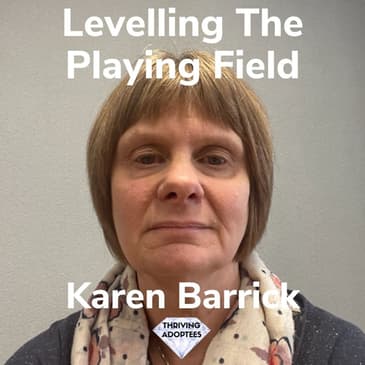
Adoptees often start life at a disadvantage. How do we level the playing field so they can enjoy the same opportunities as others? Listen in as Karen shares her learnings and insights. Karen is an adoptive mother and the Head of Service for One Adoption South Yorkshire.
https://www.oneadoption.co.uk/south-yorkshire
https://www.facebook.com/oneadoption/
Guests and the host are not (unless mentioned) licensed pscyho-therapists and speak from their own opinion only. Seek qualified advice if you need help.
Want to learn more about thriving for you, your kids, your families or your colleagues? Pick a time to talk here
[00:00:02] Hello everybody, welcome to another episode of The Thriving Adoptees podcast. I'm delighted to be joined by Karen, Karen Barrick. Looking forward to our conversation today, Karen. Yeah, me too. Yeah, be good. I was saying before we hit record, so many of the recent interviews have been across the pond in the States, in different parts of the States.
[00:00:23] So it's great to be speaking to somebody close at home, because Karen runs One Adoption South Yorkshire, which is just about 30 miles, 35 miles away, south of me. We're up in North Yorkshire, Karen's in South Yorkshire. So as well as being an adoption professional, Karen is a mum too. Your son is 18 if I remember. Yeah, that's correct. Yes, he is.
[00:00:52] And he's away at university doing mechanical engineering, is that right? Yeah, a mechanical engineering degree down in London. So yeah, a bit of a distance between us at the moment. Yeah, yeah. So that's about, for those people looking what that distance is, it's about 100, probably 170 miles or something like that. Yeah, yeah. To the smoke, to London. Yes, somewhere, yeah. Yeah.
[00:01:17] So what comes to mind, Karen, when you hear this word thriving? What does thriving mean to you? I suppose it means more than just being and existing, doesn't it? It means getting the most out of life, doing as well as you can, becoming a productive adult, I suppose, those kinds of things really. So yeah, I suppose enjoying life to its full, not just existing.
[00:01:46] So something more than that. Yeah. And if I add the word adoptees, right? So I go to the phrase thriving adoptees for the name of the podcast. What does that lens change for you in terms of a, or not, right? In terms of a way that you see thriving adoptees?
[00:02:12] Well, I suppose I've always thought that, you know, children in care, adopted, subject to all kinds of, you know, proceedings should have exactly the same opportunities as everybody else, if I'm honest with you. So I think in some sense, it doesn't, it shouldn't change just because somebody is adopted, we should have the best of expectations for our children, shouldn't we? And that's, and I think that would be where I'm at with that.
[00:02:38] I suppose that said, we accept that many adopted people have had challenges prior to being adopted. And, you know, I've had many losses quite often at the point that that happens for them. And of a history that will impact on their growing up and how they see life and how they process average things in life. So that impacts.
[00:03:05] But I still think our ambition should be that our adopted people should have all the same opportunities and experiences as anybody else, as far as that's possible. Yeah. Yeah. And I guess expectations change from, from, from child to child. I'm just thinking about, you know, somebody that's more a friend of mine, right? So he's, he's a, he's a mechanic. He's great.
[00:03:34] He's great with, he's great with his hands. I wasn't great with my hands, but I was different academically. So, you know, for him to go down the same route as, as me wouldn't have been in keeping with his, his skills.
[00:03:54] Um, so it's got nothing to do with the fact that he was raised by the people that, um, the, the, the parents that gave birth, you know, the mother gave birth to him and his, and his dad. It, it, it's, it's different, different, um, different strokes for different folks to sound a bit American when two British people are talking, right? Yeah, no, absolutely. And that, but I think that's true of all children, isn't it? Yes, of course.
[00:04:21] In that, you know, you can give birth to a child and actually they're not interested in anything you're interested in them. They're their own person, aren't they? And I, I suppose with my son as well, um, you know, he's not biologically my son and we have some shared interests. You know, we love the outdoors and going camping and stuff like that. And, um, you know, he's quite musical and so am I, but then, you know, the areas in which he's chosen for his career and that he does well in physics, maths.
[00:04:52] I managed to fail my GCSE physics twice, quite frankly, you know, we're not good at the same thing. So, and I think he's, you know, he's taking time to find the thing that is right for him. So, you know, he has some dyslexia as well. So forget English and languages. That was never going to be his thing. You know, people have to find what they're good at. And I think has he's, as he's grown and found that in life. So his confidence has grown, um, you know, and he, and he's been able to put his energies into things that he knows that he's good at. He's always been very creative.
[00:05:21] He's always been very good at fixing things. Our house is full of stuff that he's fixed, which is great, isn't it? Yeah. Really, really great practical skills to have. So yeah, absolutely. It's very individual, isn't it? About, about each person. Yeah. So what, what you're talking about, I think then is playing to our strengths. Absolutely. Yeah, absolutely. I think that's so important for all of us, isn't it? Actually, um, that, you know, we find the thing that, that makes somebody happy or they're good at, or they just enjoy.
[00:05:50] Um, and then we give them the opportunities to, to, um, engage in those as much as possible. Yeah. And that helps with all sorts of things, doesn't it? Your emotional wellbeing, your, your, your view of yourself, your self esteem. Um, yeah. Yeah. Yeah. So we sometimes dive into this link in, uh, in the, in the podcast. We look, well, we want the, uh, adoptees, the, the adopted kids and teens, adopted adults.
[00:06:19] We want them to thrive. So for, for them to be thriving, we, we need to be, we as adoptive parents, I'm just lumping myself in for, um, the, the sake of the conversation. Uh, we need to be thriving. Uh, we need to be thriving and the, the, the professionals that support them, support those adopted parents. They need to, they need to be thriving, thriving too.
[00:06:44] So how, how do you see that, that, that link, um, from a, both a personal and a professional or, or whichever, whichever way you want, whichever route that you want to go down. Karen. Yeah. Yeah. So, um, I guess, um, in terms of professionally, that support system professionally around adopted young people and families needs to be well informed, doesn't it?
[00:07:12] So I think, you know, it's really important that our staff understand trauma. They understand the impact of, um, early childhood experiences and even, um, pre-birth experiences on, on our children and young people. Um, we have, um, a psychologist as part of our service at One Adoption South Yorkshire and all our staff are trained in a variety of therapeutic interventions because we believe that that's important.
[00:07:42] And then we provide the support system for that staff group as well. So not only do we train them in those things, but we provide them opportunities to reflect and think about how they, um, approach, um, families and how they use those skills with those families. So I guess we're helping our staff group to be well supported so that they're thriving professionally, they're growing professionally, they're understanding professionally what's going
[00:08:06] on for families and they're therefore, you know, able to support and help, um, where they need to, aren't they? I suppose for adoptive parents, again, that information is really important, isn't it? I know historically we've probably not been great at giving adopters all the skills and the information that they've needed. Um, I think we're better at that now.
[00:08:30] Um, and I think some adopters potentially are better at understanding some of that need to parent adopted children in a slightly different way or with some additional skills, um, than others. Um, but I, I think as adopted parents, you know, thriving is as a parent and meeting our children's
[00:08:53] needs is about having those skills, that knowledge, somewhere to go for support, somewhere, somebody to talk to. I think that's really, really important. I mean, I was a single adopted parent. That's really important, isn't it? When you, you, you've not got somebody else to bounce off all the time, um, maintaining your own kind of, um, hobbies, I suppose, and interests so that you're, you've got inputs as well as outputs.
[00:09:21] Um, and yeah, I suppose, do you know, I think the biggest, most important thing I would say that has helped us to thrive as a little family has probably been just that bond that we had right from the off. And, and it's, it's, it's one of those things sometimes, isn't it? It's a combination of chemistry, personalities, um, interests, all kinds of things, isn't it really?
[00:09:46] But, um, I just think building that relationship with, between, uh, parent and child really early on is so crucial. And when, when, when a little person comes into your life, you might be three or four, you know, it's not, not having a tiny baby that you're meeting their basic needs and you learn as you go along what they're like. You've got a little person that comes into your life suddenly, haven't you? And, and there are lots of things that we can do to build relationships and trust and attachment.
[00:10:12] Um, I think really help little families to, to thrive, um, in that sense. What, what if you think, thinking back, um, to the early years with your, with your, your, your son clearly, you know, he's 18 now. So, um, what, what were the, what were the key kind of lessons that you learn in terms of that, in terms of that bond?
[00:10:38] Because it can seem, I guess it can seem quite logical. And also to me, it's, there's a certain magic to it that you can't put into words as well. Um, you know, like I, I think of why do I love my wife? Mm. I can't, I can't really put my finger on it. I remember asking myself that question early into our relationship, you know?
[00:11:04] Uh, and the only thing I could think of logically was a fact that she's, she's reliable. She does what she says she's going to do. She, I can, I can trust her. Mm. And, and I, and I, I trusted her cause I worked with her. So, uh, we worked together before we got together. So I had that, that, that trust, which key, you know, is a key part of a bond. Right.
[00:11:33] But that, that's me and my missus. What about you and your son? What, what did you? So I suppose that journey for an adopter, um, you know, you start to get to know about your, well, the little one that might become your child through bits of paper, don't you? You know, you're reading reports and that kind of thing. For me that, you know, I read those bits of paper and thought, well, there's nothing, you know, you know, I I'd like to know more about this little boy. It wasn't an instant sort of, he's the one for me.
[00:12:00] Um, and, and then there was a process really of the social worker coming round and you get to know a little bit more and then you go and visit the foster carer and you go and get to know a little bit more. Don't you? And I put the work, the key moments for me, I suppose. One was, you know, his little jacket on the seat of the car at the foster carers home that brought him to that made him real. You know, I went to his nursery at that time. So he was, he was nearly four, but, um, you know, and, and the people at the nursery
[00:12:26] clearly loved him to bits, you know, and wanted to come and find out who I was. I thought I felt quite vetted by them, but in a strange sense, what it said to me was they loved him and they cared for him, you know, and it was something about that little boy that they really, um, there was really endearing to them as professionals. Um, and I, you know, I think gradually through that process, um, I made an emotional connection with him. Um, and then you go, you know, you have to go to panel and all these other things that happen and then you have to wait.
[00:12:55] And, and then you finally meet the little person, you know, and, and I, I think for me, he was very much what I expected. So that was good. That meant the professionals had probably done their job well. Um, and yeah, we, we just made it, I suppose an immediate connection really in that sense. Um, I think there was then a process, um, once he came sort of to live with me, of us getting to know each other.
[00:13:21] He was a little person of four, you know, um, and he didn't know me and I know him very well, you know, after a couple of weeks, you're still very much strangers, aren't you? You're in some senses. And I remember thinking tangibly, I really liked this little boy, but, and I used to tell him I loved him, but I used to think, I'm not sure I feel that quite yet. And that was a process really. It wasn't until one night he was, he was really ill one night throwing up all over the bathroom floor where there was stuff everywhere. It was awful.
[00:13:49] Um, and he just sat on my knee and he just said, I love you, mommy. And I just said, I love you darling too. And that was it really, you know, and I suddenly thought, no, that's, this is it, isn't it? But you know, it was a process. Um, and I suppose that moment was for him. He was really vulnerable and not very well. He needed me, didn't he? And I was kind of feeling all protective, I suppose, and brought the whole thing together. And so that, yeah, that, that was interesting for me as a professional, because you, you
[00:14:18] don't all, you don't always get all the nuances of being have that personal, you know, adopt a child thing. Do you, I suppose in my head, I thought, you know, Oh, somebody waves a bit of magic dust and you immediately fall in love with this child you've heard about where actually the reality is that with many relationships, it's a process, isn't it? Over a period of time and for some of those relatively short time and others a little bit longer. And then that relationship begins to grow and you develop shared interests and you recognize
[00:14:49] that, you know, some of their character background is, is very individually there. As I think one of the things that struck me as well, we were doing a jigsaw one day and I do a jigsaw in a certain way. I like to put in the corners and then the edges and, you know, and he was sat there picking out the little characters in the jigsaw and building the little characters. And I was really tempted to say, well, actually, let's do it like this. And I just thought, actually, his, his way is perfectly valid, isn't it?
[00:15:18] It doesn't need to do a jigsaw the way I do a jigsaw. He needs to do it his way. And I suppose you learn, don't you, that, you know, actually not correcting him at that point allows him to be him, doesn't it? Not, you know, not the person I need him to be or, but he can be whoever he needs to be, can't he? And come at things from a different perspective. He needs to do that. Yeah. So thinking back to that night with him on your knee and him sharing, telling you that he,
[00:15:46] he, he loved you. Maybe that was something about you being there for him when he was, he was struggling. And, and maybe his, maybe his, his guard down, but how do you, that's just my opinion from the outside, right? What, what, what did it feel like for you? What if you, or you were to, if you were to think back for that moment, knowing him better now, what, what do you think was going on for him in that?
[00:16:18] Yeah. I think when you're feeling pretty rough, when you're feeling really poorly, you know, you need somebody to be there for you, don't you? And I think, um, in that moment and probably in the weeks leading up to that moment, he'd begun, we'd begin, begun to form that trusting relationship. And, um, yeah, I, I think in that moment, I, and they often say, don't they, you know, if you take a child swimming or something like that, that helps to build that bridge because the child has to trust you in that moment.
[00:16:46] And it helps to build, you know, you, you as a parent have a natural sort of protective instinct, I guess, as well. And the little moment, um, you know, it creates improved attachment and bonding. So there was another occasion very soon after he'd come to, um, well, I think the same night that he had actually moved in, actually, he was really, really upset and crying for his foster carer, which, you know, was perfectly natural. He lived there for 18 months. That was his safe place.
[00:17:15] Um, and it's as an adoptive parent, you don't always quite know how you're going to respond or what you're going to do in situations. Um, but I had some training ringing in my ears, really, um, about me being the adult in that situation and needing to take control of it. So I just picked him up, sat him on my knee and I just said, it's really okay to be sad. You know, it's okay to be sad. I understand why you're sad.
[00:17:42] You know, you've left somewhere that you love and people that you love and we'll stay in touch with them. But, you know, doing that reassuring thing was, I think, really important in that moment. Can't say I processed it lots because it happens and you have to deal with it. But I think giving him permission to be sad when actually I just brought my son home, um, was really important as well. And all these things add to a picture, don't they?
[00:18:07] Whereby your child learns that actually they can feel all kinds of things about their past and it's okay. You can talk about it. You know, your parents not going to have a meltdown or somehow feel, um, that that's not a valid thing to feel. Yeah. So I think, yeah, I think there's a number of things that, that sort of led up to that moment, if I'm honest. But, um, yeah. Yeah.
[00:18:30] I think the, the validation and permission to feel less than, less than top 100% feeling, feeling bad and feeling sad. Uh, I think that's so key because, you know, I clearly your, your son's a generation or two generations behind me in terms of my age. You know, he's 40 years, he's 40 years younger than me.
[00:18:54] And, and what I hear a lot about, uh, adults that I interviewed that in my generation is that their parents, adopted parents invalidated their feelings. And, uh, tried to, try to correct them, you know, try, try to change their feelings.
[00:19:22] And that never goes well with anybody, you know, what, trying to change something, you know, or book your ideas up. All right. Yes. You know, like, it doesn't matter whether you've got anything to do with your biological child, it's your adopted child, whether it's your brother, your sister, your mum, or your dad. Um, telling somebody to book their ideas up, um, and, and, and get, get over it. It never works. Never in the, you know, never. Oh, okay. Yeah. Oh, I'll, I'll do that then. Yeah.
[00:19:51] Thank you for the, thank you for the suggestion on how to change my emotions. I'll go away and I'll do that. And I'm okay now. It just, it doesn't, it just doesn't work. Um, no, no, no, no. And I think, you know, feelings that expressed feeling in that moment was absolutely the right thing to express, wasn't it? You know, and if we move away from somebody that we care about, we're sad, aren't we? It's a natural, normal feeling.
[00:20:20] And I think sometimes it's, you know, doctors get stuck, you know, there's a, your responses. I've just brought my brand new child home and how exciting is this? But actually in that moment, your child is missing somebody as well as excited, you know, don't get me wrong. He was, he went to bed singing that night. And, but there was that mixture of emotion going on for him, which needed to be acknowledged and, and, um, and was right actually. And, you know, afterwards when I thought about it, I thought, I'm glad he did.
[00:20:47] I'm glad that's how he felt because it was a normal, natural thing to feel, wasn't it? It was, it was the right thing to feel and it wasn't right for me to suppress it. You know, and we didn't have that perfect nice tea at the table that night. I just hastened to watch that. I never told a social worker about we ended up with a bowl of ice cream sat on the sofa watching a nice film because that was the thing we needed to do that night. Yeah. Yeah. It's, it's fascinating. You took it because he got over that feeling.
[00:21:17] Yeah. Yeah. Well, not, not, not straight away, but you know, there was further satisfaction. And there were some sadnesses as those days went on. Um, and that, but those were appropriate as well. I suppose they became fewer over time and we continue to talk about them and we had things that had come from their house. So there were lots of reminders as well that were important, but, but yeah, he was able to deal with it, I suppose, wasn't he? Because he was allowed to feel it. Yeah. So I wasn't being clear.
[00:21:46] I mean, he got over it that night. Um, and yeah, I often, I often think about, uh, kids being, being able to get over their stuff faster than adults can. Yeah. Yeah. Yeah. Yeah. One minute they're in one place, aren't they? And then the next minute, you know, you're playing with cars, aren't they? And you think, Oh, what? Something major happened there, but it's got for them. It's gone. And they moved on. But yeah. Yeah. And you're left with that as adults to process that, you can't often. Yeah.
[00:22:16] Well, one of the things that fascinates me about kids and emotions and parenting, because my wife haven't got any kids, is vulnerability. And, and, uh, how vulnerable, how vulnerable we are as adults, as parents with kids about our feeling less than a hundred percent.
[00:22:45] Um, and so I'd love to, and the, the, the reason I do that is the reason I ask that question is because I've done, done some work in, in, in schools. And I, I shared just very briefly, I shared some tough stuff that I'd been through and some feelings off the back of that when I was a kid. And that, that really, I got the sense that the, the, the, these were 10, 10, 11 year old kids.
[00:23:14] I got the sense that adults don't usually do that. Um, or it wasn't normal, presumably not in a school setting. But what, what do you, you know, what's your approach on, on vulnerability with, uh, with your son? Um, so I, I think I would be measured about it.
[00:23:37] Um, in that, I suppose we have adult things going on in life that children don't need to be burdened about some, depending on that, which do we? Um, but, you know, equally there were days when I would come home. I'd had a busy, you know, pretty, pretty difficult day at work. And, and I would have told, I would have said, well, actually, I'm quite, to be fair, he's a lovely little lad anyway. So he quite often says, how's your day been, mum? Um, and some, most of the time I'd say it's fine.
[00:24:04] I'm busy, but I'm making, but occasionally I would say, actually, it's been a really difficult day. I have some really difficult, nasty meetings today. Um, because I actually think it's important for children to be able to, I suppose, process that, understand that not everybody they've come across in life is, you know, is absolutely fine.
[00:24:25] And, and that, you know, that there's a reciprocal thing going on there, isn't there, which is about, you know, me being interested in him, but he, him being interested in me as a person as well. That's a relationship, isn't it? It's not all one way traffic. So I suppose getting that balance between protecting him from things that would generate a lot of anxiety, um, to sharing things that maybe just let him know that, you know, we're not always, we're not always do things right.
[00:24:54] And don't get me wrong, I was far from a perfect parent, but, um, you know, and there were times when I, you know, I was cross with him or irritated. But again, I would, I would at times say, look, I'm sorry, you know, I spoke to you like that. That was because, you know, I'm outsourced today. Oh, you know, this happened for me today, but that wasn't right for me to say that to you in that way. You know, and I think that was important as well to be able to say we're sorry, um, that we've done something that, you know, we're none of us perfect.
[00:25:22] Are we? And even as parents, we're not perfect. And I think it helps them to be able to say sorry back, doesn't it? You know, as well. Yeah. How does the, how does the, the, the professional hat and the, and the mum stuff, how does, how do they inform one another?
[00:25:44] Um, I, I mean, I'd been in social work, children's social work and adoption for many years prior to adopting my son. And I think what was interesting, I sort of went into becoming an adoptive parent thinking, I'm not quite sure I'm going to learn from this process really. Um, only to find that actually applying it to yourself is very different to, you know, your professional view. And I did learn a lot, actually.
[00:26:13] Um, and a lot about me, I suppose, and me in that situation. Um, some of the, you know, I, I, I'm still in touch with some of the people who delivered some of the training. Um, in that, those early days and, uh, what with me on that early journey, um, you know, and, and that was an adopted parent who'd, who'd adopted three children herself. And some of her insights were, were absolutely invaluable, actually, quite frankly. And I've come to mind over the years, many, many times.
[00:26:40] So I think, um, could you share some of those insights or some of your insights? Yeah. So, um, I'm like one of the things I've just said, I'm not a perfect parent. One of the things I remember her saying is that, you know, as a parent, you, you don't, you, you only need to get things right about 50% of the time for children to be able to thrive, thrive. And you'll set your word, but, you know, you don't need to be perfect all of the time.
[00:27:07] Um, you know, and, you know, children have a level of resilience to cope with the fact that you're not going to be perfect most of the time. Maybe our adopted children can be a bit more sensitive to nuances and, um, have a bit more intuition and that makes it a little bit more complicated. But, you know, that was one of the things when I got something wrong, I used to think, yeah, she said, this is okay. You know, I've had a good day generally, but I might have lost it.
[00:27:32] You know, I maybe didn't respond to that in the right way, but actually we'll be okay because, you know, there's other stuff that's okay. So, so that was one thing. Um, I can't, there's specific, I, there were lots of things that her, her children were grown up and older, but, you know, as you went through that training, there were lots of, lots of things.
[00:27:51] And one of the exercises we did, uh, that really struck me differently as a, in doing that from a personal perspective was, um, we split into a number of groups and we had to think about what would you have given to your, you know, what would you have given to your child? If this was your child by birth, what would you have given to them even before they were born? And, um, you know, things like you'd want to have a stable relationship. You'd want to have a home that you could raise that child in.
[00:28:20] You want to know that you saved enough money. You know, you'd be not drinking alcohol. You'd be, you know, all these things that you would do for that baby, even before that baby arrived. And then to think about what many of those children who are coming to us through adoption may have experienced even before they enter the world. And that really hit me that the amount of disadvantage that child, even before they're born has experienced at the point they come into, come into the world.
[00:28:48] There's such a significant amount of, um, of impact pre-birth already. And that hit me in a way that I don't think it had done before that. Not properly. I think we under, bearing in mind, we're going back probably, you know, 16, 17 years, but, um, you know, I think we understand more now, don't we about pre-birth trauma and the impact of that. But at that time, I don't think we did understand it very well, but that, that little exercise, um, really helped me to sort of,
[00:29:17] think through that actually our little people come into the world in adversity, don't they? And even before then, there would be things that have gone on for them that you wouldn't want necessarily for your child. So, you know, even when you adopt a very young child, there is impact, isn't there? Yeah. And, uh, yeah, so that was interesting. Yeah. It's not theory and it's, it's not, it's not generalized. It's not theory anymore. It's, it's specific.
[00:29:44] It, it, and it, and it's your, your own insights. You, you, you're not being, you're going somewhere in your experience rather than being told something. So. Yeah. Yeah, no, yeah, absolutely. And I think professionally that, you know, I think I probably have a lot more empathy with other families and children, to be honest, knowing and having experienced what I've been through and what I've experienced.
[00:30:12] Um, personally, uh, in that, on that adoption journey. And I quite often find, you know, when I meet with adopters and I, you know, they know who I am, they know I'm a head of a, their organization that, that one adoption South Yorkshire. Um, but the minute you tell them we're an adoptive parent, it's a completely different story. You know, if they're your friend at that point, not just, you know, and they say, Oh yeah, well, she gets it. And then she understands. So I do think professionally it's really, didn't do it for that reason at all.
[00:30:38] I did it because I thought it was something I would, um, I'd be able to do and, and, and, and wanted to give a child a home. But, um, I think, yeah, I do think it brings a lot professionally. Um, you know, so when I'm looking at service developments, I find it very easy to think about that now from a perspective of a child and a family and how they would feel in that situation. Which I think does bring a lot to the professional role. I think on the, the other side, you know, I think sometimes it can be challenging.
[00:31:07] You know, you've talking about maybe doing some training and you've got that double thing going on in your mind. So you're thinking about it from a work perspective, but you're also thinking about it from a personal parenting perspective. Um, but I think we've, we've sort of navigated our way through that over the years. Yeah. So what, what are your things you talked about service development? What, what are the things that are on your radar?
[00:31:33] I mean, we're doing this 4th of December, 25 listeners. So what, what sort of things are on, on the radar for, for 2026? So we've just started, we've just employed a, um, 16 plus worker. So thinking about young adopted adults, um, or young, young people approaching adulthood and interwolding adulthood. I think that's been an area that we've perhaps had less focus on. And we, we know now that we need to be continuing that offer of support.
[00:32:02] We're looking at building our young, uh, persons, uh, adopt adopt, adoptee voice into our service developments through that. Looking at having a sort of youth adopted youth panel that we can, um, run all our service development by. So that we've got adopted people's voices and views in there. We had a training session this week, which was on attachment and trauma through the years. Our psychologist delivered online one evening this week.
[00:32:29] And we had a young person present there, um, who, um, was able to bring her own personal experiences of that. And it was just invaluable. So not just the theory, but the young person then, you know, she's a young lady in her sort of early twenties now, but, you know, I'd really sort of been able to process a lot of what had gone on for her and bring her perspective to that.
[00:32:51] And I just, it just brought the theory to life, you know, so, so I think our direction of travel very much bringing adoptive, adoptive voices to everything that we do. I'm relatively new in this organization and been there since June, but this feels like a really important area of development for us, to be honest. So, um, we've, psychologists just joined our service earlier this year as well.
[00:33:14] And again, already it feels invaluable, you know, not only to offer consultations to families, which she does, um, but offering support to our staff going out there, um, working with families as well. So, um, so I think those are, those are two developments that have started this year, but will definitely come into fruition much more next year.
[00:33:35] Uh, we're looking at a conference around neurodiversity and in early March, um, and the impact of that for adoptive families and adopted children. Again, I think that's a huge, um, area of, of consideration. Uh, you know, we know that there's a disproportionate number of children adopted, um, with some aspects of neurodiversity going on for them in addition to what can also be trauma and other things.
[00:34:01] Um, so I think that will be a really good event in March as well, uh, when we can sort of, I suppose, expand the, the, the knowledge and the, the skill horizon for professionals, but also, uh, building that, um, family experience. So we've got a whole combination of adoptive families coming to that and, um, and professionals, uh, under the same roof. Yeah. We, you, you know, you mentioned the trauma world and professionals.
[00:34:31] I also think of, uh, about this in, in terms of, uh, in terms of, uh, in terms of adoptive parents, right? This secondary trauma stuff. So what, what, what are you looking at in this area? What are you learning in, in, in, in this area? The area of secondary trauma. Around secondary trauma. I suppose it, you know, obviously we're working with lots of families.
[00:34:54] Um, with, you know, some of them with kind of, you know, needing advice and support to that lower end of the spectrum and, and others at the other end of the spectrum where things have been difficult for a period of time, potentially. Um, and they're really struggling. And I think secondary trauma for them does, does become really important. So, um, we, we, we sort of run call courses around, uh, child on parent, child to parent violence and things like that for some of our young people.
[00:35:22] Um, those anxieties around that attachment need to all kinds of difficult behaviors. And that is, there is an element of secondary trauma without question around that. Um, yeah, I, I think secondary trauma is a big thing, isn't it? It's, it's, it's, yeah. It involves lots of different people in lots of different ways, doesn't it?
[00:35:46] Um, it's difficult to know how to sort of, um, talk about it in this context, but I think, yeah, just being aware and alert to the fact that that does happen. And that sometimes the, the adults around the child need support with, with that as well as child and young person is actually really important. Yeah. Yeah.
[00:36:04] The, the game changer for me on this secondary trauma thing was hearing Bessel van der Kolk, who, you know, like him talking about his secondary trauma and the fact that it, you know, you said it's about being aware of it. Well, Bessel van der Kolk, he wasn't aware of his, right?
[00:36:22] So it's, it's something that, um, there's that fantastic quote by Jung, isn't it about until we make the subconscious conscious, it will, it will rule our life and we will call it fate. And, you know, I think that Bessel van der Kolk with 40, 50 years experience, however long he's been working in the trauma club.
[00:36:40] And yet he was oblivious to, to, to his own secondary trauma until he did some, um, uh, I think, you know, like it was some kind of drug assisted therapy, right? Um, and, and that, and that made it, it became evident to him. He, he hadn't seen it. He hadn't seen it before. So we can say being aware of it.
[00:37:05] And I guess it's, you know, as you said, it's been aware of it, but no, no, but really being aware of it, you know, that it, that it, if it is a thing that we've, that has just been so, it comes so part of our normal that we just, we can't, we can't see it. Mm. Yeah. No, I, no, I, I, I think that's right. You know, and I think, you know, even as professionals as well, you know, you've worked in a job like I've worked in for 35 years as I have.
[00:37:31] You know, you, there is an accumulation of other people's trauma for want of a better phrase and, and, and tragedy and, and awfulness, um, that accumulates. And I, I think it's right that as professionals, we have time to stop and reflect in on the times. And maybe it sometimes comes because I don't know, maybe suddenly, you know, other life events and that collide and suddenly you don't feel okay, you know, or so it can manifest itself in, in your health. Can't it?
[00:38:01] Or your mental health or in the way that you respond to things and you think, well, what's going on here? Um, so I think, you know, creating opportunities for people to have space. We've had a really difficult situation at work last week. Um, it was, yeah. Yeah. I can't go into too much detail, but it was a really difficult experience last week.
[00:38:23] Um, uh, for some of our staff, uh, working with a family and, um, you know, it was important that as an organization, we, a recognize that and said, look, you know, this is going to be a really difficult time for you. Um, helping, supporting this family, um, and creating some opportunity to come together as a people that had, um, had, had sort of been part of that family's life.
[00:38:47] Um, to, to be able to talk about that and think about that together, you know, supporting them to, um, do what they need to do next. And, and just, you know, at one point I just said, just go home. It's fine. You know, you know, this afternoon you just need to go home and do what you need to do or go and grab a cup of tea with somebody else that's, that's been here. Um, you know, I suppose that, you know, it's just allowing people to, to think about that within the moment, isn't it? And acknowledge it and, and support them to, uh, to move on with that. But yeah.
[00:39:17] So, uh, other than secondary trauma and issues like, like this, and, you know, you talked about the life collisions, uh, what, what, what, what do you see getting in the way of us thriving? Um, yeah, so I think, I think we've touched on some of it as well, haven't we?
[00:39:37] That sort of not allowing our adopted children, young people to feel what they need to feel, um, trying to sort of push those, um, I said, you know, even behaviors. What are those behaviors about? I spent a lot of time trying to stood at the school gates thinking, is this kind of normal childhood behavior? Is this something else for my child? And quite a lot of the time it was, oh yeah, this is just normal. That's great. You know, that's the deal with it. Don't you?
[00:40:05] And other times you would think maybe there's a bit more to this and, and just giving that a little bit of thought really. So I suppose, um, I suppose, yeah, it is, it is, I suppose as, as, as, as people around that adopted, adopted person thinking behind what's going on. So it's not just surface. It's not just, oh, well, this is what three-year-olds do or five-year-olds do or whatever. That's about saying, is there something else going on here for my child?
[00:40:30] And I suppose bearing in mind that, um, sort of early childhood memories will pop up from time to time and we won't quite understand them. There was an incident for me with my son when he was quite little around a sausage roll from Greg's. And you just, it's a sausage roll from Greg's. But actually there was something around that sausage roll that was about, for him, when we unpicked it a little bit with him and had a little bit of chat with him,
[00:40:55] was about him and his brothers who were all under the age of four, you know, wandering off to a shop to get themselves some lunch, you know, in probably what was quite an unsafe environment where perhaps there wasn't very much food and the sausage roll would trigger all kinds of emotions. So I suppose it's about allowing our children to be able to express those, isn't it? Helping them to feel safe enough. And that is about validating feelings. It's okay to be sad.
[00:41:23] And, you know, it's okay to think about these people. It's okay to miss them, isn't it? You know, um, so yeah, I've forgotten the question now. No, no, I guess I'm talking about the obstacles to... The obstacles, yeah. Yeah, so when we don't do that, that would be an obstacle, wouldn't it? We're not allowing our children to, and our adopted young people to, to feel those things. Um, yeah.
[00:41:52] I suppose, yeah, just that sort of, you know, what they may want to do or progress may not be necessarily what we want to do, but that needs to be okay, doesn't it? Yeah. I think sometimes adoptive parents, because they may have some of them, you know, some of them in any event, you've spent long periods of time wanting a child, you know, not been able to do that. And then, you know, this little adopted person arrives and it's, you know, I think they've had a long period of time to dream up what ideal family life looks like.
[00:42:21] And actually it doesn't necessarily. Um, and so it doesn't necessarily fit the mold, but I think there's something about being realistic at the point that young person comes to you. Um, and I don't mean, by realistic, I don't mean that we don't have high expectations, but that we understand where that child has come from. Um, and actually that parenting, no parenting is perfect, is it? You know, what the, the image of parenting that many, um, adopters may have,
[00:42:48] who've not had children, you know, the nice seat, you know, pushing the pram around the park on a sunny afternoon. How nice is that? Well, actually babies cry and it's tough, isn't it? A lot of the time parenting is hard work and it's difficult. So whoever you're parenting, actually. Um, so I think a healthy dose of realism, um, really helps, um, um, and allowing children to be who they need to be. And that, you know, that, that's going to be lots of different things, isn't it?
[00:43:18] Um, yeah. So, uh, I think, I think all those things diversely can get in the way, can't they? If we don't allow a child to do, if I'd made my son do the jigsaw on my way instead of his way, you know, he doesn't get the opportunity to develop his skills, does he? And, and think through actually, what's the best way of doing this? And is this the best way of doing that? And, um, you know, those sorts of things. Um, yeah, I think there's lots of ways that, that we can, we can get in the way as parents, can't we?
[00:43:47] Um, yeah. Yeah. Um, just, I want to take you back a fair bit, um, to, you know, you were talking about therapy, you know, with a professional hat on, you were talking about therapeutic interventions. And I'm, I'm wondering what you're learning around, you know, what's, what, what have you learned around that area in terms of,
[00:44:14] and what are you learning in that area in terms of what is, what is effective? And the, the background to this thought, to that question really is my own work doing somatic experiencing. And because person after person that's been on the, on the podcast has said, look, talk therapy doesn't work for pre-verbal trauma. You know, if you don't have words for it, if you don't have a picture of it,
[00:44:42] if you don't have memories of it, because it's pre-verbal, then you can't talk it out. You need to go, you need to go to a different modality, I think is the jargon, jargon word in, in terms of, uh, a type of therapeutic intervention. I'm wondering what you're learning around that area in terms of effectiveness of different sorts of intervention, perhaps at different ages and for people,
[00:45:12] for, for adopted people with different backgrounds. Okay. So, um, okay. Big question. Yeah. Just, you know, just, just picking up, just something that you said there. Um, just thinking about my experience with mice and obviously, you know, at four, he's had lots of pre-experiences prior to coming to me, but as he's got older, we'd been able to sort of look at him and sometimes reflect on that. And I've been able to do that for him and, and said, you know,
[00:45:41] so this might be about, you know, this, this, this, we know this happened when you were very little and, you know, that might have meant that, you know, maybe in this area, you've not developed quite as in the way that other children will have done. Um, so that might affect the way that you are dealing with this situation now. Um, and we've been able to do that. And I think that's, that's, I wouldn't call that therapy, but I think it is helping. I know you, you know, and children don't find that easy to do until they get much older, of course.
[00:46:11] And that's a process throughout life, isn't it? But I suppose giving him the skills to be able to think for himself, why do, why have I responded to this situation in this way? I wonder if that is about something else or am I just crossed today? I've got out of bed wrong. So self, self coaching kind of stuff. Yeah. And we all do a bit of that. Yeah. We all do a bit of that, don't we? Reflection. Yeah.
[00:46:36] Reflection and, and teaching them to reflect and be able to do that. Um, and I think, I think he's, he's quite good at that now, actually. So sometimes he'll say to me, do you think this might, this happened and this is how I felt and this is what I did. Do you think that's, so I think creating that relationship whereby you can talk to your young person, um, about things like that is really important. It's not therapy, but it, it's a skill, isn't it? To be able to have.
[00:47:04] So, um, you know, and that isn't because he's got tangible memory, but we've got quite some good life story materials, which really helps. I think, you know, so we've been able to go back and say, well, you know, we know this hand because here it is, you know, it's recorded here. Um, so, so that's, it's a kind of low level. And do you think that that's, that can be supportive if adopters can do that? And, um, in terms of therapeutic intervention, obviously with the introduction of the adoption special guardianship support fund came a whole sort of raft
[00:47:33] of, um, therapeutic options for children and families. So we do lots of assessments and, um, we have considerable numbers of our families now that do access therapeutic support, um, and lots of different types of therapeutic support actually. Um, so in terms of what works, I think that's a big question. And I think it depends so much on individual family circumstances and children's circumstances.
[00:47:59] Um, probably the things we commission most of are, uh, the DDP, um, uh, informed, um, therapies. We commission quite a lot of art type therapies. So just giving children space to express themselves, play therapies, um, parent, we do quite a lot of therapeutic parenting for the adopters. So therapeutic parenting courses, which are helping parents to sort of see what's going on
[00:48:27] underneath the surface, um, of their child or young person's behavior. We run, um, therapeutic parenting courses for very little children, um, called Little Buddies, which is aimed at, you know, sort of very young children early on in their adoptive, um, with their adoptive families, um, so that we can, we can start that process really young. So, um, so I think what works best, I think lots, I think there's lots of different options
[00:48:54] out there and it's very much about, um, assessments and, and thinking about family's needs and where children have come from and what the presenting issues are, uh, will determine what happens next really, what types of therapeutic intervention is, is, uh, is appropriate. Yeah. And, and presumably then when you've got more knowledge, when you've got more knowledge of, of a particular family's challenges, then you can give them, you can signpost them
[00:49:23] different thing and different, different way. So, so, so, but obviously not all our listeners are in South Yorkshire. So, you know, you, perhaps the, the, the role of the agency, uh, can be important here in, in terms of giving you some guidance on the right, the right approach, given the circumstances and the age of the child. Yeah. Yeah. And I think, um, you know, we're about to bring our psychologists into some of that process as well, so that we've got some psychological insight, oversight of that.
[00:49:54] So, I mean, a lot of our staff are very skilled to be fair in, in determining what, what's needed, but, um, you know, sometimes our families come with lots of different needs and lots of different complexities. And, um, you know, so she can have some oversight of, of those situations to make sure that we're, we're putting the right thing in for that family. And, and of course, sometimes we get it wrong, you know, and it isn't the right thing. And we have to think again then, and I think, well, actually, maybe that wasn't the right thing. Let's think again. And, or maybe that family's not ready for that intervention just now.
[00:50:23] So let's take a step back and see what else we can do. Good. So I think we're coming, kind of coming up on time here, uh, Karen. Um, is there anything that you'd like to share that I've not asked you about that you think it's important for the, for perhaps adopted parents in particular that are listening? Um, I think one of the things we, we all often wish that families came and asked for support sooner.
[00:50:52] Um, don't leave it till you've got a crisis. I would say, you know, we've got all sorts of sort of low level interventions or sometimes just talking stuff through a consultation with somebody can be really, really super helpful and put your back on track. You might all put you on there, you know, give you a bit of advice. So I think for adoptive parents, I would say, don't wait until you're at absolute crisis point. Just come and talk to us. We're not, you know, we're not wanting to blame. It's not about blame. We expect adoptive families to need support from time to time with all kinds of different
[00:51:21] things. And that's why we've got a service, you know, so we want you to, we want people to come and that, and that would be the same for all the organizations, you know, come and talk to us early. Um, we have lots of, we have lots of kind of social kind of stuff goes on and somebody can get free tickets for all sorts of things around South Yorkshire, but, you know, just coming to an event, meeting with a, we often have a worker there just saying, oh, we've just got a bit of a problem with this. What do you think? You know, just getting that help really early on, I think can be really, really beneficial
[00:51:51] and it can be really, maybe even prevent a situation escalating to a crisis. So I think that would be my advice to adopters. Um, um, obviously young people, adopted people are absolutely what we're about. You know, we support the adults because our main concern is about those children and young people and making things right for them. I think, um, I think across the country, there's a lot of work going on to make sure
[00:52:18] that we include adopted people's voices and adopted young people's voices more in the services that we deliver. Um, so I think that's, you know, that's a really important step forward as well. So, yeah. So thank you very much, Karen. And, um, thank you. Thank you listeners. We'll speak to you again very soon. Take care. Bye-bye.