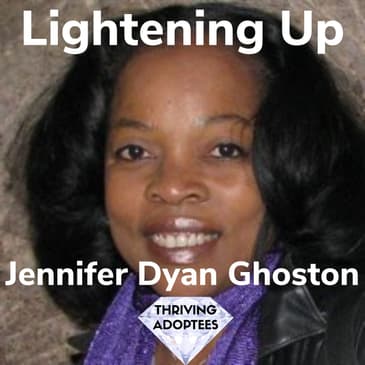
Does trauma feel dark to you? Does that darkness take you down? I know it has that effect on me. So how do we find more lightness? Listen in as Jennifer points us to toward a lighter life.
Here's a link to the interview with Jill Bolte Taylor https://thriving-adoptees.simplecast.com/episodes/with-jill-bolte-taylor
Here's a bit about Jennifer's first interview:
The powerful emotions we adoptees feel can sometimes threaten to overwhelm us. So how do we get past those feelings? Listen in as fellow adoptee and podcaster Jennifer and I explore trauma, deceit, identity, mindful awareness and much more.
Here's a link so you can listen to it https://thriving-adoptees.simplecast.com/episodes/acceptance-with-jennifer-dyan-ghoston
Here's a bit about Jennifer from her website:
Hi, I'm Jennifer who is an adoptee in reunion with both sides of my birth family. I have been connected with the adoption community for over a decade and am always interested in hearing the personal stories of adoptees from all over the globe. I was born and raised in Chicago, IL. and in foster care for two years before my adoption. Prior to my 48th birthday, I set the intention to search for my birth family. The Truth So Far… is a memoir of my willingness to be open, honest and public about my adoption experience.
Once Upon A Time...In Adopteeland, the podcast is another way for me to hopefully add a valuable resource to the adoption community from the perspective of the adoptee.
https://www.jenniferdyanghoston.com/
https://www.instagram.com/jenniferdyanghoston
https://www.facebook.com/Onceuponatimeinadopteeland/
Guests and the host are not (unless mentioned) licensed pscyho-therapists and speak from their own opinion only. Seek qualified advice if you need help.
Want to learn more about thriving for you, your kids, your families or your colleagues? Pick a time to talk here
[00:00:00] Hello everybody, welcome to another episode of the Thriving Adoptees podcast today I'm delighted
[00:00:07] to be joined by Jennifer, Jennifer, Diane, Ghoston. Notting forward to our conversation today,
[00:00:12] Jennifer, so much. I am too, Simon, thank you for having me back. Thank you. This is this is the
[00:00:22] lady with the most velvety voice that we ever have on the show, right? It's so kind, far too kind,
[00:00:30] thank you. So I just share my truth. So Jennifer, healing, da, da, da, what does it mean to you?
[00:00:42] Well, let me just first say that my right brain wanted to have some fun because you know how
[00:00:54] you used to say and you probably still do listeners I have a treat for you today, right? And I said
[00:01:02] I have to have a treat for Simon. So I spent a couple days thinking about coming up for your,
[00:01:13] what is this healing framework? Turning the word healing into an acronym, right?
[00:01:20] Ah, okay, we like that. Yeah. So for H we have help, E we have evaluate. Actually I like
[00:01:29] experiment better because I was listening to your episode today with Heather, G. Marshville.
[00:01:37] I really like her. Thank you for putting us together because she and I had a lovely conversation
[00:01:43] the other day and I listened to both of the episodes and she loves that word experiment. So we got help,
[00:01:49] experiment, appreciate. These are all verbs, right? Listen, investigate, navigate and grow.
[00:02:06] And I figured out that's why healing is going to be a lifelong journey or adventure for me
[00:02:15] because all, all those words I just gave you, seven of them, spell out healing and that's what it
[00:02:25] means to me. I can apply that to pretty much any and everything on a daily basis because I like to think
[00:02:33] I'm always in this healing mold, we're interested in healing and that's what I would say it represents.
[00:02:42] Yeah. Do you know where the name thriving adoptees came from?
[00:02:50] You may have told me, tell me again. So because I love an acronym, right? I love an acronym.
[00:02:56] So it came, I had this idea of my head for thrive and making thrive an acronym.
[00:03:06] So it was T for trauma informed, H for healing obsessed. After realizing our resilience,
[00:03:19] I forget clarity on our identity, V for vision for the future and E for empowering others.
[00:03:34] Oh yeah, like that. If I heard it, I don't recall but I like that.
[00:03:40] I don't know if I've shared that before. So yeah, I love an acronym. So which is your favorite
[00:03:50] out of your acronym, your seven acronym healing? Which is your favorite? Which is your right brain
[00:04:00] than which is your favorite? No, I like how you phrase that. My right brain, yeah, because my right
[00:04:06] would say something different than my left. For sure. So for my right, I would say
[00:04:16] experiment. Yeah. Yeah. So what experiments do you mean?
[00:04:30] So when I think of that word and I really have to give had the credit because when she shared it
[00:04:35] with me the other day when we were on the phone, I thought absolutely. Like you don't have to take
[00:04:44] things so seriously. You know, you can just kind of experiment, like just see what happens and
[00:04:53] and I'll use my podcast as an example.
[00:04:57] I had no idea, listen to podcasts but I had no idea of what it would be like to be a
[00:05:06] podcast there. And looking back, thinking back to 2021, like in the very beginning,
[00:05:17] it was an experiment. It really was because I had to learn the equipment, right?
[00:05:27] I ordered the mic, I ordered the recorder, I watched YouTube videos, I read a book,
[00:05:36] a very good book and I listened to other podcasters with a different ear.
[00:05:42] But it was fun, learning was fun, growing, right and navigating my way and investigating
[00:05:55] like what to do next. It was an experiment. Yeah. And it failed, right? Like in when I say fail,
[00:06:04] I mean if I realized 20 or 30 episodes in that it wasn't a good fit,
[00:06:14] I could just stop. Because I did learn back then that most podcasters don't get to 100 episodes.
[00:06:23] Did you know that? No, I didn't know.
[00:06:27] Yeah.
[00:06:32] So what's the opposite of experiment?
[00:06:42] I don't know, not trying it, not trying something
[00:06:47] and not giving it a go.
[00:06:53] So how does that relate to healing? Is it other than it being the E of healing?
[00:07:11] I mean taking things less seriously. The thing that flips to my head comes into my mind straight
[00:07:21] away from that is taking trauma less seriously. So I came up with this idea.
[00:07:30] There's these dark metaphors in the adoptee space and the trauma space. The brine will wound,
[00:07:43] it's dark, it's scary, it's black. The body keeps the score, right? The body keeps the score
[00:07:50] and the body is going to settle its score with you Simon. The body is going to settle the score
[00:07:57] with you, Jennifer. It's just waiting for when you're not on guard and it's going to jump on
[00:08:05] you and scare the bejesus out of you. That sounds like the left brain.
[00:08:11] Yeah, that sounds very left-brain, you know, but it takes things seriously.
[00:08:18] I came up with this idea of I was thinking about schools and I came up with soccer schools,
[00:08:24] right? So I came up with this idea of trauma one, adoptees united 10.
[00:08:32] So trauma scores first as we know, pre-verbal trauma or that,
[00:08:37] that, that, that, that. Yeah, but by coming together as a team, yeah. So adoptees united,
[00:08:43] the word united means coming together as a team and it's 10-1. So we're coming together
[00:08:50] and we're, as Americans might say, whooping traumas ass, you know, because we've,
[00:08:58] we've, those go first but and they're at home, right? Trauma's at home. The first,
[00:09:07] the first team's name to appear is the one that's at home. So we've won away from home.
[00:09:13] So that makes it even better and and it puts a little bit of lightness into,
[00:09:20] into the idea in a world that is just full of darkness. You know, I was interviewed and
[00:09:29] had you come across Anna Ginger, would you come across? She's got this podcast and so she,
[00:09:38] she asked me to come on a podcast and she was still in her podcast, I'm sorry.
[00:09:45] It's called the Anna Ginger Show, I think it's called the Anna Ginger Show, yeah. And she,
[00:09:51] she sent me this poem, she sent me this, this poem so part of our conversation was about this
[00:09:59] and the poem was just a hundred percent darkness. There was no light,
[00:10:07] there was no light, there was no shade, it was just trauma all the way and I said to her,
[00:10:15] look, I can't come on the show, I can't come on your show if you know, I had a visceral reaction
[00:10:22] to reading her plan because it was all dark and we're taking things too seriously and
[00:10:31] and yeah, we've got to take it, but like if we could just lighten up, right? If we could just
[00:10:38] lighten up. And so I heard this fantastic thing a couple of months ago, right? The fact that
[00:10:46] that many people are looking for enlightenment, right? They're looking for enlightenment,
[00:10:55] but we don't need to look for enlightenment because we are the light. We are the light
[00:11:02] and that light has been endarkened by our trauma. So our trauma has hidden us, it hasn't hurt us.
[00:11:16] And enlightenment means going outside into the world, whereas realizing and it's going to take some
[00:11:23] time, it's going to be a journey and all this stuff and then it's going to be tricky. But
[00:11:29] oh right, if we realize that we are the light and that light has been endarkened,
[00:11:37] that happens in that realization can hit us in a moment.
[00:11:43] You know, it's coming up for me. May I share this with you?
[00:11:48] Of course, I'm supposed to be interviewer you and I've just been sharing my stuff for three.
[00:11:55] No, I love it. I think it's great when we can have a conversation and yeah, I call it plan catch.
[00:12:02] You know, I throw you the ball, you throw me the ball. I think that's great but what's coming
[00:12:06] up for me now is one of the guests you had on Jill, Bolti Taylor who talks about the left
[00:12:15] and the right hemisphere. And I tell you that episode as I told you, I listened to three times.
[00:12:25] I took four pages maybe more than maybe a little over more than four pages of notes
[00:12:32] because what she shares in there made it clear to me that this healing is,
[00:12:41] it's when all parts, right? She talks about two characters on the left and our brain two characters
[00:12:50] on the right. And when they can kind of have a brain huddle, she causes it. Then there's
[00:12:55] the opportunity for there to be this whole living as she causes whole brain living.
[00:13:02] The book, the title of her book that I have been reading. And when you ask me that question in
[00:13:11] the beginning about well which one stands out to you? Which out of all of them in the acronym and I said
[00:13:20] experiment, experiment. It was in that moment that I realized we've got to have the right brain
[00:13:30] being able to participate, right? It's important because the left brain can kind of take over for
[00:13:38] me. Sometimes it's like okay do this, do that. This is how things are going to work you need to be
[00:13:46] on time. You name it. The right brain is kind of like well let's just see, let's have a little fun.
[00:13:56] Let's play and entertain ideas where healing can is doable and we will be fine.
[00:14:05] So I think it's important when we think about healing to think about how the left and right brain
[00:14:19] interface, like that's a big part of it. And if your listeners haven't
[00:14:26] checked that episode out, I highly recommend it. I think it should be required listening.
[00:14:31] It's really, you did a really great job and Jill Bolte Taylor is amazing with what she shares on
[00:14:42] that episode. So the link will be in the show notes listeners to the interview and she's
[00:14:49] she's a neuro, neuro, neuro anatomist, she calls her. She had a left brain stroke and she lost all
[00:14:58] self-criticism. That's it, that's it in two sentences and there's a lot more to it than that.
[00:15:10] I love your word entertain ideas. You talked about entertaining ideas. So you know that I'm doing
[00:15:19] working on this trauma framework at the moment and one of the ideas that I, well one of the beliefs
[00:15:36] that's come out of that is that some people don't believe that they can heal.
[00:15:43] They don't believe some adoptees that answer that questioner. Don't believe that they can heal.
[00:15:54] So I would say what if we could entertain that idea?
[00:16:04] In the right side, the right side of the brain is probably the one that would be more
[00:16:09] willing, willing and open. Yes, open. Yes, open.
[00:16:20] Suggestible. I just recently listened to a podcast where two, well the guest was an MD I believe
[00:16:33] and he was talking about the left and right brain. And I thought, yes, he said,
[00:16:41] the right brain, the right side is very interested in entertaining the left side.
[00:16:49] It's the left side that's not too interested in entertaining the right side.
[00:16:54] I was like, yeah, I think so.
[00:17:01] Yeah, so open. Open.
[00:17:07] Curious, right? And coachable, right? So I coachable open, you know, like open
[00:17:16] and the space, you know, the space creating the, creating the space for a new idea,
[00:17:27] creating the space or being the space. Being the space for, being the space for
[00:17:38] for a new idea. I heard this listening to a, I listened to a
[00:17:50] Gabbard Matte, I bought an online course and it's got videos and audios.
[00:17:59] And he asked a great question on something that was listening to yesterday with him.
[00:18:07] How, how he said about himself, how loyal am I to my trauma?
[00:18:17] How loyal am I to my trauma? Like how, how loyal are we? You know, what's, you know,
[00:18:25] and we can, we can play with that. We could put that with the football analogy, couldn't we?
[00:18:32] The soccer analogy about, yeah. Well, could we could make it about trauma one healing 10, right?
[00:18:43] Which team are we rooting for? Which team are we loyal to?
[00:18:49] Like and it's just like a little bit about glimmer. It's like, you know, like when you,
[00:18:57] you remember when, when you were losing your baby teeth and they wobbled before.
[00:19:04] Oh yeah. Yeah. So if we look at a belief such as we can't heal or such as we can,
[00:19:19] oh yeah, or we can only heal in reunion. Or we can't heal if we find out our birth mother's
[00:19:28] dad when then, then we can't heal. We can't, you know, whatever the belief will be, right?
[00:19:33] What if it's like, if it's like a tooth and we can, we can just start to wobble the baby tooth.
[00:19:42] Right. We're just wobbling the baby tooth. We're not, we're trying on a new idea.
[00:19:48] We're entertaining, usual, we're entertaining a new idea. We're, we're entertaining the belief that
[00:19:58] we may be wrong. How, how willing are we to be wrong? How much do we think we've got the whole thing
[00:20:10] worked out? We've wobbled that tooth a little bit and eventually it's going to drop out.
[00:20:25] You got me thinking about when it would be loose and sometimes a bit painful and then
[00:20:34] the candidate, that moment, right? Where it just got it out of there or it just slowly came out. Like,
[00:20:44] I look up, oh, it's out. Just kind of revisiting. Yeah. You might not even notice it's out to the
[00:20:51] spotter on the floor, but you spot it on the, yeah. And then you've got to leave it under your pillow
[00:20:56] and, and wait for you. Your mom to give you 10 pay or whatever it was. 10 cents.
[00:21:07] I was trying to remember how much was it a quarter. Yeah.
[00:21:16] You taking me way back was going way way back. Yeah.
[00:21:21] Yeah. The, the experiment goes with investigate as well, doesn't it? If I'm looking at your acronym,
[00:21:32] investigate, it's like, okay, am I going to, am I, am I going to investigate this? What
[00:21:40] is truth? Is that what you're talking about? Invest.
[00:21:44] By investigate, I mean just look into whatever it is a little bit closer. You know, these words
[00:21:59] as a matter of fact that I chose have a lot to do with what I hear when I have a guest on my podcast
[00:22:08] or in the adoption community. These words come up a lot. Navigate, listening of course,
[00:22:17] appreciate and investigate comes up quite a bit too. It's up there with curiosity. That's
[00:22:25] another one that comes up a lot in conversations that I have with my guests. They say them, I say them
[00:22:33] and I just kind of made the connection that these are some words that kind of can apply in all kinds
[00:22:43] of situations. It feels to me that investigate, just means just check it out a little bit more.
[00:22:54] You mentioned that you're coming across adoptees that say they cannot heal. Is that what you said?
[00:23:03] And I would just throw on there yet, right? YET. Like yet
[00:23:12] might be where they're really coming from because I think sometimes when we are and I certainly have
[00:23:20] been stuck or just didn't have enough answers did not know enough information like prior to getting
[00:23:30] my original birth certificate. I had no clue but really anything. I was told I was given
[00:23:40] the name Bonnie at birth, but I didn't know if that was really true or not until I saw that name on
[00:23:46] my birth certificate. So there was plenty of times in my life where I just didn't have answers,
[00:23:55] there was felt a bit stuck when I hit brick walls. I remember requesting information from
[00:24:08] Illinois and being told no, you can't add that information.
[00:24:15] Do you know what Bonnie means?
[00:24:16] I've heard sweet spirit tell me what is it mean?
[00:24:28] Well, it's a phrase. It's an adjective that's usually used north of the border so it's used in
[00:24:35] Scotland rather than England. They'll refer to Bonnie Scotland, which means pretty.
[00:24:44] Oh. Yeah, Bonnie means, Bonnie means pretty. That's quite nice. Yeah.
[00:24:53] I've heard that. Thank you. I appreciate that. I've heard sweet spirit many years ago
[00:25:02] but I like that name. I actually really like Bonnie.
[00:25:06] Yeah. I was thinking about the investigate and the experiment thing and you're talking about it
[00:25:15] looking at it in different contexts. I was thinking about the therapeutic,
[00:25:24] like looking for a therapy, looking for a therapy, looking for a therapist.
[00:25:31] I can get with that, but sure. So I think I've just started with a new therapist and she's
[00:25:45] somatic. She's a somatic. So I'm investigating a new form, a new modality because
[00:25:59] I'm looking for the bit that's pre-verbal. I'm looking for the stuff that I can't see because it's in my
[00:26:11] bones, the best of Andy Colster. I'm looking at that and that's off the back of
[00:26:21] all the therapists that came on thriving adoptees last year that took the said, but you know,
[00:26:29] so most of us are doing talk therapy. Talk therapy doesn't work if you can't put your trauma
[00:26:37] into words because it's pre-verbal and pre-memory, pre-cognitive.
[00:26:44] So investigate, experiment a different thing. So I'm also I'm going on a
[00:26:57] Kathie McKekney who's been on the show. She is into part, I think she's into parts work.
[00:27:05] Yeah, she's into parts work. So I'm doing a webinar with her, you know like I'm going
[00:27:11] on to attend her webinar for three hours next week on Saturday or something like that. So I'm
[00:27:19] investigating and exploring different things and rather than the opposite of experiment is
[00:27:29] thinking, it's pinning all our hopes on one thing, right? So on one thing that we might do as
[00:27:39] adoptees, we might say, right, okay, I'm going to put all my eggs in one basket and that basket
[00:27:50] is reunion. So I'm finding my biological mother is going to heal me, it's going to make me whole
[00:28:00] and that's the only thing that's going to cut the mustard. That's the only thing that's
[00:28:07] that's the difference that's going to make the difference. That's being attached to an outcome.
[00:28:12] I'm being attached to the outcome and we don't know what the outcome is going to be.
[00:28:20] So we're barking up the wrong tree, we could be barking up the wrong tree, we might not be,
[00:28:26] we might get the dream and we might get the dream outcome.
[00:28:33] Yeah, that's the nice thing.
[00:28:39] Yeah, I apologize for interrupting you but that's when I suffer
[00:28:44] when I'm attached to an outcome.
[00:28:49] Yeah. You want to touch the outcome with the podcast, right?
[00:28:55] No.
[00:28:58] No, not at all. Yeah, I truly think I suffer when I
[00:29:06] attach to the outcome and over-invested in things turning out a certain way.
[00:29:16] Yeah, back to that word open. I like to remain open. I like to think I remain open to
[00:29:23] how it is going to turn out. You know, kind of like that word adventure.
[00:29:31] I just love that word because when I think of an adventure
[00:29:38] you kind of don't know exactly how it's going to go but you're along for the ride.
[00:29:45] Yeah. And most adventures, we read a book or we watch a film
[00:29:54] the adventure has two things going on, doesn't it? It's the heroes two journeys.
[00:30:05] So the external journey, what's happening in the world, what's happening with our birth
[00:30:11] parents, what's happening with our adopted parents, what's happening with our relationships,
[00:30:15] what's happening with our partners, what's happening with our podcasts,
[00:30:19] what's happening with our businesses, and then there's the internal stuff is what's going on
[00:30:24] on the inside and seeing the difference between the two.
[00:30:31] Yeah. And how many times have you watched a movie
[00:30:36] and it ended unlike you could have predicted?
[00:30:40] And a lot of times those are the best movies.
[00:30:48] When you can't predict what's going to happen, a lot of people will say that
[00:30:52] all this was predictable or I didn't see that coming with a big smile.
[00:31:03] Yeah. I watched the other day like that. I was like that was cool.
[00:31:09] And it would predict that.
[00:31:14] Yeah. Well, left phrase wouldn't like that.
[00:31:21] Not at all. That's why I wanted to bring that into this conversation. Thank you for allowing me
[00:31:25] to do that because I think Jill Boltee Taylor nailed it. She kept it plain
[00:31:34] that it's worth knowing the difference between how parts of our brain are operating
[00:31:43] and just get curious, investigate what's going on up there.
[00:31:52] Yeah. So what stops us investigating?
[00:31:59] Say that again. What stops us investigating?
[00:32:03] What stops us? The unfamiliar I would say
[00:32:14] not sure what you're going to uncover, what you're going to find in your investigation.
[00:32:24] I think fear plays a big part when we don't remain open
[00:32:32] when we don't necessarily look to learn something new or to even grow.
[00:32:43] Yeah, I think sometimes it can be scary to do something different than what you've been doing.
[00:32:52] I just have enough lived experience to know it's usually worked out pretty good.
[00:32:59] Yeah, it's usually my investigation usually proves to be worth taking the chance.
[00:33:07] And I recently was reminded that I don't know if it was a study or I don't know some research
[00:33:16] that had been done that when people get to the end of their life, they don't regret like the things
[00:33:22] they did wrong or could have done differently. They regret the things that they didn't try,
[00:33:29] that they didn't investigate, that they didn't look into.
[00:33:36] Yeah. I heard that. Another word came to mind as if you were talking and that word was fruitful.
[00:33:45] Yeah, like your explorations have born fruit.
[00:33:52] Yeah.
[00:33:59] Did I tell you about bringing my biological dad? Did I tell you about that?
[00:34:06] A little bit.
[00:34:08] Yeah, so that was an experiment.
[00:34:14] And I had his phone number for about eight months.
[00:34:28] And I'd not run in.
[00:34:34] I didn't phone about any of the address.
[00:34:36] And then I was talking to somebody, a fellow adoptee about this.
[00:34:43] And I just thought, and he said, this guy,
[00:34:54] Colin, he's got pseudonym for writing books.
[00:34:59] And so Colin said,
[00:35:05] I said, I said, well, Ray, I both father's name is Ray.
[00:35:12] Ray didn't want to have anything to do with my biological mom when she
[00:35:22] told them that she was pregnant.
[00:35:28] And as I was sharing that with Colin, Colin said, he might have changed his mind.
[00:35:38] So I thought, yeah, he might have changed his mind.
[00:35:44] But let's see shall we?
[00:35:47] Right.
[00:35:51] And he hadn't changed his mind.
[00:35:58] It wasn't interested, but I'm laughing about it.
[00:36:06] I'm not crying in my point as we would say.
[00:36:16] There wasn't anything writing on it.
[00:36:20] Right. How do you think you were able to do that?
[00:36:24] May I ask?
[00:36:26] Well, because I wasn't attached to the outcome
[00:36:36] to use your thing.
[00:36:37] Because I kind of realised it was a long shot.
[00:36:41] OK.
[00:36:42] I guess.
[00:36:44] And because I hadn't got a running.
[00:36:46] So a few years ago,
[00:36:50] I used to do a program with a coach at the start of each year.
[00:36:56] And it's called creating the impossible.
[00:37:00] This is a guy called Michael Neon on the West Cups of the state.
[00:37:07] And so he runs this process.
[00:37:09] And the kind of the idea of creating the impossible
[00:37:14] is that you pick something,
[00:37:18] that you truly think you've only got like a 1% chance
[00:37:24] of doing.
[00:37:29] So the pressure of your expectations
[00:37:33] are gone.
[00:37:35] And you're expecting,
[00:37:38] the name says it all creating the impossible.
[00:37:42] You try and to create something
[00:37:44] that you think is actually impossible.
[00:37:48] So you can go all out.
[00:37:50] Right.
[00:37:53] You haven't got yourself a steam riding on the outcome.
[00:38:03] You don't need things to turn out the way that you dream.
[00:38:09] They might turn out.
[00:38:12] Right.
[00:38:14] You can go all in.
[00:38:19] If fear, I said what stops as experiments
[00:38:23] and use the word fear.
[00:38:24] Right?
[00:38:25] So there's this,
[00:38:27] you don't need to fear it anymore.
[00:38:31] Because you don't need to fear it,
[00:38:32] because you've set out.
[00:38:37] That reminds me of a quote I've heard plenty of people say that
[00:38:41] like what would you do if you knew you wouldn't fail?
[00:38:48] Yeah.
[00:38:49] Yeah, exactly.
[00:38:50] It's the same thing.
[00:38:51] It's exactly the long list, right?
[00:38:55] Yeah.
[00:38:56] What would you do if you'd go?
[00:38:58] Yeah.
[00:39:00] But our insecurity stops us doing that sort of stuff.
[00:39:05] Some people could say that some people could say
[00:39:08] that that's a trauma response.
[00:39:09] I don't know whether it is or not,
[00:39:10] but you could definitely pin the tail on that donkey.
[00:39:20] You know, I revisited our conversation.
[00:39:22] Actually, it aired a year ago today.
[00:39:27] I love synchronous.
[00:39:29] Yeah, April 30th, 2020.
[00:39:31] Wow.
[00:39:32] It's not a day.
[00:39:34] Yeah.
[00:39:34] Can you believe it?
[00:39:35] Yeah, it was a year ago today.
[00:39:38] And a couple of things that stood out
[00:39:41] that I want to mention.
[00:39:44] And one was your mention of Wayne Dyer.
[00:39:48] You know, when he went to the gray side of his father
[00:39:52] and I think we talked a little more about Wayne Dyer.
[00:39:56] And it's interesting because he's kind of my mentor online.
[00:40:01] I've been pulling up podcasts.
[00:40:04] Of course, he's transitioned but his podcasts
[00:40:08] and his voice is still very much out there.
[00:40:13] And I was thinking about that quote, right?
[00:40:16] This...
[00:40:16] Then you've probably heard it that he says
[00:40:20] when you change the way you look at things,
[00:40:23] the things you look at change.
[00:40:28] Yeah.
[00:40:28] And I love that quote because
[00:40:34] with the words I gave,
[00:40:38] but the acronym,
[00:40:41] healing,
[00:40:44] all of that applies.
[00:40:46] Like, if you just apply those words,
[00:40:48] it applies to pretty much anything
[00:40:52] you might be interested in.
[00:40:57] And I think that you're like,
[00:41:00] hmm, how do I want to put this?
[00:41:05] It ultimately ends up changing the way you look at things.
[00:41:10] Yeah, it just really does.
[00:41:15] The things themselves actually end up changing.
[00:41:18] And I didn't say, I couldn't recall the title of the book
[00:41:23] the last time I was here
[00:41:25] by him, your erroneous zones.
[00:41:28] I had to be like maybe in the seventh grade.
[00:41:31] My mother was a librarian and she brought books
[00:41:33] like this home all the time.
[00:41:36] And that's when I would be first introduced
[00:41:38] to Wayne Dyer.
[00:41:39] Except for your listeners,
[00:41:41] the book I put in I recall
[00:41:43] a year or so ago
[00:41:44] with your own feelings.
[00:41:47] Yeah, so it's your erroneous zones,
[00:41:50] not your erogenous zones.
[00:41:51] That's the that's the play there.
[00:41:54] Right.
[00:41:55] Erroneous.
[00:41:56] Erroneous.
[00:41:57] Yeah, you're so it's the
[00:42:00] areas where our beliefs are off
[00:42:05] where we are.
[00:42:06] Yeah, we are mistaken.
[00:42:09] He made
[00:42:12] that guy
[00:42:14] Wayne Dyer made a huge shift halfway
[00:42:17] towards the end of his career
[00:42:20] from a
[00:42:22] pretty psychological approach to a more spiritual approach.
[00:42:28] He was very much in 60s, he was very much,
[00:42:32] he was there.
[00:42:34] As far as I can get out of that,
[00:42:36] you know, he was at the forefront of my positive
[00:42:39] thinking and mindset stuff.
[00:42:43] But he
[00:42:45] he he he
[00:42:46] he tried yeah, he moved
[00:42:48] he moved into the spiritual world.
[00:42:54] I don't know how well he
[00:42:59] communicated that.
[00:43:03] Well it's interesting you would say that
[00:43:04] because I was listening to an
[00:43:06] an episode
[00:43:09] yesterday or today.
[00:43:10] I think it was
[00:43:12] yeah, it was this morning
[00:43:14] where he was talking about
[00:43:16] he did not at one time believe in past lives.
[00:43:22] Then he got acquainted with Brian
[00:43:25] Weiss
[00:43:27] and I'm familiar with his work.
[00:43:29] He
[00:43:31] wrote
[00:43:33] a number of books on past lives.
[00:43:37] Anyway,
[00:43:38] Wayne
[00:43:39] Dyer was saying that his relationship with Brian
[00:43:42] reading the books
[00:43:44] that he's had a shift
[00:43:46] which would suggest
[00:43:48] that he was just open.
[00:43:50] He was open to learning
[00:43:53] more
[00:43:54] Yeah, so yeah, it's interesting you would say that
[00:43:57] yeah, I could see
[00:43:58] he made a
[00:43:59] if he made a shift
[00:44:00] I think it
[00:44:02] I think it's kind of known
[00:44:04] and I think that he
[00:44:09] he started championing other
[00:44:11] championing other people.
[00:44:14] Right, like maybe like Brian Weiss
[00:44:18] but the one the big one that comes to my mind
[00:44:20] is Anita Mojane.
[00:44:23] Have you heard of her?
[00:44:25] I think so.
[00:44:26] So
[00:44:28] Anita Mojane had a near death experience
[00:44:32] and she wrote about it in a book called
[00:44:35] dying to be me
[00:44:37] and it's a big you know,
[00:44:40] it's a big bestselling book
[00:44:41] and Wayne Dyer championed that.
[00:44:45] Okay
[00:44:47] The title does ring a bell
[00:44:49] now it's time to be me
[00:44:51] dying to be me
[00:44:52] so she has a near death experience
[00:44:54] and it's similar to
[00:44:55] it was a
[00:44:57] it was
[00:44:58] similar to
[00:45:00] GeoBotty Taylor
[00:45:01] in that it was a medical thing
[00:45:05] but
[00:45:06] Anita Mojane
[00:45:07] was
[00:45:10] she was end of life
[00:45:11] end of life with cancer
[00:45:13] and she had a spontaneous healing
[00:45:18] experience
[00:45:20] and
[00:45:23] it was
[00:45:24] it showed her who she was
[00:45:27] in terms of
[00:45:28] she had a lived experience
[00:45:30] you use the word lived experience
[00:45:32] earlier on
[00:45:32] I think it's really important
[00:45:34] she had a lived experience
[00:45:36] of
[00:45:38] connecting
[00:45:39] well
[00:45:41] being consciousness
[00:45:42] you know
[00:45:43] being aware
[00:45:45] of
[00:45:48] her
[00:45:48] what some people
[00:45:49] might call a spiritual essence
[00:45:52] being her
[00:45:53] the part of us that's
[00:45:57] unconditioned
[00:45:58] by
[00:45:59] that
[00:46:00] consciousness, awareness, spirit being
[00:46:03] that stuff
[00:46:05] which is a similar sort of thing
[00:46:07] to
[00:46:08] GeoBotty Taylor
[00:46:09] you know
[00:46:09] the essence of who we are
[00:46:11] the
[00:46:12] and
[00:46:13] pre
[00:46:17] the blank
[00:46:18] the blank canvas
[00:46:20] on which
[00:46:22] our personality
[00:46:23] values our beliefs
[00:46:24] our trauma
[00:46:25] appears
[00:46:30] yeah
[00:46:30] Anita Mojane
[00:46:32] so
[00:46:33] shifting gears slightly
[00:46:35] what would you say
[00:46:36] have been the most
[00:46:38] significant
[00:46:40] healing things
[00:46:42] for you in
[00:46:43] the last year since
[00:46:45] you
[00:46:50] you
[00:46:52] you know
[00:46:54] it's interesting that the
[00:46:55] podcast
[00:46:57] has really
[00:47:01] played a major part
[00:47:04] in healing
[00:47:05] and feeling
[00:47:06] a sense of healing
[00:47:08] listening to
[00:47:10] stories
[00:47:13] from
[00:47:14] all members of the constellation
[00:47:16] but probably primarily
[00:47:19] from adaptees
[00:47:21] I've learned so much
[00:47:23] and I think a close second
[00:47:25] would be
[00:47:26] the adaptive voices writing group
[00:47:29] it has been
[00:47:31] we finished up
[00:47:32] three years
[00:47:35] this March
[00:47:37] and I think that
[00:47:40] I could have never predicted
[00:47:42] how healing that would be
[00:47:43] to listen to
[00:47:45] adaptees
[00:47:47] read aloud
[00:47:48] their words
[00:47:51] and share
[00:47:51] to the extent
[00:47:53] that they do
[00:47:55] and adaptive voices
[00:47:57] as you know
[00:47:58] created by Sarah
[00:47:59] Easterly
[00:48:00] and I co-facilitate
[00:48:03] with Kate Murphy
[00:48:05] and also Alice Stevens
[00:48:07] and that's been
[00:48:08] so
[00:48:09] healing
[00:48:12] yeah
[00:48:13] it
[00:48:15] has been wonderful
[00:48:16] and going back to
[00:48:19] experiment
[00:48:22] that's exactly what
[00:48:24] I was taking on
[00:48:27] when Sarah invited me
[00:48:28] to co-facilitate
[00:48:29] I had no idea
[00:48:31] what I was really getting into
[00:48:34] I really didn't
[00:48:39] I guess one of the things
[00:48:40] I really want to leave
[00:48:42] the listeners with
[00:48:43] especially any
[00:48:44] adoptee that feels like they
[00:48:48] can't heal
[00:48:50] won't heal
[00:48:51] I throw the word
[00:48:52] yet on the end of that
[00:48:54] and I would suggest
[00:48:59] we say
[00:48:59] curious all the time
[00:49:03] and you know
[00:49:03] I'm throwing these other words in
[00:49:05] write investigate
[00:49:06] and remain open
[00:49:08] and
[00:49:10] and maybe
[00:49:13] let's use that word help
[00:49:17] I find when I help other people
[00:49:19] which I feel like
[00:49:20] I play a part in
[00:49:22] with the podcast
[00:49:23] with the writing group
[00:49:26] that's a component of healing
[00:49:30] and I believe my guest
[00:49:33] each and every one that has said
[00:49:35] I hope I can help somebody else
[00:49:37] by sharing my story
[00:49:38] I think that's a component of their healing
[00:49:46] why do you think that
[00:49:49] works
[00:49:51] well they've said it
[00:49:52] they said I feel
[00:49:53] I feel good being able to
[00:49:55] oh okay sorry wrong question
[00:49:57] how do you think helping
[00:50:00] how do you think helping
[00:50:01] feels
[00:50:01] how do I think helping
[00:50:03] is a part of healing
[00:50:08] hmm I think the best way to say it is
[00:50:10] there's something about
[00:50:13] being in a position to give
[00:50:17] taking the opportunity to give
[00:50:21] and this could be anything
[00:50:22] it could be helping your neighbor across the street
[00:50:27] something about that feels really good
[00:50:32] most people describe
[00:50:34] when they've been able to help someone
[00:50:38] maybe just even cross the street
[00:50:42] feels good
[00:50:46] provide information like
[00:50:48] let me ask you
[00:50:50] do you think you're helping
[00:50:53] through the work you're doing in the community
[00:50:56] I hope so
[00:50:58] I think you are
[00:51:00] and I think you think you are
[00:51:02] I think so yeah
[00:51:04] and I think that you
[00:51:06] through that giving that helping
[00:51:10] is healing
[00:51:15] I think it puts the focus on
[00:51:19] on our
[00:51:21] oneness rather
[00:51:23] our it puts the focus on our oneness rather than our
[00:51:27] separation
[00:51:29] puts the focus on togetherness
[00:51:32] well that certainly sounds like helping
[00:51:35] yeah
[00:51:37] you know when you think about
[00:51:43] somebody that's depressed
[00:51:44] they tend to lock themselves away
[00:51:48] isolate yeah
[00:51:49] yeah isolate
[00:51:50] and it's the opposite
[00:51:52] of
[00:51:52] of that
[00:51:53] you know like
[00:51:54] like you're
[00:51:56] so when you talk about adoptive voices
[00:51:58] so the adoptive voices
[00:51:59] is
[00:52:00] that you're co-facilitate
[00:52:01] that's about
[00:52:04] helping adoptive
[00:52:06] right there
[00:52:08] books
[00:52:09] find their voice
[00:52:10] the memoir stuff
[00:52:12] so
[00:52:13] that's what that is all about
[00:52:14] and so everybody's
[00:52:16] everybody's giving
[00:52:18] everybody's giving back
[00:52:20] and paying forward
[00:52:20] and
[00:52:25] you know
[00:52:26] in everybody
[00:52:27] I just want to be clear
[00:52:28] everybody's not
[00:52:29] interested in writing a memoir
[00:52:33] some people are not interested in publishing
[00:52:35] that are part of the group
[00:52:36] like we're entering cohort
[00:52:38] 13
[00:52:39] going into the fourth year
[00:52:42] and
[00:52:43] I think
[00:52:45] the biggest
[00:52:46] part of what goes on
[00:52:48] is community
[00:52:52] fellowship
[00:52:53] in a space
[00:52:57] that feels very safe
[00:52:58] yeah
[00:53:03] and being able to get
[00:53:07] whatever's
[00:53:09] in your head
[00:53:14] like out
[00:53:16] because one thing that's so powerful
[00:53:19] is
[00:53:21] even people writing
[00:53:24] is them reading
[00:53:26] them hearing themselves read
[00:53:30] you know read aloud
[00:53:31] it's
[00:53:34] yeah it's an opportunity to just
[00:53:37] I say invest in oneself
[00:53:41] and know that
[00:53:42] it will be well received
[00:53:44] like the feedback from the other
[00:53:47] adaptees is just wonderful
[00:53:53] and you don't have to explain yourself
[00:53:55] everybody's an adapter
[00:53:57] so
[00:53:58] we get it
[00:54:00] yeah
[00:54:01] and referring back to the
[00:54:04] the
[00:54:05] gavarmarki thing that I'm listening to at the moment
[00:54:07] you sent
[00:54:08] you know like
[00:54:08] it starts with a broken connection
[00:54:12] trauma is about broken connection
[00:54:15] connection with
[00:54:17] ourselves connection with
[00:54:19] others
[00:54:23] and I have some
[00:54:26] I have some
[00:54:30] yeah I have some bits that I'm not
[00:54:33] I'm not sure he's quite clear on
[00:54:36] you know
[00:54:36] connection how can
[00:54:37] our connection with ourselves
[00:54:40] I would say that
[00:54:40] you know
[00:54:41] that our
[00:54:42] that implies too
[00:54:44] how will we you know we can't get in our own way
[00:54:51] I don't
[00:54:53] I question stuff like
[00:54:56] oh
[00:54:57] adoptees tell me
[00:54:59] on their discretion
[00:55:00] he's saying you're questioning that they're
[00:55:02] getting in their own way
[00:55:04] on the healing journey
[00:55:06] no you're not getting in your own way
[00:55:08] you can't get in your own way
[00:55:09] you know try try doing that
[00:55:11] literally try doing that
[00:55:13] you know try walking down
[00:55:15] the the the
[00:55:16] the street
[00:55:17] and get in your own way
[00:55:18] you can't do it there's only one of you
[00:55:20] what's getting in your way
[00:55:22] is is an idea
[00:55:24] is a thought is a is a feeling
[00:55:26] you know
[00:55:28] and you know
[00:55:30] gavars says we you know
[00:55:32] we're connection with ourselves
[00:55:33] well there's only one of us
[00:55:35] you know you can have a connection with yourself
[00:55:38] but you know
[00:55:38] what I
[00:55:41] you as as the light
[00:55:43] is endarkened by our trauma
[00:55:45] so I would say who we are is hidden
[00:55:48] by our trauma
[00:55:51] there's only there's only one others
[00:55:55] but going back to the connection bit
[00:55:58] in terms of a connection with others
[00:56:00] you know it's clearly so
[00:56:03] connection with our
[00:56:06] birth
[00:56:07] mother birth father
[00:56:09] like connection with our adoptive parents
[00:56:12] and if we don't feel connected
[00:56:16] then the connection that we
[00:56:19] feel
[00:56:22] in a group like adoptive voices
[00:56:26] in a conversation
[00:56:30] with a fellow adoptive
[00:56:32] in a conversation with a fellow adoptive
[00:56:35] for an interview for a podcast
[00:56:38] it's all about connection and we
[00:56:40] and
[00:56:42] and that's the that's the healing power
[00:56:49] yeah because
[00:56:50] that's been
[00:56:53] broken
[00:56:54] too young for too many
[00:56:59] yeah
[00:57:01] and I'm glad you mentioned Dr.
[00:57:03] my take because the last time I was here
[00:57:06] I misspoke and I would like an opportunity
[00:57:09] to clear that out is that okay
[00:57:11] of course
[00:57:13] yes I use the word
[00:57:18] acceptance
[00:57:20] and authenticity in that he spoke about it
[00:57:24] if you had to choose one choose authenticity
[00:57:28] I misspoke it's attachment
[00:57:31] and authenticity
[00:57:33] because both of those are huge survival needs
[00:57:39] and at times they may be incompatible
[00:57:45] and so it's important not to
[00:57:48] lose touch with ourselves which is the authenticity piece
[00:57:52] or suppress our gut feeling so that's what
[00:57:56] I should have said
[00:57:58] if you have to choose between attachment
[00:58:02] and authenticity choose authenticity
[00:58:07] thank you yeah that feels like a good place to bring it in
[00:58:15] let a great time with this Simon thank you again for this
[00:58:18] opportunity it is an honor and a privilege
[00:58:23] yeah it is
[00:58:25] for his boat
[00:58:28] thanks listeners we'll speak to you very soon
[00:58:30] to catch bye