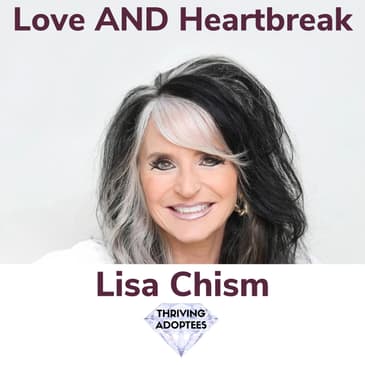
What happens when your search for belonging leads to both love and heartbreak? Listen in as adoptee Lisa shares what she's learned from her rollercoaster ride of reunion including lovebombing, jet black darkness and, eventually, light. Very powerful. Deeply profound. Listen with big ears.
Find out more about Lisa here:
https://www.instagram.com/drmommypoppins/?hl=en-gb
https://www.theadoptednurse.com/
https://www.facebook.com/lisa.astalos.chism/
Guests and the host are not (unless mentioned) licensed pscyho-therapists and speak from their own opinion only. Seek qualified advice if you need help.
Want to learn more about thriving for you, your kids, your families or your colleagues? Pick a time to talk here
[00:00:02] Hello everybody, welcome to another episode of Thriving Adoptees Podcast. Today I'm delighted to be joined by Lisa. Lisa Chism, looking forward to our conversation today Lisa. Me as well. Thank you for having me. You're very welcome. So listeners, Lisa is an adoptee, as so many adoptee from the States.
[00:00:31] And you've got an interesting story, some stuff around reunion as well that I know that we want to cover off. But let's dive into the first question that I'm normally asking in terms of thriving adoptees. And what does that mean to you when you hear that Lisa? I think it means living my life through one lens most of my life.
[00:01:01] Through the lens of being grateful as well as feeling I have to be perfect in order to be kept, in order to be wanted. Because that's the lens that I saw my beginning through. And then my 50s, maybe partially because of reunion and reunion that did not go outstanding.
[00:01:26] Going into therapy and also engaging with more folks through social media and doing more reading on my own. Kind of coming out of that time period in my life of feeling that I had to be perfect in order to be kept. And having much more self-awareness, more self-acceptance.
[00:01:51] And now kind of viewing the world through a lens that is less impacted by feeling like I have to be perfect in order to be kept. And having a better self-awareness, a better sense of who I am. And I guess less pressure to be perfect.
[00:02:14] But it's a journey because I spent most of my life through that lens and feeling that I had to be perfect and grateful in order to show that I was grateful. I, you know, always feeling you could end up anywhere and you ended up with the parents that you did. And mine were amazing. I had loving, wonderful, adoptive parents. They're both gone now, but they really were beautiful people. Yeah.
[00:02:42] So it's an interesting juxtaposition there, Lisa. You've got parents that are great and yet this feeling that you had of needing to be perfect and having to be grateful. It doesn't sound like that was kind of coming from them. No, never came from them. No, no.
[00:03:10] I was very, very close to my mother. My mother, she was my best friend growing up. I didn't have siblings. And I did have a sense to search for my birth mother. I did have a sense that that would hurt her. However, she had mentioned a few times, if you ever want to look, I'll help you. But I never had the sense I could ever do that to her.
[00:03:40] And it wasn't even necessarily anything that she said or did. It was just something that I felt. And when she passed away in my early 30s, it was a few years after that, that I started to allow myself to think about what does that look like looking for my birth mother? Yeah. Yeah. I felt that loyalty too, as well. I felt that loyalty too. That's a good word for it. I like that. That's a good word for it. It is a sense of loyalty. Loyalty. Loyalty.
[00:04:10] And also fear of upsetting her. Yeah. Fear of upsetting her. So have you got a feel for where this need to be perfect and the need to be grateful came from if it didn't come from your parents? I think it's the situation of being an infant adoptee and being given up in the first place.
[00:04:40] It's just this innate, you can't take that away. That once you, I don't remember ever not knowing I was adopted. So my mother told me so young that I grew up knowing and I don't remember not knowing. I do remember the day she told me at least enough details. She told me I was, my birth mother was raped, but she knew the guy. Those were her words exactly.
[00:05:05] And then I remember there being a shoebox of information, nothing identifying. It was a closed adoption. And I can remember where I was standing in my house in front of a closet where the shoebox was. And going back later as a child, digging the shoebox out, looking through it as if I was going to find something, some secret. And that sense of not knowing is so embedded in you at such a young age.
[00:05:33] And I think with that comes the given up sense. Well, if someone gave me up, I could easily be given up again. So I think it's situational. And something that I think is kind of embedded at the realization of knowing what it means to be given up, so to speak. Yeah. So you talked about a sense of self and self-awareness.
[00:06:03] What do those mean to you? What do those words mean to you? It's a certain sense of, I guess, maturity and awareness that I've developed as I've gotten older. And I do think that reunion, especially the most recent with my birth father, was so profound for me to actually meet a birth parent.
[00:06:32] Because since my birth mother, she passed away at 26 of leukemia. So I never did meet her. But meeting him and going through the emotions of that, finally looking at somebody that mirrored me physically and some of the traits that he has.
[00:06:56] There's just something about finding your feet on the ground and realizing where you came from that gives you this certain sense of self-awareness. But in addition, kind of coming through a negative experience that I went through and being able to put yourself back together from that.
[00:07:15] But I think almost, for lack of a better word, surviving that kind of trauma, it sounds cliche to say it helped me grow. So I don't really know if I want to use those words. But there does come with it a certain sense of if I can get through that and still know who I am, then I finally start to feel like who I am really isn't impacted by where I came from.
[00:07:43] Who I am is who I am. Who I am is who I've turned out to be. And it's a whole bunch of bits and pieces of things along the way. And finally having that sense that who I am isn't because of where I came from or impacted necessarily because of my beginning. You feel like a mistake for so long. You're someone's mistake that gets taken care of.
[00:08:11] You're a problem that's solved because you're given up. Therefore, you're no longer a problem. But you started this world as a problem. For me, hearing that my birth mother was raped, but she knew the guy, you're not only a problem and a mistake. You're your your existence is coming from either an act of violence or an act of coercion. And that is so embedded. And it really has taken.
[00:08:39] Quite a process to come out of that and feel like that doesn't have to identify. I don't have to identify by that. That doesn't have to define who I am. Yeah. So there's a sense that self for you used to mean identity and it doesn't. Sorry. Self and identity used to mean heritage and roots and parentage.
[00:09:09] But it doesn't mean that anymore. No. Or where you came from, you know, the circumstances around your existence that you weren't wished for. You weren't planned.
[00:09:22] You were someone's problem and mistake and result of a deeply disturbing beginning, I guess, you know, for lack of a better word. And that doesn't have to identify who I turn out to be.
[00:09:44] So it's almost like a whole load, a whole long list of things that used to mean identity don't mean identity anymore. No. So what does identity mean to you now? Now it means that I'm a mother.
[00:10:11] I have a 25 year old daughter that's thriving and I adore and most important person in the world to me. Identity means I'm a wife. You know, I'm someone's partner that I've been with over 30 years. Very importantly is my profession and my devotion to my career as a nurse and a nurse practitioner.
[00:10:32] I care for women and I care for women with any kind of breast concern, menopause or sexual health concern. And it's a very intimate kind of care. And for me, my identity is what I'm able to do when I'm able to care for women. That's a real gift.
[00:10:53] So that's what and I'm a friend and a niece and a sister to my half brother. That is the silver lining of my birth father finding me. So I'm that's who I am. That's my identity. So your identity is stuff that you've chosen rather than other people.
[00:11:28] Yeah. Yes. Yeah. So it's about to empower. And I really think that the reason why going through the trauma. Yes. And I think that going through the trauma of having my birth father basically love by me and then reject me more or less over a course of five years. And with a lot of abuse mixed in there from him and his wife.
[00:11:55] I think that coming through that is what really made me stop and think, wait a minute. I'm I'm not like them. And just because that's my 50 percent of my DNA doesn't mean that that's something that I would do to someone. And this is really who I am.
[00:12:12] So I guess really understanding how separate you can be, despite the fact that you share DNA, you truly are a separate person from them. And where you came from, as far as your bio, bio, biologically, where you came from does not have to identify who you are. Yeah. Were there any particular.
[00:12:38] Epiphany like moments that when when this started dawning on you? Well, I, I had was in therapy through the whole almost the whole process. Um, and I think there were many times that my therapist would say things to me and it wouldn't hit me until later. Um, and a lot of those things were.
[00:13:10] Me finally having somebody who understood my lens of always feeling like I had to work for relationships. I had to work to be kept. And this filtered over into meeting my birth father. I felt like I had to do everything perfect for him to want to be in my life. And despite the fact that I did everything I could and showed as much love as I knew how to show, I still was rejected again.
[00:13:36] I think that's when it finally dawned on me that, you know, this isn't about me anymore. This is about them. And it doesn't matter what I do or who I am or how hard I try. It's not going to change it. Um, and I think that's when I really started to peel myself away from those feelings of my identity and existence is tied to these biological roots. Yeah.
[00:14:04] So you kind of, you gave it, you gave it your all. Yes. You gave it your all. And at some point, um, you were done. And I grieved. I grieved like I've never grieved in my life. I, I lost my mom at 32. I don't feel like I ever grieved her because five days after she died, my daughter was born. And I never felt like I could give myself the grace to grieve. I just wanted to focus on being a mother. Then I lost my father. You probably didn't have time. I didn't.
[00:14:34] You probably didn't have time to grieve. No, I didn't. And then I cared for my father and, and before he passed away 10 years later of cancer and I cared for him. And I didn't allow myself to feel that. And I, I just truly don't think I ever learned or grieved until I had to grieve this.
[00:14:56] I had to grieve the fact that my birth father, who I fantasized about a parent and fantasized about what this would be like. And it was nothing at all. Like I could have ever imagined. Then I had to grieve that. And it's the first time in my life I truly grieved. And I think that grief is really what healed me. How? Should I share some more?
[00:15:25] Because it's, it's counterintuitive, right? Grief healing. Yeah. Because if you, if you can't, if you don't grieve, you can't heal. If you just shove everything down and keep trying to perform and be perfect.
[00:15:38] If you can't really feel that intense grief, that intense pain that, I don't know that there's any words I can attach to finally meeting a birth parent after all these years of wanting that connection so badly. And having them turn out to be the person you least expected would be abusive. Be so abusive and not fight for you.
[00:16:08] Not put you, not have any kind of priority over treating you the way you would expect a birth child to be treated. When that doesn't happen after years and years of wondering about it. And you have to process the fact that this is my birth father and he isn't going to fight for me. He isn't going to step up. He isn't going to treat me the way you would want to be treated by a birth parent.
[00:16:36] So now you have to accept that and separate yourself from it being about you. It's not about you. It's about them. And you, you're forced to heal. You just, you just have to put the pieces back together. You talked about him love bombing you initially. Yes. Yes. So you must, I guess you thought you were on the right track, did you? Yes.
[00:17:06] Yes. For several months it was intense. But very shortly after maybe a couple of months he came to visit quickly. And, and then it was very intense conversation, communication. You know, lots of phone calls, lots of emails, lots of communication.
[00:17:25] But within a few months also telling me how much his wife did not like the contact and communication and did not think that it was quote normal. And he shared with me, unfortunately, way too much about her reaction. And then I internalized that and took it personally and felt like I was doing something wrong.
[00:17:52] Um, but basically I was just triangulated in this triad relationship where, um, I was the, um, sounding board. He was the victim and she was the persecutor. And I was supposed to save everything. And that was a huge amount of responsibility that I put on myself and that he put on me in this whole triangulation.
[00:18:18] And, um, it, uh, it, uh, it was emotionally, um, exhausting. Um, it took my life over for a long time and finally culminated in, um, uh, you know, an episode where my daughter and I were visiting him and, and he had been drinking and became very violent.
[00:18:39] And, um, basically kicked us out of his house at midnight in a place we didn't know or live in the cold with nowhere to go. And that's a pretty profound statement. Um, if you don't see that staring you in the face that that's how this person is going to treat you, you can't miss that one. And there was no other way to other than to process what that meant.
[00:19:08] And that was about two and a half years ago. Yeah. That was the final straw, really? That was for me. Yep. Yep. It sounds like we're not, we're handed this stuff, but there's no choice of ours there. There's, um, I was just thinking about something for me and my reunion journey, right?
[00:19:36] So I had a meltdown in a therapist's chair about, I don't know, 13 years ago, something like that. And I, I had no choice after that meltdown. I had to resume my search. Do you know what I mean? It was, it was, it, it was staring me in the face.
[00:20:04] I had, there was no other way forward. I couldn't, I, I, I put the search on, I put the search on the back burner, right? I put it on hold. Mm-hmm. But the, the ferocity of that, of my emotions in that, in, in that moment, in that, in the chair with the, with the, with the therapist meant I had no option other. I had to resume the search.
[00:20:31] I had to, I had no choice in the matter, right? Like, like you, you had no, no choice in the matter. At, at that, at that time, you know, when he, when he locked. Mm-hmm. When he, when he, when he, when he kicked you, kicked you and your daughter out. Mm-hmm. Yep. No, a hundred percent understand what you're saying.
[00:20:51] I felt like when he contacted me initially through AncestryDNA, there, nothing could have stopped me from pursuing that and answering. And getting involved in this and going on this journey, nothing. So many times my husband said to me, I saw you getting hurt over and over and over. I should have done more. And I've looked at him and said, there's nothing you could have done.
[00:21:16] Absolutely nothing was going to stop me from doing everything I could until I decided I was done. So I totally understand what you're saying. Yeah. It became apparent you were done in that moment. Yeah. It was, it was, it was, I went about eight months, no contact.
[00:21:38] And finally he reached out around that time and, and I did have some contact and I've had very limited contact since, but long spans of time and things are very, very different. And the only reason I've actually been in contact recently is my brother is ill and very ill, very serious.
[00:22:06] And so there's been some communication around that. I actually have to, I am going to see my brother in a few weeks. It'll be the first time I set foot in that town in two and a half years. Um, but I actually, I feel like I can do this because my purpose and going is for my brother. Um, so I feel pretty shielded from being able to get hurt again, simply because my expectations.
[00:22:33] And anyone else is not there. It's only for my brother. So I guess the, the, the big learn from this is reunion doesn't have to go right for you, for it to be healing. Exactly. If you were to ask me if I would do it again, I would.
[00:22:59] Um, I wish I would have known what I know now because I probably would have still had contact, especially in pursuit of knowing my brother. Um, I do wish I would have understood the behaviors and the personality that I was dealing with. Um, but how do you know? And, um, I don't regret any of my reactions. I think they were honest, authentic.
[00:23:28] Um, I give myself much more grace than I think I could have say, you know, 10 years ago. So something, somebody said something to me the week about that there's, there's no wrong way to do reunion. Right. So if there's no, if there's no wrong way to do reunion, there's no right way to do, to do reunion either.
[00:23:59] Right. And, you know, if, if we have been striving to, to do everything, if we've been trying, if, if we've been striving for perfection, doing things the right way, thinking that we're going to get the outcome. Then if we realize there's no right way, there's no wrong way.
[00:24:26] Then we're kind of free of the, free of the search for perfection. Agreed. I think free of expectations too. I think if someone was approaching reunion, my, the advice I would have would be one, get a therapist to walk with you with this. Um, cause I don't care if it's the best or worst case scenario.
[00:24:51] I do think people need help when they're, when they're walking this and don't have expectations as best as you can. You can't help, but have them, but managing expectations, um, I think has a lot to do with how you're going to perceive whatever results you get from reunion. Yeah.
[00:25:18] Did I, did I tell you about getting, um, blown out by my birth father? Did I tell you about that? Yes. Yes. Yeah. Um, and blown out doesn't mean anything in, in, in American, in some American circles, right? It's an, it's a British idiom. So basically I called the guy out. I called the guy, did it completely wrong, right? I did it completely wrong.
[00:25:46] I called the guy out completely out of the blue. Um, and it was a tough conversation. And the end of it was don't call this number again. And after I hung up, I thought I could have done that better. And I thought, yeah, I could have done that better. And then I thought about some more and I thought, but I don't think it would have had a different result. I don't think so either.
[00:26:15] And I, I don't know. I remember when you told me about that, my response to you was, no, he could have done it better. It's not your responsibility as the adoptee to do it right, wrong. It's not. It's, I believe with all my heart, um, when you're an adoptee, there is no wrong way for you. He could have handled that better.
[00:26:45] If he needed a minute, he could have told you, I need a minute. Um, I don't think there is a wrong way to do it. And I think instead of you feeling that you could have done that better, I think reframing it, he could have done that better. Yeah. He could have. For sure.
[00:27:07] The, the, the, the, the, the thought that came, the bigger, the bigger thought came to me, the bigger realization that came to me after that was, I'm, I'm glad that he didn't raise me. Mm-hmm. Mm-hmm. Mm-hmm. Mm-hmm.
[00:27:28] Because, uh, he, he, he, he, he, that's, that, that sort of character, who he showed himself to be, is not a character that I would look up to the way that he did it. So. Because you can't keep self-treating someone like that. Yeah. It, it, it's a continuation. It, it's a development of your argument.
[00:27:56] He, he could have done it better. And maybe he should have, he should have done it better. But he, the, the way that he did it reflected a character that I wouldn't, that I wouldn't respect. I wouldn't, I couldn't have done. Not only that. Yeah.
[00:28:21] And not only that, he did what he was perhaps capable of. And I think when you think of it that way, because that's how I look at my birth father's personality and how he treated me, he was only capable of. Yeah. And when you think of it that way, it also separates you from him.
[00:28:48] So how he responded isn't a reflection of you. It's a reflection of him. It's what he did and how he chose to act. And it's what he's capable of. It has nothing to do with you. And I think that that was when we, when you asked me what, how is it that grief and healing happened from someone treating you that way?
[00:29:16] It was that realization over time and with therapy that he treated me the way he was capable of treating me. And you're right. Would I want to be raised by someone that was only capable of that? No, I wouldn't. It also doesn't reflect who I am because I would never treat anyone that way ever. I wouldn't treat a stranger that way. I don't treat my patients that way.
[00:29:43] I don't treat my family that way. And so something happened. I got another piece, part of the story about six months after that, where I understood more about his background.
[00:30:03] And that allowed me to understand his capability and to give him some grace, give him more grace than I was. I gave him more grace when I got this other bit of nugget of information than, so the nugget of information was that he'd been in and out of care himself.
[00:30:31] He'd been out of, him and his siblings had been in and out of care and essentially abandoned by the father. So he had done, he had done to the unborn baby what his father had done to him.
[00:31:04] The mother had died. Well, what's really interesting about that is I found out my birth father's father was very abusive to him growing up. And that the family, there was a lot of abuse in the family and a lot of trauma. And his father had actually had a relationship with the woman next door and ended up leaving his mom. And that was traumatic.
[00:31:33] And his father actually died very young in his early 40s of a cardiac event. So I only sort of understood that prior to things kind of coming to a halt, I guess, with my relationship with him. And through my healing and process and learning more about his circumstances,
[00:32:02] I completely understand what you mean as far as giving it some consideration and grace, as you put it. It helps you and I to have some compassion for them. Yeah. For sure. I think it still doesn't. It does not give them a pass, though.
[00:32:32] We can have compassion, which will help us heal. But it doesn't excuse someone's behavior. So I didn't try and have compassion for him. I felt compassion arose within me on hearing that part of the information. So it wasn't like I need to give this guy some compassion.
[00:33:00] It was that spontaneous, spontaneous compassion. The insight, what I learn allowed, gave me the grace for him. It wasn't kind of premeditated grace. I don't think grace is premeditated. I think it comes to us on the back of learnings. Like, I heard something about this last...
[00:33:29] Yeah, it was an adoptee who was reflecting on another episode. And she was saying, what I got from this is that I can change my perspective. Worst of those lines. And I thought, perspective changes come to us through insights.
[00:33:58] It's not something we make. We don't make them happen. We can... When I'm talking, when I'm training about this, I'll say we can make it to the extent... We can make it happen to the extent that we can hang out at the bus stop for insights. Right? But we can't make the bus arrive. The bus is... The insight bus has got its own timetable.
[00:34:26] And we're not in charge of the routing, as you would say, in the States of the bus. But we need to be in the place where we're likely to have insights, which is listening to podcasts, doing therapy, talking to close friends about this sort of stuff. We can't make the insights happen.
[00:34:54] We can't make the perspective. We can't make the... We can't make somebody else's behavior. We can't change somebody else's behavior. We can't change our own behavior. We can't change our own feelings. All this kind of stuff is automatic. It happens when it... It kind of happens when it happens. Am I making any sense? Yes. It's definitely a process. I think of that when you asked me how grief was able to help me heal.
[00:35:22] And I think actually feeling... Allowing myself to grieve and feel actual grief was very transformative. And you're right. You can't force that. I couldn't force grieving my mother. I couldn't force grieving my father. I chose to push it down. The thing about grief, though, is it does sometimes manifest in other ways and does come back sometimes in other ways to be present in your life.
[00:35:52] And for me, it was very much like a Niagara Falls when it happened. It was just... I had no choice but to allow it to be there and process it. And it was very profound. But you are right. You can't force things. You can't force a perspective. You can change your own personal behavior and how you react to things.
[00:36:18] But how you're feeling about them and the way you view situations, I think you're right. You can't force that. Yeah. So how do you see healing and thriving? How do you put those two together? Or not? Or don't put them together? I think it's... For me, it's feeling more whole. I think it's a certain level of...
[00:36:45] I don't feel like I have to work for relationships like I used to. And maybe, unfortunately, because I worked so hard for a relationship that was so profound for me and it didn't work out even despite my best efforts, was just one of those aha epiphany. And then also realizing how separate I am and how many things make up who I am. And I feel more whole.
[00:37:09] I think thriving as an adoptee for me means feeling like a whole person. And maybe that comes from knowing more about my history and my background and where I came from. I know my mother's side. I learned that in my late 30s. Now I know my father's side. And I'd like to think that adoptees who don't get to know biological information absolutely still thrive. I'm sure they do.
[00:37:38] For me, that question and that whole... That lack of information did affect me for a lot of my life. And maybe just going through what I went through was just so self-actualizing for me. Like if I can put myself back together after that kind of rejection and loss, it helped me see what I was made of, I guess. Yeah. It helped you see your resilience.
[00:38:08] Mm-hmm. Yeah. The wholeness thing, if I was going to put it together, you know, with my... You know, what you shared with me last time we spoke and what you talked to me today, I would think about it as something like you're whole so you don't need somebody else to complete you. Correct.
[00:38:38] There's something pretty big there, though. Like I just said it as a throwaway sentence. Do you know what I mean? Not a throwaway sentence. But it makes logical sense. Mm-hmm. But it's bigger than just 10 words that Simon said, isn't it? Mm-hmm. It's a sense of...
[00:39:10] I guess I keep coming back to that sense of feeling like I have to work to be kept. And I don't feel that anymore. It's if it changed even in my relationships with, say, my husband or my daughter who, you know, she and I are incredibly close.
[00:39:34] And despite my faults and when I mess up as a mom, because none of us are perfect, she loves me intensely. And I know that. But so I don't know if I'd count my mother-daughter relationship with her. I think looking at even my dynamic and my relationship with my husband, I feel less worried about being perfect for him. I feel less worried about being perfect in friendships.
[00:40:02] I feel less worried about being kept. I feel like I know who I am and it isn't dependent on what others think. There's such a different sense of, like you said, that other people's opinions, perceptions of me aren't defining who I am.
[00:40:25] And I really think it came from having the rug pulled out so profoundly for me and someone that I thought I really, really was going to really make me feel more complete in a relationship I always wanted, not being able to have that despite my every effort I did. And I think, well, if I can put myself back together after that, I certainly don't need that in my life. And I've learned to not have that in my life.
[00:40:55] Then that's just reflective of the fact that it never was about everyone else. It's just about what, who I am as an individual. So we've got this whole as in complete, not needing anybody else to complete you. And we've also got whole in terms of you talking about putting yourself back together again.
[00:41:28] Like you're a jigsaw? I don't know. Is that what it, what does putting yourself back together again? Because I was so broken after what my birth father did. I was so broken by the pain and the abuse that I endured for at least four years.
[00:41:52] I was so broken by that, that healing from that was so profound. I will forever be different. But in a good way. And knowing what I'm made of and the fact that I could come through that and put myself back together. I was shattered. I was absolutely shattered. It was a grief that I have never experienced.
[00:42:21] Despite losing my parents who I adored. My mother was my best friend. Despite that, I was absolutely shattered by that experience. And coming through it, it's, I don't like the expression trauma makes you stronger. Trauma messes you up. It changes your brain chemistry. It can be very damaging.
[00:42:46] But when you can heal from that kind of trauma and abuse and pain and know that you can heal from that and have a greater sense of yourself and really recognize how separate you are from how other people treat you. Especially somebody like this that I wanted in my life so desperately. I would have done anything for that to work out differently. But it didn't matter what I did. It just is this.
[00:43:13] I probably never felt so sure in the fact that I am not how people treat me. That is not who I am. That doesn't matter. That does not make up who I am. Yeah. As your therapist, anybody mentioned the words post-traumatic growth to you before? No, but that's accurate.
[00:43:44] No, but I like that. Well, we live in a world where positivity doesn't really, well, it doesn't sell newspapers or get clicks to sell Facebook advertising. Right. Right.
[00:44:08] If the story used, the newspaper publisher's mantra used to be, if it bleeds, it leads. Mm-hmm. So the lead article was the bloodiest story. Right. Right. Yeah. So these days, as I understand it, anger, anger is the biggest driver of virality.
[00:44:38] Mm-hmm. It's unfortunate, isn't it? It is unfortunate, yeah. So what that means in terms of our conversation today is that PTSD gets far more focus than ATG, post-traumatic growth. Because growth is positive. Because growth is positive. Mm-hmm.
[00:45:05] And we have a media that wants to scare the bejesus out of us or make us angry. So your point really illustrates the focus when I wrote my memoir. It was very important to me to focus on ending things positively.
[00:45:33] And it's, I mean, literally the title, you know, a memoir of compassion and healing. I really wanted to end that my story with what came out positive. So it's interesting that you make that point. Because when we talked about compassion, I talked about compassion and courage and healing. And it was important to me to talk about that. Yeah.
[00:46:03] Because I did want to end with, despite ups and downs throughout my whole life that everyone experiences to some degree in different circumstances and perspectives, I still wanted it to end positively. Yeah. It was important to me. I guess it's the difference between a movie and a newspaper. Mm-hmm. Yeah, for sure. Right? Yep. And it's a way to give back, too.
[00:46:33] I mean, your story, telling your story is healing. But telling your story to help someone else heal and walk away with hope, I think, is just a much more profound gift. Yeah. I've heard this described as the ship that we've been through becomes manure that's helped us grow. Mm-hmm.
[00:47:01] And then we share the manure with others to help them grow, too. Yeah, because at the end of the day, I think that's what gives meaning to life. You know? I mean, it's my life's work is helping people. I can't imagine doing anything else. So if I can take my story and help someone else. Yeah. That gives meaning to it. Indeed. Indeed. Indeed. Is there anything else you'd like to share, Lisa?
[00:47:29] Because otherwise, I think that feels like a great place to bring it in. I think it does. I think I'm good. Good. Thank you very much. And thank you, listeners. We'll speak to you on this. Thank you. Thank you, Simon. Thank you. You're welcome. You're a star. Thanks a lot, listeners. Bye. Bye.