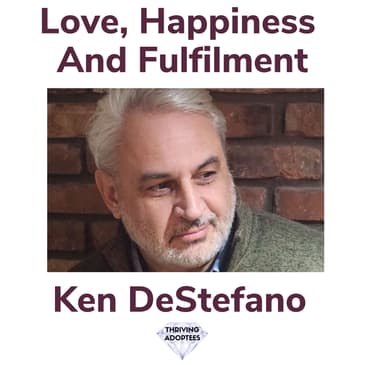
Who doesn't want a loving, happy and fulfilling life? Do I hear the HOW question? Listen in as Ken shares his learnings for catalyst ideas to help you along your journey.
https://www.linkedin.com/in/kennethdestefano/
https://www.facebook.com/ken.destefano.1
https://www.amazon.com/Will-See-You-Again-Hearts/dp/B0C63YSMWH
Guests and the host are not (unless mentioned) licensed pscyho-therapists and speak from their own opinion only. Seek qualified advice if you need help.
Want to learn more about thriving for you, your kids, your families or your colleagues? Pick a time to talk here
[00:00:01] [SPEAKER_01]: Hello everybody, welcome to another episode of the Thriving Adoptees podcast. Welcome to the show Ken, looking forward to speaking with you today, Ken DeStefano. Welcome to the show.
[00:00:13] [SPEAKER_03]: Thank you very much. I'm really looking forward to this. Enjoy your other podcasts.
[00:00:17] [SPEAKER_01]: Cool. Love it. I love it. Love it. I haven't said that for about 10 days. I've been a little bit quiet and been doing other stuff.
[00:00:24] [SPEAKER_01]: Maybe it's the start of autumn, maybe it's just a natural part of the podcast year, but I've been quiet. So looking forward to diving in.
[00:00:35] [SPEAKER_01]: So listeners, as you know, I often start with this question about whether the guests like, to what extent the guest resonates with healing.
[00:00:45] [SPEAKER_01]: And when I spoke to Ken last week, he said he came up with a kind of like an alternative subject to dive into.
[00:00:55] [SPEAKER_01]: And it's a big one, right? So we've got plenty to go at here.
[00:01:00] [SPEAKER_01]: And the phrase that Ken, that he talked about last weekend was living a loving, happy, fulfilling life.
[00:01:11] [SPEAKER_01]: So, and who doesn't want that? Right? Who doesn't want that?
[00:01:17] [SPEAKER_01]: So I thought we could just kind of break it down and talk about the loving bit first.
[00:01:26] [SPEAKER_01]: So because you've been married for all about same time as us, I think, is it? When did you get married, Ken?
[00:01:33] [SPEAKER_03]: 96. So I've been married 28 years.
[00:01:35] [SPEAKER_01]: Yeah. Yeah. So you picked us by one year. We got married in 1997.
[00:01:40] [SPEAKER_01]: So often people talk about challenges for adoptees with security and with relationships.
[00:01:54] [SPEAKER_01]: What does loving mean for you other than longevity?
[00:02:01] [SPEAKER_03]: Longevity means the ability in the context of what we're talking about to have an honest emotional relationship where you're vulnerable without fear of being rejected.
[00:02:17] [SPEAKER_03]: And, you know, obviously we all have the fear, but sometimes I find myself as an adoptee.
[00:02:23] [SPEAKER_03]: Maybe it extrapolates to other adoptees as I talk to them. I think sometimes it does that the fear of rejection so overwhelms the relationship that they don't allow themselves to be in a position where they're truly honest.
[00:02:39] [SPEAKER_03]: And instead of being in a mutual relationship, they're just pleasing, pleasing, pleasing.
[00:02:44] [SPEAKER_03]: And I think being that loving relationship is allowing yourself to be vulnerable, allowing yourself to be possibly possible to being rejected.
[00:02:55] [SPEAKER_03]: And likewise, accepting that what is being given to you is sincere. It's not manufactured. It's not synthetic.
[00:03:05] [SPEAKER_03]: So I think that's what I look at when I see being in a loving relationship.
[00:03:09] [SPEAKER_01]: And when did you tell your girlfriend that became your fiance, that became your wife? When did you tell her that you were adopted?
[00:03:19] [SPEAKER_03]: I don't really remember, but it was very early on. Very, very early on before we got married.
[00:03:25] [SPEAKER_01]: Yeah.
[00:03:25] [SPEAKER_03]: And back then it wasn't like I was disclosing a state secret. It was just casually talked about in my family, casually talked about among people I know.
[00:03:35] [SPEAKER_03]: So that's why you don't really have any specific reference or memory of when it was told to her.
[00:03:40] [SPEAKER_01]: Yeah. Yeah. And what about outside? What about outside the romantic relationships?
[00:03:48] [SPEAKER_01]: What about your relationships with your kids or with your adopted parents, with your birth parents?
[00:03:57] [SPEAKER_01]: What does that look like for you?
[00:04:01] [SPEAKER_03]: With my adopted parents, they, my father passed away in 96, 97 actually.
[00:04:12] [SPEAKER_03]: So again, we always had a very comfortable relationship with being adopted.
[00:04:17] [SPEAKER_03]: I'll tell you, the questions that bothered me that ultimately have surfaced in the last several years really were under the surface when I was at age.
[00:04:26] [SPEAKER_03]: So when I was in my 20s and 30s, so we didn't really address it that much.
[00:04:32] [SPEAKER_03]: My mother recently, she's still alive.
[00:04:35] [SPEAKER_03]: You know, like any adopted mother, it probably took her as a little surprise that at this point in my life I wanted to start digging.
[00:04:43] [SPEAKER_03]: But, you know, I couldn't be happier with the response.
[00:04:46] [SPEAKER_03]: You know, she's shown a true support.
[00:04:50] [SPEAKER_03]: She's shown an interest in listening to the ways that it impacted my life and my perception.
[00:04:58] [SPEAKER_03]: So I've been very happy with that.
[00:05:00] [SPEAKER_03]: In terms of my kids, I don't know.
[00:05:03] [SPEAKER_03]: Other than, you know, I just love them beyond belief.
[00:05:06] [SPEAKER_03]: They're great, fantastic kids and I just can't be around them enough.
[00:05:10] [SPEAKER_03]: I can't spend enough time with them even though they are older.
[00:05:13] [SPEAKER_03]: I suppose there's some adoptee related element there, but I don't really say it.
[00:05:19] [SPEAKER_01]: Yeah, because we don't know what we don't know.
[00:05:22] [SPEAKER_01]: We don't know what is adoption.
[00:05:24] [SPEAKER_01]: We can be pinning the tail on the wrong donkey, you know, blaming adoption for different stuff.
[00:05:28] [SPEAKER_01]: But we only have our experience.
[00:05:31] [SPEAKER_01]: So it's hard for us to get inside anybody else's heads, hearts or relationships to figure out what's going on.
[00:05:39] [SPEAKER_01]: So in terms of, you know, you mentioned your adoptive parents and where you were at that time.
[00:05:47] [SPEAKER_01]: So how old were you when you kind of came out of the fog?
[00:05:53] [SPEAKER_03]: I came out of the fog probably, let's see, in my late 40s, about 47, 48.
[00:05:58] [SPEAKER_03]: I got my original birth certificate in 2017.
[00:06:02] [SPEAKER_03]: And really the way what I think happened with me is my first child was born in 99,
[00:06:07] [SPEAKER_03]: my second and 03, and really experienced mirroring for the first time.
[00:06:12] [SPEAKER_03]: Like I saw people that were me and it was a little bit jarring.
[00:06:18] [SPEAKER_03]: Unfortunately or fortunately life was so busy at that time I had to sort of repress all that discovery and intuition until life calmed down.
[00:06:28] [SPEAKER_03]: It was just too busy with paying the rent, paying the mortgage, driving the kids around, night feedings, all of that.
[00:06:36] [SPEAKER_03]: And then, like I said about seven years ago, now my youngest is in high school.
[00:06:40] [SPEAKER_03]: Life has calmed down a little bit and it started to, I started to think about it more.
[00:06:47] [SPEAKER_03]: I started to have a little more time to breathe and think about some of the issues that I think were sparked at that point, at that initial point when my son was born.
[00:06:58] [SPEAKER_01]: It's weird isn't it how the busyness distracts us, right?
[00:07:04] [SPEAKER_01]: It kind of covers up what's going on and we're so busy we haven't got time to think or feel.
[00:07:16] [SPEAKER_01]: But clearly at some point you had that time.
[00:07:20] [SPEAKER_01]: And what was it like for you coming out the fork in your late 40s?
[00:07:27] [SPEAKER_01]: What did that feel like? What did that look like for you?
[00:07:30] [SPEAKER_03]: It just felt like a slowly, slow opening of all the question, of a box that all the questions had been sitting in.
[00:07:39] [SPEAKER_03]: And it wasn't a waterfall, it was a trickle.
[00:07:43] [SPEAKER_03]: Why are so many of my friendships a couple years then out?
[00:07:49] [SPEAKER_03]: Why do my working relationships tend to be very hot and then go cold?
[00:07:55] [SPEAKER_03]: I think I saw more in terms of my friends and working relationships because I think what I would do is work so hard to be what people wanted me to be.
[00:08:07] [SPEAKER_03]: And find out and please them and then at some point it would just be, I would start getting tired of doing all that work.
[00:08:14] [SPEAKER_03]: And then I would start getting resentful of them for me feeling like I had to act a certain way.
[00:08:23] [SPEAKER_03]: And it really was unfair to me, but it was also unfair to them because in many cases there was no really even stated expectation from them that they wanted me to act a certain way.
[00:08:36] [SPEAKER_03]: I was just forcing myself to act a certain way.
[00:08:38] [SPEAKER_03]: And I started to wonder why I was like that. What made me different?
[00:08:42] [SPEAKER_03]: Why? What was really driving some of these personality quirks?
[00:08:46] [SPEAKER_01]: Yeah, so it sounds like you weren't trying hard with the closer relationships.
[00:08:52] [SPEAKER_01]: It was the less close relationships, the friendships and the work colleagues.
[00:08:58] [SPEAKER_03]: Yeah, the peripherals, some of the peripherals.
[00:09:01] [SPEAKER_03]: I think the closer relationships I had achieved a level of security with.
[00:09:08] [SPEAKER_03]: And even, you know, but it was more the brushes, the shorter term relationships.
[00:09:14] [SPEAKER_01]: But was it a gentle curiosity? Was it more intense? What did it feel like for you?
[00:09:22] [SPEAKER_03]: It started off gentle, but then it became like that itch that kept going away and saying, you know what?
[00:09:27] [SPEAKER_03]: And then I started thinking more about how, you know, I am different than other people.
[00:09:32] [SPEAKER_03]: I am different from people in my adopted family.
[00:09:35] [SPEAKER_03]: They're great people, but frankly we look different.
[00:09:40] [SPEAKER_03]: We resemble each other and I think differently.
[00:09:45] [SPEAKER_03]: Like I would see pictures and when I was young, I hated taking pictures and I looked different from the people.
[00:09:51] [SPEAKER_03]: I have a mother and father and two older siblings who are biological to my parents.
[00:09:57] [SPEAKER_03]: Then I'm adopted and I have a younger brother who's adopted and I would just look different.
[00:10:03] [SPEAKER_03]: And then when the other part is, I would think differently and started wondering, you know, am I?
[00:10:10] [SPEAKER_03]: You assume the entire world views the world the way your adopted family does.
[00:10:14] [SPEAKER_03]: So you assume the way you view it is incorrect.
[00:10:17] [SPEAKER_03]: And I started wondering, is it just am I? Is it incorrect or is it just different?
[00:10:24] [SPEAKER_01]: Yeah. So what did you do about that?
[00:10:27] [SPEAKER_03]: I started to search New Jersey passed a law that in January 2017, you could get your original birth certificate.
[00:10:34] [SPEAKER_03]: Just write a letter to the Department of Health. I did so.
[00:10:38] [SPEAKER_03]: I got my original birth certificates and started to search for my birth mother.
[00:10:42] [SPEAKER_03]: Took about five or six months. Ultimately got her phone number.
[00:10:45] [SPEAKER_03]: Called her. We spoke and I've been in touch with her since including two half sisters and a half brother.
[00:10:53] [SPEAKER_01]: Yeah. So it's interesting, like you're looking for questions on the roots to on your roots, on your background to help you understand or change the way.
[00:11:11] [SPEAKER_01]: Were you wanted to change the way you behaved?
[00:11:15] [SPEAKER_01]: Were you or you wanted to change outcomes with relationships or?
[00:11:20] [SPEAKER_03]: I just want to see. It felt like something was wrong with me.
[00:11:25] [SPEAKER_03]: So I wanted to see if something was in looking at the past helped me see that there wasn't anything wrong.
[00:11:33] [SPEAKER_03]: It was just a little different. And then once you get a sense that it is different, that you did have a different experience first from your biological parents and the primal wound, etc.
[00:11:45] [SPEAKER_03]: Then you get then you would I would move to the point of wait, how has this affected my relationships in the past?
[00:11:52] [SPEAKER_03]: And how can I make sure that it doesn't affect my relationships going forward in a negative way?
[00:11:58] [SPEAKER_01]: Yeah. But you were seeking to do that through reading the primal wound, I guess, and through the.
[00:12:05] [SPEAKER_03]: No, I didn't read it. I just heard about it.
[00:12:08] [SPEAKER_03]: I just learned about the primal wound and talked about it.
[00:12:10] [SPEAKER_03]: But again, knowing that that separation, as I kind of explored myself, brought me to that.
[00:12:17] [SPEAKER_03]: Yeah. What triggered one of the big things was I read Anne Heffron's book, You Don't Look Adopted.
[00:12:23] [SPEAKER_03]: And I was totally baffled by the fact that there was somebody in a world whose mind worked like mine and who had the same questions that I had had that I thought I was the only person in the world that I thought there was something very wrong with.
[00:12:37] [SPEAKER_03]: And it turns out reading her book and speaking to many, many people that they're pretty common.
[00:12:43] [SPEAKER_01]: Yeah. So there was a relief that was that?
[00:12:45] [SPEAKER_03]: It was. It was. It made me feel less like a Martian.
[00:12:48] [SPEAKER_01]: Yeah. So you're pursuing it on two levels, right? You're doing your reading and you're searching for your birth mother, presumably to see what she was like, was it?
[00:13:08] [SPEAKER_03]: Yeah. Just to see if there were things that I always found peculiar about myself, where'd they come from? What did it mean? And I'll tell you, there's that.
[00:13:22] [SPEAKER_03]: And since I was very young, I always had this burning curiosity about why? Why was I given up for adoption? And on the pre-logical level and then most of my life. And I guess that question never went away. So I wanted to talk to her and find out what happened.
[00:13:37] [SPEAKER_01]: Yeah. But it sounds like you were asking that question, why? But was there a lot of angst behind that question? I mean, was it a gentle wondering? Was it more like a really deep yearning to know where was it? What was it like?
[00:13:59] [SPEAKER_03]: Yes, exactly. And I said that on purpose. No, no, I said that on purpose. It was both. It was, you know, I'm not a person whose emotions go from zero to 10. I'm generally between four and six. So it was more like dull and persistent, but for me very strong.
[00:14:20] [SPEAKER_03]: But it was just once it kind of got into my brain, you know, I have to get to the bottom of this. I have to find out what I'm all about. I have to understand these things because I kind of felt like I was at the point in my life where I needed to know some things to move forward.
[00:14:40] [SPEAKER_01]: Yeah. So what impact did connecting with your birth mother have for you?
[00:14:47] [SPEAKER_03]: Well, it was very reassuring because I found out that there was incredible confusion on her end. Not confusion, she extremely reluctance to give me up. But she just felt like the circumstances absolutely mandated it, that she had no option.
[00:15:06] [SPEAKER_03]: But you know, mostly culturally what her family, there was not going to be support. The area she lived, there was not going to be support. And I was in the hospital for over a week because she couldn't sign the papers. So it was very reassuring to know that, you know, it wasn't just a piece of garbage being left by the side of the road.
[00:15:27] [SPEAKER_02]: Yeah.
[00:15:29] [SPEAKER_03]: It's still, you know, there's still the wounds there but it was nice on a logical level to know that there was love and it was a difficult decision.
[00:15:38] Yeah.
[00:15:43] [SPEAKER_01]: You discovered her reluctance.
[00:15:45] [SPEAKER_00]: Yeah.
[00:15:48] [SPEAKER_01]: Because I think one of the key things that we do as youngsters and, you know, the younger it starts, perhaps the bigger it is, is we take adoption personally.
[00:16:10] [SPEAKER_01]: Yes.
[00:16:12] [SPEAKER_01]: Despite the fact that the adoption plan has been made before our birth, often. Right? So it wasn't like we were rejected on site. Do you know what I mean? It's not like a quality control in a factory where things are going, just before they go out of the factory door, they fail a quality check.
[00:16:38] [SPEAKER_01]: But we take it personally somehow. But how could it have been perfect? How could it have been if the plan's made before, if the plan is made because of all the social constructs at the time, the culture at the time?
[00:17:06] [SPEAKER_01]: And is that what you mean by reluctance? Is not seeing that it was impersonal?
[00:17:15] [SPEAKER_03]: Well, first I just love your observation there. That, you know, Ken wasn't given up for adoption. A baby was. A baby that had been committed to adoption before anybody knew that Ken was or Simon was. I love that approach.
[00:17:30] [SPEAKER_03]: It is, I think the reluctance I found actually plays in with that is once my birth mother realized I was Ken, it became harder for her. As opposed, and Ken wasn't the name she gave me, but once she, it's almost a reverse rejection now that I think about it in the way you put it, is once she got to know and encounter me as an individual,
[00:17:58] [SPEAKER_03]: not an abstract baby, it became harder. And it was very reassuring to know that, you know, once she got to know me, every fiber of her being wanted to keep me, but she just couldn't.
[00:18:17] [SPEAKER_03]: That's pretty profound, isn't it?
[00:18:19] [SPEAKER_03]: I don't know if I'd say that, but I appreciate you saying it.
[00:18:23] [SPEAKER_01]: Well, yeah. One of my favorite sayings is that we can't see the picture when we're in the frame.
[00:18:34] [SPEAKER_03]: Yeah, that's nice.
[00:18:37] [SPEAKER_01]: That's nice.
[00:18:37] [SPEAKER_01]: Yeah, there's a business mentor who did a lot of mindset, did a lot of mindset kind of work with him, a guy called Christian Simpson.
[00:18:50] [SPEAKER_01]: Yeah, it's hard to see the picture when you're in the frame. And by that, it's like we can't see our own strengths, weaknesses, profundity, wisdom, love.
[00:19:08] [SPEAKER_01]: I had this moment a couple of probably a month or so ago now when I was thinking about a conversation I was going to have with a birth mother.
[00:19:21] [SPEAKER_01]: Or an email I got from a birth mother, I think you want, a lady called Laura Engels. And she interviewed me on the show and I was thinking, because sometimes birth mothers, I feel like birth mothers want to mother me.
[00:19:40] [SPEAKER_01]: You know, they see me at my best. And I think she seems to think that I'm a really nice guy.
[00:19:52] [SPEAKER_01]: And then I had a little tear came to my eye about, you know, do I see that? It's pretty rare for me to see that I'm a nice guy.
[00:20:07] [SPEAKER_03]: Exactly. Exactly. And I'm sure you are, but we just don't perceive ourselves that way.
[00:20:14] [SPEAKER_01]: Because it's hard to see the picture when we're in the frame. But that leads me on to your second word, right? Happy. So what does happiness mean to you?
[00:20:31] [SPEAKER_03]: I think of happiness more like a piece, you know, where it's not the feeling of going on a roller coaster and just having the time of your life or, you know, when a when a Giants win the Super Bowl.
[00:20:45] [SPEAKER_03]: That that's something different. Happiness is that piece that I'm on a path, going the way I want to go.
[00:20:53] [SPEAKER_03]: I'm doing the work. I'm doing what I want to be doing. I'm handling things the way I want to handle my relationships are are are dictated by truth and honesty.
[00:21:10] [SPEAKER_03]: I'm not trying to be something I'm not, and I'm just peaceful with myself and not chasing something that people tell me I should chase.
[00:21:20] [SPEAKER_01]: Yeah. And how have those I mean, I think you use the word peripheral, don't you? How have those peripheral relationships changed for you over those last seven, eight years?
[00:21:35] [SPEAKER_03]: Well, frankly, a lot of them have ended because I realized it was an unbalanced relationship that I was trying to keep alive.
[00:21:43] [SPEAKER_03]: But I think the good thing is that the newer relationships are based on a more fundamental honesty of equality.
[00:21:51] [SPEAKER_03]: And I think they're much deeper. And I think that's really a good thing.
[00:21:56] [SPEAKER_03]: And, you know, it's very hard to let go of the past. You know, we're in relationships sometimes with people for a long time.
[00:22:03] [SPEAKER_03]: You know, a friend, a friend I've been friends with since college.
[00:22:06] [SPEAKER_03]: You know, basically, we just drifted apart because I felt that we were not equal in the relationship and it drifted.
[00:22:13] [SPEAKER_03]: But I've established some good friendship since then. And it's really a good thing.
[00:22:17] [SPEAKER_01]: Yeah. What do you mean by not equal? Or maybe to state it in the positive, how what does more equal?
[00:22:28] [SPEAKER_01]: What do these newer peripheral relationships that are more equal look like?
[00:22:33] [SPEAKER_03]: It means that. I. We have an apparent.
[00:22:43] [SPEAKER_03]: Equal increase in maintaining the relationship with each other. It's not me constantly reaching out.
[00:22:50] [SPEAKER_03]: How are you? It's not always being the initiator. It's not always being the conceder.
[00:22:57] [SPEAKER_03]: It's much more happens both ways.
[00:23:00] [SPEAKER_03]: And I think some of the old ones developed that way because I was so afraid that if I didn't do that, the person would just go away.
[00:23:09] [SPEAKER_03]: And frankly, some of them are probably because of this dynamic about me.
[00:23:13] [SPEAKER_03]: I probably know I don't want to overstay it, but they probably weren't the healthiest relationships in the world.
[00:23:20] [SPEAKER_01]: It sounds it sounds healthier. Yeah, for sure.
[00:23:25] [SPEAKER_01]: Yeah, there's this part of me that also says that I think we can kind of get into a routine with the relationships where we are.
[00:23:38] [SPEAKER_01]: One person is the initiator that sends the text message or the WhatsApp or gives the other person a call.
[00:23:43] [SPEAKER_01]: And the other is it's just a routine that we kind of get get into.
[00:23:53] [SPEAKER_01]: Almost like it's not always who instigates who instigates the contact, who suggests the meal out whenever.
[00:24:06] [SPEAKER_01]: It's not it's not always it's not always a power thing.
[00:24:11] [SPEAKER_03]: It's just that. And maybe that's that's such a good point, because that moves the discussion forward.
[00:24:18] [SPEAKER_03]: And I think that I personally have this tendency to be like this.
[00:24:26] [SPEAKER_03]: I have this tendency to notice that I'm like this.
[00:24:29] [SPEAKER_03]: And maybe in this process, I just have to stay away from that relationship until I'm that type of relationship, until there's more security.
[00:24:41] [SPEAKER_03]: Like a lot of times I think like driving.
[00:24:43] [SPEAKER_03]: You ever driven a car where like the driver's tire was a little bit low?
[00:24:49] [SPEAKER_03]: Right. Oh, I guess your driver's tires on the other side, but it constantly wants to be on the correct side.
[00:24:55] [SPEAKER_03]: You're on the wrong side. Yes, of course.
[00:24:59] [SPEAKER_03]: But the car pulls that way so you constantly you can drive it, but you just have to always be doing a little extra work to go straight.
[00:25:07] [SPEAKER_03]: And I kind of think sometimes with relationships, you know, I see myself being pulled a certain way in certain situations and have to constantly making the correction.
[00:25:21] [SPEAKER_03]: And if there is if I'm in a relationship with a friend that is actually pushing me further that way, that's not a good thing.
[00:25:30] [SPEAKER_03]: And it's maybe not something I'm ready for at this point in life.
[00:25:34] [SPEAKER_03]: Maybe when I'm further through the fog or more healed or more complete, I'll be more comfortable in that type of dynamic.
[00:25:40] [SPEAKER_03]: But right now, it just it it will be the way it would ignite my weaknesses and insecurities in an unhealthy way.
[00:25:50] [SPEAKER_03]: And when I talk about maybe these relations separating, you know, they weren't just disappearing.
[00:25:55] [SPEAKER_03]: It would be a conversation and it would be, you know, it's not just the mechanics of the going back.
[00:26:01] [SPEAKER_03]: It was much more substantive than that. So I do think one of the things I like to try and do is understand the way my mind works and and really think like, how is this impacting the situation?
[00:26:16] [SPEAKER_03]: And frankly, there's some situations that are good for some people that probably at this point are not good for me because I'm not healthy enough to handle that stress on my personality.
[00:26:29] [SPEAKER_01]: You talked about doing doing the work.
[00:26:33] [SPEAKER_01]: Have you done much work?
[00:26:36] [SPEAKER_01]: I mean, sometimes people use that phrase for going to therapy or reading books or what are they doing hanging out and doing them with support groups and stuff like that.
[00:26:46] [SPEAKER_01]: Have you done much of that?
[00:26:50] [SPEAKER_03]: I had done therapy. Frankly, it didn't.
[00:26:52] [SPEAKER_03]: It wasn't great for me because I think the therapist was not really in tune with these type of issues, you know, with adopt things, adoptee deal with.
[00:27:05] [SPEAKER_03]: I think I'm not to put myself on the back.
[00:27:07] [SPEAKER_03]: I think I'm a fairly self-reflected person.
[00:27:09] [SPEAKER_03]: So a lot of this has been internal reflection.
[00:27:12] [SPEAKER_03]: A lot of it has been talking to other adoptees.
[00:27:16] [SPEAKER_03]: And then, you know, I wrote a book which I found very it's a novel, but there is certainly true elements to it.
[00:27:23] [SPEAKER_03]: It really brought me into a place to address some things that I thought had to be addressed.
[00:27:28] [SPEAKER_03]: And then when I say doing the work, it's you know, it's times when situations arise and my wiring that may have been a little bit manipulated by being adopted.
[00:27:45] [SPEAKER_03]: Once the thought process to go in one direction, which doesn't isn't reflective of reality.
[00:27:54] [SPEAKER_03]: So the work is at those moments trying to be conscious of the present, conscious of what is actually happening versus what maybe some faulty wiring is telling me that's happening and just trying to be disciplined and strength and strong to deal with reality on reality's terms, not a manipulated reality caused by some of my tendencies.
[00:28:18] [SPEAKER_00]: So it's like a self check system.
[00:28:22] [SPEAKER_00]: So I think self check your sense check.
[00:28:24] [SPEAKER_03]: Yeah, it's an attempt.
[00:28:26] [SPEAKER_03]: It's an attempt.
[00:28:27] [SPEAKER_03]: And, you know, what I always say about it is, you know, on one level, it's very simple, but never confused simple and easy.
[00:28:35] [SPEAKER_03]: You know, it's very simple, but it's very, very difficult because there's a time this little this little gremlin raises its head quite often and tries to make you think that something negative is happening when something negative isn't happening.
[00:28:50] [SPEAKER_03]: It's just life.
[00:28:54] [SPEAKER_01]: Yeah.
[00:28:59] [SPEAKER_01]: I was thinking back to the relationship stuff.
[00:29:03] [SPEAKER_01]: And I was thinking back to girlfriends and wanting the ones that didn't want me and not wanting the ones that did make.
[00:29:13] [SPEAKER_01]: And I was thinking, now, is that an adoptee thing?
[00:29:16] [SPEAKER_01]: You know what I mean?
[00:29:16] [SPEAKER_01]: Because a lot of people would go well, you know, like non-adoptee people will say, you know, well, you're a six and she's an eight.
[00:29:24] [SPEAKER_01]: So you're punching above your weight or, you know, they will do that.
[00:29:31] [SPEAKER_01]: They will.
[00:29:34] [SPEAKER_01]: It's a human thing, not an adoptee thing.
[00:29:37] [SPEAKER_03]: It is.
[00:29:38] [SPEAKER_03]: It is.
[00:29:40] [SPEAKER_03]: But maybe it's an adoptee thing on steroids, as we say in pre-baseball.
[00:29:45] [SPEAKER_03]: I think it is more so.
[00:29:48] [SPEAKER_03]: I got married fairly, I guess, 27.
[00:29:51] [SPEAKER_03]: I was in my serious relationship with my wife at 25.
[00:29:55] [SPEAKER_03]: And frankly, I hadn't dated much.
[00:29:57] [SPEAKER_03]: Like, there were just not many.
[00:30:01] [SPEAKER_03]: There was not much interest in me.
[00:30:04] [SPEAKER_03]: Right.
[00:30:05] [SPEAKER_03]: And that's the way it was.
[00:30:07] [SPEAKER_03]: And so it wasn't, I really didn't even have this dynamic that often because I would want somebody.
[00:30:13] [SPEAKER_03]: But there tend to be not much reciprocal interest.
[00:30:17] [SPEAKER_01]: Yeah, I can really, I can distinctly remember the girlfriend that had before my wife pushing her away because she had me on a pedestal and I just couldn't cope with it.
[00:30:32] [SPEAKER_01]: Like, yeah, that was weird.
[00:30:38] [SPEAKER_01]: That was really weird.
[00:30:39] [SPEAKER_03]: There is an old joke, of course, that I would never date anybody who would be willing to date me.
[00:30:44] [SPEAKER_01]: Oh, right. It's like being a part of the club, right?
[00:30:49] [SPEAKER_01]: So you talked about the writing the book being part of your work on yourself, right?
[00:30:59] [SPEAKER_01]: Yes.
[00:31:04] [SPEAKER_01]: You talked about being a fairly self-reflective sort of guy.
[00:31:14] [SPEAKER_01]: Oh, I just want to pick up one thing that in case listeners haven't heard us talking about this, probably have.
[00:31:24] [SPEAKER_01]: There's a fundamental challenge with talk therapy for trauma that is pre-verbal.
[00:31:33] [SPEAKER_01]: That's what I've interviewed a lot of adoptees who are therapists for adoptees over the last couple of years.
[00:31:43] [SPEAKER_01]: And more and more of them have said that, right?
[00:31:46] [SPEAKER_01]: So it's something more fundamental.
[00:31:52] [SPEAKER_01]: It's a more fundamental barrier, I think.
[00:31:57] [SPEAKER_01]: You talked about it.
[00:31:59] [SPEAKER_01]: The therapist didn't go great because they didn't have a lot of experience with this sort of thing, I think is what you said.
[00:32:07] [SPEAKER_01]: But the challenge is even more fundamental than that, you know, with talk therapy and pre-verbal.
[00:32:12] [SPEAKER_01]: I'm assuming it was the talk therapy kind of thing.
[00:32:15] [SPEAKER_01]: Yes, yes.
[00:32:17] [SPEAKER_01]: Just to be aware of that as a learning point listeners, because we often ask that question, you know, what gets in the way of us healing or us living a loving, happy and fulfilling life?
[00:32:37] [SPEAKER_01]: And some of it is not doing the work, right?
[00:32:43] [SPEAKER_01]: Or being validated and stuck in our stuckness rather than being self-reflective or being coached or self-coaching to move forward.
[00:33:04] [SPEAKER_01]: We're that pleased with the validation.
[00:33:06] [SPEAKER_01]: I'm talking about myself reading the Primal Wound and being relieved.
[00:33:12] [SPEAKER_01]: And then the relief being replaced by a feeling, well, I'm stuck with this.
[00:33:22] [SPEAKER_01]: And then me reading the follow-up book, which is supposed to be about the healing of it,
[00:33:28] [SPEAKER_01]: I'm just thinking this is far too much psychological mumbo jumbo, far too much to do.
[00:33:36] [SPEAKER_01]: It just doesn't, this doesn't, she's defined the challenge quite well, in my opinion.
[00:33:46] [SPEAKER_01]: But she's not defined the process out of it, the healing.
[00:33:56] [SPEAKER_01]: If she's going to use the word wound, the word healing will stick with her, right?
[00:34:01] [SPEAKER_01]: But she doesn't define that very well in my opinion.
[00:34:09] [SPEAKER_03]: Sorry, can I just give you a quick thought about healing and the Primal Wound?
[00:34:17] [SPEAKER_03]: First, I'm not as well read and I'm certainly not as studied as many, many people in the adoption community.
[00:34:22] [SPEAKER_03]: I'm fairly new. But again, from my own self-reflection, I've heard a lot of talk about healing, healing from the Primal Wound.
[00:34:32] [SPEAKER_03]: For me personally, I don't view that as the, for me, the best approach to the discussion because I think this happened to me.
[00:34:46] [SPEAKER_03]: There was a schism between my birth mother and I when I was taken away.
[00:34:52] [SPEAKER_03]: That will never heal, is the way I think. For me personally.
[00:34:58] [SPEAKER_03]: You take someone who was born without a hand. That hand is never going to heal.
[00:35:05] [SPEAKER_03]: I don't think that the trauma that was imposed on me at that moment of separation where for nine months I heard a heartbeat, a breath, a voice, a singing voice, everything.
[00:35:18] [SPEAKER_03]: And then also I never heard it again at a moment when logic didn't function in my brain and I was totally ripped from that.
[00:35:27] [SPEAKER_03]: And that did something to my soul, to my psyche, to my mind that will never heal.
[00:35:33] [SPEAKER_03]: Much like that person was born without a hand will never grow a hand. There's nothing the doctors can do.
[00:35:41] [SPEAKER_03]: Again, this is just me. I don't mean to say anybody else should think of it and maybe it's even a bad thought.
[00:35:46] [SPEAKER_03]: Maybe you'll say it's about, show me that it's a bad thought, which I would love.
[00:35:50] [SPEAKER_03]: My feeling is what I have to do is like that person born without a hand, I have to learn to tie my shoe with one hand.
[00:35:57] [SPEAKER_03]: I have to understand that this is what happened to me and notwithstanding that still get to the point of having a loving, happy, and peaceful and fulfilling life.
[00:36:10] [SPEAKER_03]: And that's why the thought I always use again, even when I get in these situations where it seems to rear its head, where those that trauma seems to come up.
[00:36:19] [SPEAKER_03]: I'm not trying to heal the trauma. I'm trying to learn to tie my shoes with one hand.
[00:36:26] [SPEAKER_01]: We can go down it. We can go down the healing road if you want.
[00:36:31] [SPEAKER_03]: Whatever you want.
[00:36:32] [SPEAKER_01]: Well, I think we can pick the metaphors. We can extend the metaphors.
[00:36:42] [SPEAKER_01]: We can and we can play a word game with that.
[00:36:50] [SPEAKER_01]: And I think the listeners will know my thoughts on this.
[00:37:02] [SPEAKER_01]: I'll sum it up for you in two sentences and then we'll move on to your topic because the next word is fulfilling, right?
[00:37:12] [SPEAKER_01]: So in and it's not going to be two sentences. It's going to be more like four or five.
[00:37:19] [SPEAKER_01]: Right. So I mean, just just add commas instead of periods and then still two sentences.
[00:37:24] [SPEAKER_01]: Okay. Like the way you did that.
[00:37:26] [SPEAKER_01]: So on one level, psychologically we may be healing for the rest of our lives.
[00:37:33] [SPEAKER_01]: But we're not our psychology.
[00:37:37] [SPEAKER_01]: So at a deeper level underneath our psychology, we were never we don't have to heal because we were never wounded.
[00:37:46] [SPEAKER_01]: Who we are is who we are at our essence is fundamentally unwoundable.
[00:37:57] [SPEAKER_01]: That's that's my take.
[00:37:59] [SPEAKER_01]: So I'm I'm agreeing with you in healing forever on one level.
[00:38:05] [SPEAKER_01]: I'm agreeing with you on that.
[00:38:07] [SPEAKER_01]: And I'm also saying that at a deeper level, we were never wounded because our spirit or our essence, our consciousness awareness, that isn't a thing.
[00:38:20] [SPEAKER_01]: It's not a thing. So we can't be winded.
[00:38:24] [SPEAKER_01]: I love the way you put that.
[00:38:29] [SPEAKER_01]: I spend a lot of time thinking about this and I'm trying to get it into a bit where I can clearly state it clearly and concisely.
[00:38:43] [SPEAKER_01]: So back to fulfilling that what does fulfillment mean to you?
[00:38:50] [SPEAKER_03]: Fulfillment means that I have these things I want my life to be.
[00:38:58] [SPEAKER_03]: I want it to be loving. I want to have good relationships.
[00:39:02] [SPEAKER_03]: I want to be a productive member of society.
[00:39:07] [SPEAKER_03]: And I want to feel like in those relationships, in my work, in my charity work, in my sporting that life,
[00:39:20] [SPEAKER_03]: that the way I'm going about doing something is achieving the results that I'm hoping to achieve.
[00:39:30] [SPEAKER_03]: That I'm attaining things in relationships and even in other things, like on a much more practical level that I think I'm capable of achieving in a good way.
[00:39:40] [SPEAKER_03]: Yeah. And that I'm not being dragged down.
[00:39:42] [SPEAKER_03]: I remember my high school basketball coach who was really the total epitome of an ass.
[00:39:50] [SPEAKER_03]: But he used to say, talk about fear of heights.
[00:39:53] [SPEAKER_03]: And he used to talk about there are some people who are just afraid to be great at something and you have to dare to be great.
[00:39:59] [SPEAKER_03]: And I really this was not a good person.
[00:40:02] [SPEAKER_03]: But I don't want those quirks of my personality to hold me back from what I'm hoping to achieve both professionally and personally.
[00:40:12] [SPEAKER_01]: Yeah. It's funny what some coaches get into.
[00:40:18] [SPEAKER_01]: Like you see him on telly and just think this there's a lot of documentary programs, you know, at the moment.
[00:40:30] [SPEAKER_01]: And there's my mum and dad, Dr. Pennington are from Burnley in Lancashire.
[00:40:40] [SPEAKER_01]: And there's a series and it's called Mission to Burnley.
[00:40:45] [SPEAKER_01]: Burnley is run by some Americans who are Mormons and they and his dad.
[00:40:56] [SPEAKER_01]: One of the dads went to Burnley to presumably to on a mission to train, you know, build up some business for Mormons.
[00:41:05] [SPEAKER_01]: I think that's what they tried.
[00:41:07] [SPEAKER_01]: And this I love the people of Burnley.
[00:41:10] [SPEAKER_01]: And that's one of the reasons that this group of business guys are brought to Burnley.
[00:41:15] [SPEAKER_01]: But they brought in this coach and the guy you see the guy shouting and swearing at the football players in the dressing room.
[00:41:31] [SPEAKER_01]: And they got relegated last year and Bayern Munich have hired this coach.
[00:41:42] [SPEAKER_01]: They must have seen him in action.
[00:41:46] [SPEAKER_01]: They must have seen him in action on this documentary.
[00:41:50] [SPEAKER_01]: And he's shouting and swearing at them.
[00:41:53] [SPEAKER_01]: And he's being very vague in his instructions to the to the team.
[00:41:58] [SPEAKER_01]: So it sounds like a bit like your your your basketball coach.
[00:42:04] [SPEAKER_01]: And if you're wondering what this has got to do with anything listeners, I sometimes think we just have to check in with the people that we're listening to.
[00:42:25] [SPEAKER_01]: The the the are they are they ahead of us on the journey?
[00:42:29] [SPEAKER_01]: Right.
[00:42:31] [SPEAKER_01]: Is is is in a in a in an adoptee group, right?
[00:42:35] [SPEAKER_01]: Or in a in a in a.
[00:42:39] [SPEAKER_01]: As we go on this path to living a loving, happy, fulfilling life, do we do are we listening to people that are ahead of us on the journey or behind us on the journey?
[00:42:52] [SPEAKER_01]: And if we've been people pleasing, then we may get into that.
[00:42:59] [SPEAKER_01]: We may get into that position where we're not as discerning really.
[00:43:06] [SPEAKER_01]: You know, and I guess self reflection and reflecting on on others and whether we want them in our world or not, because you've been through that, haven't you?
[00:43:28] [SPEAKER_01]: You've you talked about that a little bit before.
[00:43:32] [SPEAKER_01]: Yeah, that was a bit of a round around about question, wasn't it?
[00:43:37] [SPEAKER_01]: I'm not sure why I took his down that line.
[00:43:40] [SPEAKER_03]: But it was very interesting.
[00:43:43] [SPEAKER_03]: But it is, you know, it does raise the question of perhaps, you know, we do get caught in these cycles where people say things to us that make such a deep impression when you like you say.
[00:43:59] [SPEAKER_03]: They're behind us on the on the path.
[00:44:02] [SPEAKER_03]: Why?
[00:44:04] [SPEAKER_03]: They should be listening to us, not the other way around.
[00:44:06] [SPEAKER_03]: And it gets in the way and we don't have that honest self, the honest and accurate, maybe a better word, self assessment to understand that this is not somebody who necessarily I should be.
[00:44:21] [SPEAKER_00]: Yeah.
[00:44:22] [SPEAKER_03]: Listening to an impactful away.
[00:44:24] [SPEAKER_01]: Yeah.
[00:44:27] [SPEAKER_01]: I'm I think about this validation thing being as a my experience with it, it being a double edged sword to a to a certain degree.
[00:44:39] [SPEAKER_01]: There's a relief and then there's a stockness.
[00:44:42] [SPEAKER_01]: Whereas a true coach in this in the sense would be would be asking us questions.
[00:44:54] [SPEAKER_01]: For us to encourage self reflection, to encourage us to look at our beliefs.
[00:45:01] [SPEAKER_01]: And this thing that I find myself saying a lot at the moment, something fantastic from Gabor Marti feeling not feeling enough.
[00:45:20] [SPEAKER_01]: Isn't a feeling.
[00:45:22] [SPEAKER_01]: It's a belief.
[00:45:25] [SPEAKER_01]: And what's the central belief?
[00:45:28] [SPEAKER_01]: Not a central.
[00:45:31] [SPEAKER_01]: What's one of the most common beliefs amongst us adoptees that we feel that we're not enough?
[00:45:38] [SPEAKER_01]: Well, what if that feeling isn't a feeling?
[00:45:42] [SPEAKER_01]: It's a belief.
[00:45:43] [SPEAKER_01]: What what if we can put that belief under the microscope?
[00:45:53] [SPEAKER_01]: See if it's true.
[00:45:53] [SPEAKER_01]: What if we could reflect on our beliefs?
[00:45:59] [SPEAKER_03]: So, so tying into maybe something we were saying earlier, you put that belief under the microscope.
[00:46:07] [SPEAKER_03]: You realize that it's inaccurate and we really are enough.
[00:46:14] [SPEAKER_03]: What's the first word of the next paragraph?
[00:46:18] [SPEAKER_03]: Like what do you what happens because and not but for sure.
[00:46:23] [SPEAKER_01]: So here's one for you.
[00:46:28] [SPEAKER_01]: I came up with this quite pleasing.
[00:46:31] [SPEAKER_01]: The agony after the agony of insufficiency.
[00:46:38] [SPEAKER_01]: Becomes the relief in being enough.
[00:46:44] [SPEAKER_01]: And the ecstasy of seeing our infinity.
[00:46:52] [SPEAKER_03]: That's beautiful.
[00:46:55] [SPEAKER_03]: It's beautiful.
[00:46:57] [SPEAKER_03]: But I think and I think this ties back to the pragmatic level.
[00:47:02] [SPEAKER_03]: You've taken that you've taken that correction of the belief.
[00:47:06] [SPEAKER_03]: And now you're in a scenario again where your mind tells you.
[00:47:14] [SPEAKER_03]: You're not enough.
[00:47:16] [SPEAKER_03]: And how you deal with the fact your mind is telling you something that you understand logically is premised on an inaccurate belief.
[00:47:29] [SPEAKER_03]: And I think that's that's what that comes down to.
[00:47:32] [SPEAKER_03]: It's simple but hard.
[00:47:35] [SPEAKER_01]: So so I heard something I haven't name checked him recently.
[00:47:39] [SPEAKER_01]: So I'm going to name check him again.
[00:47:40] [SPEAKER_01]: Right.
[00:47:41] [SPEAKER_01]: Listeners you've got to check out this English author.
[00:47:50] [SPEAKER_01]: And Ken and I were talking about names before and they have they have class associations.
[00:47:55] [SPEAKER_01]: British national this guy's called Rupert which is usually an upper class name in Britain.
[00:48:01] [SPEAKER_01]: And I was yeah I don't know whether my mum would do it mum dad doing social climbing but I was always I was almost a Rupert.
[00:48:11] [SPEAKER_01]: I was also a Nigel which is bit of a isn't again it's not a great name in but not not having all the class connotations.
[00:48:19] [SPEAKER_01]: But there's a my favorite author is a guy called Rupert Spira and he has this book called You Are The Happiness You Seek.
[00:48:30] [SPEAKER_01]: And we're talking about living a loving happy fulfilling life.
[00:48:37] [SPEAKER_01]: You've got to get this book ladies and gentlemen.
[00:48:41] [SPEAKER_01]: And if you like listening to audio books, you can't get it on Audible.
[00:48:46] [SPEAKER_01]: So you need to get it off the Rupert of Rupert Spira dot com.
[00:48:51] [SPEAKER_01]: If you like books of us if you like books print books or Kindle books you can get on Amazon but you can't get the audio book on Audible.
[00:48:57] [SPEAKER_01]: So you got to get it off Audible.
[00:49:00] [SPEAKER_01]: So you got to get it off Rupert Spira dot com.
[00:49:03] [SPEAKER_01]: I'll put the links in the show notes.
[00:49:04] [SPEAKER_01]: And Paul fulfillment what yeah Rupert Spira talks about beliefs.
[00:49:19] [SPEAKER_01]: And some beliefs of are busted and gone right.
[00:49:27] [SPEAKER_01]: And he uses this the example of Santa Claus Father Christmas.
[00:49:32] [SPEAKER_01]: You see your dad your 10 or your eight or whatever and you see your dad coming in to your bedroom on Christmas morning with a sack of presents.
[00:49:49] [SPEAKER_01]: And you and you never believe in Father Christmas ever again because it's become clear right.
[00:49:59] [SPEAKER_01]: That's one sort of belief but a more the beliefs that we're talking about about our sufficiency about being enough.
[00:50:11] [SPEAKER_01]: That doesn't go that's not once and done.
[00:50:15] [SPEAKER_01]: That's that's something that keeps on coming around.
[00:50:18] [SPEAKER_01]: It keeps on coming around.
[00:50:20] [SPEAKER_01]: But after we have seen our infinity it becomes easier to see through the thought when it comes back around and that's it to identify that it's happening you see it.
[00:50:51] [SPEAKER_01]: Yeah.
[00:50:52] [SPEAKER_01]: Okay, yeah.
[00:50:53] [SPEAKER_01]: Good point.
[00:50:54] [SPEAKER_01]: This the awareness first right.
[00:50:55] [SPEAKER_01]: There's the awareness first and then the discernment.
[00:51:01] [SPEAKER_01]: So it doesn't go straight to discernment, it comes back around.
[00:51:06] [SPEAKER_01]: We, we, we recognize it.
[00:51:08] [SPEAKER_01]: We discern it.
[00:51:09] [SPEAKER_01]: We see it's not the truth.
[00:51:13] [SPEAKER_01]: Because it's, it's a disbelieving right old.
[00:51:17] [SPEAKER_01]: I heard somebody else say, I don't know if we should really put Spire something up.
[00:51:21] [SPEAKER_01]: Right.
[00:51:23] [SPEAKER_01]: And this is great right.
[00:51:26] [SPEAKER_01]: Do you see it as a belief or do you believe it.
[00:51:32] [SPEAKER_01]: Yeah.
[00:51:33] [SPEAKER_01]: Do you see it as a belief or do you believe it.
[00:51:37] [SPEAKER_01]: So if you see it as a belief you get a bit you've got a bit of distance between you and it.
[00:51:44] [SPEAKER_01]: But believing it, you don't see it.
[00:51:47] [SPEAKER_01]: So great.
[00:51:48] [SPEAKER_01]: I thought it's a brilliant.
[00:51:51] [SPEAKER_01]: Absolutely.
[00:51:52] [SPEAKER_01]: Distinction.
[00:51:53] [SPEAKER_03]: And where I am in my process.
[00:51:57] [SPEAKER_03]: In the reason I focused on that.
[00:51:59] [SPEAKER_03]: That the way I did is, I'm struggling to see it happening.
[00:52:04] [SPEAKER_03]: You know that that's I'm still at the stage where just seeing it happening is itself discerning it.
[00:52:11] [SPEAKER_03]: That the belief is starting to impact your situation.
[00:52:15] [SPEAKER_03]: That in itself is a challenge for other people they might have worked through that part where it comes more naturally.
[00:52:22] [SPEAKER_03]: But it's still at the earlier stages.
[00:52:25] [SPEAKER_03]: It's hard to see it that way.
[00:52:28] [SPEAKER_00]: Yeah.
[00:52:29] [SPEAKER_00]: Well, you could be saying it less because it's happening.
[00:52:32] [SPEAKER_03]: That's what you're hoping.
[00:52:37] [SPEAKER_01]: I started asking you about what you got from writing your book and then I interrupted myself with another question for you or one of my rambling thoughts.
[00:52:46] [SPEAKER_01]: So what did you get from writing the book.
[00:52:53] [SPEAKER_03]: I'll answer this two ways.
[00:52:56] [SPEAKER_03]: One was, as I said there was a mythology from day one about me about why my mother did this.
[00:53:03] [SPEAKER_03]: It's a novel and the novel is structured from the perspective of the birth mother who gives the child up.
[00:53:08] [SPEAKER_03]: And the adoptee whose life has been impacted and seeks her.
[00:53:12] [SPEAKER_03]: So I got a way to find comfort in understanding why somebody would be given up.
[00:53:20] [SPEAKER_03]: And then I also was able to express in the other part of this story.
[00:53:29] [SPEAKER_03]: Share emotions that I felt like it's a novel, but I say it's true, but not accurate.
[00:53:34] [SPEAKER_03]: What I tried to do throughout the book is create scenarios that would depict emotions that I really had.
[00:53:42] [SPEAKER_03]: And share them with the reader.
[00:53:44] [SPEAKER_03]: Now to go there you have to go to some dark deep places, some painful places that we want to avoid.
[00:53:50] [SPEAKER_03]: So on a practical level I mean it's such a common phrase that it's almost blasé, but there was an enormous catharsis.
[00:54:00] [SPEAKER_03]: It's a 250, 300 page book.
[00:54:03] [SPEAKER_03]: I wrote it while working full time in three months and then edits took forever.
[00:54:07] [SPEAKER_03]: So that was amazing.
[00:54:11] [SPEAKER_03]: I did it for that reason.
[00:54:13] [SPEAKER_03]: No desire to ever have anybody read it.
[00:54:17] [SPEAKER_03]: Since it's come out.
[00:54:19] [SPEAKER_01]: Put yourself first listeners.
[00:54:21] [SPEAKER_01]: This is what Ken did.
[00:54:22] [SPEAKER_03]: Just do it.
[00:54:24] [SPEAKER_03]: Just do it.
[00:54:24] [SPEAKER_03]: Like I'll actually tell you the end of the book.
[00:54:26] [SPEAKER_03]: There's just a little page that says to all adoptees when you're ready, the world wants to hear your story.
[00:54:32] [SPEAKER_03]: It's a wonderful thing.
[00:54:33] [SPEAKER_03]: Do it.
[00:54:33] [SPEAKER_03]: Don't be afraid.
[00:54:34] [SPEAKER_03]: There's nothing to lose.
[00:54:35] [SPEAKER_03]: You know, you're an amazing person.
[00:54:39] [SPEAKER_03]: My biggest fear in writing it was that other adoptees would feel that I was being cheating the experience.
[00:54:47] [SPEAKER_03]: That I was not being faithful to what it is to be an adoptee.
[00:54:55] [SPEAKER_03]: Fortunately, I've been very blessed.
[00:54:56] [SPEAKER_03]: Other adoptees who've read it felt that the emotions I conveyed to situations struck them as honest and sincere.
[00:55:04] [SPEAKER_03]: So, you know, just on a purely shallow level, I've just been thrilled with the positive responses I've gotten.
[00:55:13] [SPEAKER_03]: That I feel that, you know, in my own tiny little way for some people, I pushed them forward to a place that they might not have gone.
[00:55:24] [SPEAKER_03]: And I helped them understand that somebody else thinks this and maybe they can look at themselves a little bit also.
[00:55:33] [SPEAKER_03]: What's it called?
[00:55:35] [SPEAKER_03]: I will see you again.
[00:55:36] [SPEAKER_03]: Hearts will sing.
[00:55:39] [SPEAKER_01]: And there's links to it in the show notes.
[00:55:45] [SPEAKER_01]: Is there anything else that you'd like to share, Ken?
[00:55:48] [SPEAKER_03]: I would just like to say, there's one metaphor I absolutely love.
[00:55:53] [SPEAKER_03]: It's a GPS.
[00:55:54] [SPEAKER_03]: You know, I am one of these people that I am not terribly stupid, but I have an absolute abysmal sense of direction.
[00:56:02] [SPEAKER_03]: So I have come to absolutely rely on a GPS for every aspect of my life.
[00:56:09] [SPEAKER_03]: And we talked a lot in this podcast about having a loving, happy and fulfilling life.
[00:56:15] [SPEAKER_03]: And I do think I love the metaphor, the GPS, because a GPS will only work if you know where you want to go and you know where you are.
[00:56:29] [SPEAKER_03]: And I think that's a pretty good way to look at a lot of this is, you know, we're in this journey.
[00:56:36] [SPEAKER_03]: Where do we want to be?
[00:56:37] [SPEAKER_03]: There's no use planning a route unless you know where you want to be.
[00:56:41] [SPEAKER_03]: And then once you decide where you want to be, you have to be honest about where am I now?
[00:56:47] [SPEAKER_03]: And once you figure out those two points, the journey becomes a lot clearer.
[00:56:54] [SPEAKER_01]: Brilliant.
[00:56:56] [SPEAKER_01]: And do you want to point anybody at any social stuff, social media if anybody wants to check to get in touch with you or?
[00:57:05] [SPEAKER_03]: Can we put in the show notes?
[00:57:10] [SPEAKER_01]: Yeah, which one do you want me to link to?
[00:57:13] [SPEAKER_03]: I'm not even sure. I'm working with them. My social media presence is awful.
[00:57:17] [SPEAKER_03]: I'm on Facebook and LinkedIn, but I've got to do better.
[00:57:20] [SPEAKER_03]: And I'm trying to figure out whether how to do that.
[00:57:23] [SPEAKER_01]: We're all trying to do that.
[00:57:24] [SPEAKER_03]: Yeah.
[00:57:26] [SPEAKER_01]: Get yourself some slack.
[00:57:27] [SPEAKER_01]: We'll put some links in the show notes to Facebook and LinkedIn listeners.
[00:57:32] [SPEAKER_01]: And thanks a lot.
[00:57:35] [SPEAKER_03]: Thank you.
[00:57:36] [SPEAKER_01]: Thank you. You are amazing.
[00:57:38] [SPEAKER_01]: Thanks.
[00:57:39] [SPEAKER_01]: Thank you, listeners. Speak to you very soon.
[00:57:40] [SPEAKER_01]: OK. Bye.