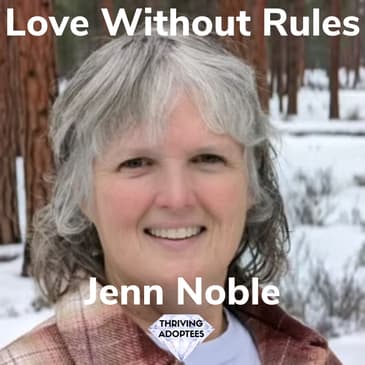
Is love with rules really love? Probably not. And yet so many of us have only felt conditional love. Having her first daughter taught adoptee Jenn love without rules. Unconditional love as a felt experience. Not an idea. Listen in as we go deep on feeling loved and whole...
Jenn works in adoption. Here's a bit about her from her agency's website:
Jenn has been working with children and their families for almost thirty years, with eighteen of those years spent focusing on the needs of children in the foster care system and on providing adoption-related services. After obtaining a Bachelor’s degree in Psychology, Jenn spent several years as a foster parent and worked in a residential program for adolescent girls. Jenn then returned to school, earned a Master’s degree in Counseling, and spent fourteen years working for Deschutes County Behavioral Health as a therapist on the school-based health clinics team. A few months ago, Jenn transitioned to a school counselor position so she can spend summers working at her favorite camp. As an adult adoptee herself, Jenn believes that every child deserves a loving, stable, forever home and she works diligently to ensure that the families who adopt through Choice Adoptions understand this responsibility. Her superpower is the “ability to micro-edit written work,” and she uses this skill to ensure that the home studies, post-placement reports, and adoption profile books that represent Choice families are of the highest quality possible. She loves meeting new families when she writes their home studies and visiting them once their adopted child arrives home. When she is not working, Jenn enjoys caring for indoor and outdoor plants, hiking, searching for waterfalls, playing tennis, riding her bike, listening to Sea Shanties, browsing antique stores, and spending time with her husband and five (mostly grown) children.
https://www.choiceadoptions.org/
https://www.facebook.com/choiceadoptions/
https://www.instagram.com/choiceadoptions/
Guests and the host are not (unless mentioned) licensed pscyho-therapists and speak from their own opinion only. Seek qualified advice if you need help.
Want to learn more about thriving for you, your kids, your families or your colleagues? Pick a time to talk here
[00:00:02] Hello everybody, welcome to another episode of Thriving Adoptees podcast. Today I'm delighted to be joined by Niemah Scherlacher looking forward to our conversation today, Jen? Me too. Brilliant. So Jen is an adoptee. She is also an adoption professional. She works at Choice Adoptions. An interesting bit that we'll get into no doubt.
[00:00:26] But the first question, as I often ask adoptees, what comes to mind when you hear the name of the podcast Thriving Adoptees, Jen? Well I think it's exciting. I haven't always felt like I was thriving. My adoption, like many adoptions, wasn't perfect.
[00:00:46] And so as an adult, just processing that and learning from it and figuring out who I am and what I value and how my experiences have led me to work with other people.
[00:00:59] And so that, you know, explains why I'm a therapist. It explains why I work for an adoption agency. It explains why I have a heart for other adoptees and why I focus on attachment and bonding with my clients.
[00:01:16] And I think it really informs my work. So to hear thriving adoptees, you know, when there were times in my life when I felt like I was quite the opposite and not thriving is pretty cool. And something that when I heard about I wanted to be a part of.
[00:01:33] Yeah. Yeah. And thank you for being a part of it. I really appreciate this. The two lenses that you bring as an adoptee and a therapist, a professional, always brings through a great rich, a really rich conversation that hopefully changes some ideas and brings some new learnings to the listeners.
[00:02:02] True. And yeah, exciting. It is exciting. Thriving is exciting. And I think that something I'm seeing recently is that it doesn't seem like that it was even an option on the table for so many of us, right? Right. Right. The thriving is an option. No, we're.
[00:02:32] Yeah. Yeah. Well, I mean, I think one of the things that I've seen as a professional that's really hard is that, you know, adoptees statistically were about 1% of the population, right? About 1% of individuals have been adopted.
[00:02:48] But when you go to treatment programs and you look at even prison populations, there's a much higher than 1% adoptees represented in those settings. And so I've always felt like we are missing something, you know, and even so back before I became a therapist, I worked in a girls residential program.
[00:03:45] And so I think that's really, you know, I think that's a really important thing.
[00:04:14] in my life and went on a bit of a spree myself. So fortunately there were some, you know, life intervened, right? And some things happened that kind of changed the trajectory, but I easily could have been one of those statistics. And then, you know, really started to find myself in college, but still got married for the wrong reasons, started a family for the wrong reasons,
[00:04:42] trying to fill the holes in my life that were existing at that time. And first marriage didn't work out, you know, largely because again, I don't think at that time I knew how to attach to people in a healthy way. So it's been a journey. I mean, you know, I'm in my fifties now and have worked in the profession for over 30 years
[00:05:10] and have learned so much, not only about myself, but from the, you know, the people that I've worked with about their adoptions. And I always find it exciting when I meet somebody else who was adopted and I've said this before, but there's even, you know, even Simon, when I talk to you, there's a million things we don't have to say to each other because we get each other. We understand that experience. And so I don't feel like when I meet other adoptees,
[00:05:38] I don't have to explain, well, this is why I felt the way I did. And this, these are the questions I had because, because you, I find my people, you know, I mean, other adoptees get me and, and I like being that support for other adoptees. And I feel like we share a really special bond in that way. Yeah. Well, there's so much to, to dive into there, Jen. I'm looking back at the, the, the votes that I was scribbling,
[00:06:07] scribbling down. You talked about missing something at one point. Do you remember what that's about? Well, I think there's so many losses inherent in adoption and I didn't, so there were comments made while I was growing up. And I remember one that really stood out for me. And it was at a family gathering and they were talking about, and this was with my adoptive family,
[00:06:36] and they were talking about noses, you know, and, and how this person has grandma's nose and this person has, you know, mom's nose. And, and my, my adoptive mom looked at me and she said, you don't have anybody's nose. And I, I felt like, wow, you know, and, and it wasn't, it wasn't the, it wasn't the, it wasn't the nose. It was the intent of the conversation. It was the intent of the differentness
[00:07:04] and pointing out that differentness. And, and it really caused me to wonder, I, I wonder whose nose I have, you know? But then it was beyond that. It was, I wonder whose personality I have. I wonder about my build, you know, I'm, I'm 5'10". And, and have always had a pretty athletic build. Where did that come from? Where did my interests come from? Where did my talents come from? What's my true ethnicity?
[00:07:35] Because we didn't even have a clear picture of that. So I think those were the things that were missing. And then the why, why did my mom make this decision? What was going on in her life at that time? And I think as adoptees, I for sure went to what was wrong with me. Why couldn't she prioritize me? And so there's a lot of negativity in all of that thought,
[00:08:03] but really what underpins all of it is a sense of loss, right? Loss of identity, loss of, of understanding of where I come from and who I am. And so it really created those gaps in my life for so long until I found my biological parents. And I was in my, I had just turned 30 when I found my biological mom. And at that point I was ready for the search.
[00:08:33] I was ready to know who I was, but a lot of years had passed with those giant holes in my life. Yeah. So that was what was missing. And then as an adult, I was able to piece those things together and find those answers. And the picture became much clearer. Yeah. One of the things that continues to fascinate me
[00:09:01] is even five years in, coming up five years doing this podcast is how, how the, the, the feeling, the, the loss feeling, I'm talking about in particular, how that loss leads to a thought that we're not good enough that becomes a belief that we're not good enough. What?
[00:09:29] Because it's, it's, it's a huge jump. Yeah. When I, when I say, well, it feels a huge jump for me. Anyway, let me answer, shut up and just let you answer the question. Well, I think it's a great question. And, you know, so much has been written on this and, and, you know, I think adoptees, we all read, right? We all want to understand what that wound is, you know, and what creates that,
[00:10:01] that core belief that we are not enough. If, and, and I think it's a simple jump and a complicated jump, right? Like, I think when I, when I think about, was I, was I a bad baby? You know, why wasn't my, why wasn't my family able to prioritize me? Why wasn't my birth mom able to prioritize me at that time in, in her life? And then why did she not have the support, you know,
[00:10:30] for in the United States, lots of grandparents step in, right? Or, or, or an aunt or somebody. And so why in my life, in my mom's life specifically, did nobody step in? And did nobody say, you're crazy. You're not making an adoption plan for that baby. Like, we're going to help you. Um, we're going to step in and we're going to, we're going to support you and we're going to help raise this baby. And she's going to be part of our lives. Um, and so I think for me, that always created a sense of,
[00:11:00] well, I must not have been good enough. You know, I must not have been enough. And so I spent the better part of my teens and twenties trying to be enough. You know, I, I ended up with a, a 3.96 in high school, um, which is, you know, two B's, um, and the rest were A's. Um, I, I was a varsity athlete. I was in a youth organization where I, I, you know,
[00:11:29] became a leader in that organization. And I felt like I was always trying to prove myself. Um, I was very competitive, still am. Um, but just wanted the world to know that I was good. Um, and it came from that hole in my life that I wasn't good. Um, and, and I know it sounds crazy and I, I don't know that I am adequately explaining it, but I, I fell into that,
[00:11:59] um, into that, that core belief, right? I fully bought on to that core belief that I was not enough. But we didn't have any distance because I did similar stuff, right? But we don't do it knowingly. No, it's an unconscious process. I think so. I think so. And, and I think if it was unique to me, then I'd be like, what's wrong with me. But, but when I talk to adoptees,
[00:12:28] we all have that same kind of wondering, right? And that sense of like, something must've been wrong with me. Um, I mean, when I'm being really irrational in my life, if I'm not good enough for my own mother, who am I good enough for? And I, and it's crazy. Like there's no rational reason to feel that way, but that see, that's where Simon, I feel like,
[00:12:56] what are we missing in adoptive parent education? And I'm not trying to lay this all on the adoptive parents, but what are we missing? When, when we're serving adoptees, right? In that population, what are we missing? When, when we all share that same belief, right? we can't all independently come to that same thought without there being something missing in how we educate adoptive parents and how we educate
[00:13:25] adoptees to believe in ourselves and to not go down that negative path. Yeah. Yeah. Well, the adoption education was missing in the sixties. Yes. Yes. Very much. So, um, my adoptive parents were told to, they were advised to tell me that I was their daughter and they did this, um, kind of almost matching, you know,
[00:13:52] where they tried to find similar hair color and eye color so that adoptive parents could essentially fake it, you know, um, and, and I, my adoptive parents who are both past now never understood that hole. They, they never got that loss and that missing piece for me. And, um, and, you know, they would say things like, but we didn't understand it though. Did we, we didn't,
[00:14:20] and we didn't understand it to explain it to them, even if they, sorry, I, I trampled over you there. No, no, no, you're good. But, but even if they had, yes, you're right. We couldn't have understood them and they didn't ask the question. They didn't know. And we didn't know. And that, and those feelings were allowed to grow because we didn't know. And nobody had put a name to it until the, the,
[00:14:49] the primal wound didn't come out until 93, you know, and so trauma knowledge is different. Now, I mean, even that Bessel van der Kolb book, which is like 5 million copies. It's not an adoption trauma, but it's a trauma book. That, that book only came out in 2013. So the whole kind of trauma field is relatively young. Yeah. In terms of, in terms of general public, uh,
[00:15:19] uh, awareness of it. But, um, I had this moment. in a adoption conference last May, I think it was, or maybe the May before, when I, when this realization happened, like the biggest, the biggest challenge that adoptive parents have is understanding their kids' behavior. And the biggest kids adopt, the biggest challenge that adopted kids have is understanding their behavior.
[00:15:48] It's the same thing. Mm-hmm. Yeah. And we do a much better job. You know, I fast forward to now 2026 and my work at choice adoptions and we require pre adoption education. Um, and, and that's been true for a long time, but I also really dive into those conversations. So I write home studies for the, for the organization. And so when I'm meeting with an adoptive couple, you know, I,
[00:16:18] I use that time to talk about, and I'll always ask, you know, do you want to hear my story? Are there parts of my story that you might find relevant or that you have questions about? But, you know, I really talk with them about understanding that it's, it's not necessarily anything they did. it's the thoughts and the feelings that we have and how they can talk to their child with sensitivity, with empathy, with understanding and compassion,
[00:16:46] and just know that that loss is there. So validating that loss, not trying to overcompensate for it. It's not a simple fix, you know, and, and it's not saying I love you a hundred times a day to, to make your child believe that, right? It's just holding space for the adoptee at that moment where you say, I don't fully understand what that's about, but I'm here for you.
[00:17:14] If you want to talk about it and I'm going to do everything I can as your parent to educate myself so that I can walk this path with you in a way that's sensitive and compassionate. Yeah. So one of the things I'm seeing more and more clearly is this kind of golden thread, right? So we want the adoptees to thrive. If, if they're thriving, if they're going to thrive,
[00:17:42] their parents have to be thriving for the parents to be thriving. The, the, the professionals that support the parents, they need to be thriving too. And for those professionals that support the, the parents, um, they're, they're leaders. The, the, the, the bosses of their organizations, the executive directors, et cetera, they need to be thriving too. So there's kind of like a golden thread here that, uh, the centers, you know, put,
[00:18:10] puts the adoptee at the focus. It's like a adoptee centered version. We're putting the adopted centered, um, the adoptee first in this, uh, first off, what, what do you, what do you make of that? How, how, how much does that fit for you? Yeah, no, I really like that, you know, to focus on the adoptee, but, but the process focuses on the adoptive parents. So,
[00:18:40] you know, the questions that go into the home study, are you, are you financially fit? Are you mentally fit? Are, you know, do you have good references? Um, do you have a home? You know, so it kind of focuses on the basics. Um, it doesn't really ask. And, and I've written hundreds of home studies. Um, but we don't ask, what's your understanding of trauma? And how are you going to support this child?
[00:19:10] It's not part of the home study. Um, maybe it should be. And then the baby tends to be kind of an afterthought, right? Like an adoption starts because a couple wants a baby. And simultaneously, yes, a birth mom needs a home for her baby. Um, but I, but who's that about? That's about the birth mom and the adoptive parents. It's, it's not about the baby. The baby is.
[00:19:40] Sounds crude, but the baby is a by-product in this situation, right? The, the baby is a commodity. Um, and then as that baby is accepted into that adoptive family and that education begins, that's when it can become adoptee centered. Um, but even. And then that starts with the adoption story from a very, very young age. So when you're reading to your, your toddlers,
[00:20:08] you're talking about their mom and where they came from and how they joined the family. And so that has to start early and it has to be part of a normalized conversation, you know? So for me, it wasn't part of a normalized conversation. It was, um, it wasn't talked about at all. It really wasn't talked about at all.
[00:20:36] It was just kind of assumed that I was going to fit into this family and I was going to be okay. And, you know, and I, and I, and I, and I heard my adoptive parents say, get over it. Right. It's this thing that happened. Okay. Sorry, listeners. There's a bit of a glitch there because, um, we've got the electrician here and he's, he's, he's fixing the smoke alarm and it's bleeping like it's been bleeping like hell, but, but the,
[00:21:06] the computer microphone doesn't pick it up. So isn't that, anyway, um, isn't that amazing? Right. Anyway, sorry, Jen. Um, I, I interrupted you there. The normalized conversation. Yeah. I mean, I think it just has to be part of the conversation, you know, and I think it has to be, um, validated and really embraced of like, you know, and we're so glad you've joined our family. Right. And you bring a richness to our family, um, because of who you are and where you come from and, and, you know,
[00:21:35] your, your cultural background and your, your talents and your personality. That's, that's different from ours. But it, a wonderful and welcome addition to our family. Yeah. Can I take you just back a step? Because you said that you haven't always felt that you were, um, thriving. What, what were the kind of the key moments for you when, when you first kind of noticed that? And,
[00:22:05] and maybe then after that, when, when, when the, the way that you felt shifted, I think it, I think it came in the empowerment of the search for my biological parents. And so, you know, I stumbled, I already explained. I stumbled through my adolescence. I stumbled through my early twenties. When my first child was born. Um,
[00:22:35] and I tried to explain this to her, but she's the one that taught me how to love unconditionally. Um, I think up to that point, love was conditional for me. It was if I was good enough, right? If I had good enough grades, if I was a good enough athlete, if I was a good enough person, when you have a, when you have a baby and you love that baby unconditionally, for me, that's when life kind of started.
[00:23:04] And I felt that connection to another human in a way that I don't believe I had ever had before. And then as my children, and then I, do you mean you felt it for the first time? Yeah. Yeah. I, I felt like it was love without rules, love without boundaries, love without proving myself. I really, I, I, it's hard to explain Simon.
[00:23:32] I think I believed for so long that. It is hard to explain. Yeah. Um, and so I think it was, I think in, and my first child was born when I was 24. So I think that was when I first really started to feel love and connection to another individual who was, who was dependent on me and who needed me and, and who I needed to, you know? Um,
[00:23:58] and then as they grew and as I developed more confidence, not just in my parenting, but in who I was and, and that I could love and that I wanted to love. Right. And wanted those connections. And at that point I was researching, you know, adjustment disorders and, and, um, yeah, I mean, in adults and what was causing those kinds of issues and, and attachment disorder specifically.
[00:24:27] Um, so then again, again, as the children got older, then I did the search. And so while they were young, I spent several years and I would, it, it was in fits and starts. So I would, I would look and I would get this piece of research done and I would find this thing. And then I would kind of sit back and digest, okay, this is what I know about my birth mom. And, and then I would go after another piece. So, so my search took several years,
[00:24:57] but it wasn't like several years of dedication. It was, I could, I could digest it in little pieces. And then I kind of had to sit back and let that soak in, um, such that I didn't find my mom until 1998. And that's when I may, I got the phone number actually for my aunt, um,
[00:25:21] is who I found first through my grandfather's death records and found my aunt and called her and had that conversation with her. Um, and they had been told that I was stillborn. So the, so that answered that question, right? Why didn't the family come forward? They didn't know that I had, that I had lived. Um, my mom had told them that I died. So, um, so that created a whole other set of questions, but, um,
[00:25:50] but having that conversation with her and then meeting my mom, and then she told me who my dad was, and then I found my dad. And so that whole process was super empowering, super empowering because I felt connected, probably except for the birth of my children. I felt connected to me and to my life in a way that I had never felt connected before.
[00:26:19] So there was a shift. A huge shift. Yes. I would say a fundamental shift, um, in my thinking, in my love for myself. I think it taught me, I think having a child taught me how to love, but also how to love and accept myself. But as an experience, you felt it was a felt experience. You felt unconditional. Oh,
[00:26:49] yes. Oh, yes. And I think it was that unconditional love of having a child that, um, there's that, there's that thing of like, I was inherently, this is what I believed. I was bad. I was not enough. Right. But, but when my child was born, my child was so much more than enough.
[00:27:14] Like there was nothing that she could do that was ever going to cause me to reject her or to, you know, I don't want you. It was, it was just pure love. And so that then helped me love myself and begin to accept myself. So that was pivotal. And then fast forward from, so she was born in 92 fast forward eight years. Right.
[00:27:44] Then that's when I could fully process my adoption and meeting my parents and having that whole story come together. Yeah. How do you, how do you, as a therapist, how do you capture this kind of,
[00:28:05] and transmit and talk about and point towards this mysterious thing that is unconditional love? Yeah. I mean, it's, it's hard. As a therapist, you know, when you, when you go to graduate school and I completed a counseling program, so I have a master's degree in counseling, you know, they, they tell you about limited self-disclosure.
[00:28:34] And they, they talk about this a lot. Like, it's not you. It's not about you. It's about your client, but really self-disclosure. It was so important when talking with other adoptees. Because to help them understand their story, I could explain to them, not all of it, not all the details. They didn't know, need to know that the ugliness of it or, or, you know, that, yeah, the ugliness of it. Let's just leave it at that. Yeah.
[00:29:02] But what they needed to understand and what I could explain to them is how it, how it evolved over time. Right. And how, when you begin to accept yourself and love yourself, that's when your heart begins to change. And you develop that confidence in who you are. And it's no longer about why wasn't I good enough. It's about, it's about forgiveness. It's about understanding.
[00:29:28] It's about bridging that gap of, you know, between my birth mother and I, and, and trying to really understand what was going on in her life at that time. So it stopped being about me, you know, why wasn't I good enough? What, what was wrong with me to like a bigger picture, a bigger understanding of what was going on in her life that she felt she had to make the decision that she did. Right.
[00:29:57] And so that was another part of the shift, right? Because that allowed me then to let go of the anger and to let go of the confusion and those thoughts, you know, those feelings of having been rejected by her and understanding it from her perspective, which I would not have been able to do as a younger person. So in therapy, when I'm talking with other kids who were adopted,
[00:30:27] part of it is, you know, kid, you're not going to get this for a few years, but I'm going to lay it out for you. I'm going to lay this process out for you in hoping that as I plant these seeds and as you grow, and as you begin to understand yourself, you too will be able to let go of the anger and the rejection. And it's very freeing. And it allows you to better understand yourself and to love yourself.
[00:30:58] So there seems to be two bits to this. And obviously the word bits kind of minimizes it. It's okay. So there's two giant chunks, right? So on one side, you've got this feeling of a felt experience of unconditional love. So we're in the heart space there, perhaps. And then, but we've also got this other part,
[00:31:26] this other chunk that is about the logic. It's about the reasons. It's about the circumstances of the circumstances that your birth mother found herself in. Yes. Yeah. Yeah. And when I move away from that, that, um, that self, I, it's a sense of selfishness, right? Of like, Oh, it's all about me.
[00:31:56] What's wrong with me, me, me, and go into her story and what was going on with her. Um, and I needed to know that I didn't know that as an adolescent and as a, as a young adult in my twenties, but once I understood her story, it started to make a lot more sense. Yeah. She didn't have the support she needed. And really it goes from like, again, you're able, I was able to let go of that anger and to move into a space. It was a space of compassion for her.
[00:32:24] I understand why she made the decision. She did. Was it hard on me? Yes. But was she in a position where she could care for me? No. And she didn't have that support in her life. And that's because she had her own history, right? She had her own story about what happened to her and how she grew up and what was going on with her. And so that then, I mean,
[00:32:50] I think about like how my heart grew when I met her and understood her story and understood my biological father's piece in that too. Like he wasn't innocent, you know, he, he complicated the situation in a, in a profound way, to where she didn't have what she needed to raise me. And that's okay. Now it's okay. But,
[00:33:19] but I'm also in my fifties, you know? So it really is an evolution, right? Simon of like, it's taken so many years and so many experiences to fully understand it and put it all together to where, you know, now I feel like I'm thriving and it's not in 2026. I mean, I have felt like I've been thriving for, for many years now, but it took a lot to get here.
[00:33:50] It wasn't easy. And, um, but I don't have the anger anymore. And I, I love my biological mom. She, as I said, she has passed. I became her caregiver. So in 2014, she was diagnosed with dementia and she began to, to go downhill as dementia begins to take over. And, and you, and, you know,
[00:34:18] one begins to lose their capacities. I became her caregiver. She didn't have any other children. Um, and she didn't have anyone else to step in for her. And so I did. And, um, what a powerful experience that was, you know, to then to, to turn those things, tables, you know, and, and I had, I used to have this thought of like, here I am feeding my mom, cleaning her up, you know, wiping her,
[00:34:48] you know, wiping her bottom, um, making sure that she's warm and fed and loved, but I didn't have that experience from her, but it didn't matter at that point, because I had gotten to that point where it was compassion and love for her, that I could provide that care for her and not feel like she did. Like you didn't do this for me. I'm not going to do this for you. She gave me life. She cared enough. She loved me enough to,
[00:35:17] to carry me through a difficult pregnancy and to, to, to do the best she could at that time in her life. Um, and I, and I felt like I can, I can do this. I can return this back to her in this way. And so that was six years of making decisions for her, caring for her, managing her money, um, to make sure that she got the best care that,
[00:35:47] um, that I, that she and I both could afford. Um, so that was also another huge turning point for me in my thinking of, again, moving away from this, the selfishness of like, she did this horrible thing. Right. And I, and I had this crappy growing up in this crappy life and, and, um, and really turned it into, she did the best she could. It became again,
[00:36:15] that pure love and compassion. And that came to you. It's not, it wasn't something that you made happen. Right. You know, you know, if you, if you care for somebody with dementia, you, you know, it's, it's challenging. It's, it's not an easy road. And, um, but I loved her. She was my mom. You know, um, it was a,
[00:36:43] it was an attachment that, you know, that grew over time. Once I met her and, you know, formed a relationship with her. And then in her time of need, it was, it was a no brainer. It was, of course, I'm going to do this. Of course, I'm going to step forward and do this. And I didn't, I didn't feel like I had to be compelled to do that or told to do that. That was what I was going to do. And even in talking with my aunt, um, when if,
[00:37:12] when I don't have a large biological family, but my aunt, her sister, um, you know, she just sent a birthday message and it's, I couldn't be prouder of you, of the person that you are. And, um, and I, you know, feel connected to the family in that way. And so it was important. It was important work to do. It wasn't easy. Um, but, um, it was important. Yeah.
[00:37:40] I'm wondering when you're doing the writing hope studies, you're interviewing the adoptive parents. Do you, do you explore this idea of idea? Again, I'm minimizing something that's huge. Do you, do you point in the direction of unconditional love?
[00:38:04] I explain it in simple terms, I think, and it depends on the family too, right? Like we connect with some people better than we do with others. And so when I think back on the home studies I've written, um, some of them really stand out for me because we had those conversations, um, because they, they asked about my story and in being able to explain my story. Um,
[00:38:34] yes, those pieces were able to come across with some families. It's, we're going to get this home study done. It's more transactional than it is relational. And that's just true of people in our lives. Um, yeah. You know, do I go into that level of disclosure in every home study? I write there's, there's no way that I could, um, we don't have the time for that. And, and the situation doesn't lend itself to that conversation,
[00:39:02] but I have had that conversation with some of the families and those are the home studies and the families that I remember the dearest. Yeah. So the reason behind the question is, uh, it's a bridge to ask you what, what you would, what would you share with adoptive parents that are listening? given that your, your,
[00:39:31] your feeling of unconditional love when you gave birth to your daughter, that was, that was what really turned, turn things around. I'm, I'm, I'm wondering, and I'm, I'm wondering how, and, uh, I have to say that I felt my birth mother's unconditional love for me too, you know, reading a letter from her that was,
[00:40:00] was written to a social worker. It wasn't written to me, but I happened to find it in my adoption file. Feeling her love for me was huge. Um, understanding, understanding, and, and feeling a connection with her on a higher plane, right? On a kind of spiritual plane.
[00:40:25] Cause I was reading a letter 15 years after she died. And yet the, the felt connection with her, the, the understanding of her predicament and the realization that, that she loved me, that she didn't give away a bad baby or, you know, whatever you want. I'm,
[00:40:54] I'm just wondering how we can point adoptive parents to, to that because there's a mystery to it, right? It's, it's, it's, it's a heart thing. It's not a head thing. I mean, I think it's about taking that leap when that baby comes home, when you are matched to that baby. Um, and it's, and I love open adoption and, you know,
[00:41:23] in California, when, when I was adopted, records were sealed, you know, forever. It was, it was considered a permanent seal. I, I have been able to get around that, um, which is another cool part of the story, but let me back up and focus. I'm going to focus on what you're saying is you, you, as an adoptive parent, if you can truly love and feel compassion for the birth mother and the birth father, if, if he's in the picture and available,
[00:41:52] it begins there. That's where the compassion begins. Understanding that birth mother's loss and the situation that she's in and why she's making an adoption plan for her baby. That then lends itself to, to growing true compassion for the baby. Right. And so it's not a, it's not a grab and go. It's not a, you know, you don't take the baby and like, Oh, now this baby's ours.
[00:42:21] And we're going to raise this baby the way we want to raise this baby. It's valuing the birth mother's role in that child's life and honoring that, that, that keeps you present in. And grounded in the gravity of the loss and the need for compassion. So I think open adoption is,
[00:42:49] is a really wonderful way. And, and it's not, it's not always going to work out that way, but that's where it begins. So I think if adoptive parents can understand, you know, the reasons why and the loss that she is feeling, and then that translates to this need for the baby to also understand their story and to understand that their birth mother does love them,
[00:43:19] did love them when she made the decision and does love them. Then that becomes the foundation for how you, how you raise a healthy adopted child. Yeah. And if you don't do that, if that piece is missing, then you better figure out how you're going to fake it. Right? Like if the birth mother maybe was using substances or maybe, you know,
[00:43:49] I don't know. There's so many situations, right? Yeah. But you still say to your child and in a genuine way, your birth mom loved you. She couldn't provide for you because the circumstances were hard, but she loved you and she continues to love you. And she thinks about you all the time. So it's about separating the action from the love. Maybe.
[00:44:18] I think it's about bringing it together though, too. Right? Like it's not transactional. It's relational.
[00:44:53] It's relational. It's not as important. It was territorial for them. You're ours. You're our child, you know? And, and they felt insecure. Such that they said negative things about my biological mom, not even knowing her. They said negative things about her.
[00:45:14] Well, you just disrupted what could have been a really lovely moment where you could have said, I'll bet your biological mom was a wonderful person. I'll bet she was in a tough situation. It's not a territorial thing. It's not adoptive parents versus birth parents. You don't have to divide love. A child can be loved by everybody. It's not pie. You don't have to cut it up into pieces.
[00:45:45] I recently worked with a birth mom who made an adoption plan. This was in January and I don't normally do the birth parent side of adoption. I normally am on the adoptive parent side. But in this case, because of geographic location, I did work with this birth mom and I met her when she was about four months pregnant, three months pregnant and supported her through the pregnancy and through the release, right?
[00:46:13] Through the surrender and consent to adoption. And when I listened to her talk about how they and they have an open adoption and she's going to see her baby regularly. But she talks about it's okay for both families to love the baby. It's not a competition. It's not dividing.
[00:46:35] It's, you know, these two families coming together to help this child feel loved unconditionally. And it's beautiful. And I feel so happy for the baby because the baby is going to grow up knowing how much she is loved by her adoptive family, but also by her biological family. And that's really what it's all about. Yeah.
[00:47:06] Did you say divide and conquer or am I just making that up? I don't think I said divide and conquer. So it's unite and love. It's unite and love, not divide and conquer. Absolutely. Absolutely. I mean, how lucky, how fortunate, how wonderful for a child to know I'm loved by two families, right? Like my biological mom thinks about me every day.
[00:47:35] And my adoptive parents are here for me every day. And how great is that? And I think it begins with the relationship between the adoptive parents and the biological mom. And again, birth father, if she is also in the picture and available, that's where it begins. Yeah. I've got an idea. I've got my answer to this question, but I'll ask you the question first, right?
[00:48:04] Because you've got far more experience than this place. Why do you think it starts at that point? I think that's where understanding begins. I think for an adoptive parent to understand the circumstances that led to their child's adoption in the first place. And that human connection then begins to grow. The baby is no longer a product.
[00:48:33] The baby is the center. So back when we were talking about adoptee-centered adoption, right? I mean, that's in a perfect world, that's where it would begin. And you create that trust and that bond between the adoptive parents and the birth parents before baby's even born. Yeah.
[00:48:54] And that's what's so great about this situation that I was involved in in January is the biological mom, the birth mom, truly trusts the adoptive parents. And truly wants the best for her child. And because the adoptive parents got to know her and care about her and have compassion for her, that translates to their compassion for the child as well. And that's where it begins to grow.
[00:49:23] Again, it's not going to happen in every adoptive situation. But I think if you begin as adoptive parents with the understanding that the biological mother, the birth mother is doing everything she can and she means well and assume good intentions, then that can become a healthy foundation. Yeah.
[00:49:50] The thing that was popping to my head was the fact that it's easier to kind of get our heads around the birth mother's loss rather than the baby's loss. Yes. And yet they're intertwined. Yes. The losses are intertwined.
[00:50:21] Yes. And if you, you know, if you go back and you look at while a baby is growing inside a mother, that baby learns the mother's rhythms and the sound of her voice and the sound of her heartbeat and her smell. Right. And so all of that changes. And the research is that babies understand that. They know that from a very, you know, from before they're even born.
[00:50:50] And so here you are in a hospital. Right. You've delivered the baby and then the baby is taken from all of those things that are comfortable and familiar and put in an adoptive family. And it, I'm not saying that the adoptive family isn't doing an amazing job, but there's still a loss. Yeah.
[00:51:12] I think what I was getting at is it's kind of, it's easier, it's easier to relate to the birth mother's loss because the birth mother is, you know, well, you know, 16, 17, 20, 25, whatever, whatever the birth mother, the birth mother's more of an adult. Whereas like, we can't, we can't get our, maybe it's just me, right?
[00:51:40] Maybe we can't get our heads around the adopt, the adopt, the adopted infants loss. We can get it conceptually. You know, I can understand all the, the, the things that you're talking about, the in utero experience and the getting used to being used to the, to that environment.
[00:52:04] But, but somehow the loss of the birth mother, it seems it's, it's more adult and therefore kind of easier to understand. Maybe just because I'm a bloke, right? I don't know. Yeah. I don't know. Maybe that is part of, part of, you know, that disconnect and why we don't understand the loss for the infant. I'm not sure. No, no. I don't know either. It's a, it's a first one.
[00:52:33] It's a first thought for me on this, this topic that the, I'll tell you how it echoes in, in my life. I think so. Me and my wife haven't got any kids, but we've, we've got dogs three and four. We, you know, our first two dogs have, have, have died. And those dogs have cried being away from their, their mum.
[00:53:03] And that's the close, the closest I can get to it is was I like that? Yeah. Yeah. Well, if you think about loss and not just adoption loss, but if you think about loss, we, we understand that experience as humans. So why can we not relate that back to adoption? It's loss is loss.
[00:53:31] You know, um, when my adoptive parents passed, I felt lost. When my biological, my birth parents passed, I felt lost. When my brother passed, I felt lost. I know what that feels like. We all know what that feels like. I guess why, because an infant maybe doesn't understand like cognitively or intellectually understand that loss. It doesn't mean that it's not happening.
[00:54:02] It doesn't mean it's not felt. Yeah, that's right. It's a felt, it's a felt thing. And the, the, the, and the beliefs that we're not good enough, they happen way down the line, but they're intertwined as we've kind of, they're intertwined too, as, as we've explored earlier in conversation. Yeah. But the. It's kind of a, it's kind of a mind blower.
[00:54:28] It's a mind, well it is, yeah, because it's not, it isn't, it isn't a mind thing, is it? You know, um, it's visceral. Loss is visceral for the, for the, for the, for the baby. Yeah. But, but if we, if, say, say we're 40 and we're adopting, we're, we're 40 and we're adopting.
[00:54:56] And the birth mother's 25. We've, we, we can kind of relate to the, the birth mother's loss somehow. And as an adult loss, it's not an infant loss. It's the, the two, the two different, the two different things. One is the pure, pure emotion of the loss. The, there isn't any confusion.
[00:55:23] It's just like, it, it, it is with, it is, it's pre-verbal. It's. Yes. And so it's pre-verbal. So there's no words to go with it. I think I might be taking this down a little, I've taken this down a little bit of a, um, a side street here, Jennifer. Yeah. Well, I think, I think it's important, right? I think it's important to understand.
[00:55:50] And, you know, maybe the conversation with adoptive parents is you might not get this right now, but let this seed just grow for a minute. You know, your child is going to feel a sense of loss and it doesn't matter what you do as an adoptive parent. They're going to feel that. And so you better figure out how you're going to deal with it. Yeah. And, and, you know, maybe when you're a brand new adoptive parent and you go, you know, that social worker told me something about loss and I, whatever, I just don't even get it.
[00:56:20] Okay. Well, it's coming, it's coming down the road. So maybe we teach and maybe it doesn't sink in or they don't fully understand it until their child is three or four or eight or 10 or 12, whatever, you know, but we still have to teach it. It's very important that they understand that it is inherent. I think probably in a hundred percent of adoptions, right?
[00:56:46] And then each person is going to handle it in their own way, but just know that it's there and understand that adoption is built upon loss for all three members of the adoption triad, right? The adoptive parents who couldn't have a, you know, maybe couldn't have a biological baby, the birth mom who gave up that baby, right? Who made an adoption plan for that baby.
[00:57:13] And for the infant who has lost the connection to their birth mom, birth father, their culture, right? Their, their connection, who they are, their identity. And then we do these really like, I'll just say really awful things. Like we pretend that an amended birth certificate in the United States, this, I think this is super insensitive, but we, we seal the original birth certificate.
[00:57:40] We seal that original record and we give the adoptees this amended birth certificate that has their adoptive parents name on it. It's a lie. Why can we not unseal those records and be truly compassionate? And that, and this is, you know, kicking up, I have a whole other story on this. And I know we have a limited amount of time, but why can't we just have our original birth certificate?
[00:58:10] Why everybody else gets their original birth certificate? Why can't we have ours? And if you think we can't handle that information, then put it in a drawer somewhere, put it in a lockbox and, and let us grow up and then let us decide if we want that information, if we're ready to handle that information, but don't seal it and disconnect us from our identity. It's another loss. Yeah.
[00:58:39] I now have my original birth certificate because of a whole slew of events that happened, but, but I look at it and it's so incredibly precious to me to see my birth parents name on my birth certificate. And I have my other one that I have to use legally, you know, because, right? Because that's how we do it in the United States, but man, give us our birth certificates.
[00:59:08] Open up those records. Indeed. Indeed. Is there anything else that you'd like to share, Jen? I just, it probably comes through in, in my conversation, but I am passionate about this. The reason I do home studies, the reason I work in adoption, and I've been in adoption for 20 years as a, it's a little side gig that I do. I have a full-time job.
[00:59:36] I work as a, as a school counselor at an alternative high school. The reason I do this is to stay connected to something that I feel incredibly passionate about. I want adoptees to feel loved, to know who they are, to have access to their true identity and to grow up feeling whole.
[01:00:00] Whole, as in W-H-O-L-E, not as in feeling the holes, to be clear. So it's a, it's a, you know, I'm going to go back to what I said before. We are 1% of the population, but in any mental health facility, in any capacity, in any, in any agency, in any organization, you know, we represent 40, 50, and in some cases, 100% of those populations.
[01:00:29] We are missing something. We've got to do better. And yes, it's come a long way, but we, we, we still have work to do. So to all the adoptees out there, I get you. I feel you. I love you. I understand you. And I am you and let's stand together, right? Let's, let's support each other.
[01:00:54] Let's help each other understand, um, all the ups and downs of growing up adopted. Thank you, Jen. Thank you, Simon. Thank you, listeners. We'll speak to you again very soon. Bye-bye.