Feeling unloved hurts like hell. And most of us have felt that way. I know i've felt that my birth mother didn't love me enough to keep me. But what if we feel are adoptive parents didn't want us? Reading about some doubt her parents had in adopting her turned Patti's life upside down. Listen in as we go deep on feeling loved, wanted and enough.
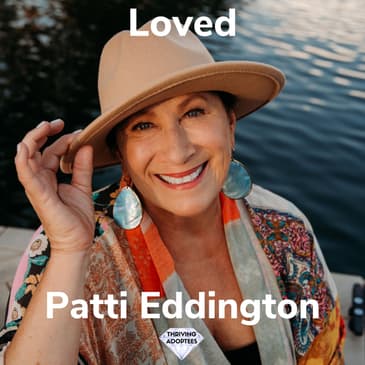
Patti Eddington is a newspaper and magazine journalist whose favorite job ever was interviewing the famous authors who came through town on book tours. She never dreamed of writing about her life because she was too busy helping build her husband’s veterinary practice, caring for her animal obsessed daughter—whose favorite childhood toy was an inflatable tick—and learning to tap dance. Then fate, and a DNA test, led her to a story she felt compelled to tell. Today, the mid-century modern design enthusiast and dance fitness teacher enjoys being dragged on walks by her ridiculous three-legged dog, David, reading with her Siamese cat Symon Francis O’Toole on her lap and watching the egrets and bald eagles from her deck on a beautiful bayou in Spring Lake, Michigan.
https://www.instagram.com/pattieddingtonauthor
https://www.facebook.com/people/Patti-Eddington-Author/100091516900287
https://www.amazon.com/Girl-Three-Birthdays-Adopted-Daughters/dp/1647426502
Guests and the host are not (unless mentioned) licensed pscyho-therapists and speak from their own opinion only. Seek qualified advice if you need help.
Want to learn more about thriving for you, your kids, your families or your colleagues? Pick a time to talk here
[00:00:02] Hello everybody, welcome to another episode of Thriving Adoptees podcast. Today I'm delighted to be joined by Patty Ellington, looking forward to our conversation today, Patty.
[00:00:12] Thank you, I am very much looking forward to this as well.
[00:00:15] Yeah, and we're recording this, ladies and gentlemen, the day before Patty launches her book. So yeah, this will go out actually on the day that she launches it. It's a big day for you tomorrow.
[00:00:29] It is. Thank you so much. That's a pleasant surprise. It's been two years since my book was accepted for publication, my book about unlocking my adoption records. It's been a long process and so tomorrow is kind of the culmination, although there's probably less going on tomorrow than there has been every day the last couple of years, but it is a big day for me.
[00:00:50] Indeed. Well, good luck with the launch.
[00:00:52] Thank you.
[00:00:53] So today we're going to talk healing.
[00:00:56] Right.
[00:00:58] What does healing mean to you, Patty?
[00:01:02] Well, you know, Simon, if you would have asked me a few years ago about healing I would have said healing from what I, I had in my opinion a happy childhood I knew as you did that, you know there was never a time when I remember being told I was told early.
[00:01:21] I was told at the age that I was not the biological child of my parents. And, excuse me, I never pushed down any questions I had I innately knew that it probably was not wise to ask.
[00:01:40] Gosh, I'm sorry.
[00:01:44] So I kind of pushed that away.
[00:01:47] And then a few years ago I had my adoption records unlocked.
[00:01:57] I've never had.
[00:01:59] Sorry, little technical glitch there listeners.
[00:02:03] We need we need water don't we?
[00:02:05] I've been for the last hour I've been talking to an adopter who's coming in the show on Thursday.
[00:02:11] And I didn't my water drawn out and I was I had a tickly cough as well so where were you where you were explaining that you'd thought healing from what you'd had some questions but you about about the background biological family but you push those down.
[00:02:30] And then something happened presumably.
[00:02:34] I am my daughter gave me a DNA test in 2017 when she was getting married she'd have a lot of health issues and had the right to know what if there was maybe something she should know.
[00:02:48] And I think it was even important that I didn't do it right away.
[00:02:55] I still put it aside for a year, almost we were moving and she was getting married and I use those as excuses but I think it was just that I'm not this is kind of a half form thought but I've been I have been considering it lately I heard someone else talking about this.
[00:03:15] You know, if people ask me about my adoption I will always say how grateful I was for my life and I am. I have wonderful parents, but you don't really ever hear biological children saying I'm grateful my parents had me.
[00:03:30] I think that adopted children maybe innately feel that gratitude is something they should express.
[00:03:40] And I did and I am like I say it's true I was very, very grateful, but I heard someone talking and adopted adult saying, you know, I always had to make everything okay for everybody else.
[00:03:53] You know, I had to make it okay for my parents and my family. You know, it's great that you adopted me and this is the best thing that could have happened to me even if it's true.
[00:04:03] It's an obligation biological children don't have.
[00:04:07] So, I did finally do the DNA test and got lots and lots of surprises. And I think that was the beginning of my healing I began to understand that I did have a right to know and answer some of these questions it was something that I didn't have to apologize for being curious.
[00:04:33] Yeah. So, was there was there a, I don't know, was there a period of pain that you that you went through or was this more just idle kind of curiosity in your in your head was was there was the trouble that would set out in the north of England we might have said trouble at the mill right.
[00:05:03] What was the trouble?
[00:05:06] I did go through a lot of pain.
[00:05:10] But it was mostly because of what was in the record.
[00:05:15] My parents, the adoption records when they came. I did the DNA test found biological relatives talked with them and they told me a story that I could have never imagined.
[00:05:27] I did not mesh with the story the few details that I did have from my early life. And so that's why I had the adoption records unsealed, but it was what was in the records actually in my case that led to a lot of pain it was based on a one day visit to
[00:05:45] my parents it was called the report of investigation. I'd been living with my parents as a foster child for a year, and a court worker, and this was in the early 1960s visited the house and you know, I have no idea how long she was there, could have been an hour or
[00:06:00] or two in the afternoon. And she did little segments of like this is about the father this is about the mother this is the house they live in and all these funny little notes that we would never think would be in an adoption record Mrs Eddington is blond and petite, and tends to be plump.
[00:06:18] My father is handsome man and, and I was a talkative little girl and it came down to the very last paragraph. And it basically I don't I hate to give away too much of the book but it said that my parents who'd waited 17 years to have a child.
[00:06:38] I was 16 by this time. Didn't know if I was the right child for them. And I dropped me to my knees because these were my parents, the people who loved me and you know my dad helped me do chin ups and learn how to you know, when I couldn't for to pass the American
[00:06:57] test, I couldn't do them and so he put up a poll and you know he helped me learn how to do them and my mother was always on my side and to look back through all those decades and see those words that they're not sure. I was the right child for them.
[00:07:12] And that's what caused me a lot of pain a lot of my healing. I would think came after that first it was great that I finally realized I could ask the questions and second, I did get some resolution to why they said that and that was very healing for me.
[00:07:30] So the, the, the conflict between the two stories.
[00:07:38] The pain of
[00:07:42] I
[00:07:44] They weren't sure lack of certainty.
[00:07:48] And then the resolution about what changed for them.
[00:07:58] Was it about what changed for them.
[00:08:01] Not really. They were lying to the court, there was something else going on in their life at the time and they realized they could not let the court know that so they lied and said we're not sure they were buying time.
[00:08:17] Yeah, so but yeah that was I didn't realize that for many, many weeks anyway I'm trying to think exactly when I did realize that my cousin found a scrap of paper that said wait a minute.
[00:08:29] This is what really happened and then I'm like, Oh that makes perfect sense.
[00:08:33] But so that period of time.
[00:08:37] Was extremely stressful.
[00:08:41] Realizing I would never have written a book had I not had that piece of paper would have indicated to me that my parents, Jim and Milly Eddington were not the people I always thought they were and finding that piece of paper helped me heal as well.
[00:08:57] I have come to realize I just don't know a lot of adoption stories. I was an adopted person who didn't really pay much attention to it until I got older. I, I think that's probably a little unusual, but I was real good at squashing things down.
[00:09:14] Yeah.
[00:09:16] How had this.
[00:09:19] How was your self esteem growing up? Were you.
[00:09:24] In a fairly good place that on that subject.
[00:09:28] Um,
[00:09:32] It wavered it was very a change.
[00:09:37] Pictures of me when I was a toddler in my parents home were very precocious the
[00:09:46] Court records, the visitors, you know, the court officer that visited my parents house said how outgoing and charming and talkative I was.
[00:09:59] And then I suffered growing up through the middle years.
[00:10:07] I remember and I can tie it back to one thing. I went through the first years of my life kind of like this was just a different way of being you know I have dark hair and my friends a blonde and,
[00:10:18] And then I was playing on a swing set with a girl that I'd never played with before. And we were swinging and dragging our kids and I was very excited because my uncle was getting married the next day and I was telling her I was going to a rehearsal dinner and how exciting it was going to be and I could have a kitty cocktail and
[00:10:37] And she said you know this is really fun. I like talking to you. I like playing with you. I'm like yeah me too. You're really nice and she said you're nice too but I'm so surprised because my mother told me not to play with you because you are not living with your real parents.
[00:10:50] And that was the first time I ever thought I'm different. I'm and I was 10 or 11 by that time. And I kind of I had a hard teacher that year it's in my book I had a teacher who did not care for me and made my life very uncomfortable.
[00:11:11] I was going through an early puberty I was unattractive and I my self esteem suffered then.
[00:11:20] My mother and father were so much older than other kids parents they my mother was 40 when I was born is that right 44.
[00:11:32] Yeah and so they were of the greatest generation and I was growing up in the 1970s you know and
[00:11:39] She was very strict and I always put my feelings of discomfort down to having older parents and having parents that children should be seen and not heard.
[00:11:55] You know, I always felt I remember thinking I can't wait till I can be heard.
[00:12:00] And so I was put it down to that I never really thought that I was uncomfortable because of the adoption but
[00:12:10] I think it was also because of the adoption and that I felt like I was so different especially after that little girl pointed it out to me.
[00:12:18] Yeah.
[00:12:20] And then I recovered in high school.
[00:12:23] Then I recovered in high school I kind of bounced back and and you know felt a lot better about my life and things but my middle years were certainly uncomfortable.
[00:12:34] Residences big for us isn't it.
[00:12:40] Residual bouncing back.
[00:12:43] And like I said that thing of gratitude and always feeling like we have to be just so I don't know if that's across the board but I certainly do I feel like
[00:12:56] I have to please everyone and I have to be you know just so and then that brings with it other feelings from people your life is so great.
[00:13:05] And it's like no my life is like anybody's life.
[00:13:09] But I think I and I don't know about you do you feel like you worked real hard to have people like you.
[00:13:18] Sometimes I don't I don't know.
[00:13:21] I felt that I felt cut I felt cut by by other people's comments.
[00:13:33] To me especially when they're when they they say something nasty like can what that girl said to you on the on the on the swing.
[00:13:49] But I've never really had anything like that said to me I've not had adoption based insults should we say from from other from other people.
[00:14:04] I've been told that.
[00:14:07] That I should be grateful about.
[00:14:15] You know it should be careful about business or being you know I took over part of the family business.
[00:14:24] And I've been told that I should be grateful about that and the people don't.
[00:14:34] It's tricky taking a moment.
[00:14:37] It's tricky taking on family business and there were some changes before I took over one of the businesses that made it a very tricky time.
[00:14:46] And people have just thought it's an easy ride while working for my dad wasn't an easy ride.
[00:14:56] It wasn't he was a tricky guy to work for for everybody.
[00:15:01] It wasn't it wasn't just me that he made or I tricky.
[00:15:06] So people have addressed me but yeah I haven't had any I don't think I've had any adoption sort of insults or I've not been told that I should be grateful for being adopted.
[00:15:19] I don't know.
[00:15:22] I don't know whether I've just forgotten those or I've never never never had them.
[00:15:30] I think we are pretty resilient as adoptees.
[00:15:38] I've just finished being interviewed by Lisa Lisa who runs the wandering tree adoption podcast fellow adoptee.
[00:15:48] And we talked a lot about resilience.
[00:15:52] We talked a lot about resilience and I had something about resilience that really stuck with me a few years ago.
[00:16:00] So some people make out that resilience is something like that you grow by going to the gym like going to the gym so this when people are trying to sell us stuff.
[00:16:15] You know they say well you know you're not you're not you're not resilient.
[00:16:20] I used to feel like you did.
[00:16:22] I used to feel like you did Simon I didn't used to feel resilient until until I learned you know three steps to resilience and if you spend time and money with me then I will show you how to develop these it's like going to the gym you have to do you know and and I don't think resilience is like that at all.
[00:16:45] I think resilience is is something that we don't appreciate.
[00:16:50] We don't appreciate our own resilience until we do it's something that we see we see through going through adversity and we don't think that we're going to be able to cope and somehow we do cope.
[00:17:09] And so that tough those tough times revealed the resilience that's that was always there but we just didn't know we had it you know.
[00:17:22] Perfect sense.
[00:17:24] So it's it's innate.
[00:17:28] I think it's I think it's you know you're just saying so I last year I was working with that therapist and she seemed to be kind of withdrawing from me she seemed like she was the last story but she she feels that I thought that she was going to.
[00:17:53] Ditch me and.
[00:17:57] I felt insecure in that in that moment and then a bit later on she did stop working for me and it didn't bother me I talk you know so the thought of her.
[00:18:14] Ceasing working with me scared me but the actuality it didn't I was I was able I was quite able to to cope and I think our minds play really really funny tricks with us telling us that we're not going to be able to get through this stuff.
[00:18:41] I'm thinking about you and you reading in this file that your parents weren't your doctor parents weren't sure about you and I'm thinking well.
[00:18:51] That would feel like.
[00:18:54] Like the world disappearing from under your feet would it I mean it felt like 60 years down the drain I couldn't believe it I came the envelope came on a Friday afternoon and interestingly let me think.
[00:19:09] No that would have been about 2018 I guess.
[00:19:13] Um well.
[00:19:16] 2019.
[00:19:18] Um I had them my records.
[00:19:22] I went to the courthouse in January 2020 so you know what's coming they came in February we immediately went on our spring vacation and it gave me a little time to take that in and then we came back and everything changed anyway so I had a lot on my.
[00:19:39] In my head.
[00:19:41] Yeah it shot me down it was I something like you just said it was like.
[00:19:48] I accept I could have never dreamed that my parents were unsure.
[00:19:53] First of all I knew their story they had been married in 1946 mom had a hysterectomy shortly thereafter they knew they couldn't have children if they wanted children desperately.
[00:20:03] They moved out to the country from Detroit and began almost immediately they went to the courthouse in 1955 I think and filled out an adoption application.
[00:20:16] And that and that was in the envelope too.
[00:20:18] And I in my mom's handwriting and it's all the information about my parents and the house we lived in how many acres and my dad raised raised beef cattle and that was poignant to me I'm a vegetarian and would say.
[00:20:30] Mr Eddington has 17 head of cattle and the next thing cross it out say 15 had a cattle I'm like oh no but um yeah um so all of that was really interesting but.
[00:20:45] Mom would stop in at the courthouse like every few months and they would put a little note in the margin they say now they'll take a girl or a boy and they'll take up to us older age they were every all the time trying to increase their chances.
[00:21:00] So I knew how much it meant to them and.
[00:21:05] Then to.
[00:21:08] You know to see that even after after after I lived with them for they took in foster children I was a foster child they've had a failed adoption before me a little boy.
[00:21:19] Whose mother got in the way and the court actually sent him out of state and broke my parents hearts.
[00:21:27] And so after all that you know all those years the story in my head was mom and dad wanted something so bad and I was that their dream and that's how they treated me.
[00:21:36] And then to see in writing they're not sure.
[00:21:40] Yeah it could all be about me right except it wasn't but um yeah that was that was a toughie I'd felt rejected before in life of course but I didn't even know what to do with that bit of information that was a hard hard thing to see.
[00:21:56] And you know what they probably I'm sure but they never never dreamed closed adoptions were something that that's just the way adoption was then.
[00:22:06] I'm sure and I'm my guess is they never saw what they wrote.
[00:22:14] You know this was typed and mimeographed or whatever my guess is my parents never got a copy of that they probably didn't do that they probably never saw those words on paper and.
[00:22:25] They probably thought one person or two people would see that they never dreamed I would see that eventually.
[00:22:31] But yeah not the easiest not the easiest time in my life for sure.
[00:22:37] So there's something quite profound about this I think in in the fact that we've got all this we've got all this evidence we've had you've had 60 years of thinking one way experiences.
[00:22:55] And the truth is that the kind of the truth is the truth right and yet this suddenly this idea comes in and it's so strong.
[00:23:12] The little however many two or three four five words coming and they're so strong that they somehow managed to wipe out 60 years of thoughts to the other one to the other one.
[00:23:33] Yeah my parents were alive a long time they were older when they adopted me but they both died at 91 so I was 50 by the time the second parent died.
[00:23:43] So all those decades of knowing you know one thing and then hearing something else.
[00:23:49] Yeah.
[00:23:51] You know when I was maybe in my early 20s my husband and I went back to my hometown my parents were still alive.
[00:24:00] There is a celebration that are I don't know if you have Lions Club.
[00:24:08] So my dad was big into service my parents both where they belong to all kinds of organizations and he was a charter member of our little towns Lions Club and they would have a festival every year they called it the homecoming.
[00:24:20] And there would be you know Ferris wheels and and cotton candy and games and the Lions made their own games they didn't have you know the run of the mill games so my dad had designed this game and I always love to play it.
[00:24:35] It was called roller score you rolled a ball down a shoot and you had to get a certain score and then either below or above and you want to prize.
[00:24:41] And I remember so vividly I was probably 22 or 23 going back to this festival which I'd always loved it's always been a safe spot for me.
[00:24:51] And my dad wasn't behind the game this time but another lion was and he gave me my six balls for a quarter or whatever and he said hey wait a minute I know you.
[00:25:02] You're that girl you're that girl that lives out there with the Eddington's.
[00:25:06] I don't think I've ever been so shocked in my life and I said I'm their daughter.
[00:25:15] And he looked completely befuddled to see how other people saw me and here I was a small town everybody knew everybody was it made me feel like wait no one ever thought I really belonged I didn't really belong.
[00:25:32] You know I was just that girl that lived out there with the Eddington's and it didn't happen often that's probably why I remember the girl on the swing set and why you know but every once in a while it would just kind of and all I always thought is that people were trying to put me back in my place.
[00:25:46] Yeah.
[00:25:50] It's as if it's as if the.
[00:25:56] Because I've got those moments as well.
[00:25:58] You know.
[00:26:01] And it's.
[00:26:06] I can't I'm struggling for words but it's like has.
[00:26:14] Has the.
[00:26:19] The comment the comment on the swing.
[00:26:23] The comment at the homecoming.
[00:26:27] The comment in the file.
[00:26:30] It's like it's it's it's undermined.
[00:26:34] It's kind of like it's undermined is it has it been something that it's like being a drip fed.
[00:26:42] It's like a drip fed idea and then.
[00:26:47] It blows it blows us away I'm thinking the same with.
[00:26:53] Me and the teddy bear moment and you know she didn't.
[00:26:59] Keep me.
[00:27:01] It's almost as if that.
[00:27:04] Does that does that moment when.
[00:27:08] Bump the hour hour insecurity comes.
[00:27:15] Into stunning focus.
[00:27:19] Perfect.
[00:27:22] And then we you know we it's our it's our maybe it's what people call coming out of the fog right it maybe so I couldn't come out of the fog moment and then if that.
[00:27:39] If that isn't challenged.
[00:27:42] Right.
[00:27:44] Then that becomes the normal.
[00:27:47] That that becomes our new.
[00:27:51] New normal unless the belief is busted.
[00:27:56] It's.
[00:27:58] This something.
[00:28:02] Really profound here for me and I don't know whether I don't I don't know how well I'm.
[00:28:10] Doing a good job.
[00:28:12] And you know.
[00:28:14] Thank.
[00:28:16] Thankfully it was blown away for you.
[00:28:19] Yeah, thank that is true.
[00:28:21] It was blown away for you.
[00:28:23] It was it's like.
[00:28:26] Our.
[00:28:28] It's a little bit of a hobby horse of mine this this belief thing right and.
[00:28:34] So I saw something from Gabel Marte saying.
[00:28:40] The feet the feeling of not not feeling enough isn't a feeling.
[00:28:47] It's not we call it a feeling.
[00:28:50] I don't feel like I'm enough but it's not a feeling.
[00:28:53] We feel it as a feeling but it's not it's a belief.
[00:28:56] Interesting.
[00:28:58] Yeah, I see that I can see that.
[00:29:01] Yeah, whatever I do.
[00:29:04] Jeremy so this people pleasing think that you obviously so common amongst us right.
[00:29:08] Amongst us adopters.
[00:29:10] Yeah, I don't I never feel I never feel I'm enough I feel that I'm putting
[00:29:13] everybody's agenda.
[00:29:15] I don't know if I'm going to be able to do that.
[00:29:18] I don't know if I'm going to be able to do that.
[00:29:20] I don't know if I'm going to be able to do that.
[00:29:23] I don't I never feel I never feel I'm enough I feel that I'm putting everybody's agenda first.
[00:29:29] I'm I'm I'm shine away from conflict.
[00:29:32] I just don't feel that I'm I'm enough.
[00:29:37] And and it's a feeling is something like anger or.
[00:29:44] In insecurity or something far more.
[00:29:49] You know, it's more tangible.
[00:29:51] It's more tangible.
[00:29:53] It's not theoretical.
[00:29:55] And this difference between believing that you know, not feeling enough is one thing.
[00:30:03] But it actually means that we don't believe we're in.
[00:30:08] And I'm laboring the point here because if how does a belief change a belief changes.
[00:30:20] When we see it's not true.
[00:30:28] And the beliefs gone.
[00:30:33] So.
[00:30:35] So it's about insights.
[00:30:38] It's about a shift in our belief.
[00:30:41] That's what.
[00:30:43] That's what changes.
[00:30:45] That's what changes.
[00:30:47] So I had this belief.
[00:30:52] I had this anger towards my personal.
[00:30:54] And I saw this teddy bear as a consolation prize.
[00:30:59] From a woman that didn't love me enough to keep me.
[00:31:04] And then eight years later, eight years later.
[00:31:08] I get the correspondence.
[00:31:11] I get the correspondence that refutes totally refutes that.
[00:31:17] And it becomes clear that the teddy bear was not an effing consolation prize.
[00:31:24] It was a symbol of her love.
[00:31:27] And that blows the wrong belief completely out of the water.
[00:31:35] I'm so glad that that happened that way.
[00:31:37] I loved reading that story.
[00:31:40] Yeah, I think when I was a young journalist.
[00:31:44] I was only maybe in 24.
[00:31:46] I was working at a newspaper in Holland, Michigan and a reporter for the Associated Press knew my story.
[00:31:52] And she was adopted.
[00:31:54] And she was doing a series on adoptees.
[00:31:56] I don't remember why or and she came to me and she wanted to interview me, which was weird because I was on the other side of you know for the first time I was on the other side of that and I must have said I don't remember what I said.
[00:32:10] I only remember what she said.
[00:32:12] I must have told her I didn't have any curiosity.
[00:32:15] I was happy.
[00:32:16] I was a happy person and I didn't care and I was doing well.
[00:32:20] She did not obviously have the same feelings about it.
[00:32:24] And she said, I don't believe you for every adopted person.
[00:32:30] The first thing that ever happened to us as we were rejected and I can't believe you don't have stronger feelings about that.
[00:32:39] And I thought, well, I don't know my story.
[00:32:44] I don't know, you know, I told myself a narrative for years that was my mother was a beautiful college student who had an affair with her English professor.
[00:32:53] You know, it was not that way at all.
[00:32:55] But I didn't know the story and I didn't assume.
[00:33:00] And I didn't feel rejected when I was growing up.
[00:33:04] I had these couple incidents that were a little strange, but I felt very loved my families were very caring and big families on both sides.
[00:33:14] So, but the rejection thing I've come to learn she wasn't wrong just because I didn't think I felt it.
[00:33:23] I think that's one of the things that has driven me to take the book.
[00:33:27] It's gotten great reviews, Kirkus, which you know could be a little cranky, loved it and book life loved it and lots of people.
[00:33:35] Oh my goodness just have said the nicest things but there have been a few who don't like it.
[00:33:41] Who do you think I think about?
[00:33:42] And I know that's human nature as well.
[00:33:46] I don't know what the weight is.
[00:33:49] Is it just because we're human that we go right to the people who don't like something we did or said, or is it because wait a minute here I'm in danger again of someone rejecting me?
[00:34:00] I don't know the answer to it.
[00:34:02] Me neither.
[00:34:04] Me neither.
[00:34:06] But you know, we can't please all the people all the time.
[00:34:09] Right, definitely.
[00:34:11] Yeah.
[00:34:14] And there is what's the truth?
[00:34:17] You know, is it a fantastic book or is it a poor book or is it somewhere in between and I'm going to go with that.
[00:34:22] I think it's a pretty good but but you know we can't just say oh this is true because everyone is a different opinion.
[00:34:29] But it just would be helpful not to always go to the negative and say oh no they must the people who are rejecting me or some part of me are right.
[00:34:38] It would be nice to be able to bring that a little bit you know and say can't please all the people all the time.
[00:34:43] But something I'm working on.
[00:34:45] Yeah.
[00:34:54] What helps us see that we're enough?
[00:34:56] The reflection in the people that we love's eyes I think.
[00:35:04] I know my family loves me and I know I love them and you know they'll call me out of my bulb crap or whatever but also then they're just also very complimentary when I've done something well.
[00:35:22] I know that I try every time I think a bad thought about myself I try to go say something nice to somebody else.
[00:35:29] That helps I think to give love to other people.
[00:35:35] I think we know we're good.
[00:35:40] I don't really have a great answer for that but that's how I do it.
[00:35:43] Yeah, I think that's I know it.
[00:35:47] Have you heard this idea that we are we are actually we are love.
[00:35:54] We had that we are love.
[00:35:58] Yeah, oh I like that yeah I one time heard something it's a little little different but also it's the same.
[00:36:06] My mother because she was so much older.
[00:36:09] And she was very pragmatic and stoic woman she loved me.
[00:36:13] I, it wasn't until my parents got into their 70s that we began ending couple of conversations with I love you.
[00:36:19] But I always knew it was, you know, it was there.
[00:36:23] I heard I read an article or something one time maybe around Mother's Day which is coming up and it says when you've lost your mother sometimes you have to be your own mother, you have to be the one who gives that to yourself it doesn't you doesn't
[00:36:36] necessarily mean it comes from a woman who birthed you or raised you.
[00:36:40] Sometimes you're your own mother, sometimes you find mother and a friend.
[00:36:44] And I think that's nice that we are love.
[00:36:47] I see the same the similarities and I like both of those things very much.
[00:36:51] Yeah, have you have you come across internal family systems it's a mode of therapy.
[00:37:00] You come across that.
[00:37:01] I have not.
[00:37:07] The guys called the guy that came up with it's called Dick Schwartz is a therapist.
[00:37:12] And he talks about uppercase as self, right, who we truly are so he calls uppercase as self and other people, other people might call it spirit.
[00:37:27] Other people might call it consciousness.
[00:37:31] Other people might call it yeah our non non physical identity.
[00:37:43] This the space in which everything occurs.
[00:37:48] But the uppercase as self is the parent is is is in your in the energy that you just said.
[00:38:01] So in the absence of in the absence of a parent, we are we are parenting ourselves.
[00:38:10] And what what Dick Schwartz this internal family systems guy means he means so he means there's the uppercase as self and then there's the bits the bits of us the parts of us that are.
[00:38:31] stuck in time, often to do with trauma right so there's the.
[00:38:38] So for the thing I'm using my own experience right so at 13 I got dropped from the rugby team.
[00:38:47] And I felt a, I felt a sting of not good enough right I turned away.
[00:38:56] I felt a sting in my eyes like I'm going to cry.
[00:38:59] I turned away from the rest of the kids in this rugby pitch on this rugby pitch, because I didn't want to you know 13 year old boy, it isn't cool to be seen crying you turn it away.
[00:39:12] And then you so the uppercase as self right the true Simon will put his arm around the little 13 year old guy that's not good enough at rugby in that at that time to be anything and comfort the kid and say look it's kind of it's all right.
[00:39:39] You're okay.
[00:39:43] Your your rugby skills do not define you, you know, right. Yeah, did you feel that at the time or did you feel any comfort for yourself at the time.
[00:39:55] No did I have I was crying.
[00:39:57] I bet.
[00:39:59] And that's what but that's that's that's the little stuff by the 13 so so the idea of this IFS thing is basically the you go and parent those you do what you do to parents it so it's not just but it's a useful thing to do.
[00:40:25] Yes, for sure.
[00:40:27] The useful thing thing to do. And we are by where we're identifying with ourselves without uppercase as self right not with the so we're an adult right and we're
[00:40:47] We're offering the different parts of ourselves unconditional.
[00:40:56] Yeah, I think it's very helpful to see it that way.
[00:41:04] I, I thought about things different times in my life that were rejection and how I dealt with them was kind of a similar story when I was in must have been seventh grade. I think I tried out for cheerleading and I was had a great I could do the splits.
[00:41:19] That's what I had. I was a little meek and so I didn't have a great loud voice and I didn't have a great cartwheel.
[00:41:28] And we had a, you know, very small school and I remember they took five girls I think.
[00:41:37] And guess who was number six. And so they came to six and seven and eight and said, would you like to be a cheerleader for the girls basketball team.
[00:41:53] You're not going to be on you're not going to be a cheerleader for the boys, but you're going to be a cheerleader for the girls.
[00:41:59] And I think seven and eight said yeah. And I said, no, I did just started gymnastics club and I want to be in that.
[00:42:09] And I have always been proud of that decision is like, no, I'm not second best. And I, whether I didn't think it was a second best thing but they did right to cheer for the girls back then was like that's that's second best.
[00:42:22] And I don't know where I found it in myself because the other two girls seem to be like, yeah. Okay, sure. Thanks. I'm glad I got chosen for something.
[00:42:32] And so it's kind of nice to when you can look back on a few little victories like that and say, I made the right choice and I did.
[00:42:41] I did put my arm around myself and say no, you're better if you if you want to do something and someone says you can't do that but you can do this you don't have to accept it.
[00:42:51] That was one. One example.
[00:42:56] So the ultimate question that seemed to be how do we see that we're enough? I mean, I made the thriving adoptee, I changed the thriving adoptees logo to a diamond.
[00:43:20] That's great to signify our value and this I heard this phrase.
[00:43:35] And it from a podcast and it wasn't an adoption podcast. Interestingly.
[00:43:41] And the lady talked about existential wrongness.
[00:43:50] Existential wrongness.
[00:43:54] And I just thought, what if we could see our existential right?
[00:44:04] That's right. Exactly.
[00:44:10] But we have to we have to see it for ourselves, right?
[00:44:15] I think I feel the most like I'm okay when I'm helping somebody else.
[00:44:21] It's where you know, you're the better to give than receive and I honestly believe that I had a bad day a week or so ago about something and I don't cry a lot lately but I did cry that day and I just got done with this wonderful cleansing sobbing.
[00:44:39] And I got a text from a friend and he basically told me something that he had used from my book that helped him.
[00:44:52] And all of a sudden I couldn't even hardly remember what I'd been upset about.
[00:45:00] I think that that made me know I was okay. You know that I had done something to help somebody else and that's where I get it everyone is different of course but I'll never forget that I was like wait a minute what was I so upset about a few minutes ago.
[00:45:14] This friend said, hey, I wanted to tell you how this affected me.
[00:45:18] So that that that's where I know I am when it and then I know I'm not so self directed or inner directed, which we all need to do we need to be introspective but I think if we only think about that, then we're not probably being the best we can be.
[00:45:38] Yeah, it's simplistic it's just the way I think.
[00:45:42] So what's, what's cleansing sobbing.
[00:45:45] You said cleansing sobbing.
[00:45:47] Oh, like, snotty nose and kind of like all all over the place just absolutely sobbing and I honestly I can't tell you now what it was about.
[00:45:58] Just but I felt better afterwards and then when I got my friends text I felt even better. And to the point that I forgot what I was upset about.
[00:46:08] I'm sure it was just to build up there's a lot of stress, you know with releasing a book and we've got lots of people coming into town and I've got three parties in the next 10 days and and radio interviews and NPR interview and all kinds of stuff that's great but be careful what you ask for because it's a lot of greatness at one time.
[00:46:29] And that can that can kind of build up and make you feel a little stressy.
[00:46:34] Yeah.
[00:46:37] So the cleansing sobbing did the hard lifting though.
[00:46:40] I was, yes, I think so.
[00:46:43] Yeah, I highly recommend it.
[00:46:46] I highly recommend cleansing sobbing.
[00:46:49] Yeah.
[00:46:53] So the other day, the friend they could the comment from the friend was like the IC on the cake.
[00:46:58] It was and it reminded me that I am loved I am cared about and I helped him.
[00:47:05] I, I and by the way his as I remember his text was something he had had a few tears to over something I had said and then he heard a song.
[00:47:14] Something had said in the book and then he heard a song and it all came together for him.
[00:47:20] And he said just wanted to let you know this is how what you wrote affected me.
[00:47:24] And he said I had a few tears so I guess it doesn't even have to be cleansing sobbing just a few tears will help.
[00:47:33] Yeah.
[00:47:34] So I told you about reading the letter from the birth mother.
[00:47:38] Yes.
[00:47:39] And that that was that though that was followed by some cleansing sobbing.
[00:47:46] Yeah, I bet.
[00:47:48] Yeah.
[00:47:50] In the opposite way of my court record, you know, words on paper just and words you never expected surprises.
[00:48:02] Very affecting.
[00:48:06] How did you feel when, when you got the proof that your parents did love?
[00:48:19] Um, that I had been validated.
[00:48:24] Not so much that it was more that I couldn't believe what I had seen in the records.
[00:48:34] I just couldn't believe I could misjudge people for that long and that much.
[00:48:40] And the piece of paper then was like, Oh, that's actually absolutely what happened.
[00:48:48] I know it.
[00:48:49] And so it's just being proven right, I guess, you know, and I felt relief for sure.
[00:48:59] And then I felt, Oh, I can write about this now.
[00:49:02] I would not have written about it before that little piece of paper.
[00:49:05] We wouldn't be talking because I wouldn't have let anyone know what was in that report.
[00:49:13] Yeah.
[00:49:18] There's like a good place to bring it in.
[00:49:25] I think so.
[00:49:30] So listeners, as always, I sometimes forget to do this, right?
[00:49:35] And some people I got told off last week.
[00:49:41] There's always links.
[00:49:48] There's a link to Patty's book in the show notes.
[00:49:52] There's a link to Patty's website in the show notes.
[00:49:55] There's a link to a socials and the show notes.
[00:49:57] And that always is.
[00:49:58] So if I forget to mention that business, it's always there.
[00:50:03] And this, the book coming out tomorrow.
[00:50:08] Have you got any plans to do an audio version?
[00:50:14] I do.
[00:50:15] This was a pleasant surprise for me.
[00:50:18] Talk about validation from someone else.
[00:50:21] I'm an indie author.
[00:50:23] My, my book is being published by she writes press, which is a wonderful press.
[00:50:29] And it's all, all women.
[00:50:32] And, but it is an indie press.
[00:50:35] And so went into the process knowing that if I wanted to do an audio book,
[00:50:40] that would probably be the expense would be on me.
[00:50:45] And probably I'd have to go into a studio and it sounded torturous.
[00:50:49] But a couple months ago, I did get an offer.
[00:50:53] Someone bought my rights.
[00:50:55] And so that is being handled by my publisher and I don't have a lot of information on when it will be recorded,
[00:51:01] but it will be out.
[00:51:03] It's the girl with three birthdays is the name of my book.
[00:51:06] So I know that that will be coming.
[00:51:10] I just don't have a date, but I'm very happy about that.
[00:51:13] And especially happy.
[00:51:14] I don't have to do it myself.
[00:51:15] Okay.
[00:51:16] So when you hear, when you hear that it's out, can you send me an email and then,
[00:51:24] and then people, there'll be a link to it.
[00:51:27] So if I'll add the link to the audible book to the, to the notes when it's available.
[00:51:33] So listeners, you know, just if you want to, if you want to check that out,
[00:51:38] then have a look in the show notes.
[00:51:41] If it's not there, you're going to have to make do with the,
[00:51:45] with the, the paperback or the, or the Kindle version or whatever it is in the meantime.
[00:51:50] Yeah.
[00:51:51] If you let us know.
[00:51:52] I appreciate that.
[00:51:53] I'll be sure to let you know.
[00:51:54] Yeah.
[00:51:55] Thanks a lot.
[00:51:57] Oh, it was a pleasure talking with you.
[00:51:59] I enjoyed our conversation and thank you for all you're doing to bring
[00:52:02] adaptive issues to the forefront.
[00:52:04] And I think it's important to let people know what we, what we're thinking.
[00:52:10] Thanks a lot.
[00:52:12] And what we're thinking.
[00:52:13] Take care.
[00:52:15] Take care.
[00:52:16] Bye-bye.