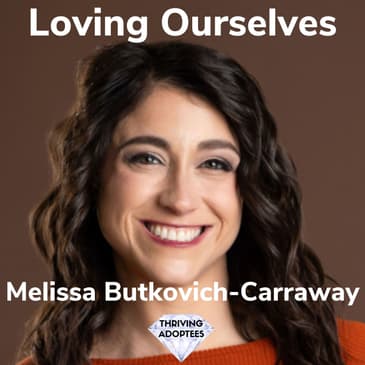
What matters more than loving ourselves? And yet...so many of us believe that voice in our heads that doesn't love us. Listen in as Melissa shares her learnings on self love , helping others love themselves and more...
Find out more about Melissa and the agency she works for at:
https://www.forever-families.org/
https://www.instagram.com/foreverfamiliesmi/
https://www.facebook.com/ForeverFamiliesLivonia/
https://www.facebook.com/melissa.butkovich
https://www.instagram.com/melbutkcarr/
Guests and the host are not (unless mentioned) licensed pscyho-therapists and speak from their own opinion only. Seek qualified advice if you need help.
Want to learn more about thriving for you, your kids, your families or your colleagues? Pick a time to talk here
[00:00:02] Hello everybody, welcome to another episode of the Thriving Adoptees podcast. Today I'm delighted to be joined by Melissa Butkovich-Carraway. Did I get it right? Yes you did. I'm sure she's okay? Good. Yeah, so Melissa is in Michigan, she's in Metro Detroit, so that's kind of the outskirts of Detroit, is that what Metro means? Yes, yep, the surrounding cities of Detroit.
[00:00:28] Right. And she works with Forever Families, and so, and it's the domestic adoption you work in? Yes, I'm in domestic adoptions and I also do help in our state ward, so the Foster Care Adoption Program as well. Okay, cool, cool. So what does thriving mean to you, Melissa?
[00:00:52] Yeah, thriving to me means to be the best version of yourself. Not necessarily to be better than others, or to be perfect, but to have a healthy level of self-confidence and self-love. I feel I really like the quote that says, the best way to make the world a better place is to start with yourself. So making sure that we are working on that self-care and trying to get rid of things that bring down our self-worth.
[00:01:16] I feel like thriving doesn't only come from ourselves and our self-worth, but also from our parents and outside influences, like other people who are important in our lives, and then from society as a whole.
[00:01:26] Yeah, yeah. Nice big scope there. That's great, because that gives me lots to explore with you. The one that really jumped out for me was the self-love thing. So I don't know if that is a thing. Let me be more professional. Self-love itself. So what does that mean to you? What does self-love mean?
[00:01:55] I feel like that means feeling that you are worthy of accepting the good things. I feel like those of us who have experienced trauma can sometimes feel that that trauma voice within us that tells us that we are bad and we are unworthy can overpower sometimes. So making sure that we're doing all that we can to not let that voice take over. Yeah. Yeah. Yeah. The inner voice.
[00:02:47] The inner voice. The inner critic became an opinion that we no longer valued. I like that. Yeah. I think we can go to war with the inner critic, can't we? Definitely. Definitely. Definitely. I've heard too, the way you talk to yourself is that how you would talk to one of your friends or one of your loved ones. Yeah.
[00:03:17] And when you think about that and all the mean things you can say to yourself, no, I would never say that to someone I love. So why do I have those thoughts and say those to myself? Yeah. Yeah. So I guess that begs the question, really. Why do we say that stuff to ourselves? Where does it come from? So I looked into that internal family system approach by Richard Schwartz that you had talked about previously. And I think a lot of it has to come from those different parts that we have.
[00:03:46] Originally, they are not born bad, all these different separate parts with a capital P that we have. But trauma or attachment injuries may force those parts to become destructive. Those parts might continue to live in survival mode as if the trauma is still happening and interfere with our lives. They can make us feel those feelings that we felt when we were originally traumatized and we might not even be aware of those triggers.
[00:04:13] And in order to survive that trauma, we had to push away those feelings of those parts at that time. Yeah. Yeah. I feel like, too, as we had talked about off camera, that adoptees experience those separate parts or those separate selves even earlier than non-adoptees do because of the trauma that they go through right at birth. Being separated from that birth mother with all those familiar smells, familiar sounds, familiar sights.
[00:04:41] And then they're thrown into an unsure world and not sure if they're able to trust these new caregivers. So that new part of them is just immediately established within themselves. Yeah. Yeah. This is a question that fascinates me, Melissa, and I don't have an answer for it. I'm not. I'm not. Sometimes I ask a question and I've got an answer kind of up my own sleeve and sometimes I don't. This is an occasion when I don't have one up my sleeve.
[00:05:08] It seemed to me that trauma is largely a felt experience, right? So it's more about our feelings than our thoughts. And we've been talking about the voice in our head, which is clearly our thoughts.
[00:05:27] So how do you see the connection between those two, the thoughts and feelings and trauma being a feeling, whereas the negative voice in our head is our thoughts that we say to ourselves, right? Yeah. Yeah. Well, I think it also comes from the fact that trauma isn't what happens to us.
[00:05:54] It's what happens inside of us as a result of what happens to us. So the trauma that we experience are those feelings and our nervous system and everything that went on inside of us while things were going on around us or going on to us. It is difficult to separate ourselves from that trauma. But what happened to us is not who you are. Yeah. Yeah. I love metaphors around this.
[00:06:22] And, you know, so when I was adopted back in 1967, people thought that infant, you know, baby adopters, I was five weeks old, right? And they think that babies come as blank slates, right? But they don't. But we don't. Definitely.
[00:06:49] And that's a misconception, actually, that a woman named Georgia Tan told adoptive parents when they were starting to adopt in the 1930s, 40s, that these infants are blank slates that they could turn into whatever they wanted them to be. But that's so not true. So adoptees, non-adoptees, we all come with a history of family genealogy, family history, family social history, all of that that makes up who we are.
[00:07:14] And that doesn't just get erased when we are born or if we are placed into a different family. It's also with regards to nature versus nurture. Just because you are raised one way doesn't necessarily mean it's going to overfight all those nurture characteristics that you were born with. Yeah. Yeah. I think about it. What was the lady's name? You said Georgia Tan. Georgia Tan, yes.
[00:07:41] She had a big influence on adoption in the United States. She ran actually all the 5,000 adoptions that she ran in Tennessee were illegal. And that was because she either didn't follow state policies. Her agency was not licensed. So that alone made all of her adoptions illegal.
[00:08:04] But she also kidnapped children and claimed that their birth parents didn't want them or tricked their birth parents into signing off on them. So she's the one that actually made infant adoption really popular in America. So I guess that's a positive that she did. But her negatives far outweigh any of the positives that she contributed.
[00:08:27] She's also the reason why in America when a child is adopted, a new birth certificate is issued out with the child's new adoptive name and listing the adoptive parents as the birth parents. She did this as also a reason to claim that adoptees are these blank slates that you can recreate into whoever you want them to be. But it was also a tactic to cover up those crimes of kidnapping that she did and to make it harder for birth families to find that child that was adopted. Yeah. Yeah.
[00:08:57] So I think about that blank slate thing as, well, if adoptees are not blank slates, then what's on the slate is therefore trauma. It's trauma on the slate. So that begs the question to me, right? So what's the slate? Do you see what I mean? I think so.
[00:09:25] That the slate is like our personality and all those parts that we are just born with. Yeah. I was thinking, I was thinking, I'm going to look into the Georgia town thing because I've not come across that. You were talking earlier on about this IFS approach.
[00:09:49] And it seems to me, so he talks about Richard Schwartz and the book, ladies and gentlemen, listeners, that is a good dive into this for a lay person is called No Bad Parts. Right. So it's about the absence of shame. It's about grace for ourself.
[00:10:16] It's about not criticising our parts. It's about loving ourselves. Right. It's about loving ourselves rather than hating our bad parts. Right. So there's no bad parts. Therefore, there's no bad parts to hate or dislike or not be very keen on or whatever it was.
[00:10:37] So he talks about the trauma being in the parts rather than the uppercase S self. So for me, the blank slate is the same as it's the same thing. It's the same thing as the uppercase S self.
[00:11:01] It's the part of us beneath our trauma or beneath our psychology. Yes, I would agree with that, that our slate is that capital S, the capital S in self that Richard Schwartz talks about. It made me think, too, I mean, how you said no parts of us are born bad. And it made me think of neglected, really young children.
[00:11:28] If we think of a baby who is cold or hungry and they're crying out for their caregiver and their needs are not being met, eventually they're going to internalise those feelings and wonder, oh, it must be something wrong with me because no one's coming to my care. But we're not born with these feelings of shame and guilt. Rather, it's a learned behaviour and a learned emotion. So that's the start of the trauma, really? Yeah, it's the start of the trauma.
[00:11:58] Apart from the trauma that might be like the generational trauma, you were kind of alluding to that earlier, weren't you? So there may be some in utero trauma, there may be some generational trauma, there may be this trauma at the relinquishment. So it sounds like trauma is a layer cake, right? Just layering things on it.
[00:12:19] But the hope here, listeners, is and the truth is, right, we're not the cake. We're the cake. We're the cake holder. We're the cake stand. So we're separating out who we are from the trauma that we feel. You talked about internalising.
[00:12:48] You talked about internalising the trauma, Melissa. Can you tell us a little bit more about that? Because that's, yeah. I think you've got a bigger take on that than I have.
[00:13:31] Yeah. Yeah. So do you see, some people talk about processing the emotions. Is that how you see how we heal? How do you see that? How do you see the healing given what you've just talked about? Yeah. I think it's definitely something that we have to work through. We have to identify those emotions. We have to acknowledge them.
[00:14:00] And then we have to work through them, understand that those feelings are valid. And that can be difficult because the adult in us might understand why these things happened. We might understand why they were placed for adoption or why this other trauma happened in our lives. But that child within us still has those feelings and didn't understand. But as an adult, we do have to try to connect with that inner person within ourselves that was so young,
[00:14:27] that experienced all this and let them know that it's okay. We're going to work through it and how we're going to get to that point of self-love and total connection. Yeah. So are you talking about confusion there between the adult self and the inner child? How would you describe the relationship between those two parts? I think confusion could be a good word for it.
[00:14:54] Again, just understanding as an adult that maybe you were relinquished because your parent was young or because they had other children or they just weren't in a time in their life to parent or they were single parenting. But again, that child within you didn't understand. All they felt at that time was abandonment or rejection. So trying to connect with that inner person within yourself and understand that what happened
[00:15:20] wasn't because you were so bad and your mom rejected you or your parent rejected you. It was just what was going on with the adult at that time. Yeah. So it's a new understanding that changes an old belief. Yeah. Yeah. Yes, I would agree. And it doesn't just come from us either. I think our adoptive parents have a lot of work that they can do.
[00:15:49] And I can dive deep into that if you would like. And then I think society as a whole has lots of misconceptions about adoption and policies that also restrict our adoptees. And all of these do contribute to that ongoing trauma if they're not corrected or addressed. Yeah. So you talked about self-love.
[00:16:14] You talked about self-confidence and worthiness, feeling worthy. We've looked at self-love. How do you see the worthy, feeling worthy or the self-confidence part of the topics that you suggested at that outset? Yeah.
[00:16:43] I think it comes back to just understanding that we are all human. We are all that same self with the capital S to a degree where we all deserve the same value. Every human has value and understanding that just because you went through something different doesn't mean that you deserve that pain that happened to you. That it's valid that you have those feelings, but you didn't deserve that.
[00:17:12] Yeah. I like that. I think that's really profound that we didn't deserve it. That we didn't deserve the feelings. And it wasn't our fault. Yeah. Yeah. You've reminded me of something that I heard ages ago, which was our feelings aren't our fault. I like that.
[00:17:40] And that's for everybody, right? We don't have any... We don't have... I don't think... Well, I don't know. I don't think we have control over our feelings. I was just having that same thought. So if we don't have any control over them, if we're not choosing them, then can we beat ourselves up less for feeling less than or for feelings that we don't want to feel?
[00:18:11] Yeah. It's not going to make us any better of people to have those feelings of guilt or shame or believe that we just deserve this, but it's hard to control that within us as well. Yeah. I mentioned mine on the West Coast, a guy called Michael Neal talks about being emotiphobic. So like we're trying to push away bad feelings. You know, people talk about this, don't they push away? They're talking about suppressing bad feelings.
[00:18:39] And yet deserving bad feelings, that's a whole... That feels somehow more powerful to me than pushing away. People talk about, you know, pushing them away, self-soothing, all those things. Yeah. I... Yeah, going back, that trauma wasn't our fault. So we don't deserve to feel that bad way about ourselves.
[00:19:09] And it's so much easier said than done. So if we didn't deserve the trauma, we didn't deserve the feelings that came off the back of that. I would agree with that, yeah. This is profound stuff.
[00:19:32] So I remember reading the letter from my birth mum to the social worker that helped me feel her love for me and kind of blew that belief out of the water that there was something wrong with me or that she didn't love me. Mm-hmm. And it was a whole body experience, right?
[00:20:02] It wasn't just a kind of a thought in my head. Mm-hmm. And that can be hard too if we are telling our adopted children that their parent placed them for adoption out of love. That can be really a confusing message to a child too. Like, oh, well, my adoptive parents love me so much. Are they going to leave me one day too? Yeah. Yeah.
[00:20:31] So what if you... Five minutes ago, you talked about the... Kind of the adoptive parents... Insights for adoptive parents that you've had a look at. So do you want to share some of those? Yeah. I have a lot of advice for our adoptive parents. And I know it's going to sound overwhelming. So adoptive parents, pick and choose what you feel like you need to work on
[00:20:59] or what you think would help your adoptee thrive the most. For starters, I think as adoptive parents, before they even adopt, they need to heal from their own trauma. They need to understand why they are looking into adoption. If it had feelings and struggles to do with infertility, then they need to make sure that they have come to terms with not having biological children before they adopt. Because an adopted child is not a replacement to a biological one. And if adoptive parents don't work through those feelings,
[00:21:28] then an adoptive child might end up feeling like they are held to standards of an unborn biological child. So making sure that those adoptive parents work through those feelings and that they are ready to adopt, I think is the first one, before they even have a child placed in their home. Yeah. Do you, clearly that's going to get in the way of the family thriving.
[00:21:58] What other barriers do you see to adoptive families thriving? Well, I'm not sure if all of our adoptive families are completely informed on adoption trauma and the primal wound and statistics that come with adoptees, that they are four times as likely to attempt suicide, that there's higher levels of substance abuse. So the adoption worker should be talking about this with the prospective adoptive parents,
[00:22:27] but adoptive parents also need to be doing their own research. They should also be looking at the behaviors that their child is having and trying to understand if those are normal attachment behaviors or if it's something to be concerned about. Like if, for instance, if a teenager is just wanting privacy or they're experimenting with self-identity, those aren't anything to be concerned about. But if our toddlers and our older school-age kids
[00:22:56] are just completely unable to regulate their emotions, maybe it is time to seek that professional help because there might be an attachment disorder. Do you get many parents coming to you and your colleagues, Melissa, on this stuff? Not, no. I feel like it's something that I introduced to them and sometimes they're not aware of it. I know I was not aware of it until I really got into this field
[00:23:24] because it's not something that society talks about. In society's mind, adoption is this positive, fairy tale, happy ending, and that's not the case. Adoption is not a destination. It is a journey. And there's always loss involved with it. The child has lost their chance to grow up with their biological parents, sometimes within their biological family. And if it's a transracial or international adoption,
[00:23:52] they've also lost that chance to grow up in their own culture or in their own country with their own language. So as adaptive parents too, they need to acknowledge the loss that their child has endured. Yeah. So do you think then they kind of, we're not doing enough pre-adoption training? I don't think there's ever too much pre-adoption training. Yeah. Yeah. Good point. Good point.
[00:24:19] Because is there a mandated minimum in Michigan? Because I think it changes, doesn't it, from... From state to state? Yeah. In Michigan, for families adopting from the Michigan foster care system, they do have to go through a training. I believe it's 24 or 32 hours long. Right. And it covers family relationships, trauma-informed parenting, child development,
[00:24:51] attachment and relationships. It covers many, many different topics. And then personally, at our agency at Forever Families, we do put our adoptive families through a six-hour training. And within that, it covers communication. It also covers legal and recruitment. But in the communication part, we do talk about trauma and being trauma-informed. Yeah. And so do many parents, adopted parents,
[00:25:21] come to you with... Come to you or your colleagues with challenges after the event? Or is it... Are they taking them elsewhere or trying to figure it out on their own? What's the usual kind of vibe around that? So after the adoption is finalized, we do have support groups for our adoptive families where we all get together in the community with the adopted children just to build everybody's network of having other adoptive families.
[00:25:50] But with regard to issues, unless it's really brought up at those post-adoption meetups or the family is reaching out to us, we don't really overstep our boundaries to see that. But at finalization, we do recommend support groups that they can join. We give them those post-adoption resources that the state of Michigan offers for our families so they are able to reach out to them. They also have built that community of other adoptive families, pre-finalization and post-finalization,
[00:26:20] so that hopefully they can go to their peers as well with the issues that they are dealing with and maybe that other family will have some advice for them. So other people have told me that there can be a reticence. I think it's a human thing, not an adoptive parent thing. But there can be a reticence. People can be slow to seek outside support
[00:26:49] because they think that they know their child best or they think that they should be able to handle this stuff themselves. What do you say to that? Is that something that you've come across? I would say to that, to not be afraid to seek out help, that if you are experiencing any challenges, it's most likely guaranteed that there is another family that has gone through the same challenge as you
[00:27:18] or that they will know somebody who is able to help you with that situation you are in. So nobody knows everything. Nobody is a perfect parent. Even if you've raised 10 kids, nobody always knows what they're doing 100% of the time. So don't be afraid to seek out help and ask questions. Yeah. Because I see that getting in the way of thriving, that kind of pride. And I'm thinking back to something.
[00:27:50] I'm thinking back to a friend of mine who used to kind of laugh at me for having a business coach. And that turned out to be kind of funny really because he went bust twice. You know, like, oops.
[00:28:20] It's pride. I mean, I'm talking about quite a proud guy or arrogant chap. I haven't come across anything approaching that in the adoption space. So perhaps I shouldn't have brought it up. Okay.
[00:28:44] What else do you see in terms of barriers and how we overcome barriers so that our adoptive families thrive? Yeah. I think also educating them on the importance of birth family relations when it is safe to do so. Keeping that line of communication open for the child because research has shown that open adoptions are the best
[00:29:14] for the adopted child so that they can know their biological roots. They can know who their biological families are. And it just gives the most peace of mind to that adopted person. So I think as adoptive parents, they should be open to having that line of communication with the biological family as long as it's safe to do so. Also not talking poorly about the child's birth family. Even if it is how you really feel, the child might start to internalize those feelings and feel that there's something wrong with them
[00:29:42] when it's circumstances that are completely out of their control. And then if you are matched with a birth mom while she is still pregnant, providing that emotional support to her before birth and after relinquishment, if that's applicable to your adoption scenario. One of the things that's really struck me, Melissa, having met you a couple of times now, is how much you kind of pour into,
[00:30:08] how much of your energy and time you pour into studying and learning. And I think that's fantastic. I take my hat off to you on that. Thank you. What else helps? Well, what else? You talked about being the best version of ourselves. I'm just wondering if we could change tack slightly and look at, you know, talk about you
[00:30:37] and what helps, you know. So maybe first off, how do you see the relationship between learning and being the best version of Melissa that you can be? That's a good question. I don't think that anyone should ever stop learning. I feel like even though I have been in this field for five years, there is still so much left to learn. I can never learn enough,
[00:31:08] even learning more about individual people's experiences. And just in my free time, I do read a lot of books about adoption. I listen to podcasts like Thriving Adoptees in my free time. Thanks for the plug. So it's just something that I've always been really interested in ever since I was in about high school. When in America, we have MTV and the show 16 and Pregnant and Teen Mom came out when I was in high school
[00:31:37] and there were some teenagers on there that placed their children for adoption. So that really started getting me thinking about unplanned pregnancies and adoption. So it's just always been something I've felt really passionate about. So I just, yeah, going back to the learning, I feel like I just can never learn enough. There's always different topics. Right now I'm reading a book about safe surrenders. The next book I'm going to read is about embryo adoptions.
[00:32:04] So there's just so many different types of adoption and topics within the adoption world that I feel like I could just never know at all. There's always room to grow. So, yeah, fantastic. Fantastic. What are the most kind of surprising things that you've been learning over the last six months or so? What is it that kind of, you think, oh, I didn't see it like that. What were the kind of light bulb moments for you?
[00:32:35] I'm not sure within the last six months, but since being in this field, I always had the misconception that a child adopted from birth had no trauma. And I think that's something that society as a whole thinks too. Oh, I want to adopt a baby because they have no trauma. And as we talked about earlier, there's that generational trauma and utero trauma and that primal wound separation. Once I read Nancy Verrier's book of the primal wound, my mind just exploded. I was like, how could I have not thought
[00:33:03] that separation from birth parents at birth? How could I have been so ignorant as to think that there's no trauma with that? So I think that was the biggest light bulb moment. And that was a few years ago at this point. And within the last six months, I've really gotten to work more with domestic families, whereas before the majority of my experience is in foster care adoptions. So seeing the birth mom going through her experience of relinquishment and making that decision for herself,
[00:33:33] it's been interesting to actually see it in person, the decision process that they have to go through and those tough feelings of relinquishment. Yeah, yeah. Other than learning, which clearly is a passion of yours, what helps you become that best version of yourself? I think also unplugging when I need to. So after a long day of work,
[00:34:02] coming home and not thinking about work, trying to ignore it on the weekends, unless I do get a call on my cell phone or a really important email, that self-care and social work is very important so that you can always come back as the most refreshed version of yourself. I think secondary trauma is also very real in the social work world, especially when you're working with foster care adoption cases. And these children are being available for adoption due to parental rights being terminated due to abuse or neglect.
[00:34:30] So reading about some of those histories of why the children came into care and why they are available for adoption can be really hard. So I think sometimes in the social work world, we have to laugh about some bad things because otherwise it'll just break us down. So making sure that we are recognizing that secondary trauma that we are going through as social workers, leaning on our coworkers when we are feeling overwhelmed and we need that extra support, and then taking that time
[00:35:00] to just unplug and recharge ourselves. Yeah. Have you come across Bessel van der Kolk in your research? I have not. What is that? Or who is that? So he's a trauma guru guy. So he's a bit like Richard Schwartz in that respect. So his book is best sell. It's about 5 million copies of it only in the last 10 years.
[00:35:28] So 10, 11 years maybe? It's called The Body Keeps the Score. Oh, yes. It's on my reading list. Okay, it's on your list, yeah. He's like a veteran, a veteran of trauma work, right? I don't know whether he's a military veteran or not, but he's a veteran trauma guy. So he's in his 70s or his 80s. And he, and despite that, right,
[00:35:57] you've talked about secondary trauma. He's only just seen his. So, like, that was a real, you know, I ask you that question about what's, what's surprised you the most recently. That's what surprised me the most recently,
[00:36:19] that somebody who is steeped in trauma research, and a trauma researcher, somebody that's pushing the boundaries, understanding this trauma that's internalised within our bodies, is, was unaware of his own secondary trauma.
[00:36:48] That leads me to a question, is that, because you know, the Primer Wound came out in 1993, I think it was published. I don't know when it really, I didn't know whether it was an instant hit straight off the bat, or if it was a long burn, or whatever it was. But Nancy Berry was the lady that became, was the first person to kind of make us aware of this trauma. She was really ahead of her time.
[00:37:17] She was ahead of her time. And I'm wondering to what extent social workers are aware of secondary trauma? Is it kind of a, well, is it widely understood, given that this Bessel van der Kolk guy, couldn't, didn't see his until he started doing some ayahuasca and, you know, therapy with that? Yeah.
[00:37:46] I can only speak to the trainings that I've been through, and I've only ever done social work in the state of Michigan, but the state of Michigan, and at least the private agencies that I've worked at, I feel like do a very good job of making sure our workers get self-care. We have had yoga on our lunch hour before. We are, we have like little pizza parties and stuff every once in a while. So I think our work, especially where I'm at now at Forever Families,
[00:38:15] does recognize that our workers need to take those moments for self-care. And like I said, unplug a little bit. And I do recall in the state of Michigan training for foster care adoptions that they do touch on secondary trauma. And at the private agencies I worked at, they do recognize self-care. Our agency is definitely understanding if you need to take time off.
[00:38:45] We do not get scolded for taking time off and using our paid time off. That's something that they understand that we need so that, again, we can come back to be that most refreshed and recharged version of ourselves. Yeah. Yeah. That's good to know. It's, it's just the old timers that may be missing it. Maybe it's a generational thing, right? And it could be, it might definitely be something that was not addressed previously, but as I've started working in the social work field in about 2016, I think it's definitely something that is being addressed more often. Yeah.
[00:39:14] That's great to hear. That's great to hear. So you did a whole load of preparation for today. Is there, is there anything that I've not asked you about that you'd like to share? I definitely do have lots of notes. I came prepared. Yeah. And it, I know I keep putting it back on the adoptive parents. And so I'll,
[00:39:41] I'll do larger right now and I'll talk about society as a whole. We had talked earlier about how society as a whole does tend to see adoption as this positive thing, or it's just an opposite to an option for abortion. And usually that trauma is ignored that adoptees go through. I did hear a really good comparison once that was, if we think about a baby who just got adopted into a closed adoption,
[00:40:09] and then a baby who lost their mother in childbirth, society tends to only grieve for the child who lost their mother in childbirth and not the one who lost their mother in a closed adoption. And I do understand death is permanent, whereas adoption has the chance for reunification. But in that moment, both of those babies are having those exact same feelings of loss and rejection and abandonment and what's going on around me. Everything is so new. Can I trust these new caregivers?
[00:40:38] But as a society, we tend to only feel bad for the one baby. Yeah. Yeah. It's a, it's a stark, it's a stark reminder, really, I guess. And one of the things building off the back of what you said, Melissa,
[00:41:00] is that a lot of the anger that people may see online from adult adoptees, this misunderstanding and diminishment of the trauma, that's, that's, that's a core part of, well, a core driver of the,
[00:41:30] of the, of the, uh, their anger. Right. So, uh, and so at first, I think there's, there's, uh, there's an anger towards the parents. So if, if the parents, and this is, this is also kind of generational time base, right? So the, the, the older, the, the older,
[00:41:58] 1993 was the time that Primal Wound came out. Right. So I think it's, I think it's really unfair of us as adoptees to blame, uh, well, to criticize parents who raised us in the sixties, seventies, eighties, early nineties, right. To criticize them about trauma knowledge when trauma knowledge wasn't around. Right.
[00:42:28] Adoption trauma knowledge wasn't around. Right. So I, I, I say this some, I sum this up. If I can think of the words, uh, I sum this up hopefully a little bit more succinctly than that. It, it's wrong. it's not fair to, to criticize, well, to judge 20th century parenting knowledge with 21st century trauma knowledge. It's just, it's just, it's just not fair to do that.
[00:42:58] So, so what's happened? So if, if a parent has raised a child, thinking that that child is a blank slate and has no trauma and the child is fully aware of that trauma, right. There's a mismatch there and that leads to a lot of challenges within the adoptive family. So then that,
[00:43:28] that can, if we, if we kind of scope that out to the societal challenge, right, the mismatch is even bigger. Right. So it's not only did my parents minimize my trauma, society's minimizing my trauma. So they, the anger kind of snowballs. And that's the reason for the, that's the reason I think,
[00:43:52] a big part of the reason that adoptees sometimes say what, say what they say, because it's this first parental and then societal negation of their, of their trauma. Yeah, I would agree. And I like your point of not comparing adoptive parents to what they used to be, to what they are today, because we have so much more research and information of how adoption affects the person
[00:44:21] than they ever had. Back in the 50s, 60s, 70s, workers told adoptive parents to not tell their child that they were adopted, that they didn't need to know that information, that if you just love them enough, it will be good enough. And there were, in, in America, there were, there was like a match science that happened in like the 40s, 50s, 60s, where workers and researchers felt that if they could just find the right temperament
[00:44:51] and the right looks physically, and they could just match them perfectly with their adoptive family, then they could just ease in there as though it was their biological family and gave adoptive families the misconception that the child would have no trauma, there'd be no issues from the adoption. And then even therapists overlooked it and didn't feel that adoption was something that needed to be talked about in therapy. So it is pretty amazing how far we have come as a society. Yeah. But there's still a lot more.
[00:45:20] There's always here to go. Yeah. A lot to go. I think part, part two, society needs to realize how hard searching and reunification can be. I think some people have the misconception of, well, if the adopted person had a really good childhood, why do they need to search for their birth relatives? But if we think about it with non-adopted people, non-adopted people also do ancestry DNA and are interested in their family history. So it's not just something that someone who wasn't, didn't grow up around that would be curious about.
[00:45:50] And it's a total natural curiosity too. It doesn't mean that the adoptive parents did anything wrong. And I think there's a misconception that once an adopted person meets their birth parent, that that's all good and reunification is done. And that's the happy ending when it's not reunification. The initial meeting is just the very beginning. And there can be a lot of different feelings that come with that with regression or a secondary rejection.
[00:46:17] So it's not all just sunshine and butterflies. Again, that I think the large scale of society tends to think about adoption. Yeah. Good points. Good points. So thank you so much, Melissa. It's been a great conversation. And nobody has ever prepared as well as you for one of the conversations. So hats off to that. Oh, thank you. It was great.
[00:46:46] Anything else you want to add? Or are we, are we, we can wrap it up. I think we can wrap it up. I would just reiterate the point again, that I think to make our adoptees thrive, it will come from internally, making sure that we are processing all the emotions and trauma that we've went through. But on a bigger scale, it's making sure our adoptive parents are well-educated and trauma-informed and doing everything they can to boost their child's self-esteem
[00:47:13] and helping them search and helping them know their birth parents' information. And then on an even larger scale, it's society needs to make some changes. Policies need to make changes. So there's a lot of different moving parts that go into making an adoptee thrive. Fantastic. Thank you, Melissa. Thank you, listeners. We'll speak to you again very soon. Take care. Bye-bye.