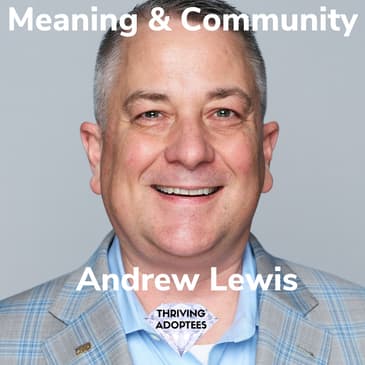
Looking for inspiration? Andrew, father of three - including one through adoption - shares his insights on igniting our passion, finding meaning and community. A powerful and empowering episode.
Andrew is a passionate supporter of foster care and adoption. Andrew launched the KPMG National Foster Care and Adoption Network in 2021, which has now grown to more than 45 of KPMG’s US offices. Focused initially on mentoring and coaching opportunities for new and prospective foster and adoptive parents, the network has grown to serve as a platform for connecting foster and adoptive parents, adult adoptees, birth parents, and adoption advocates. The network also connects with key community organizations that focus on foster and adoption and are actively supported by KPMG’s partners and employees.
Andrew has received numerous awards and recognition, including Seramount’s National Working Dad of the Year, and the Association of Government Accountants’ Andy Barr Award, National President’s Award, National Treasurer’s Award, and National Author’s Award.
Andrew and his wife are adoptive parents and former foster parents. They have three children, and live in Maryland.
If you'd like to connect with Andrew you can email him at aclewis@kpmg.com or connect here https://www.linkedin.com/in/andrew-c-lewis/
Guests and the host are not (unless mentioned) licensed pscyho-therapists and speak from their own opinion only. Seek qualified advice if you need help.
Want to learn more about thriving for you, your kids, your families or your colleagues? Pick a time to talk here
[00:00:02] Hello everybody, welcome to another episode of Thriving Adoptees Podcast. Today I'm delighted to be joined by Andrew Lewis. Looking forward to our conversation today, Andrew? Me as well, Simon. I'm looking forward to this too. Yeah, so listeners, Andrew is a dad, an adopted dad. You've got three kids and your youngest, if I remember rightly, is the one that came to you through adoption, is that right? Correct, through foster care and then we adopted her.
[00:00:29] Yeah, and shout out to Marcy Bersack if you're listening, Marcy, because Marcy's been on the show a couple of times, introduced me to Andrew, so delighted for that, if you're listening, Marcy. And the other thing about Andrew is doing some great work in his company, bringing together communities of resource parents,
[00:00:55] foster and adoptive parents, which we might explore as the conversation unfolds. But let's dive in with the question that we always ask, right? So what does thriving mean to you, Andrew? Yeah, thanks Simon. And you know, I just want to say thank you for letting me come on and join you on this podcast. This is an amazing opportunity. You open that these podcasts are a chance to hear wisdom.
[00:01:20] I can't guarantee that there will be wisdom in the next time we're together, but you know, certainly happy to share with you my thoughts. And if you think about thriving to me, it's about knowing yourself and about finding or building a community. I think that's a great opportunity. Because what I think is that so important for each one of us is that it's important for us as we have faced challenges, have faced obstacles and uncertainties in our lives.
[00:01:50] It's really important that we turn around and lend a hand to those people behind us who are also facing similar challenges or uncertainties in their own lives. And you know, that to me, like what you're doing here with this podcast, this is about building a community and allowing people to be able to come together to thrive together and to be inspired by ways to thrive in their own lives too. Yeah, it is.
[00:02:18] And I want to go back to your first point about wisdom. And like, have you ever met anybody that's good at modesty? That would be like a contradiction in terms, but that's what I try to do on the pod. I try to interview people and mind their knowledge or their learnings or the wisdom, which too bodice to say it's wisdom, right?
[00:02:48] And share it with others in the hope that parts of the learnings inspire people along their journey. And that's what it's all about. And I don't know quite why I came up with that way of doing the pod, because it wasn't a conscious decision.
[00:03:14] I knew, I must have known at some level that that's what it was all about. I think because of those turning moments in my life, the insights, the epiphanies, the aha moments. And we were sharing a couple of non-adoption ones before we started recording, but listeners.
[00:03:40] But that's the whole essence is we're bringing people together to share learnings in case that helps others along their journey. And we're focusing on our learnings rather than, yeah, more about the learnings and the story bits of the story come out during the conversation.
[00:04:06] But the frame for the conversation is I try and make it always about the learnings. Well, you're certainly doing that, Simon. I mean, I in preparing for this, I had a chance to listen to dozens of the podcasts. I haven't made it to all 500 that you've recorded now, but I had a chance to listen to dozens. And and certainly there are so many things that I was inspired by, learned from others who have sat in this chair before me.
[00:04:34] So I just really want to thank you, because, again, this is about thriving. And I think creating this community of listeners who come together and, you know, are nudged forward in their way of thinking as a result of listening to the fantastic exchanges you have with other guests is something that I think fits right in with the theory or the theme of this podcast. Yeah. Yeah.
[00:04:59] You said thriving is about knowing, knowing, knowing ourselves, no matter who we are, right? You know, no matter, no matter whether we're adopted or not. So what does self mean for you? What does knowing yourself mean for you, Andrew?
[00:05:21] Well, for me, you know, I've been involved in a lot of causes throughout my career and throughout my life, helping to support a number of different charities and organizations.
[00:05:33] You know, and throughout my career, I've been asked to join certain boards and been been inspired or there's been a connection to the cause of what they are, whether it's something that was important to me while I was a student at university or whether or not it was a health related cause that's impacted my family.
[00:05:53] But when my wife and I made the decision to become foster parents and went through that journey to ultimately arrive at the destination of opening up our home to children in need, that ignited a passion for me that I didn't even realize is just going to burn right for decades to come.
[00:06:14] And it's really transformed the entire framework of how I prioritize my time and my passion by focusing me on things that I can do to be able to help those impacted by foster care and adoption. You know, whether it's creating communities at work, like I'm sure we'll talk about here in a few minutes, whether it's what my wife and I do in order to be able to, you know, help out others in the community. And of course, for me, joining board.
[00:06:43] So for me, that journey of finding that passion, that place where I felt like I can really have a meaningful impact. And, you know, that to me as an ally or now as an adoptive parent was so important for me to then find and build a community to thrive.
[00:07:04] And I think as I think about the experiences of adoptees and others who I, you know, work so closely with and have partnered with in a lot of different efforts. I think for those that have been directly impacted by trauma, neglect or abuse, knowing yourself is a very different journey that they have to navigate through than me coming to the table to choose to open up my home as a foster parent. So that's why I really think it's about knowing yourself.
[00:07:33] It's about connecting to your lived experiences. You know, working through some of the impacts of trauma, neglect and abuse, but then ultimately opening yourself up to being able to share that work that you've done to overcome those uncertainties and challenges.
[00:07:56] To be able to help other people who are behind you, who are hurting in the way that you might have hurt years ago. Yeah. I mean, we're talking about identity and identity and passion here. And I mean, are they are they at some level? Are they the same? Well, certainly, I think.
[00:08:23] But, you know, there are some people that struggle with their identity. They it takes them a long time. I mean, you've you've even shared that, you know, you only became aware of portions of your identity in your 40s. And so I think as people go through this process to be learn who they are and for some having to work through some of the issues or setbacks.
[00:08:50] I think it's important to ultimately just study yourself as much as you study others around you in order to be able to figure out how you can really connect that purpose to others and help others who are behind you. Yeah. Well, identity is something that fascinates me, Andrew. So I'm going to I'm going to dig a little bit deeper and perhaps bring in because you use the word flame.
[00:09:19] Right. And when you were talking about flame, I thought about light for some reason, because, well, because of the way some of the ways that I guess of the way I see and self. I think. And the other the word that came after after that for me was enlightenment. Mm hmm.
[00:09:52] And the thing after that came after me is this this phrase I heard from from one of my teachers is about is endarkenment. Right. So so the the the the Western way of looking at this is, you know, we're looking for some of us are looking for enlightenment.
[00:10:17] And then some of us have have seen that we we are actually the light and that that light has been endarkened. And I'm coming at this from a non-religious, non-religious take about it. I know you consider it. I mean, how do you describe your man of a man of faith? Is it I mean, how would you? Absolutely. Yeah.
[00:10:46] I mean, I think of deep faith, deep faith. So how bear in mind my slightly perhaps a 90 degree, it's like 90 degree tangent off from from self to to light and enlighten and darken.
[00:11:01] And what's your what's your take on self from your perspective, you know, child of God or man of deep faith or however you however you see it? Well, I purpose for me also has a very deep connotation to it as well about what I'm put on this world to do or accomplish or impact while I'm here.
[00:11:31] And, you know, those I work with also know that I I have a saying of you're only in this world once you're only, you know, on broader perspective, you're only on this planet once. You know, what are you going to do with the time that you have, the limited time that you have in order to be able to change the environment, the world, the culture around you? And so, you know, I think that that is something around a life purpose.
[00:11:56] Yes. But also that has been a motive for me every time I've stepped into a role, a volunteer role, a work role of urgency. You know, having an impact today because, you know, the time is limited to how long you have in that time, in that role, with that community, with that group of people in order to have an impact.
[00:12:22] And so, you know, every every time I step into a role, I always in my mind feel like there's a countdown clock going behind me. And that creates some sense of urgency that, you know, we need to move and we need to move today to be able to create impact, to be able to create and achieve what we're there to achieve in the role that we're there to do.
[00:12:47] Yeah. So the second strand for your thriving was the community, the creating community. So can you share a little bit about what you've been doing within the business, within your employer?
[00:13:07] Sure. You know, and I think we we spend a lot of time in our at work with work colleagues and creating a community. At work to me is also very important to my firm, KPMG, a big professional services firm. We did a study around, you know, friends at work. And, you know, I think that that is really impactful because. Having friends or having connections with others at work.
[00:13:38] You know, four out of five people who participated in this one study identified that having connections to colleagues is highly important and has a significant impact on mental health. And enormous mental health benefits. And, you know, one out of four people at work feel lonely or isolated. And so to me.
[00:13:58] As I was going through this journey of becoming a foster parent, being open with my colleagues around me about this part of my identity that was forming and became, you know, even more important to who I am. And I got so inspired by the opportunities.
[00:14:14] I had to be able to connect with other people who were either on a journey of becoming foster parents, adoptive parents, people already were adoptive parents, people who were helping support the child welfare system as court advocates or adoptees. And so I was just so excited and inspired by those experiences that I wanted to bring them together.
[00:14:40] And so we started I started a foster care and adoption network at my company, an employee resource group that now has, you know, in the U.S. has generated several hundred members across more than half of my firm's 90 offices in the United States.
[00:14:58] And this has just been a tremendous way to be able to bring people together, to learn from one another, to help other people navigate through the process of becoming foster parents, adoptive parents, but then also creating community of people who have similar passions or yearn to connect with others who have had similar lived experiences like adoptees or like court-appointed advocates.
[00:15:28] So I've just been so excited.
[00:15:59] What have you learned about yourself from being a dad and now being an adopted dad? But, you know, I'm just going to call you dad, right? Because I know that, you know, my mum and dad don't use that terminology. And I don't use that terminology to them either. No, we just use that in the conversation and things. So what have you learned about yourself through parenting?
[00:16:28] Well, I've learned about the capacity for love. I mean, it's just limitless. And it's just been so wonderful to be able to build a family in different ways, but to be able to come together as a family. And that's been just so important for my wife and I just to see the impact that we can have to children in need.
[00:16:54] I mean, that's what motivated us when we got started was helping children in need, not expecting it to result in an adoption, but very proud when we opened up our hearts in our home to an adoption and, you know, completing our family in that respect.
[00:17:12] So I think I've learned a lot about love and, you know, also learned a lot about helping and still learning a lot about helping children who have been impacted by trauma, neglect and abuse. You know, my daughter only spent a lot of time. She came to us when she was nine weeks old. So, you know, but she had only a brief period of time with her birth mother. But then also, you know, I think that the.
[00:17:41] The. The impacts that she faced and continues to face, I mean, it's it's certainly impacted her and changed her and trying to parent and trying to support the development and growth of a child. As a. As a. As a. Adoptive parent, as a parent. It.
[00:18:02] You have to lean on a community around you to continue to make sure you're pulling in the right skills and resources, whether it's from other people who have gone through the journey, whether it's from therapists, doctors. Just making sure we understand my wife and I and our whole family understand. You know, what are some of those triggers? What are some of those things that, you know, can accelerate or, you know, cause an emotional reaction or outburst?
[00:18:32] And so just learning a lot of those parenting techniques is something that I'm learning, have learned and I'm going to continue to learn as we navigate through this. And. Have there been any key kind of learning moments for you on that along that time?
[00:18:49] Well, it became really clear, you know, so as you acknowledge, I have two older children who were biological children, and I think the parenting strategies that worked for them are very different as far as the parenting strategies that I need to use for somebody who's impacted by trauma, neglect and abuse. And so, you know, my wife and I going through the process of realizing it's not working. What do we need to do to change?
[00:19:14] And then, you know, tapping into podcasts, tapping into post adoption support services like what Debbie Riley provides in the Center for Adoption Support and Education. I mean, leaning into these other resources around you has been acknowledging that you need help and then reaching out and finding the resources to help you is something that, you know, I needed to do as a parent because parenting is different. We're utilizing different techniques and different.
[00:19:46] You know, different strategies. Yeah. Because there's that point, well, there's that point when you realize, when you acknowledge it, when you become aware of the need for support. One of the things I hear quite a lot from professionals in the adoption space is that, and it's human nature, right?
[00:20:15] This isn't an adoptive parent thing or even a parent thing. This is a human nature thing from what I can gather, is that we have a tendency to sometimes leave it later than we should have done. What do you make of that? We should say that again or? Sorry.
[00:20:40] What I hear a lot from professionals is that adoptive parents often leave it later than perhaps they should have done to get support. And I don't think that that's just an adoptive parent thing. I think, and I don't think it's just a parent thing either. I think it's a human nature thing that we often, maybe we're maybe a little bit more optimistic.
[00:21:08] You know, and I'm wondering, that's just my take on this. I'm wondering what you make of that. Now I'm tracking. I think, I don't have any statistics whether or not they do wait long, too long or not. But I think it is a human nature issue to self-reflect and feel like when you're running into parenting challenges, that there's something broken in how you're parenting.
[00:21:34] And sometimes I think, you know, understanding that you need to adopt different strategies. It also has to do with generational impacts. You know, I think how you were raised is not necessarily the same way that you should or will raise your children.
[00:21:57] You know, you need to break some generational traditions that may or may not be healthy in the current environment. You know, it's interesting when I became, when my wife and I were going through the process to become foster parents in Maryland, the process to become a foster parent was an incredibly interesting process.
[00:22:20] One specific example is that we went through a, they administered, the social worker came out and administered a test. And, you know, I'd been married to my wife at that point for probably, I don't know, 15 years. I thought I knew all the stories. Like, I thought I had heard all the stories from her over time and over life.
[00:22:41] But it was interesting that to understand generational impacts of parenting that gets passed along generation to generation in a family, primarily issues around abuse or neglect. You know, one of the questionnaires was, you know, describe your relationship growing up with your mother. And it listed all of these, you know, descriptions, warm, soft, cold, distant, present.
[00:23:08] You know, you had to go through and need to check and choose not to check certain things. And then, you know, the next question is, describe your relationship today with your mother. The same with your father growing up and today, siblings. And it was really interesting that my wife and I completed this separately. But then we came back together with a social worker. And as my wife and I went through this, you know, and looked at each other's responses,
[00:23:35] it was amazing to hear stories I had never heard about her growing up. And I shared stories about me that I had never shared with her growing up. But I think it did help me learn a lot about the traditions in my household, the traditions in her household, and then the traditions that we wanted to create in our household together. Yeah.
[00:23:58] So, you're clearly really, I think you're like a really emotionally aware, emotionally intelligent guy. Do you know where that comes from? Can you track that back? I don't know. I think it's, you know, a lot of great leadership development programs and, you know, great parents and a great family. Yeah.
[00:24:28] Yeah. I loved, because, I don't know if you heard that listeners, Andrews talked about working for KPMG. And I, when asked about some, asked one of the questions, you said, I don't have any data on that. I thought that was, like, I thought that was very. I'm an accountant after all. So, I am a little bit more data-driven and linearly minded. Yeah. So, what does, we've talked about thriving.
[00:24:59] We've talked about community. Talked about passion and meaning. So, what does thriving adoptees mean to you? You know, thriving adoptees to me is similar to what we talked about with thriving.
[00:25:19] It's about knowing your story, but then helping others who may struggle or may face some of the same things that you faced. And I know that that's a little bit more of a challenge or a different path, like I said before.
[00:25:37] But I think that thriving adoptees to me is making it, extending a hand of friendship and being there to walk the walk with others who need that support from you. So, thriving to me is about, is a verb. Thriving to me is active.
[00:26:07] It's about being engaged. It's about being present with others and helping to be able to improve the life and the experience of others around you. Yeah. I love that because how many times have I said thriving adoptees? And have I ever thought, I was thinking it as an adjective, actually, not a verb. So, I like that. I like the more action focus and the process of it.
[00:26:36] Another question pops into my head in terms of to connect the two worlds, right? The work world and the home world. You mentioned that there are, I think you mentioned that there's some adoptees that are in the employee resource group.
[00:26:52] And I'm wondering, is there anything that you've learned from them that has influenced the way that you're raising your daughter?
[00:27:07] Or, yeah, anything, any big or small or big learnings from them that's shaping the way you think about thriving and you think about raising your daughter? Well, there are so many things that pop to mind when you say that.
[00:27:30] I think that I've been so inspired by and informed by the adoptees in our network as I've sat and talked to them. I think within our network, it's helped to broaden my awareness of being an inclusive leader, about making sure that the programs, the activities, the way in which we talk about adoption is informed by adoptees.
[00:28:00] And, you know, adoptees have had varied experiences, whether it's inter-country or domestic, whether it comes out of foster care or private placement. You know, I think that there's so many different ways that adoption transpires. And with that comes so many different lived experiences.
[00:28:18] So hearing about the multitude of both positive, neutral, and negative experiences through adoption from the adoptees has helped me to be able to design programs, use language that, you know, recognizes all adoptions begin with a loss, a loss among the triad in many cases.
[00:28:40] And so I think that that's really helped me to make sure that our program at work, which actually started as the foster care and adoptive parents network, because that's my experience. And that's when I came to the table wanting to bring together adoptive foster and adoptive parents.
[00:28:59] And, you know, was blown away when I realized how inaccurate that was, because I was only reaching out to a small segment of those impacted by foster care and adoption. And when, you know, I realized the error of kind of my initial thinking, and we opened up the tent, you know, then we brought in people who have provided surrogate care. We have a small number of people who have a small number of birth parents.
[00:29:27] And then, of course, adoptees, advocates, foster care, adoption, intercountry and domestic people providing kinship care. I mean, there's so many different ways that people are connected into this adoption constellation. And that's been informed to me by the adoptees.
[00:29:46] Now, as a parent, I'll tell you, I've also learned a lot about how adoptees look back at their experiences of growing up in an adoptive household, including in our family as a transracial family now, too, through adoption. You know, hearing about some of the things that I need to be aware of as a parent to be able to shape those experiences,
[00:30:11] to allow appropriate space for my daughter to continue to learn of her identity as it evolves, for her to continue to process her own adoption as she goes through different stages of her own maturity and development. And, you know, to realize that there's times to be a parent, there's times to be just connected,
[00:30:37] also being a parent, but also to be a supporter and to, you know, provide that kind of safe space for her to continue to process the manner in which she came to our home. Yeah. So you talked about the variety of people that are involved in the group and the variety of experiences,
[00:31:03] good, neutral and poor of the adoptees. What is it that, other than clearly the adoption thing, what is it that brings the group together? What's the gel? What's the gel that brings it all together? What's the oil that keeps it moving forward?
[00:31:34] So is it, so for example, you know, the vulnerability and sharing, what is it that helps everybody learn and grow from one another? Well, I think because there's so many different people connected into the network and who are connected into foster care and adoption,
[00:31:57] we look to be able to address or highlight and focus on each one of those different communities when we come together. So, because we want to make sure that there's a voice for all and that there's interest across such a diverse set of experiences. So in our network, we come together quarterly for a virtual meeting
[00:32:19] and, you know, we invite in nonprofit organizations that our network members are active within and we invite like an executive director to come in and talk about what they do. And often that opens up a broad discussion around how they're helping to impact the community of foster care and adoption. And then we often have a panel discussion of people who are connected in.
[00:32:44] So we've done, you know, a program around advocates and then had a panel discussion around advocates. We've had an adoption 101 session and had a panel group come in. So, you know, I think there's a lot of people who come to learn. There's also, we also do a lot of mentoring programs. And we just kicked off a six-month mentoring network program. So it brings together people at different stages of the foster care and adoption journey.
[00:33:12] And also we have a separate segment for those who are adoptees. And so there are people who come together wanting to create a small community of shared experiences. And then lastly, it's just a chance to be able to identify work colleagues that have the same experience as you and sometimes coming to work with the same approach, the same experiences that may color or adjust the lens that how you see things around you.
[00:33:41] And then learning how to navigate your career and the culture of your company with the experiences you've had coming up to day one when you started. And so, you know, having a program to be able to allow for mentoring, I think, is also really powerful, too. So there's a give and take that I think creates that gel that brings people together.
[00:34:05] Yeah. And it sounds like a lot of flexibility and organic development from the needs of the members. And so, you know, even in just the term of, you know, you started off with a foster and adoptive parents focus, but that's broadened out to give more variety to the network.
[00:34:30] So what do you think gets in the way of us and thriving? You know, I think it's either those who aren't ready to look in the mirror to see themselves for who they are.
[00:34:55] I mean, the experience that you've had shape who you are today and being able to look in the mirror and process through everything you need to do in order to look in that mirror and see you are who you are. And seeing the power in who you are is something that I think holds back people from thriving. You know, they're either running away from or they're not seeing the enormous potential of impact that they can have to others around them.
[00:35:24] You know, they think it's just me, but they don't realize that they could be a powerful catalyst for change in the right community or with the right people. My other daughter, she, we were, you know, going to different camps and stuff that she went to. And she ended up going to a science and technology camp that I went to when I was growing up.
[00:35:48] And it was funny after the second year that she went to that camp, she got in the car when I picked her up and she's like, dad, these aren't my people. And, you know, we went through a process for her to find her people. And, you know, she ended up finding that theater and arts and performances in musical productions. That's her, that's her people.
[00:36:13] And, you know, I think that that to me is, I see in her now, she was successful in one experience, but she is dynamic and so amazing in now that she found her people. And so I think for thriving, it's about finding your people.
[00:36:36] I found my people when I realized how important my connection is to foster care and adoption. And, you know, that's where that flame that I mentioned at the top of the episode came from. And I hope that all the listeners here, you know, are, know what their people are or who their people are, or they're actively trying to be able to find those people that they can have true impact. Yeah.
[00:37:04] What do you think helps us shift from the me to the we? Do you know what I mean by that? Yeah. You know, I think it's natural for people. I look back even in my own career where I was very me led at the beginning of my career. And that's, you know, not something to be ashamed of.
[00:37:26] I think that there's a point in everyone's life where you're trying to find yourself, establish yourself, plant yourself, whether it's personally or professionally. But I think that there also kind of comes a tipping point where you realize that there's you're you're a part of a larger group, whether it's a family, whether it's a community, whether it's a workplace, whether it's a community within a workplace.
[00:37:55] I mean, I think that when you start to realize the power of culture and the power of connection. That's when I think that's when I felt I went from a me to a we mindset. And, you know, that's been a motive for me throughout the balance of my life then from that point on. You mentioned something earlier on about, I think, a lack of expectation.
[00:38:27] You didn't you didn't see the flame coming or something along that. Did you did you feel the the the the chip? Did you feel the chipping point coming from me to we or did it surprise you? You know, I think I I don't know if there was any specific point I can look back to where I kind of felt that.
[00:38:54] I mean, I was I'm proud to have grown up in a family that, you know, was very thoughtful around the experiences of others. I lived overseas when I was in high school and again, while I was in college. And that, I think, certainly broadened my awareness and understanding of the lived experiences of others around. And I think up until the point that I went abroad, I lived in the former Soviet Union when it actually still was the Soviet Union and became Russia while I was there.
[00:39:21] I think up until that point in my life, I was very much me, me, I only me, you know, very self-centric. But, you know, as I started to see the broader world around me and I started to see the impact that I can have on others, I think that's when that transition began. And then I continue to see that transition go on throughout my 20s and 30s. Yeah. I can.
[00:39:48] Would you mind sharing a bit of context around this this rushing trip? Because it really blew me away when you shared it with me last time. You were like 16 or 16 or 17, went to Russia? With the American Field Service, a international exchange student exchange program. And I had an opportunity. It was only the second year that people from the United States were being exchanged with students from the Soviet Union. And so I ended up going to the Soviet Union.
[00:40:18] It was 1991 that I got there. There was a coup or attempted coup to overthrow President Yeltsin at the time. I'm sorry, President Gorbachev. President Yeltsin then ended up taking over after President Gorbachev abdicated and dissolved the Soviet Union, formation of the Commonwealth of the United States.
[00:40:37] And just such an amazing and transformative time globally, geopolitically, but also, of course, a hugely transformative time for me personally. As I learned how to navigate the world around me alone or independently.
[00:40:58] And so I think that that forced me to grow up, grow up very quickly and grow up very fast as I kind of encountered a lot of different new experiences. So, I mean, I just think the world of being somebody focused upon multicultural experiences, it helped me become a more inclusive leader throughout my career. I think that there's a lot to be gained from seeing a broader community around you. Yeah.
[00:41:28] Could you share just the bit where you had to move houses, didn't you? You were being posted and the people couldn't afford to feed you? Was that? You know, economically, it was a really hard time in Russia. There was a release of price controls at the time. There was enormous inflation that the country was facing.
[00:41:53] And so the host family that I was with wasn't able to support themselves, let alone an extra mouth to feed in the family. And so it just it wasn't the right environment for me to be in. And so the American Field Service was great. And they helped me move to a family that was able to weather those economic conditions a little bit better. But it forced me to move cities. But again, everything happens for a reason.
[00:42:18] And that's where I ended up meeting other exchange students in that new town that are still friends of mine today. Yeah, that's brilliant. So let's close on time here. Is there anything you'd like to share that I've not asked you about, Andrew? No, there's nothing you haven't asked me about.
[00:42:42] But I mean, I do want to, again, let you know how much I sincerely appreciate the work that you're doing to through this podcast to bring, you know, so many of the listeners together who are eager to learn, eager to grow and are active in supporting foster care and adoption in so many different ways.
[00:43:01] I will also, and maybe a call to action for all the listeners, if you are interested in talking to me about creating a community in your workplace or want to engage with me about what we did at my firm and maybe some ideas about what you could do in your organization, I want to extend a hand. You're welcome to reach out to me. You can connect with me through LinkedIn. Just look up Andrew Lewis, L-E-W-I-S at KPMG.
[00:43:28] Or you're also welcome to email me directly, aclewis at kpmg.com. I'd love to connect with any one of you who are interested in taking that next step to create a community at your own organization. Yeah, that's fantastic. And as always, listeners, there'll be links in the show notes. I usually link to LinkedIn as well. Obviously, I'll do this in this case because we know that that's where Andrew's at. And thank you. You thank me.
[00:43:58] I take my hat off to you for all the work that you're doing. And doing this work in companies is really groundbreaking stuff. So good on you. And I love the way. I love the flexibility that you're developing, all the stuff that you do. So thank you, Andrew. And thank you, listeners. We'll speak to you again very soon. Bye-bye. Thank you. Thank you. Thank you.