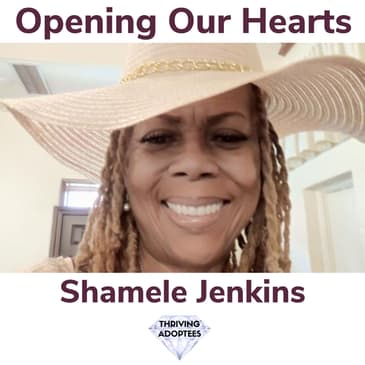
Can you open your heart more fully? Shamele has opened her heart to 4 kids through adoption, another through a special guardianship and over 300 more through fostering them. Listen in as we dive into helping our kids have fun, feel listened to and loved.
Find out more about Shamele:
https://www.linkedin.com/in/shamele-jenkins-bb9ab712/
https://www.facebook.com/shamele.jenkins/
Guests and the host are not (unless mentioned) licensed pscyho-therapists and speak from their own opinion only. Seek qualified advice if you need help.
Want to learn more about thriving for you, your kids, your families or your colleagues? Pick a time to talk here
[00:00:02] Hello everybody, welcome to another episode of the Thriving Adoptees podcast. Today I'm delighted to be joined by Shemel, Shemel Jenkins. Looking forward to our conversation, Shemel. Hi Simon, it's so good to talk to you and what an amazing thing that we can talk overseas on the phone.
[00:00:18] It's amazing, it's amazing. I often think I should have started the podcast earlier, right? But if I'd started it much earlier, I wouldn't have been able to get it going like we have because I wouldn't have had Zoom, right? That's right.
[00:00:37] I might have had Zoom, but the rest of the world wouldn't have been used to Zoom. If lockdown has any silver linings, then mass use of Zoom has to be one of those things. That's right. So, listeners, Shemel and I met at the Adoption Conference, Families Rising Adoption Conference in Orlando. Well, it wasn't last month. Yeah, it was, it was start of October, wasn't it? It was.
[00:01:06] We spent a lot of time together, including a Japanese meal and we had some fun together. But I hadn't really asked her much about her story because we were too busy just chatting about other stuff. But you're in for a treat today, ladies and gentlemen, because Shemel, she has five kids, five adopted kids and one special gadget kid.
[00:01:33] And she has also raised over 340 kids as a foster mum. And she's done this as a single lady. She said that she's still looking for, what would you say, did you say a sugar daddy? Or what was it, Shemel? A rich husband. She's looking for a rich husband. Really safe. I'm looking for a very affluent husband. Very affluent. Yes, that's a nicer way of putting it. Yeah.
[00:02:04] So she also is involved in this adoption space running the Foster Adoption Association for, it's Miami-Dade, if I remember right. Is that how you pronounce it? Miami-Dade County Foster and Adopted Parent Association. Yeah. So a huge, a huge heart and a huge amount of wisdom that you've gained over those years.
[00:02:29] So what, what are some of the things that come to mind when, when I say, when I say wisdom to you? I know you're a very modest lady, right? So you, you, you probably not going to say, but what, what's, what sticks out for you in terms of your learnings over those, those years, Shemel? To not repeat the same mistakes. To keep an open heart.
[00:02:59] To listen more and more intensely, because everyone's story is very different. And to not judge, but to really listen first. And to see where I can be of service. Yeah. Have you read the Stephen Covey books? Seven Habits of Highly Effective People. Have you come across that? I read part of one. I did.
[00:03:28] But that was seven years ago. Yeah, it was because I think the second habit is, is about this. I think it's seek first to understand. So that, that speaks into that deep. Right. Effective listening. Absolutely. Effective listening. Yeah.
[00:03:50] What, what, what stands out as, as the kind of the key epiphany moments, you know, like you talked about not repeating the same mistakes again. What, what have been your most profound kind of learning moments, Shemel? I think that not everybody wants to be adopted, but everyone wants to be loved.
[00:04:21] Everyone wants to have a sense of belonging to someone other than themselves. Um, so for, there is some, especially older kids, the term adoption doesn't sound good, but the emotion and the attachment is what sounds better. Yeah. Yeah. And do you remember when you heard that, when you, when you came to that realization? Yeah.
[00:04:50] And working within our association and working with our teens. Yeah. Because a lot of them, um, I, my house is the fun house. Everyone wants to come to my house and they would tell all the kids would tell them, Oh, you're so lucky you have a mom like that. And we want to come in. Um, but the older kids would, would be, I don't, I, I, I don't really care about whether I have her last name. I just want to live there. I just want to know that I belong to something.
[00:05:20] Um, and if not her, that I can attach myself to someone else. And that's, that's really important. Um, and then when you think about it, um, I don't know about over in, in the UK, but here. And in past, maybe the past five years, a lot of universities have made some changes. Because there are a lot of children that are homeless. They're homeless because they're in foster care or they're homeless because their families are homeless.
[00:05:48] So when we have holiday break, um, Christmas break, Easter break, they have nowhere to go. So now the universities and colleges, they keep their dorms open so that these kids have a place. Um, so as an older child, because here you can even stay in foster care until the age of 21. You don't have to age out at 18. You still want to know that you belong to something, to someone.
[00:06:17] That someone's going to kind of look at you and, and, and say, how are you doing today? Yeah. Um, or if you have a problem, be able to call that one person who knows your business and you can confide in and lie to when you think you're going to get away with it. Um, but that one go to person that you can go to, that's going to have your back. Yeah.
[00:06:39] So when you say about creating a fun house, this is about the, the, the culture, the atmosphere, uh, what you're doing in the home, right? Right. And, and that just what I'm doing in the home, but because of what I do for other kids. So an example, uh, Thanksgiving is coming. We'll have a thousand turkeys sitting in my, between my house and office Christmas comes.
[00:07:05] We'll have thousands of toys that are not just in our warehouse, but in my home. Um, cause we don't have the space. So what happens with my kids is they have to work. They have to help sort the toys as though they're an employee. Um, knowing that they can never have that toy, but mom will get them something similar to that. Um, when we finished with preparing for these parties and these special events.
[00:07:28] Um, I always have every month, there's a field trip just for kids and care, but then I also have trips just for my immediate family. So my house is very different from a lot of other houses. There's something always going on. Yeah. And how are you getting on with the cruise? Cause when we were together in Miami, you were trying to, uh, get the cruise people on side for a. We've got that.
[00:07:56] We actually have that, but I'm holding off because I know that you've had to have heard that here we have a government shutdown. Um, so people that get food benefits, SNAP benefits to help them with their families, it's affecting them. Um, the military just got paid two weeks ago. I have a daughter that's in the Navy and she, even though she's an officer, she lives off base.
[00:08:23] I had to send her money to pay her rent. Um, wow. Even her childcare fees, they have no money. And then our, our, our government laid off from our president on down laid off thousands of people so that they no longer have a job.
[00:08:42] Um, well, half of the people that you've laid off have to go and apply for unemployment, but you have taken social security services and released some of those people from employment. So trying to even register to get the benefits is a six month delay. Yeah. Probably intentional because it doesn't want the money to go out. Absolutely. Absolutely. And it's, it's very sad, um, because it affects a lot of people.
[00:09:11] Then when it comes to medical coverage here in the States, every child that's in foster care is entitled to Medicaid. Even though it's paid by the state, it's not paid on a federal basis. Um, on a federal note, that money has been funneled down. So a lot of children are losing their medical benefits. That's a tough time. Or their benefits are being cut as a result of all that's going on, which is absolutely ridiculous.
[00:09:38] You have people who, who are medically needing, who cannot go to the doctor the way they used to or cannot get treatment. And this is affecting some of our kids in foster care as well. Yeah. And our kids that are adapted because the benefits of being cut. Yeah. So what, what gives you the, uh, what gives you the resilience to rise above this stuff?
[00:10:02] Because you, there seems to be so many challenges going on for the people that you love and care for. Say that again. I'm sorry, Simon. What, what, what, why do you find the resilience? You just kind of keep going. You just have to keep going. Um, we, you know, we have federal employees that are working and they're not getting paid. Um, it does affect the states.
[00:10:30] But, you know, within the Department of Social Services, luckily everyone is being paid and everyone is working. But then, you know, you're working with people who need assistance that are not getting it right now. Yeah. Yeah. Yeah. So you, you, you grew up steeped in this, in this community caring. Absolutely. Yeah. Absolutely.
[00:10:54] So what, what do you, what come, what do you remember from your youth in, in this, in this space, in this regard, what we're talking about? Yeah. Yeah. My father's veterans of legions post the veterans of far, whether VFW veterans of foreign affairs and meets twice, three times a week. And then of course they have activities for the veterans. Um, every week they would go to the local children's orphanage.
[00:11:25] And I got to go with them and meet all the kids and playing all the games. And I can remember people saying, Oh, I want to come home with you. Your dad is so nice. And I like, I'll just come and visit you. Um, but I got locked up one night in the shelter and I was treated horribly. And I got to see the other side of midnight, as they would say, when all the cameras are gone and all the special people are gone.
[00:11:52] And, um, I was not an individual. I was just a number and the stat, it showed that the staff didn't really know everyone that was in there. They thought I was just a new kid that was brought in. Um, I kept saying, no, I was here with my dad and they didn't want to listen. And it took until about two o'clock in the morning until I was able to leave that facility. Yeah. So that had a profound impact on you. Absolutely.
[00:12:21] Um, there was a time where, you know, as a child, you come into an orphanage because even though they had foster homes, it wasn't as plentiful as now. I would see kids banging their heads on the wall, blood spattered walls, because people wanted, I'm sorry, we've got some things going on in the background. People wanted to, kids wanted to, to, to, to, they're losing their minds. They wanted to know why they're here.
[00:12:51] And there were no answers as to why they're here. They knew that they had a mom and maybe a dad, and they knew that they have siblings and they were at home watching television. And all of a sudden they're here with hundreds of other children and, and, and, and, and they can't understand why, you know, they're getting a small ration of food. They're not being treated properly. They're not being treated properly. And I expect, got to experience that and see that. And that's not a good thing. It is not a good thing. No.
[00:13:19] So how did what you learn in, in, in, in, as a kid yourself, how did that impact how you raise your kids? Well, the best thing about when you're a giver, you do receive. And sometimes you don't realize that you're receiving until months or weeks later. Um, so my cupboards were never empty.
[00:13:48] I've always maintained a job. I've always had a salary. So my kids never went hungry. And because my parents were thrifty, I've always had a food pantry that had plenty of food, like a supermarket. So we could help feed others. But again, being locked up in that shelter for several hours showed me that the flip side of what happens to these kids.
[00:14:15] Um, there are wonderful foster and adoptive families. And then there were some that are really horrible. And when we find them, we, you know, we try and help them get into a better state. And if not, we, we have the children moved. Um, we try and get therapy for whoever needs it. Um, you don't forget things that happen in your childhood. And of course they call a lot of it childhood trauma.
[00:14:45] I call it just childhood experiences, some good, some bad. So that as an adult, you know how to, to navigate when you see something. You can actually do something versus just looking at it and experiencing something that you shouldn't have to experience. Yeah. What have you learned about that navigation process? Yes. The term never let it happen again.
[00:15:15] That's the term. Never. If I see something that's wrong, I'm going to stop it. Even if it's not my business, I'm going to make it my business and I'm going to stop it and make it better. Um, and whatever I'm not able to do, I'm going to find someone else who can do it. I'm not just going to turn my head and walk away.
[00:15:37] Um, you know, when we've had the pandemic here, the amount of children that came into foster care was very low. And of course it was very low, just like women being battered and men being battered was very low because everyone was in their homes where you couldn't see anything. And zoom was not alive and new then. Um, so things were happening in the homes and they were a secret.
[00:16:07] And as we started slowly coming out, you started seeing the damage that was there. Well, I'm one of those people, if I see the damage, I'm going to fix it. If I can't fix it, I'm going to go somewhere where it can be fixed. Um, and there was a lot of damage that was done during that time.
[00:16:27] A lot of people who didn't even have mental health issues developed mental health issues from being locked in isolation or locked in with people that they didn't like or having to learn to love someone that they didn't really love or understand someone that they didn't want to understand. Um, eating things that they didn't want to eat. Um, but we have to make it a better place for everybody. Yeah. No exceptions. No exceptions.
[00:16:55] Um, you said that you make a distinction, you use the word experiences rather than trauma. Is there a particular reason for that? Because trauma normally affects people in a negative ways. An experience is when you can take that which has happened to you or that you have witnessed.
[00:17:23] And as bad as it may seem, not keep it in a bad situation. Find out a remedy so that it doesn't happen again. Find out the why it happened. Um, and, and view the entire scenario and keep it moving forward for the better than being stagnated in the worst and stagnated in the past. Yeah.
[00:17:47] And, and how, what does that look like when, when you're supporting foster and adoptive parents within, within the association? A lot because about five years ago, we've come into something in foster care called co-parenting. Um, prior to that, you could not meet the, the biological parent.
[00:18:13] Uh, if you did an adoption, it was a closed adoption. Now we want you to co-parent with the biological parent and we were not initiating an open adoption, but it's nice if the, the biological family at times, the parents may know where their child is being adopted.
[00:18:38] Um, not that, that, that means that there was going to be any connection, but it makes everybody feel a little bit better. Yeah. Yeah. Brings into a form of clarity. Um, it's kind of hard in the beginning, especially for foster and adoptive parents or pre-adoptive parents, because you don't really want to meet these people, but the whole purpose is for in foster care for them to mimic everything that you do and to learn to become a better parent.
[00:19:06] But initially many of those, those parents will hate your guts. You know, they'll tell you you're stealing their child. Um, especially in relative care, which is really hard on adoptions, you're stealing someone's child. Um, and you have to remind them that you didn't even know this person until that, that biological parent did whatever it was that they did that brought the child into care.
[00:19:36] Right now, if it's relatives, um, you have to remind the other relatives, listen, you saw what was going on and you did absolutely nothing about it. I, in this case have decided to, to put a stop to it and to do something about it to save these children. Yeah. And what do you talk to in terms of how you help adoptive parents navigate their kids trauma?
[00:20:06] What are... Well, we have monthly training workshops. Uh, foster parents have to take, uh, uh, throughout the year to get in-service credit to maintain their license. As an adoptive parent, that license is also lifetime, meaning we know that you've adopted the child.
[00:20:29] But the trick is don't let there be an allegation because the first thing the judge is going to say is, well, are you continuing your parenting training? Uh, didn't you know better? Weren't you taught to do certain things when you see certain scenarios? Yeah. So we have, um, all kinds of trainings for both foster and adoptive parents in and outside of the parenting world. Life skills for parents, um, money management, stress management.
[00:21:00] Because as an adoptive parent, it's a little bit harder. It's hard as a foster parent to return a child that may have been with you for six, seven, eight, nine months or a year. But with an adoptive parent, you're going to have them forever. But when you start to see certain behaviors, sometimes you cannot go back because you don't know the entire history of that biological parent.
[00:21:23] But you're trained to, to withstand the barriers that you have to go through to get this child the help that they need. And some of our workshops will help because we know that when a child turns two to three, that's when they're learning the most. We know that when they're seven and eight, they start to change. When they're 10 and 11, it used to be 12, they start turning like they're teenagers. And by the time they're 15, they're a whole new breed.
[00:21:51] Um, our trainings teach you how to handle that. One of the, the most important things is when a child says, well, you're not my mom, you know, and that hurts because you've done every single thing for them. And you can turn around and say, well, there's, there's nobody else here but me. So obviously I must be the parent. I must be the mother. Um, and you have to understand why they'll say that, why they'll lash out like that because they're hurt.
[00:22:21] And you have to take that journey of pain with them and let them know who's still standing with them. Then when they turn 18, you have to understand a lot of them will wonder where's my biological parent. Do you know them? Can you find them? What kind of parent were they? They would let me go into the system like this.
[00:22:46] And, and, um, you have to decide if you want to tell them the history that you know, we have places where if they put their name into a registry in that biological. If a biological parent has put their name into the registry, they might find a match. Um, a lot of times there is no match. And sometimes they do find their parents, but it's not a happy situation as they thought it would be.
[00:23:12] Um, for me as an adoptive parent, we have found some of the biological parents for some of our children, for some, it was good for some, it was not. I like to train our parents, even as young, uh, when the child is young, that listen, they're going to be wondering and it's natural to wonder who, who am I? And you tell them they are exactly who they are because of you and the surroundings, the village that you've afforded them.
[00:23:40] Not because of what the biological parent gave them. Additionally, um, you're, you're explaining. We know that you want to find your, your biological parent, but let's first focus on who you are. And then we tell the biological, we tell the adoptive parents, listen, when they find their biological parent, be prepared to be the worst parent in the world.
[00:24:09] Because the child will lie, scheme everything in the world to, and this is in most instances to make that biological parent feel guilty. To make that biological parent want their child more than ever to get that biological parent to apologize.
[00:24:34] And the, the, the child that you've adopted doesn't even realize what they're doing in many cases. Because what they're doing is trying to make that biological say, look at me, you know, you're beautiful. You're absolutely wonderful. And you must have my genes. And, and the, you know, the adoptive child is also, um, trying to say, look at me. Why did you discard me? Look how great I am. Um, look what I've become.
[00:25:02] So you have this combative thing going on between the two and the person who's traumatized that most at that moment is the adoptive parents. And we have to tell those adoptive parents, listen, the love continues. We train you to understand that these things are going to happen. And to remember, just remember from whatever day you got this child, all the memories that were made and no one else was there.
[00:25:32] And, and, and to know that this child will come back to you. The love will come back to you. It's just that this is a, a metamorphosis of sorts. That this adoptive child has to go through trying to find their way. Because there are so many questions as to why, why, why, why did you let me go and look at me now? Look at me now. This is what you missed.
[00:25:58] Not thinking that they may not have ended up the way they're ending up now in such a positive light. Had they been there? There are rare cases, but there are many cases where you were given up as a child because that biological parent knew that they couldn't take care of you.
[00:26:16] And that was the greatest love offering that they could give was to let you go where they would hope that you would be with someone else who, who has more resources, may not be on drugs or alcohol or in a, in a horrible situation that can take care of you. So it's a lot, it's a lot. But we try and train our parents with this because I've been through it. My board has been through it and, and it's, it can take a toll on you, but this is something that we share. Yeah.
[00:26:47] What about when adoptive, you talked about stress management. What about adoptive parents when they're, they're struggling under the stress? I've heard this talk. It talked about, you know, that they struggled not to take their kids trauma personally. Right.
[00:27:08] They, at one level, they know that it, it's the, the, the, the, the trauma isn't their fault, but at a more emotional level, it feels like that there's something wrong with them because they can't fix their kid. Well, you know, we, like I said, we have monthly meetings in different locations of the county for our parents to meet. But we also have something called meetups. We have mother's meetups.
[00:27:38] We call them Empress and Queens where they meet once a month somewhere for lunch. You have to pay for your own lunch. But when the mothers get together, they can talk about what's happening and it's, there's no set theme. It gives you a chance to meet someone else who may have, you have five girls, they have five girls. And you can become backups for each other. Talk about your situations. We just did a meetup about three weeks ago with the fathers where they met at a, a place where you pay pool and bowl.
[00:28:08] And it was instrumental, especially for the fathers, because a lot of times the fathers want to get a divorce because they feel like they've been abandoned by their spouse. They feel as though the mother is giving more time to the children. The mother is, has more emotions and, and the fathers are very stern and it has to be this way or the highway.
[00:28:34] But when men can come together, they can understand that other men may feel the same way and how they've gone through that experience. That it's natural. There are certain things you don't want to say to your spouse because of fear of actually breaking up or you were on the verge of breaking up because of one of the children's behaviors. But when other men can get together and talk about the situation, then they can realize this happens in other households too.
[00:29:01] And how one, one father can tell the other adoptive father how they journey through that problem. And it makes a big difference. So we can also have therapists that will come in and talk with our parents. But I think the best therapists are other like-minded foster and adoptive parents because we're the ones that have gone through the journey. Many times the therapists that you have are not foster or adoptive parents.
[00:29:31] They don't know that village. Only those who've lived in those, those villages can understand. So that's why we have those special meetups every month. And it makes a big difference. Believe me. Yeah. And when we have the ones for women, only women can be there. When we have the ones for men, I help set it up, but I'm not there. It's only for men. Yeah. Yeah.
[00:29:55] So these themes, like the concerns that the fathers have about divorce because of this, their wives focusing on the kids. What other sorts of surprises are common and yet unexpected for adoptive parents? What don't they see coming like that stuff?
[00:30:25] They don't see the medical or mental health issues that the children may have as they go through different stages of life. They don't see, no one remembers that we were all children once. And we somehow, well, I don't know about you, but I was an angel growing up. Yeah.
[00:30:49] We think that having issues is something strange when it's actually normal for every child to have issues. So when it comes to our adoptive parents, we just remind them, listen, when you were 14, what did you do? Did you run away from home? Did you steal a piece of candy at the store? Did you threaten to hurt someone? It happens with everyone else too.
[00:31:20] How do you deal with it? How do you go through it? In California, it's called a 50 to 50 or sometimes. And here it's called being Baker Act. When a child or an adult has a mental breakdown. A lot of times we can curtail these breakdowns when we have these meetups.
[00:31:45] Because some of them can come on the edge of really being ready to give up this child. Give up the whole scenario. They just want to walk away. And be on the brim of if the spouse doesn't want to leave, well, I'm leaving. It's either me or that child or the children. I'm leaving.
[00:32:12] And having conversations, they get to understand the different choices and all the elements that are involved in those choices. And then they'll realize, well, that's what came out of my mouth because that's what was in my head. But my head wasn't thinking straight. My head wasn't analyzing. My head was having an emotional attack, so to speak. Yeah. Right? But when they can hear that someone else had that same emotional attack, then it becomes okay.
[00:32:42] Because now we can talk about it, especially if we were holding it in secret by ourselves. And that's important. You know, I know that I adopted a child when he was five. And he came out of a very, very horrible situation. And when he was nine, he stabbed me. I had to get four stitches. And he tried to kill everyone in the household.
[00:33:10] And I had him baker acted. And after three days, the therapist said, well, just take him home and lock up the utensils. Now, I have stitches in my stomach. And I had to fight this child as though he were a grown man. And I said, no, I'm not doing it. The only thing that saved me from the rule is leaving your child is called abandonment.
[00:33:36] The only thing that saved me was that I was a special liaison for the Department of Children and Family Services. And they already knew the situation. I had to go to court. I had to go to hearings. Eventually, they took the child back. And he never came back home with us. But I tried to keep track of him. But because of that, we were able to mandate some new changes so that no one else would have to go through that same situation.
[00:34:04] In other words, finding out where the resources are to help you. Because today, we have a lot of parents, adoptive parents, foster parents, biological parents, who are afraid of their children, want to get rid of them. They don't know they're going to jail if they do that. But at the same instance, they don't know where the resources are to help them help their child. Because of what I went through, we've been able to create some more resources that will help these families.
[00:34:33] And we've been able to save a lot of children and a lot of families because of that. So I'm very proud of that. Sorry, I had to go through it. I don't want to ever see anyone else go through that. Because when we as adults act up, it's because we have a problem. But when a child does it, they don't have the same mentality or the same resources or the same experience that most adults have. So the behavior is going to be worse.
[00:35:01] And you have to be trained to understand and prepare for that. Yeah. There's some really tough stuff there. Oh, yeah. Yeah. What's helped you navigate that tough stuff? God, my friends, my family. And I have this thing. Everyone who knows me gets absorbed into what I do.
[00:35:31] They don't have a choice. If I'm having a party and you're a friend, you're going to be part of that party for Kids in Care. If I'm having an event, you're going to be part of that because I'm going to ask you, can you come and help? If you can't help this time, I'm going to ask you again. And eventually you're going to become part of it. And that's what helps me. The community that you've built around you. Yes. Mm-hmm. Yeah.
[00:36:00] Was that the trickiest stuff that you went through with this son of yours? Yes, I think so. I think so. I mean, it's never a bed of roses. You know, you have the trials and tribulations of every child has their challenges and you have to deal with it differently. And then it reflects on you, which gives you challenges of your own to go through.
[00:36:28] I think a lot of the challenges that I may have personally had, my children were able to go, Mommy, that's not how you act. You know, or why are you doing that? You don't have to do that. And, you know, that helps. When your children can see that you're doing something and that you're traumatized and they can turn around and tell you what you need to do. Yeah. And you listen. Yeah. How did you get them?
[00:36:57] How did you encourage them to share their stuff or did it just come naturally to them? What was going on? I think it came naturally because every week we have a family meeting. You know, we sit at the dinner table, which is what a lot of families miss nowadays of everyone sitting at the family table. Forget the phones. Sit at the family tables and you have conversations. But in addition, we would have family meetings and talk about whatever else is going on.
[00:37:27] Every now and then, we'd have a chance to play role play. So they could tell me if I was being too mean by reenacting something that I've done and I can react something that they've done. And, you know, sometimes you have to see it from someone else's eyes to understand, did I do that? Did I say that? You know, and make amends for it and move on. Yeah. It sounds easy, doesn't it?
[00:37:56] It sounds easy. It's not easy at that moment. But you live from one moment to the next and you get through it. If you believe you can get through it, you'll get through it. Yeah. How do you help adoptive parents see that for themselves? By sharing experiences. By asking how you're doing and sharing experiences.
[00:38:22] Because most of our experiences are going to be very different, but at the same time, very similar. The journey is the same. How you go through the journey is what's different. What are the most important things on that journey? I mean, you've talked about community for yourself, but what else is really big for you on the journey? Keeping families safe.
[00:38:51] Keeping the children safe. Here in this country, they have something called first responders. First responders. And they're calling firemen and doctors, first responders. Now they're calling teachers, first responders. But I'm teaching the community that foster and adoptive parents are first responders too.
[00:39:16] When you call for the police department, if they're not strolling the area of looking for trouble, or in the office waiting to hear about trouble, they're waiting. Fire department, same thing unless there's a fire. Well, same thing for foster and adoptive parents. We're on call 24-7 to take care of these kids that belong to other people. We're not getting paid to do it, but we're always on call. Always ready.
[00:39:46] Always alert. Therefore, we are first responders too. And it's important for me to let them know that they are thanked, that they are wonderful, that we recognize that they're only human, and that they're going to have issues, but that we, I, and my organization is there to support them.
[00:40:12] And the difference is the Department of Children and Family Services and all those agencies are there to help manage the account of the children. We, on the other hand, are here for the total experience of each and every child that's in our home, and for the total experience of the children that are already in our home,
[00:40:39] and then for the total experience that, for each and every person that's in our village. Big difference. Big difference, yeah. Very big difference. You know, unless you're walking the walk, people talk the talk, but they're not really walking the walk. So, 25% of their information is wrong. It's what they believe, and what they believe is false,
[00:41:06] because they have not seen, or they've seen and don't understand, because they've not experienced it. Big difference. Big difference. So, you've talked about the importance of community. You've talked about the importance of connecting specifically with people in the same role as yourself, whether that's mums or dads, right? Yes.
[00:41:32] You've talked about family meetings. You've talked about advocating for what's deserved. What are the other kind of big, big themes that you see for adoptive parents along this journey, talking about this total experience of their kids?
[00:42:02] I think letting them know that they're going to be rewarded. Letting them know that we appreciate what they do. Letting them know that we care about them just as much as we care for the children. Things like that. And that's what Anaja does. Yeah.
[00:42:29] She calls up the families and invites them to events, and she gets to hear them say, I can't make it, and then she tells them, you're going to make it. You know. Yeah. Or just disseminating information and hearing their stories and helping to figure out how to make things better, how to make things easier for our families. Yeah. Especially for the parents, because I'm of the adage, if the adoptive parents or the foster parents are not happy,
[00:42:59] then the house is not going to be happy. And that's the difference. We have to make sure that we're all happy. We have to make sure that we're all safe. We have to make sure that we all have food. We provide food when needed. Whatever the security is, we're here to help with that. Yeah.
[00:43:25] So what would you like to share that I've not asked you about, Jamal? That would be the word government. Just that we need more foster families. We need more adoptive families. We need more people to look inside wherever they are and see that they can make a difference. You can be an adoptive parent or a foster parent without even legally doing it,
[00:43:53] just by being there and supporting that family or supporting that parent or supporting that child. Just do it. And sometimes we look at the world as a whole and we think we've done this and we think we've done that. And we can do more. We can do a lot more. Because when we need someone, we're sure turning around looking for help. Yeah.
[00:44:19] So how can you expect other people to help you if you're not in turn helping someone else? I have a thing here. We have these commercials. Give $19 to help these poor dogs that are stressed that need help. And I give $19 to help the kids that need food. Give $19 to help the foster and adoptive mothers who can use that extra help.
[00:44:43] So just turn around and open your heart and open your eyes and see that there is something that we can each do for each other. Plain and simple. You know, sometimes we have to ask because some people don't see it until you tell them. So we're willing to tell you. See again and again and again until you give and give and give and understand why you're giving.
[00:45:08] Because once you give, because you want to give, it's a whole different world. And that's what we want to do. We want to make everyone have a great life while they're living. Right? So that's what it's all about. Spreading the love. Spreading the security. Whether it's financial security. Mental security. Household security.
[00:45:34] Just making sure that everyone is somewhat happy and somewhat comfortable on this journey called life. Yeah. Beautiful. You like that, don't you, Simon? You're smiling. I'm smiling. It feels like a great place to bring it in. Thank you. Yeah. Thank you, listeners. And thank you, Shamel. Thank you so much, Simon. Speak to you again soon. Take care. Bye-bye.