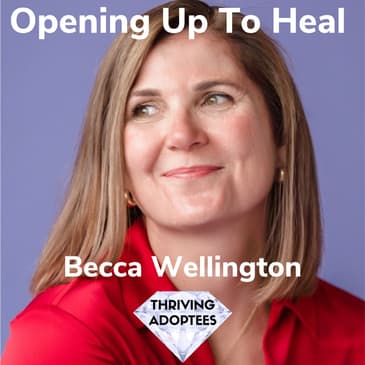
Is your trauma eating you up from the inside? That's how it felt to Becca. Writing her book and talking about it openly is helping her shift to thriving with the help of a great therapist, energy work and some fab people lining up behind to support her. Great insights on seeing our connectedness, authenticity and vulnerability.
Here's a bit about Becca's previous interview:
Do you wish your healing was faster?
Did your world fall apart when you came out of the fog? Are you wondering what comes now you're consciously aware of your trauma? Listen in as Becca shares how she came out of the fog after tragedy and what's helping her heal. An incredibly vulnerable and empowering episode.
Becca was born in 1975, adopted at 2 years old and lives in Seattle.
Here's a link to Becca's that interview https://thriving-adoptees.simplecast.com/episodes/out-of-the-fog-beyond-with-becca-wellington
Here's a link to the Kubler Ross curve https://www.ekrfoundation.org/5-stages-of-grief/change-curve/
https://www.rebeccawellington.com/
https://www.linkedin.com/in/rebeccawellington/
https://www.instagram.com/_rebecca_wellington/
https://www.facebook.com/profile.php?id=100085186204263
Guests and the host are not (unless mentioned) licensed pscyho-therapists and speak from their own opinion only. Seek qualified advice if you need help.
Want to learn more about thriving for you, your kids, your families or your colleagues? Pick a time to talk here
[00:00:02] Hello everybody, welcome to another episode of the Thriving Adoptees podcast. Today I'm delighted to be joined by Becca. Rebecca? Do you prefer Becca or Rebecca?
[00:00:11] Both. Rebecca on the book but everybody calls me Becca in my world.
[00:00:18] Becca Wellington. Back for a second time. So it must have been interesting the first time or else I guess you want to jump back the second time right?
[00:00:29] I'm just saying Becca that I was on holiday a few weeks ago when I was reading. I got through the first half of her book. We're going to kind of touch on the book as well but we're also here to talk about healing. So healing, does that word resonate for you, Becca?
[00:00:48] Oh yeah. I mean it's, I mean I can't, I feel like I can't talk about that without talking about the book because I'm in the book is my healing journey right?
[00:01:02] I've been doing a bunch of talks and I'm at this place where I say that the book saved my life. So yeah, so I feel you know even since the last time we talked which was I guess a year ago we're trying to figure it out.
[00:01:24] Yeah I'm in a fully different place because I've been out there just talking about my experiences in Adopt Eve very publicly because of the book and that's been a really healing, profoundly healing experience.
[00:01:47] Yeah so both writing it and getting out there to talk about it have helped.
[00:01:52] Yeah, yeah, yeah, yeah I think I'm just, I mean I'll share, so I'm at my in-laws house outside of Boston and my mother-in-law who's just lovely put this little book talk together last night in her neighborhood.
[00:02:09] So like the folks like ran across the street just from the neighborhood and they all came in. I'd given it, I just had given a talk at Simmons University in Boston which I'm an alum of and so this was kind of the casual talk but it was amazing.
[00:02:26] You know I was talking about the book and then her neighbor across the street literally just, she came home a little bit late. She ran into the to join us and she just sat down and unloaded this incredible story.
[00:02:42] She's a NPE, do you know that term?
[00:02:46] Misattributed parentage something.
[00:02:50] And I don't even know what NPE stands for but she identifies as NPE. She learned literally five years ago that her father who raised her since birth was not her biological father.
[00:03:06] And this, you know she's in her early 50s and she just learned this and she's just on the beginning path of this journey but I wanted to bring that up because she just came in and sat down with this group of us and just unloaded and just like
[00:03:24] And she just like literally bared her soul and sold us this entire story. All of us are, aside from my mother-in-law, strangers to her largely.
[00:03:32] And it just made me realize that in the telling of the story, that is such an important part of the healing.
[00:03:39] You know, just that you can like get it out and she was sharing these family secrets. Like secrets are so damaging and toxic and just in the, just sharing it was just, you can literally see her on her healing journey.
[00:03:55] Getting it out there, you know?
[00:03:57] Yeah.
[00:03:59] Yeah.
[00:04:00] Was it the writing of the book that saved your life?
[00:04:05] I think all of it. Like I think I had to write it, you know, sort of similarly in that I had to put this story out there
[00:04:17] because it was like eating me alive.
[00:04:21] You know?
[00:04:23] And it felt like it was like a, it was like, you know, like this, I don't know, like a tumor or cyst that was going to just burst.
[00:04:34] So, so writing it and putting it pen to paper or finger to keyboard was like such a relief. Every stage of the writing, once I got it out and then reread it, it was, it was a relief to literally get it out of me.
[00:04:52] And then I think that was really powerful, but sort of what I was saying with the neighbor running across the street to unload her story. I think then the follow up, the telling of it and just talking about it to people who have a connection to adoption and to people who don't
[00:05:11] is sort of the follow up layer of healing, you know?
[00:05:17] So if we break it down into the first part, the writing and then the telling. Eating you up alive from the inside and then getting it's getting out. Why is that so big do you think? Why was that so big to you?
[00:05:44] No, I can't like, I can't logically explain it.
[00:05:50] I, so I don't have you heard of Bessel van der Kolk? Yeah. Oh God, I just totally spaced the name of the book. Body keeps the score. Body keeps the score. Yeah. So I've been reading that like bits and bits. That's a very intense book.
[00:06:11] With a lot of trauma stories, but I think that that's sort of the closest sort of scientific explanation into the power of getting it out and the impact on the body. If you don't get it out like that's kind of his whole premise, right?
[00:06:29] And if you keep these, it's not the trauma that happened to you. And he's working with patients who have experienced just really severe physical abuse and also mental abuse.
[00:06:47] But it's the second wave of not just the abuse that happened, but then it's keeping it in and not processing what happened. That's extra toxic and kind of like his climate like leads to cancer and leads to literally your body falling apart.
[00:07:08] Yeah.
[00:07:12] Because I think the big start of profound shift for me was probably 16 years ago and on a retreat, there was two people leading the retreat.
[00:07:25] Five or six of us on the retreat. This wasn't an adoptee thing, but it was a consciousness thing. And I think the first three days all we did was get our stories out, share our stories.
[00:07:49] But it was about how we felt as the key protagonist in the story, as the hero of our own journey. And there was that validation that we all had the same stuff basically.
[00:08:13] There was a different cause of the stuff or different causes. So, you know, for some it was, well, for the course leader Liz, it was her abuse at the hands of her dad in every way, including sexual when she was a tiny kid.
[00:08:35] So there was that, there was business failure, there was marriage failure. For me, there was kind of this business shit and adoption shit.
[00:08:54] But none of us thought that we were good enough. That was the essential story. None of us thought that we're good enough.
[00:09:03] And I think I felt that we had the best reason for that. We had the most cast iron.
[00:09:21] So yeah, yeah, we had incontrovertible evidence. I think it's the word, you know, our case was cast iron. So they had reinforced concrete.
[00:09:36] But we had double reinforced concrete belief that we weren't good enough. And there was this incredible lifting of the weight when you realize that everybody thinks it was exactly the same, but doesn't just tell it, doesn't say it.
[00:10:00] So at the swimming pool, a lot of the guys down there and the women, they have this thing called not baditis. Right? So I say to them, how are you doing? And they say, not bad.
[00:10:13] And I say it's catching isn't it? What's catching? It's not not baditis. What do you mean Simon? What are you on about?
[00:10:21] But we go through life in Britain as you know, talking about being fine or being not bad. And that's about as deep as we go most of the time.
[00:10:34] Whereas maybe it's the shame, you know, we keep those, we keep the shame inside where it eats us alive. And I'm doing some stuff. We're doing a little mini one to one course with Pamela Caranova on and it's grief stuff.
[00:11:02] And it's the you know, they talk about four myths. And I think the first one is about essentially, essentially it's about fighting feeling bad.
[00:11:27] It's being ashamed. It's not being able to voice our feelings, especially the dark ones. And that's why we go through life as fine or not bad.
[00:11:54] It's like you're just surviving. Yeah, you haven't moved to the thriving stage yet. Yeah, I think most people don't get to the thriving stage because we're so in that space of yeah, feeling like shit.
[00:12:12] Yeah. And there's that, there's that double edged sword with the validation there. For me anyway, at one point, it's a relief.
[00:12:30] And then, like Primal Winster. And then all the validation can keep us stuck, right?
[00:12:42] Yeah, if you get stuck in your sort of victim, I think it's easy to get stuck in a space of feeling like a victim, you know, and that's, you know, I don't want to be there. Either I think you have to you have to go there. But then you got to keep walking through it to get to a place of feeling.
[00:13:05] You know, that's where you have to get through that to get to thriving. I think. Yeah. And that I think that's one of the challenges right there with the healing wound, with the healing idea, with the wound idea is I can, I know I felt knocked sideways by it.
[00:13:29] I know, I know I felt that I was stuck with it. I think that was the biggest kind of the biggest thing for a while. I thought I was stuck with it. And I didn't have at that point, I wasn't doing anything with other people who were in that same stock position.
[00:13:49] And I often think what would it have been like if I had been in those in those groups, because because where everybody is valid validating our stuff. I think it can become extra reinforcing to the belief. Yeah,
[00:14:08] I think you have to go there. I think, I think it's important. You can't just skip that part of the journey. But then you have to move beyond it, you know. And that's I think the hardest step.
[00:14:24] And there are, I know because they've told me, right. There are adoptees out there who don't believe that they can heal. Yeah. Yeah. And that scares the bejesus army. Yeah. Well, I think everybody, whether you're a victim of sexual assault or physical, you know, whatever you've experienced in your life, you know, you're not going to be able to heal.
[00:14:53] I think there's always people who, who say you can't heal from it. But I believe, I mean, I know people who have gone through just profound, profoundly horrific experiences and have not I mean, not many, but some people who have gotten to a space where they have made a lot of mistakes.
[00:15:13] You know, I definitely think it's possible. You know, I, I feel really grateful because I feel like I'm walking into that space. You know, it's not like I'm just there. I mean, it's gonna be a lifelong journey. And I also think it's not like you're the only one who's going to be able to do that.
[00:15:29] And then you do your work, whatever that looks like and you fly your way or climb your way back into I want to be in this thriving space, you know, and I think that's the only way to do that.
[00:15:45] I think you get kicked back into the victim space and then you do your work, whatever that looks like and you fly your way or climb your way back into I want to be in this thriving space, you know, and that's just it just it's a journey constantly doing that I think, you know,
[00:16:05] It's not like you get you like, you finally get to this place. You're like, this is it. Everything's perfect. No more suffering. You know, it's just constant work.
[00:16:17] Yeah. So what did the work look like for you?
[00:16:28] Um, you know, I think it's been really, it was very, very, you know, I only identified as an adoptee like four years ago. This is the whole thing is like so new for me. So I feel like I'm on this like high speed bullet train going through this process.
[00:16:55] Which is, and I have a phenomenal therapist who I don't think I could have be on this journey without having that sounding board. I think I think having that support is really important.
[00:17:09] And my husband and children and in-laws, you know, I family that are really supportive and a lot of friends like I think that's a big piece of it. You have to have a community, right? You've got to have people in your corner who who are kind of you have to do the work, but they're like we're here.
[00:17:30] We're standing, we're lining up behind you. When the shit hits the fan, we're a lot, we're behind you. You know, you got to have those people.
[00:17:39] And for me, I just, I have dealt with a lot of fear as I've put this book out. You know, it published April 9th and
[00:17:49] My family, my parents are still alive. My adoptive parents and they know about the book and I don't know because I haven't heard from them. I have no idea. They've not responded. But I think that was the most incredible amount of fear and challenge I've had to face is just, you know,
[00:18:12] Is it safe for me to tell my story? Am I allowed to? Because I, for my whole life just embodied that identity of being the good adoptee, right? Like you've read some of the books. So my older sister who died of a drug overdose in 2017, she was not the good adoptee, right? She was the bad, you know,
[00:18:37] She was the bad, you know, she was the bad purchase. My parents ever said that she was a bad purchase, but she was, she was the bad kid and I worked so hard to be the good kid and really to, I wanted so badly for them to feel like I was a good choice to be that they chose me.
[00:18:57] Do you know what I mean? I think that's something a lot of adoptees wrestle with. Like, you know, I was given up by this person. I hope I hope I'm good enough for you. You know, and in telling this story writing this book like that's I put that in the dumpster and lit it on fire.
[00:19:13] You know, and that was really, really hard for me to completely step out of my lane of goodness and appropriateness and being the good kid and validating and affirming that I was the good kid.
[00:19:29] I think the story that I believed my adoptive parents wanted me to be telling, which was I'm grateful. This is all good. You saved me. I'm the good girl. I mean, I just writing this book and putting it out in the world was like, you know, burning my heart.
[00:19:45] And that's been terrifying, like terrifying for me. But I finally feel like I'm at this place where I don't have as much fear around it. You know, I don't know if I'm going to be able to do that.
[00:20:01] You know, even just when I talked to you a year ago, that was I'm like, oh my God, who's going to listen to the podcast? And I've done so I've been I've get done so many interviews at this point.
[00:20:13] I was on TV. Like, I mean, I'm just like, whatever the ship has sailed. I'm just moving on. People are either going to like it or not. But I really don't care. I'm just going to do what I can do. I'm just going to do what I can do.
[00:20:29] I'm just moving on. People are either going to like it or not. But I really don't care at this point, I have to tell it. I have to tell my story. And it's not my job to take care of what other people think.
[00:20:52] And what other people think of me. It's more important for me now to speak my truth.
[00:20:59] There's a meaning there, right? There's a there's a purpose. There's a meaning. There's a
[00:21:10] Yeah, yeah. Well, behind all of it, Simon
[00:21:15] is my sister, right? It's I wrote the book for her. I and that's the thing that has kind of just just been this propulsion behind me when I get scared or when I'm like, I can't say that or I can't do that interview or what are people going to think? I'm like, I just go back to that. She's behind me.
[00:21:37] I she's dead, right? I have taken on the mantle. I have to tell her story and just and having that and that's been just the thing that has just propelled me through this is just knowing that she is behind me. You know, she's an adoptee.
[00:21:57] She relinquished a child.
[00:22:01] And she was just silenced through all of it. And I think really misunderstood and I have to tell her story, you know, and in telling her story. It's I think it's telling our story. It's telling telling the story. It's centering adoptee voices.
[00:22:20] It's centering the voices of birth mothers, right? That's what I'm doing.
[00:22:27] So the the guy that led the retreat thing that I went on 16 years ago, he says your purpose has to become bigger than you fear.
[00:22:40] Yeah. Yeah, that's great. That is what I feel.
[00:22:45] Yeah, your purpose has to go too big in the new fit. So there's two ways of doing that. So what you're doing, and I'm explaining this this way around basically in case it in case your stance, your book, your stuff, in case that in
[00:23:11] your stuff, in case that inspires somebody else. Right. So what you're doing is you're focusing on you're focusing back on the back on them on the passion back on the purpose.
[00:23:26] Yeah. Yeah. So there's two ways to do it. You can either basically boost your purpose.
[00:23:33] Focus on your purpose or diminish your fear. That's the that's the two ways of that's the two ways.
[00:23:41] They're embedded because I have had fear the entire time. Sometimes it rears its head bigger, you know, but so it's always there.
[00:23:59] It's always there. But I think, you know, again, I've done a lot of therapy over the last, well, since my sister died, but also worked with this incredibly. I mean, I have to say the system, the focus is healing.
[00:24:12] I have to share. I went to see this incredible woman in Seattle. I live in Seattle. I'm going to name drop her because she's phenomenal. Her name is Becky Moore. She's an energy healer.
[00:24:25] And, you know, some people may think that's woo woo, whatever. But I met her through a friend and I was getting it was right before the book came out and I was like, I will try anything because the fear was so massive.
[00:24:44] The fear of putting this story out there was so massive. And so I just I was like, you know, through through my, you know, caution to the wind and saw and made an appointment to see this lady.
[00:24:56] And it was unbelievable. It was the craziest out of body experience I've ever had. Like I went in there.
[00:25:02] I had like a table, like a like a chiropractic or massage table. And I just laid down and just I literally just told my story and she just put her hands on my shoulder, you know, on my arms and asked these questions.
[00:25:19] And I just like went down this rabbit hole and I was like in a fetal position crying and talking to my sister.
[00:25:27] And I came in at the end of the session. I don't even know what happened because it was so not cognitive. It was like, it was emotional spiritual whatever.
[00:25:41] At the end of it, you know, I really felt like my sister was there. She was in the room. And this practitioner Becky said, you know, Rachel's Rachel's got your back.
[00:25:56] And and she is with you 100%.
[00:26:01] And I walked out of that session and it was like something switched, you know, where I could just lean on that that purpose.
[00:26:09] Knowing that I this path that I'm walking on.
[00:26:14] She's she's there with me.
[00:26:17] You know, and and so I think you know, you said there's sort of two ways you can have the purpose and combat the fear like I am combating the fear constantly because of that.
[00:26:30] I have that purpose and she's.
[00:26:34] I really feel like she's with me, you know, every time I have to get up and talk on stage or do something scary.
[00:26:42] Stand in front of a TV camera.
[00:26:45] I just visualize it and that just it's like that's what tamps down the fear.
[00:26:50] You know, yeah.
[00:26:54] At this point, I would be tempted to say the word Trump.
[00:26:59] Yeah, yeah, I know.
[00:27:02] That's right there.
[00:27:05] Yeah, I know.
[00:27:08] Let's not go down down there.
[00:27:10] We have Boris guys and you know, wish.
[00:27:17] Yeah.
[00:27:20] Have you felt that before that connection with your sister?
[00:27:27] I have felt connections with her.
[00:27:34] I have felt her presence.
[00:27:37] So she died.
[00:27:39] But not as profoundly as I did when I had that session with that energy healer.
[00:27:46] Yeah, I don't know.
[00:27:51] I mean it's people have just crazy stories of their dead people, you know.
[00:27:58] It's pretty amazing, but I think there is.
[00:28:02] That was so profound that it.
[00:28:05] I stopped questioning it with my logical brain like what?
[00:28:10] How can I be talking to you know how can my sister spirit be talking to me?
[00:28:13] I'm like whatever that just happened.
[00:28:17] And and so I just go back to that, you know.
[00:28:23] Have you felt connected to others?
[00:28:26] Other people who are dead?
[00:28:30] Dead or alive.
[00:28:34] Dead or alive.
[00:28:35] Oh, well I definitely feel very connected with alive people.
[00:28:42] Yeah, I mean she I think I had such a connection with I think I had there was an opening for me to have such a connection with her because she was so close to me.
[00:28:54] You know.
[00:28:56] She's the first person in my life who I've really I was really really close with.
[00:29:02] Who died.
[00:29:06] So that that I think opened an opportunity to have a stronger connection.
[00:29:14] But yeah, I have.
[00:29:16] I think I'm a very again like I said I think part of combating fear is having people in your corner and having a community.
[00:29:27] And I feel very connected with people like I will say even since the book came out I've connected with so many like so many amazing adoptees who are doing this profound work you know like your podcast and.
[00:29:43] I feel very connected with people in the adoptee community.
[00:29:49] You know I feel really supported by people in the adoptee community.
[00:29:55] Pretty amazing group of people, you know.
[00:30:11] For me there's that the sense of connection, my peak experience moment, sense of connection with my birth mother.
[00:30:26] Who had been dead.
[00:30:28] 15 years or whatever when I had that moment.
[00:30:35] Since then it's it's it's become clear to me that that's basically.
[00:30:45] That's like a sampler that's like an example connection that that's that's a harbinger of oneness.
[00:30:59] Your birth mother.
[00:31:01] Sorry.
[00:31:02] You're saying that your connection with your birth mother.
[00:31:05] Yeah, so.
[00:31:06] So I had the profound like you had the profound moment in that energy session with the with with Becky.
[00:31:15] And I had a profound moment reading a letter from birth mother.
[00:31:22] And since then I've realized that that moment is basically a reflection of our my oneness with everybody.
[00:31:36] That's awesome.
[00:31:38] And I say this on the podcast a bit but I've I've had that connection in rugby stadiums and rock concerts.
[00:31:55] So I can be watching.
[00:31:57] I can be standing in a rugby stadium right and.
[00:32:06] I was born in Wales right so but it's so but I'm not watching Wales play rugby.
[00:32:12] I'm not watch and I live in England.
[00:32:14] I think I lived in Wales for maybe three weeks of my life the first three weeks of my maybe maybe not I don't know.
[00:32:24] Maybe it was just a couple of days.
[00:32:26] But I'm watching Scotland play France in the rugby stadium and before that you know the French.
[00:32:37] They play the French national anthem and all the French fans sing along to that.
[00:32:43] And then they and I feel that one with them.
[00:32:47] And then then the Scottish.
[00:32:50] And it starts with this bagpiper I'm getting shivers up my spine as they do it.
[00:32:55] So there's this the guy with the bagpipes is stood on the top of the Murrayfield Stadium right.
[00:32:59] So he's whatever that is like 400 foot in the air 300 foot I don't know how it is.
[00:33:06] He's on the he's on the he's on the top of the stadium and he starts off with the with the bagpipes.
[00:33:12] And then everybody comes in to sing the you know the first first course first course.
[00:33:18] I don't know the first whatever is first lines and I feel that one with them.
[00:33:25] And I'm not rooting for the French.
[00:33:28] I'm not I'm not French and I'm not Scottish.
[00:33:30] It's it's it's oneness.
[00:33:33] It's touching a space where idea of oneness becomes a concrete and real feeling.
[00:33:45] It's not it's not it's not an abstract concept anymore.
[00:33:49] It's it's a lived experience.
[00:33:54] You know you use the word spiritual.
[00:33:56] What becomes clearer and clearer to me is that the spiritual I've got to use this word sorry trumps the spiritual trumps the psychological.
[00:34:09] I think for me most of the time a spiritual essence shared oneness whether that's in a with a group of adoptees on a zoom call with a fellow adoptee in a rugby stadium at a killer's concert or reading a letter from my birth mother.
[00:34:33] That's where the juice is.
[00:34:35] And as you say, it's way more than cognitive.
[00:34:38] It's not cognitive at all.
[00:34:39] We can't really.
[00:34:41] Yeah.
[00:34:43] I think barriers are a facade.
[00:34:47] You know, it's all that like the thing like the French versus Scottish right whatever that that's just a figment.
[00:34:56] It's yeah, I've been listening to a lot of the other thing that's gotten me through this past year is listening to a lot of really cool Buddhist podcast.
[00:35:07] I'll drop in name drop another Dan Harris he he's a podcaster and he has this great podcast called 10% happier.
[00:35:18] And it's all situated in Buddhist practice meditation practice and, and that's, that's a kind of an underlying theme in that.
[00:35:30] I don't know if you want to call it a philosophy or spiritual approach or whatever but we are all totally connected.
[00:35:38] Right, we're all just essence of stars, literally.
[00:35:44] And the barriers between us are all.
[00:35:49] It's, it's really amorphous right we're all just energy.
[00:35:55] And I think once you have that profound experience like you had with your mom, and you can touch that and sort of experience Wow.
[00:36:06] We are all connected like then it's like there's you can't go back. You know.
[00:36:19] So my feeling is that trauma is the barrier.
[00:36:23] Yeah, that could be.
[00:36:27] Or fear.
[00:36:29] Fear and trauma.
[00:36:32] Yeah.
[00:36:34] Definitely so I was talking to a doctor about this on on Friday.
[00:36:42] She was saying, I don't feel, I don't feel traumatized anymore.
[00:36:50] And, and I don't, I don't think, you know, when we, when we kids until we discover the word trauma. We don't feel trauma.
[00:37:03] We feel different we feel unloved we feel afraid, you know, if you're talking about the fear word.
[00:37:11] I would go, I would go further than that sometimes we can feel terrified.
[00:37:16] That's what we feel. We don't actually.
[00:37:19] We don't actually feel your trauma isn't a feeling.
[00:37:24] It's a paradigm.
[00:37:26] Well, yeah, it's a it's a paradigm. Yeah, it's a paradigm. And it's, it's a, what do they call it?
[00:37:32] Say, a complex diagnosis. I'm not using the right word there.
[00:37:36] So, so is it symptom symptom complex. Anyway, but for me, I came up with this last year, therefore.
[00:37:46] Trauma is a toxic cocktail of fear.
[00:37:51] And to use your word, I'd say fear or terror is a toxic cocktail of fear, terror, insecurity, shame.
[00:38:01] Those that are kind of like the main ingredients in this toxic cocktail.
[00:38:05] And, and yet what your Buddhist pal Dan Harris would say is that we're, we're not our feelings.
[00:38:15] Yeah, yeah, yeah, yeah. And in the Buddhist practice, you know, you feel your feelings, but you there, you're not connected to them.
[00:38:24] You feel them and they can't go through you.
[00:38:27] You know what I mean? You know, you don't hold on to them.
[00:38:32] You experience them and you let them pass like a wave. Right.
[00:38:37] Yeah. And you definitely don't identify with them.
[00:38:41] No, because they're not yours.
[00:38:45] Like that's not you.
[00:38:47] They're not you and they're not yours. It's just a feeling.
[00:38:51] Yeah. So,
[00:38:56] Trauma is a toxic cocktail of fear, insecurity, shame, terror.
[00:39:05] We're the glass, not the contents of the glass.
[00:39:10] So this is, this is the metaphor to express the disidentification.
[00:39:16] And, and, and so what are we with, with, with the trauma, with the trauma free glass?
[00:39:25] Yeah.
[00:39:27] And, and what we, you know, I love the idea of not holding on to them.
[00:39:35] Because we do hold on to them. We have been holding on to them.
[00:39:42] I do want to say though, I think this from my perspective, and I know also from the, from a Buddhist perspective, that doesn't mean that people are not traumatizing other people.
[00:39:55] Right. People abuse other people. And that is real. Right. That happens.
[00:40:03] And I think the intention is to walk on a path.
[00:40:08] Ideally towards a space where people are not treating each other like that. You know what I mean?
[00:40:16] To say that we are not, you know, our feelings and we let the emotions pass through us is not
[00:40:26] legitimizing or excusing abuse
[00:40:32] or things that happen to people. Does that make sense?
[00:40:35] It's not, it's not denying it. It's just wanting not to hold on to it.
[00:40:40] Yeah. Yeah. In a healing, on a healing journey.
[00:40:44] And I'm also, I think, working towards a space where there's less of that happening in the world.
[00:40:52] Do you know what I mean? Where there's less.
[00:40:55] Because if, you know, it's like that saying hurt people hurt people. Right.
[00:41:00] So if we can all hold the space for the possibility of everybody to walk a healing journey, then less people are being hurt.
[00:41:12] That makes sense? Yes.
[00:41:17] And my little brain has it like this. If we see we're all one, hurting others hurts us.
[00:41:30] Yes. So we're less likely to do that.
[00:41:35] Or we'll do it less frequently.
[00:41:38] Yes. And it will have a bigger impact on us.
[00:41:43] If there's an awareness that if I hurt this person, it's going to hurt me.
[00:41:48] Like that would mitigate an assault, I would think.
[00:41:55] Yeah. I want to just change the focus slightly on this because it's an area that I've not explored.
[00:42:05] And as somebody, my mum says don't have any kids.
[00:42:09] So we don't I don't have this thing. Right.
[00:42:17] You talk about these two girls you've got, I think that's right.
[00:42:22] You mentioned them as part of alongside your husband and the other people who are lining up behind you.
[00:42:32] What does the what does the kind of sharing that let's put it to put it some to put it into three words.
[00:42:42] What does sharing the trauma story?
[00:42:48] What how was that with you with with your girls because the teenagers I think, am I right?
[00:42:56] The teenagers 12 and 14, 14.
[00:42:59] OK, so one's not the young, not quite teenager.
[00:43:02] What does that mean? Because I cannot I can know.
[00:43:05] I know about my own stuff like with my mum, for example, like not wanting her to be upset by stuff.
[00:43:15] But what does that look like? What does that kind of vulnerability with you with the girls?
[00:43:22] What does that look like? Feel like.
[00:43:26] It feels it feels really liberating.
[00:43:29] You know, I feel like. First of all, I feel like I'm a better parent.
[00:43:36] Having written this story and putting this book out because.
[00:43:43] You know, whenever you share your truth.
[00:43:47] And you tap into your vulnerability and you realize how connected you are with people like you're saying.
[00:43:54] Like it just you that's stepping into a space of thriving.
[00:43:59] So this is the other piece that's really transformed for me.
[00:44:02] This is something that a lot of adoptees struggle with is trusting yourself.
[00:44:07] Right. I have never trusted myself.
[00:44:13] You know, I've always felt like I wasn't good enough.
[00:44:16] You know, I wasn't enough.
[00:44:19] And so I.
[00:44:23] I never trusted myself and I feel like for the first time in my life, I'm really.
[00:44:30] Trusting myself and that I think is you know, I think my girls feel that when I'm interacting with them, I think it just it's made our relationship better.
[00:44:42] You know, and I think.
[00:44:45] I think it's pretty amazing for them to see me being really vulnerable.
[00:44:56] And feeling empowered by being vulnerable.
[00:45:00] You know, when you watch somebody you love do that.
[00:45:04] That's it's pretty mind blowing, you know, and I would hope that it.
[00:45:14] It allows them to do that too.
[00:45:18] As young women.
[00:45:20] To also realize.
[00:45:23] I get to tell my story.
[00:45:25] My truth matters.
[00:45:28] So it's okay.
[00:45:29] Vulnerability is a strength, you know.
[00:45:32] All those things, you know, with parenting we can preach things, but if we don't practice it.
[00:45:39] And kids, especially like teenagers, they will see right through your bullshit.
[00:45:43] If you preach something, but you don't do it.
[00:45:46] And I teach, I teach it teachers right so my professional world is working with pre service teachers in a master's in teaching program.
[00:45:56] So I'm in school all the time.
[00:45:59] Kids will see right through your bullshit unless you practice what you preach and then they will line up behind you and you have their respect.
[00:46:11] And I think.
[00:46:13] That's you know, I just I think my girls are pretty blown away by what I'm doing, recognizing that it's scary and it's vulnerable and it's high risk.
[00:46:25] And it's just pretty awesome, you know.
[00:46:30] I mean the word that sort of oozed from you to kind of came to my mind to some of what you just shared was about honesty.
[00:46:47] But this is about honesty.
[00:46:52] And I think I'm starting to make a connection.
[00:46:54] So before I did the, you know, did they come to the adoption stuff.
[00:46:59] I used to do a lot of work in schools and I would share.
[00:47:06] I would share stuff about being bullied.
[00:47:10] And whenever I got to that part of my little workshop, the kids went really quiet.
[00:47:21] And there was a sense that adults don't do this.
[00:47:25] Adults do not share how they felt when they were a kid with other kids.
[00:47:34] Because they have, you know, they've got their grown up mantle and they have to wear that.
[00:47:44] And they really, the kids really were blown away by the honesty and actually going to the truth.
[00:48:00] Yeah.
[00:48:01] Rather than just most people don't.
[00:48:06] Does that, it sounds similar-ish I think?
[00:48:10] Oh absolutely.
[00:48:11] I mean that's what I love about kids, you know.
[00:48:15] And that's where I just, you know, I think that when you talk about having a purpose, you know, as a teacher, as a professor, somebody who works in education, that is my purpose.
[00:48:27] Is I'm very clear that my intention is to put in the world, to facilitate educators who allow their students to be seen and heard and speak their truth.
[00:48:43] That is what shapes all of my work in education.
[00:48:48] Because that's the heart of it.
[00:48:50] That's what kids need.
[00:48:51] Because there's less and less of it, right?
[00:48:54] And they know viscerally if somebody is being inauthentic or untruthful with them.
[00:49:00] And unfortunately a lot of, that's where a lot of adults live, you know.
[00:49:06] And it has a huge impact on their trajectory as students, you know.
[00:49:17] Not just in the classroom but like students of life and humans.
[00:49:22] And in the same way you go first for your girls.
[00:49:27] Yeah.
[00:49:29] Those teachers have to go first for their teaching.
[00:49:33] That's what they need.
[00:49:34] Like kids need that.
[00:49:36] They're craving.
[00:49:37] They're craving for an adult who can model that for them and say it's okay to do this.
[00:49:45] You know?
[00:49:47] And you're talking about the BS detector that the kids have.
[00:49:52] What, you know, I've seen this in marketing actually as vulnerability is a strategy.
[00:50:04] Oh, that's awful.
[00:50:06] And it's almost like I think what you guys call a cookie cutter approach to it.
[00:50:12] So somebody says right this is the way to do it.
[00:50:15] So people follow, you know, to the letter.
[00:50:21] And it just comes, you know, after you've heard two back-to-back,
[00:50:26] you start to realize that this is a strategy.
[00:50:31] This is vulnerability as a strategy, not vulnerability from a place of honesty.
[00:50:38] It's inauthentic.
[00:50:39] I mean, that's the other thing.
[00:50:42] Kids especially can read right through inauthenticity, you know?
[00:50:49] So if you're marketing something with pre-manufactured vulnerability, you know,
[00:50:56] pitches or whatever it is, that's bullshit.
[00:50:59] Like that's not vulnerability.
[00:51:03] Yeah.
[00:51:04] The word that popped into my head, you shared that you're going to Germany in the summer.
[00:51:11] There's this thing called Ersatz Cafe.
[00:51:16] It's about Ersatz Cafe, right?
[00:51:21] So but it's like replacement coffee.
[00:51:24] It's like fake coffee.
[00:51:26] So it's like a Ersatz vulnerability.
[00:51:30] It just makes everybody really sick and see through it.
[00:51:35] Yeah.
[00:51:36] It's also I mean that's especially disingenuous because it's manipulative.
[00:51:41] You're trying to elicit a response,
[00:51:44] but you're not actually taking the risk.
[00:51:47] So another person I'll plug is you've probably heard of Brene Brown.
[00:51:51] Yeah.
[00:51:52] And she's kind of like the lead researcher on vulnerability at UT Austin.
[00:51:58] So she's really unpacked the layers of vulnerability,
[00:52:02] but vulnerability has to involve risk because you're exposing something authentic about yourself.
[00:52:08] And when you market it like you're explaining our Ersatz, there's no risk.
[00:52:14] Well, and the people.
[00:52:21] Yeah, I think there's a fear there.
[00:52:25] So it might be done to manipulate intentionally.
[00:52:30] Right. I totally get that.
[00:52:32] And it might also be done.
[00:52:34] It might be copied cookie cutter approach because somebody is too scared to actually do it their way.
[00:52:39] Or they think, well, this this marketeer has told me that this is the way to do it.
[00:52:46] I don't know how to do it.
[00:52:48] So I'm going to cookie cut to them.
[00:52:50] So they're coming at a place more like insecurity rather than out and out.
[00:52:58] You know, desire to manipulate the just that they're not trusting.
[00:53:02] They're not trust.
[00:53:03] They're not trusting their own grounding.
[00:53:05] They're not trusting their own self.
[00:53:06] They're not risking.
[00:53:07] They're not prepared to risk.
[00:53:12] They want to color by numbers, right?
[00:53:14] They want to paint by numbers rather than, you know, paint freehand or whatever the word is.
[00:53:21] Yeah.
[00:53:23] What do you see in the education sphere in terms of trauma informed teaching for one another for better world?
[00:53:38] Do you see do you see much of that?
[00:53:40] Is that is that something that's on the professional standards?
[00:53:43] Is that something that's come in?
[00:53:45] Well, I think it's, you know, in the post-COVID world, that's something every educator is dealing with.
[00:53:50] I mean, I do think that kids were I mean, we were all traumatized by COVID.
[00:53:58] It had an impact on all of us.
[00:54:00] And I think for kids when they were so isolated, we're still seeing the fall out of that.
[00:54:06] You know, I teach in higher education.
[00:54:08] So I've I've worked with undergraduate students who were, you know, in high school during COVID.
[00:54:13] And now I'm in classrooms where my students are teaching and their students were, you know, like elementary or, you know, little little people during COVID.
[00:54:25] And and there has been a really traumatic impact of the impact of that isolation at a time when when they, you know, in adolescence development, they needed to be with people to learn from each other, like to really grow and thrive off of that connectedness.
[00:54:39] Right. We learn that when we're little when we're little people and we're playing with our friends and in kindergarten and we learn how to read each other's faces and find the right words to use.
[00:54:49] And so so the isolation piece of COVID was really, really, I will say traumatizing for a lot of youth.
[00:54:59] And that's why we see Jonathan Haight just published this incredible book.
[00:55:03] Forget the name of it, but bestseller about the impact of social media on youth and the data where it's going to be used.
[00:55:13] And so, yeah, those are kind of the things that we're facing in education.
[00:55:19] And I think that the response to that was back to what you're saying.
[00:55:23] It's connection.
[00:55:25] It's the connection to the world.
[00:55:28] And so I think that's really important.
[00:55:30] And I think that's really important.
[00:55:32] And I think that's really important.
[00:55:34] I think that's really important, Jonathan.
[00:55:36] Yeah, I think it's a question of how do we get to the things that we're facing in education?
[00:55:44] And I think that the response to that goes back to what you're saying.
[00:55:48] It's connection with other people, authentic.
[00:55:53] students can be together and feel seen and heard and valued,
[00:56:00] in connection with each other in a community space.
[00:56:03] Like I think that is the antidote.
[00:56:07] It's very simple and idealistic,
[00:56:09] but I think it's also really gets at the heart of it.
[00:56:13] And so that's what I know that's like a best practice
[00:56:18] in education now is creating community space
[00:56:22] and really valuing student voice,
[00:56:26] what we call it centering student voice.
[00:56:31] So they can talk, kind of what you're doing
[00:56:35] with your podcast so they can share their stories
[00:56:38] and be heard and seen.
[00:56:43] Yeah, I mean, I was in South Carolina teaching,
[00:56:47] well not teaching, running workshops
[00:56:48] in elementary schools last March.
[00:56:51] And I saw that and all the teachers that I saw said,
[00:56:57] oh well, you're dealing,
[00:57:00] your workshop today was with the kids
[00:57:03] who were in first grade in COVID
[00:57:08] and it's still having developmental,
[00:57:14] they're still behind.
[00:57:16] They're still getting developmental delays.
[00:57:19] Like, and as I say that now,
[00:57:24] that's what hits us, doesn't it?
[00:57:27] As adoptees there's developmental,
[00:57:29] there's often a developmental delay associated with trauma.
[00:57:34] And for adoptees and here with the COVID stuff
[00:57:39] in schools as well.
[00:57:40] So it's kind of the same sort of thing,
[00:57:43] a different reason, different cause of the trauma,
[00:57:45] different sort of trauma.
[00:57:48] Yeah, yeah.
[00:57:50] And what COVID did was isolate us,
[00:57:52] which is like the worst thing, right?
[00:57:54] If we're, if healing is like you were saying,
[00:57:59] it's about seeing how connected we are with each other.
[00:58:03] Like what COVID did is it isolated us.
[00:58:06] So that was really bad.
[00:58:12] Wow, but I was just zipped past by COVID.
[00:58:18] Have you got anything else that you'd like to,
[00:58:20] obviously we're gonna link to the book
[00:58:22] and your website stuff and the show notes
[00:58:24] as we always do listeners.
[00:58:25] Is there anything else that you'd like to share?
[00:58:31] You know, I just sort of,
[00:58:35] I've been sharing, you know,
[00:58:36] I think it's pressure to what we've been talking about.
[00:58:39] I just am really grateful for opportunities
[00:58:44] for opportunities that like your platform presents
[00:58:49] so many great platforms right now
[00:58:50] for people to share their stories, right?
[00:58:53] I think that is what facilitates healing
[00:58:57] is ways that we can share our stories.
[00:59:04] You know, anybody can, you don't have to be famous
[00:59:08] or Michelle Obama, you know,
[00:59:10] and that's one thing I'm just really enjoying
[00:59:11] about podcasts is it's this really cool platform
[00:59:16] for sharing stories, which facilitates us
[00:59:20] seeing how connected we are with each other.
[00:59:22] And so I'm just really grateful
[00:59:24] for the opportunity to share again
[00:59:26] and grateful that you have this platform
[00:59:29] and that you're using it in this way.
[00:59:32] So thank you, Simon.
[00:59:34] Yeah, thank you.
[00:59:35] And Michelle Obama still touring her books, right?
[00:59:39] Like I listened to becoming, I don't know,
[00:59:43] three, four years ago, something on audio when it came out.
[00:59:46] But yeah, she never stops touring that one.
[00:59:48] No, no.
[00:59:49] Well, I'm not Michelle Obama.
[00:59:51] I will stop touring.
[00:59:54] But yeah.
[00:59:55] What's the next book?
[00:59:57] Well, I do have another book under contract
[01:00:00] and it is very different.
[01:00:01] It's from my doctoral dissertation
[01:00:03] and it's on student resistance,
[01:00:05] indigenous student resistance to off reservation
[01:00:09] Indian boarding school government education
[01:00:12] in the progressive era.
[01:00:14] It's called Breaking Boundaries and that's a ways out.
[01:00:16] I still have a lot of research to do,
[01:00:18] but very different story.
[01:00:22] But again, good important voices.
[01:00:25] Yeah.
[01:00:27] And you touch upon that in the current book.
[01:00:32] And have you seen the Kevin Costner trilogy series
[01:00:37] that ends with Yellowstone, doesn't it?
[01:00:42] Yeah, I haven't seen Yellowstone,
[01:00:44] but people keep mentioning, oh, there's,
[01:00:50] they talk about government boarding schools in the show.
[01:00:55] They do.
[01:00:55] They do.
[01:00:56] You talked and there's some depictions
[01:00:59] of them in the earlier and they're trying to brainwash.
[01:01:05] Well, I think they're trying to cleanse culture cleanse.
[01:01:10] I think is that the word I'm not sure.
[01:01:12] Cultural genocide.
[01:01:13] And it's like, it's assimilation education.
[01:01:17] That's kind of my specialty in research.
[01:01:19] It assimilation education,
[01:01:21] kill the Indian, save the man.
[01:01:23] That's a quote from Richard Pratt
[01:01:25] who for started the very first film
[01:01:28] started the very first off reservation
[01:01:30] Indian boarding school in Carlisle, Pennsylvania.
[01:01:33] And from what I can remember from the reading the book,
[01:01:36] the reason that this actually is relevant
[01:01:39] to a conversation about adoption
[01:01:41] is because they didn't find that strategy
[01:01:45] that you just talked about there,
[01:01:48] particularly powerful.
[01:01:50] So they started to do adoptions instead.
[01:01:54] Well, a report was accumulated
[01:02:00] and filed around 1930 called the Marion report
[01:02:03] which exposed just the pervasive atrocities
[01:02:07] and abuse that were happening in the schools.
[01:02:10] And this is right after the depression.
[01:02:13] And so there was just a map of defunding.
[01:02:16] And most of the schools got shut down
[01:02:18] in the forties and fifties,
[01:02:20] but yeah, there was still an impetus to assimilate
[01:02:24] because the government wanted to control Indian land.
[01:02:28] It's all about land and resources.
[01:02:30] And so yeah, in the 1950s,
[01:02:32] they started funding this next wave of assimilation
[01:02:36] through adoption, which was the Indian adoption project.
[01:02:41] Very scary stuff.
[01:02:43] Very scary stuff.
[01:02:45] Yeah.
[01:02:49] So check out the book
[01:02:51] and listeners, and thank you very much, Bucking.
[01:02:55] Thank you, listeners.
[01:02:56] We'll speak to you very soon.
[01:02:58] Thank you.