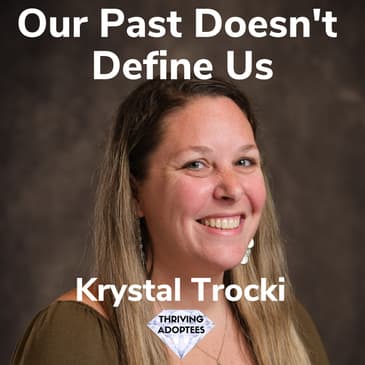
How do we free ourselves from the past? By seeing that it doesn't define us. Listen in as Krystal, adopted in her 30's talks about getting stronger through adversity, processing tough emotions and more.
Connect with Krystal here https://www.linkedin.com/in/krystal-trocki-1372321a3/
Find out about her employer here https://26health.org/
Guests and the host are not (unless mentioned) licensed pscyho-therapists and speak from their own opinion only. Seek qualified advice if you need help.
Want to learn more about thriving for you, your kids, your families or your colleagues? Pick a time to talk here
[00:00:02] Hello everybody, welcome to another episode of Thriving Adoptees Podcast. Today I'm delighted to be joined by Krystal, Krystal Trocki. Looking forward to our conversation today, Krystal. Krystal Trocki I am as well, thank you for having me. Krystal Trocki You're very, you're very welcome. So, something slightly unusual, we don't normally have people on the show that have been adopted as adults, but Krystal was in the 30s when your father adopted you, right? Krystal Trocki Absolutely.
[00:00:29] Krystal Trocki Yeah. And can you, she's also, listeners, an adoption professional. So can you just give us a bit of context around that, around your dad? Krystal Trocki Yeah, absolutely. So my mom and my dad started dating when I was very young, approximately six months old. And he was my parent figure my entire life.
[00:00:59] Krystal Trocki Yeah. Krystal Trocki When we were, we had talked about adoption off and on, as I was an adult. And at 32, 33, some stuff happened with my birth father. And my father and I talked even more seriously about it. And he said, absolutely. You know, you've always been my daughter. So I would be happy to adopt you.
[00:01:25] Krystal Trocki Wow. So we did a step parent adoption in October of 2014. Krystal Trocki Wow. Krystal Trocki Wow. Which was wonderful. Krystal Trocki Yeah. Yeah. So what did that give you, Krystal? Krystal Trocki So the biggest thing for me, because he was already my father in every sense of the word, is my maiden name was then his last name, which was very important to me as I was moving forward.
[00:01:55] Krystal Trocki Yeah. Krystal Trocki Yeah. Krystal Trocki Cool. So what does thriving mean to you, Krystal? Krystal Trocki So I've thought a lot about this since the last time that you and I spoke. But to me, it means being rooted in love and possibility. As I said, I was adopted by my stepfather. And both my stepfather, or my father and my mother gave me the gift of stability,
[00:02:22] Krystal Trocki Guidance and unconditional support. And their example of parenting taught me that family isn't just biology. It's about the choice, commitment and love that they lived out every day for not only themselves, but for me. Krystal Trocki Yeah. Krystal Trocki Wow.
[00:02:41] Krystal Trocki And now as an adult working at 26 Health, I carry that lesson forward to all of my families and everyone that I work with. And it means creating those spaces where both children and families can experience security and belonging. And it also means honoring my journey by ensuring that others have the opportunity to grow, be seen, and be fully embraced by the families who are choosing them. Krystal Trocki Yeah.
[00:03:09] Krystal Trocki Wow. I love the breadth of that, Krystal. Krystal Trocki Thank you. Krystal Trocki Thank you. Krystal Trocki Yeah, I love the breadth of it. But it's broad, and it's also deep, right? So you were talking about being rooted in love and support. So the metaphor that's coming for me is a really big, wide tree with very deep, deep roots.
[00:03:36] Krystal Trocki And that giving you, that giving you and that giving your families, as you say, stability and security, I guess, is that as well? Krystal Trocki Yeah, definitely security. So in that it's helping them create their forever families and helping not only the newborns that we work with, but also the older children who are in foster care,
[00:04:04] Krystal Trocki That we're helping create families for, that stability and security knowing that they have somewhere to call home every night and people that will always be there for them. Krystal Trocki Yeah. And of course, if they come from foster care, then they've known insecurity. Krystal Trocki Absolutely.
[00:04:22] Krystal Trocki Yeah. So how does that transition show up? I guess every kid is different, but what does that shift in security? How does that show itself? What does that do for their kids?
[00:04:46] Krystal Trocki Like you said, every child is different. Every situation is different and every family structure is going to be different when you're doing the foster care adoptions, especially.
[00:04:58] Krystal Trocki But I found that when they start feeling more secure, they will start breaking down those walls and letting other people in, talking to their families and their support systems about some of the trauma that they've either gone through or experienced or witnessed.
[00:05:18] Krystal Trocki And it's their way of showing people that they feel safe and they feel secure and they want to let them into their lives. Krystal Trocki So it's kind of opening up the trust, opening up because they're feeling the trust and they're feeling the love. Krystal Trocki Yes. Krystal Trocki Yeah. And what does that mean for you?
[00:05:45] Krystal Trocki What does love and trust mean for you in your life and in your personal life and your professional life? Krystal Trocki What does that give you? Krystal Trocki So for me, the love and trust is knowing that there's always people there for me, whether it's my parents or my family that I was made part of at a very young age.
[00:06:14] Krystal Trocki Even my birth family on my birth father side, I have a really good relationship with most of them. Krystal Trocki And they were very supportive in my adoption. Krystal Trocki So feeling the love that way and knowing that they made, they trusted me to make the decision that was right for me and my family.
[00:06:43] Krystal Trocki And I think that's the biggest thing is just knowing that people support you and knowing that no matter what your choices are in life, you will always have somebody standing behind you. Krystal Trocki Yeah. Krystal Trocki Yeah. Krystal Trocki And why is that important? Krystal Trocki It's a sense of being. Krystal Trocki You know, it was a very, I mean, it was a very easy decision to move forward with my adoption because like I said, my dad has always been my dad.
[00:07:09] Krystal Trocki But it was also with my birth family, making sure that they knew that I wasn't trying to cut them out. Krystal Trocki And that they accepted my decision, which was really important to me. Krystal Trocki Because they could have quite easily seen it as a rebuttal, I guess. Krystal Trocki Absolutely. Krystal Trocki They could have seen it that I was trying to cut my entire family out of my life.
[00:07:38] Krystal Trocki And that wasn't the case at all. Krystal Trocki My grandmother on that side and some of my cousins, I've been very close with my entire life, and they played a very important role in my life. Krystal Trocki So I wanted to make sure that my family, my birth family knew that they were still very important to me. Krystal Trocki You talked earlier on about creating spaces of security and belonging.
[00:08:04] Krystal Trocki What do you think helps us do that? Krystal Trocki I think knowing ourselves. Krystal Trocki So for our adoptive families, knowing where they are in their lives, and what will help them to parent.
[00:08:24] Krystal Trocki So I always tell my families, make sure, especially for the older children, make sure that you've done the research and the thought on yourself about what you can parent or what you feel works in your life in that moment.
[00:08:44] Krystal Trocki And what I mean by that is, if you are concerned about some of the trauma that your child has possibly been through, and you don't feel that you have the resources or the means to help them through that trauma, it's okay to not parent that child, but to make sure that they find the parents that will be able to help them through the trauma. Krystal Trocki Yeah.
[00:09:10] Krystal Trocki So I guess it's about the personal responsibility and the matching, finding the right match. Krystal Trocki Absolutely, and it's the right match for the child, and also the adoptive parents. Krystal Trocki Because at the end of the day, if a match doesn't work for any child, but especially the older children who have spent years in foster care, potentially, and have already gone through the losses that led them to foster care.
[00:09:40] Krystal Trocki If you take placement of a child, and that placement doesn't work, it's another trauma and loss for that child that they have to process. Krystal Trocki Yeah.
[00:09:53] Krystal Trocki Yeah, yeah, clearly. You talked about knowing ourselves, and you related that to our ability, I guess as prospective, you know, as prospective adoptive parents, we're talking about from that perspective, our ability to cope with the needs of each child in hand, right? Krystal Trocki Right.
[00:10:21] Krystal Trocki To me, there's a broader side of that, as well as our ability to parent. Krystal Trocki In terms of self-knowledge, self-awareness, those sorts of things.
[00:10:48] Krystal Trocki Is that, is that making any, making any sense to you? Krystal Trocki Yeah, I think it's also, so knowing, you know, the type of parent that you feel comfortable or parenting, but also knowing your limitations, knowing the communities that you're residing in, and making sure that you know how to
[00:11:15] Krystal Trocki Get those resources and help your child, and this is for newborns and foster children, but making sure that you know how to get those resources and be part of the culture and heritage of your child, so that they always feel accepted and wanted and seen as well. Krystal Trocki Yeah.
[00:11:40] Krystal Trocki One of the things I heard early on in terms of interviewing adoptive parents about what helps their kids thrive, I was struck by something that a lady called Holly Ann Petrie shared with me on the podcast. Krystal Trocki Yeah, so she's an adoptive mom and adoption professional as well, like you, runs a, got like eight or nine kids and runs a big agency in Texas called Addie's Hope.
[00:12:08] Krystal Trocki She said that successful, successful adoptive parenting is all about, her phrase was unpacking our own emotional baggage as adoptive parents. Krystal Trocki Yeah. Krystal Trocki Absolutely, because for, for someone to have any, I mean, to have lived it all.
[00:12:35] Krystal Trocki People have gone through things, whether it's good, bad or in between, and knowing how those experiences that they've gone through. Krystal Trocki Knowing, knowing those experiences and understanding how it will affect how they parent is so important.
[00:12:54] Krystal Trocki And processing that so whether it's processing with their friends or family, processing through therapy, any of those ways, but it does help like you say, unpack that emotional baggage. Krystal Trocki Yeah. Krystal Trocki So I guess that to me kind of sits with the kind of the self awareness piece. Krystal Trocki Yes. Krystal Trocki Yeah.
[00:13:19] Krystal Trocki So what have you, what have you learned about that processing and unpacking? Krystal Trocki Well, for me as an adoptee, I've realized that my past doesn't define me. Krystal Trocki And that it just helps you grow stronger.
[00:13:49] Krystal Trocki For the adoptive parents as they're working through those, you know, and I'm there as an adoption, in the adoption field to help them kind of process. Krystal Trocki And a lot of them have realized, okay, you know, these events happened to me as a child. Krystal Trocki And this might be why I don't feel comfortable parenting certain children. Krystal Trocki Or I've had some families or adoptive parents say, you know, I have ADHD.
[00:14:19] Krystal Trocki And I feel that I would be perfect to help another child who has been diagnosed with ADHD, learn how to grow and thrive and be successful in their everyday life. Krystal Trocki Yeah. Krystal Trocki Yeah. Krystal Trocki So it's that personal experience that, well, personal experience and the skill, passing on the skills that we've learned, I guess. Krystal Trocki Absolutely. Krystal Trocki Yeah. Krystal Trocki Yeah.
[00:14:47] Krystal Trocki What did you learn about yourself going through the training to be an adoption professional? Krystal Trocki So I actually went through the training before I was adopted. Krystal Trocki Ah, okay. Krystal Trocki And I've been in child welfare or social services in one way or another for the past 24 years.
[00:15:16] I say as I date myself a little bit. But so I went through a lot of my trainings before I was adopted. And that actually led to some of the discussions with my dad about, you know, we can do these adult adoptions. We can make it official, even though I'm past 18. And so it just showed a
[00:15:37] little bit more how important it was to me and to my family as a whole to have my dad's last name and officially be his daughter, even though I always was. Yeah. Yeah. So you talked about your past not defining you and hardships helping us grow, grow stronger. Were those things that
[00:16:06] came, were those learnings that that came to you during your training? Or was that earlier in life or later in life? Or where did those realizations come from? It's a little bit of both. A little bit before I decided, I always say that people in social welfare, or social services, probably have
[00:16:32] something that they need to unpack or something that they've been through, which has led us to this field. So for me, my experiences and understanding to not let them define me started when I was younger, I was probably in high school, or early college and realizing what I wanted to do with my life
[00:16:56] and realizing that I wanted to help make families better. So that some of these kids had different relationships with their families than I did with my birth father. And then going through all the trainings that I've gone through over the years has definitely strengthened that desire and that
[00:17:18] understanding. Yeah. So the driver was better relationships? Absolutely. Yeah. And were there any particular moments of insight around that that come to mind? So I realized that I really wanted better my senior year.
[00:17:47] Um, some things happened my senior year with my birth father and just, I realized in that instance, that was kind of the kicker for me in the, like at home, I'm not as important to him as I should be. And for me, that made me realize in that moment that one, I want it better for myself. And two,
[00:18:08] I wanted to continue to help families and individuals find that peace and understanding and feeling of acceptance and being wanted and not having any, um, stipulations or barriers to that.
[00:18:33] Yeah. Yeah. It's big stuff, isn't it? It is absolutely. And it's big, especially when you're a child. So whether you're adopted as a newborn and you find out as you're getting older that you were adopted or you're adopted out of foster care, it's big and it's emotional and you're going to have a lot of emotions and thoughts around the
[00:19:03] adoption process. And it's always just making sure that you have as adoptive parents, um, that you have those supports in place, whether it be counseling or another adoptee or other adoptive parents that either your child or you as a family can talk to and feel that somebody else understands.
[00:19:25] Yeah. So, I mean, you, you mentioned the word processing earlier on, um, what, what does your, and you've talked with you just now about big emotions. What does processing mean to you? It means several things, but the major thing in this case is working through those big emotions
[00:19:52] emotions and understanding that you are not alone in the adoption world, um, that other people are, that you may not even know, or that you do know have been adopted or have adopted and realizing that there are other people that you can talk to, um, that are there for support and they help you work
[00:20:19] through your feelings and thoughts about that adoption process. Yeah. Yeah. Just to, um, change tack slightly. What, what do you think gets it in the way of us thriving?
[00:20:41] Not being open. Um, so by that, I mean, for, let's say our adoptees, um, when they find out they're adopted, not being open to that love and support that they've always had by their adoptive parents and shutting people out, not feeling accepted, not feeling heard and
[00:21:07] just kind of retreating into themselves is the biggest. Yeah. And did you do a bit of that yourself at some stage? Um, so I did it more. So for us where I did the adult adoption, um, I still needed my birth
[00:21:24] father to sign consents, um, and the surrenders and sending him the paperwork to sign, um, as much as I wanted him to sign it and not give me a hard time and not have to go to court to try to get him to terminate his rights, getting that paperwork back without any fight or any, you know, what can we do
[00:21:51] to not terminate my rights? It was still a shock and it still hurt. Um, because it was, it kind of solidified the feelings that I had had all along that he didn't necessarily want me as a child. Um, so I definitely had those feelings and have had to process it. I'm a big proponent of going to
[00:22:14] counseling, um, just to have somebody else to talk to that may not be your family that can kind of help you work through those big feelings. Yeah. And how are you, how are you now in terms of the, uh, your,
[00:22:32] your feelings towards the, your biological father? Um, I, I go back and forth. Um, I still get angry that he didn't want me as a child. Um, but then I also look at it that he also did me or did the best
[00:22:57] that he could for me. And I was able to be raised by an amazing man who did want me as a father or as a daughter, I should say, and who wanted me in his life. So although my birth father didn't want me and it hurts and I have really big feelings and I still talk about it with counselors, um, I am thankful in
[00:23:21] some sense that his decisions led me to my father. Yeah. I mean, one of the things that more and more people talking about in, in the adoption space, it is the, the, the paradox of the two
[00:23:44] the two emotions. Yes. Absolutely. Yeah. Um, I had, uh, did I tell you anything about what happened with me and my biological father? Did I tell you about that? Um, you told me a little bit, I'd love to hear
[00:24:04] more about it. Yeah. So he, he, and my birth mother had been, so this is back in 1966, right? So according to the adoption file, they'd been dating for five months. Uh, and when she told him that she was pregnant, he didn't want anything to do with the, uh, unborn baby. And he signed a little piece
[00:24:27] of paper relinquishing his interest or his rights. And that was probably the last that he'd heard of, uh, of this. I don't know for sure, but I, um, I, um, I rang him up completely out of the blue about 18 months or so ago. And, uh, it didn't, it didn't go very well. Uh, I didn't, uh, uh,
[00:24:53] and I shouldn't have done it in the way that I did. However, I think I probably had the same outcome anyway, which was that, that, you know, the end of the call was don't call this number again. And that, that set, set me off thinking, uh, a lot of, a lot of thoughts. So the first one was, I could have done that better. The next thing was, well, I don't think I would have had a different
[00:25:20] outcome, even if I had handled it better. The next thing was, um, I'm what, what would my life have been like if this guy who clearly didn't love my birth mother, um, had done what society would say is the right thing and, and, um, and, and married her. What's, what sort of environment
[00:25:47] would that have been for me to grow up in when, where the, where the father doesn't love the mother? Uh, how, how would he, uh, would he have resented me, um, as the cause of a marriage that he didn't want? And then the next thing that came up for me was, well, he, uh, just the way that he was,
[00:26:13] I'm glad that guy didn't parent me just his, his character. What, what I, the insight that I got into his character, um, in a, in a phone call that lasted a couple of minutes. I'm kind of glad that guy didn't raise me. Um, and if I hadn't called him up, I wouldn't have got to all that.
[00:26:38] I wouldn't have got to all that stuff. And then a bit later on, probably another nine months later, I found out that the guy had actually been in, in, in care himself. Him and his siblings had been in care because the, his mother had died when, when he was really young and his father was away working, uh, working at sea and there was nobody else to support, nobody else to look after the kid.
[00:27:05] So him and his siblings wouldn't care. And I thought, well, he's kind of done, he's done to me what was done to him. Absolutely. Uh, so all these sort of things like helped me realize that, you know, I'm how lucky I was really. You were. And I think as adoptees, we always
[00:27:31] have that, what if, um, that if that, like you said, if they had stayed together, what would your life have been? Um, and we always wonder, would it have been better a different way? But I think in the end, nine times out of 10, we are all, all adoptees, not all, but all adoptees are better off in the
[00:28:00] families that were created for us. And sometimes we go back just like what happened to you. Um, and it's happened to me in a sense, and we reconnect with those birth parents and we realize my life really was better, um, because of the decisions that they made. Yeah. But it takes, it takes, you have to do the next step on the part of the journey to get to the realizations, right?
[00:28:28] Absolutely. And you've got to do them at the time that's, uh, that's right for you. So I, I didn't, I, I knew where the guy was for 10 months before I contacted him. Um, I knew where my, but didn't, but didn't feel the need. And I kind of just did it as an experiment to see, well, a fellow adoptee
[00:28:56] that I was interviewing on the show. So I was telling him about it, um, before he said, oh, well, he might've changed his mind, Simon. I thought, yeah, he might've changed his mind. So let me see if he has. And he hadn't, but at least I knew that. Right. It gives you that closure.
[00:29:18] It gives you the closure. Um, if, if we don't, if we don't take the next step, then we don't get to the closure. Do we, we don't, we sit and wonder what if, or, you know, will it be different? Do they still think of me? And it's actually funny that you were saying that you had reached out
[00:29:40] to your birth father. I actually recently, um, reached out to mine for some various reasons to, so I'm waiting to see if he responds. I'm not expecting a response. Um, but it will be interesting to see. And I think if I've had closure for years, um, but since losing my dad, um, we lost him in 2023,
[00:30:11] I've gone back and forth on if I should contact my birth father and just kind of check on him or get some updates, um, about his life. Um, about his life. And it's not necessarily that I want him to be a big part of my life because he had that chance as when I was growing up. Um, but it's really just to check in and see how he is and get some of that health history that we as adoptees don't always get
[00:30:39] or have readily at our fingertips as much as people who were raised with their biological families have. Yeah. Why, why do you think the closure is so important to us?
[00:30:59] I think it helps us grieve. Um, I think it helps us. I think we'll always grieve that loss of our birth parents. Um, but I think that it helps to close that chapter and it helps us to get through that
[00:31:20] grieving process a little bit more than if we didn't know or we didn't reach out or make contact with any of our birth family. Yeah. I mean, there's a lot of, there's peace. You mentioned the word peace, uh, a little bit ago, but I was thinking about,
[00:31:52] you know, the peace as the end of the questions. Is that what closure is about? Is that what we're seeking? I think in most cases or in many cases, absolutely. Um, and I think it looks different for everyone. Um, you know, there are some adoptees who don't want that information on their birth family
[00:32:18] or to have made that connection. And then there's others of us who need it in our lives, um, to kind of help us feel whole and seen by other people in our lives. Yeah. And I think it changes as well, doesn't it? I mean, uh, well, it did, it did for me,
[00:32:40] you know, I, I had a big look around, uh, you know, uh, consideration of do I go for the, you know, the search and reunion back like 18 years or so ago. And it didn't feel right for me to do it
[00:33:00] at the time, but then, then things changed and I, and I took a step and then I got some information and then I stopped again. And then I don't know, maybe a year later, I resumed, I resumed the search,
[00:33:20] but, but it was a matter of timing and, and when I, when it was a no brainer, right? So I felt I had to, I had no option other than to re restart the search. So timing, I think timing plays an important
[00:33:42] part. And we, you know, we go at our own pace. We, we start and stop when, when feels right to us, when, when, uh, when the, the wisdom in our, in our, in our gut or our gut, our gut is telling us to, to start or, or stop or take a break.
[00:34:05] I agree. And I think it's the same for the birth parents who are searching, um, for their children, whether they place that or made an adoption plan at birth, or even had their child removed through state care, when they start making that decision to look for their child and make those
[00:34:33] connections. I think it, like you said, you start and you stop and that could happen several times before you make the decision to finally reach out. And it really just depends on the season of your life that you're in and what's going on in that moment, I think. Yeah. I was interviewing a fellow adoptee earlier on, and she was talking, uh, she, she was talking
[00:34:59] about impulsivity and I'm wondering how that plays into, to, to this search and reunion process. Yeah. Yeah. I mean, I think that it can be an impulsive decision to make that contact. You know,
[00:35:23] you could be sitting and just decide I'm going to search the internet or I'm going to search social media and then you come across either their profile or something about them and you reach out without even thinking. Um, so I think in those cases, it can definitely be impulsive. Um, and I think it plays a role. And then in other times like you and I have, you think about it for quite a period of time
[00:35:53] before you actually do it. So I think it really just depends on the person, um, and where they are in that moment. Yeah. Yeah. It's all individual. And somebody said to me, uh, uh, last week, you know, when you've, when you've met one adopted person, you've met one adopted person.
[00:36:16] It's like, uh, we're all, we're, we're all different and, and yet we're all different. And yet I'm, I'm trying with the podcast to, to share the learnings, you know, in that way. We are definitely all different. Everybody has a different story and journey, um, as to how they got there and how they were raised or what their lives would have looked like if they hadn't been placed for adoption.
[00:36:43] Yeah. Have you had much contact with, uh, other fellow adoptees, Crystal? Um, so yeah, I actually have, um, one of my uncles on my dad's side, um, had placed a, two of his children for adoption when they were younger and we've actually reconnected. Um,
[00:37:09] so two of my cousins were actually adopted and then reached out and found their birth family, which has been amazing. We've reconnected with one in the past, um, probably three or four years. And then I had another one who we reconnected with when I was in middle school or high school. Um, so that's been great, you know, having other family members that were adopted and then.
[00:37:37] Um, what, what's that given, what's that given you? How's that benefited you, Crystal? Um, I don't know if it's necessarily benefited me in any particular way, but having those extra family members that have resurfaced in our lives has been wonderful. Um, and making more family
[00:38:02] connections. So no matter how that looks for people, having those extra family connections is great. So it goes back to the, the roots that we talked about earlier on. It's more, it's more roots, more connections, more roots. Yes. Yeah. A bigger network. Yeah. Yeah. Is, uh, I'm,
[00:38:28] I'm thinking, is there anything that I've not asked you about that you'd like to share, Crystal? Um, no, I think that we had a really thorough discussion on everything today. It's been wonderful. Yeah. Yeah. I've enjoyed it. I've enjoyed it too. And we hope you have to, uh, listeners and, um, we'll speak to you very soon. Bye.
[00:38:58] Bye. Bye. Bye.