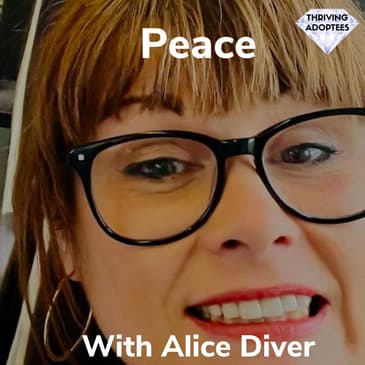
If we're ok with not feeling ok, we're always ok. Listen in as we dive into healing, coping, peace and more. You'll love Alice's honesty and humour.
Here's a bit about Alice's last interview.
Listen on as Alice shares how she found the patience and persistence on her quest to find and meet her birth mother. There are bags of insights, realisations, twists and turns. Buckle up for a rollercoaster of a ride.
Listen to it here https://thriving-adoptees.simplecast.com/episodes/patience-persistence-with-adoptee-alice-diver
Here is a link to the publication Alice mentions https://drive.google.com/file/d/1b2nqk1B6XrYH1qRez_tryDW34Yv0qSmd/view?usp=sharing
Here is a link to her profile and research
https://pure.qub.ac.uk/en/persons/alice-diver/publications/
Here's a link to the webinar video I mention https://www.youtube.com/watch?v=bnz7I7V_IOQ&t=224s
Here's a link the webinar on another podcast episode https://thriving-adoptees.simplecast.com/episodes/whole-healing-my-primal-wound-webinar-recording
Connect with Alice on Linkedin https://www.linkedin.com/in/alice-diver-b6939545
Guests and the host are not (unless mentioned) licensed pscyho-therapists and speak from their own opinion only. Seek qualified advice if you need help.
Want to learn more about thriving for you, your kids, your families or your colleagues? Pick a time to talk here
[00:00:02] Hello everybody, welcome to another episode of Thriving Adoptees podcast.
[00:00:05] I'm delighted to be joined by Alice Diver.
[00:00:08] Looking forward to our conversation today.
[00:00:11] Me too Simon, thank you for having me back again. It's good to see you.
[00:00:14] Great to see you. Great to have you back.
[00:00:16] So, I don't know, is it a five million pound question or a 17 trillion dollar question?
[00:00:23] What does healing mean to you Alice?
[00:00:27] Oh, okay. It means I guess several things.
[00:00:34] I think it's a good thing to have.
[00:00:36] I don't think personally that I'm at that stage yet.
[00:00:40] I'm very pleased for people who are healed and who are happy to tell me how they did it
[00:00:45] and how it happened and so on. Me personally, I think it's ongoing.
[00:00:51] I'm not sure and I know this is going to sound slightly negative.
[00:00:55] I'm not sure if Adoptees ever fully healed from the thing,
[00:00:59] from what happened to at birth, before birth and ongoing.
[00:01:04] I think we see rejections and triggers and so on everywhere.
[00:01:11] Equally that could just be me but I think coping, if you haven't got healing,
[00:01:16] at least I think I'm quite good at coping.
[00:01:19] So I'll give it that whether that means I'm healed or just very grumpy
[00:01:22] or in need of something then I'm open to being told.
[00:01:28] But those are my thoughts.
[00:01:29] I just sometimes, I know sometimes things heal over.
[00:01:32] You think they're healed but they're actually scar tissue
[00:01:34] or there's something underneath the thorn didn't come out.
[00:01:37] Those are my negative thoughts with which to begin.
[00:01:41] So based on what you said, is then an absence of any perceived
[00:01:52] rejection would that be one indicator of being whole?
[00:02:02] You said see rejection everywhere, which we all know that.
[00:02:07] That's a song that we all know.
[00:02:10] I think in my, I've called it the projection of rejection for me.
[00:02:17] So do you think if we are, do you think that
[00:02:26] not seeing any rejection would be a part of being whole?
[00:02:31] Yes possibly because sometimes I, sometimes they are,
[00:02:35] I would call them micro rejections.
[00:02:37] I think life is made up of them where you maybe,
[00:02:39] you don't get something or a friend falls out with yours
[00:02:43] or something or people are rude on the street or something just triggers.
[00:02:47] Sometimes that's maybe down, I admit to myself being sensitive or hypersensitive.
[00:02:54] So there's that.
[00:02:56] Don't know, I would love to be at the stage where I would be oblivious
[00:03:00] to slights or triggers and so on.
[00:03:02] But I think we remain vigilant.
[00:03:04] I don't know, that could just be me.
[00:03:06] But I know other adoptees who are a bit like that as well.
[00:03:09] So it's a bit like you're seeing that you're trying to predict,
[00:03:13] you're on guard because you think or maybe like an abused child,
[00:03:17] you think I've got to be very careful.
[00:03:19] I'm walking on eggshells and I have to not say this.
[00:03:22] And here's what might happen.
[00:03:23] So I'm going to break up with you first
[00:03:25] or I'm going to stop being your friend before you can hurt me.
[00:03:27] Et cetera, et cetera.
[00:03:28] I know I've heard other adoptees talk about this.
[00:03:32] So it's a thing.
[00:03:33] Will I always see little rejections?
[00:03:35] Probably no because I'm negative in that way
[00:03:37] but I'm also, that's the coping.
[00:03:43] I don't know if I'll ever,
[00:03:44] I'm better than I used to be put it that way.
[00:03:46] I used to be a lot worse now.
[00:03:48] I'm just mildly grumpy most of the time.
[00:03:50] So I guess that's progress.
[00:03:52] Yeah, yes, certainly sounds like progress to me.
[00:03:56] The things coming to my mind is that we put conditions
[00:04:02] on this status of healing, don't we?
[00:04:04] We put, yeah.
[00:04:07] And what if we didn't now?
[00:04:10] That's a really big question.
[00:04:11] But rather than just kind of side stepping the question completely
[00:04:19] or what some people call, I think they call it spiritual bypassing.
[00:04:25] As you were talking about the rejection stuff,
[00:04:28] I remembered something.
[00:04:32] So this was a memory from 40 years ago
[00:04:39] that I saw in a completely different light
[00:04:43] about four months ago.
[00:04:46] So I was 17, I was walking back from the pub
[00:04:50] and I saw a girl that I'd been out with a couple of times
[00:04:56] and then who had dumped me.
[00:04:59] I saw her walking towards me with her,
[00:05:04] but we were still kind of friends,
[00:05:06] we'd been sort of friends before.
[00:05:08] I saw her walking towards me with a mum and her new boyfriend.
[00:05:14] And this boyfriend was like four inches taller than me
[00:05:18] and really big, muscly, wide guy.
[00:05:21] Right?
[00:05:23] She didn't acknowledge me as we passed on the pavement.
[00:05:28] And I said to her, don't say hello then Fiona.
[00:05:35] Don't say hello then Fiona.
[00:05:37] So I'd had a few drinks.
[00:05:39] So obviously my tongue had been slightly loosened.
[00:05:43] And she carried on walking, the old character walking.
[00:05:48] And then about five minutes later,
[00:05:50] I turned around to talk to one of my friends
[00:05:52] and as I did this massive fist arrived in my face.
[00:06:00] And I went down like a bag of proverbial, right?
[00:06:04] So the guy started, was going to start kicking me on the ground.
[00:06:11] And a friend of mine, one of them happened to know him,
[00:06:14] not very well, but he said, look, I think you've done enough.
[00:06:19] And so he pulled away and I had a really bad black eye and all sorts of, you know,
[00:06:26] it wasn't gray.
[00:06:29] I wasn't damaged any more than a black eye,
[00:06:34] but it took probably about four months to go.
[00:06:36] Now I projected rejection.
[00:06:40] I'd said, don't say hello then Fiona.
[00:06:43] I thought that she'd blind me.
[00:06:44] Right.
[00:06:46] And then like last month, not last month, about four months ago,
[00:06:50] something came to me when I realized that what she'd probably done
[00:06:55] is not acknowledged me because she knew this boyfriend was the jealous type with a loose cannon.
[00:07:05] And that's why she'd not said hello to me
[00:07:09] because she didn't want to do anything to aggravate him.
[00:07:13] Right.
[00:07:15] And in that moment, I saw that she hadn't been actually rejecting me as I thought.
[00:07:24] She'd been in a way, she'd been maintaining the peace.
[00:07:30] And when I saw that for the, it took me 40 years, can you believe that?
[00:07:36] It took me 40 years to see that and then ping in a moment, it's gone.
[00:07:42] And I think those for me are those healing moments.
[00:07:53] And as you were talking about this rejection thing,
[00:07:58] I was thinking about this idea that I've never thought of before, right?
[00:08:02] That we're putting conditions, you know, I'll be healed when.
[00:08:08] I'll be whole when.
[00:08:10] I'll be whole when I no longer feel triggered by people kind of rejecting me.
[00:08:24] Does that make?
[00:08:25] It does, it does make sense.
[00:08:28] I think it's accurate to the way it is.
[00:08:30] It's an accurate analysis for some people anyway.
[00:08:35] I don't know.
[00:08:36] It'll be interesting if I was tasked with coming up with a checklist,
[00:08:41] doing the lawyer bit now.
[00:08:43] Yeah.
[00:08:44] Legislative welfare checklist.
[00:08:46] At what point have I ticked enough boxes to say, yeah, I'm good now and I'm healed now?
[00:08:51] You know, because I think I'm probably quite high functioning and I'm a grandmother now
[00:08:54] with another on the way and it's things are good.
[00:08:57] And I'm definitely not as angry as I was, you know, decades or even a few years ago.
[00:09:03] Reunion, not perfect but it's been good.
[00:09:07] It's been helpful.
[00:09:09] But I don't think I could honestly say I'm healed.
[00:09:14] And I just think you can have, you go having very good days.
[00:09:19] One thing could sort of set you off and take you back to being a teenager.
[00:09:23] So example, somebody a friend falls out with you and stops speaking to you or says
[00:09:28] something, you know, sort of hurtful or whatever.
[00:09:30] And even though you're able to rationalize it, you're 70 or 60 years old.
[00:09:33] I've got to catch myself on.
[00:09:35] This is ridiculous and I haven't done anything.
[00:09:38] Things happen.
[00:09:39] You still, you just find no, I've come on.
[00:09:43] I'm just, I'm so, it's just like back to being a teenager again when things maybe
[00:09:48] weren't so good and you weren't able to process and, you know, you think, well,
[00:09:53] but coping mechanism was like, well, I'm going to go get a new tattoo.
[00:09:56] Running out of room now, but you know, something just like legalized self-harm.
[00:10:00] So, you know, that maybe ticks.
[00:10:02] That sounds very dark.
[00:10:03] I don't mean it to be as dark.
[00:10:06] You know, so there's, I just think if you've got layers of healing,
[00:10:11] but sometimes just something gets through them and there's a wee scratch
[00:10:14] and you can take your wild decline back up again.
[00:10:18] Then I think you're a bit more cautious than about you're sort of like,
[00:10:21] maybe I need less people in my life or maybe I need to be more
[00:10:25] guarded and put some walls up and hibernate a little for a while,
[00:10:29] which is probably not a good way to be, but I think it's whatever works.
[00:10:34] Again, that sounds quite dark.
[00:10:36] Well, there's darkness and light there for sure.
[00:10:42] One of the things that popped up for me is you used the processing word.
[00:10:46] So, is kind of more effective processing.
[00:10:53] Is that a sign of healing for you?
[00:10:58] Yes, to an extent.
[00:10:59] Although I wonder, healing and coping, are they,
[00:11:05] wondering are they different concepts or are they maybe a bit closer than
[00:11:12] we give them credit for?
[00:11:14] Could coping be disguised as healing and vice versa?
[00:11:17] That's interesting.
[00:11:17] And I don't know because I'm not a psychologist,
[00:11:19] I would need probably a professional person to guide me through it.
[00:11:26] Yeah. I think sometimes the professionals can definitely help.
[00:11:31] I think healing and coping to me has more of a kind.
[00:11:39] Yeah. It's not as profound.
[00:11:43] It doesn't sound as nice a word to me.
[00:11:48] Coping seems like a strategy rather than healing.
[00:11:53] Is that an insight thing?
[00:11:57] So, in that little moment, when I saw that Fiona, that was the girl,
[00:12:05] when I saw that she hadn't rejected me, there was a kind of a buzz of,
[00:12:12] oh, I wasn't 40 years ago, I wasn't being rejected.
[00:12:19] Are there other moments in my life when I have projected rejection that wasn't there?
[00:12:27] Right? It wasn't there.
[00:12:30] Or the action wasn't a rejection, it was something else.
[00:12:34] So her reaction was a...
[00:12:41] Really? She was being a bit of a butytonic stand.
[00:12:43] It was protection.
[00:12:46] It was protection. There we are. I love her catchphrase.
[00:12:48] It was projection, not rejection.
[00:12:51] Yes.
[00:12:52] You can see that on a t-shirt.
[00:12:54] No, I suppose perception is everything and then hindsight.
[00:12:58] You definitely look at things differently as you get older.
[00:13:01] And I've definitely grown a thicker skin over the years.
[00:13:06] But, yeah, I still...
[00:13:09] I still just...
[00:13:10] And I know how it would have...
[00:13:12] Others, other adoptees in the same position, just from conversations they would say,
[00:13:17] you could go for years and think, I am doing good and everything's fine
[00:13:21] and that's all in the past.
[00:13:22] I just want one little thing and see, you know, it doesn't make things flare up.
[00:13:26] I suppose if it's like a physical...
[00:13:28] I mean, I have a bad ankle, which from time to time decides to spectacularly throw me into the pavement.
[00:13:35] So I wonder, is it a bit like that?
[00:13:37] Maybe I'm equating mental and physical a bit too closely,
[00:13:40] but to me it's a bit like that.
[00:13:42] So you're fine.
[00:13:43] It's like shingles.
[00:13:44] You chickenpox, you get over it.
[00:13:46] And then it waits a couple of decades and can just, you know,
[00:13:49] okay, now you've got shingles because I lived in your spinal cord and I'm back.
[00:13:54] But that's a bit gothic.
[00:13:57] But I don't know.
[00:13:59] I think if we're, at least if you're, is it putting too much pressure on yourself to say,
[00:14:03] I'm healed now and I'm good?
[00:14:05] Does that stop you then from ever having a moment where you might need to sort of go,
[00:14:10] oh, okay, I got to take a day.
[00:14:12] I've got to, you know, that this is a thing.
[00:14:15] And if I ignore it, you know, because of the things that go away by themselves can come back by themselves.
[00:14:19] I wonder are you putting it somewhere but not really dealing with it?
[00:14:23] I don't know.
[00:14:23] I'm a great fan of the darkness and the bleakness.
[00:14:26] Having a day to wallow.
[00:14:27] I always think that feel a lot.
[00:14:29] I love Beckett because Beckett, he upsets you but it's all about grief and grieving and,
[00:14:34] you know, weirdness.
[00:14:36] But in some ways it's sort of therapeutic and cathartic.
[00:14:38] I don't know.
[00:14:39] But it's not always cup of tea.
[00:14:40] I know I'm too much for some people.
[00:14:42] They just, you know, they might, my kids will be like, don't start.
[00:14:45] Do not start.
[00:14:46] You know, you've spotted something in the TV show.
[00:14:49] There's something in a sitcom where adoption was the joke.
[00:14:51] And I'll be, they'll see me just starting to levitate and they'll go like, we know,
[00:14:55] it's not on.
[00:14:56] So, yeah, that's just the gothic thing sums up that book.
[00:15:05] When I read the title of that book, the body keeps the score.
[00:15:10] Right.
[00:15:12] That sounded me like the body keeps a score.
[00:15:15] It sounded gothic kind of as you were describing it.
[00:15:18] You know, it's lurking, right?
[00:15:21] So there's this trauma that has gone away, but it's lurking somewhere in my body
[00:15:28] and it's going to jump out and get me and frighten the bejesus out of me.
[00:15:32] That's what the title.
[00:15:36] It might not.
[00:15:37] And it might not.
[00:15:39] But I just think it's probably, I know I'm a pessimist,
[00:15:42] but I think that way I'm never disappointed.
[00:15:44] I'm just always on the lookout like when you're driving.
[00:15:47] I think it's because so many, so many times I've gone up, you know,
[00:15:50] drive along the street and someone is coming in the opposite direction on a one-way street or
[00:15:54] something, you know, if it can go wrong, it will go wrong.
[00:15:56] Not as pessimistic as it sounds.
[00:15:58] I just call it pragmatism just being prepared for maybe I have a very low bar.
[00:16:01] I'm like, you know, I get through today and I didn't fall over or I didn't make anybody cry.
[00:16:06] Today was not a bad day.
[00:16:10] That's a low bar really.
[00:16:11] I'm actually happier than I'm making out.
[00:16:13] It's just from time to time.
[00:16:15] Well, yeah, low bars.
[00:16:18] I mean, the bigger the goal, the easier it is to score, right?
[00:16:24] So making the bar and mixing the metaphor.
[00:16:29] Do you know, I'm thinking about where is the line between sensible
[00:16:38] vigilance and hypervigilance?
[00:16:40] Do you know what I mean?
[00:16:41] That like where is that bar?
[00:16:42] I mean, where is that gap?
[00:16:43] It's a line that's drawn in.
[00:16:47] It's a line that's drawn in the sand and we'll draw it because we'll draw it in a slightly different
[00:16:51] place.
[00:16:55] Though I think as adoptees, I think we're, you know, I once said we're a bit like rescue
[00:17:00] dogs and I remember one friend being appalled by that and said, don't describe yourself
[00:17:05] like that.
[00:17:06] And others were sort of like, that's maybe not a bad way of self-labelling.
[00:17:13] It's maybe a bit defeatist, but you're sort of saying, we are a bit, you know,
[00:17:16] I think once you acknowledge that we have the hypervigilance or some differences,
[00:17:21] then you can sort of go, okay, I'll put them over there and I know they're there
[00:17:24] and it might not need to look at them now for a while.
[00:17:26] And then you go on, but maybe that's too defeatist or I don't know.
[00:17:29] These are just my thoughts.
[00:17:31] Well, that's what we're doing aren't we?
[00:17:34] Which is such a change in thoughts.
[00:17:37] Is it the thing that's coming to my head is kind of like there's hypervigilance
[00:17:45] and are we shaming ourselves there?
[00:17:50] Are we saying, is healing saying, well, it's hypervigilance, it's okay.
[00:17:55] Whereas the other one, you know, as we could be saying, I can't get any sleep.
[00:18:02] I've been awake for five weeks.
[00:18:05] I'm hypervigilance all the time and like we're villainizing how we feel.
[00:18:14] And so given that, what seems, what healing would be would be
[00:18:23] villainizing our emotions less being, having more grace for how we feel.
[00:18:32] Not so, I'm making about myself for a minute.
[00:18:36] So I used to be, you know, worry about worrying or get angry about being angry.
[00:18:43] And there's a space where then I'm fueling the fire, right?
[00:18:52] Rather than accepting the emotions.
[00:18:57] And it's a thing that keep coming back again and again is on the podcast that
[00:19:05] guests see that accepting rather than fighting our feelings is a sign of healing.
[00:19:19] Because we've numbed, we've stuffed, we've tried to push them away.
[00:19:27] We've been, because we've been so worried that the wave of trauma is going to drown us.
[00:19:35] Right? We've been trying to put our hand up against the wave like that,
[00:19:38] King Can You guy that we did in history.
[00:19:43] He put his hand up against the wave to try and stop the waves coming in.
[00:19:49] And clearly that's a completely pointless exercise.
[00:19:53] Yeah, that's a tricky one.
[00:19:58] It is a difficult one.
[00:20:00] And then I wonder is there a difference between, I know adoptees who've been to therapy
[00:20:06] who are still in therapy ones that would not go to therapy.
[00:20:09] I've never had it.
[00:20:10] I've been told a few times that I probably shouldn't go and see about it.
[00:20:15] But it's, I wonder does that make a difference at how you look back on stuff
[00:20:20] or how you see yourself situated within it?
[00:20:23] Well, I sometimes, you know, I use this a while ago.
[00:20:31] The guy who is in a roundabout way responsible for me doing the podcast.
[00:20:39] It was a mentor guy at mine like 10 years ago.
[00:20:43] He said it's hard to see the picture when we're in the frame.
[00:20:47] Hard to see the picture when we're in the frame.
[00:20:49] So a third party can, a third party perspective can help them.
[00:20:54] I guess that's why, you know, a therapist or a coach can help us.
[00:21:00] But what we're doing here is like we're talking about perspectives on healing
[00:21:08] and you're sharing your perspective on healing.
[00:21:10] I'm sharing a little bit of my perspective on healing.
[00:21:12] Some of the perspectives I've heard from other guests.
[00:21:15] And in that way we can kind of look at our perspective and say,
[00:21:22] without me to pay to go to the therapist, we can look at our perspective and say,
[00:21:26] well, is there something in what Alice said there?
[00:21:30] I mean, that's the purpose of the podcast is for me to,
[00:21:36] well, yeah, as I saw it was for me is to kind of ask the guests about their
[00:21:44] perspective on healing, their perspective on thriving and see if anything that's helped
[00:21:52] the guest can help the listener.
[00:21:54] That's what we're trying to do.
[00:21:55] We're trying to offer a different perspective on it.
[00:21:59] And in particular, I feel that what I'm trying to do now is healing education.
[00:22:07] We've had so much trauma education in the books, right?
[00:22:12] As we've had so much trauma education in the books or from videos that we've watched
[00:22:19] or stuff that we've seen on Facebook.
[00:22:21] We've had loads of trauma and trauma education.
[00:22:25] Let's focus on healing education.
[00:22:26] Let's focus on healing perspectives in the hope that our shifts in perspectives
[00:22:34] may catalyze a shift in perspective for the listener.
[00:22:39] So do any healing moments come to mind?
[00:22:46] So the moments where you've had those shifts in perspective?
[00:22:51] Definitely.
[00:22:52] I mean, I suppose maybe I'm sort of being too negative and I'll try to sort of see some of the
[00:22:57] some of the positives.
[00:22:58] I mean, I suppose the big moment was obviously reunion seven years ago now with the maternal
[00:23:05] side of the family.
[00:23:06] That was a very, very positive experience and that definitely helped put a few demons to rest.
[00:23:13] Now again, I have that has to come with the proviso of quite often think reunion
[00:23:18] is the be all and end all.
[00:23:19] It's you know, there's your birth certificate off you go.
[00:23:22] There's your family.
[00:23:23] You should be happy now.
[00:23:24] You found them.
[00:23:25] It only took you 50 years.
[00:23:27] So it's good, but it's not if I'm expecting perfection and for a line to be drawn.
[00:23:35] You know, it's an ongoing thing.
[00:23:36] It'll net you know, it's an ongoing process, but it's definitely helpful.
[00:23:40] I'm very much in favor of repatriation of redress.
[00:23:45] You know, and again, there's so much that happening in various places around the world
[00:23:48] where they're trying to work out how do you heal a generation?
[00:23:51] How do you heal a group of people who have been mistreated and violated and everything else?
[00:23:56] And I see different examples of it.
[00:23:58] You know, what will do we have memorial?
[00:24:00] Do we give them money?
[00:24:01] Do we put time limits on?
[00:24:03] Do we just do we give them some extra support?
[00:24:06] And it's good that there is, I guess, a bit of a realization that people need more than
[00:24:10] just the bit of paper or there's the name off you go and search, you know,
[00:24:15] or there's the reunion.
[00:24:16] Be careful because it could break down.
[00:24:19] I think it's good that they're realizing that adult adoptees do need a bit more.
[00:24:23] You need to talk to other adoptees and have support groups are great.
[00:24:27] I only joined one a few months ago.
[00:24:29] That's another moment.
[00:24:31] But again, it's the kind of place where people talk about anything.
[00:24:39] You know, so it's quite good and it can go a bit dark.
[00:24:42] There's sometimes emotions can run high, so there may be some sharp, not sharp exchanges,
[00:24:46] but you know, sometimes people get upset and talk.
[00:24:50] It's only a small group, but that has been, you know, that sounds awful.
[00:24:54] You feel quite wrung out by the end of it, but I look forward to that.
[00:24:57] So because you're just among kindred spirits and some will come and go
[00:25:01] and you can see people from week to week often healing and getting better.
[00:25:07] But it's nice to know that it's there because sometimes they'll come back
[00:25:10] after a while away and say, well, my reunion is broken down or something has happened
[00:25:14] or I've discovered this and they just need to come back into that safe space.
[00:25:19] So that would be one.
[00:25:20] Let me think what else?
[00:25:21] I mean, having children was something that I highly recommend.
[00:25:29] Having a grandchild was kind of, I'm falling into the stereotypical granny
[00:25:34] of I am a granny, I have grandchild, she's very cute.
[00:25:36] But that to me, that's amazing because she, I could see she looks like my,
[00:25:41] she's a small brown round thing.
[00:25:44] So that's nice when I look at her and I can sort of say,
[00:25:46] well, you look like all these Canadian cousins and the ancestors,
[00:25:50] she's quite indigenous looking, which is nice for Northern Ireland.
[00:25:55] So there's lots, yeah, I can point to lots of things that are healing,
[00:25:59] but I can't yet say that I'm at that level of having been healed.
[00:26:06] I think I'm doing well.
[00:26:07] I think I'm doing okay, but it's just occasionally something will come along
[00:26:11] to, to floor you a little and you think, whoa, where did that come from?
[00:26:15] And why am I, you know, feeling like I felt 40 odd years ago when times were very dark?
[00:26:22] You can pull yourself out of it.
[00:26:23] But I think, I think it's important to notice, you know,
[00:26:26] when something like that's happening that you can then maybe seek help.
[00:26:30] Yeah, sounds awful.
[00:26:31] Help.
[00:26:32] But you know, I don't know.
[00:26:34] Is the, is the support group, you said it was a small group.
[00:26:39] Do you meet in person?
[00:26:40] Do you meet online?
[00:26:41] How does it work online?
[00:26:42] Online, which in some ways is good because I think if you were in person,
[00:26:45] I don't know.
[00:26:46] I think sometimes people maybe open up a little more online
[00:26:48] because they can be comfortable to have not to leave the house.
[00:26:51] You're in your space, you know, you can stop and get a drink of water.
[00:26:55] You can sort of come and go if it's getting too much,
[00:26:57] you can go and have a moment.
[00:26:59] And I think just, yeah, I think that's, that's a very good thing.
[00:27:03] And how many people are on, on the couple?
[00:27:07] It varies from, you know,
[00:27:11] from meeting to meeting.
[00:27:12] Sometimes you get quite a big attendance.
[00:27:14] Other times it's smaller.
[00:27:17] So that on average, I mean, what does it range?
[00:27:20] Does it range from six to 20 or, you know?
[00:27:23] Yeah, I would usually fall in.
[00:27:24] I would sort of fall into that.
[00:27:26] So obviously we're sort of bound by, you know, confidentiality.
[00:27:32] Not sort of too much about it, but it's a nice manageable number.
[00:27:36] And from month to month, it could change in composition.
[00:27:40] So some people are there a lot.
[00:27:42] Others you might only see once or twice.
[00:27:44] Like if something has annoyed them, they'll come in.
[00:27:47] So I think that's important too.
[00:27:49] It's a nice safety net.
[00:27:52] So no, it's good.
[00:27:52] It's good to hear the other stories
[00:27:53] because you feel a lot less lonely.
[00:27:55] You think each of us, you think you're the only person
[00:27:57] that had the fear or the dark thoughts.
[00:28:00] And then you'll hear somebody else and think,
[00:28:03] oh, it's okay to feel like that.
[00:28:04] They have the same, they're feeling the same.
[00:28:07] You know, they're sensitive to this kind of stuff too.
[00:28:10] And that's quite validating.
[00:28:12] You sort of think, okay, you know, this is good.
[00:28:16] Yeah.
[00:28:16] So safety and number.
[00:28:18] We flock.
[00:28:18] I like it when we find a flock or a tribe or whatever.
[00:28:22] I could say tribe because of the Indigenous connection.
[00:28:25] But I like having a clumped.
[00:28:28] I don't know what the collective noun is
[00:28:31] for a group of adoptees.
[00:28:32] That's a good one, isn't it?
[00:28:34] That's, there's your next post,
[00:28:35] can we call ourselves?
[00:28:37] Yeah, have you got a suggestion off the top of your head?
[00:28:42] I think about it.
[00:28:43] I don't want to say an anger of adoptees.
[00:28:45] I don't know a justification of it.
[00:28:47] It's really, I'm not good at those things.
[00:28:49] We've got the murder of crows.
[00:28:50] We don't want that.
[00:28:51] I have to think of some, a gratitude of adoptees
[00:28:53] because in a way I have to be able to sort of,
[00:28:55] I have a problem with gratitude.
[00:28:56] I hate being told to be grateful.
[00:28:58] And I am very grateful for everything.
[00:28:59] But yeah, there's just something as it wrangles a bit.
[00:29:02] Yeah.
[00:29:03] We're talking, there's a lot of that coming up at the moment.
[00:29:06] That kind of like the difference between spontaneous gratitude
[00:29:10] from within and forced gratitude from without people.
[00:29:15] And I don't think any of us,
[00:29:16] I don't think any of us like to be told what to do.
[00:29:20] It wrangles with me.
[00:29:22] Yeah, it really gets us.
[00:29:25] And it's the opposite, isn't it?
[00:29:26] It's that invalidation.
[00:29:29] A big time, yeah.
[00:29:30] Is it a...
[00:29:31] The invalidation.
[00:29:32] Yeah.
[00:29:33] You talked about expecting perfection in reunion, which as you...
[00:29:41] Well, it's clear, isn't it?
[00:29:42] I like a bumper sticker.
[00:29:44] So what, can you expand a bit on that?
[00:29:47] On how you think expectations influence what's going on for us?
[00:29:56] What's the link?
[00:29:57] Is there a link between expectations and healing?
[00:30:01] How do you see it?
[00:30:02] I think literature and law, I think I have a lot to answer for.
[00:30:07] The classic tale, I don't want to say fairy tales because they're too dark.
[00:30:12] But the happy movie, the happy end,
[00:30:15] I've talked with the recent, I've talked with them,
[00:30:16] they think handmade tale, the sequel.
[00:30:18] Spoiler alert if anybody's watching it.
[00:30:20] But with the testaments, you wait for two books
[00:30:24] and a whole bunch of terrifying things.
[00:30:26] And then just in the final few pages, it's like,
[00:30:28] ah, reunion, and then just fades to black.
[00:30:31] There's so many books where I see that happening.
[00:30:34] So it's the cutoff point, it's like the old,
[00:30:36] and they live happily ever after.
[00:30:38] And then it ends, you don't get to say,
[00:30:39] well, how did that marriage work out?
[00:30:40] Did they struggle?
[00:30:42] How did that reunion go?
[00:30:43] Did they stay in the honeymoon?
[00:30:45] And I just think we get the expectation then that
[00:30:49] it's okay from here on in.
[00:30:50] I've found family or I've got my answers or I've got whatever.
[00:30:54] And therefore, it's like an apology with the line being drawn under of,
[00:30:58] you've got your apology, what more do you want?
[00:31:00] Or you've got your compensation, go away.
[00:31:03] But this line is drawn and we have to be just kind of,
[00:31:05] that's you, you're fine now.
[00:31:07] We know that that's not the case.
[00:31:10] You know, things can, sometimes things are great
[00:31:12] and they will go on great.
[00:31:15] But I think yeah, we have a cultural or societal way of
[00:31:21] drawing lines under things that I don't think
[00:31:24] lines can be erased.
[00:31:26] And there is an expectation of you must be happy now.
[00:31:28] And as you say, gratitude, we've kind of been raised to be
[00:31:32] grateful for having been taken in.
[00:31:34] I was told over the years, you're very lucky,
[00:31:36] you'd very good parents.
[00:31:38] They were very good up to a point.
[00:31:41] You know, they were good.
[00:31:42] They were not perfect.
[00:31:44] Aren't you lucky you found your family after all these years?
[00:31:47] Isn't it beautiful?
[00:31:48] And I will say it's nice, it's going well.
[00:31:51] There are triggering moments where it's,
[00:31:53] you know, and you crush it down because you don't want to break it.
[00:31:56] We're very good at walking on eggshells.
[00:31:58] So, you know, I'm complaining to you because you're my friend.
[00:32:01] You're very privileged to hear the complaints.
[00:32:04] But yeah, I would be tampering this if someone was saying,
[00:32:07] isn't that great that that's happening?
[00:32:10] How lovely.
[00:32:10] I'll go, yeah, yeah, because 99% of the time it is.
[00:32:14] But then there's that 1% that I think maybe just cuts a bit
[00:32:17] deeper because I think we're maybe covered in more scar
[00:32:19] tissue than most, but that's, you know, it's still healing.
[00:32:23] It's still healing.
[00:32:24] But it's, I think, you know, that's the fact that we need to heal
[00:32:29] whereas sometimes the kept didn't and they have their own problem.
[00:32:32] And that's terrible to call non-adopties the kept.
[00:32:35] They have their own problems.
[00:32:37] You know, families can be dangerous no matter what the scenario.
[00:32:40] But I still do think we just, I think we're that way,
[00:32:43] but we've got different that we need a little extra time,
[00:32:47] extra healing, extra understanding.
[00:32:49] I don't know.
[00:32:49] Those are, yeah, those are my thoughts.
[00:32:54] As you were thinking, as you're talking about that, I was thinking,
[00:32:58] do they want to, are they saying it because they want to feel better?
[00:33:05] I think so.
[00:33:06] I think society, as we know, we used to get hidden away,
[00:33:09] the illegitimate, we used to get put behind a wall or shipped
[00:33:12] to another country or buried at a crossroads and went very
[00:33:15] dark all of a sudden.
[00:33:16] I know, sorry.
[00:33:17] But, you know, I think we scare people.
[00:33:20] Let me think of all the, you know, the folklore
[00:33:24] that is attached to us, you know, the history of,
[00:33:26] oh, they've got unknown ancestry.
[00:33:28] Don't know where they came from.
[00:33:30] Our demon seed mythologies, are they, are they to be trusted?
[00:33:33] Are they angry?
[00:33:34] They did get angry.
[00:33:35] We have a lot of that that I don't know if people maybe
[00:33:38] always would say to us.
[00:33:40] I don't like being the punchline.
[00:33:41] There's a lot of jokes.
[00:33:42] There's a lot to be answered for there, which I think needs to stop.
[00:33:45] But yeah, so I think there's that which makes us also more cautious of.
[00:33:52] Yeah.
[00:33:53] So it's for that benefit, not ours.
[00:33:56] I think so.
[00:33:56] I think society probably feels, I don't, I think society feels a bit of guilt
[00:34:01] at the fact that adoption has to happen.
[00:34:04] So like our generation had had to happen because you couldn't have the unmarried
[00:34:07] mother, you couldn't have the illegitimate child.
[00:34:09] That society is failing.
[00:34:10] Mothers didn't have enough money.
[00:34:12] Society let them down, probably let a lot of us down by saying,
[00:34:17] well there you go and you don't need your birth certificate.
[00:34:19] That's not a sign of a good, you know, so I think there probably is that
[00:34:22] guilt at the level of the state or the church, the fact that they're apologizing.
[00:34:27] Yeah.
[00:34:30] You're talking about different cultures and countries.
[00:34:33] And you mentioned before we,
[00:34:37] we before I hit the record button that you've been over to the states
[00:34:40] for a conference.
[00:34:42] Do you see any differences in American versus Brit adoptees?
[00:34:53] I think in some ways we're lucky here in the UK, obviously you can get your
[00:34:59] original birth certificate a bit more easily.
[00:35:02] There's some in the States, Canada, there's still efforts to open the records
[00:35:06] and same with Ireland as well, but there's still a lot of people that will.
[00:35:10] I'm not going to get mine even though I found, you know,
[00:35:14] you know, maternal side of the family because she signed a veto in the 1980s
[00:35:18] and she has said to them, you know, Earth mother, she doesn't mind the terminology,
[00:35:22] she's okay with the term.
[00:35:24] She's said, but no, I've been to Ireland, she's been here, can you give her her birth
[00:35:28] certificate?
[00:35:28] And they said no that veto was forever, the one that you signed in the 1980s.
[00:35:32] So that's the ridiculous nature of the law which also makes me angry.
[00:35:37] I think also over there as well, so I think the fact that people can't get
[00:35:41] their birth certificate is a barrier.
[00:35:44] There's some people just can't find reunion DNA works sometimes.
[00:35:48] I think the difference with the UK as well, don't forget the baby scoop over there.
[00:35:52] So there's a lot of the indigenous, you know, race needs to be factored in, the poverty.
[00:35:59] But over here, I suppose we have the cross-border aspects of children being
[00:36:04] transported and hidden away.
[00:36:07] The US as well will probably have more international adoptees.
[00:36:11] So that brings with it a whole lot of sort of separate issues.
[00:36:15] So it's a rich tapestry.
[00:36:18] Yeah.
[00:36:19] The whole thing about the loss of ancestry and identity.
[00:36:22] There's a whole load of different things there.
[00:36:27] The ones that have occurred to me at the wealth, the reason I asked the question was because
[00:36:31] you were talking about welfare, right?
[00:36:34] And in the UK we have a bigger safety net.
[00:36:39] We've got a big, is our is our welfare state a bigger state, bigger safety net than it
[00:36:45] is in the states?
[00:36:47] I think up to a point because, yeah, I mean, I think I wonder when we look back on this
[00:36:54] period of time with food banks and with more poverty, poverty is always a trigger for neglect
[00:37:02] because there's a fine line between your child is undernourished while it was food or heat.
[00:37:06] You know, your child is cold or clothes aren't washed.
[00:37:09] Is that neglect or is it that you couldn't afford to run the washing machine and buy
[00:37:12] soap?
[00:37:13] So I don't know.
[00:37:13] I think there's a bit of blurring.
[00:37:14] I know the UK has a name for having speedier adoptions and calling for speedier adoption.
[00:37:20] You cut the time limits and I can see that child protection.
[00:37:23] Yes, there are times when child can't stay with birth parents, but it does have, if you
[00:37:29] look at the rest of Europe, the UK is sort of seen as being a bit quick to act.
[00:37:36] Is there a move towards open adoptions here in theory?
[00:37:39] Yes.
[00:37:40] But again, open adoption could be letterbox once a year.
[00:37:43] So there's a lot of blurring that goes on.
[00:37:49] What about the fact that adopted parents pay in the States whereas the state pays in the UK?
[00:38:01] Yeah, it's a lucrative business and I have issues with children with us having maybe been
[00:38:08] commodified or put the label on in that way.
[00:38:14] The debate I think is getting opened up when we see surrogacy happening more.
[00:38:19] It just puts a lot of things into the mix.
[00:38:22] At what point do we sort of tip into this industry?
[00:38:26] We know adoptions have been an industry for a very long time as they children used to be hidden
[00:38:30] and then they discovered what?
[00:38:31] I'm thinking of Ireland and then suddenly in the 1940s, 50s,
[00:38:35] movie stars decide we could adopt the child lovely, bring this little Irish baby over and
[00:38:40] then the church realizes, oh you know what?
[00:38:42] This is lucrative.
[00:38:43] So maybe instead of silently sending them away, we could repackage this as here is a lovely baby
[00:38:50] and they did.
[00:38:51] We know that money was made from that.
[00:38:54] It's all in the spin really.
[00:38:56] Yeah.
[00:38:57] I feel that what you call that commodification, I think I feel that's a big thing.
[00:39:03] I think that's a big thing.
[00:39:04] It would be me just seeing a price list of babies a couple of years ago, mainly want to be sick.
[00:39:13] So how it feels, how it would feel if I'd uncovered for example the documentation in my parents,
[00:39:25] you know, the draws in the attic that they never go into and I found that there'd been
[00:39:31] a price on my head.
[00:39:34] Could have been a donation might have been made to the church if it was church welfare.
[00:39:38] There was a lot of, you know, records were not always kept that well.
[00:39:41] You make a donation.
[00:39:42] We're not selling you a baby but make a donation.
[00:39:45] I know I was, I do know that I don't know how much I cost but I know I was black market.
[00:39:48] I would like to think I was, you know, not perfect because it was about seven months.
[00:39:52] So there was whether it was the indigenous deafness, there was some flaw that kept me for seven
[00:39:58] months in the, I don't want to say the whole big because they're not home like the institution.
[00:40:03] But I know there was a black market fee paid.
[00:40:06] My sources tell me something was paid but finding the evidence is tricky.
[00:40:10] But I'll tell you what really bothers me is that the rehoming of percent about the U.S.
[00:40:16] Reuters did a study in this, you know, I have done over the last few years
[00:40:20] of the giving back of a child.
[00:40:23] So it's we've had them for a while.
[00:40:24] It's not working out.
[00:40:26] And then they're advertised with like poppies and that upsets me.
[00:40:30] But yeah, there's a lot that's less than ideal.
[00:40:35] Well, I would, I've just seen one story about that.
[00:40:39] I've not seen any statistics but I was being interviewed by a Brit adoptee
[00:40:48] Annalisa Takaru is doing, she's doing a PhD in social media.
[00:40:54] She's doing a media adoption.
[00:40:55] Yeah, she's actually, she's great.
[00:40:57] I'm glad she's doing it.
[00:40:58] It's good needs to be done.
[00:40:59] That's a good story.
[00:41:00] Yeah.
[00:41:00] So I did that.
[00:41:01] I was interviewed by her as part of her research and that we can and for some at some point
[00:41:08] I found myself ranting about the the rehoming story.
[00:41:14] So there's something for me it was, I don't use the word triggering very often, but I was
[00:41:20] so I'm going to have a little bit of a think about and then we'll think about that.
[00:41:27] And I'm, I'm seeing it make watch your mainly somatic therapist at the moment
[00:41:34] and I might when I see her in a couple of weeks, I might bring that up.
[00:41:39] What?
[00:41:43] Yeah, rehoming that's going to make us sick as well.
[00:41:47] Yeah.
[00:41:48] Yeah.
[00:41:51] There's a lot to poke at, you know what I mean?
[00:41:55] There's creeping below the surface.
[00:41:57] There's there's never fails to amaze me.
[00:42:00] I sort of sometimes I think, well, I've heard it all now and then, you know,
[00:42:04] read about the rehoming or I won't even talk about Ukraine and the fast track passports,
[00:42:09] the children that are being labeled as abandoned when they're not.
[00:42:14] You know, so there's, there's that going on.
[00:42:16] But again, to play devil's advocate, one good thing that might come out of all these bad things,
[00:42:22] if it makes others aware that they need to be nicer to us, if it makes the lawmakers aware that,
[00:42:30] you know, these things matter, that we do need a bit of extra accommodation or,
[00:42:36] you know, people need to cut us some slack sometimes because this is not normal to things,
[00:42:40] you know, you're set things that we went through, not normal.
[00:42:43] And I just think people need to not, they just need to take a bit of care.
[00:42:47] Don't don't do the micro rejection.
[00:42:49] So if you're not included in something or if someone walks past and doesn't speak,
[00:42:55] it just cuts a bit deeper with us that we sort of think, oh, here we go.
[00:42:58] There the abandonment again.
[00:43:00] And at the average person, the kept person can sort of go, yeah, it's fine.
[00:43:04] Never liked the anyway.
[00:43:05] We will sort of go, oh, what is wrong with me?
[00:43:07] And what's going to happen next?
[00:43:08] I don't know that that's me anyway.
[00:43:10] Just not speaking.
[00:43:10] Yeah, you've just taken me to the solution, to the reason for my upset with the rehoming.
[00:43:25] That was a reminder of abandonment.
[00:43:30] Oh, big time.
[00:43:31] Big time.
[00:43:32] Did you have that?
[00:43:33] I hadn't seen it.
[00:43:34] You helped me see that, by the way.
[00:43:36] Sorry if that's what.
[00:43:38] I can always spot the dark.
[00:43:39] I can find the darkness in anything my husband says.
[00:43:41] You could find the darkness.
[00:43:43] I'm like, yes, but once you found it, you can put it over there and switch on a light.
[00:43:47] Maybe that's sort of my healing.
[00:43:49] But I have a question, but feel free not to answer it.
[00:43:52] But I found this with other adoptees that in childhood at some point,
[00:43:58] and I have this in common with a lot of people, that your adoptive family might have been
[00:44:04] saying, they would have been saying it in jest usually, would have made a throwaway
[00:44:08] remark like, I'll send you back.
[00:44:11] Or you need to go back to whatever it is.
[00:44:13] And I would have said it from time to time.
[00:44:16] I was not a bad teenager.
[00:44:17] I read books a lot.
[00:44:18] I was a good kid.
[00:44:19] I was grumpy, but I was a good child.
[00:44:21] But yeah, there was the threat of we could send you back.
[00:44:25] And I have friends who this was said to, but it may have been said in jest.
[00:44:28] But the fear that certain sounds or smells that could spark off just absolute abject terror of
[00:44:36] a friend who's scared still of the bin lorry, because they would mix it up when they were young,
[00:44:41] not very young.
[00:44:42] But they mixed it up with the sound of like the child catcher.
[00:44:45] Oh, is this the truck that comes around to take adoptees back or whatever?
[00:44:51] It's completely irrational, but it's some kind of primal fear of that's the sound
[00:44:55] that would make it just the bin lorry.
[00:44:56] You weren't getting put in the bin.
[00:44:58] Does that make sense?
[00:44:59] It's a bit dramatic, I know.
[00:45:00] But it's amazing how many adoptees have a memory at some point in their childhood
[00:45:04] of someone saying to them, you know, we'll send you back.
[00:45:08] Maybe not.
[00:45:08] And it wasn't said in seriousness, but it just did enough to unsettle us.
[00:45:14] So I don't know.
[00:45:16] So luckily I was never told that.
[00:45:21] On the, but this is how sensitive I feel that we can be or I can be.
[00:45:29] I don't like that when my wife says that to adopt them, to one of the dogs that's misbehaving.
[00:45:36] Oh, no, no, no, no, no.
[00:45:39] No, we can't know that's yet.
[00:45:41] That would make me, yeah.
[00:45:44] Right.
[00:45:45] Because there's no way you wouldn't send that dog back.
[00:45:47] It would have to be like attacking you before you would send it by it even then
[00:45:51] you probably wouldn't because just we can't have it.
[00:45:54] I wouldn't say it.
[00:45:56] No.
[00:45:56] Don't even think it.
[00:45:57] Don't even think it.
[00:45:58] We don't abandon things.
[00:46:00] We collect books.
[00:46:01] We don't throw out this.
[00:46:02] I never threw out a book and it drives my family nuts and they're all, it's a book.
[00:46:06] And I'm like, but it might be lonely.
[00:46:07] I can't get rid.
[00:46:07] No, I bought it.
[00:46:09] So stay on the shelf.
[00:46:11] Should it go moldy?
[00:46:12] We just, I don't know.
[00:46:13] I think it's a tendency to be project onto others that don't know.
[00:46:18] Yeah.
[00:46:20] And your dogs look lovely and happy because I've seen them on Facebook.
[00:46:22] Yeah.
[00:46:22] Yeah.
[00:46:22] Yeah.
[00:46:23] They're probably the...
[00:46:24] They're healthy moments, misbehaving, right?
[00:46:25] They're healthy moments.
[00:46:27] But I would never say that to them even in...
[00:46:29] Yes, no.
[00:46:31] Resonates too much with us, I think?
[00:46:34] Yeah.
[00:46:36] It sends...
[00:46:38] So we've had...
[00:46:41] We've got our third and fourth dog now.
[00:46:43] So we've got one dog 25, 26 years ago, maybe something like that.
[00:46:50] And then she died it when she was about 12.
[00:46:52] We got another one.
[00:46:54] She died about 11, 12.
[00:46:57] And...
[00:46:58] But the third one, or we just on our fourth,
[00:47:02] about third and fourth.
[00:47:04] But the fourth one didn't end it.
[00:47:09] She doesn't, she didn't, she never cried at night.
[00:47:12] She never cried at night when she was little.
[00:47:14] Like even the first night away from her mum.
[00:47:17] But other dogs have.
[00:47:19] And that's been spine chilling.
[00:47:26] Yeah.
[00:47:27] Yeah.
[00:47:27] I would say, Trigory.
[00:47:29] That's just the way we can sort of, we can relate to the horror.
[00:47:32] And you think, yeah, we must have gone through something like that.
[00:47:37] Because we're mammals at the end of the day.
[00:47:39] And it's horrific, it's horrible.
[00:47:41] But then it turns out okay because...
[00:47:43] Yeah.
[00:47:45] You get to keep the doggy.
[00:47:46] You get to mother it and you know...
[00:47:49] And although I know it's spine chilling,
[00:47:53] I know that the more I think about it,
[00:47:55] the worse it can seem to get.
[00:47:57] I can start creating all sorts of...
[00:48:02] I've had that spine chilling moment.
[00:48:04] I must admit to being a little bit angry.
[00:48:09] Because they've interrupted my sleep.
[00:48:13] And as I say that, how can I be angry with them about being upset?
[00:48:18] But that's what I'm saying.
[00:48:19] I'm not saying that I'm going to be upset.
[00:48:21] I'm not saying that I'm going to be upset.
[00:48:23] I'm not saying that I'm going to be upset about being upset.
[00:48:25] But that's the truth.
[00:48:29] But I know that I could make that spine chilling moment a lot worse with my imagination.
[00:48:41] Yeah.
[00:48:42] I know what you mean.
[00:48:43] And you have to be...
[00:48:44] That wouldn't be the easiest of things to go through.
[00:48:49] Some people probably would pick it all apart and say,
[00:48:53] And then I'm going to tomorrow, I'm having a duvet day.
[00:48:56] And after that, I might feel better.
[00:48:58] Or you might think I'm going to soldier on because that is what it is.
[00:49:03] And I can't go down that path.
[00:49:04] So not every path can you go down if that makes any sense?
[00:49:08] There's times you have...
[00:49:09] There is a danger that you go down.
[00:49:10] I remember you saying about the tunnel.
[00:49:12] Posting that you had once before and you said,
[00:49:14] It's okay to go down the tunnel, but sometimes you have to turn around and come back.
[00:49:17] I'm probably the maniac that would keep going in the tunnel
[00:49:20] and end up having to be rescued and pulled out by the feet.
[00:49:23] Just either out of curiosity or out of...
[00:49:25] Well, let's just see what happens, which is not ideal either.
[00:49:31] But...
[00:49:31] You know...
[00:49:33] That's what we do.
[00:49:34] Different types of healing or different types of...
[00:49:37] What do you think gets in the way of our healing?
[00:49:42] Oh.
[00:49:44] I can give you a lawyer answer.
[00:49:45] I could give a lawyer answer.
[00:49:47] I will feel more healed when I see that the law
[00:49:51] is affording us more respect and equality and equity and parity of esteem and everything else.
[00:49:57] That would help me greatly.
[00:49:58] I'd quite like to find the paternal side of my birth family out of curiosity as well.
[00:50:04] Oh, I got a bunch of other siblings on that side.
[00:50:07] So there's various things.
[00:50:08] I think the more grandchildren I have, the more healed I'm going to be.
[00:50:11] Time is doing its thing.
[00:50:14] If I'm being very honest, I probably...
[00:50:19] There's always going to be a bit that's not healed for me personally.
[00:50:22] But I've made peace with that.
[00:50:24] If that's maybe not to defeat us or realistic...
[00:50:28] No, I don't think that's...
[00:50:30] I think that's the point.
[00:50:33] Right?
[00:50:33] If we're...
[00:50:37] This is a bit of a tongue twister.
[00:50:38] But I'm saying what you said in two words in a few more, right?
[00:50:46] If we're okay with not feeling okay, we're always okay.
[00:50:53] Yeah, I agree with that.
[00:50:59] If we can...
[00:51:02] I was just writing something before we spoke about...
[00:51:06] I talked about resolution being healing and meeting your family,
[00:51:15] via family on the paternal side would be an example of one of those resolutions.
[00:51:23] And there's also the being at peace with the lack of answers.
[00:51:29] Being at peace and making peace with the fact that the puzzle will never be fully finished.
[00:51:41] It's kind of...
[00:51:43] To me, that is the epitome of healing because healing is peace.
[00:51:51] Yeah.
[00:51:52] And it's an ongoing process I guess.
[00:51:55] If you think of your skin's always repairing itself.
[00:51:58] Despite the fact that I'm going about wrinkly now.
[00:51:59] But again, I suppose if you think of it like that, that it's always having to do something.
[00:52:05] But deafness is getting worse.
[00:52:07] It's not going to be healed.
[00:52:09] But the hearing aids I cope and I hear enough, I'm able to switch them off if it's night time
[00:52:15] or matrimonial arguments.
[00:52:17] Push off, yeah.
[00:52:20] But the ears aren't healed but the ears are happy enough and they cope.
[00:52:24] But if I ever lost the hearing aids, that would be not good and frightening.
[00:52:31] I do have a tendency to sleep through alarms and step in front of buses.
[00:52:34] But it's okay.
[00:52:35] So it's strange.
[00:52:37] Yeah, I think we sort of agree.
[00:52:41] Yeah.
[00:52:42] Peace.
[00:52:44] Finding peace is for me, that's the...
[00:52:48] Peace.
[00:52:49] You know, you talk about expecting perfection in reunion.
[00:52:53] And expecting perfect thoughts and perfect feelings.
[00:53:02] It all comes down to expectations.
[00:53:05] People have been on the show and they said,
[00:53:08] well I'm not thriving a dog tea Simon because I sometimes feel like I'm not.
[00:53:13] I'm not.
[00:53:14] I'm not.
[00:53:16] I'm not thriving a dog tea Simon because I sometimes feel bad.
[00:53:20] Well, I never said that thriving a dog tea always feels good.
[00:53:26] I never said that.
[00:53:26] We put conditions on and clearly I do it as well.
[00:53:31] Right, yeah, I'm not blaming the other person.
[00:53:36] So is there anything...
[00:53:39] What are your thoughts on that peace thing that I've been
[00:53:43] wishing on a thing?
[00:53:45] Maybe it's because it's a Northern Ireland thing.
[00:53:47] We've had peace now for a while but it's an uneasy peace.
[00:53:51] You would never ask who won because nobody's quite sure that anybody won,
[00:53:56] but it's better than like the troubles are essentially over.
[00:53:59] So that's a good thing.
[00:54:02] But it's an uneasy peace because every now and again
[00:54:06] something can flare up.
[00:54:08] So obviously there's been the Brexit things of where is the border?
[00:54:11] Is it in the sea or is it on land?
[00:54:13] What does it mean?
[00:54:15] Yeah, it's an uneasy evolving thing.
[00:54:21] So that's peace.
[00:54:22] Yeah, it's peace.
[00:54:23] It passes for peace and 90% of the time it's great.
[00:54:27] And I mean, I was here in the 80s, it's an awful lot better,
[00:54:32] different world, different city both now.
[00:54:36] But it would be very foolish to think that everything's fine
[00:54:41] because something could happen with a flag.
[00:54:44] Tomorrow it wouldn't take much for everything to be like,
[00:54:46] oh, they're burning cars again.
[00:54:50] But I think if you're aware of that, you have the sensitivity to say,
[00:54:52] I will proceed with caution.
[00:54:54] So workplaces are careful to have things neutral and so on and so forth.
[00:55:01] Yeah, that's an interesting one.
[00:55:04] But I live in a crazy place.
[00:55:06] So I don't know if we can...
[00:55:08] Maybe Northern Ireland is like epitomizing the sort of the lost child of England and Ireland
[00:55:13] and it's sort of sitting here going, which one of you wants me?
[00:55:16] Yeah.
[00:55:17] Maybe it's the ultimate adoptee.
[00:55:18] There's an article in that now somewhere.
[00:55:22] Brilliant.
[00:55:23] Thanks, Alice.
[00:55:24] Thanks so much.
[00:55:25] Thank you.
[00:55:25] Thank you.
[00:55:26] We'll speak to you very soon.
[00:55:27] Take care.
[00:55:27] Bye-bye.
[00:55:28] Okay, thanks.
[00:55:28] Bye.