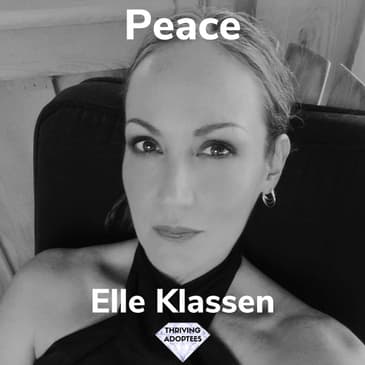
Does the term healing resonate with you? It doesn't for Canadian adoptee Elle. For her it's all about peace and feeling better. And being at peace with not knowing. Listen in as she shares how growing up with evangelical adoptive parents impacted her. And what's helped - and continues - to help her to peace.
Here's Elle's bio from the Adoption The Making Of Me podcast
Elle Klassen is a Canadian who was born to a young woman of nineteen years of age in 1970. She was relinquished and then placed with her adoptive family when she was five days old. She grew up in a very conservative Canadian evangelical family where adoption was spoken of as God's plan. Much of her religious background didn't sit well with her, including the narrative around adoption. As an adopted person whose big goal in life was to fly under the radar as much as she could, she never challenged the common narrative surrounding adoption that she grew up with. Several years ago she did a DNA test on a whim & with a hint of morbid curiosity. She wanted to know if her adoption information had been falsified as so many others in the baby scoop had been. As a result, she was reunited with her first family on both her maternal, and paternal sides. Digging for truth led to seeing relinquishment, and adoption as complicated, traumatic events in a child's life. The repercussions of this reach into adulthood, and can never be fully dealt with until it is seen for what it is whether someone has had a "good" adoption or not. Truthful conversations about adoption have become her passion. She now co-hosts the podcast "Pulled by the Root" to help facilitate the conversation about relinquishment & adoption, showcasing the voices of those adopted people, and first parents, who have been previously silenced in favor of perpetuating the idea that adoption is not a trauma or a system of belief that should not be challenged.
https://www.facebook.com/luana.klassen
Guests and the host are not (unless mentioned) licensed pscyho-therapists and speak from their own opinion only. Seek qualified advice if you need help.
Want to learn more about thriving for you, your kids, your families or your colleagues? Pick a time to talk here
[00:00:03] Hello everybody, welcome to another episode of Thriving Adoptees Projects. Today I'm delighted to be joined by Elle Klassen, looking forward to our conversation today Elle. Yeah me too, thank you for having me Simon.
[00:00:16] Delighted, delighted. Now keen listeners that are up on the detail may have noticed that I sometimes ask these days Does the start by asking does the word healing resonate with you? And the reason that I do not do that is because of you Elle, you know that right?
[00:00:36] It's because healing does not resonate with Elle and you've got some pretty good reasons for that. Right, right. I think I do. Yes you do. So please shout because it might resonate with one of the listeners.
[00:00:58] Right, well and I have had conversations with others in our community where it doesn't quite resonate either. But we all want to feel better in our situations. You know a lot of people don't resonate with the terms coming out of the fog either or
[00:01:26] I can't think of any others right now but there are some other things or even how we refer to biological family or whether we say biological mom or first mom. But I think it's because until very recently we haven't as adoptees had much of a voice.
[00:01:49] And so you use the terminology that is maybe appropriate for now or it's the best we've got at the moment. Right, but as we listen to each other's stories sometimes we're thinking oh okay that makes sense but I'm not quite in that space.
[00:02:11] So for me that word healing is too mixed up with growing up born again and growing up in that really high control evangelical religion and which I for me feels really culty now because it's very high control and it's very insular
[00:02:32] and I grew up as a pastor's kid as well so I was literally in the church all the time. And so yeah that word healing feels like there is an absolute end goal that you can get to
[00:02:56] where everything will be all better and there will be no problems from then on in and if you don't get there that's your fault. That's somehow on you and if I just take that religious road it's on you because you haven't trusted God enough.
[00:03:20] You have maybe sin in your life that's not dealt with. You are not moldable enough. You're not with the term. I've been out of it so long now that I'm starting to lose some of the terminology which I'm kind of glad about. Yeah, that's a good thing.
[00:03:42] But it also makes it sometimes hard to recall well is that again teachable is one of them soft and malleable to the Lord's leading. Are you open to the voice of God? Right, yes. Did you just ask me that?
[00:04:07] I'm just thinking about we sometimes get Jehovah's Witnesses once every 18 you know you get them knocking on the door. They have the kind of slightly taunting words sometimes because they're trying to disrupt aren't they?
[00:04:27] And I'm also thinking about people Roman is coming to our office once about 20 years ago and wanting to go and come into our offices and disrupt the staff and sell them lucky header. Right. And I said, I'm sorry they're all busy. They haven't got time for your stuff.
[00:04:59] And she threw some put down at me like you know well God be with you or something you know like you know but it was there was a barb to it. There was a barb to it.
[00:05:15] It was like oh well yeah you're not miss it's not the header you're missing out on it's salvation. Yeah, but you're an ignorant and worth obsessed idiot. But I'm just going to try and put you in my place in your place.
[00:05:31] But really it's my defense mechanism for being rejected from a workplace. But that's what they do. They try people try and put it on us you know we're not open to that. We're not open to that. That's right.
[00:05:50] You're closed off and growing up born again rebellious then you know your heart is hard. Right. Yeah. That's the opposite of the man. That's the opposite. Yeah, exactly. So you're you've hardened your heart off to the true leading of the spirit all this sort of stuff.
[00:06:18] But the point is that there is an answer. There is a definite answer. My the mother I grew up with she was very well part of evangelicalism too it's in the name right you're supposed to proselytize.
[00:06:37] That's the point and many are well meaning I have to say this many are well meaning because they so think that there is a black and white that they're that this is the truth and everything else isn't it.
[00:06:51] And they are literally concerned that people are going to an actual literal hell forever right so the well meaning this is that they they don't want you to think about it. They don't want you there to end up there. Right.
[00:07:10] And so the proselytization, but she would often use the mean by selling. Do you mean selling the message by pro proselytizing well by witnessing right and trying to bring people into, you know, have a conversion moment where then you give your, your heart your life over to.
[00:07:34] God. Yeah, and you're trying to that's right. Yes Jesus into your heart now you're saved in your end. Yeah, a friend the other day called it fire insurance which I grew up calling it too.
[00:07:48] What should crack me up. I was like, oh yeah, I know that term. Yeah, fire insurance. Also, also there's a sort of a, what would I say there's sort of you know as children, maybe.
[00:08:02] Because you don't quite understand, you know, there would be eventually a cut off date where you become responsible for for being able to know and understand right.
[00:08:11] And I heard somebody a while call that when you become hellageable, which kind of cracked me up, you know, so there's this cut off point where all of a sudden you're old enough to understand and, you know, now if you don't ask Jesus into your heart
[00:08:28] you're going to be in hell later. The metaphor that was coming to my mind ties in with what you just said actually, it's like a monopoly metaphor and it's called the get out of hell card.
[00:08:46] Right. Yeah. Absolutely. Yeah, you got your card you're in. Uh huh. Yeah. Totally. But she would always ask people, do you have assurance of salvation? So this, this one and done deal where you can know at the end of your life you will go to heaven.
[00:09:10] Because that's as literal a place as hell. Right. So assurance so everything is about knowing everything for sure. And yet Simon, I can tell you right now. I've never met so many insecure people in my life. Yeah.
[00:09:32] Because well partly because if some is good more must be better like who's rules that right so Christianity is pretty broad.
[00:09:45] You've got Catholicism and within Catholicism that's Jesuits and Franciscans and Carmelites and you know like and they all sort of have a different seemingly I don't really know Catholicism but they all seemingly have a different bit of a point of view.
[00:10:01] And in Protestantism you have that evangelical thing you have very charismatic you have possibly I don't know what would Eastern Orthodox is that more Catholic or what I don't know but who's got it who's who's right. Yeah.
[00:10:19] So in order to be certain you have to keep making up more rules. Yeah. And it's it's like, you know you talked about fire, fire insurance. Somebody, somebody selling fire insurance has to.
[00:10:41] And you know, has to dramatize it has to bring in some sort of jeopardy has to has to put you in a place of fear of something that you need the fire insurance to protect you from.
[00:10:57] So it's it's part of the game of convincing selling proscelot I can't even say the word proscelotizing but it's like. I'll let you say that bit. So it's part of that thing right they have to they have to introduce some insecurity.
[00:11:19] So probably the reason probably one of the reasons that they may be insecure on the inside is because they spend so much time trying to make other people feel insecure on the outside so that they will join the join the get out of the get out of health.
[00:11:41] Right. Well, you know the thing is we humans are meaning making machines right. We tell stories and Christianity is only one religion among thousands really and only one among thousands that have ever existed of traditions and mythologies and creation stories and because people will want to know why.
[00:12:08] Right we want to know why things are we want to know what when you think of old Greek mythology to like why is that big yellow thing up in the sky so scorching hot well it must be somebody riding across the sky every day to
[00:12:23] to share it right like we we come up with things to explain the unexplainable and to so that we can know and religion is one of those those forms of knowing and somehow trying to create a comfort in being able to
[00:12:46] and yet so often we end up from my perspective I just have to say this to everybody I get it it's my perspective so you know don't come for me but I
[00:13:02] I think so often when we want to just know we end up sometimes being more insecure because there are questions behind that now too. And I don't I just don't feel that we can ever really be settled in.
[00:13:23] Now I have it now I know all the truth now I got it I've arrived and I'm better and.
[00:13:35] That issue I have then with us as adoptees and all is like how can I find healing in whatever the situation is that I found myself in the insecurities the.
[00:13:47] You know we all have such different stories you didn't grow up religious from what I understand and I really did a lot of adoptees grew up in really religious homes because especially Christian I think because they love adoption.
[00:14:03] They even use some scripture verses completely out of context in order to support the idea of earthly adoption as opposed to heavenly adoption and.
[00:14:14] And there are as many stories that we have because there's you know that many of us and yet they're often these really ubiquitous experiences like sort of this underlying depression that we can't figure out. Why you know I have a nice life.
[00:14:37] Somebody might have a wonderful partner and kids or they've had a great career or whatever and yet there's always this.
[00:14:44] Depression or anxiety all these unexplainable things that we find out later often our trauma responses to having been separated we are mammals after all right we don't even separate puppies and kittens too early from their mothers and yet somehow with humans it's fine it's okay.
[00:15:03] And I'm not saying again that sometimes external care isn't needed but this idea that there will be nothing wrong. After that is absurd.
[00:15:17] And so we often have similar experiences and then to try to figure out why it happened and to have a reason for why it happened so that I can get to ultimate healing.
[00:15:29] I just I don't think that life is something that just gets on a trajectory and goes up until I find that healing spot where I have all my answers and now I'm better. I think it cycles around. And some days are better than others.
[00:15:50] You kid of pop culture I just think of inaccessible some days you kick some days you get kicked whatever some years you kick some years you get kicked but I think for me the idea of peace instead of healing.
[00:16:07] Has been much more helpful and peace in sometimes not knowing that sometimes shit happens. And one of the things that is. Was us being separated from biological family having things changed having secrets having gatekeepers why I mean.
[00:16:39] There are lots of reasons I don't think there's some ultimate power out there who did it on purpose to teach us a lesson like what do you what are you teaching baby like that's that's bullshit you know like. But this is where we are. So now what. Yeah.
[00:17:00] I was thinking about as you said you know meaning making machines. And we're also meaning seeking machine don't we. Yes yeah. You know like like like a heat seeking missile right yeah yeah absolutely we're seeking to know why yeah and and as you were talking you know the.
[00:17:28] Answer to the question will give us peace. Is that kind of myth I think. The bit that comes to you know it the bit that comes to me I'm just trying to think about whether I can make it into a peace thing. Yeah. If we're if we're always.
[00:17:51] If we're at peace with not being at peace. Always at peace. Yeah exactly. Exactly.
[00:18:04] I love listening to or reading different philosophers and I don't have a great wrote memory but I remember concepts and ideas right so I can't ever necessarily say well this this motive thinking was Emmanuel Kant or whatever but I you know these different. Things but there's this.
[00:18:29] He's a philosopher modern philosophers name is Peter Rollins he's Irish and. He he does come from a Christian sort of perspective but his is very different and he he talks about often. Peace in that on knowing that when you are able to.
[00:18:58] Be okay in the lack in the sort of area that I can't possibly know everything that's when you can relax. Because it's impossible to know everything to get every answer to have everything explained to you and when you can be at peace in that.
[00:19:20] That also opens you up to learning. Because you're coming at things with curiosity and you're coming at things with an open mind. Rather than coming at everything with one perspective and with one.
[00:19:45] With one way of thinking that already is going to direct what you're open to sort of that confirmation bias instead of. The learning of oh well that's an excellent point actually. That keeps you expansive and. He often in the things I've listened to will.
[00:20:11] Comment about alberca new and alberca new the idea of the rebel which. I had it written down here where is that the rebel lives in tension between the life that is.
[00:20:30] Lived and the life that is on lived yet and to live in that tension rather than feeling that you need to have all the answers in order to. Finally be healed. Yeah I'm as you were talking you I love the in excess reference and you know what.
[00:20:55] Yeah what what what a great loss that was that guy you seen the documentary about. Michael Hutchins yeah. What a lot what a lot yeah and I was thinking about somebody around that time it was that there was the Madonna film desperately seeking Susan. Yes.
[00:21:13] You know I was desperately seeking desperately seeking answers. Yes you know like I can't rest and I have this answer until I. Right why and you know and obviously for it for his adoptees what why I was relinquished. I I what one of the biggest moments of my.
[00:21:43] Peace healing whatever I thought it was. Feeling viscerally feeling the. The pressure. My birth mother was under I mean I could I could reading this letter from her to the adoption social worker I could feel the power imbalance. I could feel that I could feel the desperation.
[00:22:13] I could feel the desperation and how much free will. Involved there.
[00:22:22] Yeah you know I don't I don't know how much free will was involved there but I but I can I can tell that there was a there was a lot of desperation going on and my guess would be influenced a lot of influence influence was being brought to bear.
[00:22:41] Yeah a lot of coercion. Yeah and there's. You know when you talk about the evangelical peace I think. You know really just have religion has had a lot of involvement in. The churches have a lot of involvement in. In adoption. Yes.
[00:23:05] And you talked about Peter Rawlings being an Irishman. One of the things I think about that is. You can't you can't buy a kid in the UK. Right excellent. You can buy a kid in America so was that was that.
[00:23:27] How much of that coercion and how much of that. Migration of adoptees from Ireland to the US you know this. Yeah yeah you just with the Magdalen laundries and things like that. And my I found out that my. My. My. My.
[00:23:55] Birth father and or his siblings were involved in one of those. In Liverpool right which is that's that's England that's it's pretty it's not very far from Liverpool to Liverpool and Dublin you know like trading ports ports hubs you know very close to one another.
[00:24:14] Very scorn across all the time but yeah I didn't know I'd heard about those laundries in Ireland but I'd never heard about them. In the UK but they were in 60s. Sure. Well because for the church whether it is.
[00:24:34] I mean I don't know if this was in the UK and Ireland.
[00:24:39] But the Salvation Army which is Protestant also had mother baby homes you know so it wasn't just Catholic like Magdalen laundries and things but what what is behind a lot of that is this idea that that is the mother's redemption to you know she got herself pregnant so first
[00:24:59] that's amazing. How many immaculate conceptions have been. But she was fallen she got herself pregnant so she's slutty right so this relinquishing of her child redeems her by giving the child a proper better life. Which makes her feel really great right that she's not even.
[00:25:28] Okay enough to be a mother she's she's not mother material. But also it's our redemption because we're bastards. Right so if we go to a nice home and back in the day it was a two parent heterosexual you know a home.
[00:25:49] Dad nice middle class hopefully upstanding citizens conservative and I don't mean politically conservative conservative but just you know they all fit in nicely into their neighborhood. And that is also our redemption.
[00:26:05] And that is the part of religion that I grew up with as well so they will reference in the tradition I grew up in I don't know any other Christian tradition what they say but in the one I grew up in.
[00:26:20] And I reference Paul's verses about how being adopted into God's family by asking Jesus to take control of your life is makes us joint heirs with Jesus so that we go to heaven and we're you know joint heirs is like.
[00:26:40] And that's the reason why we're called the earthly adoption. But now you have set up adopting parents as little godlets really which is idolatry actually but but the thing was always that our earthly adoption was an example of what God does for us spiritually.
[00:27:07] And I think I'm going to be adopted in my head. I'm thinking how much redeeming did I need. I was a baby.
[00:27:18] Right and when you think of why they say we need to be adopted into God's family we need that redemption is because God can't stand sin he can't stand the imperfect he can't be anywhere near it.
[00:27:36] And we need to be made right through Jesus sacrifice on the cross so that we can actually be in the presence of God. Well as a human like what is fallen what is so I'm fallen.
[00:27:56] I'm imperfect I need redeeming I need to be made pure I need like so my adopting family that's what they're doing for me because I'm that shitty. Now I don't know if everybody else took it in like that but I sure did.
[00:28:11] Yeah you know and that's not even what the verses mean. They are the verses they are the verses did you. Right right you know there's some like. Adopted transubstantiation happening where all of a sudden my DNA has turned into theirs miraculously I don't know like.
[00:28:39] So let's go back let's get back to peace. Yes back to peace because we could go down that route and you're far brighter than me on that stuff.
[00:28:50] So what's brought what I can't follow up I can't even say I can't even say idolatry or prosolatizing whether and what has what has brought you peace. Well it comes and goes.
[00:29:08] And I think that's the part where when I hear just like getting to healing that that is kind of I don't love the word triggering but if I guess it sort of activates something in me because I don't. Feel like I'm at peace all the time.
[00:29:26] It comes and goes it depends on maybe a new piece of information I've learned or not or. Another interaction that I've had with somebody that was activating. What brings me peace though. In those moments or coming out of them. Is the fact that I don't.
[00:29:52] Need to know and. I'm going to get this not quite right I know it but I saw a little.
[00:30:05] I guess somebody had made a meme you know out of it and it was on social media and it was about how a lot of in sort of indigenous cultures that are. Pagan pagan just means of the earth like you know so I don't mean pagan and from.
[00:30:27] You know how Christians would use that word but just. You know that's right it's like Celtic spirituality to like that that like it's of the earth right you have the cycles of the earth. Anyway that a lot of those sort of cultures.
[00:30:43] Have this idea that we're just a part of the world like everything else is a part of the world the insects the dogs the. The birds all the creature creatures and trees and things we're just a part of that.
[00:30:58] And so when I think of myself is just a part of that and I can enjoy the sunset and I can join how hot it's going to get today outside and.
[00:31:10] And that that summer and our summer is short and then it will turn to autumn and it's just part of these cycles that I can enjoy in moments. That is what's peaceful to me so there's a there's a lack of resistance there's an opening.
[00:31:30] Yeah so to just be in the moment rather than hearkening back all the time or trying to figure out where I'm going all the time. If I can just be in a moment. Whatever that moment is. That is a peaceful place.
[00:31:54] Because there's a lot of chaos going on all the time that I can't stop and that I can't have answers for. And there's a oneness right so part of the right yeah. Right yeah. Have you heard of a guy called Romana Maharshi good of him.
[00:32:15] I have that name sounds familiar but I don't think this is what I'm going to attribute this quote or attribute this quote to him. But it's so it's a problem an Eastern. Bloke. He said. My secret is I don't mind what happens. Mm hmm.
[00:32:41] Yeah, that's very that's very much it yeah absolutely but I think it also like Camrys rebel.
[00:32:51] Also puts you in a space where that I mean that's perfect right like you don't have to know but it puts you in the perfect space which I think a lot of adoptees are in.
[00:33:07] We find ourselves in the perfect space to be at peace in those moments, but also able to still fight for change. What did I have room down here.
[00:33:27] Fighting for change and enjoying the fight to make things better while we still live in the beauty and pleasure of the moment as opposed to being angry in the fight. Right. Now there are always people who will say you sound angry I'm like do I am.
[00:33:48] I'm actually not but I am pointing things out and if that makes you think I'm angry that sounds more like a new problem to quote my daughter right that's something you problem like if if you're taking it that personally I'm just pointing out the absurd.
[00:34:05] Yeah, so the red, you know what's wrong like it's wrong to pay money for babies like come on. But it's also wrong to separate children from biological family to the point of changing birth certificates which still happens in the UK. Right.
[00:34:28] The ending Canada there might not be a lot of buying and selling going on in private companies, but that's still wrong.
[00:34:38] And it's absurd like when you think about it so you change my birth certificate as if I'm now from this family tree, but that family tree is not actually continuing it's absurd my it's mine. That's continuing it's still my line it's still the fallen line.
[00:35:00] So called that's continuing it's not this this German one. It's this Russian Scottish one like so if you think I'm angry I. Okay. But that said, anger is a normal response to abnormal situations and it's okay to be angry for a bit. But building it inside creates disease.
[00:35:35] Yes, I when when I get onto this subject. I only have really one hand on this that just seems really correct right like this things like it is spot on.
[00:35:57] And it's not my it's somebody else's handhold right so a Brit adoptee, I could go into all her backstory that doesn't matter right. And then there's a person who's a British adoptee who does advocacy work in the legislation right legislation space.
[00:36:18] What she said to me is, if I show any anger in front of politicians. I get moved out of the room. That is that is the only thing that I'm talking about. I'm thinking about you know does does our does my state of mind.
[00:36:42] Does it help me on my state of my state of heart right. It does my state of heart. Does that support me in getting to where getting the change I want to change to happen. Right.
[00:36:57] And if and I will, if I was doing that, I have chosen not to go down the advocacy legislation space right it's not the space that I feel. Oh, I was going to I was going to put some really religious language on there. Oh do it do it.
[00:37:16] But I'm not religious at all you know I was kind of brought up a little bit religious but you know just. You know, I don't think do I want to spend a lot of time with. Do I want to spend a lot of time with politicians.
[00:37:33] No, do I want to spend a lot of time with lawyers. No, no, you know, so I don't want to do that right what interested what interests me is being at peace or healing or feeling better you know you said feeling about it right so I want to.
[00:37:50] You know we don't want to think that I want to feel that. And so I don't, but when I when I'm whenever the topic of anger and advocacy comes up. I make that connection because that is a learned experience of another adoptee.
[00:38:08] And I think it's I think it's sage advice. Absolutely. Absolutely. And I will change. I will change my demeanor to get what I want. Now, you know people say well, I'm a chameleon and that's a bad thing.
[00:38:27] Well, sometimes being a chameleon is a good thing because it helps you get what you want. Sometimes if you feel that you're, you know, you're going against everything that feels sacred. Everything you go against everything that feels authentic to you.
[00:38:43] Yes, of course, you know, like chameleons, you know chameleons change color to stay alive. Yeah. So, you know, it's not we live in a world of oversimplification. Oh, absolutely. And perhaps that's brilliantly put because perhaps that is why the idea of just healing or justice
[00:39:11] or, you know, like slotting things in is so activating for me because that isn't easy. It's not easy to get to these points, but just to have that answer and it's done.
[00:39:27] But I think we, your friend who is in that advocacy space, of course they have to reign that sort of show of emotion. And also it's a woman, right? Yeah.
[00:39:47] So, I mean there's the added sort of bonus of being a woman in a space that is mostly male often and the moment we as women have heightened emotion, you're being hysterical, right? That now gets into sort of the patriarchal view of things.
[00:40:05] And so she's very dismissible because she's just an angry shrieky woman who should get some therapy, right? So there's the added bonus there. This is the UK, right? So she should get some friends. We wouldn't say that. Right. That's right.
[00:40:22] If you go to a therapist, you're a weirdo. Haven't got any friends. Okay. This is the British way. Okay, fair enough. The British way, yes. Didn't do any harm. She's going to the club instead with her friends.
[00:40:36] I was beaten up within an inch of my life every day of my school, of my eight years at Teton. That's right. Did you get any harm? What are you saying? That's right. Fine. I'm fine. That's so funny. Oh God. Keep calm. Carry on.
[00:40:58] But I think we do need to use those chameleon aspects. You know, we learn them as children. Again, it's not exclusive to an adoptee's experience. And yet it is very ubiquitous that we talk about.
[00:41:14] And I think it is heightened because we truly are square pegs in round holes. And so if somebody in their biological family feels like they don't quite fit, well imagine not being related at all. Right? So it just heightens the experience. It's not exclusive. It's heightened.
[00:41:35] And I think we do learn how to do that sort of thing. And on the one side, people could say, like you were saying, you're a chameleon. And then they go down the negative side of, well that's manipulative and blah, blah, blah.
[00:41:52] And I'm like, actually no, it's survival. Right? But also it enables us, and this is where we get to the rebel again. Right? Like your friends are rebel because the only thing that would make one get involved
[00:42:09] in advocacy is a certain level of dis-ease and anger to a certain point that these things are wrong and this needs to change. That is a different thing though from being an angry person. There's sort of that idea of back to religion of righteous anger, right?
[00:42:36] And I imagine I often have the mental image of Jesus in the temple flipping tables, losing his temper. And everybody backs that one. Well yeah, because people are being idiots, right? So he's mad. He's flipping tables. That sort of righteous anger drives that sort of advocacy work.
[00:43:02] But you don't storm the bestie you've made, like in anger because you're going to get thrown out. So there is a tension there that you have to live in which is Camus Rebel where you're living in that. That's right. That's right. Yeah.
[00:43:26] Which that sounds like a you problem. And so I think she's 24. But she was saying that when she was 16. Who's she got that from? Her, yeah, I don't know either. She's an anomaly.
[00:43:46] But when we live in these spaces where we're able to sort of hold it back a little bit and find that peaceful space for ourselves where we can rest, even though there's a lot of chaos, a lot of the time. But that is also maturity. Right?
[00:44:13] Like your friend is bringing maturity into that space rather than just blowing in like an angry 15 year old who's trying to make space for themselves. There's a time and place for that parliament. Not not so much. Right.
[00:44:31] Like that would be the same here if I were to fly down to Ottawa and walk into Parliament and let somebody have it. I would also be escorted out.
[00:44:46] Yeah, well, let's not go anywhere near American politics in terms of no, no, we're just going to stay in the Commonwealth here. A bit of a sideways question, but help that just me and my wife haven't got any kids, right?
[00:45:06] So I am thinking about meaning and, you know, like focus and self self centered and otherness, you know, focusing on others. And I'm wondering how, you know, caring having your daughter. And I wonder how that impacted your peace meaning. Let's see. We'll back up a little bit.
[00:45:43] I, um, I sorry, you're probably going to have to like get rid of these pauses because now I'm thinking real hard. I never felt pro like part of my family. I know that a lot of adoptees will have the real both and of I did feel loved.
[00:46:12] I did feel supported and I still felt like I didn't quite fit and I wasn't sure of myself. So that it's a real both and I think that is a complicated space in which to live.
[00:46:25] And I also think it's one that people often don't understand that things are not so binary binary as either or black or white all the time. It is a both and you can love your family and still feel like you want to know where you came from, right?
[00:46:42] I never really felt like I fit at all.
[00:46:46] And because it was also so controlling and I was not always very malleable, you know, I would fight and then I would feel bad for fighting because my religious upbringing taught me that I was supposed to respect my elders or like honor your parents.
[00:47:08] And so I would try to rein it in but it was so discordant that I would end up fighting again. So it was just this constant thing.
[00:47:17] And so I was never one of those girls who thought, oh, when I get married and all the children, I wasn't that but I had a big sense that I would like to have a family because I didn't feel like I had a family.
[00:47:32] And at that point, I didn't know that I could do a search. I didn't know that that was allowed and they found that out like maybe when I was 19 or 20. And back then you had to pay right. So anyway, got married young because that's also a religious thing.
[00:47:52] You know, you don't just move in with your boyfriend or anything. We got married very young. We had our first child when I was 26. It was a boy and then when I was 30, we had our twins a boy and a girl.
[00:48:05] And when I held that first our first son and he was a dead ringer for my baby pictures. That was pretty mind blowing because I had never, of course, like all of us or most of us, I should say, I had never seen anyone who looked like me.
[00:48:33] And I didn't know that that would be a thing. You know, like I didn't know that that would affect me like that to look at my baby picture and his and think, oh my God, that's amazing.
[00:48:48] It was and then when we had our twins and the our son was first and you know, it's a boy and then she was born and the doctor said it's a redhead. Like that was pretty funny. And you know, having those little people.
[00:49:16] I have been an imperfect mother. I know this. And I also know now looking back some of the things that I did some of the ways that I reacted. The ways in which I interact it.
[00:49:34] I can see now that it was related to being an adopted person or relinquished an adopted person. And some of those things make me feel. That's a little bit of a knife in your heart.
[00:49:51] You know, like I wish I would have been out of the fog, let's say then. But I wasn't and everyone. Let's let's give the benefit of the doubt most people try their best and I tried my best.
[00:50:13] But what I did know was that I wanted them each to be their own selves, which I have never felt like I've ever been able to be. I don't even know now and I'm kind of at peace with this now back to the peace thing.
[00:50:32] As I try to just be me, whatever that is. I wanted them to actually really be. And if that meant they were pursuing sports or art or music or physics, although that one would be a long shot.
[00:50:53] But that they could do that because that is not how I was raised. I wanted their actual, you know, nature cells, not nurture cells. I wanted to nurture their nature. Yeah. And that wasn't done for me, but that was very high on my list to nurture their nature.
[00:51:28] Does that answer your question? It does. It's a beautiful thing. Yeah, and our oldest is 27. The twins are 24. And they're pretty cool people. They're cheeky. Let's go with a cool lump. Yeah. Yeah, but I'll go with that. I'll take it. Yeah. Yeah.
[00:52:02] We all find it tough that compliments stuff. Yeah, yeah. Yeah, it is hard. And that is a funny other common experience for us. Again, not exclusive to adoptees but heightened by adoption, I think. Is there anything that you'd like to share that I've not asked you about?
[00:52:30] Oh, goodness. I think maybe if we could just all cut each other slack, you know, sometimes in the adoptee space, I see people say, well, this person still seems so angry even amongst ourselves, right?
[00:52:59] This person still seems really angry or I don't like the term fog or, you know, we do this to each other even, even though we all know how complicated this journey is. And people are on their own trajectory. It takes as long as it takes.
[00:53:28] So somebody seems to sort of be an angry person and it seems like they've been there for a bit. Well, who am I to know what's happening in their head or their heart and how long they need to sit in that space?
[00:53:45] Or if somebody uses a different term other than fog, okay. It's all right. Like how about we just sit back, take a breath and cut each other slack because I think so often we haven't cut our own self slack.
[00:54:06] Because we felt like we need to try to fit or then we feel shitty for not fitting or, you know, we feel guilty for searching because now we've made our adopting mom feel bad or so, you know, all these different things.
[00:54:20] We need to cut each other and ourselves some slack and not get picky about the words we use, but also be aware of the words that we use, you know,
[00:54:35] like if we know that who we're speaking to has a hard time with, you know, fill in the blank because we have a relationship with them. Well, okay, I can see that and I will try to be careful for you because I care.
[00:55:03] But also let's be aware that we're all doing our best. We're trying. Yeah, that's all we can do, right? Yeah. Thanks. Oh, thank you, Simon. Thank you, this is we'll speak to you again very soon. Okay.