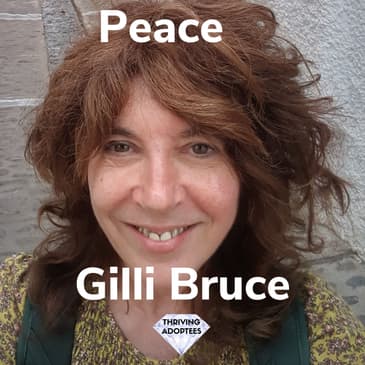
Peace. Isn't that what all want? Or maybe just a bit more peace would be nice. A bit more well, peaceful. Triggered less of the time. Trigger for shorter periods of time. How do we find peace when our nervous systems have been shot to pieces? When we are constantly hyped up and hyper-vigilant. Adoptee and therapist Gill shares 25 years of learnings and what's really worked for her.
https://www.facebook.com/gilli.bruce
https://www.lara-leon.com/first-retreat-for-adopted-adults-june-2023/
https://howtobeadopted.com/blog/2021/study-into-lifelong-impacts-of-adoption-by-gillian-bruce
Guests and the host are not (unless mentioned) licensed pscyho-therapists and speak from their own opinion only. Seek qualified advice if you need help.
Want to learn more about thriving for you, your kids, your families or your colleagues? Pick a time to talk here
[00:00:00] Hello everybody, welcome to another episode of the Threibing of Doctories podcast.
[00:00:05] Today I'm delighted to be joined by Gilly.
[00:00:08] That's Gilly with the G, Gilly Bruce, a Doctorie and Therapist and a fellow Brit.
[00:00:14] You know, like we don't know how many Brits on the show.
[00:00:16] It's all time to be Americans and Canadians.
[00:00:18] So here we are, nice to see you Gilly looking forward to our conversation today.
[00:00:23] Yay!
[00:00:24] Hello everybody. You know, I used to do work that frightened the life out of me, to go and do massive presentations around the world and, you know, speak. And it was just terrifying, but I did it anyway, because a generalised was my normal. And it felt alive. So now not needing to be a generalised, being able to become and chilled is just a relief.
[00:01:43] Yeah.
[00:01:44] So that's a big clue that I'm different now. that it doesn't serve me well at all, didn't ever get any sleep. And finding having a finding some peace through various practices, really enjoying it and go, Oh, this is what stillness is like. Oh, how lovely I can just sit and relax and read a book, you know, not needing to be up and doing. Yeah. Did you think it was going to be boring?
[00:03:04] I think so. I think I dreaded it would be boring. I'd be like, Bridget the fidget, you know, twitting around. But then eventually starting to have moments of peace and going, oh, this isn't a nice, whoo, you know, and realising that I needed to expand that.
[00:05:25] system that's shot to bits, you know, it's going to kick off. But now there's an ability to, A, recognise what's going on, acknowledge it and sit with it and sort it, rather than let it run
[00:05:32] and muck for a day, you know. Just one that. That works. I love playing with the metaphors and extending the metaphors.
[00:07:03] Yes.
[00:07:04] You know what I mean?
[00:07:05] Because everybody goes by triggered.
[00:07:07] Yes. There was abandonment fear, there was rejection fear, there was other stuff going on that I was just, for me the fog is denial. Yeah. That's how I describe it. Yeah. Yeah. So what's helped you to this healing, to you've mentioned practices and meditation.
[00:08:23] Got you.
[00:08:24] The flexions.
[00:08:25] What's helped you to this more conscious ability you know, why do I have to feel sick, you know, about speaking my truth? And then, so it starts with that awareness piece. And then going on assertiveness training started to do that. And then why is this so hard? And various works, obviously, work actually. I was really fortunate to work with an organization that did lots of personal development training.
[00:09:42] So we got a lot free from work.
[00:09:44] Yeah.
[00:09:45] Layers of denial came away. The first one of the first things he said to me was, so okay, so you're adopted and you found your birth family and you're feeling different. Look, correct. And it was kind of like permission to accept that. You know, that actually the damage to the nervous system was done. And that whilst finding the birth family was lovely,
[00:11:00] actually, they've had a very successful reunion
[00:11:04] that I'm happy to report.
[00:11:05] It didn't take away the reactivity and the patterns to when I find them it'll be all okay. But then you've got all those neurological pathways of built-in, you've got 46 years of habit-built-in and a nervous system that's shot to bits, which doesn't alter just'll all be okay. Yeah. One of my fascinating questions is how does this life for any trauma, Colossum, where the bridges are that join right brain to left brain. That isn't fully developed to you, 12. So we can't have made that logical move of I was abandoned and I, that was terrifying
[00:15:01] in a trauma.
[00:15:02] And therefore I must be been a queue. Five or ten minutes later a passerby finds me climbing out the window screaming blue murder. They've left me, they've left me. And I remember distinctly thinking, they've left me. This is it. They've left me and they've gone to France and they've left me. And being utterly convinced, this is it. This is the time I've been abandoned.
[00:16:20] And that trauma reaction was a full blown meltdown panic attack in a five year old. thinking going on there. Yes, you've got to be, you know, there's a sensation or an emotion or a body held, you know, terror that somehow the left brain's going to try and make logic of. But that doesn't really come online to you about five. You know, when we're, when we're small, when we're infants, all we've got mostly is right side. This is much slower to develop the left side.
[00:18:44] viewed, I can't remember now, it's 20 or 30 million times. Fantastic.
[00:18:45] And it's left there, it's left brain versus right brain.
[00:18:50] Yeah, it's not.
[00:18:51] Deep into stuff that you're talking about.
[00:18:54] She's a neuroanatomist and neuroscientist.
[00:18:57] She had a stroke.
[00:18:59] And she had a left-run brain stroke, so she lost.
[00:19:04] She lost all her emotional baggage.
[00:19:06] Oh, crumbs. was the laundry. They used to have high rails with all these clothes wrapped in plastic sheets with a pole where they unhooked the high ones because they couldn't reach them. And I had this image of your parents going into a dry cleanness and looking at all the babies in plastic covers and pointing to me and somebody lifting it down with a pole
[00:20:21] and going, this one, this is the only one knew it was mine, you know. We look for signs and then we make it turn them into facts. Oh, yes, you see, I knew. You know, like me and the car at five, yes, that's it. The gods of France, they've left me. I knew this had happened, you know. And they were just in the Kufus and Port Chopped
[00:21:40] in the butcher shop.
[00:21:42] LAUGHTER
[00:21:43] So, how do we see through our...
[00:22:47] is to challenge their perspective. Yeah, and well, to look at limiting beliefs and look at challenging those cause and effect that, you know, well, that must equal that really, does it?
[00:22:53] And one of the gifts for me was going through my counselling training,
[00:22:58] you know, because I did integrative therapy, which looks at all sorts of,
[00:23:03] what do they call it, transactional analysisth of December and bring a load of presents. And we firmly believed it. And then when you got to 7 or 8, you kind of went, really? But we haven't got a chimney and where does the sleigh park? And you start to have doubt, don't you? And then by the time you're 10, you've got some new information, you don't believe at all. So yeah, I agree. I think belief's a much easier to bust than
[00:24:24] a sense of trauma.
[00:25:21] but I needed to hear which was, and we will never give you away no matter what.
[00:25:24] So I just went round with this note,
[00:25:26] didn't it, and it would be a bloody minute?
[00:25:28] You know, nothing solid here.
[00:25:30] Well, presumably the,
[00:25:36] the emotional,
[00:25:40] the fear,
[00:25:42] would have obliterated that thought,
[00:25:45] I'd anyway, wouldn't it?
[00:25:46] I mean, you're talking about the pork chop instrument, right? Yeah, every time. Every time. Yeah. That's the benefit of a nervous system, isn't it? Yeah. But I think personally for me, the best thing I've come across that has escalated my
[00:27:00] recovery, no end, is internal family systems. That piece of work is just fantastic. I've had more success and more results with that than anything else. Brilliant. Richard Swartz, no bad parts, best book on planet. So what does that title mean to you? It's almost the flow state, you know, it's almost that beautiful flow state, just clarity and loving and, you know, we're all one, you know, back to that oneness thing and really, yeah, coming from a very wise and loving place, there's
[00:29:43] not to reactive. It's certainly not a tax and cry for help and submitting collapse. And, you know, points I think I've acknowledged all of those running. So Janina Fisher's work is incredible on trauma
[00:31:01] and how those parts live within us,
[00:31:03] how a fight part doesn't necessarily mean
[00:31:06] I'm gonna go and punch somebody.
[00:31:07] It just means I might get angry or resentful Traneal sacral therapy, which is body base, that's lovely. I, you know, I had to identify where my little tiny baby was in my body. It was tucked under my right hip. So yeah, a lot I've done so much and I've spent God knows how much money on recovery. God knows, thousands and thousands and thousands, far too much.
[00:32:23] And we should be getting this on the National Health Service. You know, oh, I've got to go, I've got to go, run. You know, and I was literally propelled out the door and never knew what it was. It was the flight response. It felt as a pent up impulse. It wasn't a thought, didn't it? It was at the head base. It didn't make me say, oh, need to go for a run now. It was, you know, if there was potential conflict in the house,
[00:33:41] it would be, right, I need to go and run.
[00:33:43] Of course, what that is, it's right.
[00:33:46] You know, I'd have all my healing since then. I'd found my birth family, but I didn't start doing the healing. So my birth parents were dead. It's time to adopt if parents were dead. So that was a big one for me. I think denial, you know, denying that I need any help and the spiritual side step. You know, not understanding that understanding the nervous system stuff, not understanding how that all works. I think there's a lot I've done a lot in my healing journey. And I would love to be able to condense that right down for other adoptees in the future and it could just go just go do all this, do it earlier, do it quicker.
[00:36:22] Crack on, do it.
[00:36:27] Yeah, don't wait to leave differentiate but then a listen. Right. I think when I was younger I went to meditation classes not so much to grow myself as just to zone out. So I went to meditation classes
[00:37:41] I went to Buddhist classes but it help you? Did the feel actually there's more to
[00:40:20] life than just this.
[00:40:23] You know, yes, being adopted is difficult.
[00:40:25] Yes, it's a touch-based thing. And Havening is a trauma soothing modality that they do with returning military personnel. So when the army or the Navy are repatriated into the UK, they come in via the northeast coast by a hall and teams go up and do Havening with them
[00:41:43] if they've done combat. And it's about system somehow. Yeah. And I was just crying, crying, crying. And I think that was letting go of the grief. Because I did some, yeah, wow, so long time ago. Yeah, 24 years ago. I did some, I did some Reiki.
[00:43:02] I want to see this woman once.
[00:43:05] So I tried to teach a couple of different people. And there's a website for that. You can Google T-R-E. What's the company called now? Just a minute. TraumaPrevention.com. TraumaPrevention.com. Dr David Bachelli. Too light to prevent it mate. Yeah, it happened to you. She's in a wetsuit. I'm in swimming shorts, bored shorts, no budgie smugglers for this boy. And we were in a tank, like a swimming pool, but it was. And he said, and it wasn't adoption specific, I think, enough. He said Okay. So when I got my adoption file, eight years after the volcano of coming out of the fog, basically. Yeah. A bat that was instigated by this tellyback. I got my adoption file,
[00:48:24] an in the adoption file, there's a letter. once right yes I remember I thought for 20 seconds. It was a symbol at a deeper and deeper level. There's always further to go. There's always further to go. It's not the Santa Claus belief is But I've been, you were talking about spiritual side step. I think some people call it spiritual bypass as well. Yes. And you talked about meditation to zone out.
[00:52:21] I never done any I completely agree. It's gold. And the title is, I think, we, you've talked about numbing, deduced numbing and stuffing. Yeah. So I think we numb, we stuff, we deny, well, it's not good.
[00:55:07] Well, it's really right to feel. As if it's not right. Yeah.
[00:56:20] But then the book title says, sounds very plausible, but it's the magic stuff there. Yeah. Does the heavy lifting stuff? Yeah, yeah, you're right. The sort of intangible, unwritable, loving the self, that beautiful place of sounds.
[00:57:41] There's just, yes.
[00:57:43] It's like, we get a his 5,000 calorie Christmas cake. You've got really cheap articles written by journalists to gorge on all these calories.
[00:59:01] Do the repair now.
[00:59:04] Yes.
[00:59:05] You've got to do the repair now. I think as a result of this, I have been able to have better relationships and be more authentic without fear and rejection. So I think some of the work, all that work, has not only brought me a more manageable
[01:00:20] nervous system, but also newspapers and the self, you know, most of the world is focused on the downstream kind of activities. You know, just get adopted and that's the end of the story, dear, but yeah. I came to, you talk about double trauma. I came to this idea a couple of weeks ago that I think trauma multiplies, right?
[01:03:02] Oh yeah.
[01:03:03] So if you put the relinquishment trauma
[01:04:02] Finally, we've got rid of Offstead. So this is the law about who can offer therapy to adults adoptees.
[01:04:08] Yeah.
[01:04:10] Lifted on the 18th of December, finally.
[01:04:14] Not before time.
[01:04:15] Yeah.
[01:04:15] Thank you for your work on that.
[01:04:18] Oh, we weren't for letting it go.
[01:04:21] We badgered and badgered and badgered.
[01:04:23] Yeah.
[01:04:24] Yeah.
[01:04:25] And after the discussion.
[01:04:26] I think we can be very persistent. doggedly pursuing the cause of adoptees. So people can check Gilead in the show notes, so linked into a LinkedIn profile, Facebook, and do you want to tell people about their retreats that you run as well? Yeah, we do run in-person retreats, myself and
[01:05:42] McCallie Glare, who are adoptees in alliance,'s being adopted with our experiences, living with your birth family, living with your adoptive family, finding reunion, you know, having a dodgy nervous system. There's so much to it, you know, relationships, how it affects our relating to others, how it affects our whole life. So there'll be usually a mixture of some input,
[01:07:01] some sharing, some relaxation is stuff, Claire does a bit of, you know, relaxing nervous system