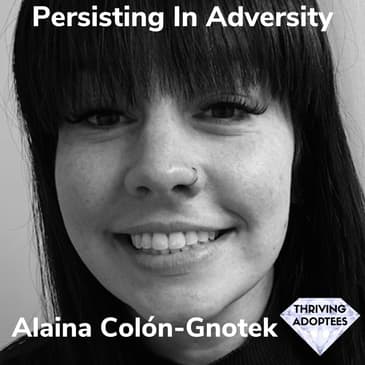
If you're in hell keep going. But how? Listen in as Adoption Permanency Director Alaina dives into digging deep, what empowers us to persist through the toughest of tough stuff and more...
Find out more about the company Alaina works for here:
https://www.facebook.com/EnnisCenter/#
Find out more about adoption support in Michigan here:
Listen to the podcast with Jaycie on secondary trauma herehttps://thriving-adoptees.simplecast.com/episodes/healing-for-them-jaycie-bias
Guests and the host are not (unless mentioned) licensed pscyho-therapists and speak from their own opinion only. Seek qualified advice if you need help.
Want to learn more about thriving for you, your kids, your families or your colleagues? Pick a time to talk here
[00:00:02] Hello everybody, welcome to another episode of Thriving Adoptees podcast. Today I'm delighted to be joined by Alaina. I'm sure I'm going to butcher this, how we say this surname, right? Alaina Colón-Gnotek. Perfect. Perfect. Wow. There we are. Thank you. I should remember Colón because it's a city in Germany I lived in for three months, right? So that bit should be okay. It was just the Gnotek.
[00:00:29] Yeah. That's what throws people off. That's what throws people. It's, listeners, if you, in case you're wondering, I guessed it as a Czech name, but it's actually Polish. Polish. It's Polish. Yes. So Alaina works at the Ennis Centre and so we're just going to dive in. What comes to mind when you hear this word thriving? We talk about it a lot, right? We've all got a different view of what that means. What does it mean for you, Alaina?
[00:00:58] For me, thriving means continuing to try even when you might not want to. So it's not something that is, you know, some magical word that everything's going great and all of our ducks are in a row.
[00:01:15] So to me, thriving is getting past the hard seasons of your life, of your day and continuing to show up even if you're, you know, your spirits might be low or you're having a hard time. It's really continuing to try for me. Yeah. So it's kind of related to persistence then or resilience? Yes. Yeah. Absolutely. Both of those.
[00:01:44] Resilience and yes. Yes. Um, it's, life is hard and you have to just keep trying and showing up and not everybody does that. Um, and I think especially in the adoption realm, um, persistence is really, really important to just, just to try and learn as you go and continue trying. Yeah. So what do you think, what do you think drives that persistence?
[00:02:14] I think it might be different for every person. Um, I think as an adoptive parent, a part of it could be love for children, love for your child. Um, maybe as a pre adoptive parent, it's wanting them to have the best life, trying your best, knowing that they've been through so much.
[00:02:38] Um, and if they're, you know, if they can get through what they have gone through, you know, they need somebody supportive in their lives. So I think for everybody, it can be different. Um, you know, in the professional realm, persistence, persistence can be driven by, um, just the drive to do better and to make the professional space better. Um, and that's, that's definitely hard to do.
[00:03:08] Yeah. What, what, what does it mean to you? What, what's the, what are the drivers of the persistence in, in, in your, your life, whether that's your personal life, whether it's your professional life, however you want to look at that?
[00:03:25] For me, it would be, I do have such a love for children. Um, so in regards to professional life, it's definitely, I just have an innate, um, a drive to help. So I want to help children. And I always have, since I was younger, um, I've always been in a space where I've either taken care of children.
[00:03:55] You know, started off babysitting, um, worked in daycares and then moved into the child welfare space. So it's always been, I just look at them as like, they up to a certain point didn't ask for, you know, what's gone on in their life. Um, a lot of things that I've seen, they didn't deserve, you know, they don't deserve the things that have happened.
[00:04:19] So it's just having, knowing at least one supportive person can be in their corner. Um, even if I can't make all the difference in the world, you know, for their entire lives, I feel like for the time being that I'm with a child, I can do my best to show up the best I can support them. Um, and hopefully that makes, you know, a difference along the way.
[00:04:43] Yeah. So I'm, I'm kind of detecting a sense of kind of injustice. You, you feel some injustice and that, that kind of drives the persistence that it's not, it's not fair that the kids have been through this.
[00:04:56] Absolutely. Yes. It's an injustice for me. Um, it's, uh, you know, they've gone through things. They didn't ask for it. They deserve to have people that at least try and love them and show up, even if they're, you know, their behaviors might say otherwise because of, you know, different things, but everybody deserves love. So I think love for me is, is, is the top of it.
[00:05:25] Yeah. Yeah. I, I heard talking to an adoptive mom a couple of weeks ago on this and she was relating, she, she was relating the injustice, uh, and, and she was linking that to, to secondary trauma.
[00:05:46] And what, yeah, she, you're nodding, you're nodding away. The sense I got from that was that she was her own secondary trauma. One of the drivers of that secondary trauma was this sense of injustice and how it, how that impacted her was.
[00:06:15] And what, what made them, it was, it was, it was, it was quite emotional. It was very upset about that and kind of determined to do, do better by, by her, her, her kids. And do, she, she works, uh, um, she's the executive director of, uh, like a, a county or, or a, no, it's not, it's a state adoption,
[00:06:40] adoption, adopted parents organization. So the kind of, the, the injustice drove for her personally, a really, it, it, it, you know, it, it led, it, it was more than a bad taste in her mouth.
[00:06:56] It was like an embodied bad taste, bad taste across whole, a whole of her body. And that, that was her, that was her driver. So it had a, it had a positive side.
[00:07:15] I, I, and it also had a negative side in, in terms of how painful that was for her. I've never got into that kind of discussion with anybody before, but you've been nodding away. Um, I've been stumbling over the words for the last couple of minutes on this. Maybe, maybe you can bring more clarity to it. Um, and your take to that sort of stuff.
[00:07:43] Sure. Um, I completely relate to what you're saying and what this person, um, seems to be feeling because I feel all of those things as well. Um, I consider myself an empath and not just because the word is thrown around all the time. Now I truly do feel that I feel people's emotions and observe, um, you know, different.
[00:08:14] Motives behind people and the energy in the room really, um, affects me. So in this type of work, secondary trauma is absolutely something that I would say almost every professional might go through. I do believe there are some people that can keep it on the surface, um, that can tuck it away, go on with their day. I can do that to a certain degree. Um, but I, I take things very deeply.
[00:08:45] So, I mean, I'll be honest, I cry all the time. I am a crier. I'm an emotional, so I can cry when I'm happy. I cry when I'm sad. I can watch a commercial and cry. It's just my go-to, you know, release, I guess. Um, but I, I will, you know, I've cried at night because of these children sometimes, um, or children on my own personal caseload, you know, after I've gone and seen them or, you know, a family that's been on my heart.
[00:09:14] Um, you end up absorbing, um, you end up absorbing, you end up absorbing. You can, not everybody, like I said, but I sometimes will absorb all of that pain that I've, you know, witnessed in that time that I've spent with them. So, I have to really be careful and, um, decompress and do different things to not stay in one stuck place with these families because otherwise I'm no help to them.
[00:09:42] Um, so, even initially, you know, starting to do the adoption process just from the very beginning, I'll speak as, you know, a professional in that regard. You get a bunch of paperwork and you're reading their, you know, their stories, quote unquote, that's on paper so far. And these are the most traumatic things that you have never seen or read or dealt with before in your life.
[00:10:12] And it's horrifying just reading police reports, you know, everything it's for me. I need time to digest that kind of thing. Um, and then you go see the child and your heart is breaking even more knowing that this is the child that is on the paper with these horrible things. And you have to learn how to separate. Okay. I can't just dwell on that here. Like I'm here to, to do some good.
[00:10:40] And hopefully, um, whatever time, you know, I get to spend with this family, I want to do my part and do good. And if I can get them, you know, adopted and get some supports put in place for this family, then I can feel like I did, you know, my, my part for my small part. Um, but the secondary trauma, absolutely.
[00:11:07] I, I just completed my master's of education in trauma and resilience, um, earlier this year. And that degree alone opened me up to a lot of, you know, down to the physiology of trauma and secondary trauma and stress.
[00:11:27] And so to know some of the behind the scenes of what can physically happen to you, but also the emotional side and having to go through it, it's a lot. And then I also don't ever want to feel like I'm complaining to, you know, somebody or thinking, wow, this is really hard for me to get over because there's people that lived that. But I'm helping families and children who have lived through these things.
[00:11:57] So who am I to, you know, cry about, oh, this is so hard for me to deal with. I'm not the one who lived it. So I feel like it's kind of two, two sides of the coin of, you know, I want to do good. I'm going to try my best to help these families and these children. But also you do have to kind of realize what they've gone through.
[00:12:19] And you have to take care of yourself, you know, professional or not people in general, you know, self-care, I think is another, you know, foo-foo word that is being thrown around all the time now. But you do have to care for yourself. Otherwise, you get pulled under by all the negativity and the sadness and the evil that you've seen and read about. And you can't stay in that place because you cannot help anybody when you're not helping yourself. Yeah. Yeah.
[00:12:49] There's so much there. I don't know where to quite, where to dive in on. First off, I was flicking around because I couldn't remember the name of the lady that I spoke to, the adoptive mum that I spoke to, who was talking about this, this two sides to the injustice. So the injustice being profoundly upsetting and profoundly motivating at the same time. And it's a JC bias.
[00:13:18] So I'm going to put a link in the show notes in case listeners want to listen to that. The other thing that struck me as you were talking was that you were talking about crying at watching TV and stuff, right? Which I do too. And as you were saying that, there was a smile on your face.
[00:13:41] So to me, that was about being okay with crying, like not trying to suppress it. Absolutely. And the thing that pops into my head is, so I was on a retreat a couple of weeks ago and there was a guy there wearing a Cure t-shirt. Do you know a British band called The Cure? They might be before your time, right? The Cure? The Cure, yeah? I've heard of them, yes. Yeah, okay.
[00:14:11] So I've got probably, I don't know how many years I've got on it. Decades, right? So one of their songs, and I'm not sure whether it was an album as well, but as well as it being a single, it was called Boys Don't Cry. And this guy had it on his t-shirt.
[00:14:32] And I had that on my, the wall of my student, you know, and my student digs, right? In the house, the wall of my student bedroom. And I thought, I was thinking, boys don't cry. And I was thinking, yeah, social workers don't cry. But it's okay to cry.
[00:14:59] And we've become kind of emotophobic, haven't we? Like, whereas this is, this is, this is a release. This is an openness. Last time we spoke, you talked about, you know, I said something about us Brits being stiff upper lip and not talking, not liking to talk about our emotions.
[00:15:25] Perhaps that's why there's more guests from the States on the show, because clearly adoption is an emotional, emotional issue. But the, but being okay, being okay with our emotions, like you've just done this deep dive, the masters.
[00:15:46] What did you learn about emotions and openness on that, on that course or in, or in any part of your world? What's been the learnings? Yeah. So it did make me feel a lot more comfortable.
[00:16:09] I didn't use to accept that I'm such an emotional person and I can cry at the drop of a hat. I thought it was something to be ashamed of. I didn't understand why am I feeling all of these big things and why does something instantly make me tear up? And it was, cause I didn't, there are people around me that I have seen that aren't that way.
[00:16:35] And especially, you know, when you go to the office, you know, it's not, you know, you're doing your job and you're expected to present a certain way. But I have definitely gotten comfortable with, there's nothing to be ashamed of, to be emotional and to cry. It is, like you said, a physiological release. Like you actually do need to cry your body.
[00:17:00] Once it goes through, um, either a trauma or even just a situation where you need to release energy. So your energy is just stored up in your body and learning about the body and the brain was so fascinating. It's just stored inside of you. You have to have some sort of release.
[00:17:21] So they say even, you know, getting up from your desk and doing some jumping jacks or taking a walk, um, or you have a hard, you know, conversation with somebody or a hard meeting or whatever the situation may be. Your body physically needs to release that energy. So now I understand that my crying is just the way that my body is processing, you know, those thoughts and emotions instantly, you know, so it might take somebody else longer.
[00:17:50] Um, to process things or have it affect them or whatever the case may be. But for me, it's pretty much instant. Um, so I can, you know, like I said, I can cry at the drop of a hat and it's just, it's just my thing now. And I'm not walking around, you know, my office or any spaces just sobbing. Like that's not what I'm going to do.
[00:18:15] But if I need to close my door and have a second, because I had a really hard conversation with a teenager or something of that nature, or, you know, I'm talking to adoptive parents who have had a really rough time.
[00:18:57] It's okay to take that time. And in even parenting, allowing those little boys specifically support them, allow them to cry. They're releasing an emotion. And the more that we take care of that when they're children and allow them that space to talk about things and to help them name their feelings and emotions, they grow up to be men.
[00:19:21] So if we're trying to fight all of these injustices, you know, that are more men specific and condemning them, then we need to start when they're babies and toddlers and allowing them to be softer, quote unquote, and cry. Because then they're able to get to a teenager and adult and process their emotions and release those emotions. And then they're not bottling them up and getting angry.
[00:19:49] And then we're condemning them and sending them to jail for something that they did because they threw a tantrum because we didn't allow them the space to feel those things. So I think it really is healthy for whatever it is for anybody to, you know, really set energy and emotion. It helps you in the long run. So, yeah. This is a gorgeous conversation, Elena. Thank you. I love it.
[00:20:23] Emotions get in our way of persisting sometimes, right? Absolutely. Because you have to check yourself, you know, and if you are stuck in, you know, say I have a hard day or a hard visit with somebody, or maybe I know that something happened with people that are, you know, close to my heart, or I've worked with a family and children that are close to my heart.
[00:20:50] You know, I have to take that time to digest that and process that. And, you know, moving forward, what can I do? Can I help in this moment to do something? Or is it not for me to help? And I just have to deal with, you know, my own emotions and let things happen how they happen. But if you're stuck in that space too long, then I can't, you know, then I can't move forward. And I'm, like I said, I'm not helping anybody if I'm stuck in this one little place.
[00:21:20] So it really is just acknowledging, okay, I'm having a hard time right now. Like, this is really affecting me. I'm going to go take a walk outside for a second. And then I'm going to come back and I'm going to put my hat back on and I'm going to keep working or keep whatever I need to do to continue. But you have to feel those things and acknowledge those things. Let yourself have that time to just feel and be human. And then, you know, you move on.
[00:21:48] When did you first hear of this thing, right? Secondary trauma. When do you remember hearing it? Do you remember the first time you heard about that? You know, I've probably heard it. I have probably when I got my bachelor's in psychology. It's been years now. That's probably when they touched on it. But I know in the past, you know, five years even, it's been such a big thing.
[00:22:17] And trauma has come to the forefront, you know. And then again, you know, in my studies starting my master's degree, you know, two years ago is when we really dove in. And, you know, you start to understand more of, you know, there's trauma and there's hard things. And then there's secondary trauma. And that is absolutely very much real for the people that are, you know, kind of sitting on the sidelines, I guess. Yeah.
[00:22:45] For those sitting in the sidelines or in the midst of, in the midst of it. Like whether we're social workers, whether we're parents, like we're in the midst of raising kids. We're doing it. You know, they're in our house. To what extent do you think people are aware of it? Of their own. Not aware. Aware of it as in aware that it's impacting them.
[00:23:13] Not aware of it as a general thing, you know. I think that's something that people and society can improve upon. So, like you said, I do think people are becoming more aware of it in general. But I think parents in general and adoptive parents and caregivers are so busy living the life and trying their hardest and really going through hard things.
[00:23:41] And maybe not telling anybody that they're not sitting around thinking, oh, what is my secondary trauma? This is affecting me in this way. They're just living in the moment. And they're, you know, they could be triggered by, you know, my child having tantrums so badly for hours, you know. And then you're exhausted just trying to live and survive another day sometimes. So, I do, I don't know, I just encourage parents to really, and that kind of ties into the whole self-care thing too.
[00:24:10] You know, like people really need to take care of themselves. And I think moms especially, you know, they are still considered the primary caregivers of children in our society. And so, they're expected to do all of these things and parent and take the kids to school and then go to their full-time job and still pick up their kids from daycare.
[00:24:34] But when is their time to relax and, you know, take a bath or read a book? Like they are exhausted at the end of the day for the most part. So, I do think people really should try and take the time to do that, you know, introspective work. But, man, they're just out here surviving. So, I get it.
[00:25:01] This self-care thing, you know, you touched on two parts of it for me. You touched on the kind of more surface level stuff, right? Like bath time and that sort of stuff. But you also talked about introspection.
[00:25:24] And so, that's kind of looking within rather than taking a bath as a relief thing, right? Yes. I did a training for adoptive parents a couple of weeks ago. And we touched kind of on this area of their stress.
[00:25:48] And, well, we got to, and we went deeper, right? So, we explored our deeper nature, you know, beneath our psychology, underneath our stress. Stress.
[00:26:15] And a more profound look at self. And after we'd done the session or towards the end, you know, after we'd done the session, an adoptive mum said, this is, this has been, this is tough. This, this introspection, this deeper dive look at us and who we are and what's driving us.
[00:26:40] And she mentioned this self-care and I said, well, this self-care isn't bubble bath. It's the deeper dive, the more introspective work, the exploration of who we are underneath that secondary trauma. That, that is, that is deep and profound work.
[00:27:05] And that's where we grow our capacity to handle what's going on. And so, this, this summary that I've got to, summary sentence I've got to from talking to adopted parents, who, who take this time for this in, in, in introspection has been, I could sum it up in one sentence and it's
[00:27:36] raising our, raising our, raising our adopted kids, it's not about fixing them. It's about growing our, our, as in our adopted parents, our capacity to handle their trauma, to not take their trauma personally. Exactly. Exactly. Exactly. And that's, that's tough work. That, that requires persistence.
[00:28:05] That isn't lighting a candle. That's, that's lighting the candle and maybe meditating on something. You know, I'm not a meditator, but I'm listening to, to a book about meditation at the moment.
[00:28:25] And what have you learned about that capacity to, to take kids trauma less personally? I think you've absolutely nailed it. And I actually think that's probably one of the number one things and reasons why a placement
[00:28:49] might not work out for a child in fostering, um, because we, it, it is such hard work. Like you said, those children and especially teenagers, I love teenagers so much. Um, you have to, you can't take what they're doing or what happens personally.
[00:29:14] Um, because it goes so deep for them. And as children, you know, their brains aren't fully developed. We know that. Um, but we don't remember that sometimes in the heat of the moment. And we do take everything so personally because we, we love these children. Um, and we get a lot of, you know, foster and adoptive parents who, I mean, bless their hearts.
[00:29:44] They want to try so hard. Um, but sometimes I think they have a picture in their head of what this is going to look like. And when it doesn't look like that for them, or maybe the child that's newly placed in their home, you know, the quote unquote honeymoon phase is over and they start having these real big feelings and behaviors and they don't know how to deal with it or consistently deal with it.
[00:30:13] Um, I think that's where, you know, placements and families can fall apart sometimes, unfortunately, but we're all human and it's so hard to deal with those things. And I think that's, um, definitely the self-care comes from the real self-care, like you said, comes from the introspection. And I always encourage, you know, we're big therapy advocates, you know, in the United States, especially too.
[00:30:43] Um, I've been in therapy for four years myself. And before I started, um, I didn't know the value of just even having an outlet for myself to just, you know, talk through things. And it's, it is not to go on a therapy rant, but it is the one place where that person should be in your corner. So while you're taking care of all of these children and families in your home and all of
[00:31:11] the things, I always encourage people to try and get into therapy and go, you know, one hour a week or every two weeks or once a month, however long you need to, to just have that one place for you. And you can go and you can talk and you can, um, say what you need to say and have these conversations with the one person that, you know, is required to listen to you and provide feedback. And it's almost like a mirror.
[00:31:39] So if you really want to get to do that deep work, it takes work on your part. Um, and so I do think the self-care situation really does go beyond those little things that you can do during your day, but you have to take time, whether it's journaling, really writing stuff down can help finding at least one outlet for yourself where you can be in a
[00:32:06] quiet space and just process everything that's going, you know, that you're going through because days can be hard. And if you have a child who's throwing these intense tantrums, for example, and you're just, you know, you're exhausted at the end of the day, like, wow, like that was a really hard day. You have to be able to process that. So everyone needs to find at least one outlet where they can really dive in and look at themselves
[00:32:35] and you need, besides a therapist, if you can get one, um, support groups and community resources I'm finding are very, very helpful for people. And just being able to relate even to one other person who might be going through something similar, like, wow, I'm not the only one in this world that's going through this really weird, hard time because, you know, my adoptive child has such trauma and, you know, a unique
[00:33:05] background that our family's unique and trying to deal with, you know, the daily things, just having one person to, you know, relate to and share stories with. And, um, I don't know, I think support groups are so valuable and I don't think we, we try to promote them, um, especially within our agency. Um, but again, you know, the parents have to find the time and it takes time, but I really,
[00:33:34] I really do think they're valuable for people. It's, it's hard to do that work on yourself. Definitely. Yeah. The, so therapy and support groups are key capacity drivers for you. Yeah. Sideways though. Yeah.
[00:34:03] What about capacity drivers? What, what, what about capacity drivers for professionals? We have, you know, I see this link and kiss on a simple guy, but it seems a very simple link to me, right? If we want adoptees to thrive, we need the parents that's, uh, that are raising those kids to, to thrive. And if we want adopted parents to thrive, we, we want the adoption professionals like
[00:34:30] yourself that are supporting their, supporting those adoptive parents and families to thrive, want them to be thriving. So what, what do you see as the capacity growing drivers or the, the things that drive adoption professionals capacity? I think for professionals, it comes with, again, acknowledging what you're going through during the day.
[00:35:00] Um, but also having your own, you know, boundaries, which again, I think is another word that's, you know, has been thrown around lately, um, and misused, but there are professionals who are very good at that. And they, you know, they go to their job and they help these children and families and they really do what they need to do during the day. And they're able to go home and they turn it off and they have their own family and they
[00:35:27] find support from their own families, um, and their own hobbies. So I think for professionals, it's finding a life outside of what you do as much. It doesn't mean you don't care about what you do and your children and families. It means you also have your own life and you have to, you have to balance it or else you're not going to be able to just do one or the other. So I really think it is having boundaries, um, spending time with your own family, your people
[00:35:55] that support you, allowing other people to support you and fill your cup. Um, because I think also as professionals, we are so independent and, you know, we're so steadfast and headstrong and, um, our jobs sometimes are, you know, maybe we feel a little bit more difficult than other people's depending.
[00:36:23] Um, but it's allowing yourself to be filled up by the people that actually do love you and support you and finding, finding a hobby, going and exercising, you know, if you like reading, finding, you know, time to read your own book, to give that space when you can, when you're not working and doing, you know, your job or going on some emergency, you know, taking an emergency hospital shift overnight, different things like that.
[00:36:51] It's gotta be, it's gotta be filling your own cup on the side because, you know, you can't come to the office if you've dwelled on all the negatives and the trauma all weekend. Um, so it really is just, uh, leaning on your, leaning on your coworkers, you know, your supervisors being honest when you need help expressing that like, Hey, I'm drowning a little bit here or I'm in a really bad head space. Like I need some time.
[00:37:19] Um, I really do think it is coming together and, um, I just think people can really help each other and, and we don't remember that all the time. Community. Similar, similar to adoptive parents then. Absolutely. In terms of that community and their outlets. Yeah. And you talk about reading books. Um, one of the people that I interviewed earlier in the year, uh, who is good. She's Leah Cushman.
[00:37:48] She's the boss executive director or CEO of, um, Families Rising, which is a, if you come across them, they used to be called NACAC, North American Council for Adopted Children, something like that. They changed them to Families Rising. So it's a children's welfare, family children's welfare services, do a lot of work in adoption. She's an adoptive mom. And her, you talked about journaling and reading. Her release is, is writing fiction.
[00:38:18] Cool. Uh, and it's pretty way out friction. You know, like it's, it's not realistic fiction. Like fantasies. Fantasy kind of thing. Okay. Um, we talk a lot on the, on this podcast about psycho spiritual approaches like IFS, internal family systems. Do you, have you come across this? Yes.
[00:38:47] I haven't dove into that, but yes, I've, I've heard of it. Yeah. So what, um, what Richard Schwartz does and what, what these psycho spiritual approaches do is they separate what they are psycho spiritual so that they're not purely psychological, right?
[00:39:11] They've got a psychological element, um, which is where all the, the, the trauma is. And they've got a spiritual element, which is the, uh, the, the, the, the part of ourselves that is, is whole doesn't need fixing the part that has been hidden by trauma, not harmed by it.
[00:39:40] Um, does that make any sense to you? Yes, absolutely. Yeah. Um, so one of the, so one of the, um, I'm going to talk about it. I was, I put a post on Facebook about, about this, this sort of thing, a couple of, a couple of days and I saw a, a, I saw a post, you know, a reply to it said, we need, we need to, we, we need to talk about the trauma that's present. And I, and I thought, yes, we do.
[00:40:10] Yeah. We do need to talk about the trauma and we do. That's what we've been talking about. But what, what we talk about a lot less is that what Dick, Dick Schwartz, Richard Schwartz, he calls it the uppercase S self. It's, it's, it's our essence. It's the, the stuff underneath that psychology. It's beneath that psychology. Uh, have you looked around this stuff yourself?
[00:40:40] Does that, you're nodding like I'm kind of making sense, but. Yeah. Um, I haven't, like I said, dove into that specifically, but I do think everybody needs something else to tap into to do this type of work and to raise these families. I don't know how anybody doesn't, you know, personal, you know, I believe in God.
[00:41:09] I love Jesus. I, you know, always have, that's my, that's my higher power. That's my faith. That's, you know, when I'm at the end of my rope or feeling, you know, at my lowest, I have something to tap into, to carry me until I can, you know, get back on my feet. I don't know how somebody might not have that. Um, I really do think people, and if they don't, I would hope that they are able to explore
[00:41:36] that more because I think in the end, that's really all that matters in life. Um, and to have something higher than us to focus on and, and just help in general. Um, it's so necessary. It's so necessary. But what if you haven't got Jesus? Well, then I'd hope you got something.
[00:42:05] Um, or, you know, if you haven't, if you weren't raised in any, you know, specific type of way, do your own exploring, you know, I, I think everybody should maybe not take something at face value of what you've maybe grew up as, or learned like go explore. There's a million informational ways to find things out. And, and I think you'll find your way.
[00:42:32] Um, yeah, there's way, you know, there's ways to, to find something that fulfills you and to carry you. Where I see this spiritual thing, you know, when we look at psycho spiritual, that, that spiritual bit can be a religious spirituality or, and it can be a non-religious spirituality.
[00:42:58] So when, when Richard Schwartz is talking about the uppercase self and, and it's, um, that, and it's, it's calm. His genius for me is really in his personification of, you know, he brings character, he brings personification to this uppercase self. He, he personifies it. He gives it attributes.
[00:43:22] So one of the, one of the, the most, the seven or eight seeds to, to this, uh, to, to this, um, to this personification. One of them is connectedness, right? So you talked about community for adoption professionals. You talked about community for adoptive parents. And clearly, you know, the other one would be community for adoptees, uh, community.
[00:43:51] What, what we're doing here on this podcast is it's community within the adoption constellation, right? So it's all about community, community and, and conversation learning from one another. So, but I, and he can look at, so we can look at spiritual from a, a religious point of view or a non-religious point of view. And for me, that's where the, the, the, the spiritual side, religious or non-religious is, is the power side.
[00:44:21] It's the power, it's where the power, you know, you said, what did you say at the end of, you said something like at the end of the day, that's all for real. In the end, that's, yes. Yeah. Yeah. Um, I think it's what connects us all. Um, yeah. And it doesn't have to be, doesn't have to be a religious thing.
[00:44:44] As long as you have somewhere to turn, you know, uh, again, separating yourself from that negative and trauma side and, you know, being able to be multifaceted and having different parts of your life, um, to focus on and not just the horrors that you're seeing and hearing and, and, you know, celebrating the wins and celebrating the good times. That's really, really important too.
[00:45:14] It's not all bad and negative. Um, I think, especially as professionals, we have to take time to sometimes pat ourselves on the back for little things like, Hey, we helped out here and this family was really, you know, happy about that. Or yeah, we've, we finished an adoption. Like that is a proud moment for us, but then we just continue and keep going. And, you know, it's a never ending spinning wheel.
[00:45:39] So I think it's really important also to just take the time to celebrate, you know, the little wins throughout your life. Yeah. I was just thinking about the religious side as well, that has been, you know, I've interviewed a lot of adoptees and a lot of adopted parents who take, like you take incredible, uh, strength.
[00:46:05] You know, God, God keeps you, keeps you ticking along until you can get back into the game was the kind of, you know, thing that I was, that I was getting from, from you on this. And then on the other side, right, there's the, there's adults, uh, adoptees who have been perhaps brought up in religious families and have rebelled against it.
[00:46:34] And, you know, how could God have done this to me? You know, like classic lines, isn't it? Right. Yeah. Non-religious people say, so if there is a God, why is he allowing this to happen? That could be anything, right? That could be the, um, the pandemic that could be on a big scale, on a communal scale, on a global scale, or, or, or me being adopted on a small scale, right? On a micro, uh, micro scale.
[00:47:00] So it's, uh, it's an interesting conundrum around that. And also adoptees get, you know, I remember hearing about religious organizations playing both sides of the card, right? Playing both sides of the, uh, less than ethical practices, should we say.
[00:47:26] And then that's another reason for adoptees to get, to, to get more angry about what, what's happened in the, in the past. So it can, it can fuel, God can fuel healing and it can fuel trauma, obsession and trauma. Yes. Yeah.
[00:47:54] Do you, I don't know, it, it's a, it might be too personal question or it might be like a question you'd rather not answer, but how do you see that sort of stuff? Um, personally, I guess my outlook is we have a fallen world. We have an evil world. That's just how it is.
[00:48:24] Um, I don't blame God for things that happen. I, I've had moments, of course. I think everybody at least does have, you know, like, man, I'm so mad. Like, why is this happening? This is not fair. There's a lot of not fair.
[00:48:42] Um, I think, but I know I am in a space where I need a higher power and I need God on my side to make it through. But I absolutely understand where people come from and where adoptees might come from who have seen and experienced negative sides of those things.
[00:49:08] Or if they've been a part of, you know, a religious group and that, you know, shady things were happening or they've been hurt by people. I absolutely can understand. But I do think everybody has their own path that they're going on in their own journey. Um, and I, I just always hope and pray in the end that, you know, adoptees, especially,
[00:49:34] I just, I always want them to find their way and find what makes them happy and have a long life and thrive, you know, to the best of their ability, despite like the really terrible things that might have happened. Um, and it's okay to be angry and it's okay to, it's okay to feel however you feel. So if that's, you know, if that's the conclusion you come to, that's the conclusion you come to,
[00:50:01] you know, I just hope that there's another, there's another space that they can draw strength from, you know, at least. I think one of the reasons for me bringing this up is, is, is when there's a mismatch, right? When there's a mismatch between, so one of the things that we hear, I hear a lot from adult adoptees is, is this, and perhaps it's, perhaps it's changed as trauma knowledge has, has grown, right?
[00:50:30] So you've got this adoptee that feels that's suffering. And then you've got this blanks, you know, tablo rosa, blank screen rainbows and unicorns view of, of adoption that's going, that, that was going on for the past. And the, and the, and the, the lack of, the lack of crossover between how the parent feels
[00:51:00] and how the kid feels, it's profoundly invalidating, right? And, and so one hopes that as trauma knowledge has, has grown and continues to grow, then we will see less of that. We'll see less clash between how adoptees, adopted kids feel and how their kids, how their parents feel.
[00:51:28] But I think it's really important to look at it in terms of, learn from the past. I, we've got to, I, I sense a lot that adopted parents want to learn from adopt, fellow adopted parents. Some, some adoptees really, adoptees that have really been really struggling, don't want to work, don't want to support adoptive parents and their education.
[00:51:58] Don't want to work with the system, with the, with the parents, with the agencies that are involved to, to help make adoption better. I'm clearly not one of those guys. Clearly. I'm clearly, I want to, I want to elevate everybody's thriving.
[00:52:23] That's, that's what we're, that's what the whole thing is, is about. Yeah. So, I don't know why I started ranting on about that, but anyway, it's one of those. What, what have I not asked you about that you think may be of benefit for the listeners, especially if they're adoptive parents listening?
[00:52:52] You know, it was trauma and resilience, your, your masters, which I think is a really interesting combination, right? It wasn't just trauma. Right. Because I, I think we do, we can talk ourselves into the, further and further down the trauma tunnel, right? That's, so that's, that's the point. Yes. Psycho-spiritual approach is we're looking at something, we're looking at, at, at what we are as well as the trauma that we feel. And we're separating how we feel from who we are. Yeah. Essentially.
[00:53:24] Um, I don't know about something that you've asked me, but I just, I just want to encourage adoptive parents to, A, take time to, like I said earlier, celebrate the good things. Even if it's the small, you know, your child made it through a week of school without being suspended.
[00:53:51] Um, you know, things that maybe a different family might not understand, or they, you know, they look different from another family, but taking the time to acknowledge that they're, you're doing a great job. You just have to keep trying. Um, don't take things personal as much as, you know, you have a teenager swearing and, you know, calling you names.
[00:54:19] And obviously that feels super personal. Um, but it usually comes from, you know, a place of hurt for, you know, something. Um, so I just, I encourage adoptive parents to just have a community of their own. Um, if you need help, reach out for help, whoever that may be. If it's a professional, if it's another adoptive parent, a support group, a therapist, spend time on yourself, fill your own cup.
[00:54:49] Um, so you can help your child. Um, and if you need, you know, extra trainings or, you know, um, try and be open and honest about what you and your family actually need. Because I do think as professionals, sometimes we get lost in, um, you know, checking our boxes and doing things that we have to do.
[00:55:17] And, you know, we have a lot of, a lot of stipulations that we, you know, and policies and procedures that we have to follow, but being open and honest about, Hey, we actually need this or, um, you know, whatever it may be. And then for the professionals to be really listening to the family and the parents about what they do need. So we can guide them and get them resources and, you know, tangible things that they need.
[00:55:42] Um, so I think it's just, it's just acknowledging you're not alone. Um, you know, there's a lot of adoptive families out there, adoptees. There's obviously a lot of hard things and trauma again going on, but, um, try and surround yourself with, you know, good, helpful people and, and take time to fill your own cup. I think it'll be, you know, very helpful. Yeah. Thank you, Elena. And thank you listeners.
[00:56:12] We'll speak to you again very soon. It's okay. Thank you. Thank you.