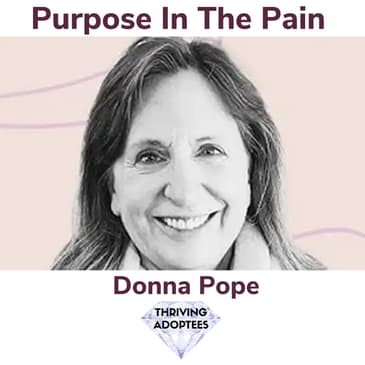
Are you suffering right now? It probably - or definitely - doesn't feel like it, but finding the purpose in that pain somehow makes it more bearable. The earlier we can see that purpose the sooner the pain can ease. Join Donna and I as we dive in life changing insights and shifts in perspective. Donna is an adoptive mother, executive director of an adoption agency and podcaster.
Here's a bit about Donna from her agency's website:
Donna is an irreplaceable member of our adoption agency, dedicated to aiding women who are contemplating placing their child for adoption. Helping women through an unexpected pregnancy has become her life’s journey. She is seldom “off duty.” On weekends she communicates with birth mothers to aid them with their financial concerns or traveling to a hospital to ensure they are receiving the best medical possible.
Her resolute dedication and heartfelt compassion make her an essential figure in supporting these women throughout their entire journey.
Donna ensures that every person who works at Heart to Heart Adoptions treats birth mothers and adoptive families with respect and compassion. She insists on a non-judgmental approach to every situation. She creates a safe and nurturing space for them to share their concerns, dreams, and worries. By approaching each individual with empathy and without judgment, Donna ensures that these exceptional women have the necessary guidance and resources to make well-informed decisions.
Donna’s expertise within the Utah Adoption Agency lies in her ability to find the perfect match between birth mothers and adoptive families, making her an invaluable asset to our agency.
Connect with her here:
https://www.linkedin.com/in/donna-pope-41652ba/
Explore her podcast here:
https://www.instagram.com/voicesof_adoption/reel/DLH-sYjJPf4/?__d=1
https://voicesofadoption.podup.com/
https://www.instagram.com/voicesof_adoption/
Find out more about her podcast here:
https://hearttoheartadopt.com/
https://www.facebook.com/HeartToHeartAdoption
https://www.instagram.com/hearttoheartadoptions/
Guests and the host are not (unless mentioned) licensed pscyho-therapists and speak from their own opinion only. Seek qualified advice if you need help.
Want to learn more about thriving for you, your kids, your families or your colleagues? Pick a time to talk here
[00:00:02] Hello everybody, welcome to another episode of Thriving Adoptees podcast. Today I'm delighted to be joined by Donna, Donna Pope. I'm really looking forward to this conversation. Me too, me too. Thank you for having me. You're very welcome. So Donna is a mum to three boys through through adoption. They're all in their twenties if I remember rightly. 21, 23 and well let's see,
[00:00:27] is he 24, 21, 23 and 26? 26, okay. 25 was a big year for me. I don't know, it just, it seemed like they're all just numbers but 20 didn't seem particularly significant. 17 was significant because I could learn to drive. 20, 30, 40, 50 haven't really been significant but there was something,
[00:00:55] 25 was a really round number. That is interesting. I mean 21 was a big deal for my youngest son and we all can probably guess. We were actually in Europe when he turned 21 and that was a big deal for him. 26 in the United States. It's a significant year because they go off of the parents insurance, their health insurance. They have to figure it out on their own. So that's a big year too.
[00:01:23] That is a big year. That is a big year. So Donna's also a fellow podcaster. So if you want to check out the podcast, it's called Voices of Adoption and it's in the link in the show notes. As I sometimes mention this, I don't always but there are always more links and information about the guest in the
[00:01:47] show notes. So check those out. She also runs an adoption agency called Heart to Heart. Correct. I sure do. So a fantastic, broad, multiple perspective look at adoption stuff is what we're going to have for the next hour or so. And I have to say that I'm looking at Donna's setup here. She's got a really
[00:02:16] professional looking mic. She's got all the sound headening on the wall and this is not my setup. So hats off to you for your proper setup. So Donna and I met a couple of weeks ago. I pretty much 99.9% I always meet the guests first before we do the interview so that we can get to know each other. And
[00:02:43] you said something very profound at the end of the conversation. And I wrote it down here as purpose in the pain. Do you remember? Do you remember? Oh yeah, absolutely. Because I think about it a lot. And what do you mean by that? Well, there's a there's a number of ways to go about explaining it.
[00:03:08] Life is pain. We all know that life is pain. It we it in my mind, in my mind, it's designed that way. Now, I believe in a higher power. And so I think that there is a reason why we live in a life that's full of pain. It is to develop us. It's to help us to become more of what we can become. And if we
[00:03:32] don't go through some of these experiences, then, you know, we just languish in incompetency. Whereas if we go through some tough times and some very painful times, then it helps us to grow if we choose to let it help us to grow. Now, a guy going into the weight room and lifting weights, you know, he becomes stronger. And we all know that what doesn't kill us makes us stronger is the
[00:04:00] adage, but he becomes stronger and he does it for the purpose of becoming stronger. Well, most of us, we don't really think about that. We don't think, oh, I want to be stronger. But we do. But we want to be stronger without doing all the work. Well, what's the work of becoming stronger? Well, the work of becoming stronger is kind of enduring some of the pain that we go through in this life. But not just enduring it as far as just living through it, but learning from it.
[00:04:30] Going, this is hurtful. This is painful. How can I become a better, stronger, more capable individual in order to better meet the task in front of me? And in quite honestly, the pain in front of me. So that's one way to look at it. Another way to look at it is... Can I stop you there, Donna? You bet. You bet.
[00:04:51] So this clearly applies to profound things. Does it also apply to my computer printer issue? Oh, well, what did you have to go through in order to deal with your computer printer? You had to learn something. I fixed it yet. Well, you will have to learn something in order to fix it. But we are generally here talking about more profound issues than computer. For sure.
[00:05:18] Well, yes and no, because it's those little things that can drive us absolutely crazy. But the bigger things, the big things are like war. And I'm not going to try to address those things right now. Because, but the bigger things for this podcast are the trauma that comes through our feelings of disconnectedness, our feelings of abandonment, our feeling, those types of trauma.
[00:05:47] Those are big things. And oftentimes we want to do one of two things. We either want to blame other people for the pain that we're going through. That's one choice we always have is to blame somebody else. And we all do it. We all blame somebody else because it's easier than taking on ourself the choice of the pain.
[00:06:16] So we either blame somebody else or we see purpose to it. Now, sometimes we do both at the same time. We blame someone else, but then we still feel so see purpose to it. But if we choose to see purpose to it and we look at that purpose, then we internalize it in a different way than if we just blame other people for our pain. Are those the only two options then, as you see? Oh, I'm sure there's other options. What are your thoughts?
[00:06:48] Well, my first thought was that most of the time, most of us aren't choosing what we think, feel or do. Right? So if I... I haven't done this yet with the printer. Right? But if I'd taken a hammer to it, right? Mm-hm. I would... That's one way to do it. That's one way to do it. Just to destroy it. Right? I wouldn't be choosing in...
[00:07:16] I wouldn't be choosing that action, right? I wouldn't choose to be frustrated about the printer. You know? Mm-hm. And I wouldn't choose to have... I wouldn't choose to blame myself for the feelings of frustration, because that often...
[00:07:44] That is often what comes up for me, right? Right. So I will... I'll feel something and then another part of me will make something wrong about that feeling. Right. That's not a choice either. So that's just a little... I find it easier to talk about big stuff or big principles with little items,
[00:08:14] because there's not so much drama around the printer. So, you know, I'm not choosing. And I think most of our lives we do not choose. I agree with you. Most of our lives we are just reactionary. We just... We feel mad. We feel hurt. We feel upset. We feel joy. And sometimes we don't even consciously choose anything that we're doing. Yeah.
[00:08:45] So... Blame is... We're not choosing to blame. We just feel angry. We just feel... We just feel... Just feel angry. Until we don't, I guess. Well, and so that's the thing, is at some point... And usually when you're right in the middle of the pain, you're not really thinking much of anything, except for, ah, I'm pain...
[00:09:14] I feel pain. And that being able to step away enough to think about something as just to be in the middle of it, that putting ourselves a little bit outside of whatever the pain is or whatever we're experiencing. We call it mindfulness. We call it being mindful of what we're thinking and feeling. And sometimes we just choose not to do that. We escape from it.
[00:09:44] We just watch TV. We get on a video game. We don't take the time to be mindful of what we're experiencing. But if we choose, if we choose to think about what we're thinking about, then we can make some choices as to how we're going to feel about what we're thinking about. Yeah.
[00:10:11] So I'm not choosing right now, and most of us aren't choosing most of the time. I guess what we're introducing here is that choice as an option. Right. Choice as an option, but something that we can look at, perhaps not when we're in the thick of it.
[00:10:36] We can have a look at it more closely when we're out of the toughest part of the stuff. But we have to choose. I don't know, and I'm using choose, but kind of we have to make a pattern or a practice of stepping outside of our thoughts. And I know that's hard to say, but just stopping and thinking,
[00:11:04] what am I feeling here? And why am I feeling that? And is that, am I choosing what I'm feeling and why I'm feeling? We have to kind of make a practice of stopping ourselves. And most of us don't do that. Yeah. So I just come back from a retreat and we were looking, it was a seven day retreat,
[00:11:31] and we were doing some meditations and some Q&As with the speaker. And this guy, he's got a, this guy called Rupert Spire, who I name check on the show quite a lot. He's got a book called, it's called We Are the Happiness We Seek or You Are the Happiness You Seek.
[00:12:02] And I was reflecting on this last night. His philosophy is based on the truth that our essence is happiness. Our core is happy. And yet that's covered over.
[00:12:29] That's covered over by our thoughts and our feelings. He was talking about happiness as peace or as contentment rather than as delight. Yeah. So as we're thinking about this, I'm thinking, as we're talking about this, I'm thinking that
[00:12:54] I am now at peace because the blocker, the blocker to that peace was the frustration with the printer. I'm 10 minutes into our conversation. It's gone, right? Yeah, because your mind is totally somewhere else. And you're present. And I think about this often, that the times when we feel most at peace,
[00:13:23] it's kind of when we're not thinking about ourselves at all. We're thinking about the activity that we're involved in. We're thinking about another person that we're talking to. And when we can get outside of ourselves, we're actually more at peace with ourselves. Yeah. And how does that link into purpose in the pain? Yeah.
[00:13:53] So we're feeling pain. And again, when we're feeling the pain, it's hard to get outside of our feeling of the pain. It's so painful. And so we just feel it. And sometimes we can think, oh, I really hurt. But there's a reason for this. It's usually later on, or it's usually after the pain subsides to some degree, that we can then choose, well, that was just so stupid.
[00:14:22] I hated that. And someone else caused this and this and that. Or we can say, I'm glad I went through that. Or boy, I learned a lot from that experience. We can choose to do that. So it's about our perspective on our pain. I think so. About how we view it. Funnily enough, I interviewed another adoptive mum yesterday.
[00:14:51] And we got onto this subject. And I wrote a little, when I released the podcast earlier today, I always write some show notes to go with it. So I came up with the title, Grateful for the Tough Stuff. Oh, that's good. Yeah.
[00:15:21] So, and here's how the summary went, right? Tough stuff feels, well, tough. But with hindsight, it becomes clear that the tough stuff prompts our biggest learnings. What if we could see the gift of the tough stuff earlier? Be more grateful for it when we are in it. Listening as a doctor from JC shares her insights on grace, grief and learnings.
[00:15:50] I love it. So it's about our relationship with our pain. Mm-hmm. Do you remember when you first saw that? Well, I think we all think of the song and we go, what doesn't kill you make you stronger. And we say it and we're maybe a little bit flippant about it.
[00:16:19] But there is sort of a pattern of, oh, this is just too hard. This is too hard. And right in the middle of this is just too hard. We're not thinking, oh, I'm so glad that I'm getting stronger. We're not thinking about that. But we get into a routine or a pattern of behavior and choices that allows us just to keep on moving.
[00:16:49] I call it plotting. That's my phrase is I'm just going to keep on plotting through this. Am I happy about it? No, I'm not happy about it. But I'm just going to keep plotting through this because I believe, I have faith, I have confidence that if I just keep moving, things will ease up a bit.
[00:17:12] Or and or I'll see the value of what I'm doing because I believe in what I'm doing. And I think that's very true with parenting. Parenting's tough. I do, as I run an adoption agency, I will often do a placement and hand a beautiful little child to a family. And they're so happy and they're so excited.
[00:17:41] And I sometimes want to warn them, you're excited and happy, but this is going to be tough. This is going to be tough. You're going to go through some struggles. The child's going to go through some struggles. But I don't be happy for now. And so why do those parents take that on? Why do they? Because they see a purpose to it. They want to be parents.
[00:18:10] They want to be able to provide a wonderful home for this child. There's a purpose for it. And so they're willing to do that and they want to do that. Anything in life worth doing is tough. Yeah.
[00:18:29] So last time we taught, I think you mentioned about the reason that you set up the agency was because you didn't like what you saw in the adoption world. Yeah. So the. It was was that a moment where you saw the purpose in the pain. So as you were setting up any new, any new venture, it's going to be tough. Right. So. Yeah. Everything.
[00:18:59] So you saw the you saw the purpose. And this was a. How many years ago? How many years did you say? About 20 years ago. Yeah. That you set the agency up. Right. So. The purpose in the pain. So. You saw some stuff going on in the adoption world that brought you pain and you turned that pain into the purpose of setting up the agency to try and.
[00:19:28] And reduce that pain to have more, more adoptions with more grace and respect for birth mothers. Yeah, for sure. For sure.
[00:19:43] And that was kind of my initial reason was because I felt such respect for women who chose to place their children for adoption because I could see the challenge. It was you talk about pain. There is so much. There. A woman who finds herself. First of all, she finds herself in a vulnerable position.
[00:20:10] She's pregnant and she is not in a situation that she feels like she can parent this child. So she feels this huge desire to give this child opportunities that she herself could not otherwise give that child.
[00:20:29] So she goes through the literal physical pain of just having the child grow within her and then the very literal pain of giving birth to that child, whether it's vaginally or whether it's via C-section. There is pain to it.
[00:20:49] Now, for her, she can almost always see the immediate response of, you know, now a child is born into the world. There's a purpose there. But then she chooses to go through an additional amount of pain, which is choosing to place that child for adoption.
[00:21:11] And now she goes through her own self-inflicted, to some degree, pain of loss. Now, hopefully, that pain is somewhat offset by the relationship she will have with the adoptive family. Hopefully, it will be somewhat offset by that.
[00:21:33] But even that, to some degree, is painful because she sees their joy and knows that she's not going to have what now they're going to have in the sense of being able to raise this child. So she feels that pain. Now, and then she also feels, I'm choosing that.
[00:21:54] Now, she has to feel purpose in that or it would be overwhelming to her if she doesn't feel like, I am choosing to go through this for this child. And by seeing that purpose, it helps her to move through that pain that she is choosing to have. Yeah.
[00:22:21] How do you see that sacrifice, for want of a better word, impacting on adoptees? No, that's a really good question. Many adoptees, and it isn't, everyone in life needs to feel attached, that they need to feel like they belong.
[00:22:50] It's a natural, normal feeling for all of us have. We want to feel home. We want to feel that sense of belonging and that I am a part of something. And adoptees have that, sometimes will have that disturbed. They'll have that disturbed with the thought of, do I belong? Do, okay, this adoptive family that adopted me, hopefully it's a good situation.
[00:23:19] It may or may not be. And hopefully they feel connected and a part of that family. Sometimes they don't. And they long for that feeling of belonging. And so that naturally leads them to think, well, where do I belong? And why don't I belong? Why don't I? Why am I not with my biological family? Why am I not there?
[00:23:44] And so then that leads up to thoughts, well, because my mom gave me away. That is a painful thought. That is just a painful thought. And there can come a lot of anger from that painful thought. Another way to look at it is to try to understand why and what was her purpose.
[00:24:13] And if I understand her purpose better in choosing to go through what she went through and the biological father, if he's involved, what they went through in order to give me a situation that, in their opinion, was better than what they could provide. Now, the hard part about that, too, is that the mom made that decision.
[00:24:38] And with the pain of separation and with the pain of loss that she was going to go through, also comes another really kind of weird pain. And that's a pain of failure. That's the pain of, I did this placement because I couldn't give them what I want them to have. Which is a huge sense of failure for them as well.
[00:25:05] So all of these things are immensely difficult for the mom. And so for her to make that choice, she had to see a bigger purpose. She had to see that. And that bigger purpose was to give this child more than what she was able to do.
[00:25:29] And so if the child can see that, it doesn't necessarily mean that they don't feel that loss because they do. They feel that loss of maybe I was given up. I was tossed away. I was deserted. That's painful. But seeing maybe the purpose of that can help with the understanding of it. Yeah.
[00:25:56] You talked about that pain and that pain becoming anger. Do you ever see it becoming other emotions or sex than anger? You know, we often talk about the grief cycle. And we often will say that the stages of the grief cycle are that they feel denial. They're not even paying any attention to it.
[00:26:26] And a lot of adoptees, that's their choice. I don't care. I'm not going to pay attention to it. But then when we do pay attention to something that comes to us as loss, that sense of loss creates a sadness to us and will often lead to anger. That's part of just kind of our normal reaction. It will lead to anger.
[00:26:53] And then if we find purpose to that, then the anger becomes, no, no, I get it. I get it. And I can accept that. So it leads to acceptance. But when we get it, when we understand it, when we can then put a reason to why we feel the loss, then we move into acceptance. And then even more so, we can move into growth. Okay.
[00:27:22] Yeah, I see that. And we can grow from it because we see the purpose. And that has now become a much more powerful way of facing loss. And we go through the anger and, yeah, we feel it. But then we accept it and we move into more growth. Are you talking about the Kubler-Ross curve? Absolutely. Absolutely. Kubler-Ross.
[00:27:50] I'll put a link to it in the show notes in case people want to check it out. So it's this U-shaped, it's a U-shaped thing. And Donna's talked us through some of the main points. And it's a grief. And it's usually grief of death. That's what Kubler-Ross. But it's the same thing. It's a grief.
[00:28:18] Relinquishment is seen in that same way as the loss of our birth mother. One of the things that I remember seeing that before. This isn't a once and done thing. We keep on going through it, don't we? Sure. We keep on going through the curve. It's not just a one. It's not just one cycle.
[00:28:46] The way that you describe it, Donna, is incredibly straightforward and clear. And clearly knows that you know your onions, right? On this stuff. The richness of conversation that I anticipated the start of our conversation today is clear, right? It's clear for everything.
[00:29:13] For me to hear and hopefully for the listeners. One of the things that fascinates me is how the grief of loss becomes a belief, right?
[00:29:37] So I think about myself away from my birth mom for the first time. And then I was reunited with her shortly, a few weeks after that. So she put me into foster care. I was into short-term foster care. She collected me from there to take me to the adoption agency.
[00:30:07] And I think about how I might have felt on the first night of losing her or the second night of losing her. And not even consciously. Not even consciously, right? So there's a pain there. There's a pain that I can't remember. So I don't know how painful it was.
[00:30:31] The only clue I have had in my life of that pain is with our dogs. Yeah. Yeah. And I've, and I've, so we've, we've had four dogs. We've got dogs three and four at the moment. And out of those four dogs, I remember some distress, right? For some of the dogs on the first night that they're away.
[00:31:02] And that continuing. Okay. So there's some distress there. And I'm thinking, was I that distressed? You know, I can't, I can't remember. But that distress was pure. Maybe not even emotion, pure sensation. It was, it was pure sensation. It had no words. It was pre-verbal. It's pre-cognitive, all those sorts of things.
[00:31:31] And then later on, we've got this thought arising. And the thought didn't come to my conscious mind until I was 40. She didn't love me enough to keep me. Hmm. So one of the things that fascinates me is how does that distress become a, a thought?
[00:32:02] And it fascinates me. And I'm wondering if you have any insight. Let me ask, let me repeat what you're asking. So, and I'm going to, as I, as you were thinking, as you were talking, I was imagining, again, the soothing cycle. Attachment comes about because as a baby, we, we, we feel distress. We're hungry. Our diaper's dirty. Or maybe we're just lonely.
[00:32:33] And so we begin to cry. And our parent comes in and picks us up and says, oh, you're okay. Or picks us up and gives us a bottle or picks us up and changes our diaper. And so they soothe us. And, and they take away our feeling of anxiety, physical pain, emotional loneliness. They soothe us. And, and many people don't get soothed.
[00:33:03] That there, there's a certain lack of soothing that they experience when they're infants. Now, everything that we know now tells us that the more soothing we can give to a child and the more awareness of their needs and responding to their needs, the more they now feel attached to us. So a child that doesn't have that experience, and does it matter who it is that's soothing them?
[00:33:33] I don't know. I really don't know. But whoever soothes them, they feel attached to. And, and then they look at them and they look at them for, for additional soothing. And that continues on throughout our lives. Um, where we feel distress, we go to someone who will help us feel less distress and feel soothed.
[00:33:58] Now, your thought of the person that gave life to me didn't stay around long enough to soothe me. And now you feel hurt and, and upset about that. I, I can see why. I, I can see why you would feel that way. And then you have to go, did anybody soothe you during that particular time? And from the story you've told me, I think the answer is maybe not. Do you know?
[00:34:31] Well, no. Yeah. But, uh, if you ask me about attachment, I would, I've had a look at attachment, um, attachment types and I've done attachment questionnaires. And, and the, and according to what I, the, you know, the, the quiz I answered, I am firmly attached. You know, uh, to, to your, to my, to my mom and dad.
[00:35:00] So, and so there's some evidence there. And the, the other evidence that is more kind of self-evident to me is I remember my sister asking me a question when she'd be about 10, I'd be about 12, something around that age. And she said, do you ever think about finding your real mom and dad? I said, no, mom and dad are our real mom and dad.
[00:35:27] So that, that's my evidence of the attachment here. Yeah. And so that, that attachment's there, but you're saying that still doesn't take away from the thought, well, my biological mom didn't love me enough to keep me. And that was a thought that those were words that came up out of my mouth at the age of 40. And I'd never said those words before.
[00:35:55] I'd never thought that thought before it came from, it literally came from nowhere. So my question is really, and I don't know, it's not, it's, I don't know whether it is an answerable question or not. However, the question is, how, how can the, how can the distress lead to a thought? Because they're two very different things.
[00:36:21] A, a wordless, a wordless suffering is one thing. Putting words to it is, is something completely different. It's a, it's about meaning. It's a, it's a, it's about meaning. Now, when I said those words, she didn't love me enough to keep me.
[00:36:49] And the, the lady that I was talking to at the time, she said, I'm a mum, Simon, and I don't think it would have been quite like that. And I saw, I saw the truth in what she said. So, that was a new thought to me, but it wasn't a thought that, that gathered roots.
[00:37:14] Because as soon as I'd said it, she counted it. And I saw that it wasn't true anymore. I saw it wasn't true. The, the, the new thought I'd had wasn't true. Now, if I'd had that thought at five. And nobody countered it. And nobody counted it. And I never expressed it to anybody. So that nobody could counter to it.
[00:37:43] Then it would have fested. And it would have had deep roots. But that thought would have become an entrenched belief. For sure. And, and, and, and, uh, oftentimes people will ask it not as a thought, but as a question. Did she not love me enough to keep me? And they may not be able to find the answer to that. And then it get groats roots.
[00:38:13] And they don't get anybody to answer it. Um, but your friend was right. There is no mum. Um, and I love that way you say that. That it's, uh, my, my oldest son. I, when I, he was really struggling at one point. I'm not sure how old he was. I'm guessing nine, 10. Um, and I took him to a counselor.
[00:38:39] Um, and the counselor said to me, she said, uh, after the introductions and stuff, she said, why don't you step out and let me talk to Josh for a few minutes. And so I stepped out into the, the lobby. And it was not 30 seconds until she opened the door and called me back in. And I thought, what in the world did he say in less than 30 seconds that she would call me right back in? Well, guess what it was?
[00:39:10] It was that question. Why did my mom, my biological mom give me up? He wanted to know the answer. And I think everybody wants to know the answer. And so it gave us a chance to talk about it. Now she and I have a good enough relationship that I was very, very clear why she had placed him for adoption. I was very clear about that. And she and I had actually talked about how I would answer that question at some point.
[00:39:38] And it had nothing to do with her not loving him. And it had everything to do with the fact that she did love him. Yeah. If, if, if trauma is made of thoughts and beliefs, what percentage do you think? Sorry. Let's go for it again.
[00:40:05] If trauma is feelings and beliefs, that's what I was going for. If trauma is feelings and beliefs, what, what split is it? Is it 80, 20? 80, 20? Meaning 80% feelings and 20% belief. Well, I think they lead, they, they bleed back in forth into each other. They do. I mean, I'd say it's 99% feeling and 1% belief. Mm-hmm.
[00:40:34] And, and, and, and, and can you change those feelings because of your belief? Well, that's the, that, that's the, um, the $20 million question or $60 million question. I, I think, I think maybe the answer is probably, it may, based upon 99%, the answer would be no. Cause, but 1% affecting the 99, maybe.
[00:41:02] Unless the belief itself creates a feeling for you. Unless that belief becomes so powerful that it creates a new feeling for you. I think the percentages don't matter.
[00:41:26] But it matters to think of trauma in, in a, in a combination of those two, two things.
[00:41:35] I, for me, um, because a lot of the stuff that's going on for, the, the older we get, I, I think the, the more belief builds.
[00:42:02] So the, at, at, at five weeks old, it was a hundred percent felt sensation. Yeah. And, and, and zero belief. Mm-hmm. Cause the winner, I, I didn't have words to say. Or if, if, if I, if I'd had words, the only words I could have said was, where's she gone? Mm-hmm.
[00:42:30] Not, why does she live, why does she give me enough to, you know, if, if the, if the, if the distress had words, it would be confusion. What, what, what happened? Mm-hmm. Where is she? That's what it would have. It wouldn't, the, the, the, she, she didn't love me enough to keep me. That comes along, along further way down the line, right?
[00:42:58] And, and, and, and I would think, I think the feeling is, um, am I loved? And, and, and the first person that's supposed to love us is our biological mom. And that feeling of, am I loved? And if it's been replaced with, yeah, I'm loved. Um, it can maybe help offset some of that feeling. I told you about the letter that I got. Uh, remind me.
[00:43:28] Oh, when you saw a letter that she'd written? Yeah, about the teddy bear. Oh, yeah, yeah, yeah, yeah. But tell it again for your audience. I'm supposed to be interviewing Donald. No, well, that's okay. So I felt her love reading that letter.
[00:43:56] That, that, that's an important thing for me to hear, uh, as somebody who works with these women is to continually encourage them to write those kinds of letters because every child, every adoptee asks the questions that you're asking. Everyone does. Basically, did she love me? And if he, if there's a he involved, did he care? Um, I, that's a different story.
[00:44:25] That, that's a whole different story, but I'm going to bring it up right now because yeah, I, my 20. For me, yeah, sorry. Well, and I want to hear your part of the story. I'll tell it from my point, the point of view of my second son, because he and I were just talking last night. Um, his biological father, um, according to his mom. Um, was not aware of the adoption.
[00:44:52] Now, I honestly don't know how much he was aware of the pregnancy or anything like that, but I had seen one picture of him, uh, he, which then got lost. And then she didn't give me any more information about him. Well, for Christmas one time I gave my son's a DNA test and they all took the DNA test.
[00:45:14] Well, years later, I get this call from this woman who says my husband, uh, found himself matched to somebody, a DNA through the DNA test. And he thought it was his brother, but found out it wasn't his brother. And then realized, well, who else out there has that close of a relationship with the DNA? And he realized he had a son.
[00:45:39] And so they were able to find my son's name and my phone number and called me. And so now I had the chance to get to know my son's biological father. And I did, we did phone calls and we did, uh, letters and messages. And I even set up a group for him to be able to communicate with my son. And then I went to my son and I asked him, I told him what happened.
[00:46:06] And I said, would you like to get to know your biological father? Guess what his response was? No. And that made me feel really sad. It made me, I felt really sad. And then I had to stop myself and say, this is totally his call. And he's now 20 at the time he was 20 years old. And maybe now's not the time for him. But I actually felt bad for his father. I felt bad for him.
[00:46:35] And, um, and I asked, why not? And I don't know that he could give me an honest answer as to why not. I don't know. I could make some speculation, speculations as to why he didn't. And the answer he gave me is that I don't want to get all involved in this whole thing. He didn't want his identity to be an adoptee. Honestly, he, at this point in his life, he's a golfer and, and, and he's a good friend.
[00:47:05] And, and those are his identity. Um, he's a football player. These are things that matter to him. And even last night I said to him, because he was telling me about his golfing and that he was getting pretty ripped and he was looking pretty good. And he was talking to me about his genetics associated with why his arms were looking so good. And I said, honey, you know, I can show you and connect you with her, your biological father.
[00:47:34] And maybe you can see something about that. And he said, no, no, no. I don't know, honestly, all the feelings that go into that. Maybe you do better. Well, we're, we're, we take the next step when we're ready. If we become ready.
[00:47:59] You know, I, I looked at, I, I, I looked at, uh, when this stuff came up after the teddy bear stuff, when I was 40, I looked at the idea of, and I, and I considered the idea of looking for it. And I asked. How old were you then? 40. Oh.
[00:48:27] And I asked a few people that I know and respect and, uh, about it. Uh, I, one of the people, uh, I had a business coach at the time and I shared it with, I shared the thing with her because she'd been, um, she'd introduced me to the lady. I've got into too much detail.
[00:48:56] And she, she, she'd introduced me to the lady that said, I'm a mom, Simon. And I don't think, uh, I don't think it was like that way. So I, I talked to her and she happened to have another client who was, uh, also an adoptee. Uh, and in this is 18. So this is 18 years ago. And I didn't call myself an adoptee. Right.
[00:49:21] You know, you said that your, you, your, your son's identity is, is a, is a golfer, you know, adoptee isn't part of his, um, identity. Well, neither. It wasn't to mine until I came into doing this podcast and doing the podcast, you know, five years ago. So, um, so, so, so the business coach had another client who was an adoptee. Uh, and she said, do you want to, I can't remember her name. Say it's Jill.
[00:49:49] Do you want to speak to, I've spoken to this, uh, to, to Jill about this, Simon. And I've not, I've clearly not mentioned your name. I respect, uh, um, confidentiality or something, but, you know, she said that whoever that fellow client was, that she would be up for a conversation about searching reunion. Um, if, if that other client was up for it. So I had a conversation with her.
[00:50:16] I thought about it and I had no, I had no inclination to, to do. I had no, that there was no force within me that said, I must find this out. So I asked around, I asked a couple of people, I asked around, I asked a couple of people to say that I respect, I considered it and I thought, no, I need to work on me.
[00:50:47] I need to work on me. I don't, that was, that was the wisdom that came back. Work on yourself, right? This, this idea that you talked about blaming, blaming somebody else as an easy way out.
[00:51:10] The, the flip of that is believing that somebody else is going to make you happy. I love that. No, absolutely. And, and at that stage, it was more important for me to realize, to, to look inside for happiness rather than to look outside for happiness.
[00:51:37] And it wasn't for another 10 years until I actually, I had a, I had my own, my only, my second meltdown about adoption stuff. Right. I want to hear how these meltdowns go. Well, this, this meltdown. My son was in a therapist office and she was asking me about where I was on my search.
[00:52:03] And in that moment, the picture came into my head of my birth mother in, in inverted commas, and she was rejecting me again. And I, I flushed frozen in fear, in fear. And then I, then I, then this heat came back on top of that frozen fear.
[00:52:32] I'm not going to let this fear of rejection stop me. I've got to resume my search and resuming the search led me to the teddy bear. When I realized the two meltdowns were totally, my, my, my thinking was totally off.
[00:52:55] So on one level, I, I got the idea intellectually that, that she didn't love me enough to keep me was untrue. And then I got that at a far more profound layer, level, sorry, 10 years later when I read that letter
[00:53:19] for her, from her, when I felt her love for me from beyond the grave. That's really, that is really neat that you had that experience. No, that, and, and one of the things that I've noticed, I, I was actually talking to somebody
[00:53:41] the other day and mentioned this, that this additional sense of trauma that a birth mother feels is that they do so desperately love the child. And they want more for the child than they know they can give them. So the trauma for them is that feeling of, I am a failure.
[00:54:10] I can't give this child what this child needs. And, and, and so sometimes run that forward 20 years, 30 years, 40 years, and now the child comes back to them and wants to reunite. That raises that sense of failure again, that sense of, I, I failed you.
[00:54:36] And, and, and it is no wonder that at that point they may pull away. Unfortunately for the adoptee, they see it as an additional rejection when it's actually, they're still struggling with their own sense of failure. Yeah. Which is not, and, and it's not because they, it's not, they, they have, they made the choice
[00:55:03] that they made in behalf of the child, but they still may be struggling with, with, with the aftermath of that, of that choice. So there's, there's no guarantee. And all this is going to make a happy reunion less likely. For sure. And a, and a stable ongoing reunion less likely.
[00:55:27] And, you know, I, I heard this, I heard this, uh, phrase, this word, and I think is so, so powerful, you know, cause we, we look, we look for happiness outside when we know that happiness is an inside job, when we know feelings are an inside job.
[00:55:52] We can get that intellectually, but we can still go looking outside for, for happiness. Right. Because we don't know how to create it inside of ourselves. Well, the, the, the, the word that I heard used in, in conjunction with this that I thought was really, was a real jolt. Right. We can't extract happiness from somebody else.
[00:56:19] And that's what we're looking to do sometimes. Right. We're thinking reunion is going to make me happy. Well, what if it, what if it doesn't, what if it doesn't go well? We see too many of those Hallmark movies. Wow. How wonderful. Yeah. But it, it, it often doesn't go, it often doesn't go well. I don't know what the numbers are.
[00:56:44] I'm sure there are some numbers, but the averages don't mean anything because we're looking at our little instance, but placing all our bets on external happiness is, we're going to end up losing, losing the lot because happiness is an inside job and happiness is our nature and it is covered over by this frustration.
[00:57:13] So we've got to be looking for happiness in the right place. Now, one of the things that I do hear, and you probably can confirm this. One of the things that seems to come from the reunion visits is that mirroring thing. Now, that, that fact that there is somebody else in the world that, that looks like me.
[00:57:38] People seem to take that and regardless of how the experience happens after that, and regardless of how the relationship develops, the fact that they saw somebody that looked like them, they seem to be able to hold on to that. Yes. Uh, yes, I've, I've heard a couple of people. It's called genetic mirroring. I think it's the, it's the kind of the, um, the jargon for it.
[00:58:07] I've heard that from an adoptee who is also a therapist that I've interviewed, maybe a couple of others, maybe a couple more. I've seen it on posts, but I would say, I would say it's the, it would say, I would say it's a minority thing. That, that, that was a positive thing.
[00:58:33] So it is a positive thing, but it's not, but, but, but it's a, um, it's not something that many people have mentioned to me. So I would say it's a positive thing for a minority of the people that, the minority of the adoptees that I've spoken to. It's not, you know, it's not like, oh yeah, yes. Spot on Donna.
[00:59:00] And I've spoken to 50 adoptees about reunion and 47 of them said, yeah, the genetic mirroring, that was a big relief. It's nowhere. It's a minority. It's a, it's a minority, but that doesn't matter. If, you know, if the, the, the fact that it is, it is only 10% doesn't matter if you're one of those 10%, right? The, the, the, the, the, the, the, the percentage is completely immaterial, completely immaterial.
[00:59:29] How are we doing for time at your end on that? Um, we're probably about out. I do need to go on to another one. So yeah, but no, this has been great. This has been great. Me too. Thank you. No, it has been. And so if I, if I kind of, kind of ask one final question.
[00:59:53] So in talking with the different people that have gone through the, um, through the reunion, and they're obviously looking for answers, but I think even more so they're looking for a feeling, a feeling of belonging, a feeling of connectedness, a feeling of home. They're looking for that. And they may see, oh, look, there is somebody that looks like me. And they hold onto that as sort of a feeling of belonging.
[01:00:22] But then oftentimes things don't go as well as maybe they hoped for. And I think about my son and I think, why don't you want to meet this guy? Or why don't he, why don't you even want to get to know him? Um, and maybe it is because he's afraid that he won't feel that feeling, or maybe, I don't know, or maybe he just doesn't feel the need for it. Um, I don't know honestly why he doesn't. And maybe that will change over time.
[01:00:51] Um, but. Yeah, I think we try and we, we look for a reason for the feeling. Yeah. Explain that. And there isn't always a reason, there isn't a, there isn't a reason for the feeling. And. You know, feelings are all over the shop. I, I look at when I'm looking at myself, I look at more about what I'm doing. Right. So if, if I want to do something, I'm pretty persistent and pretty tenacious. Right. Right.
[01:01:21] So I, I look at, but my feelings are all over the shop. Yeah. My feelings, but I don't really, I don't look at my feelings that closely. I look at what I'm doing. I look at what I'm doing. So does that make any sense? Yeah, for sure. For sure. And, and so we just do it. And even if someone asks us why we did that, we go, oh, I just felt like it.
[01:01:49] Well, I can, I can tell you that there was a, I shared the reason that I restarted my search process because I had no option. You know, I had no option that the, the, the strength of that, the strength of that. Drive. Drive. Was. Yeah. I had no option. So what was the feeling that drove that drive?
[01:02:21] I'm not going to let this fear of rejection hang over me. Fear of potential rejection, should I say. Right. Fear. I don't know whether, I don't know what's going to happen, but there's, I have to do something about this. I have to get, I have to get to the truth. That getting to the truth, regardless of what the truth is. Kind of, yeah.
[01:02:51] I mean, I'm putting words to it, but there was no option. I like, I'm, I'm justifying it 10 years after the event. It was just like, I froze in terror. And you're not. The terror was, the, the, the, the freeze, the freeze was replaced by determination and anger.
[01:03:19] I'm not, I'm not going to be, I'm not going to be afraid of this stuff. I'm not going to put this, I'm going to let this fear hold me captive. Yeah. Thank you, Donna. Thank you, listeners. Thank you. It is so fun to talk with someone who thinks as deeply as you do.
[01:03:49] And, and has worked through some of these things. Thank you. Thank you. And right at you, you know, like the clarity. I've, I've waffled a little bit today, but the clarity and, and the depth of your knowledge is, it's incredible. Thank you, listeners. Thank you, Donna. Let's talk again sometime.