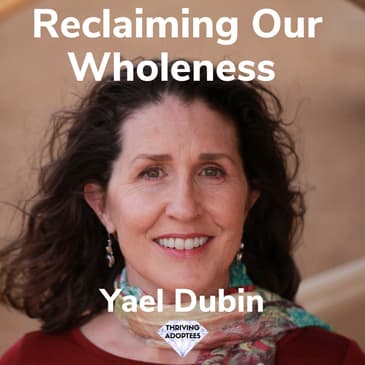
Does healing seem like a journey to you? A long, arduous trip. What if wholeness were closer? Something we can see and feel sooner? Listen in as Yael and dive deep into revealing and reclaiming our wholeness.
Here's a bit about Yael:
"My personal experience as a bisexual Jewish woman, a practitioner of Mussar, an adoptee, a divorcee, a “bonus mom” and a “career transitionist” have given me a deep repository of strength and skills as well.
As a mindfulness-based coach, I help people who are at turning points in life get crystal-clear on who they are, what they need in the next chapter of their lives, and how to create it.
I help you develop the confidence to express yourself authentically and bring true closure to past chapters. Together, we discover your inner barriers to fulfillment. With support, you learn to rewrite old programming you didn’t realize you had.
My intention is to accompany you on your journey to living a life that is deeply meaningful to you with clarity, confidence, courage, and connection – whatever your identity, whatever your situation."
https://www.instagram.com/bechiracoaching/
https://www.facebook.com/yael.dennis.817/
Guests and the host are not (unless mentioned) licensed pscyho-therapists and speak from their own opinion only. Seek qualified advice if you need help.
Want to learn more about thriving for you, your kids, your families or your colleagues? Pick a time to talk here
[00:00:01] [SPEAKER_01]: Hello everybody, welcome to another episode of the Thriving Adoptees podcast. Today I'm delighted to be joined by Yael Dubin. Looking forward to our conversation today. And laughing so much about getting the pronunciation wrong. That's two minutes ago, right?
[00:00:19] [SPEAKER_00]: Yes, thank you so much for having me on. I'm really excited to dive in.
[00:00:23] [SPEAKER_01]: Yeah, yeah, I'm laughing at myself. Okay, so I've never messed up an intro as much as that one. And I've done like 520 by now. So you know, people say that practice means perfect, but obviously not, right? So, healing, does this word resonate with you and to what extent does it resonate with you, if so?
[00:00:49] [SPEAKER_00]: So, yes, it does resonate with me. And I don't, I would say as relates to adoption, it didn't always resonate with me. I initially and for a really long time had a hard time with the concept of healing related to adoption because I hated the notion that there was something wrong with me just by virtue of the fact that I was adopted.
[00:01:13] [SPEAKER_00]: And for a lot of people. And for a lot of people. And for a lot of reasons that maybe other adoptees can relate to.
[00:01:18] [SPEAKER_00]: But when people decide already that there's something wrong with you, they decide they don't have to listen to you.
[00:01:24] [SPEAKER_00]: And that can be really, really disenfranchising, really alienating.
[00:01:29] [SPEAKER_00]: So I initially didn't like that word, but I have come to really love that word, especially as it relates to adoption.
[00:01:39] [SPEAKER_00]: Because I, for me, it has come to really represent reclaiming my wholeness.
[00:01:45] [SPEAKER_00]: And letting, letting go. Obviously, I lost my mother at birth. Obviously, that did some damage.
[00:01:54] [SPEAKER_00]: And letting that go, like, I don't have to stay damaged. I can heal from that. I can regain my wholeness.
[00:02:02] [SPEAKER_00]: That has become really meaningful for me.
[00:02:04] [SPEAKER_01]: Yeah. Yeah. I saw something this morning, a post on an adoptee group, and it was a, it was a paragraph from a book about generational trauma.
[00:02:16] [SPEAKER_01]: And it, it said something along the lines of babies associate.
[00:02:25] [SPEAKER_01]: And clearly, it's not a mental association, right? Babies associate mothers with life.
[00:02:37] [SPEAKER_01]: And that struck me as very profound.
[00:02:41] [SPEAKER_01]: And, and something that, yeah.
[00:02:49] [SPEAKER_01]: Something I can't really put a pick. I, I, I have no, we have no memory of it.
[00:02:54] [SPEAKER_01]: We have no mind.
[00:02:56] [SPEAKER_00]: No, yeah, we don't have like a conscious or verbal memory of it.
[00:02:59] [SPEAKER_00]: It's like what we would call an implicit memory.
[00:03:02] [SPEAKER_00]: It's embedded deep in our bodies.
[00:03:05] [SPEAKER_00]: And in an, like in a less conscious, less verbal part of our minds, but we have an experience that lasts.
[00:03:13] [SPEAKER_01]: Yeah.
[00:03:16] [SPEAKER_01]: When I, when I was thinking about this the other week, um, and how creative we are as human beings, in terms of that being in the, in the, in the, uh,
[00:03:32] [SPEAKER_01]: in the space or in place of this, in lack of, with, with a lack of explicit memory, we could, we, we could be building, we could build this up.
[00:03:46] [SPEAKER_01]: Or we could build it down.
[00:03:49] [SPEAKER_01]: Do you see what I mean?
[00:03:50] [SPEAKER_01]: It's like, how will we ever know?
[00:03:54] [SPEAKER_01]: How will we, how will I ever know?
[00:03:56] [SPEAKER_01]: Uh, am I overcooking the relinquishment trauma or am I underestimating it?
[00:04:03] [SPEAKER_01]: Uh, yeah.
[00:04:05] [SPEAKER_00]: Right.
[00:04:05] [SPEAKER_00]: And we won't know really.
[00:04:08] [SPEAKER_00]: Um, but, but slash, and I think either, I think how we know we're overcooking it is if we, if we stay stuck in it.
[00:04:20] [SPEAKER_00]: Because it is possible to heal, to recover wholeness, despite having traumas early in life, no matter what that trauma was.
[00:04:29] [SPEAKER_01]: Yeah.
[00:04:31] [SPEAKER_01]: Where'd I, where I'd been, um, on this until, cause the idea has been bouncing around a little bit for the last couple of months.
[00:04:40] [SPEAKER_01]: And I was thinking that maybe I had been, uh, over estimating it.
[00:04:49] [SPEAKER_02]: Hmm.
[00:04:49] [SPEAKER_01]: And yet talking to, well, talking to, I, I didn't do a lot of talking.
[00:04:54] [SPEAKER_01]: It was, I'm doing some work with a somatic, um, experience.
[00:04:58] [SPEAKER_01]: So there's not a lot of talking, but I did a somatic experience, uh, probably my fifth or sixth session with, um, this lady.
[00:05:06] [SPEAKER_01]: A couple of weeks ago.
[00:05:08] [SPEAKER_01]: And I started to get the idea that maybe I had been underestimating it.
[00:05:14] [SPEAKER_02]: Mm-hmm.
[00:05:16] [SPEAKER_01]: Um, and so I had been, uh, treating it, seeing it smaller than it, it was.
[00:05:24] [SPEAKER_01]: I had been not negating it, but, um, diminishing it.
[00:05:28] [SPEAKER_01]: What's the word?
[00:05:29] [SPEAKER_01]: Yeah.
[00:05:30] [SPEAKER_01]: Underestimating it.
[00:05:32] [SPEAKER_00]: Yeah.
[00:05:33] [SPEAKER_00]: Yeah.
[00:05:33] [SPEAKER_00]: So, you know, when you know the end of the story, it's really easy to underestimate how suspenseful that moment really was.
[00:05:41] [SPEAKER_00]: You know?
[00:05:42] [SPEAKER_00]: So when you survive the car accident, it's really easy to dismiss how scared you were in the middle of it.
[00:05:49] [SPEAKER_00]: And I got in a terrible car accident with, um, my three children in the car.
[00:05:54] [SPEAKER_00]: It was horrible for me.
[00:05:55] [SPEAKER_00]: And everybody walked away completely fine and unscathed.
[00:05:58] [SPEAKER_00]: I don't even think I had a headache afterwards.
[00:06:00] [SPEAKER_00]: My car had $23,000 worth of damage done to it.
[00:06:04] [SPEAKER_00]: So it was definitely a significant.
[00:06:06] [SPEAKER_00]: And I had a reason to be afraid.
[00:06:09] [SPEAKER_00]: But now that I know the end of the story, that's all seems very silly.
[00:06:13] [SPEAKER_00]: You know?
[00:06:14] [SPEAKER_01]: Interesting.
[00:06:15] [SPEAKER_01]: Interesting.
[00:06:15] [SPEAKER_00]: But in that moment as an infant, um, all what, you know, there have been studies that, um,
[00:06:22] [SPEAKER_00]: I think Daniel Stern did these studies that show that infants prefer their mother's breast milk to other mother's breast milk.
[00:06:27] [SPEAKER_00]: They can recognize their own mother by smell.
[00:06:31] [SPEAKER_00]: They know what her voice sounds like.
[00:06:33] [SPEAKER_00]: They recognize their mothers pretty immediately based on their physiological experience in that mother's womb.
[00:06:41] [SPEAKER_00]: And when you have a loss or disruption of that, there is a moment of terror for an infant, um, of not knowing like what comes next.
[00:06:52] [SPEAKER_00]: And we know that we survived.
[00:06:54] [SPEAKER_00]: So that seems silly to carry that in your body forever.
[00:06:58] [SPEAKER_00]: Right?
[00:06:59] [SPEAKER_00]: Like how, why would I do that?
[00:07:00] [SPEAKER_00]: I know I'm fine.
[00:07:01] [SPEAKER_00]: I know that obviously I've been fed and nourished.
[00:07:04] [SPEAKER_00]: I made it to adulthood, but there, that experience hasn't been processed and hasn't gone away and does live on in implicit memory physiologically.
[00:07:14] [SPEAKER_00]: When you somatically re-experience it, I come from an internal family systems.
[00:07:18] [SPEAKER_00]: I'm an IFS coach.
[00:07:20] [SPEAKER_00]: So in an internal family systems way of looking at it, I would have a relationship with that infant part and I would reparent her.
[00:07:28] [SPEAKER_00]: So that she knows that she's safe, that infant got split off as a part and sort of lives in this world where she is perpetually experiencing that loss.
[00:07:39] [SPEAKER_00]: And when I reconnect, she can reintegrate and, and come to wholeness again and know that she's okay.
[00:07:47] [SPEAKER_01]: Yeah.
[00:07:48] [SPEAKER_01]: To, to what extent did, um, becoming a mom.
[00:07:53] [SPEAKER_01]: So you, you've got three kids, right?
[00:07:54] [SPEAKER_01]: Right. So to what extent do you think becoming a mom helped you, uh, see what I haven't seen?
[00:08:06] [SPEAKER_01]: You know, that, that, that mother child bond.
[00:08:08] [SPEAKER_01]: I mean, how could you know what I've seen?
[00:08:10] [SPEAKER_01]: It's a bit of a silly question, but I, maybe, uh, uh, you were going to ask, um, that you were going to ask it.
[00:08:15] [SPEAKER_00]: You know, like, honestly, I, I would honestly have to say that that didn't do that for me.
[00:08:23] [SPEAKER_00]: That didn't help me see the things I haven't seen.
[00:08:26] [SPEAKER_00]: I think it was many years later when I got in touch with the fact that my body is picking up a lot of experiences that I have not, that I had been like a very rational thinking, intellectual person.
[00:08:41] [SPEAKER_00]: You can see the books. You made a comment about my bookshelf. I've been a very, a brainiac. I've been very much in the rational mind and really couldn't understand the somatic experience and how things get locked in the body in the way they do.
[00:08:55] [SPEAKER_01]: Yeah. So, um, what was it that changed? You said, you said that, uh, the word healing didn't always, in regards to adoption trauma, relinquishment trauma, you said that didn't always, it didn't always work for you, but it resonate with you.
[00:09:16] [SPEAKER_01]: But, but then it did. So what changed?
[00:09:20] [SPEAKER_00]: I have to say like anyone who's listening to this podcast now is already doing some of the things that helped me change. Um, I had read primal wound back when I was in my late twenties, early thirties.
[00:09:31] [SPEAKER_00]: It didn't quite land. It didn't quite land. It did a little, but I think for me, what has changed is getting to know other adoptees and working with adopt adoption informed practitioners and really getting into the somatic experience and recognizing having someone validate.
[00:09:50] [SPEAKER_00]: For example, like I had, um, I had, um, I had a different experience and a lot of adoptees talk about being angry with their birth parents. I never had that experience. In fact, what I knew as a child was that my birth mother loved me, that it was extremely painful for her to relinquish or surrender me.
[00:10:11] [SPEAKER_00]: And that for some reason I took this on as a burden that I had to somehow be good enough to make up for her suffering.
[00:10:21] [SPEAKER_00]: That I knew that it was a weight for her. And I had finally, like I had been to a couple of therapists where I said, you know, I remember being eight years old and knowing I hadn't felt loved since before I was born.
[00:10:35] [SPEAKER_00]: And I had therapists who said, you couldn't possibly, that must've been an early childhood experience. And finally, a couple of years ago, I had a therapist who said, I believe you.
[00:10:45] [SPEAKER_00]: I believe that before you were born, you felt loved by our biological mother. And I believe that you didn't feel loved after you were born. I believe your experience.
[00:10:56] [SPEAKER_00]: And that was when healing started for me was when someone could acknowledge my experience.
[00:11:03] [SPEAKER_02]: Yeah.
[00:11:04] [SPEAKER_00]: Yeah.
[00:11:04] [SPEAKER_00]: And then I could acknowledge it as well. Does that help? I don't know.
[00:11:10] [SPEAKER_01]: I think so. I'm going to just flip back to something that happened literally just before I came on the call.
[00:11:20] [SPEAKER_01]: So I, I'd emailed an adoption lawyer and quite a few adoption was about guests, you know, about knowing people that might be guests on the show.
[00:11:36] [SPEAKER_01]: And, and I shared with, I shared with the, in the email to the lawyers about this feeling that, this feeling coming up at 40, that my birth mother didn't love me enough.
[00:11:50] [SPEAKER_01]: Right. To keep me. So, so it's the flip of your, it's the opposite.
[00:11:56] [SPEAKER_01]: And they, this, one of the attorneys came back and said, I'm, I'm sorry that you, I'm sorry that you don't, I'm sorry that you interpreted relinquishment as rejection or being unloved, something along those lines.
[00:12:15] [SPEAKER_01]: And I thought, what? Like, I didn't, it, it, it, it wasn't a conscious choice. It wasn't, do you know what I mean?
[00:12:28] [SPEAKER_01]: Yeah.
[00:12:29] [SPEAKER_01]: It wasn't, it wasn't a conscious choice. It wasn't the way that I interpreted it. I'm, and, and what, what's this, what's this person saying to me?
[00:12:40] [SPEAKER_01]: You know, like, I'm, I'm sorry that you, you interpreted it that way. Well, that's.
[00:12:50] [SPEAKER_00]: That's your experience of it.
[00:12:52] [SPEAKER_01]: Yeah.
[00:12:55] [SPEAKER_01]: But in a way she's, she's undermining my, she's, she's, she's, she's undermining my experience or she's apologizing.
[00:13:05] [SPEAKER_01]: Yes.
[00:13:05] [SPEAKER_01]: You know, like, I'm sorry you got it wrong, basically.
[00:13:07] [SPEAKER_00]: She's dismissing you. She's dismissing your experience. She's not, yeah, she's, she's dismissing it.
[00:13:15] [SPEAKER_01]: And, and it just felt, it, I didn't feel kind of under attack because sometimes when things happen to me of that sort of nature.
[00:13:27] [SPEAKER_00]: Yeah.
[00:13:28] [SPEAKER_01]: Feel under attack. Or I didn't feel dismissed. I just thought there's something a little bit off here.
[00:13:33] [SPEAKER_01]: You know, like, and, and so I went, I went back, I went back at her, um, uh, went, went back at her and, and explained where I picked her.
[00:13:45] [SPEAKER_01]: So maybe she just, maybe she just nailed an email out, like just too fast and didn't think about it.
[00:13:52] [SPEAKER_01]: But that got me thinking about, that, that's what popped into my head when you talked about you having this, um, this experience, this experience of validation.
[00:14:07] [SPEAKER_02]: Mm-hmm.
[00:14:08] [SPEAKER_02]: Mm-hmm.
[00:14:09] [SPEAKER_01]: And how that helped you, um, how that helped you move on.
[00:14:15] [SPEAKER_00]: Yeah.
[00:14:16] [SPEAKER_00]: Yeah. And I, and I think that whether you feel angry or you don't feel angry, there's no judgment about it.
[00:14:24] [SPEAKER_00]: There's no one right way to feel.
[00:14:26] [SPEAKER_00]: And this is the thing, like a lot of, a lot of people expected me to be angry and almost any other situation in the world.
[00:14:33] [SPEAKER_00]: If a person feels angry, they say, Oh, you're not really angry.
[00:14:36] [SPEAKER_00]: You're really hurt.
[00:14:37] [SPEAKER_00]: You're not really angry.
[00:14:38] [SPEAKER_00]: You're really this.
[00:14:39] [SPEAKER_00]: They think anger is a coverup emotion, except when it comes to being relinquished or surrendered or however we want to describe it.
[00:14:47] [SPEAKER_00]: When being separated from your mother at birth, there's an expectation that the only logical feeling would be anger.
[00:14:55] [SPEAKER_00]: And I just wasn't angry.
[00:14:58] [SPEAKER_02]: Yeah.
[00:14:59] [SPEAKER_00]: I wasn't hurt by her.
[00:15:01] [SPEAKER_00]: I felt grief.
[00:15:04] [SPEAKER_00]: I felt grief.
[00:15:06] [SPEAKER_00]: I felt sad.
[00:15:08] [SPEAKER_00]: I've always felt a little sad about missing my mom.
[00:15:11] [SPEAKER_00]: Um, and I, my, I did a search finally, and you would think this was where a lot of things came, came out.
[00:15:18] [SPEAKER_00]: Um, it's where some things came up.
[00:15:19] [SPEAKER_00]: I did a search in the late nineties.
[00:15:21] [SPEAKER_00]: And what I discovered was that my birth mom had died, um, about a month after my adoptive mom died.
[00:15:29] [SPEAKER_00]: So in 1994, she had died four years before I did my search.
[00:15:33] [SPEAKER_00]: And I was living on the Navajo reservation in Arizona at the time.
[00:15:38] [SPEAKER_00]: And the reason I did my search is I had gone to a Navajo ceremony.
[00:15:42] [SPEAKER_00]: And at the end of the, at the end of it, I thought I have to go find my birth mom.
[00:15:47] [SPEAKER_00]: I need to find my people.
[00:15:48] [SPEAKER_00]: I felt separated from my people my whole life.
[00:15:51] [SPEAKER_00]: I need to find them.
[00:15:51] [SPEAKER_00]: And I did my search and discovered that my mother, who had been a flight attendant when she had me, eventually became a nurse and was also on the Navajo reservation at some point in her life.
[00:16:04] [SPEAKER_00]: And was in fact, working at a hospital, not far from where the ceremony was, um, which was an amazing thing for me to feel like I knew my mother from the inside.
[00:16:15] [SPEAKER_00]: That even though she had passed, somehow we were always connected that we ended that we were on this same little patch of land, which is a unique place that not a lot of white people ever work on.
[00:16:27] [SPEAKER_00]: Um, so I thought, wow, we really were connected.
[00:16:31] [SPEAKER_00]: Um, and that, that helped validate my sense that I had always been connected with her meeting, you know, meeting family who said, wow, you're just like her all over again.
[00:16:40] [SPEAKER_00]: You move like her.
[00:16:42] [SPEAKER_00]: Your syntax is like hers.
[00:16:44] [SPEAKER_00]: You speak English the way she spoke English.
[00:16:47] [SPEAKER_00]: Your worldview is like hers.
[00:16:51] [SPEAKER_00]: Your spiritual nature is like hers to, to feel that.
[00:16:56] [SPEAKER_00]: That was really validating of that connection, but it, it wasn't really, it honestly wasn't until I've, I've worked with someone who could deeply validate my experience that.
[00:17:10] [SPEAKER_00]: It like tied a bow on it.
[00:17:12] [SPEAKER_00]: If that makes any sense at all.
[00:17:14] [SPEAKER_01]: Yeah.
[00:17:15] [SPEAKER_01]: So you talk, you talked about reclaiming wholeness.
[00:17:20] [SPEAKER_00]: Yeah.
[00:17:20] [SPEAKER_01]: So how do those two things sit together?
[00:17:24] [SPEAKER_01]: What you just shared there and, and, and what you, what you described as healing as in reclaiming wholeness.
[00:17:30] [SPEAKER_00]: Yeah.
[00:17:30] [SPEAKER_00]: So, so the feelings are, so I, I'm going to go back to reclaiming wholeness as related to healing, healing and hail and whole all have similar etymologic roots.
[00:17:41] [SPEAKER_00]: So it's kind of restoring wholeness.
[00:17:44] [SPEAKER_00]: But really we're always whole on the inside.
[00:17:48] [SPEAKER_00]: So always deep inside.
[00:17:50] [SPEAKER_00]: I knew my experience.
[00:17:52] [SPEAKER_00]: We get split off or splintered a little bit when our experience isn't validated or isn't mirrored in the world around us.
[00:18:03] [SPEAKER_00]: And that's, you know, like whenever there's like parent child misattunement, for example, you get a little split off in that moment.
[00:18:10] [SPEAKER_00]: And reclaiming wholeness is just really bringing those split off parts back into the wholeness that we are on the inside already.
[00:18:19] [SPEAKER_01]: Yeah.
[00:18:19] [SPEAKER_01]: So people, I think, like maybe it's just me because of my background in, in, in publishing.
[00:18:30] [SPEAKER_01]: And so words kind of matter.
[00:18:35] [SPEAKER_01]: People, people that are tuning in to, to your words may see a, a, a, a contradiction in terms like, or a juxtaposition or a,
[00:18:49] [SPEAKER_01]: yeah, I don't, I know exactly the right word.
[00:18:52] [SPEAKER_01]: Right.
[00:18:52] [SPEAKER_01]: So there's, there's a slight mismatch because on, on, on one hand you're using the word reclaiming and then you're talking about restoring and then you're talking about being whole already.
[00:19:08] [SPEAKER_01]: So, um, can you, I, I've got a handle on why I've got a handle on why you're, you're, you're talking at those two different levels, but it would be more impactful.
[00:19:19] [SPEAKER_01]: I think if the listeners to hear that from you.
[00:19:22] [SPEAKER_00]: Yeah.
[00:19:23] [SPEAKER_00]: So I want to make sure that I, maybe we don't have a handle on it.
[00:19:27] [SPEAKER_00]: So let's explore that.
[00:19:28] [SPEAKER_00]: It's a great question.
[00:19:29] [SPEAKER_00]: So I believe that we really are all whole already internally.
[00:19:34] [SPEAKER_00]: Our experience of that wholeness can be disrupted and we can live in a place where we're separated from the wholeness that already exists.
[00:19:43] [SPEAKER_00]: For example, like I said, I always felt that my birth mother loved me.
[00:19:48] [SPEAKER_00]: Always.
[00:19:49] [SPEAKER_00]: I always felt that she was grief stricken about having to surrender me.
[00:19:54] [SPEAKER_00]: That was validated when I did my search.
[00:19:57] [SPEAKER_00]: I had, there was written documentation that the, the confidential intermediary shared with me.
[00:20:03] [SPEAKER_00]: And when I met my biological half sister, I was very much still a living presence for my birth mom.
[00:20:11] [SPEAKER_00]: She talked about me to my half sister her whole life.
[00:20:16] [SPEAKER_00]: Like this was, this was validated.
[00:20:18] [SPEAKER_00]: This was also my experience, but it gets split off a little bit when people can't acknowledge it or can't accept it.
[00:20:26] [SPEAKER_00]: So I stopped talking about it.
[00:20:29] [SPEAKER_00]: In fact, the, the, the idea that I'm on a podcast right now discussing my adoption is a little mind blowing because I don't often do it.
[00:20:39] [SPEAKER_00]: People respond to you strangely.
[00:20:42] [SPEAKER_00]: They, they don't know what to say.
[00:20:44] [SPEAKER_00]: They're at a loss for words.
[00:20:45] [SPEAKER_00]: They, you know, they, it can be a conversation stopper.
[00:20:49] [SPEAKER_00]: So I hide that.
[00:20:50] [SPEAKER_00]: And that part of my experience gets a little split off from my daily reality.
[00:20:55] [SPEAKER_00]: Does that make a little bit sense?
[00:20:57] [SPEAKER_00]: Yeah.
[00:20:57] [SPEAKER_00]: So my awareness of it, my ability to accept it about myself, it gets sort of put in the corner.
[00:21:03] [SPEAKER_01]: Okay.
[00:21:04] [SPEAKER_01]: Could you give a kind of a macro explanation of that as well?
[00:21:10] [SPEAKER_01]: So you've done it from your own perspective.
[00:21:15] [SPEAKER_01]: Can you, by a macro, I mean like a bigger, you know what I mean?
[00:21:19] [SPEAKER_01]: I'm sorry.
[00:21:20] [SPEAKER_01]: Yeah.
[00:21:20] [SPEAKER_00]: So.
[00:21:20] [SPEAKER_01]: I don't mean to patronize it.
[00:21:22] [SPEAKER_01]: You know what I mean, don't you?
[00:21:24] [SPEAKER_00]: Yeah.
[00:21:24] [SPEAKER_00]: No.
[00:21:24] [SPEAKER_00]: So like it can happen with anybody about a lot of things.
[00:21:27] [SPEAKER_00]: And this is really like at the root of internal family systems.
[00:21:30] [SPEAKER_00]: And this is the root of what it means to, to coach.
[00:21:32] [SPEAKER_00]: In IFS, we believe everybody has at their core self-energy, which is where calm, clarity, confidence, courage, reside, creativity, the eight C's of self.
[00:21:42] [SPEAKER_00]: And from a coaching perspective, we tap into the creativeness, resourcefulness, and wholeness that our clients already walk in the door with.
[00:21:50] [SPEAKER_00]: So this is my personal perspective on us is I believe we're always tuned into soul.
[00:21:55] [SPEAKER_00]: I believe that goodness is what's really at the core.
[00:21:58] [SPEAKER_00]: And then there's, it's like the pure light of sacredness, divinity.
[00:22:02] [SPEAKER_00]: And then we have a lampshade over it.
[00:22:05] [SPEAKER_00]: And that lampshade, it can color the light that comes out.
[00:22:09] [SPEAKER_00]: It can block the light that comes out.
[00:22:12] [SPEAKER_00]: But the light is still going on inside.
[00:22:14] [SPEAKER_00]: The light is still there.
[00:22:16] [SPEAKER_00]: And so if you are a really energetic person and you're a little bit impulsive and you happen to have parents who hate that about you and criticize you about it, you will develop a self-critical voice that hates that about you and wants to shut it down all the time.
[00:22:36] [SPEAKER_00]: That's an example.
[00:22:37] [SPEAKER_00]: And then being able to love that part and bring it in because that part also has creativity and liveliness to it.
[00:22:44] [SPEAKER_00]: Being able to own it and reclaim it is really important to your wholeness.
[00:22:51] [SPEAKER_01]: So we mentioned that we do a lot of the conversations that I have at the moment.
[00:22:57] [SPEAKER_01]: We get into this zone.
[00:22:59] [SPEAKER_01]: We get into the IFS.
[00:23:00] [SPEAKER_01]: And I mentioned the book, the Dick Schwartz book, No Bad Parts.
[00:23:06] [SPEAKER_01]: So my take on it is that when we can look at healing on two levels.
[00:23:13] [SPEAKER_01]: So on one level, we'll be healing for the rest of our lives.
[00:23:19] [SPEAKER_01]: So that might be what some people might call that level psychological, right?
[00:23:23] [SPEAKER_01]: Or they might call it emotional.
[00:23:26] [SPEAKER_01]: And on another level, according to Dick Schwartz and his IFS and a lot of other people as well,
[00:23:34] [SPEAKER_01]: our essence is always whole.
[00:23:41] [SPEAKER_01]: Cannot be whole.
[00:23:43] [SPEAKER_01]: You cannot put a whole over there.
[00:23:46] [SPEAKER_01]: It's whole beginning with the W.
[00:23:49] [SPEAKER_01]: And you can't put any holes in it.
[00:23:51] [SPEAKER_01]: You can't wound it.
[00:23:54] [SPEAKER_01]: That essence is, to use the wound word, fundamentally unwoundable.
[00:24:05] [SPEAKER_00]: Yes.
[00:24:08] [SPEAKER_01]: So when I was coming around, one of my biggest healing moments was seeing that our essence is unwoundable.
[00:24:18] [SPEAKER_01]: And then I started talking about that.
[00:24:21] [SPEAKER_01]: And people thought I was completely nuts.
[00:24:24] [SPEAKER_00]: Yes, they do.
[00:24:25] [SPEAKER_01]: A lot of people think they're completely nuts.
[00:24:27] [SPEAKER_01]: But then last year, I figured it, you know, because I got into, I interviewed a few IFS coaches,
[00:24:37] [SPEAKER_01]: IFS people, experts like yourself.
[00:24:40] [SPEAKER_01]: So I'm talking to Cathy McEachney after we've spoken.
[00:24:43] [SPEAKER_01]: She's an IFS, an adoptee IFS expert coach, therapist on the West Coast, right?
[00:24:53] [SPEAKER_01]: So that's when it made sense, because we can look at healing on two levels.
[00:25:00] [SPEAKER_01]: And we can look at the, when we talk about no bad parts, the trauma can be in the parts,
[00:25:11] [SPEAKER_01]: but none of those parts are bad.
[00:25:17] [SPEAKER_01]: And underneath those parts is an unwoundable hole.
[00:25:24] [SPEAKER_01]: And therefore, identifying with the unwoundable hole is the place to be.
[00:25:34] [SPEAKER_01]: Whereas we might go and talk to our therapists and talk to them about that other parts.
[00:25:39] [SPEAKER_01]: You've, you've been alluding to this already, right?
[00:25:42] [SPEAKER_01]: As a, as a, an IFS coach and I've asked therapist, you will point your clients to their wholeness.
[00:25:52] [SPEAKER_00]: Yes.
[00:25:53] [SPEAKER_00]: Yes.
[00:25:54] [SPEAKER_00]: And I help my clients connect to that wholeness.
[00:25:59] [SPEAKER_00]: And that is where like, we're not always operating from that wholeness.
[00:26:03] [SPEAKER_00]: We're not.
[00:26:03] [SPEAKER_00]: So, you know, I'm a very spiritually minded person.
[00:26:06] [SPEAKER_00]: There have been mystics throughout the ages who have used the metaphor of divine light.
[00:26:10] [SPEAKER_00]: Even if you read the, you know, book of Genesis, which a lot of people are familiar with,
[00:26:16] [SPEAKER_00]: we're created in the image of God.
[00:26:17] [SPEAKER_00]: So there's this sacredness that is just already part of us.
[00:26:21] [SPEAKER_00]: And then we all know we act in ways that are not divine.
[00:26:24] [SPEAKER_00]: We all know that we act in ways that aren't good.
[00:26:26] [SPEAKER_00]: We make mistakes, whatever.
[00:26:28] [SPEAKER_00]: And in an IFS language that comes from parts.
[00:26:31] [SPEAKER_02]: Yeah.
[00:26:32] [SPEAKER_00]: Parts that carry trauma, parts that carry burdens, parts that are trying to protect us,
[00:26:37] [SPEAKER_00]: parts that are afraid, you know, part, parts that carry all of that woundedness.
[00:26:40] [SPEAKER_00]: And what I try to help people do is really just get in touch with that wholeness
[00:26:44] [SPEAKER_00]: and operate from that space more of the time.
[00:26:47] [SPEAKER_02]: Yeah.
[00:26:48] [SPEAKER_00]: Which really gives those parts the nourishment they need to become reintegrated.
[00:26:55] [SPEAKER_01]: Can you explain a little bit more about that last bit?
[00:26:58] [SPEAKER_00]: Yeah.
[00:26:59] [SPEAKER_00]: So, for example, let's, let me try to think of a, of a, of a really,
[00:27:05] [SPEAKER_00]: so people who might have an anxious attachment disorder, anxious attachment style,
[00:27:11] [SPEAKER_00]: anxiously attached parts, those parts want to be connected, which is a good thing.
[00:27:15] [SPEAKER_00]: They act that out by texting people every 10 minutes throughout the day, which is a counterproductive
[00:27:25] [SPEAKER_00]: strategy.
[00:27:26] [SPEAKER_00]: And when we can get into wholeness, that part that is anxiously attached can start to form
[00:27:32] [SPEAKER_00]: a healthy attachment to self energy.
[00:27:36] [SPEAKER_02]: Yeah.
[00:27:36] [SPEAKER_00]: And from a place of self, when we have a, an intent to connect, it goes much better.
[00:27:43] [SPEAKER_01]: I love the way you bring in this with examples, because I'm an example man rather than a theory
[00:27:48] [SPEAKER_01]: man.
[00:27:49] [SPEAKER_01]: Just want to put in something, um, uh, because we can look at this, this, um, uh, consciousness
[00:27:57] [SPEAKER_01]: stuff.
[00:27:57] [SPEAKER_01]: Um, you can look at this spiritual stuff.
[00:28:00] [SPEAKER_01]: We can look at it through a religious lens or a non-religious lens, non-religious lens,
[00:28:06] [SPEAKER_01]: or we can look at it through both.
[00:28:08] [SPEAKER_01]: So if, if the religion is putting anybody off, uh, checking out this book by, uh, Dick Schwartz,
[00:28:15] [SPEAKER_01]: No Bad Parts, or checking out, working with Yael or anybody else in IFS, don't let that do,
[00:28:21] [SPEAKER_01]: don't, don't let that put you up because it stands on its own without any religion.
[00:28:28] [SPEAKER_00]: It absolutely, yeah, absolutely does.
[00:28:30] [SPEAKER_00]: Absolutely.
[00:28:31] [SPEAKER_00]: And I, I would say like spirituality rather than religion for a lot of people, spirituality
[00:28:35] [SPEAKER_00]: is an easier reach than religion.
[00:28:38] [SPEAKER_00]: Um, and we'll leave that conversation there.
[00:28:42] [SPEAKER_00]: Um, but yes, that, oh, it overlaps with spiritual thinking, I think is what I mean to say for people
[00:28:47] [SPEAKER_00]: who might be a little on the religious side or a little on the versed with traditional theology
[00:28:53] [SPEAKER_00]: side.
[00:28:54] [SPEAKER_00]: There are also sources in the traditional canon that point to this inner wholeness was we've
[00:29:01] [SPEAKER_00]: all heard a lot about original sin, but there's another perspective also in the canon.
[00:29:07] [SPEAKER_00]: If that makes any sense at all.
[00:29:09] [SPEAKER_01]: I, I think it does.
[00:29:11] [SPEAKER_01]: I think it does.
[00:29:12] [SPEAKER_01]: So it sounds to me that, um, reclaiming, um, when we talk about this essence of us that
[00:29:25] [SPEAKER_01]: is whole, it sounds like it's a seeing thing to me.
[00:29:31] [SPEAKER_01]: Sounds like it's something that we see rather than we do.
[00:29:35] [SPEAKER_01]: It sounds like a, it sounds like an insight.
[00:29:38] [SPEAKER_01]: Is that?
[00:29:39] [SPEAKER_00]: It's sort of, it's interesting.
[00:29:41] [SPEAKER_00]: You say seeing, I think how you experience it is probably related to your personality style.
[00:29:46] [SPEAKER_00]: I feel it.
[00:29:47] [SPEAKER_00]: I can feel it in my body physically when I'm aligned with self energy can feel it.
[00:29:54] [SPEAKER_00]: Some people will see it.
[00:29:56] [SPEAKER_00]: Some people will understand it cognitively.
[00:29:59] [SPEAKER_00]: And I think it really, um, if you at all are familiar with Myers-Briggs personality typing,
[00:30:04] [SPEAKER_00]: some people are feelers, some people are thinkers, and it probably has something to do.
[00:30:08] [SPEAKER_00]: Something to do with how you access.
[00:30:11] [SPEAKER_02]: Yeah.
[00:30:12] [SPEAKER_00]: Your own insights.
[00:30:13] [SPEAKER_00]: I feel them physiologically.
[00:30:15] [SPEAKER_00]: I'm very, which is why somatic work is, I do a lot of somatic coaching.
[00:30:19] [SPEAKER_00]: And that's partly why, because I experienced it very physically.
[00:30:23] [SPEAKER_01]: Yeah.
[00:30:25] [SPEAKER_01]: Um, I love that.
[00:30:28] [SPEAKER_01]: I love that.
[00:30:29] [SPEAKER_01]: So it's a feeling thing.
[00:30:32] [SPEAKER_01]: It's a seeing thing.
[00:30:34] [SPEAKER_01]: So the seeing is more on the cognitive side, you say?
[00:30:38] [SPEAKER_00]: Yeah.
[00:30:39] [SPEAKER_01]: Uh, feeling and feeling, thinking it through.
[00:30:45] [SPEAKER_01]: So I think the biggest moment was the feeling thing.
[00:30:54] [SPEAKER_01]: And then this, and then the understanding for me, then the understanding thing came later.
[00:31:05] [SPEAKER_00]: Yes.
[00:31:05] [SPEAKER_00]: I think, I think that's accurate.
[00:31:07] [SPEAKER_00]: I think that's accurate.
[00:31:09] [SPEAKER_00]: Yeah.
[00:31:10] [SPEAKER_01]: So, um, in the same way we have a gut feeling about somebody.
[00:31:17] [SPEAKER_01]: Uh, I was thinking about somebody that I hired.
[00:31:20] [SPEAKER_01]: I hired a guy years ago.
[00:31:22] [SPEAKER_01]: I had a gut feel that was wrong.
[00:31:25] [SPEAKER_01]: I overrode my gut feel because he, he, he was very good in interview.
[00:31:30] [SPEAKER_01]: And then it was, it was, um, he was a bad hire.
[00:31:37] [SPEAKER_01]: Yeah.
[00:31:38] [SPEAKER_01]: Um, and I realized it was a bad hire.
[00:31:40] [SPEAKER_01]: And so that was the parting of the, that was the parting of the ways.
[00:31:44] [SPEAKER_01]: But in this, in, in this sense, in the adoption sense for me, it was, um, reading this, reading a letter from my birth mother about, uh, about the teddy bear when, where, uh, where I could feel.
[00:32:00] [SPEAKER_01]: I feel her love for me.
[00:32:04] [SPEAKER_01]: And I felt at one with her.
[00:32:09] [SPEAKER_01]: And then I think, yeah, there I think, and then I must've read something a few years later and I thought, okay, that's what was happening then.
[00:32:26] [SPEAKER_00]: Yeah.
[00:32:27] [SPEAKER_00]: I'm just sort of taking that in.
[00:32:30] [SPEAKER_00]: Yeah.
[00:32:30] [SPEAKER_00]: Yeah.
[00:32:32] [SPEAKER_01]: And some of the stuff that I see popping up at the moment is somatic experts working with IFS experts.
[00:32:44] [SPEAKER_01]: So the Peter Levine guy, he's doing webinars with Dick Schwartz, the IFS guy.
[00:32:51] [SPEAKER_01]: So people actually starting to come together and take a more holistic approach to that because of these different learning styles, but I've never connected it.
[00:33:05] [SPEAKER_01]: I, I think I did a Myers-Briggs once ages, a long time ago.
[00:33:09] [SPEAKER_01]: I've done lots of different sort of personality type profiling stuff like that, but I've never put that together with the adoption stuff.
[00:33:18] [SPEAKER_01]: I've never, uh, and I never put it together with healing stuff.
[00:33:23] [SPEAKER_00]: Hmm.
[00:33:24] [SPEAKER_00]: Hmm.
[00:33:25] [SPEAKER_00]: Hmm.
[00:33:25] [SPEAKER_00]: Mm-hmm.
[00:33:26] [SPEAKER_00]: Yeah.
[00:33:27] [SPEAKER_00]: So I'm an, I'm an, I'm an IFS, I am an INFP or J depending on what year it is.
[00:33:33] [SPEAKER_00]: I'm pretty close to the middle on the perceiving and judging.
[00:33:38] [SPEAKER_00]: Sadly, I guess I'm judging the judging.
[00:33:40] [SPEAKER_00]: Um, so maybe today I'm a J.
[00:33:43] [SPEAKER_00]: Um, but I think that has a lot to do with how we relate with the world, how we relate with information, how we process things.
[00:33:52] [SPEAKER_00]: And for me, it's about feeling for sure.
[00:33:54] [SPEAKER_00]: And I know you mentioned having that gut feel on a hire and going against it.
[00:33:59] [SPEAKER_00]: I think what I learned about 20 years ago when I was getting divorced from my ex-husband about 22 years ago now is that I had been ignoring my feels, my gut feel.
[00:34:12] [SPEAKER_00]: And my gut is always right.
[00:34:13] [SPEAKER_00]: That our nervous system is always assessing safety.
[00:34:18] [SPEAKER_00]: And that's where I decided to spend a lot more of my energy.
[00:34:21] [SPEAKER_00]: So I am, I, I also can think pretty well.
[00:34:24] [SPEAKER_00]: And then I, I feel, and I trust my, my feelings more now.
[00:34:30] [SPEAKER_01]: Yeah.
[00:34:31] [SPEAKER_01]: So what would you suggest to, uh, listeners if they kind of like this, um, approach?
[00:34:41] [SPEAKER_01]: I mean, should we do, should we dive in and do a Myers-Briggs thing?
[00:34:45] [SPEAKER_01]: And to, uh, to see, to understand how our learning styles may be impacting our healing?
[00:34:59] [SPEAKER_00]: Um, well, gosh, I don't know.
[00:35:02] [SPEAKER_00]: I don't know that I would recommend that.
[00:35:03] [SPEAKER_00]: I think where I would recommend, you mentioned Kathy McKechnie, who's a really wonderful IFS thinker when it comes to adoption.
[00:35:10] [SPEAKER_00]: Um, I think one of my recommendations would be do one of her workshops.
[00:35:14] [SPEAKER_00]: She's great.
[00:35:15] [SPEAKER_00]: She talks about how not all parts get adopted.
[00:35:18] [SPEAKER_00]: And I, I did her workshop and, you know, we talked about not all parts get relinquished either, which was, you know, I have a lot of parts that stayed connected to my birth mom and, you know, always have been.
[00:35:29] [SPEAKER_00]: So I think doing, you know, listening to what she has to say, reading what she has to write, doing one of her workshops would be brilliant.
[00:35:37] [SPEAKER_00]: Um, yeah, absolutely.
[00:35:41] [SPEAKER_01]: I've done, I've done a workshop, uh, a couple of months ago, actually.
[00:35:44] [SPEAKER_01]: Yeah.
[00:35:45] [SPEAKER_01]: Where are we?
[00:35:46] [SPEAKER_01]: August.
[00:35:46] [SPEAKER_01]: So yeah, I think I did it in July, June, maybe, maybe June.
[00:35:50] [SPEAKER_01]: Yeah.
[00:35:51] [SPEAKER_00]: Yeah.
[00:35:52] [SPEAKER_00]: I think it's been close to a year ago for me.
[00:35:53] [SPEAKER_00]: So I, I mean, I think, I think knocking around and allowing yourself to just have experiences and draw the, you know, whole and the experiences that really matter to you.
[00:36:04] [SPEAKER_01]: Yeah.
[00:36:05] Yeah.
[00:36:05] [SPEAKER_01]: So, um, the, the, the reclaiming the wholeness for you then is a, it's, it's more of a, it's a feeling thing.
[00:36:14] [SPEAKER_01]: It's feelings first.
[00:36:15] [SPEAKER_01]: Yeah.
[00:36:17] [SPEAKER_00]: Yeah.
[00:36:17] [SPEAKER_00]: For me it is.
[00:36:18] [SPEAKER_00]: Yes.
[00:36:18] [SPEAKER_01]: Yeah.
[00:36:19] [SPEAKER_01]: And so what did that, what did that look like?
[00:36:23] [SPEAKER_01]: Was that working?
[00:36:24] [SPEAKER_01]: Did you do a lot of somatic stuff?
[00:36:28] [SPEAKER_01]: Are you still doing somatic stuff?
[00:36:30] [SPEAKER_01]: What, what does your, what does your, um, your life?
[00:36:34] [SPEAKER_01]: I mean, are you into, are you a lifelong learner?
[00:36:36] [SPEAKER_01]: Are you into?
[00:36:37] [SPEAKER_00]: I'm a totally lifelong learner.
[00:36:39] [SPEAKER_00]: I'm a total lifelong learner.
[00:36:40] [SPEAKER_00]: Yeah.
[00:36:41] [SPEAKER_00]: So anyone who's listening to the podcast cannot see that I have a whole wall of books there.
[00:36:45] [SPEAKER_00]: And that's not, that's like half of the books I've ever had in my life.
[00:36:48] [SPEAKER_00]: I have to get rid of them because I don't have enough space.
[00:36:51] [SPEAKER_00]: Um, I'm a lifelong learner.
[00:36:53] [SPEAKER_00]: I'm totally enjoy learning.
[00:36:54] [SPEAKER_00]: It's one of my strengths.
[00:36:56] [SPEAKER_00]: Um, and I think leaning into your strengths, do, um, the Clifton strengths 34, figure out what your strengths are.
[00:37:04] [SPEAKER_00]: Use those to your advantage.
[00:37:06] [SPEAKER_00]: Continue to knock around and do things that work for you.
[00:37:08] [SPEAKER_00]: Reading is a, is a big thing for me and also meditating, reflecting on experiences.
[00:37:15] [SPEAKER_00]: Um, really like my huge, huge, hugely my healing journey really began when I left my first spouse.
[00:37:23] [SPEAKER_00]: I had so much healing work to do at that, that really, I couldn't, I did some therapy, but I really couldn't begin healing, healing until then.
[00:37:31] [SPEAKER_00]: Meditation was a huge part of it.
[00:37:33] [SPEAKER_00]: Being able to sit with and alongside difficult emotions and just sit still with them.
[00:37:39] [SPEAKER_00]: And let them pass through me.
[00:37:41] [SPEAKER_00]: Huge, very somatic, very much about just letting the body feel the emotion without getting reactive to it.
[00:37:48] [SPEAKER_00]: And allowing that feeling to pass was big for me.
[00:37:52] [SPEAKER_00]: Not everybody can do that or wants to do that.
[00:37:54] [SPEAKER_00]: But for me, that was a really important thing.
[00:37:56] [SPEAKER_00]: Um, I did a lot of work with a somatic re-experiencing therapist aside from, you know, just the adoption trauma.
[00:38:03] [SPEAKER_00]: Um, had I been born into my adoptive family, I would be traumatized.
[00:38:08] [SPEAKER_00]: It was a very dysfunctional family.
[00:38:11] [SPEAKER_00]: Um, very abusive and very ill-equipped to raise a child.
[00:38:15] [SPEAKER_00]: So I did a lot of work on that trauma before I could even come near the adoption work.
[00:38:22] [SPEAKER_00]: Because that was just traumatic, period.
[00:38:25] [SPEAKER_00]: Oh, you didn't even have to add separation from my birth mom into the mix for that to be traumatic.
[00:38:31] [SPEAKER_00]: So I did a lot of work with that.
[00:38:33] [SPEAKER_00]: Yeah.
[00:38:33] [SPEAKER_00]: And that has equipped me very well to sit with, with what an infant would experience in being separated from her mom.
[00:38:43] [SPEAKER_01]: Yeah.
[00:38:45] [SPEAKER_01]: So, um, what, what's at the edge?
[00:38:48] [SPEAKER_01]: What, what are you, what's the, at the edge of, uh, your learning now?
[00:38:54] [SPEAKER_01]: What is it that you're focusing on now?
[00:38:58] [SPEAKER_00]: Um, to be honest, it is my relationship with food.
[00:39:03] [SPEAKER_00]: Um, I am sort of getting at or imagining into, um, I have a deep feeling that I cannot consistently rely on the availability of food.
[00:39:13] [SPEAKER_00]: And I don't know how many other adoptees have this experience.
[00:39:16] [SPEAKER_00]: Um, I was born in a Salvation Army hospital for the poor.
[00:39:20] [SPEAKER_00]: They were in the business at the time of facilitating adoptions.
[00:39:24] [SPEAKER_00]: There's a book out called Booth Girls.
[00:39:26] [SPEAKER_00]: Um, it was the names of the hospitals were booth hospitals.
[00:39:32] [SPEAKER_00]: Um, and I imagine they were understaffed.
[00:39:34] [SPEAKER_00]: I imagine they had specific schedules that didn't necessarily take into account an infant's needs.
[00:39:40] [SPEAKER_00]: I was raised by alcoholic parents who I, I remember at least by the time I was eight or nine,
[00:39:45] [SPEAKER_00]: had a difficult time getting food on the table, but that probably didn't start when I was eight or nine.
[00:39:51] [SPEAKER_00]: So I'm really working on that experience of hunger, of not having my needs met in a timely fashion that happened really early on.
[00:40:01] [SPEAKER_00]: And being able to just feel that and be okay and come back to that whole, that essential wholeness and recognize that I can assure that I will have food.
[00:40:13] [SPEAKER_00]: Like this is something that's pretty easy for me today.
[00:40:16] [SPEAKER_02]: Yeah.
[00:40:20] [SPEAKER_01]: So was the, um, you talked about the, uh, divorce from your ex-husband was there was processing of that presumably at the same time.
[00:40:35] [SPEAKER_01]: I mean, how, how does that all sort of sit together with what?
[00:40:42] [SPEAKER_00]: Really attachment trauma.
[00:40:45] [SPEAKER_00]: Honestly.
[00:40:45] [SPEAKER_00]: I mean, too, I was, I had a, I had a lot of attachment trauma.
[00:40:49] [SPEAKER_00]: I was separated from my mother at birth and I had, I was, uh, for some unknown period of time in a hospital nursery.
[00:40:57] [SPEAKER_00]: My, my parents don't remember when they got me, but, um, I think Bulby's research would suggest that even just a few days can create an attachment trauma.
[00:41:08] [SPEAKER_00]: And then I had parents who really weren't capable of attaching and a lot of disruptions in parenting after that.
[00:41:15] [SPEAKER_00]: So ending that relationship was a huge attachment, you know, huge attachment challenge to say this person really isn't healthy for me.
[00:41:25] [SPEAKER_00]: And I need to part ways was difficult in light of all of the attachment issues I had.
[00:41:33] [SPEAKER_01]: So, um, um, Bulby was a, was he a British guy, Bulby?
[00:41:38] [SPEAKER_01]: As an American?
[00:41:38] [SPEAKER_00]: I believe he was.
[00:41:39] [SPEAKER_00]: I believe he was.
[00:41:39] [SPEAKER_01]: So this was a, an attachment, a very early attachment theorist.
[00:41:44] [SPEAKER_01]: We don't hear, we don't hear much about that, that, that guy's name in, in, uh, in the adoption community.
[00:41:54] [SPEAKER_01]: It's always Basil van der Kolk and his body keeps the score and Nancy Verrier and, um, Peter Levine or Dick Schwartz.
[00:42:02] [SPEAKER_01]: Um, we don't hear much about Bulby.
[00:42:06] [SPEAKER_01]: I don't know.
[00:42:07] [SPEAKER_01]: We see a lot of that in adoptive.
[00:42:09] [SPEAKER_01]: I see a lot of that in programs for adoptive parents, but I don't see a lot of it for us, um, for adult adoptees.
[00:42:20] [SPEAKER_01]: I don't see people.
[00:42:22] [SPEAKER_01]: Is it, any idea why that might be?
[00:42:27] [SPEAKER_00]: Is it, you know, that's a really good question that I really, I cannot answer.
[00:42:30] [SPEAKER_00]: I know, so I, my training before I was a coach for many years, I was a child and adolescent psychiatrist.
[00:42:35] [SPEAKER_00]: I did, I really was very interested in attachment and I did a lot of clerkship experiences around issues of attachment.
[00:42:46] [SPEAKER_00]: Um, so it's something that's on my mind, something I think about.
[00:42:50] [SPEAKER_00]: And the fact that attachment is malleable, that it is changeable, that it's an attachment style that is not a permanent fixture in your life,
[00:42:57] [SPEAKER_00]: that it is shiftable based on life circumstances was a eureka moment.
[00:43:03] [SPEAKER_00]: Um, yeah.
[00:43:05] [SPEAKER_00]: So I believe that at least for me and maybe for other people losing my mother at birth was an attachment wound.
[00:43:14] [SPEAKER_00]: And I probably did not receive consistent care on my, on the schedule of my needs.
[00:43:20] [SPEAKER_00]: It was, you know, maybe perceived as arbitrary and on the schedule of the nursing staff, but not on my needs.
[00:43:25] [SPEAKER_00]: And then adopted into a family that was, you know, well-intended people who had a lot of trauma themselves.
[00:43:35] [SPEAKER_00]: And, you know, both of my parents were alcoholics.
[00:43:37] [SPEAKER_00]: So they, they just couldn't be consistent attachment figures.
[00:43:40] [SPEAKER_00]: They didn't have the capacity to do that.
[00:43:42] [SPEAKER_00]: So I know that I have those issues to, to deal with.
[00:43:46] [SPEAKER_00]: And as an infant, it's terrifying.
[00:43:50] [SPEAKER_00]: A three-day old infant kind of knows that they can't get up and go get food.
[00:43:55] [SPEAKER_00]: It is a terrifying experience to not be held and to not be fed.
[00:44:02] [SPEAKER_00]: Right now I have the capacity to address that.
[00:44:04] [SPEAKER_00]: So I can allow that intensity of terror and also remind myself that that is not what is happening right now.
[00:44:16] [SPEAKER_01]: Yeah.
[00:44:17] [SPEAKER_01]: Have you, have you read the, the blue, the Bruce Perry and Oprah Winfrey book?
[00:44:24] [SPEAKER_01]: Yeah.
[00:44:28] [SPEAKER_01]: It's, well, it explains it.
[00:44:33] [SPEAKER_01]: For me, it's trauma education rather than healing education.
[00:44:37] [SPEAKER_01]: And also it's, it's a, it's one of those pieces, which is trying to argue the case for trauma, you know, trying, trying to get people to realize.
[00:44:47] [SPEAKER_01]: And it's not an adoption specific book, but he, and so largely for me, it serves as a, a justification piece and a long advert for Bruce Perry, who's the expert of it.
[00:45:01] [SPEAKER_01]: Because he keeps on saying, well, it's trauma all the way, but we've got this thing called neuroplasticity.
[00:45:07] [SPEAKER_01]: Um, so everything's okay.
[00:45:09] [SPEAKER_01]: And then he goes back into the trauma story again and there's, but it's okay because we've got this thing called neuroplasticity.
[00:45:16] [SPEAKER_01]: Um, so it's okay, but it doesn't actually tell you what neuroplasticity is or how to do it yourself.
[00:45:22] [SPEAKER_01]: Right.
[00:45:23] [SPEAKER_01]: Um, I, I, so I mean, this is what people do, right.
[00:45:27] [SPEAKER_01]: You know, they don't, they, they don't sell you the cure.
[00:45:30] [SPEAKER_01]: They, uh, they don't give you the cure.
[00:45:34] [SPEAKER_01]: They sell you the problem and then, um, get to his stuff.
[00:45:39] [SPEAKER_01]: What I came up with, I heard something this morning that I really liked, which was self-directed neuroplasticity.
[00:45:47] [SPEAKER_00]: Yes.
[00:45:47] [SPEAKER_01]: Self-directed neuroplasticity.
[00:45:50] [SPEAKER_00]: And that's like the key.
[00:45:51] [SPEAKER_00]: That's the key right there.
[00:45:52] [SPEAKER_00]: Thank you for saying that.
[00:45:53] [SPEAKER_00]: Self-directed neuroplasticity is a fact and it happens.
[00:45:57] [SPEAKER_00]: Right.
[00:45:57] [SPEAKER_00]: And, and self-directed neuroplasticity is about determining what you want the outcome to be and behaving in ways that help your neurons form that outcome.
[00:46:10] [SPEAKER_01]: So is that why you call yourself a coach?
[00:46:13] [SPEAKER_01]: Because this is about going forward.
[00:46:15] [SPEAKER_00]: Yes.
[00:46:16] [SPEAKER_01]: Yes.
[00:46:16] [SPEAKER_00]: It was a hundred percent why I call myself a coach and that banking on that.
[00:46:21] [SPEAKER_00]: Let's determine the goal and help your neurons adjust to that goal is really that neuroplasticity.
[00:46:30] [SPEAKER_01]: Yeah.
[00:46:30] [SPEAKER_01]: So if you're worried listeners about what self-directed neuroplasticity is, just call it lifelong learning because it's the same.
[00:46:41] [SPEAKER_01]: It's the same thing.
[00:46:42] [SPEAKER_01]: It's putting yourself in the place where you're going to see or feel as, um, yeah, I was told us, uh, shared with us early.
[00:46:54] [SPEAKER_01]: You're going to feel something.
[00:46:57] [SPEAKER_01]: You're going to feel different.
[00:46:58] [SPEAKER_01]: You're going to see something differently.
[00:47:01] [SPEAKER_01]: Neuroplasticity for me, it's just about, well, it's just, it's about a change of mind, right?
[00:47:10] [SPEAKER_01]: Or a change of heart.
[00:47:13] [SPEAKER_01]: So knocking around other adoptees, listening to adoptee podcasts that are focused on healing rather than stories.
[00:47:24] [SPEAKER_01]: Doing Kathy McKechnie's course, all these things are, uh, actions that can lead that would form part of self-directed neuroplasticity.
[00:47:36] [SPEAKER_01]: It's just basically, I call it hanging out at the bus stop for insights.
[00:47:41] [SPEAKER_00]: Yeah.
[00:47:41] [SPEAKER_00]: And it's, well, I mean, there's like default neuroplasticity, which is you don't make a decision about what you want the outcome to be.
[00:47:47] [SPEAKER_00]: You keep doing things that aren't good for you and you become a, you know, a different person or you hope for the best.
[00:47:53] [SPEAKER_00]: You hope there will be good experiences that will shift your neurons.
[00:47:57] [SPEAKER_00]: That's a, you know, hope for the best, a default.
[00:47:59] [SPEAKER_00]: And then there's intention that I know I can spend more time in this place of wholeness.
[00:48:05] [SPEAKER_00]: And I'm going to learn how to do that.
[00:48:09] [SPEAKER_01]: So can, uh, when we talk about self-directed neuroplasticity, I want to look at the self word, right?
[00:48:20] [SPEAKER_01]: What self do we mean?
[00:48:22] [SPEAKER_01]: Do we mean that essence thing?
[00:48:25] [SPEAKER_01]: Yes.
[00:48:25] [SPEAKER_00]: That's what I mean.
[00:48:27] [SPEAKER_00]: Yes.
[00:48:29] [SPEAKER_01]: Because we use this self and we, we, we use it in lots of different contexts, contexts.
[00:48:35] [SPEAKER_01]: So, um, the one I think I came about, uh, uh, sorry, the one I found out about most, you know, earliest in, in my early leaning, leaning, leaning, sorry, learning and healing journey was actually now being coached.
[00:48:56] [SPEAKER_01]: It was actually being, being coached, business coached, right?
[00:48:59] [SPEAKER_01]: We're talking about, um, self-awareness, which is mainly for me looking at things I'm doing wrong, right?
[00:49:15] [SPEAKER_01]: Looking at things I could do better.
[00:49:18] [SPEAKER_01]: Um, he's not very self-aware.
[00:49:21] [SPEAKER_01]: Uh, so Simon isn't very self-aware.
[00:49:22] [SPEAKER_01]: Therefore, uh, his staff don't, um, you know, don't react well to him because he is shouting, he shouts at them all.
[00:49:36] [SPEAKER_01]: So self, that's kind of, because you can look at self-awareness as a, kind of, a behavioral, a behavioral check.
[00:49:47] [SPEAKER_01]: But you can also look at self-awareness as in, no, awareness of this unwoundable essence.
[00:49:56] [SPEAKER_01]: We can also look at self-directed neuroplasticity.
[00:50:05] [SPEAKER_01]: What does that feel like to you?
[00:50:07] [SPEAKER_01]: What self are we talking about?
[00:50:09] [SPEAKER_01]: Is that the kind of the pet, is that the kind of the reparenting stuff that you were talking about?
[00:50:13] [SPEAKER_01]: What does it look like?
[00:50:15] [SPEAKER_00]: I think when I say, when I say self-directed, I just mean things you choose for the purpose of neuroplasticity.
[00:50:21] [SPEAKER_00]: So I know, for example, if you have a habit of smoking and you decide you want to give that up, you can rewire your brain to stop craving nicotine.
[00:50:31] [SPEAKER_00]: That is self-directed neuroplasticity.
[00:50:34] [SPEAKER_01]: Okay.
[00:50:35] [SPEAKER_01]: So you made a choice.
[00:50:36] [SPEAKER_01]: It's intention.
[00:50:37] [SPEAKER_01]: It's a conscious choice.
[00:50:40] [SPEAKER_00]: Yes.
[00:50:41] [SPEAKER_01]: It's an intention.
[00:50:42] [SPEAKER_01]: And it's the kind of the first step on the, it's the first step on the way.
[00:50:48] [SPEAKER_01]: It's, it's the, the fire in your belly that's going to stop, stop smoking.
[00:50:57] [SPEAKER_00]: Yeah.
[00:50:58] [SPEAKER_01]: Yeah.
[00:50:58] [SPEAKER_01]: So you, you may need some, some aids.
[00:51:02] [SPEAKER_01]: And I did stop smoking.
[00:51:05] [SPEAKER_01]: How many years ago?
[00:51:06] [SPEAKER_01]: Yeah.
[00:51:06] [SPEAKER_01]: 12 years ago.
[00:51:07] [SPEAKER_01]: I had that, I had that moment, right?
[00:51:09] [SPEAKER_01]: That's it.
[00:51:11] [SPEAKER_01]: And then 15 minutes later, I was in the pharmacy, drugstore, chemists, whatever you call them.
[00:51:20] [SPEAKER_01]: I was in there buying a little piece of plastic with nicotine in it to put in my mouth to stop the craving.
[00:51:34] [SPEAKER_01]: And so I had something to do with my hands.
[00:51:38] [SPEAKER_01]: So the, it was the insight, the intentionality did the hard work.
[00:51:46] [SPEAKER_01]: And then I got the tools.
[00:51:49] [SPEAKER_01]: So the tools didn't do the hard work.
[00:51:53] [SPEAKER_01]: The intentionality.
[00:51:54] [SPEAKER_00]: The intentionality does the hard work.
[00:51:55] [SPEAKER_00]: Exactly.
[00:51:56] [SPEAKER_00]: Exactly.
[00:51:57] [SPEAKER_00]: Because if you don't have that intentionality, the tools will not get used.
[00:52:01] [SPEAKER_01]: Yeah.
[00:52:03] [SPEAKER_01]: So how, how could you relate that?
[00:52:08] [SPEAKER_01]: How, what, what, what, what do you see happening within the adoptee community on that?
[00:52:14] [SPEAKER_00]: Well, within the adoptee personally, I see the awareness that maybe there are adoption issues that might still be affecting you physiologically.
[00:52:23] [SPEAKER_00]: It, it might be keeping you separate from that essence or that wholeness within.
[00:52:28] [SPEAKER_00]: You might notice problems with relationships or problems with self-esteem, or I just mentioned problems with food.
[00:52:33] [SPEAKER_00]: You might notice that you have an area that is a bit of a hiccup for you on a regular basis.
[00:52:40] [SPEAKER_00]: And you determine that you want to learn about how that could relate to adoption.
[00:52:45] [SPEAKER_00]: You might read some books.
[00:52:47] [SPEAKER_00]: You might work with an adoptee therapist.
[00:52:49] [SPEAKER_00]: You might work with an adoptee coach.
[00:52:52] [SPEAKER_00]: You might just meditate, but you will make an intention that you want to resolve that, that you want to release that pattern, that you want to regain connection with that wholeness within.
[00:53:03] [SPEAKER_01]: Yeah. And just one more question off the back of that.
[00:53:11] [SPEAKER_01]: What, what do you think if, if anything has got in the way on your journey to, to reclaiming your wholeness?
[00:53:20] [SPEAKER_00]: Oh, honestly, and this is a really hard one to talk about, and we're going to talk about it in the last minute.
[00:53:25] [SPEAKER_00]: So we're going to be able to get off this call soon, but shame, shame about feeling broken, shame about being adopted, shame, shame.
[00:53:35] [SPEAKER_00]: And I was adopted in the, you know, in the mid sixties, shame about being an illegitimate child was huge.
[00:53:44] [SPEAKER_00]: Being born outside of wedlock.
[00:53:46] [SPEAKER_00]: Shame.
[00:53:47] [SPEAKER_01]: Shame.
[00:53:47] [SPEAKER_01]: Shame.
[00:53:48] [SPEAKER_01]: So maybe if you want to, you want to come back on in six months, we'll talk about shame.
[00:53:54] [SPEAKER_00]: Six months from now, maybe.
[00:53:56] [SPEAKER_00]: Maybe.
[00:53:58] [SPEAKER_01]: Whenever you're ready.
[00:54:00] [SPEAKER_01]: And it's anything, obviously listeners, there's links to your aisles, contact details in there, in the sharing exercise always.
[00:54:10] [SPEAKER_01]: Is there anything that you'd like to share before we bring it in?
[00:54:15] [SPEAKER_01]: Anything that I've not asked you about, for example?
[00:54:17] [SPEAKER_00]: Oh, gosh.
[00:54:20] [SPEAKER_00]: I, I don't think we, this conversation has been so wide ranging.
[00:54:24] [SPEAKER_00]: And I think if I were going to share anything, it is, if you're listening to this podcast, probably some, some, on some level, you have an awareness that you have become separated from your inner wholeness by adoption and by that adoption trauma.
[00:54:40] [SPEAKER_00]: And there's another side.
[00:54:43] [SPEAKER_00]: And there's another side and you can regain complete access to that wholeness.
[00:54:46] [SPEAKER_00]: Yeah.
[00:54:47] [SPEAKER_00]: So please keep doing the things that you're doing now.
[00:54:51] [SPEAKER_01]: Thank you, listeners.
[00:54:52] [SPEAKER_01]: Thank you, Yael.
[00:54:54] [SPEAKER_01]: We'll speak to you very soon.
[00:54:55] Thank you, Yael.
[00:54:55] Thank you.
[00:54:55] Thank you.