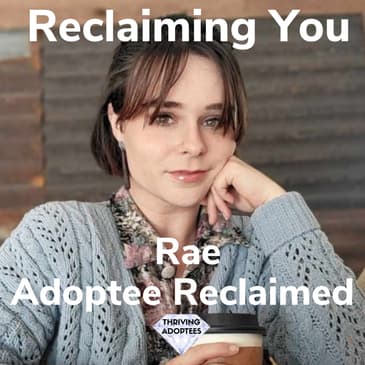
Do you feel you've lost yourself through being adopted? Listen in as adoptee and adoptee coach Rae shares her take on finding ourselves, how insights heal and overcoming emotional challenges. Enlightening and empowering.
Here's a bit about Rae from her website:
I'm a domestic U.S. adoptee, adopted from the foster care system when I was three years old. I spent my whole life trying to be "someone else's child" until my world crashed around me as a senior in college. I was not succeeding while wearing that mask. I was lost. Confused. Unsure what I was experiencing or why things just didn't seem to 'work'. I wanted to self-destruct! When I sought support, the nuances of adoption were rarely addressed. I had never learned how to voice my experience as an adoptee. After college I entered reunion with my biological mother. As our relationship blossomed, there was still so much I couldn't understand. Over time, it became apparent: Adoptees need adoptees.
https://www.adopteereclaimed.com/
https://www.facebook.com/raekrecoverycoach
https://www.instagram.com/adoptee_reclaimed/
Guests and the host are not (unless mentioned) licensed pscyho-therapists and speak from their own opinion only. Seek qualified advice if you need help.
Want to learn more about thriving for you, your kids, your families or your colleagues? Pick a time to talk here
[00:00:00] Hello everybody, welcome to another episode of Thriving
[00:00:05] Doctor's podcast today. I'm delighted to be joined by Ray, Ray of a Doctor who reclaimed.
[00:00:10] Looking forward to our conversation today. I'm excited to be here Simon.
[00:00:15] Yeah, so healing. We all talk about it and every belief that it's an act of reclamation. That's why my handle on Instagram is Dr. Reclaimed. That's what we work with with every adoptee is to re-center themselves in the loss of self they may have experienced in adoption and to really
[00:01:41] reclaim what it means to be adopted for them and discover what that means for them in their own terms and find their communities that honor that side of them is all a part of what we do. Yeah. Yeah. Okay. That's an interesting one. It's a thing I'm pondering at the moment.
[00:03:00] I'm thinking about writing a book and I've got kind of two themes and I could fly the
[00:03:07] way. my life, you wake up and you realize you're a very different person than you were before you started asking those questions and before you started pursuing that healing, which is some of the exciting part about being an adoptee and kind of coming out of the adoptee fog and of us, two people leading the workshop and six others on it. And it was about separating our story from who we are. Hmm. Okay most evenings, my wife. And we watch a lot of cop shows for some reason. And whether they're British or American or German or Polish, right, with subtitles looking at this why in Simon logic, you know, like I'm not tricky word but apologies. So I say trauma is a toxic cocktail of fear, insecurity, shame.es' identities, which is why I think for many adoptees, the process of healing and reclaiming their identity tends to be a bit of that messy entanglement of the story, the trauma, the contents, the actions, the who am I, who am I not. And one of the really exciting privileges I have is walking with
[00:11:04] adoptees as they start to see those distinctions, as you've pointed out, and realize that they are
[00:12:12] with cortisol and that's why it's tricky. That's why the cortisol and the glass are kind of intermingled rather than separated. Yes, yeah. Yeah, interesting point. I don't know if this is the segue you were planning, but I actuallyes and it's fascinating. Fascinating. And I had no, I had no segue planned. I just took that one on aren't we? Sure, yeah definitely. So which is why the one of the themes that comes up quite, it's coming up more and more so is this and I'm looking at this somatic stuff.
[00:17:43] I'm looking at a pure play somatic healer work for some of the body, the somatic stuff, if it's trapped in the body, for sure.'s part of what caught me into coaching actually, but this therapist was really good and understood that there was something pre-verbal related to what was holding dolls that I had in the EMDR session on the blanket. It was wild. It was wild. Before my brain could remember what a precious moments doll even was, I understood that something
[00:20:04] wanted for me and they were nice, they were good people and they just didn't fit what's wrong with me, right? And so I think a lot of times for me, for my story, it was a constant
[00:20:10] like, why can't I get better? What's wrong with me? And so when you said, what's your
[00:20:14] favourite moment of healing? I mean, that just, that lights me up inside because it
[00:20:17] was such a moment of, I guess, relief four, five, six, seven, you're a kid and you don't know what trauma is. It's not your business to know what trauma is. It's not your job to understand mental health. It's not your job to understand the physiology of trauma, right? Like, that's not what kids do. And for us, for adoption, it being a predominantly childhood experience,
[00:21:42] being able to separate that is not something that because none of us were told that. Right. And none of us were told that because, you know, them then is gone, anger towards them is gone. And with all that, all that is part of healing.
[00:25:23] perhaps didn't realize or didn't consider it as necessary because they had this sort of religious adoption agency
[00:25:26] saying, well, here's all the nice, freshly cut material
[00:25:29] for you to read.
[00:25:30] And it wasn't always as scientifically informed.
[00:25:32] It wasn't always as holistically informed.
[00:25:34] It wasn't as respectful as I would have liked it
[00:25:37] to have been.
[00:25:38] I think for a lot of adoptees of my generation,
[00:25:40] of course, every adoption is different.
[00:25:41] Every adoptive parent is different.
[00:25:43] But I do think that there were limitations.
[00:25:46] A lot of younger adoptees like myself I think initially in the moment I was shocked. I was just, it was just shell shock like, oh, whoa. Something's really connected here. And I folded that blanket and I put it up in a corner of my closet to like let it sit for a minute. And after I had let it sit for a minute, I think the transformation was almost immediate. I think I just felt,
[00:27:02] I felt more confident in my approach to my story
[00:27:07] and my identity as an adoptee. So it was almost personal validation of the wound. Right, it's validation of the wound but also easing of it because so much of that is the gaping unknown. So much of it is like, why do I feel so
[00:28:20] sad around my birthday? Like what's wrong with me? You know, like, and you don't have the unconscious becomes conscious. I like that. We become aware of it and it's almost as if we've been scared. Yeah, no, I'm not sure if I've got the right metaphor here.
[00:30:43] I can see the guys, they're a bit abstract, but you're right. I mean, the unknown or the anticipation, however you want to call it, does impact our functioning.
[00:30:50] It impacts our approach, it impacts the story we tell ourselves in our head, the way that
[00:30:54] we feel in our body, it impacts the ways that we move forward and proceed when we have,
[00:31:01] you know, something hidden in the dark and we don't want to venture out.
[00:31:04] When you shine a light out there, you're like, oh, okay, let's go. become delicious because they're true. What do we talk about this? It's a normal reaction to an abnormal occurrence. And we're not going mad. Do any other healing moments come to mind?
[00:33:26] child, I think, and that's something I've been honestly enjoying. As much as I hate being, you know, wheelchair bound and less able to move as I used to, it's been necessary, I
[00:33:32] think, for me to step back and say, you know, care and receiving care and community is a
[00:33:37] good thing. it follows patterns, it has systems. We have years and years, decades and centuries of medical and anecdotal and scientifically studied knowledge about it. The healing of the heart of the self, of the who you are in relation to your family and how your family relates to you and who you are in
[00:35:00] the world because of it, right? All of that is very relational, is a little bit harder to look at, those processes have changed. The difference for me is just thinking about my own experience.
[00:36:22] And also what you just shared in terms of this moment with the blanket,
[00:37:26] degree of action you put yourself in the you put yourself you hung out at the bus stop for insights as I as I like to call it yeah and it happened the the big the the one of the big shifts
[00:37:37] in your life happened in that moment and it's the most obviously it's the most memorable because
[00:38:48] Whereas healing the heart happens in lots, and it's once and done, right? Once my wrist is healed, it's healed.
[00:38:53] You might say, well, it's weak and it could be broken again,
[00:38:56] but that's where there's a limit to every idiom kind of runs out of steam
[00:39:01] and you can argue with it, and you're blue in your face.
[00:39:04] Especially if you're slightly argumentative and logical like I am with stuff. give a diagnosis and then do most. So I'm talking about me. So the metaphor, the primal wound who are diagnosed with like rad, reactive attachment disorder when they're little. It was a way that people could kind of categorize their behavior that they thought was problematic, which would, you know, and if they sit with that label and say, well, then I just have that, and they continue to have disordered relationships throughout their life, and they're creating problems in their romantic partnerships and in
[00:41:40] their, you know, workplaces and whatnot. Yeah, they never't hear the word. So before I got into the adoption space, I spent a lot of time in the personal development space where beliefs are our bogeymen, right? And we're gonna shoot them. Yeah. That's nice, isn't it? What a nice metaphor. Thank you,
[00:43:00] son. Right. But you know, in the adoption space, we don't hear, it's bust a belief with a somatic? I don't know, but you know, you can say, you bust a belief with actions that counter it. A lot of times when we hit this roadblock adoptees who I work with and I, we find that that lack of definition, the, you know, I'm not good enough, all of that comes from not having done things to satisfy
[00:44:23] the opposite of that belief.
[00:44:24] You know, I think a lot of adoptees
[00:44:26] who limit themselves by that, you? It's eight, 12 hours. I can't remember how long it was and I listened to it. And you can sum it up in three letters, yet, right? I can't, I can't, I can't do an adoption podcast yet. Okay. I love that as well. I love that as well, but I'm going to shift your, I'm just going to shift your metaphor slightly to the rocking of a baby tooth. You know, when you had, when, when you still had your baby teeth and wobbly. Yeah. Wobbly
[00:47:01] before they fall out. Yeah. Yeah. So baby and insight is a nice idea, you know, an idea in your head, or something that you get in your heart or a whole body experience of stuff. So you used the word disruption there, I thought I think that's pretty cool, I've not heard that, I've not are and how they relate to you, the trauma, your experience of adoption, your identity, all of these things, they do need to be separated for a little bit for the healing process. But at the end, I think in a really with the contents of the cocktail glass rather than wanting an empty one. Yeah, yeah. There was a great quote I saw that reminded me when you're saying these
[00:52:23] things. I just saw it the other day on Instagram. I'm glad you brought it back at the end because I think that's probably a really good place to bring it in unless you've got anything else that you want to share that I haven't asked you about. No, I think this has been really exciting.
[00:53:41] I really enjoyed the dive into the distinctions there Yeah. So the first part of the first part of the first thing in that metaphor is the involved. Okay. Like a pair of scissors. Okay. So if we get a pair of scissors, and in the game, rock,
[00:57:29] So, but nobody's denying, especially not me, I'm not denying the, the, the, I don't teach wrong because I've felt it. So I'm not going to die. What if, what if our trauma, instead
[00:57:36] of being scissors, because we just kind of given us a way to kind of move from the primal wound to something more maybe adoptee-centric. I think that's really neat. And I just believe it reflects, it reflects, you know, like you said,
[00:59:04] it is in line with your philosophy. horrible thoughts. We may have, we may feel horrible feelings, but we're not our thoughts, not our feelings. We're the space in which that happens and who we are, how we feel isn't who we are. And our thoughts and feelings don't change us, they just hide us.
[01:00:21] We can actually change our thoughts and feel like, which is a neat thing to kind of work on.