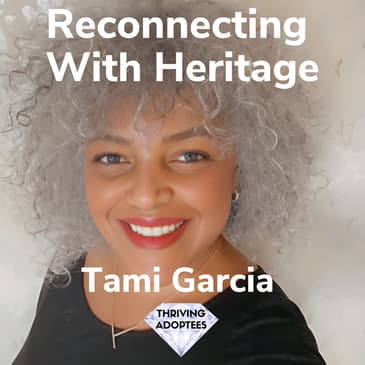
Do you feel disconnected from your cultural heritage or identity? Tami did - even though she wasn't adopted. She was determined her daughter who was born in Ethiopia would feel connected with her heritage. Listen in as we dive into cultural heritage, identity and more.
Here's a bit about Tami from her website:
I grew up disconnected from my Dominican and Jamaican roots, always feeling like I wasn't “enough” of anything—not Latina enough, Caribbean enough, not even Black enough. I carried shame, confusion, and uncertainty about whether I even had the right to claim a heritage I barely knew.
When I began exploring my roots, there were no guides, no roadmaps, or no one to show me where to start. I had to find my own way—slowly, and in a way that felt authentic to me.
When I adopted my Ethiopian-born daughter, I promised she wouldn’t grow up with that same disconnection. That promise became my purpose.
I’m living this work every day—raising an Ethiopian daughter, caring for my aging mother, and navigating my own Dominican/Jamaican identity, all under one roof in Mexico. I know what this journey really looks like—and I’m here to walk it with you.
Now, as a Cultural Heritage Reconnection Coach, I offer the support I once needed. I guide people to rediscover their roots, reclaim pride in who they are, and create a legacy so future generations never have to wonder where they belong.
You don’t need permission to reconnect.
You just need a place to begin—and you don’t have to do it alone.
https://www.instagram.com/tamideegarcia/
https://www.tiktok.com/@tamideegarcia
https://www.facebook.com/TamiDeeGarcia
Guests and the host are not (unless mentioned) licensed pscyho-therapists and speak from their own opinion only. Seek qualified advice if you need help.
Want to learn more about thriving for you, your kids, your families or your colleagues? Pick a time to talk here
[00:00:02] Hello everybody, welcome to another episode of the Thriving Adoptees podcast. Today I'm delighted to be joined by Tami, Tami Garcia. Looking forward to this Tami? Yes, excited. What a brilliant smile. If only listeners you had video and you could see Tami's big, big smile. So Tami is an adopted mum. You adopted a daughter from Ethiopia.
[00:00:30] And she also does some very interesting stuff off the back of what she learned from adopting her daughter from Ethiopia. So, and we often talk about the fact that transracial adoptee or international adoption brings in a different sort of complexity that I've only heard other people talk about.
[00:00:59] I don't have that lived experience myself. So, with all that being said, what comes to mind when you hear the name of the podcast Tami, Thriving Adoptees? What does that mean to you?
[00:01:11] It means giving those adopted the tools so they can live full lives. Those that are living full and they're thriving and living to the best of their ability. And what about thriving more generally, you know, thriving as human beings?
[00:01:44] Well, thriving as human beings, like what within that, as far as thriving? Well, is it the same? Is thriving for the human race living to our full abilities and being equipped to do that?
[00:02:09] Does, does the, to what extent does adoption bring a different flavor to thriving? Or is it the same kind of, is it the same? Is it just like a different flavor of ice cream? Or is it like the whole shebang? Is it the same? I am not adopted.
[00:02:26] I am not adopted. So, when I think of thriving, I think of everyone as a whole adopting. Everyone as a whole being equipped to thrive. However, when I look at being a parent of a child that's adopted, in order for her to thrive, I not only want her to have all of the things that I think about, but I want her to be confident within herself, in her story.
[00:02:54] I'm proud of that and proud of that and being able to carry it all. And so it's my responsibility to give her those tools and the things that she needs, so she can thrive in everything that she is. Yeah. Yeah. When you say carrying it, you mean carrying the story? Yeah.
[00:03:17] Yeah. Her story of, yeah, of who she is. I always tell her that being adopted is not a four letter word. Yeah. You know, there's no nastiness behind it. It shouldn't be behind it, right? And so I want, it's just part of who she is. It's part of her story. So I want her to own that story.
[00:03:42] I tell her, I say, you know, we all have problems and issues. I just don't want adoption to be one of yours. Pick something else.
[00:03:49] Yes. So it's not easy, but I do the best that I can to make sure that I keep an open door about being able to have a conversation about anything that she wants, that she always feels comfortable, that there's no competition between me and her family, her first family.
[00:04:18] None of those things she has. It's a safe space. So giving her a safe space, the tools and anything that she needs so she can thrive in life. So I don't see her situation as being any different for thriving. Although she has, she needs some additional resources at times and that's fine. Yeah. Has she picked something else yet?
[00:04:52] Maybe. She's 14. So she picks many things as a teen. Yeah. Yeah. Yeah. Well, being a teenager, but they're not going to say that though, are they? They're not going to volunteer that information. I'm presuming like me and my wife haven't got any kids, but I'm presuming she's going to turn it around. Teenagers, are you going to blame themselves? They're going to blame somebody else. That's right. She, she is very headstrong. She's like a little bulldozer.
[00:05:18] Bulldozer. So I keep telling myself that this is going to serve her well when she gets older. I'm just trying to make it through the 10 years. Right. Yeah. A bulldozer. So what going at full force? Does she go through brick walls? Is she, is this, is this a, is this a way of overcoming obstacles just to plow through or what's that about? She is very headstrong, very headstrong and wants to stand in her point, whether it be right or wrong.
[00:05:51] And so that's what I mean, you know, a bulldozer. And she just, she doesn't let go of like, if she wants to do something and wants to make a point, she doesn't let go easily of things. Yeah. So tenacity, tenacious. Okay. We can call it that. Yeah. Stubborn. Stubborn.
[00:06:16] I mean, I, I, I think of myself as pretty tenacious, but sometimes I, I keep going too, too far. You know, I, I flock the dead horse. Right. So, you know, I'm not asking you to comment on your daughter on this point, right? Okay. I'm just talking about me. You know, sometimes I, I, sometimes I keep, I keep twisting when I should have stuck.
[00:06:48] Yeah. Yeah. Yeah. So when you talk about her, her story and given the work that you do in, well, yeah. Can you, can you explain how, how raising your daughter helped you come up with the idea for what you do for a, for a woman?
[00:07:14] Sure. No problem. So what I do is a combination of raising my daughter and my background. So I was personally, I am not adopted, but I was raised disconnected from my cultural heritage.
[00:07:30] And my family is from the Dominican Republic in Jamaica, but I was raised in Cleveland, Ohio in the U S and I never quite fit in. I wasn't black enough. I wasn't Latino enough. Kids laughed at me for being a Garcia who couldn't speak Spanish or Patois. And everybody just told me that I was trying to be something that I wasn't, but I was just trying to be who I was. Right.
[00:07:57] And then I went to college. I went to Howard university in Washington, DC. And I always call that my second greatest love after my daughter. She's my first love. And I was surrounded just by people who were embracing their identities. And I decided that it was time for me to explore mine.
[00:08:17] And so I learned like the more that I was learning, the more I wanted to learn and the more confident I became. And so I vowed at this point that I would never let my children go through what I went through. Later, I adopted my daughter from Ethiopia. And so at that point, I made a promise to her, her country, her family, that she would stay connected to her heritage. But I quickly realized that it really wasn't as simple as I thought that it would be.
[00:08:46] Even in a city like Washington, DC, that has the largest population of Ethiopians outside of Ethiopia, it wasn't easy. And I would ask my Ethiopian friends, like, where should I go? What can I do to keep her connected? What are all these things? And they didn't even know, because surprising to me, they were having similar challenges of keeping their kids connected to the culture. And so they said to me, when you figure it out, let me know.
[00:09:15] So I was like, oh, man, it really shouldn't be this hard, right? So that was kind of like the tipping point for me. And that's when I decided that I was going to build something to help people stay connected to their culture. So I started building programming for kids, keeping them connected to their culture. And then we had COVID and all these different things.
[00:09:36] And so I just kind of progressed into the work that I do now in helping people as a heritage reconnection coach and as an author of Rediscovering Your Roots. So that's kind of how I got there. And, you know, people say, well, this heritage reconnection coach, that's how did you come to that? And how did you do that? It's really interesting. And so my answer to that is always I just kind of made it up.
[00:10:08] Like there wasn't a term for the work that I was doing. So I just decided that I was going to create one. Right. And I had always been doing work. The majority of my career was around working with marginalized populations. So I worked with a lot of asylees, refugees, other immigrants, and to help them hold on to their culture and identity while they were shifting to a new place.
[00:10:35] And then so combined with all those things, I wanted to create something that would make it easier for people to do that. And, you know, with the popularity of the genealogy testing, it was this thing about, well, once you get your results or you know what your makeup is, what do you do? Like how do you turn those percentages into connection and community and belonging, all of those things?
[00:11:05] And so that's how I stepped into that space with the work that I do. Okay. So can you connect the two things then in terms of how this cultural consciousness, if you like, how that helps your daughter thrive? How it helps my daughter thrive. Yeah.
[00:11:35] So for her, knowing who she is, has really been key. So if you notice, I always say reconnection, not connection. Right. Did I say connection? I'm sorry? Did I say connection? No, I don't know if you did. I don't think so. But I was just saying a lot of people were like connection, reconnection, whatever.
[00:12:04] But I always say reconnection because the reconnection is the part that we've always had this, right? We've always been a part of that, our heritage. So I'm big on, and you will hear me say it in a lot of different ways, that your heritage is your birthright. It's yours no matter how much or how little you know about it. It's yours. It's nothing that you can take away.
[00:12:31] And it's like a gift from your ancestors, right? So this is who you are. So regardless of her being born in Ethiopia and not raised within Ethiopia, it's still been part of her.
[00:12:46] So for me, in keeping that cultural connection, it was very important because I know that knowing who you are, it helps you in confidence and in your pride. And it's building of your foundation. And without that foundation, it makes it very difficult to withstand the pressures of the world and of society.
[00:13:16] So in raising my daughter, one thing that I did was that make culture not optional. Her heritage was just not optional, right? And so everything I did around that, I was very intentional about the work that I did and how she interacted with it. Even if I didn't know it, I knew that it was important for her.
[00:13:44] So there's a sense really that rediscovering your roots helped you feel more confident in yourself and thrive. But that didn't happen until college. You know, maybe you were in a small town and you went to a larger college where it was more diverse, I'm guessing.
[00:14:13] Was that kind of the... Correct. Yeah. Well, it wasn't... Cleveland is not really a small town, but at that time it wasn't super diverse around different ethnic groups, right? Okay. So it was about the lack of diversity rather than the size of the place, but the university. Yeah. So you rediscovered your roots and started rediscovering your roots at college.
[00:14:39] And you wanted to make sure that your daughter did it a long, long time before that. Correct. I wanted it... For me, it wasn't something that I was raised with. And I always wanted to know more and connect.
[00:14:58] But like many immigrant families, which you can align to with adoptive families if they come from different backgrounds of their children, that they're just trying to live their lives, right? And to make a living. And what my family called, you know, like the dream, right? The American dream since we're in the U.S.
[00:15:21] And there wasn't much time for our family to really delve into the traditions. It was like, we're just living. This is what we are. And it wasn't a big deal. But for them, because they knew those things and they were able to connect, I think they just assumed that it would carry over with each generation, but it didn't.
[00:15:43] So then like adoptive families, they don't know the culture, the heritage, they don't have the time to connect and to figure it out. It feels so overwhelming that they don't do those things. And then you have this little person that's left with these questions and they know they're different and they see all these things and there's nobody to connect with and nobody can answer their questions.
[00:16:07] So they grow up with all these questions and this lack of identity around who they really are. So. So is something missing? Is it something missing? Is it? Absolutely. Something is missing in who you are because you don't know who you are. So and then people are trying to tell you who you are based on how you look or what they think you should know.
[00:16:36] So then it turns into another type of imposter syndrome, which is a cultural imposter syndrome. And then we all know of what an imposter syndrome does.
[00:16:45] And I had all of those things until I started really looking into my roots and who I was and started connecting and understanding all of those things and being able to grasp on two different pieces and bring them into my world and begin living that.
[00:17:11] So for my daughter, I didn't want her to have those challenges. I wanted her heritage to be a part of who she was, her core makeup from day one. Right. So, you know, and that's what I said. I was very intentional and her heritage was not an option. So from day one, she knew she was adopted. She knew she was Ethiopian.
[00:17:40] She knew mommy wasn't Ethiopian, was something different. But this was our family. Right. So I always say that our family is Gritz, Plantsen, and Dorawat. So Gritz is for African, you know, the African American and Black American side. And Dorawat is an Ethiopian dish. It's like a chicken stew.
[00:18:07] And then Plantsen, you know, it's a Caribbean vegetable. So that's what I always call our family. So that's what she grew up with always. And I just created rituals around those things. Like every Friday, we would go eat Ethiopian food.
[00:18:29] And there was a point when she was maybe four or five that she wanted to reject the idea of being Ethiopian. And we're in the Ethiopian restaurant. And it was me, her, and my mother. And she starts having a tantrum around, I don't want to eat this. I don't like it. I don't want it.
[00:18:57] And everybody's looking at me. And I'm so embarrassed. Because she looks Ethiopian. And so people are wondering, like, what's going on? And most people, they think I'm Ethiopian as well, even though I'm not. But they're just wondering why. When they start trying to speak to me and I'm haric, then they know that I'm not Ethiopian. But anyway, my mother is saying, well, if she doesn't want it, she doesn't have to eat it.
[00:19:26] And don't make her eat it and do it. And I told my mother, I said, no, this is not optional. I am not raising a little Ethiopian girl to dislike her culture, to dislike her food, to not be able to relate to it. So she's going to eat it. But truth be told, I said, Isley, please eat the food. I'll take you to get ice cream afterwards. Yeah. It's not that.
[00:19:58] So, yeah, what sort of ice cream did you have? I guess you've got to have different colors, right? Yeah, it really didn't matter. She just wanted ice cream. Ice cream, okay. But the point is that, and we move through that, and she even laughs about it today. She says, can you imagine if I didn't like Ethiopian food? If I didn't like, and Jer, if I didn't want to eat it? She'll go, you remember that one time in the restaurant? I said, I don't know. She said, well, that was good that you did that, mommy. She said, you always try to make sure that I know my culture and everything.
[00:20:28] I said, yes. So that's what I say that, you know, education is not optional. Our kids wake up in their days, they don't want to go to school, right? And they throw tantrums, but they have to go. And something that's so core to our development and who we are as your heritage, your identity, that it just should not be optional. Yeah.
[00:20:55] So you've got your wall behind you, and it's got the rediscovering your roots, right? Yeah. So how does this thing work, right? How does rediscovering the roots help the tree be stronger? Yeah. What's that about? How does that work? Right.
[00:21:21] So rediscovering your roots, reconnection, it's not a one-time event. It's something, it's a series of small things that you do over and over again. But here's the key, in ways that work for you. So people have to understand that.
[00:21:46] There is no magic pill around heritage, right? There's no connection. There's no test that you have to take, that you have to prove your authenticity or your heritage, right? Nobody's going to question you on it. There's no cape that you're going to get afterwards. There's none of those things, right? There's not one way to do heritage.
[00:22:13] So you have to figure out what works for you in your situation. So in our case, because our family is a big mixture of all of these things, and to add, I live in Mexico right now.
[00:22:35] So we're American, Black American, Ethiopian, Dominican, Jamaican, all those things that are living in Mexico. So we celebrate all of the cultures the best that we can. So like fusion cooking, I'll call it like heritage fusion, right? So we just throw everything in there together and celebrate what we can and what we're interested in. But we always have different pieces of our heritage. We have artwork all over the place all the time.
[00:23:04] We play different music and foods and these things. So that's what people need to understand, that you pick what works for you and you begin to do it. So through the book, there's four steps that I have for people to understand about reconnection. Yeah, reconnection and connecting to your roots. So it's, I call it the seed approach.
[00:23:32] And so it's where you start just with curiosity and you seek out what you know. So this is like your baseline where you're answering questions. What are those things that you know? You're gathering all this information because oftentimes we know more than we think we know. But instead of starting from a place of loss, let's, I don't believe in that. I like to start from a place of appreciation.
[00:24:02] What do you know? And let's build on that. So we're going to start there. And then once we get those things, it's we embrace what's there, right?
[00:24:16] And so we start to embrace all of these pieces that we've put together and this new identity we're working on forming at the same time while looking at some of our challenges and the things that have held us back. But we have to look at that and then remember, like what I said, remember that our heritage is ours, no matter how much we know about it. So do that.
[00:24:43] And then once we do that, we begin to express it in our life. And so that's the pick what works for you and figure out how you can become involved in the heritage because it's not a one time event, right? It's things you do over and over and over again. And so that's where you want to get to the point that it is just who you are and it is part of your life and all these different pieces.
[00:25:11] And before you, once you start doing these things, before you know it, it's like everywhere, right? This is who you are and you're proud of those things. And then finally, it's develop. So you take all of these different pieces of the work that you've been doing, the things that you're learning, and you put it all together and start creating this legacy of what you want to pass down to generations, you know, the future generations.
[00:25:40] So they are more engaged, you know, so you make sure that they're engaged and with your heritage, and you're putting together those things. So it's not repeated for generations past. Yeah. So, you know, I'm thinking of, well, actually, I'm thinking of a question for you. And I kind of alluded it to when I introduced you.
[00:26:09] But do you consider yourself, and if it's just too narrow a label, you don't like it, right? And if it comes across as insensitive, but do you consider yourself a transracial, somebody who has adopted transracially?
[00:26:35] Would you use that sort of language or is that too labeling? Is that too narrow for you? I don't consider myself a transracial. Yeah, an adopted parent, I don't.
[00:26:55] Because, but what you're saying sounds eminently useful information for transracial adopted parents. You know, and I'm thinking, that's what I'm thinking as a guy who has admitted he's naive in this area as a white guy,
[00:27:18] brought up by white adoptive parents, and in a very white part of the UK. So I'm really naive around this stuff, you know? For sure. But what I'm speaking is definitely applicable to transracial adoptions to, and of course, multicultural and different families.
[00:27:46] And so the work that I do is not limited to races. I simply don't consider myself a transracial adoptee, or adoptive parent rather, because we are the same race, right? Right. And so as Black people within the diaspora, we're a mixture of many, from many different ethnic groups, right?
[00:28:16] So that's why I don't consider who I am as a transracial parent, because it's the same race. Okay. And as I listen to you, and as I think about the stuff that you've been sharing, I think that this information that you're talking about is also really interesting food for thought for a transracial adoptee who's listening.
[00:28:46] Yeah, absolutely. Absolutely. I'm involved in the adoption community for the Ethiopian adoption community. There are many groups with that. I'm also in other different adoption communities.
[00:29:04] And it's very important for adoptive parents, regardless of race, to make sure that our kids are connected to their cultures, right? Their birth cultures. Because it is who they are, we can't take that away.
[00:29:28] For transracial, it's even more important because your child cannot fake or pass off or ignore the fact that they are not your bio children. That's not something that can be passed off. And I've heard many times that love should be enough.
[00:29:54] And we don't like to focus on those things, color or culture or those things. We just love our kids. But the fact of the matter is, it's not enough. Love simply is not enough. And we cannot take away our child's identity. You cannot love it away. You cannot wish for them to be something else. And by taking that attitude, we're doing a disservice to our children, right?
[00:30:23] And I've seen, and I'm sure you've heard, as these children are starting to age and become adults, the stories that they're telling. And I listen to these podcasts and read these books on especially children, you know, Asian children, Ethiopian children, Haitians, up from other different ethnicities who have been raised
[00:30:49] by families who don't acknowledge who they are and carry the biases with them and transfer that to their children. Or they keep them away from their culture because they don't think it's necessary, because they live wherever now. And this is not who they are. We're doing disservice to them.
[00:31:13] And it's only creating thousands of adults who are dysfunctional. And they can't, they don't have any place to go. As I said, it was hard for me. I never felt like I was Black enough or Latino enough. These children, they're growing up and they feel that way. They don't feel comfortable in whatever their group is.
[00:31:42] So we'll say, you know, a Black group or an Asian group for now. They're not white, so they're not comfortable within that white group. They don't have any place to go. They don't belong anywhere. And so they're trying to fight that and figure out where they belong. I've just heard stories over and over and over again.
[00:32:07] So this is, you know, another reason why I am so adamant and do the work that I do. And I'm so passionate about it because there are different communities all over the world that are facing these challenges. You used dysfunctional, which seems to me is a really strong word.
[00:32:32] And I guess that, you know, my reaction to it was, oh, that kind of shocked me a little bit. And I'm a guy that's already admitted twice during this conversation, right, that I'm naive around this area. So maybe that's why it hit me because it's like one of those things.
[00:33:03] Like we can have the, you said it's not once and done, right? Rediscovering you, it's not once and done. I often think about understanding as we're raised at school to understand, you know, is the answer, you know, is it black or white? Is the answer correct or incorrect? Is it true or is it false?
[00:33:32] And is it a one or a zero, you know, in the computer world, in the world of digits, right? But stuff like this isn't one or zero. It's like it has infinite depth. It's like a learning that keeps on learning.
[00:33:55] A metaphor that I came up for this was the, you know, we talk about an insight like the penny drops. Right. So the penny drops. I listened to a transracial adoptee. I interviewed a transracial adoptee. And I'm thinking of an Asian transracial adoptee I interviewed maybe four years ago.
[00:34:19] And she said that she felt like a banana, yellow on the outside and white on the inside. So it was very confusing for her. That's what it's saying. So I heard that. And, oh, that lands for me. But then, so I have the insight.
[00:34:45] But what I'm seeing more and more is that insights keep, you know, we talk about the penny dropping. A penny in a well, dropping a penny in a well for good luck, right? It drops, it falls through the air. It gives a little plunk when it hits the water and then it settles down and it lands on the bottom of the well. What we're talking about here is, well, infinite wells.
[00:35:16] So this, this understanding and this, maybe this, the roots, the roots keep, keep strengthening, keep growing. There's always kind of more. It's like an infinite learning thing. Absolutely. So it's about the, it's about the depth of our understanding.
[00:35:43] And like, we have to, we have to get this sort of stuff fairly deep or else we're going to treat it with, treat it shallowly. You know, I remember, I'm thinking about a woman that I interviewed that was talking about the importance of hair to African-Americans, right?
[00:36:11] And, and, and she, you know, she had this range of, of, of, of her stuff. And if we're not careful, the transracial adoption kind of tactics are that shallow. Oh, well, we've got, you know, so where, where's, where does the, where does the depth come from?
[00:36:34] Also, you know, you, you've been talking a lot about creativity really for me, rather than giving people 10 commandments on this. You've given them a, you've alluded, you've described a four-step process. And, and the person that's involved in that process or the people that are involved in the process, the family that's involved in that process, they have to kind of create their own way. And that's part of the, that's part of the fun, right?
[00:37:05] Yeah. So I don't give a step-by-step process because everyone is different. Everyone's situation is different. Everyone enters this space with a different level of connection, right? And who they are, they're going to have to, like you said, find their own way and connect their own way.
[00:37:34] The best in those things that they're open to. And I'm just a firm believer that you have to figure out what works for you within your situation. And that's absolutely part of the fun in it. And you've got to own it. You've got to own the solution. You've got to own the solution. Exactly. And that depth that you speak of, it comes from those repetitive actions, right? Over and over and over again.
[00:38:03] And it's never going to end. And it could be at a conversation that you have with someone. It could be your next door neighbor that had a guest over. And you find out they have the same background as you. And you end up in this long conversation. And you come out of it maybe with a new root, right? And it's a little deeper. Or it could be at an event.
[00:38:33] It could be a podcast. It could be when you travel. So I've traveled to Dominican Republic many times. After college, I moved to New York City to a Dominican neighborhood and worked in a Dominican nonprofit. Because I needed to become part of the community.
[00:39:00] And doing that, it was the first time in my life that no one asked me, what are you mixed with? Who are you? Everybody just looked like my family. And they assumed I was one of them. It was great. It was the best time, the absolute best time of my life. And then, but my mother also, she never lived in a community like that. She never did that.
[00:39:27] So my mother's, her understanding and her connection with her heritage is very surface. And she had never traveled to Dominican Republic. Because she was born in Spanish Harlem in New York City. But they had moved from there. So I took her to Dominican Republic with my daughter. And we spent almost two months there. Traveling throughout the country and doing all the things.
[00:39:55] Her connection, her roots, they got a little deeper. Because she was able to finally, you know, as they say, you know, kiss the land that your ancestors walked on. And she's to do all those things. But for me, I had traveled there. And I had been there many times. But I had never spent that amount of period in the country. And so for me, my roots got deeper. Much deeper.
[00:40:20] Because I was able to say, now I'm able to say, oh yeah, I've lived in country or traveled there for this amount of time. And I've been here. I've been there. I know these different people there, right? Who are not my family. But I've spent so much time with them. People were treating me just like a local. And the things that people were saying to me and bringing out bottles of wine. You know, just those.
[00:40:50] It gave me this feeling that I had been searching for for so long that I only get in certain places. Like when I lived in New York City, I got that feeling. But it was that heart-centered feeling of home, of acceptance, of belonging. And that's what we're all searching for. That feeling of that belongingness, of acceptance, of some community of going somewhere, right? And so I'm saying that your roots with each interaction, things will get deeper.
[00:41:19] You'll get a different root. But it's repetitive over and over again. And you never know what you're going to get, but you have to be open to it. So those that are held back from these types of connections, right? When I say I have that heart-centered and this feeling of belongingness, they don't have that. They're missing that.
[00:41:48] And they know that they're supposed to feel that, but they don't feel that. So while they might love, and they probably do love their adoptive parents and are happy with, however, not everybody, but with how they were raised and appreciative or whatever, all those things, there is still going to be a hole.
[00:42:12] And there's absolutely nothing that you can do as being a transracial adoptive parent outside of that to give that space to them. So that's what I say by keeping them away from that and not allowing them the space to explore that is doing a disservice to them.
[00:42:37] And there are growing up with all this wanting and not understanding, and it does create dysfunctionality. But the stories that you read when people are beginning to connect with that and how it makes them feel.
[00:42:57] Now, even though for my daughter, she grows up in a house where we're the same race, not ethnicity, she has said to me at times that she wants to talk about her birth family or her culture and things, but she doesn't want to make me feel bad. I have, and I kind of giggle sometimes when we talk about it because I have changed my career and I'm trying to build something new for her because of her, right?
[00:43:28] And because I believe in this work. And she still feels that way sometimes. And I don't take her feelings from her. I let her speak and it's who she is. She can say what she wants, but it's my role to come back and make sure that she understands that that's not the case. So imagine how someone feels that they do not have that. Yeah.
[00:43:50] She's saying, well, what she's saying is almost, it's agreeing with my stuff. There's no, there's no, my thought that this is infinite. Yeah, it's infinite. There's always, there's always more, there's always more to be done. So she has asked, her desire is to spend, we spent time in Dominican Republic. I did that for my mother.
[00:44:19] So her desire is to spend time in Ethiopia. So my plan, because we haven't been back since she's come home in 12 months. My plan is next summer to spend at least two months there. I would like to spend a year, but we'll see how that works out if we'll spend her 10th grade year there. So, but that's the plan.
[00:44:46] So she can, you know, just be who she is and live in country and experience all the things. It's an immersion. The word that came to me was immersion, right? As you were describing your time in Spanish Harlem, your time in Dominican Republic, it's, it's, it's immersion stuff. Yeah. Yeah. She's very proud of who she is.
[00:45:11] I've raised her to be very proud and what she knows, she can speak about it and stand up for who she is and her culture and all of those things. But she doesn't have that heart centered, those feelings yet. And she hasn't lived there enough to, I think, just to stand a little taller and, and the sense that I got once I was there. And she deserves that. Yeah. She deserves that.
[00:45:39] I'm thinking what you have to do that because you have to go there because otherwise, well, here in the UK, that, that, you know, if you think about Ethiopia, like what, what do we see of Ethiopia?
[00:45:53] It's literally, it's, it's, it's, it's, it's, it's, it's, it's, it's, it's, it's, it's long distance runners. That, that's about it in terms of what we see in mainstream culture here in the UK of Ethiopia. And clearly that's not even touch that.
[00:46:20] It's very, not even, it's, yeah, it's very, very superficial. Very, there's, there's nothing there. Yeah. And, and that's not it. Ethiopia is a beautiful country with people and a lot to do and they're thriving. You know, they have challenges just like everywhere else and they're figuring it out. But the parts, the good parts and that are thriving and how they're developing and all that, that's not shown. You're correct. You're correct.
[00:46:52] Thank you, Tammy. Is there anything that you want to mention that I haven't asked you about? Well, I wanted to share how to connect. Yeah. There's going to be some links. There'll be links in the show notes. Okay.
[00:47:13] And, you know, if I could just give any advice to adoptive parents and adoptees, it would be that for parents. Start now. You know, start helping your children connect with their culture. Be intentional about it. This is your job. You know, put the music on, learn the recipes, take them places.
[00:47:43] Like you cannot keep this from them. You know, and for adoptees, no matter how long it's been since you've connected with it. If you've never been to a country, even if you don't feel like you're worthy, like you're not authentic, you can't go there. It's not true. These are just stories that we tell ourselves. Right.
[00:48:11] And what I say is that your heritage is your birthright. So it's no matter how much or how little you know, how big your DNA is, how small it is. It is yours. And nobody can take that from you. So step in there and start exploring it. Pick one thing and build from there.
[00:48:39] Because building from that point, that's that. When it becomes bigger, your roots become deeper. And that's where the change comes from. Brilliant. Thank you, Tammy. And thank you listeners. We'll speak to you again very soon. Bye bye. Thank you.