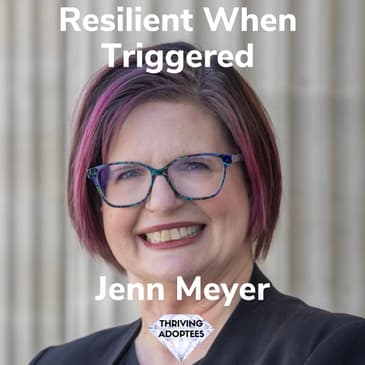
Would you like to be triggered less? More resilient when you are triggered? Listen in as Jenn and I dive deep into resilience for insights on how you react, bouncing back faster and more...
Jenn is Director of Kansas Caregiver Training & Support and brings a unique blend of academic expertise and lived experience to her work at the Children’s Alliance. She holds both undergraduate and graduate degrees in education, with a focus in her graduate studies on neuroscience and trauma. As a former foster parent and current adoptive parent, Jenn brings a personal and compassionate lens to her professional work.
As a trainer, Jenn is known for her warmth, empathy, humor, and authenticity—qualities rooted in both her personal journey and her deep understanding of trauma-informed care. She is passionate about the power of connection within families and its role in healing and resilience. In her free time, she loves to be with her husband and three daughters or cheering on the Kansas City Chiefs and Royals.
More about The Children’s Alliance Of Kansas at
https://www.facebook.com/childallyks
Guests and the host are not (unless mentioned) licensed pscyho-therapists and speak from their own opinion only. Seek qualified advice if you need help.
Want to learn more about thriving for you, your kids, your families or your colleagues? Pick a time to talk here
[00:00:02] Hello everybody, welcome to another episode of Thriving Adoptees Podcast. Today I'm delighted to be joined by Jenn, Jenn Meyer from Kansas, from the Children's Alliance of Kansas. I'm looking forward to this today Jenn. Thank you so much for having me, I appreciate it. You're very welcome. So as well as working for the Children's Alliance of Kansas, Jenn is a mum through adoption, so you
[00:00:28] have three kids and the youngest, I think it's your youngest that's adopted right? It is. Yeah, she came to us from the hospital and then we adopted her right before she turned two. Fantastic, cool. So thriving, what does thriving mean to you Jenn? I've been thinking about that a lot and for me
[00:00:50] I think thriving means really living my values and living who I was meant to be, kind of knowing who I am but still being willing to grow and to learn things. I think also I think thriving really means knowing that it's not all going to be perfect and that there will be some hard times but being able
[00:01:15] to get through those hard times. Yeah. So a strength then? Some kind of inner strength or fortitude or? Definitely, yes. Definitely that inner strength, that resilience to keep going on. Yeah. Because we use this word resilience a lot don't we? We do. We do. And like it's even part of the
[00:01:42] Thrive framework so Jen and I are meeting next week to look at this Thrive framework which I which I've put together from what I've learned and the R of the Thrive is resilience. So it's yeah, it's a favourite topic, favourite topic of mine. What does it mean to you? What does resilience mean to you?
[00:02:07] I think again, that is, that's just it. It's being able to just have that inner strength to be able to work through the chaos and have that support around you and just knowing that that I can help other people too. So I think when you're resilient, you're not only resilient, like you're resilient for yourself but in that resilience you can help other people find their resilience too.
[00:02:38] Yeah. Yeah. I totally agree with that. I totally agree with that. One of the things that kind of fascinates me about resilience, is it like, is it a skill? Is it an ability? Is it a function? Is it all of those things? How do you see it? I think, I mean, probably all of those things. I definitely think it's something that you can learn,
[00:03:03] something that you can grow upon. So probably a skill, I think, describes it really well. I don't know if you are just naturally born with that resilience. I think it's something you kind of have to learn. And honestly, you probably have to learn that by going through some hard things, going through some times that can challenge you. Yeah. I'm fascinated by the different takes on it.
[00:03:33] My own take on it is, it's in line with going through some tough stuff. So I kind of think it's a skill or it's an ability, but it's something that we see often after the event. Yeah. So we don't think, like something, so like if somebody said to us, how will you cope
[00:03:59] if this happens? And we say, well, I don't know whether I cope at all. I'm not sure whether I'm resilient enough, da-da-da-da-da-da. And so we kind of, if we look back after how we got through something, then we kind of appreciate it after the event, if we even notice it at all. Because
[00:04:24] as a busy mum, right? With three, I know you're two older girls, they've fledged, right? They're not. They have, yes. But as busy people, like busy mums, like busy dads, we're also busy, busy, busy. But I don't think that
[00:04:44] we kind of often stop and take stock. And yes, it's the resilience. Oh yeah. Okay. Yeah. Yeah. That kind of makes sense. Yeah. That's resilience. And then what's next? Right. Right. Yeah. I don't know that you know that you're resilient until you've actually gone through a challenging time. Yes. But
[00:05:08] I'm also really interested in what can you do ahead of those challenging times to help you through them. So that's something that's really interesting to me too. Yeah. Well, first off, I talked about resilience being part of Thrive and a key topic of mine. Then I spent about four, five, six sentences
[00:05:35] describing it and you did it in one, right? So yeah, it's, and it's, it's, it's good that it's so big or else we wouldn't have, we wouldn't have much to talk about. But I like, so sometimes if it's a skill, right, it's honing it. I don't know, can we hone it without, can we hone, can we hone resilience
[00:06:03] in advance of the tough times? I don't know. Is it a capacity that we see, we see in ourselves so we can say, right, well, I got that happened and I got through that. So is this a transferable capacity or skill that I can take forward into future tough stuff? Fascinating.
[00:06:31] Yeah, I, I think so. I think, again, it's almost that you have to start with that challenging time to be resilient and then look back, like what would have helped me even more make it through this time? Or what will I do better next time? What will I, to use your word, hone, what will I work on so that I can go through that
[00:06:55] next time with even more resilience? I also think of resilience as, as you describe it there, as a little bit of detachment and distance between our emotions. So if, if we feel that we're going to be, if we, if we feel overwhelmed, it, in, in, uh, yeah, so this is what often happens to me, right?
[00:07:24] Something happens, I feel overwhelmed and that, that's kind of my initial reaction. And then, then that kind of dissipates and maybe a minute or maybe an hour, not usually more than that. I'm onto, okay, so what am I going to do? So initially it might knock me the, right. So I, I, I had some
[00:07:51] challenges with a central heating system last week. And I only became aware of them at six o'clock in the evening when no, no boiler engineer is going to come out. Oh no, no. And we had the, we had the, the, the tenant moving. So this is on a rented property, a property that we rent out. So the, the, the, um,
[00:08:20] the, the guys coming in, the, the new tenants coming in and he's come in in about eight o'clock. And I'm floored by this because I have no ability to fix the, the, the, the, the boiler. I don't know whether it's a boiler issue or an electrical issue. And this is going around my head. How am I going to solve this? Okay. All right. I text my wife when she says, well, get a heater there.
[00:08:50] Yes. You know, I, um, so, but, but then the following morning, everything becomes clear and I, I, and I'm okay, well, I'm, I'm going to, I'm, I'm going to ring the, ring the guys really early and see if they can come out. And one guy didn't answer. So I rang another guy and that guy was out within an hour and a half and it was fixed another hour after that. So there was an initial kind of
[00:09:19] panic. Yes. Yes. But I'm giving an example here that's quite superficial, but it didn't feel superficial at the time. Right. And it's definitely a long way from the challenges that raising adoptees kids can, or any kid, right. You know, we went through a challenging time I did as a mother last
[00:09:45] year. And, um, one of the things I really feel like it's so important for us as adoptive parents to talk about those challenging times because nobody wants to, nobody wants to say when it's hard and what that feels like as a parent. But, um, it was very interesting. So I tried to talk about it like
[00:10:07] about two months after that, it had all happened, not ready at all to talk about it. And, um, it was really hard and I even prepared myself. Um, and it was just, I couldn't do it. Um, but then like I continued to work on that resilience. I continued to work on taking care of myself so that, um, so that I could start to talk about it. Um, and so I did actually a presentation on it, um,
[00:10:36] last month, much better because I had had that space. I've had that time to, um, to look at it and kind of step back, think about all those emotions and really kind of think about my resilience through that. Yeah. So although they're two very different things and the, the, the space was the, was the thing that was similar to my lawyer and your more profound and more worrying
[00:11:06] issue. Right. Yes. Yeah. Yeah. That space, that space just to be able to kind of, like you said, look at, look at that as emotions, look at, um, how you're feeling. Yeah. Is it space between us and the emotions that are threatening to overwhelm us in the moment? Oh yeah. Yeah. So it's kind of edging into
[00:11:31] kind of emotional intelligence, isn't it? Like I, I think I've asked a few people about this. I it seemed, it seemed to be really big at some point, but it seems to have kind of gone off the radar,
[00:11:57] but clearly not in, in your, in, in your spaces. For me, it was more, more of a thing that's been, I don't know. It's, it's, it's, it's some new people have, it's been a trend and then the trend has come in that, that'd be interesting to put it into, into Google and put emotional intelligence and find out how many searches they've been. Right. Yes. Yeah. Yeah. I think we are still,
[00:12:26] especially in, um, in my job, I think we are still hearing about, um, emotional intelligence and still talking about that. Um, and helping, helping our adoptees really be able to describe those emotions. Yeah. And I think that's different too. I mean, as a kid, I didn't grow up talking about my emotions. Um, we were either happy or upset. And so that was really all that we kind of talked about. And so now
[00:12:52] really, um, really exploring those more. Yeah. The thing I remember about emotional intelligence, well, a few things, um, first one, it's a far bigger definer or driver of our success in life
[00:13:16] than IQ. So you call it EQ, don't they? IQ is intelligent questions. EQ is emotional attention. Quotient. And it's something like, I think I remember something like eight times, it's eight times more powerful, a predictor of success than, than, than I, than IQ. So that,
[00:13:42] that, but, but then again, you know, when I say that it's off the radar, people don't talk about that a lot. Although that's, that's a fact that these, or that, that's a, that's a finding from the research that these guys have done. Right. But, but the, I wonder how many schools have, I wonder how many schools say that to, to, to their kiddos? I don't know. Maybe I'm being prejudiced.
[00:14:09] Maybe I'm just thinking about the old way. Um, when I was a kid, right. That it was all about IQ, but, uh, I don't know. To what extent do you think, uh, do you think today's schools are more kind of in tune with that? I do. Yeah. Yeah. I really do think that they are. I think very much so, um, in really helping our kiddos to explain, you know, to think about not only understanding that emotion,
[00:14:34] but then reacting to it or not reacting. Like how can you handle that emotion in an appropriate way? Um, so really kind of looking that in both, um, in both sections. Yeah. So that goes back to what you were talking about with at the top of the conversation about, um, thriving. So a capacity within
[00:14:58] and a capacity without, right. With our, with our kids. And the other thing that I remember from doing that emotional intelligence, I did an emotional intelligence, like a questionnaire as part of, I think about a book and then you got a token to soon you go online and check out your own emotional intelligence. Uh, and then it gives you the results back from it.
[00:15:23] I do recall the first, there's, there's kind of four quadrants and the first two were very internal focused. So they were about us and our inner relationship if you like. And then the second two were about our relationships with, with others. So the whole emphasis was it starts with us, which is going to be key for any parenting message. Oh, definitely. Definitely. And don't I really find
[00:15:53] that almost everything when we think about parenting and training our families really does start with us. It starts with our mindset. It starts with thinking about things that we bring, um, to parenting. Um, it just, yeah, everything really starts with us before we can even, um, you know, help our kiddos. We've got to really think about what are we bringing to this? What are we, you know, what's, what's that baggage that we're bringing?
[00:16:19] Yeah. And that was one of the most profound lessons I had early on from, from interviewing an adoptive mom. So she was an insurance agency as well. She was in Texas rather than Kansas. And she said that, uh, raising adoptive parents is sorry, raising adopted kids is about releasing our own emotional
[00:16:48] baggage as adoptive parents. So she was clearly in that camp where, uh, that it starts, it starts with us. It starts with the parents. Yeah. Oh yeah. I agree. I think that things that we grew up with,
[00:17:16] things that bother us, those, um, hot buttons that we can, um, our kiddos can hit a lot of that so much leads back to what happened when we were kiddos and what happened, um, what, what we were raised like. And so, um, yeah, I think it does. We have to really think about all of that to be, um, you know, we have to think about if disrespect is something that is a hot button for me when my child disrespects
[00:17:45] me, then what do I do? You know, am I mindful enough to take that step back and kind of think about it and take a breath or do I just, because that's a trigger, do I just immediately blow up? So I think there really is. Um, I totally agree with her about that. Yeah. How would you put those two things together? Uh, resilience and on what we're talking about in, in IQ with maybe with that example that
[00:18:11] you gave? I think that it would be, it's that with resilience, I think you, after the challenges happen, you're kind of looking back at that emotion. There's where that emotional intelligence comes in. Can I look back at those, at those feelings that I have? Can I look back at, um, the emotions that I
[00:18:35] was having and see what, you know, how did that affect that whole process with me? How did that affect my resilience? Yeah. The word that was popping into my head was sovereignty. Mm-hmm. With sovereignty, like, um, realizing that, uh, our feelings, well, realizing that feelings are an
[00:18:59] inside job. Mm-hmm. So it's about my butter, not their behavior. Yes. Yes. Yeah. I just actually had this great talk with, um, my kiddo, even thinking about if I am upset about something, if I'm mad about something, it is not her job to try to, like, she doesn't have to think about how I handle that.
[00:19:26] That's my job. That's my work that I have to do. That's not on her. That's on me to work through those feelings. Yeah. People often talk about that work in, so you're talking about the work in a, like a, a, in a micro, um, in a, uh, what do we call it? I, you're talking about your work with this,
[00:19:51] in, in this area, with, with that particular situation. Right. And often talk about people talk about doing the work as in the bigger, the bigger piece, the big, um, the, the, the, the bigger exploration of emotional intelligence or resilience or our own personality. And, you know, one of the things I've heard many adoptive say, parents say is we've got to do our
[00:20:20] own work. Mm-hmm . And that's kind of the driver of our own resilience and our, uh, um, um, emotional intelligence, our own sovereignty around kind of our emotions. Yes. Yeah. Yes. What, what do you, what do you find as
[00:20:40] the, well, talk about your work and your, your, your learnings from, from the work that you've done? Because you're clearly you're doing this, you're not just doing this at home, you're doing this at, at work. Right. So I'm talking about, I'm not talking about, we get, you got in trouble here, because there's too many work words going on. Do you, can you, can you put this for me, Jen?
[00:21:07] Yeah. Yes. So I think, um, kind of thinking about, I always say that, um, having an adopted daughter has really changed me as a person. It has really made me a better person. Um, I've grown in patients, but through all of that, I've had to, as we say, do the work. I've had to kind of see what things
[00:21:30] trigger me, what things bother me. Um, and why, why is that something that, um, why is that something that bothers me? And being able to set that piece aside. And then if I see that behavior that is happening, not taking all that back stuff that I have. And, um, again, like just exploding with it, I have to have done the work that I can be like, you know what, that's something that
[00:21:57] bothers me. I need to take a step away, or that's something that bothers me. Like I need to take a couple of breaths. So really that's kind of how I think about doing the work, being able to see those things, um, that trigger my hot buttons and being able to just like take that step back from it. Yeah. Because, um, I don't know about other adoptees, but boy, um, my kiddo has figured out like, she knows those buttons and, you know, it's quite fun to push the buttons. What will,
[00:22:26] you know, what will mom do? And so being able to like, again, just take that step back and not have those buttons be pushed. Yeah. How, how do you see this kind of, uh, sovereignty and, and triggering? How do you put those two things together? Because to me, the kind of, I haven't got like, you know, sometimes I,
[00:22:52] I have an answer right in my head before, before I ask the question, this one, I have no answer, right? And so it's generally, uh, genuinely fresh territory for me, but how, well, first off, do you, do you see, cause it might, it's probably just about my perspective, right? But do, do you see a, a clash between this idea of sovereignty? You know, like our, our emotions are down to us, right? So it's an, it's an feelings are an inside job as they say, right? Yep.
[00:23:22] And then we've got this triggering, we've got this triggering thing, which sounds like that to me, that kind of sounds like it's clashing with the sovereignty, but I don't know. Yeah, I do see it like that too. It's almost like the two of them are coming together, um, and butting heads, right? So we are thinking that we have, you know, like we own our own feelings, we own our own reactions. Um, that's something that is, that's something that is just me. Um,
[00:23:51] but when I have those, when I have those hot buttons and they're hit, you know, then it is, then it be, could, could become that outside piece where I'm having it affect other people. But I think doing that work and probably having that resilience means no, I don't have to let it affect other people. I know how to handle it within myself.
[00:24:15] Yeah. So when, when we talk about doing, doing the work out our learning or our, our growth, what have been the biggest drivers for you of clearly your daughter's been a big driver? Right. Right. Um, yeah. What, what else comes to mind in terms of what, what's helped, what's driven your growth? You talked about, um, uh, a big becoming more patient, um, as another, uh, another,
[00:24:44] I guess an outcome perhaps, uh, what, what, what have, what have been the biggest drivers of your learning and growth in this space? Jane? I think so much of it is really becoming, um, the mother that she needs and the mother that I want to be. So I don't want, I don't want to be in a house where everybody's
[00:25:10] yelling and everybody is upset with each other. And, you know, people are mad and slamming doors. I want to be in a house where like we enjoy each other and we want to spend time together. And so really, I think my growth and my learning has come from, um, being able to like, that's what I want our family to look like. That's what I want. Um, that's what I want us to be as a family. And,
[00:25:39] and so also understanding that that trauma piece of it, um, has effects on, um, my kiddo. And so being again, coming back to being that best mother for her, that I can be knowing that that trauma piece is in there too. Yeah. So it's the, the, the word that popped my, into my head was intent intentioned. Do people use
[00:26:08] the word intentionality? You're being quite intentional about it. Yes. Very much intentional. So. And very mindful about it. Yes. And what's the, what's the difference? How would you see the difference between intentional and mindful about it? Um, I don't know that there is much difference between the two. Maybe intentional might be. At the start. And mindful is as you going on. Maybe. I don't know.
[00:26:36] Yeah. Intentional might be the out we're going and the mindfulness might be the info, the inside work. Okay. You know, if I'm in, if I'm intentional with, with being a mother, it's the things that I'm doing. But if I'm mindful of it, that's more what I'm thinking. And that's more what I am. Yeah. Um, you know, so I could be more, I think I'm probably more mindful of my emotions. I'm more intentional with how I react to things.
[00:27:02] Okay. Yeah. Interesting. Yeah. I was thinking of intention as in the start of the journey and mindful progress on the journey. So that's interesting way of looking at it internal, external. Yeah. I like that. I like that. So you, you, you mentioned, um, you mentioned trauma. Um, so how do you see the interplay between trauma and, and, and thriving?
[00:27:32] You know, trauma affects so much of, um, children who have experienced it. But I think one of the things that, you know, we think about the behaviors so much, but one of the things we don't think about as much is that, um, how kiddos see themselves, their self-worth, how they, um, their identity that trauma can affect. And I think that's something that we need to be remembering. Um,
[00:28:00] you know, imagine, um, if a child with trauma struggles at school and they're told all day, you know, that, um, they're not doing well enough and they're not, um, they're not, they're not following the rules and they're not, you know, getting all the A's. And I mean, that's going to affect their self-worth and, and their, and who they are. And so I think that that trauma has a piece there that we don't think about often enough.
[00:28:31] Yeah. I mean, how, how do you see like identity and, and trauma? Well, I mean, you know, for the kiddos that, um, that I, the families that I work with, the mom and dad, but the kids in their home, that identity of being in, um, having that trauma,
[00:28:55] being in foster care, being adopted with that identity. I think there's so much that, that identity piece of, you know, why didn't, um, why didn't I stay with my family of origin? Why didn't I, um, you know, did they not want to raise me? So I think that is such a huge piece of their identity.
[00:29:17] Yeah. And what have you learned about dealing with that? Um, because there's the, when I get near this, when I get near this space, I think about validation. I think of it from an, that because me and my kid, me and my wife haven't got any kids, right? So I don't think of it as a
[00:29:41] kid perspective. Uh, I want, but when I think of, when I think of adoptee groups, for example, right? We will, um, and I think about growth. I think about coaching of which I've had a lot and
[00:30:08] coaching is an invalidation of a belief in, in the nicest possible way. And that's, that's what a coach is trying to do, right? They, they're trying to get you to, they're trying to, they're, they're encouraging you to, uh, to a different belief. Yes. Yes. Um, and that, that, that, that in, in one way of looking at that, you could say, well, that's kind of like invalidating
[00:30:36] them. And what I hear a lot in adoptee, adult adoptee circles is that they feel that their, their feelings have been invalidated. Right. Because we can't, we can't tell our kids that they can't have those feelings. They have those feelings. So we have to accept that, um, that they do have those feelings. And I
[00:31:00] think that acceptance is a big part. You know, if I, um, if you told a child who was, um, upset about, you know, whatever it is about their hair and you say, no, no, you shouldn't feel that way. Your hair is beautiful. Well, that is invalidating to them because they are struggling with how their hair looks. And so, you know, we've really got to make sure we understand that they can have those
[00:31:27] feelings and that's okay. But later on, maybe then down the road, we can talk about, um, you know, how to help them, um, maybe look at things a different way or, or, um, you know, just give them different ideas. Yeah. It's gotta be tricky, this stuff, right?
[00:31:50] So hard. So, so hard. So hard, you know? Um, and I think there's so much coming at our kids too. Yeah. With, um, you know, other kids at school and social media and all of that. Yeah. The, I, I had something from a guy on a podcast a while ago on, uh, about this and he was
[00:32:15] talking about, uh, he was talking about to his kids, uh, about, uh, as if feelings were like visitors. Right. Oh, I see. So, right. This is a young kid, right? So five or six like that. Right. Oh, um,
[00:32:36] um, I, I, I, I see, um, anger has come to, come to visit. Right. So what, what the, what the dad was trying to do was to separate what the kid was feeling from who that kid is. Right. Yes.
[00:32:59] So angers, angers, angers come to stay. Angers come to visit rather than you're angry. Yes. Yes, definitely. Yeah. I think I read somewhere that like our feelings only are there for like 90 seconds to a couple of minutes for the most part. Um, and so I thought that was really interesting too, that, um, you know, if we can understand we're in that moment with them and we're feeling,
[00:33:28] um, and we're feeling that anger at that time and then just be able to, um, you know, just to sit with that for a little bit and to accept that for a little bit. Yeah. And not fight it because if we fight it, it just, what we resist persists as they say. Yep. Yep. It just drags on.
[00:33:52] So we're talking about let it dissipate. Um, so how, I'm thinking about this from a, a parent perspective and, and, you know, like, um, would you call it modeling? You know, so rather than, you know, we're kind of leading by example. Yes. What, you know, kids, what did people say that
[00:34:16] kids do what we do, not what we say? Yes. Um, yeah, I really felt that, um, you know, when we were, um, foster parents, the first kids that reunified. And so it was just my two big girls. Um, but they were not big at the time, but we kind of had to model for them what that sadness could feel like. And we talked a lot about like, you can be sad in your way and in your own way, and it can come
[00:34:45] and go. And all of that is okay. Um, and so even, um, my mom passed away about two years ago. And so that was really conscious in my mind. Like I have to model grief and I have to be able to talk to say, you know, I'm feeling really sad right now because my mom is not here and modeling
[00:35:07] that that is okay to feel that way. Um, and, but for, to let them see that, you know, to let them see that example of it. Yeah. It's another area that fascinates me is our vulnerability and openness, uh, openness with, with, with kiddos. Um, I'm wondering what you could,
[00:35:36] um, cause I don't have the lived experience here. And I'm wondering if you can talk in into that. You it's a lead in, um, you, all I, you know, the, the, the words that come to me is, well, we've got to be age appropriate and dah, dah, dah, dah. I, I don't, I don't have any, I don't have the lived experience. So can you share a little bit with us about openness with our
[00:36:03] kids and, and our, our own emotions and honesty and, and, and sharing in, in this space? What, what have you learned around that topic of vulnerability? You know, I think when we are able to do that with, with the people around us, our kids, um, even, you know, again, those people around us, it really brings us closer and it builds that
[00:36:33] attachment so that if I'm able to show you that I'm feeling really sad, um, then when you feel sad, you may be like, okay, mom has felt that. So I can talk to her about that because I know she has felt that. And so just being, um, being able to be vulnerable with our kiddos to, to have that, um,
[00:36:57] you know, to have that bond that is bringing us closer. And I think too, I mean, our kiddos are so good at, at seeing us and are, you know, so trying to hide it, I think it's just going to be so hard. It's not going to be good for them. It's not good for us. Um, and they can tell when things are wrong. So really just being able to have that openness when them with them. And then I think that also helps
[00:37:23] them with empathy, which is so important for, um, for our kids to learn too. And for them to be able to grow with that. And again, grow with that emotional intelligence. Yeah. Cause I've heard it said that kids can see straight through us. Mm-hmm. So I think that, yeah, sure. I mean, for as well as we end up knowing our kiddos,
[00:37:49] I mean, they know us pretty well too. Yeah. It's not often I'm stuck. Um, if we shift the, shift the focus from, well, we talk, we've been talking about family, family thriving, I guess, which we've been talking about your thriving and you're trying,
[00:38:20] what, how, how does your definition of thriving, is your, is your definition of thriving, is it changed if I put the word adoptees after that, after thriving? A little bit, because if I think of adoptees thriving, for me, there's got to be that, um,
[00:38:46] that understanding, like, I think adoptees thrive when they can understand that they are part of two families. And hopefully those families are coming together for everybody to, um, to love that child or love that person. Um, and I know it's hard. I can't, I mean, I can't speak for an adoptee. I'm not one, but as a mom, that's when I see us really thriving with
[00:39:15] my daughter. And when I'm able to, um, answer questions for her, when I am able to talk about, um, you know, any question that she has, that I'm able to understand that I want, you know, I want adoption to be a part of her, but I don't want it to be all of it. That's not all of who she is. It's a big part of who she is, but there are other parts of her too.
[00:39:39] Yeah. Yeah. And how, how do you see resilience and emotional intelligence then around, around adoptees? Yeah. I think that resilience to, um, to be able to know that their stories of origin may not always
[00:40:03] be pretty, they may be hard, but to understand that, um, that's just what it is. It's just a part of their story. It's just a part of who they are. And so that resilience through that, um, and again, knowing they can have emotions about and that and feelings about all of that. And they should, they should be able to have feelings about, you know, everything that they have been through,
[00:40:29] but then how can we kind of bring it all together for them? Yeah. What's kind of occurring for me is that, you know, I think about adult adoptees and, and adults of my generation, right? So what people call baby scoop, um, yeah. Um, forties and forties in the fifties. And
[00:40:50] they, they, they were raised by, let's call it trauma blind parents. Yeah. So we, we were trauma blind until largely speaking in the adoption space until, you know, 1993, when they're a,
[00:41:12] when the Nancy Berry book came out of the primal wound and that, that's, that was the first time, that was the start of people becoming aware, trauma, trauma aware, when they've been, they've previously been trauma blind. So, but by that time I was 26, right? Yeah. By the time. So
[00:41:38] what, what, what was, what was going on, there was a, there was a fundamental clash because some, some adoptees were feeling some pain and some parents were, were trauma blind because they hadn't had, they didn't know that there was no public perception of, uh, of trauma. Um, right. So
[00:42:08] the, there was a fundamental lack of empathy because they, their, their adoptive parents weren't expecting traumatic stuff, traumatic, trauma driven, uh, behavior from their kids because they'd, they'd been told whether the kids are a blank slate and, and all, all that. So clearly things have
[00:42:37] changed a lot, um, since then. Where do you see the growth? You mentioned the word empathy. Where do you see the drivers of our empathy? And by ours I'm, I'm talking about, you know, I'm putting, I'm putting myself in, in, in the,
[00:42:59] the adoptive parents space, right? So what are the, what are the drivers of our empathy? What, what helps us to our highest sense of empathy for our, for our kiddos? I think for me, it's understanding that I cannot be everything for my daughter. I don't have the
[00:43:25] experiences that she's had. And so in that I've got to be able to find people that she can talk to, that she can relate to. And so for me, that is that, that empathy of even knowing, like, I can't do it all for her. I wish I could, but I can't. And so I really have to be thinking about
[00:43:47] how can I help her build her? Um, how can I help her build her identity? And so for me, that empathy piece is knowing that I'm not going to be the only one who can do that for her. As you were describing the, um, the, the, the notion of understanding adopt the adoptee's
[00:44:15] experience, what, what I thought was, yeah, finding somebody that does, right? And I thought of the, other way not to do that, right? So the way not to do that is to go into an adoptee, an adoptive parent group on Facebook and, and, and, and see all the trauma stuff because people don't go, people, people don't go into those groups,
[00:44:44] whether they're adoption or anything, they, they don't go into the group. People don't go into groups to talk about how that they're having a good time. You know, people don't, right. We, me and my wife watch a lot of, you know, telly people don't go to, they don't, they don't, a lot of cop shows, right. So there's in, in any cop series, whether it's, whether it's the, uh, in the States or when it's in Britain, there's always somebody that's in AA,
[00:45:08] right. People don't go to AA to talk about how they're having a good time, right. With alcohol. They go to talk about, they go to share the, share the darkness rather than the, the, the light, hopefully find, they find some light, right. But, but, so one of the things not to do is, is to go into one of adoptees, unadopted parents and see how people are fairing because they're not that they're not,
[00:45:33] they're not showing their best sides. They're not. Well, probably they're in that middle of the challenge. They're, you know, in the middle of that hard, hard place. And so just aren't able to, um, aren't able to share that story. Yeah. It's a bit like me with, in the meltdown about what to do about the, the, the boiler service. Mm-hmm.
[00:46:01] Boiler function. Yeah. We're in, we're in the middle of the, of the, um, I don't know what it was. Uh, urgency. There was a real urgency to get this fixed and, and also a helplessness, right. Mm-hmm. Uh, helpless, right. So who, you know, what if the guy doesn't turn out? What if, what's the, um, uh, catastrophizing, isn't it? Yes. But then, uh, the following morning, it looks,
[00:46:28] it looks, it looks different. It looks different. So what do you think gets in the way of our thriving? Um, I think it's those outside voices who try to tell us who we should be as a person, who we should, what we should be as a parent, um, you know, what we should be doing as, um, you know, what we should
[00:46:57] be doing, how I should be parenting. So really just all that outside noise. And I think when we forget about who we are, who we want to be, what we want our parenting, what we want ourselves as a person to be, I think that is, that can really get in the way of thriving. Yeah. What about the, what about the inner voices? What about the inner voices too? Yes. Yes. Very much so that inner critic,
[00:47:26] really trying to, um, teach that inner critic to be a little nicer to us and to, um, and again, I think that's some of the work that we have to do because that inner critic can be very hard on us. Yeah. I'm trying to remember if I heard much about the inner critic when I was reading, books on emotional intelligence. That'd be an interesting one. Do you remember anything about
[00:47:54] that? I don't, I read more about it when I, um, are, and thinking about like self-compassion. That's when I really hear a lot about that inner critic. Yeah. So can you, can you share some of your insights in, in that space? Um, for me when, with that inner critic, I have to think about with that
[00:48:18] inner critic, like, would I ever say that to a friend or if, um, if a friend told me the same thing, my inner critic would say, would I still be friends with that person? Probably not. I wouldn't want that person around. And so really, um, that self-kindness, being kind to ourself, understanding that, um, you
[00:48:40] know, yes, things can be hard, but we can also have that resilience to go through it. Yeah. And what have you learned from the parents that you work with around, around that, around this? Um, I think when you, when as parenting with that, um, information about trauma, a trauma parent looks very much
[00:49:08] different than what we would think of as a traditional parent. And so there can be a lot of that inner critic and outer critic to those people around, but who are saying like, you're doing it wrong. You're being too easy on this child. You are not helping. Um, and so that's where I think a lot of our, our adopted parents hear that inner critic. And so really, um, making sure that they understand
[00:49:34] that you have to look at this like for the long, the long race. This is not, um, Karen Purvis, I think, said this is not a sprint. This is a marathon. And so really looking at it like that and that, um, and that through time, that's really where you're going to see the trauma parenting really help.
[00:49:55] So what, um, how, how do you see the, um, yeah. Do you, do you model that? But do you, um, are you, uh, what was the word that I used earlier on? Um, are you vulnerable? Do you, do you talk to that? Do you talk to your daughter or daughters, right? Do you talk to your daughters about the voice in your head?
[00:50:25] Um, yeah, I do. And talk to them about how, um, it's really not true. Like that, that inner critic likes to lie to us. And so, um, you know, especially at this age with my youngest one going to be a teenager, really understanding that that is a lie. And so we need to, um, you know, she needs to make sure she can see, um, the truth.
[00:50:51] And I think that's something else we have to help her do that. We have to pour into her, that truth so that inner critic doesn't, um, you know, doesn't get too loud. Yeah. Um, one of the, one of the most significant moments for me on this subject,
[00:51:11] for a learning moment from the, from the podcast was, uh, interviewing a, a, a mom. So, uh, who was also an adoptive mom. So, so like you, she, she, she, she had, uh, uh, she, she had some biological kids and she had, uh, she had a daughter as well and, uh, uh, who she'd adopted and where we were talking about identity and self-worth,
[00:51:39] right? Cause we're talking about, we're talking about self-worth, right? Cause obviously self and self-worth are very closely related topics, but we were talking definitely about self-worth and what, where, where we got to was she had an insight. So she was talking about, uh, encouraging her daughter to see her self-worth. Mm-hmm.
[00:52:07] And, uh, something, something came up in the conversation, um, caused her to see that, that more clearly she could see her own self-worth, the better she would be able to point her daughter's daughter to her self-worth. Yeah.
[00:52:31] So again, it's, uh, it's, uh, would you call that a modeling thing or how would you sum that? Probably, but I think that's so hard to do. It's easy for me to tell my daughter that there's only one of her and she was created because we, the world needed her. Like there's something amazing and special about her that the world needed. And I can say that, but that may be a little harder to believe
[00:52:58] myself. And so I think that could be hard. Um, I think that's really interesting to think about it like that. Like it can be easy to see for our kids, but maybe not as easy to see for ourselves. Yeah. And that's why it was so significant for me. Mm-hmm . Because I, I, I, I genuinely believe that, that it, that we, we can't share what we don't have. Mm-hmm . Yes.
[00:53:25] So yeah, there's, there's, there's, there's seeing it, there's two, there's two bits to work on here. If we want to say work, right? Um, it, it, it's our own, it's our own self-worth, which is a seeing job. And then the second part is the skill bit, which is the pointing job. Right. And realizing that the, that the daughter, that our children, that the other people
[00:53:53] have to see it, they have to see it for themselves. Yes. Yeah, definitely. Yeah, I do. I love that thought though of that. And it is very true. Like we have to, to teach our kids something, we have to have that. So if I want my kiddo to be confident, then I've got to show her what confidence looks like. And I've got to give her situations where she
[00:54:21] can practice being confident. Yeah. And this, going back to the voice in our head. Mm-hmm . That, that, seeing that that voice in our head is a liar, the more, the more clearly we can see the, the, the, the, the voice in our head is a liar, the higher our self-worth is going to be. Right?
[00:54:45] So that two, yeah, the two opposite, the two opposing forces in a, in a, in a sense. Yeah. Yeah. Yeah. Yes. Um, so it, it, it's about where the, uh, yeah. And if, and it fights back, um, Oh, it does. Sure. It fights back. And other people's voice in the head fight back. I once, I once put something on Facebook a couple of years ago and it said, uh,
[00:55:16] all it said was, has anybody ever told you that the voice in your head is a liar? Yeah. That's all it was. That's all I said. And, and somebody came back and said, has anybody ever told you to sod off? Oh, wow. And they didn't say sod. Right. Mm-hmm .
[00:55:38] Um, so this, this, this inner, the, the, the, the, the inner critic often moves, it moves outside. Right? Yes. It moves outside and it, it, it, it goes and attacks, uh, uh, uh, uh, attacks others. So. I wonder though, if that comes back to knowing who you are.
[00:56:06] So that if I know who I am that, and that voice in my head tries to tell me different, I can be like, mm, nope, that's not, you know, that's not who I am. This is who I am. That, that, that's discernment. Yeah. Exactly. Exactly. That's exactly that. That's, uh, that's, that's, that's what I was trying to say in a few more words. Right? So the, the clearer we can see the voice in our head is a liar. Right.
[00:56:34] The less notice we're going to take of it, uh, the, the, the, the less that, that, um, untruth, that, that, that lie is going to, uh, conceal the honesty and, and conceal. Right. It, but it's a, it's a, it's a, well, the, like the thriving adoptees logo is a diamond. Mm-hmm .
[00:56:58] Right. And that, that's a direct challenge because there are some, uh, adult adoptees who think that they're not good enough. Right? So the, the, the, the, it's a direct challenge to the trash can. Yeah. That's why it's a diamond. It's, it, it, and, and it's a, it's an excavation job. Right? Right. So we're talking about this when we're sending it to the, so it's an excavation with,
[00:57:25] like finding the diamond is like, to go diamond mining, you've got to dig through loads of rock. Yes. Uh, and to, to, to find the diamond within us, we, we, we, we have to go through the layers of trauma and we have to bypass the, the, the voice in our head that's telling us that we're not good enough. We have to be able to, um,
[00:57:51] to do the work, but then also to see us as that individual who was, um, like the world needs you. The world needs you as a person. Yeah. Yeah. That feels like a good place to bring it in, Jim. I think it does. Yeah. Thank you so much for sharing your insights with us. Thank you so much. Thank you so much for having me. It's been a pleasure to talk with you. Yeah. Thank you listeners. We'll speak to you again very soon. It's okay. Bye-bye.