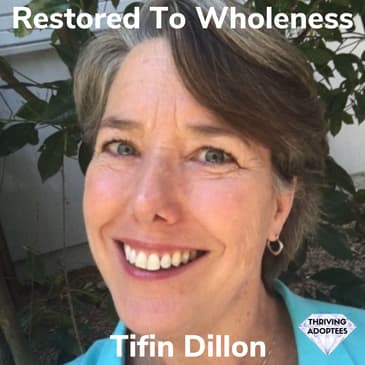
Do you feel wounded? Do you yearn to feel whole? Tifin started searching for her biological family at 19. Listen in to what she's learned about wholeness since then including insights from coaching and astro-coaching.
https://www.facebook.com/groups/1776536339297503
https://www.youtube.com/channel/UCVkdPPGv968-oUSl-NUKsCw
Guests and the host are not (unless mentioned) licensed pscyho-therapists and speak from their own opinion only. Seek qualified advice if you need help.
Want to learn more about thriving for you, your kids, your families or your colleagues? Pick a time to talk here
[00:00:00] Hello everybody, welcome to another episode of Thriving Adoptees podcast. Today I'd like to be joined by Tiffin Dillon looking forward to our conversation today.
[00:00:11] I am too, Simon good to see you.
[00:00:13] Yeah, do any people just call you Tiff?
[00:00:16] Yeah that's my most common nickname.
[00:00:18] Yeah.
[00:00:19] Yeah.
[00:00:20] And have you heard of like a cake dessert called Tiffin Cake, have you heard of that?
[00:00:28] Yes, and like the afternoon tea time called Tiff. I didn't, I learned that when I was in college actually. There was a tea shop in Santa Cruz at that time called Kokula's Tiffin.
[00:00:37] And that's when I also learned about the Indian stacking metal containers called Tiffin.
[00:00:45] Oh they are.
[00:00:46] My parents didn't know that though.
[00:00:47] Yeah.
[00:00:48] So healing, what does healing mean to you, Tiff?
[00:00:56] I have been thinking about this since we spoke before and knowing this was going to be part of the conversation. I think of healing as that being restored to wholeness or being restored to full functional health.
[00:01:11] But I really have been more drawn to the like being restored to wholeness idea. And I think
[00:01:24] it's interesting in the realm of adoption wounding, right?
[00:01:30] Like I think we can do a lot of healing but I don't know that there's ever a full wholeness.
[00:01:37] Or I'm in that question I guess.
[00:01:39] Yeah.
[00:01:42] Well I guess it gets to, it's down to how you define identity as well when really.
[00:01:48] Really down to that. Yes.
[00:01:55] Yeah, that's good because it's a big question.
[00:02:00] My biggest area of curiosity and I know that all my life wondering who am I? How do I know? You know, and growing up in the sort of, you know, the conditioning and expectations of my adoptive parents and, you know, they really believed as so many adoptive
[00:02:22] parents did that, you know, a baby was a clean slate and they could teach them and mold them and, you know, they would become, you know, their child. And that was who I would be, you know.
[00:02:38] And the question of nature and nurture in terms of identity really comes in there for me. So I think for me that whole healing journey has been around that question of identity, who am I and who was I before I was adopted?
[00:02:54] And who am I that what parts of me have I inherited from biological family?
[00:03:02] Yeah.
[00:03:04] I'm asking you questions and you just fire a little questions back at me.
[00:03:09] I know it's not great.
[00:03:12] Um, I, yeah, I am very much a questioner.
[00:03:19] Yeah.
[00:03:21] But I think it's it is important of like, what are the questions that we grapple with?
[00:03:27] You know, and I think on the healing journey, any kind of a healing journey.
[00:03:31] I think the questions we're asking influence our.
[00:03:37] If we come at it from a really sick or broken or victim kind of perspective like why me, or what the matter with me.
[00:03:51] That kind of question leads to other questions and different answers than, hmm, what's here for me or what can I make of this or how could this actually, you know, be something that I could create from with
[00:04:13] work with rather than just be at the effect of.
[00:04:19] Yeah.
[00:04:21] Well, where do I take it from that?
[00:04:25] Well, I don't know. I mean, I think the questions of identity are really important for everyone really and I think that I think in some ways I well I wonder I don't know but I wonder if all of us in our growing and maturing journeys whether we're adopted or not.
[00:04:43] I wonder if that question of who am I is central for people and who who am I becoming is the next question to me that feels more interesting.
[00:04:58] Yeah.
[00:05:00] First thing for me is like the.
[00:05:04] Well, who am I really that that's that's Damon's podcast isn't it.
[00:05:09] And yes, he's been on the show.
[00:05:12] Yes.
[00:05:13] Yeah.
[00:05:14] So this this kind of like this this this this who am I and then this who am I do you know what I mean it's.
[00:05:24] Yeah right.
[00:05:25] Yeah, that piece that piece around that piece. So the who am I really that points me in a like, oh, I've been pretending to be someone or I've been wearing a mask or I've been performing a role, but really who am I is like who am I behind that role of daughter to my parents who am I beyond all this sister who
[00:05:51] who am I beyond the roles I fulfill, you know or the.
[00:05:56] Yeah, that and so that really adding really in there.
[00:06:01] I think it's in a different direction and a really important one so I know for me, I, I.
[00:06:10] I've been more aware of the different social roles or masks that I've worn in my life and how easy it is for me to anticipate.
[00:06:21] And then in a conversation like this. Oh, what's our question conversation going to be about how should I show up and what will be useful and helpful and how can we connect.
[00:06:33] Yeah.
[00:06:34] But the who am I really who am I really sounds.
[00:06:39] It doesn't sound like an angry.
[00:06:42] You know, I would say, who am I want to know who am I.
[00:06:47] Really, you wouldn't there's that piece of it that oh I can feel that anger that rage underneath that and as an adopt I was closed private adoption in the state of Arizona where the records have been closed until just recently I think in January 22 or three
[00:07:08] when the state opened for a it was a weird opening of the records like if you were born between these dates you now have access and I fell within those range that range.
[00:07:19] But that angry who am I like, why don't I get to know like someone has the answer to this, they're not telling me.
[00:07:29] And that always infuriated me.
[00:07:32] Yeah, I did get to know it was about me.
[00:07:36] I think that your identity is an issue for non adoptees.
[00:07:42] And I would say on the basis of the people that I've met in the learning spaces I've been in. Definitely.
[00:07:52] Definitely. Yeah, yeah, I would I would say that as well I mean I've been a teacher and a life coach for 25 years and yes, I think it's a human question.
[00:08:01] And who am I growing into and how can I, you know, questions of how can I be my best self or live my best life.
[00:08:12] I do think that that's it's a common human question and I think there's a there are nuances for adoptees.
[00:08:19] Yeah, or those packages of we don't get to know where we came from, or who we're related to or, you know, I think being born into your biological family.
[00:08:30] I think people grow up like knowing things about themselves and their history that they just take for granted.
[00:08:39] They don't question that there.
[00:08:43] I'm thinking of, you know how people associate talents and skills and things like that is like, oh, you're good at this just like your dad or you're good at this just like your aunt, so and so, you know.
[00:08:59] And adoptees are sort of like that grab bag mystery mystery bag, you know.
[00:09:05] Yeah.
[00:09:07] The restored to wholeness thing.
[00:09:10] So yeah so that like.
[00:09:14] So I in my journey, I began searching when I was 19.
[00:09:21] And I went to Arizona and did what I could at the time which was not much.
[00:09:30] But I did find the lawyer who handled my adoption and I went to his office and tried to get information from him.
[00:09:39] And I didn't get any answers.
[00:09:42] And it was, you know then another decade of really questioning and really wondering and signing up for registries at that time, you know in the, in the 80s and early 90s.
[00:09:57] And then really a
[00:10:05] really interesting thing about that listeners a technical glitch we don't know whether it's American internet, British internet or whoever it is but here we are.
[00:10:15] So we're going to go I just want to take you back to the this idea that you mentioned earlier on about right at the start your definition of of healing is, it couldn't be like restored restored to wholeness.
[00:10:29] You've also said that, you know that we are told we're led our parents were led to believe that we came as blank slates.
[00:10:39] Yeah.
[00:10:41] So if I put those two things together.
[00:10:44] Are you saying that.
[00:10:48] I'm saying that restored to wholeness is is kind of like rubbing.
[00:10:53] I say, I first off are you saying that we're not a blank slate. There is something written on our slate and that and what is written on us late is trauma.
[00:11:02] And so restoring to wholeness is basically wiping the slate clean wiping the trauma.
[00:11:10] That could be that could be a part of it so I think healing the trauma is part of our healing journey.
[00:11:16] But I think this idea of blank slate for me so as a child, I, I wasn't thinking about birth mother adopt the adoption story I heard and I knew very young that I was adopted but it was framed in they really wanted
[00:11:33] children, and they chose me, and I was special, and I made them so happy.
[00:11:38] And that that very beautiful chosen child thing and it suited me and it felt good and my younger brother was also adopted.
[00:11:49] And then my sister was their biological child and that's just sort of how our family was I didn't really question it.
[00:11:55] You know, and until my late teens, when it was like, wait a minute.
[00:12:02] What about before that.
[00:12:04] You know, and so I think the light coming into awareness of, oh, there's more to the story than I've been holding or that I've known.
[00:12:17] And now I want to know what that other part is like, there were it.
[00:12:21] I think coming into late adolescence early adulthood was when there was more of a dawning of, Oh, there are pieces missing here and I don't know them.
[00:12:32] You know, and that's when it was more I was more aware of there was a wounding.
[00:12:39] There was a missing of being separated from biological mother.
[00:12:45] I think I had wondered like, well who was she and my mom and dad didn't know anything really it was very closed adoption.
[00:12:53] And then but the story of like she wanted you to have a better life.
[00:12:58] You know, that like okay but I didn't know anything about her or her life.
[00:13:03] And I will say, you know at that age, my parents had divorced when I was 16, and our family really fell apart.
[00:13:14] And so there I had that family wounding as well so I was, I was more processing that but then it sort of.
[00:13:21] Then I found Oh and then also this other abandonment of family earlier.
[00:13:27] Yeah.
[00:13:29] So I think like in our awareness and you know, adoption adoptees talk we talk about being in the fog and coming out of the fog.
[00:13:38] I think while you're in while I was in the fog place.
[00:13:41] I wasn't aware of the wound so much or the broken feeling or the need to know identity.
[00:13:50] I think I, you know, accepted the family I had and the stories I was told.
[00:13:58] Yeah.
[00:14:00] I think we all fall for it don't wait to a certain.
[00:14:03] Oh, I think so and you know I really have thought about this a lot.
[00:14:06] I think it's a very adaptive thing.
[00:14:10] I think it's a survival strategy.
[00:14:12] I think it's really I'm grateful that I got to have a childhood where I was really so aware of that.
[00:14:20] And our parents fell for it too.
[00:14:23] They completely fell for it.
[00:14:25] And it's been an interesting process in my parents are still alive and shared my search journey that I so I did the DNA.
[00:14:35] Yeah, process and took me six months to solve the puzzle four years ago.
[00:14:40] So during the COVID lockdown was when I did that.
[00:14:44] And they've both been supportive of and like, yes, we'll help in any way that we can in your search since I started at 19 doing that.
[00:14:58] But there they don't still have an awareness of the impact of adoption on people or how I hold it emotionally even when I try to share they just really don't see that.
[00:15:11] My dad shows some curiosity about it.
[00:15:14] And my mom acknowledges that I, you know, I'm going through a process, you know, but I it's been harder for me to communicate the feelings of, you know, all wide range of feelings that it brings up.
[00:15:31] So I thought I was talking to earlier on, we were talking about this idea of our parents and admitting stuff.
[00:15:40] And I think one of the ideas was that, you know, they couldn't bear to admit to this stuff.
[00:15:48] And I thought, well, no, that's not true. They just didn't know they didn't believe that to be true. They're not they're not they weren't trying to.
[00:15:57] They weren't they weren't trying to pull the wool over our eyes.
[00:16:04] I believe that too. You know, and I think one of the other parts that adds to the the wounding is the grief that's never spoken about that the adoptive parents have of not not conceiving or not having their own biological child.
[00:16:23] And part of our story growing up, you know, not we tried for seven years to have a baby and we finally decided to adopt, you know, the the grief in that or the struggle in that was never acknowledged.
[00:16:38] It was lost over in like, we really wanted a baby for seven years and then we finally found you.
[00:16:46] You know, which I think is a much.
[00:16:51] Happy ending sort of a story or a fairy tale sort of a story.
[00:16:57] But I think that that, you know, there are layers of emotion that are that are glossed over.
[00:17:04] And again, I think that is also an adaptive strategy.
[00:17:10] Yeah.
[00:17:11] Yeah.
[00:17:15] And it's child like looking at adoption, like I knew how much I was wanted and then they tried for so long and then they find me. It was that happy ending intentional energy about me coming into the family.
[00:17:27] And then my younger sister is their biological child, but they didn't even realize that my mom was pregnant until she was five or six months along.
[00:17:36] And so my sister always had the attitude of she was the real child.
[00:17:41] And then I had to come back of, well they wanted me and you were, you were a mistake.
[00:17:48] We didn't have the healthiest sibling.
[00:17:51] No.
[00:17:54] Yeah.
[00:17:56] Wow.
[00:17:57] What was the point in sharing that?
[00:17:58] There's so many complexities and places along the way where, you know, healing is about, you know, healing from a wound or an illness kind of a thing.
[00:18:09] But the wounding part of it speaks to me and like, Oh, you know, there's the initial wound, but then it scabs over a bit and you function.
[00:18:16] And then something rips the scab a bit and then it bleeds again and it hurts again and then it can heal up again and scab over and, you know, like we live with it.
[00:18:27] And we work with it, you know, but I think there's always a bruise or always a scab there.
[00:18:33] And, you know, and hopefully, you know, eventually it's a scar that just becomes part of us that, but does it ever fully go away?
[00:18:41] I don't think so.
[00:18:47] I'm thinking about trying to frame the question in a...
[00:18:55] I do have another idea to jump with.
[00:18:58] So back to the question of identity and who am I really?
[00:19:03] In the four years since I've known who my biological family was and about them, I feel like parts of me are filling in.
[00:19:13] Parts of like, Oh, those empty pieces I can see.
[00:19:16] Oh, this is who Trudy was.
[00:19:18] This is who Phil was.
[00:19:19] This is what they were like.
[00:19:22] I have four half siblings.
[00:19:24] I've gotten to know three of them filling in some other pictures of family.
[00:19:31] Both my birth parents had died before I found them.
[00:19:35] And then my search became learning who they were and who else could I reach out to to find out who they were, what they'd been like.
[00:19:46] And in that process, I think like more of the pictures been illuminated for me or more of the pieces to the puzzle have come in so that sort of the image is fuller and that self-image or that identity feels fuller to me now.
[00:20:03] Not like the missing piece or the invisible inherited things.
[00:20:12] In a way, like learning their personality or character things as their, you know, people had described them.
[00:20:22] The recognition of, Oh, those are characteristics traits personality things that I recognize.
[00:20:33] I am kind of like each of them.
[00:20:36] And that has helped me feel more myself.
[00:20:43] So more, I feel a stronger sense of identity now is that part of being 59 years old and that's a natural part of maturing maybe.
[00:20:53] Is it part of this search and finding and learning piece?
[00:20:57] I think so, you know.
[00:21:01] Yeah.
[00:21:03] What did you learn from becoming a life coach in terms of either identity or feelings?
[00:21:18] Oh my gosh.
[00:21:20] Yes, thanks for bringing that in because I was thinking about that too.
[00:21:24] So it was really important in my journey.
[00:21:28] I did the training when I was 35 and they started off with just sort of a other classmates ask each other, you know, what do you want?
[00:21:38] And I found that that like, what are your dreams and what do you want?
[00:21:42] And I found that question absolutely paralyzing.
[00:21:47] I did not know what I wanted.
[00:21:49] I didn't know a direction of my life.
[00:21:51] I didn't really know what wasn't necessarily that I didn't know what I liked or what my preferences were, but I felt like I didn't have the right to them.
[00:22:01] I felt like I like back to the light, the masks that I wear like in the role of the eldest daughter.
[00:22:09] I was always expected to be concerned for others to look after my siblings to help around the house to if I expressed what I liked or what I wanted to do, I was being selfish.
[00:22:22] And message a question I heard often was, who do you think you are?
[00:22:27] Like to want that or to expect something.
[00:22:30] And so that question itself, who do you think you are?
[00:22:35] Repeatedly poked my wound of who am I or that unknown question.
[00:22:41] And so the beginning of coach training helped me personally in like that self.
[00:22:49] I have, well, what do I want? What is important to me? What are my values? What are my preferences? Oh, you mean I get to create my life the way I want it to be not just following my parents' expectations or societal expectations or,
[00:23:06] gee, I went to college, got my degree, I've been teaching like I need to just do the jobs.
[00:23:13] And so it really was confronting and opening for me personally.
[00:23:22] And then that there were, you know, it was a process to engage people in self discovery.
[00:23:28] And it was a process that I then got to really enter into my own self discovery around.
[00:23:36] Actually this is part of what I was thinking about sharing about the question of thriving.
[00:23:41] You talked about focusing your work more with healing and thriving.
[00:23:46] The coach training that I did really emphasized that thriving, how do we find fulfillment and purpose and that quality of thriving in our lives and that it, we need to know ourselves, we need to know what's important to us, our values,
[00:24:05] we need to know our strengths and our gifts and what makes us feel alive to feel that sense of thriving.
[00:24:16] But for me it started with that, that been confronting question of what do I want?
[00:24:23] And that then like self worth question for me of like, well, do I get to want what I want?
[00:24:29] Or what's the point of wanting what I want if it's just going to be shut down, or that I have to put it aside so that I can help other people get what they want.
[00:24:41] And yet it's a path, a career path that that's really what it is about is helping other people know themselves and get what they want, you know, design their lives and align more with who they actually are.
[00:24:55] And that fascinates me. It's like I engage with these questions of who are you and what's thriving and who are you becoming have been the main questions in my work over the last 25 years.
[00:25:12] So you mentioned the elder being the eldest sibling and you mentioned a little earlier on about your, your youngest sister throwing the you're not I'm the real kid.
[00:25:27] Yeah.
[00:25:28] Did that mean did it hurt to what to what you stand at that her or did you just kind of.
[00:25:34] It did. It did. And my, my dad's mother, our grandmother lived with us during part of our childhood, and she very had that prioritizing preference as well.
[00:25:56] But like I was great because I was the first and then my brother was great because he was a boy and then my sister was really great because she was the biological or the old one, you know.
[00:26:07] But it didn't you didn't paint up a picture of being wracked by it earlier on.
[00:26:14] I don't think I was wrecked because I think I had.
[00:26:18] I had my comeback, I had my well I was wanted and you were just had, you know, you were a mistake. I had that like weapon.
[00:26:30] And, you know, I was older and taller and ahead. And so it didn't, it didn't take me down.
[00:26:40] But it did have an effect. Yeah.
[00:26:43] And you know, I then around in childhood to recognizing that in school and and kids insulting each other, you know, by telling each other that you're adopted was a was a threat and an insult.
[00:26:57] And I think that people use that there's a double edge to it though too because I know a lot of people who weren't adopted often wonder if they were because they don't feel like they fit in their family.
[00:27:08] They don't feel like they belong.
[00:27:12] So it can be that threat of like you don't belong here, you're adopted and you don't fit.
[00:27:18] Or when you have a sense of not fitting that well.
[00:27:23] I've adopted and I belong somewhere else.
[00:27:30] Yeah.
[00:27:31] So it makes sense.
[00:27:33] I think so.
[00:27:34] I want to go back to the, the blank slate thing.
[00:27:39] Okay.
[00:27:41] So I think the way I kind of formulate the question was, so we're not blank slides.
[00:27:48] We come, we come with pre verbal, we come with pre verbal memory, right?
[00:27:54] We are our bodies and what I've been learning in the last several years of reading about trauma and epigenetics and like we inherit the psychological and emotional trauma and patterns of our lineage.
[00:28:09] And our bodies, ourselves hold that memory.
[00:28:13] So it's not a blank slate.
[00:28:17] And it's just come to me as you express that nobody's a blank slate.
[00:28:24] Nobody is right.
[00:28:26] Nobody is even kept.
[00:28:28] Have you heard this word kept kids kept kept.
[00:28:33] Yeah.
[00:28:34] So we're adopted.
[00:28:36] That that you could say, well, that non adoptees right.
[00:28:39] They're kept.
[00:28:40] Right.
[00:28:41] Okay.
[00:28:42] Yeah.
[00:28:43] But you know, so the whole thing and that takes just that ours is unknown.
[00:28:50] Largely as I know too, because, you know, most of us are unconscious of all this stuff.
[00:28:56] Yeah.
[00:28:57] But I think part of the process of healing for me and part of the process in the coaching work I do is helping people become aware of the messages that we get aware of the conditioning aware of our beliefs.
[00:29:13] And then realizing that we have agents.
[00:29:17] Like, oh, I was given that self image.
[00:29:21] My parents wanted me to be this way and they told me I was.
[00:29:26] And I can question that.
[00:29:28] Is that true?
[00:29:29] Does that feel true to me?
[00:29:30] Do I want to move with this forward?
[00:29:32] You know, do how do I want to be?
[00:29:35] And that sort of process of maturing and individuating as we grow up and then a process kind of becoming more aware of our, you know, questioning beliefs.
[00:29:52] Like, is that really, really true?
[00:29:54] Or, you know, is it true for me still?
[00:29:59] Yeah.
[00:30:00] Yeah.
[00:30:01] Yeah.
[00:30:02] So I mean, yeah.
[00:30:04] And in that way, I think that's where we get to play with the eraser and the erasable pen on our slates.
[00:30:12] You know, like, oh, I'm noticing, oh, here.
[00:30:15] Oh, something's appearing.
[00:30:16] Oh, there was an invisible ink.
[00:30:18] And now I get to question that, you know, and I bring it to my awareness.
[00:30:22] And then it's like, if that feels good and it feels true, it can be part of our self image and our identity.
[00:30:28] And if it doesn't fit anymore, then we can work it at rewriting, you know, at recreating.
[00:30:38] So as a coach, you're surfacing, you're bringing the beliefs out of the darkness into the light and pointing towards them.
[00:30:50] And so that the client can see, hopefully see what is being pointed out.
[00:31:00] Right.
[00:31:01] Right.
[00:31:02] And make your conscious kind of decision around that.
[00:31:05] Right.
[00:31:06] And kind of that refining sense of self and what's true or just questioning.
[00:31:12] I know I've always been a big questioner, but I was school came easily to me.
[00:31:19] I was a good student, high achieving went right to college.
[00:31:24] But really question like, what do I want to be doing with this?
[00:31:28] You know, and I took time out to that's the year that I began my adoption search.
[00:31:35] I took a year off from college and I traveled and I went to Arizona to search and to question not just that automatic pilot of your good at school.
[00:31:49] Of course, you're going to college. You're going to get a degree. You're going to, you know, just like whatever that stoke that path was.
[00:31:54] But to question, like, why am I here? What am I doing? What am I interested in learning?
[00:32:01] Yeah.
[00:32:04] I'm fascinated with white with your blank slate thing.
[00:32:10] Perhaps because I'm not quite as bright.
[00:32:15] I'm thinking that, you know, we can have the blank slate has got some generational trauma on it.
[00:32:26] And then the relinquishment trauma is kind of added to that.
[00:32:31] So we can get maybe we can, you know, whether we can or whether we can't. I mean, that's that's that's the thing isn't it?
[00:32:43] If we were able to if we were able to erase the the relinquishment trauma, just assuming we were would we would we be also be able to erase the generational trauma?
[00:33:02] I mean, we're going to be on a trauma with the rest of our lives.
[00:33:06] It's going to be like whack-a-mole, right? I've got. Okay. I've got rid of that.
[00:33:11] You know, so if I was to look at it, I've got rid of the divorce thing.
[00:33:17] So you're divorced, right?
[00:33:20] Yes. Yeah. Okay. So if I was to look at it, okay, so we can we can get rid of we can get rid of Tiff's divorce trauma because that's got to be a hellish time for everybody to go through, right?
[00:33:34] We can get rid of that and then we can get rid of the the the the really sorry, we can get rid of the parental divorce trauma, right?
[00:33:46] Then we can get rid of the relationship.
[00:33:48] Then we can get rid of the relinquishment trauma and we're just going to be on a game of whack-a-mole trauma for the rest of our lives.
[00:33:56] I think that's one that that's a perspective of it.
[00:33:59] And I think what rings true for me in that is that the way my process has worked and the way the different, you know, grief comes in waves, the awareness of the pain or the trauma for me comes in waves.
[00:34:14] And I'm like, okay, I'll deal with this piece.
[00:34:16] I'm like, oh, as my parents are aging and I'm realizing like, oh, they're not going to be around like the pre-grief waves, but then that brings up past family grief.
[00:34:27] My divorce brought up memories and things about my parents' divorce.
[00:34:33] New relationships and dating things not working out feels like not being chosen.
[00:34:38] Like different experiences in our lives, I think bring past memories and traumas and wounding to our awareness, right?
[00:34:45] So in that sense, I think there's cyclical things of like where but the whack-a-mole thing, I don't think we whack them down and they're done.
[00:34:55] I think there's a healing and there's a way that then we can integrate some of that into our self-image and then we have more capacity.
[00:35:06] We come into ourselves more.
[00:35:08] We're still going to be, I think, you know, feeling those waves of grief or awareness of the wounding or the trauma.
[00:35:16] But I think we have then more, we're stronger in ourselves.
[00:35:20] We have more ability and capacity to meet it and to allow it to pass through or to have another layer of healing happen.
[00:35:31] Or to, you know, we gain more facility and we get more tools as we go along.
[00:35:42] So the same, right?
[00:35:44] And I think really about integration, right? Healing and integration.
[00:35:49] And as we integrate a new aspect of healing, then that helps us meet either fresh new woundings because we're alive.
[00:35:56] And of course, that's going to happen too.
[00:35:58] We have disappointments in all areas of our lives, right?
[00:36:01] And some are more painful than others that may then bring up, you know, echo some of our relinquishment trauma or abandonment trauma or, you know, family of origin.
[00:36:14] Adoption family trauma, you know.
[00:36:18] But I also, the various ways that we approach these questions of identity and who am I have been, or the ways I've approached them have helped my healing and strengthening that sense of self that gives me more ability to ride those waves of grief
[00:36:43] or deal with the moles as they come up out of their holes, you know.
[00:36:49] And I studied psychology in college, been fascinated with human development and I taught middle school for years, an age that is really in that identity question of who am I.
[00:37:04] But I also have been fascinated with different personality typing systems and with astrology as a way of understanding who I am.
[00:37:17] And the astrology piece, I know I shared with you when we connected before has been really deeply meaningful to me as a map, a map of the sky when I was born.
[00:37:29] And the astrology says, you know, this gives us an indication of your natural given your essential qualities character your natural strengths your natural within you struggles and the dynamics that you're going to be working out in this lifetime.
[00:37:50] And I had my first reading that same year that I did began my search and that astrology reading at that time in my life really blew me away that there was someone who could tell me about myself who never met me and only had my time of birth, you know.
[00:38:10] But it gave me something to hang on to, you know, and, and to explore that was just about me wasn't about who my parents wanted me to be or what my teachers and my culture and, you know, religion or any of the other viewpoints but really just who am I.
[00:38:31] And over the years I've studied and really become fascinated with that tool. And for the last eight years have been using astrology with my clients, and just having astrology clients to.
[00:38:47] But for that self discovery for a deeper look at identity and, and our journey of life and like what, what questions are we being. Are we like as our soul being asked in this lifetime.
[00:39:05] I think that there's, for me it's helped illuminate like, oh, it's not just that everyone out there. I keep repeating the same relational patterns like oh that's a pattern within me.
[00:39:17] That's a sensitivity or a way of approaching the world that I have so of course I'm going to see things through that lens, or even understanding that I have emotional we have emotional lenses and we have intellectual mind lenses that we perceive life through.
[00:39:34] And it feels embarrassing now but to realize that not everyone thinks the way I think was revolutionary to me. And it's been really helpful in my growth because it's like up until that point I really thought, like why are people not getting it like.
[00:39:54] But we don't think the same way, you know, any of us.
[00:40:00] What's changed on your adoption lens.
[00:40:05] Oh gosh that's a good question.
[00:40:13] I feel like I'm in a process of change with it right now so I'm going to be going to the untangling our roots conference in Denver, a couple weeks.
[00:40:24] And it's bringing up like oh I'm going to be examining the adoption question in a whole new ways and meeting people who are in different parts of the constellation and
[00:40:37] in the last few years I've been in a process of integration with it of like, you know, absorbing and integrating what I found out about my birth family.
[00:40:46] Kind of adjusting that self image and feeling some of it.
[00:40:51] In the lens to I have been becoming more aware of how automatic it is for me to try to be understanding of other people and how easily I sort of put myself aside and try to, if I can understand why they did what they did.
[00:41:08] Like, I that would be adaptive for me or keep me safe or something but
[00:41:18] there's a way of balancing that myself that's part of the lens that I'm like fine tuning like you know you go to the up, comatris like lens a or lens B you know and you have to choose, which is clearer.
[00:41:29] And I kind of feel like oh being totally oriented over there with the other people, whether that's my adoptive parents their perspective or birth parents like what went into their decision making at 23 when they discovered they were pregnant with me.
[00:41:44] And, you know that overly understanding the other person's perspective but then the other lens is like, how do I see it what do I need what do I feel.
[00:41:54] And like, I'm learning to pay attention to both of those lenses and find a way that that's been a binocular view of my life or adoption or, you know, the question.
[00:42:09] So what's your aim or what what what are you looking for? Is it clarity is it, you know,
[00:42:24] because she said you 59.
[00:42:27] What am I looking for? Yeah, what am I looking for? Yeah.
[00:42:32] I think it is, you know, a more
[00:42:40] more consistent sense of wholeness a more consistent sense of who I am.
[00:42:48] Self compassion and acceptance I think.
[00:42:53] And I think there's still a big self awareness of what self awareness, not self awareness.
[00:43:01] Yeah self awareness but acceptance of Oh, this is like the whole of my life.
[00:43:10] I think there's a part of me that's still so yearning for belonging and feeling like I have a family.
[00:43:21] I haven't used this word before, but it seems to be kind of an appropriate one.
[00:43:28] To sum up what I think how you've been over the last whatever it's 45 minutes on a bit the word equanimity.
[00:43:40] Yes.
[00:43:42] Yes.
[00:43:43] I do think I'm seeking equinony.
[00:43:46] And that's how I would describe you.
[00:43:52] Oh, you sense equanimity in me.
[00:43:55] Yeah, I couldn't put it in.
[00:43:57] I couldn't define the word equanimity but it somehow is like it's a gut level feeling.
[00:44:03] Yeah.
[00:44:04] So so that they're like you've not really have a lot of emotion that's being I think that is something I've been seeking and trying to cultivate.
[00:44:15] And so it feels like really that acknowledgement feels really important. Thank you.
[00:44:23] And that equanimity of like considering others in the big picture but really considering myself in it.
[00:44:30] That's the balance that that's worth like both and, you know, to me that's what it is feeling like.
[00:44:40] Yeah.
[00:44:42] Like I can hold the pain and the trauma and the I'm not knowing and the confusion of identity and the and acknowledge all of the growth and learning and healing that I have done so far.
[00:44:54] And I think equanimity to me makes it. It's like, there's enough. I'm enough.
[00:45:02] I've learned enough healed enough. I'm wondering like when is enough.
[00:45:08] Yeah, you know, I have when is enough. Yeah.
[00:45:18] Now.
[00:45:21] And that question of when does whack a mole stop.
[00:45:24] Oh, oh yeah.
[00:45:26] You know, I do have hopes I'm in that and a conversation recently with another adoptee where she said that she feels complete in her journey.
[00:45:37] And that was the first time I'd really heard another adoptee say that, not out of resignation of like, well, I got as far as I could in my search or oh I found them but they're dead already.
[00:45:48] But really like she sounds and feels and is claiming that she's complete.
[00:45:57] And that really gives me hope. And it also makes me realize like, you know what, even if I don't have all these answers or it's not 100% healed. I am still complete myself.
[00:46:11] We are all whole human beings. And there is a sense of can be a sense of completion and not I think
[00:46:24] it's not a sense of completion.
[00:46:33] And if we're not always working on healing or fixing then I think it opens our lives up to enjoying and thriving.
[00:46:41] But I think they're not. First you have to do all the healing and fixing and then you get to thrive I think it's weaving together, you know, like attention on what is fun, what does feel good, what does bring me joy.
[00:46:53] What relationships, you know what friends to spend time with or brother and sister-in-law to have dinner with or, you know, what are the things in life that bring me joy and make me feel like I'm growing and thriving.
[00:47:09] Fantastic.
[00:47:11] Thanks Tiff. Thanks, Liz.
[00:47:14] You're welcome. This has been great. I really appreciate your questions and your perspectives and the opportunity to talk with you about that.
[00:47:25] Thank you. Thanks, Liz. Bye bye.