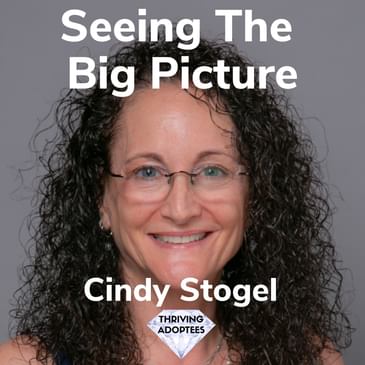
So many of have so much going on we can't see the wood for the trees. Today's interview is a chance to stand back and see the big picture - what helps us thrive, what helps our kids thrive and much more. Listen in - adoption professional Cindy really knows her stuff!
https://www.facebook.com/AllForKids.CA/
https://www.facebook.com/AllForKids.CA/
https://www.linkedin.com/in/cindy-stogel-2a1093171/
Guests and the host are not (unless mentioned) licensed pscyho-therapists and speak from their own opinion only. Seek qualified advice if you need help.
Want to learn more about thriving for you, your kids, your families or your colleagues? Pick a time to talk here
[00:00:02] Hello everybody, welcome to another episode of Thriving Adoptees podcast. Today I'm delighted to be joined by Cindy, Cindy Stogel from All For Kids, over on the west coast of the states. Really looking forward to our conversation today Cindy. Cindy Stogel Thank you, me too, very much. So what comes to mind when you hear the name of the podcast, Thriving Adoptees, what comes to your mind Cindy?
[00:00:30] Cindy Stogel The first thing that comes to my mind is the adoptive parents and how they raised the child and how they honored the child. Because I think that children thrive in families where there's strong and healthy attachments, where the parents can meet the children where they're at,
[00:01:01] Cindy Stogel Where there's commitment mentality, not consumer mentality, meaning they make a commitment to the child no matter what. Cindy Stogel And they are in it forever. Cindy Stogel Not like buying a car, that if you get a car that you don't like you can trade it in for another model.
[00:01:23] Cindy Stogel So I think that children thrive in families that are strong and healthy, where children are protected and nurtured, their emotional needs are met, where the resource parents or adoptive parents or families who are adopting the youth can provide them with healthy attachment opportunities to explore who they are.
[00:01:53] Cindy Stogel How they became a member of the family, what their adoption story is, what it means to them in their hearts, help them grieve their losses. Cindy Stogel Because adoption is all about loss, sadly. Cindy Stogel Children have to lose a family to gain one. Cindy Stogel And my hope is that children don't actually have to lose a family to gain one, but they can have all of their families.
[00:02:24] Cindy Stogel So that's what I think about when I think about children thriving. Cindy Stogel Was that a mouthful? Cindy Stogel Yeah, there's lots to go out there, Cindy. Cindy Stogel Let's start with attachment, because I was listening to something today. Cindy Stogel I was listening to an old podcast actually, with a lady also from California, Terry Markcroft from Northern California.
[00:02:54] Cindy Stogel And we were talking about attachment and attachment styles. Cindy Stogel And I'd recently done an attachment style questionnaire online. Cindy Stogel Oh wow. Cindy Stogel And I thought, what a great tool that is for us all, whether we are adoptees, whether we are adoption professionals, whether we are adoptive parents, whoever we are, is to understand our own
[00:03:24] Cindy Stogel Understand our own attachment style with a third party view. Cindy Stogel So these things, this is like an online survey, right? Cindy Stogel And you do them free. Cindy Stogel And you don't have to tell anybody else. Cindy Stogel You don't have to talk to a therapist. Cindy Stogel You don't have to pay any money. Cindy Stogel You don't have to do it. Cindy Stogel But what a great tool for our kind of self-awareness. Cindy Stogel Oh yeah. Cindy Stogel For our self-awareness.
[00:03:53] Cindy Stogel To help us move on. Cindy Stogel And like a real practical thing that we can do to help us understand ourselves. Cindy Stogel Because I've had a lot of mentors along the way and one of my key mentors who, what he said, set my healing journey on a different trajectory.
[00:04:19] Cindy Stogel He used to say, it's hard to see the picture when we're in the frame. Cindy Stogel It's hard to see the picture when we're in the frame. Cindy Stogel So doing one of these attachment style questionnaires allows us to reflect back on our own stuff. Cindy Stogel And hopefully we can see some opportunities to change there. Cindy Stogel Because if we, if we don't change, we'll keep on getting the same results.
[00:04:49] Cindy Stogel And if we don't change things for children, they'll keep getting the same results. Cindy Stogel Yeah. Cindy Stogel It's family history too. Cindy Stogel And we're trying to break that cycle for children in families that are healthy. Cindy Stogel Yeah. Cindy Stogel So the, the, the golden thread for me is right. Cindy Stogel If we want the adoptees to be thriving, the adopted parents need to be thriving. Cindy Stogel And if we want the adopted parents to be thriving, then the adoption professionals that support them, they need to be thriving too.
[00:05:18] Cindy Stogel So self-awareness is a big thing across that golden, that golden thread. Cindy Stogel And it's, it's called parallel process.
[00:05:29] Cindy Stogel When, when, when professionals are thriving and they understand attachment theory, and not just the theory, but how it really impacts people that the strength and importance and value of attachment for themselves for the resource parents or the adoptive parents, and we call foster parents resource parents and, and all for kids. Cindy Stogel So the, our program is a foster and adoptive program so when I say resource parents that's what I'm referring to.
[00:05:57] Cindy Stogel But, but, but so you need to have healthy, healthy, strongly attached, securely attached professionals working working with and helping develop and educate and support.
[00:06:12] Cindy Stogel So they can help support and meet the needs over and over and over again of the children in their care so they can form healthy attachments and become securely attached. Cindy Stogel Because most children in the foster care system are either insecurely attached, they're, they're ambivalent, they push people away, they have anxious attachment because they don't trust that the world is a safe place.
[00:06:42] Cindy Stogel So the other piece of it is trust in order to trust the world that the world is safe and that people will take care of you and meet your needs and be there for you no matter what, and, and accept you for who you are. Right? No matter what. You need to be securely attached, and you need to have trust. And so from trust comes secure attachment. Yeah. So. That's the lesson for the day. That's the lesson for the day.
[00:07:12] So what, what gets, what gets in the way? Let's, let's, let's talk about adoptive parents. Right? Okay. What, and, and, and, and going on the back of this idea that it's hard to see the picture when we're in the frame. What is it that, what is it that you think adoptive or resource parents as you call them?
[00:07:42] What, what, what do you think that are some of their blind spots? Are there, are there, are there, are there some kind of consistent blind spots? Or. Yeah, that, that's actually a wonderful question. And I'm glad you asked that because I think about that all the time. I think about it every day and I face it every day. Right. Um, I think that the, the blind spots for our resource parents is their own need to be parents.
[00:08:14] They're, they're, they're such a strong need for our families to be parents. And a lot of our, our families come to us struggling with infertility and have exhausted all their resources to become parents biologically.
[00:08:37] And so typically for our families, adoption is their last option to become parents. And if families, if our resource parents, adoptive parents haven't worked through that grief and loss from not being able to have a biological child, a child they can call their own.
[00:09:04] They can struggle with becoming parents to a child that's not related to them. That's not theirs biologically. And so a lot of the, the work that we do is, is encourage families to get into therapy, work through that grief, that loss. Again, there's that word loss, that four letter word.
[00:09:29] It's, it's unresolved grief and loss for our families that gets in the way of being able to truly accept the child for who they are. And accept that the child has a birth family, that they have a right. And our agency supports children's right to stay connected and have feelings support. They, they need their feelings about their birth families supported by their prospective adoptive parents.
[00:09:58] And if those feelings aren't supported, it gets in the way of attachment. Because no matter what, the birth parents will always be the birth parents, even when parental rights are terminated. Children are always going to have feelings about their birth family and why couldn't they be raised with them? Whether, whether, and they need to understand their story.
[00:10:22] And so when adoptive parents are struggling with their own self-confidence in being able to help children understand all those things, that's what gets in the way of strong, secure building of trust and attachment. Because then the children don't feel confident that their, their adoptive parents are truly in it for the right reasons.
[00:10:50] Yeah. So if I look back on my own learnings. Yeah. I'm still learning, right? 18 years, 18 years on, right? After finding out the teddy bear was from a birth mum and that initial anger, right? So there's always, there's kind of always more to do. Always. There's always more to do. Adoption is a lifelong journey. Have you heard that statement?
[00:11:14] I have heard that statement. It's a lifelong journey and, and it's about lifelong learning on that journey. So that I've come up with this metaphor for that recently, which is, you know, like if you go to a, if you go to a canteen and you're collecting your plates, the plates are spring loaded.
[00:11:39] Yes. So you take one off and you put that on the tray and then you push the tray along and you help yourself. Right. So life is always showing us more. Oh yeah. It keeps on sending another plate up. Right. There's another plate and you deal with that. And then there's another plate and then there's another plate. So this, this learning is, is one of lifelong profundity.
[00:12:13] And that's a good thing. Right. This, so this isn't, this isn't a Herculean task, you know, putting the, rolling the rock up. But this, this, this is about life getting better as you say, as we surface more stuff and we get our own stuff at a deeper level. I love that.
[00:12:40] I like that metaphor and I'm going to use it. And in fact, you know, what else you can use with that metaphor is we keep putting thing, we take things off because we keep receiving things. But we also can take things like the conveyor belt when you take a tray and you put it on because you're done with that. You can take your tray or your plates or your silverware, things that you're done with and let them go on the conveyor belt.
[00:13:09] And you can say, okay, I'm through with that for now, but it may come back later. Yeah. Like there, like there's certain times in life where things come up regarding adoption, birthdays, adoption day. The passing of, of a loved one, whether it's a birth or adopted family member. Marriages, graduations, children being born.
[00:13:38] And when you're an adoptee, if you have children, you weren't biologically related to the people who raised you, but now you're biologically related to the child that you have. How is your attachment going to work with that child when you weren't raised by people who were biologically related to you, if they made you feel that way? Yeah. So the lifelong learning. I like that lifelong learning.
[00:14:09] It's kind of reliant on some curiosity though, isn't it? You need to be curious, right? Ask questions, think about things. Self-reflection. And, and I like the word curiosity and self-reflection. I like those terms because we have to do the work. Adoptees have to do the work, but they need the support of the people around them.
[00:14:39] Yeah. Well, and we need to lead by example, right? We need to show. Yeah. We need to show that we're ready to learn too. Yeah. And I think for families that can get in the way. That can get in the way. And, and as we're talking about this, I'm thinking, who's got the time? Right?
[00:15:09] Like, well, we kind of make the time. Like, if we see the importance of it, then we kind of make the time. We have to. Yes. Or we multitask, which I know that here in the UK, women, women have a big thing about the fact that they can multitask, but us blokes, we can't do it. Right? I don't know whether that's the same in the States. Do you, do women think that they're better? I think women feel that they can multitask.
[00:15:39] I think women feel they are better multitaskers than men. Okay. Right. So it's not a UK up, it's not a UK. So I guess that takes us back to this, that we, you know, we started off with this, this idea of an attachment questionnaire, doing an attachment questionnaire online. They're pretty quick, they're pretty quick to do. I mean, I'm sure there's longer and shorter ones. I'm sure that the free ones are going to be shorter because then they're going to try
[00:16:08] and sell you the premium one. Right. Right. So what, what, what tools have you come across that are really useful for adoptive parents, given the fact they're busy with their kids and yet they're curious and they want to do their work. They, they, they see the importance of doing their work.
[00:16:32] And, and so it's a question of what, what, what have you, what you mentioned therapy, right? So clearly therapy, um, listen, maybe listen to podcasts. You're already doing it. And I do like to say this on the podcast. You're already doing this. You're listening, right? So you're open and you're curious. And we encourage families to listen to podcasts, join support groups, support groups. Yeah. Yes. Online. Uh, we have a support group at our agency.
[00:17:02] Um, and be careful. I would say, I don't know whether I'm talking about support groups for adoptees. Be, be careful who's leading the group. Absolutely. Like if we, if we want to learn, we need somebody to learn from somebody that's further along the journey than us. We don't, we don't want to be, uh, all sitting around with our struggles.
[00:17:29] You know, it's, we need to check out the leadership of the group that we join. Yes, we, we agree with that. I agree with that. So we have our own support group and we can refer our families to other support groups with adoption professionals who we trust. Again, it's about, there's that word again, trust, trust, because, um, we, we want the
[00:17:56] families to, um, experience support groups that are going to be meaningful to them and not steer them in a direction that's not going to be healthy, um, or going to be, um, one-sided. We, we need openness because we believe in that. With our families and helping them understand what the journey is all about. We call it a rollercoaster of, of love, right? That that's the adoption journey is a rollercoaster of love.
[00:18:22] And there's ups and downs and there's struggles and twists and turns, especially in the foster care system. When families come to us because they really, really want to adopt, but they have to foster the child first, even if they're matched for adoption. It's still foster care first. And it's not, it's not an adoption until the judge says so. And things can happen. Birth parents can successfully get their lives together.
[00:18:52] Relatives can say, Hey, you know, this is my niece. I'd like to have her join my family. Um, but you, you asked about tools. Our organization uses, um, the pride model of practice, which is from the child welfare league of America. And there are a number of tools that are helpful for families that we utilize with them during their pre-approval training and all along their journey.
[00:19:20] One of the most incredible tools is the pathway through the grieving process. And it really, it, it, it's a picture of the pathway that people travel through grief. And what we are regularly reminding families when issues come up for them is, well, where are you on the pathway? Are you in denial? Are you in bargaining? Are you in anger?
[00:19:49] Or are you in a place of understanding your own losses, able to cope with them and with healthy coping skills? And then are you able to be a loss manager, manage your own losses so you can help manage the losses of the child that you're taking care of, that you're parenting. And that's one of my favorite tools that we can use over and over with families when issues come up.
[00:20:19] Like the child is doing this, when, when the, when the families say the child is the problem, right? We can say, wait, wait, wait, wait, wait. No, this is a family. It's not the child. This is a family. So let's take a look at what's going on with the family. What's going on with you, mom, dad, dad, dad, mom, mom, just mom, just dad. What's going on there? What, what is, what is trauma reminding you rather than the word trigger, right?
[00:20:51] What's going on with you that is, is causing you to have these feelings that you're putting onto the child? Again, I think the success of an adoption of foster care placement that's turning into an adoption is the family, the parents, not the child. Yeah. So it is the word for what you're talking about projection. Is that, is that the word? Yeah. Yeah.
[00:21:19] Projecting their, their stuff onto the child. Yeah. And I'm not saying children don't have behaviors and complexities because adoption is full of complexities, right? You know that it's full of complexities. But how do we manage them? Because children have a right to work through those complexities and they need parents to
[00:21:43] help them who are healthy people and ready and willing and able. Yeah. So is, is that projection a blind spot then? Yes, it can be. If they haven't worked through all of their own grief and loss and if they don't have healthy attachment styles, it can be. Yeah. Projecting their own stuff onto the child.
[00:22:08] Well, if we could have had our own biological child, this would not, we wouldn't have a child doing this. Well, that's not necessarily true. So, so what, one of the things as an adult, I think of that, right? So is, is this a human issue or is this an adoption issue? I'm talking about my own stuff here, right? Yeah.
[00:22:35] And I was talking to a coach about this a couple of years ago and she said, you'll never know, Simon. And, and it's true. I think. And it's not, and it's not the most important question. It's not about the source.
[00:23:03] It's about, it's not about the history of the, the, the, the, the, the source of the issue. It's about the issue itself. Right. I think it's human to project whether you're an adoptive parent, a biological parent, a step parent, it's how you handle it. And you may not know because you're an adoptee and you weren't raised by your biological parents,
[00:23:27] but you can know because of the people in your life and what their life experiences have been like. You won't personally know it, but you can know it. Like I'm not an adoptee, but I know it because of the connectedness I have with adoptive parents. And I've seen so many of them and what they've struggled with and the work that they've needed to do to be healthy parents to the children that they're parenting.
[00:23:53] But I think by a lot, I mean, my parents projected issues onto me that were from their own childhood. So it happens. But I don't know it from the adoptee perspective. But that's okay because I had it from my perspective. I can think about, okay, I don't know what it's like to be an adoptee, but I know what it's like to have issues projected onto me. I can still help an adoptee or an adoptive family. I can still help them because I know what that feeling is like.
[00:24:23] Not their perspective. So, and if they need the adoptive parent perspective, then I need to find somebody for them who can help them have that perspective. I know my limitations. We have to find a resource for them. Yeah. One of the things that I think about trauma is, well, I think about adopted parents and their trauma.
[00:24:50] And the one that really hits home for me because I, my wife, have got friends that have had miscarriages, right? People talk about infertility and the one that always really gets me is miscarriages because that's, to me, that's a far more potent and terrible thing.
[00:25:12] And, and, and I also think that to an extent, the, the, the trauma that the adopted parents have been through, it allows them to understand their kids' trauma. And if they understand it, hopefully that's, there's some empathy there through that understanding.
[00:25:37] And, and I'm wondering to what extent do they get that? Do they, to, to, to, to, to what extent do adoptive parents get the fact that their trauma is, their trauma is, helps them understand their kids' trauma? If they have self-awareness and, and if they have the resilience to be able to have worked through their trauma and come to a place of understanding it.
[00:26:05] If they've taken the time to work on their self-esteem, their self-worth, to know that they have, they have a history that they can share with the child and support the child through their history, through their story. We have a lot of families that have come to us who are adoptees, who are adopting children. And the beauty of that is they have the lived expertise.
[00:26:29] They live through it so they can help their child live through it and grow into a caring and productive adult who understands the reason for their adoption, the why, because they've been through it themselves. Yeah. So I just. We have families who. Oh, go ahead. Yeah. I'm just linking. I'm just thinking back then.
[00:26:53] When you're talking about groups, adopted parents groups, I'm thinking that we were talking about checking out the leadership of the adopt, of the support group that you're doing. That might be another question. That might be another question. If you're, if you're talking to somebody about another support group, do you have any adoptees who have adopted in the support group? Because that would allow you.
[00:27:18] That would allow you to ask them about their lived experience and help you as an adoptive parent. Right. I think it's a great question. And I think it's great to, for adoptive parents to be connected to other adoptive parents and other adoptees to be connected to other adoptees.
[00:27:40] Because that's, there's a lot of unspoken understanding. Just this feeling that our families describe when they're around other families that have adopted. The kids describe being, feeling connected to other adoptees because they've been through this.
[00:28:06] Their stories are different, but their, their, the way they got to their stories is, is similar. You know, that they all got, were separated from their birth family. They all had, they're no longer legally related to their birth family, but biologically are. And how does that feel? What is that like? What does that mean?
[00:28:31] How do, how do I live my life knowing that, that my parents are my parents, but they're not my parents. These are my parents. The adoptive parents are my parents. Is it okay to have two sets of parents and feelings about two sets of parents? You know, there's, so it's, those things are so important for families.
[00:28:56] And for the, the adoptees to thrive, to have good self-esteem, to be, to feel lovable, no matter who they're being raised by. But they're lovable, they're capable, they're worthwhile, and they're responsible. That, that, that is what attachment, that's the gift of attachment, self-esteem and the development of trust.
[00:29:26] And, and, and, and, and, and you can work on all of those attachment pieces, even with teenagers. We have two teens that joined families recently. They were matched for adoption.
[00:29:48] And, and I know it's the families that are, that are making these matches successful. Because they are right there with these youth. They've accepted, accepted them. And the first thing they're working on is attachment and trust. That's it. Forget about everything else. Attachment and trust is the first thing you have to work on.
[00:30:15] With the support of social workers, therapists, county. Because the last thing we ever want is a failed adoption. A disruption. It's a failure for everybody. It sets kids back. It's, it's catastrophic. Rejection. And failure for the families.
[00:30:43] And failure for the families, especially those who came to us with infertility. Who already feel like a failure because their bodies aren't working properly. So that they could have a biological child. Yeah. It's just deep stuff. It is. One of the topics that sprung to my mind as you were sharing that last part, Cindy, was about expectations.
[00:31:13] And I was thinking that people do their work right there before they've been accepted, before they've got their wings, right? Before they've been approved for adoption. They feel that they've done some work. And they've done the work. They've cleared their work out.
[00:31:39] Then they get their training and they feel that they've cleared some more other stuff out. And then, but then the child lands and they feel that, and some new stuff comes up, right? The spring-loaded plate of, you know, it produces some new things.
[00:32:01] And, you know, in theory, there's no difference between theory and practice. But in practice, there's loads and loads of difference. So you've got that expectations gap. So what helps us bridge that expectations gap? Oh, that is, I have to admit, that's a tough question.
[00:32:32] Because we have to figure out what the expectations are first before we can address them with the families. And we have to help the families understand their expectations and where they are coming from. I think talking with the families and observing and watching and really thinking about them, talking, just really talking to them. What are your hopes and dreams from being a parent to this child?
[00:33:01] What are your hopes and dreams from adoption? What's your motivation? In the foster care system, there's so many complexities with the court system and the laws and reunification. And then there's safe surrender babies. And everybody wants a safe surrender baby because there are no birth parents involved. But is that really, but what does that mean for the child in the future? You have to time travel forward. What does that mean?
[00:33:31] So family's expectation is we get a free and clear baby with a safe surrender, right? No birth family contact. But then there's unknown medical, there's unknown ethnicity, there's unknown biological relationship. And those are all questions families need to be prepared to answer when the child asks. Well, if I'm not biologically related to you, who am I related to? And what are families going to answer?
[00:33:58] So the expectation that easy breezy, safe surrender baby is really even more complex than knowing the birth family, knowing about the birth family. It might be easier in the short term, but it's going to be a lot harder in the long term. Right. Right. So expectations like, well, the birth parents, they were not able to take care of their child.
[00:34:24] And even though the court has asked them to do this, this, this, and this to get their lives together, to get them back, the court's given them long enough. But then we have to ask the families, what if it was your sister? What if it was you? Put yourself in the birth parents' shoes and think about what it might be like to have your child separated from you, no matter what you did. Right. So expectations come everywhere at all points.
[00:34:53] It comes as impatience with the system. It comes with, well, I wanted a perfect child. Well, there's no such thing as a perfect child, even when you give birth to a child. So it's constant communication, understanding, listening, asking questions, exploring, reflecting with families, doing a lot of reflectings to encourage them to do self-reflection.
[00:35:26] Being there to support, help them provide mentors who've been through the experiences. Maybe even sometimes we've had the, well, we've had the opportunity for adopting parents to meet adopted kids and see their perspective. What was important to them?
[00:35:52] What did they wish their parents knew to help them thrive? So one of the things on that point that I hear from adoptees is, and these are mainly older adoptees, right? Adoptees in my generation is the denial of their feelings.
[00:36:21] So one would hope that trauma education has moved on and parental, pre-adoption training has moved on so that parents are not doing that anymore. They're not. So in the extreme case, right? In the extreme case, the, and this is like 60s parenting, right?
[00:36:48] So the child feels, isn't happy about stuff, is struggling. And the adoptive parent, because the primal wound, this is the 60s or the 70s, right? The primal wound hasn't come out yet. It didn't come out until 1993. The body keeps the scorebook. That didn't come out until like 2014. I have that book. You have that book, right?
[00:37:17] But there's this mismatch. There's this mismatch between how the kid feels and how the adoptive parent thought that the kid was going to feel. Right. And there's this clash. There's a clash between two different sets of emotions. Absolutely. Adoptive parents want the children to be grateful that they got adopted by them because they can provide them with a better life.
[00:37:47] Well, some want to do it. Some want to come at it like that. So we really have to look into what I think that goes back to your point about the motivations. Because I haven't talked to a lot about this sort of stuff. However, they adopted me and it was all about me.
[00:38:16] Like you're called All for Kids, right? It's not for all four parents. It's not all four resource parents, right? That's right. But if we're coming at it from a consumer perspective, and this word gratitude is so loaded. It is so loaded. And adoptees hate it.
[00:38:46] I know. You know, they hate this expectation of gratitude. And I've talked to a few adoptees about this. And I said to them, look, I hear you. I know this is the case. And yeah, could that actually, the pushing away of gratitude, stop us being grateful for other parts of our life?
[00:39:15] You know, we've got a determination. I am not going to be grateful. I am, you know, it can kind of push away. The parental expectation can actually be self-defeating. It can push the desired emotion out of the way. But that's a side point.
[00:39:43] We need to make it about the kid. It isn't about the consumerisation. You know, we think of pop stars. We're not going to name anybody, right? But we think of pop stars. And I just think this is a bit... This smacks of consumerism to me. Absolutely.
[00:40:12] When families feel that children should be grateful that they were adopted by them, that's consumer mentality. Commitment mentality is what you described your parents' motivation to be. All about you. They adopted because they wanted to give you a family. Because you're important. You have value. You deserve a family. You bring meaning to our lives.
[00:40:39] We are grateful to have you in our family. Right? It's the flip of that. Right? And our most successful families have commitment mentality. They can end every single sentence. I love this from my mentor, who was with the Child Welfare League of America when we brought the pride model practice to our organisation. Her name is Eileen.
[00:41:09] She said that to be a parent is a privilege. Whether you're a step-parent, an adoptive parent, a resource parent, a grandparent. Right? To be a parent is a privilege. A bio-parent. A birth parent. It's a privilege, not a right. But for a child to have a family they can call their own is a right, not a privilege.
[00:41:34] Have you ever seen this mentality shift? So what I mean by that is a parent is coming at it from a, what did you call it? You said a consumer. Yeah.
[00:41:53] Have you ever seen a parent have some semblance of consumer mentality and actually shift that, for that to be shifted to? Can you tell us a story about that or paint us a picture of what that? There was a family that, oh my gosh.
[00:42:19] We have a family, I could probably tell you several stories, but there is a family right now that we're working with. And they came to us because of infertility. They tried to have children and were not successful and may have even had miscarriages. I'm not remembering their exact story. But, and in fact, this story parallels another successful family story.
[00:42:46] The family fostered two children who they fell in love with and would have adopted in a heartbeat. And they came to us because they wanted children. And during the time they were caring for these two children, their thinking shifted to, this is all about the children. This isn't about what we need. This is about what the children need. Do you know what led to that shift?
[00:43:19] The attachment the children had to their father and how they ended up supporting the children's reunification with their father. Even though they really wanted to adopt these children. The irony in the story is the children ended up not being able to stay with their father successfully. And they went back to the same family. And this same family supported reunification efforts with the father again, a second time.
[00:43:50] Even though they came to this to adopt, they really wanted to adopt. They wanted to adopt these two children. They supported the first reunification, took the children back, supported the second reunification. That was not successful either. And when I mean supported it, they took the children to the park every single week to see their dad and spent and monitored the family time with that father over and over and over and over and supported him. Tried to coach him.
[00:44:20] And unfortunately, he couldn't reunify. He was not able to do it. They ended up adopting these two children. And I get pictures from them daily on how these children are doing. And I can see how they're thriving. And I think one of the reasons why they're thriving is because they know that the parents that adopted them supported their relationship with their dad.
[00:44:46] And their mom for a period of time and still support their feelings about their dad. And any feelings they have about him. They have gone on to adopt another little boy and they're fostering a little girl right now. And the other way I've seen the shift in this family is that they supported reunification for three or four other little babies who reunified with family.
[00:45:14] When they came to us strictly to adopt. So it's about selflessness, really. Self-awareness, selflessness, resilience, working through their grief of not being able to have a child biologically, supporting children's feelings. Being able to be selfless and support children's feelings about their birth families.
[00:45:44] No matter what it is, there's nothing harder than what a child experiences to end up in the foster care system. So they learned that no matter what pain they're feeling, not nearly the pain that the children have experienced to come into the system twice. Not just once, but twice. That was the lesson that they learned. And they're able to give that back to the children.
[00:46:14] And the children are doing amazing. They're 10 and 8 now. And these children are supporting their adoptive parents fostering a new baby. And helping that baby and other babies that have been in the family reunify to their families. Yeah. Wow. So it can happen. But it's something in here that happens.
[00:46:40] It's something inside that the families have to have the ability and the willingness to work through. To overcome their own needs for the needs of the child. That feels like a good place to bring it in, doesn't it?
[00:47:11] Okay. This is amazing. You've been amazing. You're amazing. Thank you. I love that. Before I do bring it in, though, I want to ask you if there's, is there anything that I've not asked you about that you'd like to share with the listeners? Okay. Okay.
[00:47:36] So another, I have a couple of mantras to share that I learned from Eileen. Her name is Eileen Mayers-Pastor. Look her up. She's amazing. I'll send you an email. Minimize trauma by maximizing teamwork. And resource parents, adoptive parents, they're members of that team for that child.
[00:48:07] Minimize trauma by maximizing teamwork. It's not the home that heals or hurts children. It's the people that live there. We want to be on the healing side of children, not the hurting side. We learn from each other, too. I learned from you today.
[00:48:39] Likewise. So here's one for you. Because people say that time is the greatest healer. What do you make of that? Time and being surrounded by the right people. Yeah. Surrounding yourself with the right people.
[00:49:07] And being in a family that accepts you for who you are. All of you. All parts of you. Yeah. Brilliant. Thanks, Cindy. Thanks, listeners. Thank you. Thank you. We'll speak to you again very soon. Take care. Bye. Bye-bye.