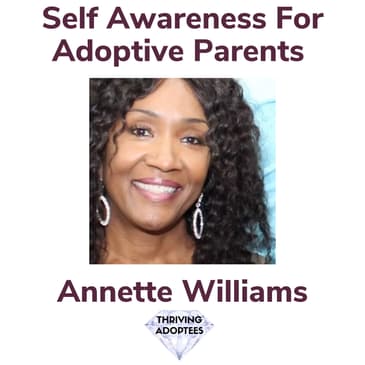
Thriving starts with us. If we want our kids to thrive, we need to be thriving. And that all starts with self awareness. Listen in as Annette shares insights into self awareness and how it helps us tackle the tough stuff and thrive.
Annette Williams, PhD, M.Ed., LPC, RPT, CAS is a Professional Member of the Association of Play Therapy and is a National Certified Counselor through the NBCC.
Find out more about her here:
https://www.williamscounselingplaytherapy.com/
Guests and the host are not (unless mentioned) licensed pscyho-therapists and speak from their own opinion only. Seek qualified advice if you need help.
Want to learn more about thriving for you, your kids, your families or your colleagues? Pick a time to talk here
[00:00:02] Hello everybody, welcome to another episode of the Thriving Adoptees podcast today. I'm delighted to be joined by Annette, Annette Williams. Looking forward to our conversation today, Annette. So am I, I'm very excited about this. Cool, cool. So Annette is a counselor and a play therapist and does an awful lot in the adoption space and has done for many years, right? Yes, correct.
[00:00:29] Yeah. So what comes to mind when you hear the name of the podcast Thriving Adoptees Annette?
[00:00:39] It puts me in the frame of mind of adoptees who, I guess for lack of better terms, making the best of whatever their circumstances are, which includes dealing with past trauma, trying to or attempting to work through any traumatic experiences,
[00:01:07] perhaps trying to understand more about adoption because we're looking at this age range. very young to, you know, adoptees who are now adults.
[00:01:23] But also, how adoptees feel or how they are navigating in their adoptive homes and the family's role in adoption. Because adoption is just not about the child who is adopted. It is also about the family, a change in family dynamics,
[00:01:49] perhaps going from parents without children to having a child or children, children, and then birth children having new siblings in the home. So there's an awful lot there. And what, what, what, what stands to that for me as I was scribbling down your, your comments was this idea of working through and, and what does, what does that mean?
[00:02:18] What work working through trauma? What does that mean to you? What does that process? Okay. I'll share an experience. I'll share an experience. I'll share an experience, um, to, to help, uh, clarify. I have a young lady that I'm working with who was adopted when she was eight years old. And from that time to now, she will soon be 16.
[00:02:46] I realized that regardless as to the life she has had in her adoptive home, which is just fabulous. There's still the unknown for her. There's still the why. There's still a desire to know more about her birth family because the circumstances under which she was removed, was very traumatic.
[00:03:16] So what she did was she decided to find her birth family, the assault, you know, via the internet. And she did. And as a result of that, she is seeking emancipation because she wants to return to her birth family. Now the thriving piece for me in terms of working with her is let's talk through what you're feeling.
[00:03:43] Because what you're feeling is causing you to make some decisions that could be very detrimental to your future. Let's reason through this. Let's talk about the wounds that you have not talked about or expressed. And then let's make sense of all of this, because our ultimate goal is for you to be successful and for you to, to have a good life.
[00:04:10] But also being well mentally, physically, and perhaps even reuniting with your birth family, but in a healthy way. Yeah. I hope that works out, you know, because it's sounds like a tricky, a tricky predicament that she's in. It is very tricky. And I'm seeing it more often than I would like. And that's just the nature of having access to the World Wide Web.
[00:04:40] Yeah. Yeah. Yeah. And I see parents who are devastated, adopted parents who are devastated, even to the point of being just angry, going so far as to packing their children's things up and saying, hey, you want to go? There's the door. There's the door. So it's not only about the adopted child. Again, the parents are involved in this, too. And the siblings, the birth siblings are, too.
[00:05:09] There are a lot of hurt feelings. So it's like, how do you navigate through all of that? How do you come home from school one day and you see your belongings packed and your mom is saying, I don't care where you go. So you just have to go. Wow. The mother's being really triggered by that, right? Very triggered. Very triggered.
[00:05:33] And it's difficult in a situation as such unless you were prepared on the front end. And what I mean by front end is pre-service trainings or workshops along the way where you understand the perspective of adoptive children and know that this is a possibility. They may want to reunite with their birth family.
[00:06:01] So you need to assess your role in this protective, if you will, protective family or the family dynamics. Is my role to be possessive of this child and just kick myself into believing that this child will never have any thoughts about birth family? Or am I open to this child having a relationship with birth family? And one other point to speaking to that is another example.
[00:06:30] I had a family to go so far that they said they would never tell their children that they were adopted and they even left the state to start a new life. It's so unfair. Dipping back to a perhaps a more macro view after this incredible insights of this example from this young lady.
[00:06:59] You mentioned the why question. So that is why were we adopted? That's on a lot of adoptees minds as they're growing up. Yes. And I guess it's a spectrum, right? So some kids are not thinking about that at all.
[00:07:22] And some people, some kids are thinking about them and young people, young children and adults into adulthood, teens and adulthood are thinking about that all the time. I was in the, I don't think, I didn't think about it. I was at that end of the spectrum where I wasn't, where I wasn't thinking about it. Now, when we look at that why question, it's a logic question.
[00:07:52] It's a logic question. And yet what we're talking about here is with the particular example that you gave is, is a very emotional space. Absolutely. It's very strong about the feeling.
[00:08:09] So how do you see these two parts of our human experience, our thoughts and our logic and this more emotional side to life? How do you see those fitting together? Because the logic isn't going to, isn't going to trump the feelings, right?
[00:08:40] I would say that feelings, and again, depending on age, depending on experiences and upbringing, you know, in their home, what I'm seeing is that feelings trump logic.
[00:09:00] I can talk, and I do, until I'm blue in the face, saying to youth, abandoning where you are now because you had a disagreement with your adopted mom or your parents. Which birth children do as well, right?
[00:09:25] At a certain age, we bump heads because we think we have all of the answers and we believe that we're adults until our backs are put against the wall. And we realize that, no, I can't pay bills. I don't have a job. Nor do I want to do that. I have to do what?
[00:09:44] So, when I'm talking to youth about the realities of going out, leaving where you are, you're jeopardizing a high school education. You're jeopardizing a free college education by doing this because you have no plan. And I know part of you wants to believe that your birth family, and let me just say this quickly. This isn't to say that all birth families have not changed, right?
[00:10:14] But in situations where they haven't, these children believe that because my parent, my birth parent told me that they've changed, yes, let me go home. Let me go and start this life with my family. And I don't care how much logic I talk about. I don't care how many plan B's that I present. Um, there's something about the connection between a child and the birth family.
[00:10:45] And they want to know more. And what I'm seeing is that at any cost. But I'm seeing more adoptive parents say, if you leave that door, you can't come back. Yeah. And they're putting themselves in a very sticky, sticky position. It's a mixed bag. And so it goes back to what I was saying earlier about on the front end.
[00:11:14] Families really need to assess, why am I doing this? Am I doing this to help this child get ahead in life? Am I doing this because I want to see them be successful and I want to pour the knowledge and the wisdom and everything that I have into this child so they can leave my home like your birth children and go out and be good, you know, citizens to society. That's it.
[00:11:40] But I think many adoptive parents go into it using their lonely hearts. And I think many adoptive parents, this is my child. I don't care what the birth family says. I've invested in this child and nothing's going to come between them. That is the wrong approach to child placement. Yeah.
[00:12:01] So we've got to turn up the dial and increase the quality of pre-adoption training. Absolutely. Absolutely. And assessing families better for placement. You know, I'm going to say this and I may be putting my foot in my mouth, but I'm just using this as an example and I'm not saying that this is the case for everyone.
[00:12:26] But when someone comes to you or a family comes to you and they say, we lost our, we can't have children or we lost our baby last year or, you know, something very traumatic. Anyway, you have to die deep with that. The person who, or the family that lost a child, let's say hypothetically last year or six months ago. So are you looking for a replacement?
[00:12:55] Or do you really want to parent a child? And what I mean by that is, are you looking for a child to fill that space that your biological child once had? And what are your expectations of this child once placed? Are you looking for that child who will come in and he's going to love baseball because my birth child did. Oh, she's going to love ballet and dance because that's what my birth child did.
[00:13:24] That is very unrealistic, especially when you're considering children who have traumatic past. You have to work through the trauma first. There's nothing normal about this. Does that make sense? You know, because if we approach it with, oh, we're just going to, everything's going to fall back in place and it's going to be grand. No, it's not. Yeah.
[00:13:46] So I wish we had a time machine to be able to take, take the parents that have adopted this six, that adopted this little girl at six. I wish we had a time machine to go back and to ask these deeper questions and get to this more resolution of the parental trauma before that. But we can't do that. That's wonderful.
[00:14:15] So what would you say to parents who are struggling in the moment because they are being triggered by their kids, their teens' behaviour and insecurities? It's an insecurity.
[00:14:37] I was thinking that the question, asking the question why is the logic, but that is the thoughts, the questions, but that coming from a clear, coming from a space of a feeling of insecurity.
[00:14:53] So what would you say to adoptive parents who are maybe listening and are struggling in the fact that they're being triggered at the moment by their own kids' behaviours or insecurities? I would suggest first revisiting why you came into this.
[00:15:18] The second thing is take advantage of post-adoption services. The agency that I contract here, contract with here in Houston, which is arms wide, we have a post-adoption program. And in that program, there are workshops and support services that are offered to families throughout the year.
[00:15:42] And so if I want to change things, if I want more knowledge, I also have to avail myself to the workshops. Sometimes the turnout rate is so low of families not participating, but we're offering the services.
[00:16:06] And so what people tend to do is they come to us when they're in crisis, when some preventative things, excuse me, could have been done to offset where we are now. Or at least you would have the skills and be in a position to address what's happening now, if that makes sense.
[00:16:29] And it won't be a panic or World War III or, you know, hey, we can ease into this. We can defer to our case manager. I can call some of the people who were in my training class and ask them if they've had this experience and how they worked through it. So there are so many resources. But again, we have to shift from the mindset of I got this.
[00:16:58] Or how does that make me look if I'm asking for help? Does that make me look like a failure because I am asking for help? No, it doesn't. It means that you're concerned about yourself, your child, family dynamics and the placement. So I think what you're alluding to is pride, right?
[00:17:20] There's the the the the adopted parent has some pride and the pride is the barrier that we're talking to here about asking asking for help. Absolutely. Absolutely. Yes. So are there are there any other barriers alongside alongside pride that mean that adopted parents leave it to to to late in the day till till that crisis point that you're describing?
[00:17:47] There are financial situations that, you know, some adoptive parents have. And I'm going to put a pin there and say this. And that really. That really. Came to light for me when I started working with post-it op families here in Houston and Fort Bend, because I think.
[00:18:14] Society is under the auspices that. These people are being paid to do this. But what they're receiving in terms of adoption subsidy, at least here in Texas. Yeah. That's not enough to compensate. For all of the needs, the endeavors, everything that a child needs.
[00:18:40] And I'll just say hypothetically, let's say a family is receiving four hundred dollars a month. If your child is in ballet or if you're just struggling trying to make ends meet, then, of course, I'm not going to participate in some of these workshops and things because that's gas. That's time. I have to take off from work. You know, just a gamut of things. So the financial aspect is also a barrier.
[00:19:08] Not knowing who to talk to or who to ask is also a barrier. And that's why post-adoption programs are so important, because you can be connected to a family that is experienced. Yeah. And can help you through this journey. You know, some of those long term, seasoned, adoptive families, and they know how to navigate through these waters.
[00:19:36] There are also some complexities when it comes to Medicaid and programs or services that you need where they don't accept Medicaid, like a therapist or a hospital. And they're like, no, we don't accept Medicaid. And so that can be very discouraging for a family that is truly seeking services.
[00:20:03] And after call after call after call, be told, no, we don't accept it. So what do you do? Especially if your child is not on your personal insurance. And again, here in Texas, children are on the foster slash adopt Medicaid program. And so they families choose who their carrier is going to be. I may choose and I'm just throwing out something.
[00:20:29] I may use UnitedHealthcare and someone else may use community resources or something like that. But if what you need, if I need a psychologist that specializes in trauma and that psychologist says, but I don't accept that insurance. So here you are out of pocket, upwards of $3,000 trying to have a psychological assessment completed on your child. So you'll know what's going on. Yeah.
[00:20:59] So we've really got to get because there are many free post adoption resources. We really need to get to grips with what's available for us in our state or in our country. It's about doing the research to find out what's available and to track down free resources if they're not going to be paid for. Yes, yes, absolutely. Yeah.
[00:21:27] But the pride is the pride's going to be the bigger issue, though, isn't it? Isn't that that? I believe it is an issue. Issue. I wouldn't say the bigger issue. No. But I will say that it is it is a pretty big issue. It is. And I wanted to add this in quickly, Simon, as we're talking about barriers.
[00:21:57] Sometimes you have parents who just go through the motions to say, oh, I oh, yeah, I called them and it's not a good fit or. And then they just bow out. And these behaviors and other issues, they escalate and they escalate to a point where they are out of control. And so now you have willingly allowed a situation that could have been managed.
[00:22:25] If you had just given it more initiative. And I will say this, too, there are some case managers, at least the ones that I work with at Arms Wide, they have created resource lists. Where they have matched providers with particular insurances. So they've taken the guesswork out of it. It's just a matter of families asking for it. And following through.
[00:22:55] Yeah, we've got to do that. We've got to do the legwork, do the research to find out what's available. Yes. So it kind of leads into another point, another point. And this, this came from, I interviewed an adoptive mum who runs an agency down in Texas as well. And she got eight or nine kids, Holly and Petri from Addis Hope.
[00:23:25] I don't know if you've come across them, which Texas is clearly a big state. Right. So somebody told me it takes 17 hours to drive from the bottom left to the top right of Texas. And she talked, she talked to me about, she came up with the theme for, for the podcast and it was unpacking our own emotional baggage. Absolutely. As adoptive parents. Absolutely.
[00:23:50] So another way of looking at that is right, if we want our kids to thrive, we have to be thriving too. It starts, it starts with, it starts with us. It's about our own, well, the unpacking part of the emotional, our own trauma. It's about our own self awareness.
[00:24:16] It's about our own accountability and taking this stuff on board for, for ourselves. So how does that look to you? What, what does, what gets in the way of adoptive parents thriving and how can we overcome some of those barriers?
[00:24:45] Uh, going back and I'll start here and then I'll matriculate to my thoughts about that. It goes back to having those difficult conversations when a family presents itself as wanting to adopt. So we have to get into their business. And I need to know about your mental health. I need to know if you're seeing a therapist, uh, and if you're on medications and for, for what, right?
[00:25:14] Uh, and then that's going to bring about a larger conversation around your trauma and your mental health. And so we can't just select families to have warm bodies to take care of children. We have to make sure that they are emotionally stable.
[00:25:41] And so a family or a parent participating in individual therapy is not, you know, one and done. Oh, you're out. No, no, no, no. We want perfect people. There are no perfect people. But if you are genuinely working on your issues and if your therapist, because we asked for letters of recommendation from them, if your therapist says, Miss Jones has, I've been seeing her for years. She's made tremendous progress. She has the skills.
[00:26:09] She knows what to do in the event of blah, blah, blah. Then we can work with this family. So, uh, speaking to unpacking, right? And I have to be willing to unpack. I have to be willing to acknowledge that. Yeah, that is a trigger for me. And that reminded me of when I was molested as a child and it just sent me to this place.
[00:26:35] And so maybe I need to be back in therapy to help me work through this because I can't help my child work through their sexual trauma if I don't have a grips on mine. And we have to move from this place of feeling our first of all society, uh, stigmatizing people who have mental health issues.
[00:26:58] And as a parent, adoptive parent or foster parent, be willing to acknowledge that it's there and be advocates for change. Yeah. I mean, it's a big word, right? Willingness. It's willingness to seek help for the reasons that we've said already. Will, so that the willingness is bigger than the pride.
[00:27:29] Yes. That's the equation we're looking at here. Putting it in a left brain kind of logical way. Right? So the willingness to seek out support, whether it's for our self, whether it's for our child or whether it's for both. Right? Yes. And you know, something else, Simon, is we can't be too busy.
[00:27:56] What I mean by that is, if, if it is recommended that a parent and a child participate in therapy together, obviously the person recommending, if it's a therapist or a psychologist, or maybe even your physician, if they are recommending this, they see something that needs support.
[00:28:24] But I've had situations where parents will drop their kids off at my office and then say, oh, I'll be back in an hour. I'm going to go shopping or I'm going to go pay a bill. And it's like, but you're supposed to be in here. And this is why we're not seeing change because you're not committed to the process. Yeah. So we have to commit. We have to be all in. We have to be honest with ourself. Yes. Yeah.
[00:28:53] Um, yeah, I, uh, I, I was swimming this, this lunchtime. It's clear it's later in my day than it is in your six hours difference between us. And, and I, I saw a, I was swimming next to a big guy, right? He, um, and I said after, afterwards, after seeing him, um, I saw him in the, in the changing room. I said, do you need to be a bit? I said, it was a bit busy in there, wasn't it? And he said, yeah, it, it, it was.
[00:29:21] And, um, uh, he, he said, I hadn't been, uh, I'm just starting back. You know, I only, I'm only just round the, I, my office is only just round the corner. Uh, and, uh, and I've, I've stopped coming and, and I've, I've got, I've got fat. I've got too fat. That's what he said. And then he started talking about being in the headspace to do it.
[00:29:48] Uh, and then he started talking about making excuses and that he was just making excuses. And he was doing all this. I wasn't saying anything. I just said to him, it was busy in there, wasn't it? You know? Um, and I think I said something like, well, for me, I seem to be in the habit of doing something or not. There's no middle ground with me. I do something or, or I don't.
[00:30:15] Uh, and that's, that's all I, all I said, but he was obviously thinking this through to himself and talking about, he was seeing from a kind of self awareness perspective. He was seeing the excuses and he's a big guy. Um, and it, it struck me that he's got, he's going to have to be swimming a lot. He's going to have to really persist at it.
[00:30:44] Yeah. Anything worth having you have to work for. And so again, even with biological children, there are no manuals about child rearing. We, we learn on the job. Same thing with adopted children. We learn on the job, but with our birth children, we ask a ton of questions. We're calling the position.
[00:31:11] We're calling, you know, the school we're attending, uh, meetings at the school, et cetera. We have to do the same thing for our adopted children. And again, revisit why we truly came into this. Did I do it for selfish reasons? Or did I do it because I genuinely want to help children understanding that one day they're going to leave just like your birth children.
[00:31:40] They're going to leave. So I have to prepare myself for that. I have to prepare myself for when things don't go well and, and not allow myself to be triggered to a point where I'm packing youth things and saying, you know, you've got to go. We have to prepare. And if you don't know how seek professional help with that. Yeah. So how, how do you see, I mean, I'm using this word self-awareness, right?
[00:32:06] So be being aware and by that, I can't, I think, I mean, being aware of our, our choices, being aware of our, to use your word kind of like emotional stability, um, looking at, you
[00:32:21] know, the reason that I shared the story about the, about the guy at the swimming pool today is it struck me that his, his thoughts about his persistence, shall we say, at, at swimming and him falling out of the habit. You know, that they were, they were fluid. Right.
[00:32:45] So one minute it was, Oh, I need to get into, into the head space for it. And then the next moment he was saying, I'm just making excuses. And I kind of use the word self-awareness to look at that sort of stuff. Do you, is that how you see it?
[00:33:06] Is there a different way that, cause if you, if you were counseling a, an adoptive parent, clearly you'd be asking them questions, but you and I just having a conversation and we're hopefully putting, you know, shedding some light on this area of self, self, self-awareness. Because we're not talking, asking the, the parent questions.
[00:33:37] So I guess what we're doing is we're talking about some of the questions that a listener could ask themselves. Mm hmm. Mm hmm. Okay. Um, the first thing is I have to be honest and being honest can be hurtful, but it can also be helpful. So for that gentleman, he already knew, and that's why he was so fluid. These are the facts.
[00:34:07] I've sat too long. I'm eating the wrong food. He knew this already. So he has already played this over and over in his head. Right. So when we're talking about self-awareness and I think I've missed, I think I missed the last part. I was so focused on, um, the honesty piece. Yeah. And then you can just throw it in later if I need to go back.
[00:34:35] But if I am not aware of, or refuse to be aware, if I ignore signs, if I ignore that I'm depressed or I'm becoming depressed raising this child.
[00:34:53] If I ignore the fact that maybe I'm in over my head, uh, you know, just some telltale signs and I just keep pouring in and going through the motions. Then I'm doing a disservice to myself and a disservice to the child.
[00:35:13] And, and as sad as we may think it is, we have to support adoptive parents in saying, this is over my head. I concede and I need help. And unfortunately we have some adoptions that disrupt. But I would prefer that the adoption disrupt with a parent knowing I'm doing more harm than good.
[00:35:40] And perhaps that child matched with another family. Then for families to live in denial about their capabilities and what's transpiring in their homes. And so I think throughout the adoption process, because adoption is not one and done. And so I'm going to, to facilitate a training on that. Adoption is not the end.
[00:36:07] And so we have to be prepared again, knowing ourselves, knowing our triggers, knowing our capabilities, and then how much we're able to give to the child and to self. I need to take a respite. Maybe I need to go away for the weekend. That's being honest. It doesn't make you weak. Yeah.
[00:36:28] So I'm just thinking, taking what we've just taking what we've been talking about and trying to come up with some questions. Right. So thinking about some questions that a listener could ask themselves. You know, am I being true to myself here? Yes. Am I being true to myself?
[00:36:55] Do I, do I know what I need to do, but I'm just not doing it like this guy? Okay. Okay. He, at some point he's realized today. I think I'm just getting back into it. I think it was his first session back in the pool. So he'd taken the, he'd taken the first step. So the question was, will he take, will he be back tomorrow? Mm-hmm .
[00:37:20] So, so he's, he's, he's in, he's starting to, he started the process. He just needs, it's just now it's going to be about persistence. Well, I guess another question for, for adopted parents, am I in over my head? Right. Am I, am I, am I struggling in my heart of hearts? Do I now, and do I now need to take some action, do something differently?
[00:37:51] Yes. So what are the questions kind of, what were the questions would you say would be useful for a listener to ask themselves? Do I need a respite? Do I need a break from my child? Do I need more parenting classes? Am I putting more thought into this? Am I overthinking this?
[00:38:18] Am I over, am I adding more to this or seeing it through lenses that are not actually factual? And so let, again, let me reassess because I'm seeing this child and I'm at a point where I hate this child. What were you expecting though? Ask yourself, what was I expecting? Was I expecting a perfect child to walk into this home? So reassessing again, myself.
[00:38:47] Other questions are, how do you feel when you wake up in the morning? Do you, is this, do you want to see this child? Do you want to engage with him or her? How do I feel after a tantrum or a blow up? Is this the end for me? Am I ready to call it quits? So there's just a litany of things, a litany of questions that we could ask all day long.
[00:39:14] But I'm going to say this, that the list of questions have to be created around honesty. And so again, we can go on and on and on. But if you, you focus and think about, let's talk about honesty and let me write these things down. Let me write my feelings down.
[00:39:39] So the next time that I talked to the case manager, the post-adopt case manager, or the next time I talked to Miss so-and-so who's been an adopted parent for years, they can bring some clarity to this and help me see this, you know, in its truthful state or in a state where I've just added to it because I have so much stress for my job. I'm taking care of my sick mother. I haven't had a vacation in three years.
[00:40:08] I'm behind on my bills. All of that can exasperate what's really happening. Yeah. The one that came into my head is, you used the word overthinking, like, am I overthinking and underacting, right? So am I thinking too much, but not actually taking action?
[00:40:33] So am I, am I overwhelmed by all the stuff that's going on and all the options that I, that I have? And you know, like, am I, am I like a, we do, I don't know if you have this, you say this saying in the States, like a, like a rabbit in the headlights. The other headlights. It's a, it's a freeze, it's a freeze response. It's a, it's a freeze trauma response. Yeah. Yes.
[00:41:02] Where we're just overloaded and we're overstimulated and, and we do it, we're doing nothing. So do I need to kind of people say, you know, get out of my own way and just pick up the phone to the adoption agency and find out where I can get some post adoption. Yes. And don't wait until you're in crisis.
[00:41:30] Just as you do for your birth children, you plan out their lives. Oh, I'm going to introduce him or her to, you know, some type of extracurricular activity. I can't wait to go to the games. I can't, you know, you plan out your, your birth children's lives. Now that looks different in some cases for adopted children, because again, we're dealing with trauma and trauma affects responses and reactions.
[00:41:57] So the best laid plan might not be the best laid plan. And so I have to be flexible. I have to be fluid and I have to be able to adapt to what's presented to me in that moment. Today, your child may be perfectly fine. Your adopted child. And like, wow, we had a great weekend and there weren't any tantrums. And then the next week. All heaven is breaking loose. Right. And we change.
[00:42:27] Well, I don't know what's happening. And I, and I'm speaking on what I've experienced. I don't know what happens, but I just can't deal with this anymore. And I just can't. Well, did you attend the workshops and the, the group counseling session? Well, no, I didn't have time to do that. And see, that's the issue. Because you didn't avail yourself. And so if something comes to mind now, I have to be willing to listen. As a parent. I have to be willing to listen and take advice. And not walk away thinking, I got this.
[00:42:57] I'm I, my birth children are perfect. And I'm going to use that same parenting style on my adopted child. It doesn't work. It's, it's, it's not just adoptive parents that leave things until it's a crisis point. It seems to be part of human nature today. And whether it's not, I don't even know it's human nature or let's say it's human behavior today. Yes. It's a cultural, it's a cultural thing. Yes.
[00:43:27] We all kind of, we all seem to do it like the guy that finally takes big action after the heart attack. Right. Um, avoidance. Avoidance. What, why do we do that? Well, there are several reasons. Sometimes when we're depressed, um, we avoid doing things that we just don't want to do.
[00:43:56] Sometimes we think about our considered time. It's going to take too much time. So I bought it. Sometimes we avoid, we avoid things because we don't, we fear the truth. We fear having tough conversations. We don't like, uh, confrontation. So just a host of reasons why we do that.
[00:44:18] And then we wait until the deadline, the finish line, and we want to throw something together or respond to, uh, something that's happening in our home. And when we do that, we're not at our best and we're not giving our best. Yeah. You use the word fear. And about 20 minutes ago, you also talked about fear, maybe a little bit longer than that, fear of looking a failure.
[00:44:45] So how big a thing is fear in, in our avoidance? That's huge. Huge. Because society has equated fear with failure, fear with individuals being losers.
[00:45:08] Um, and even culturally what we've told boys and men, you don't cry. You're tough. What are you, what are you scared of? Just going out there. And if the snake bites you, so what? But we've told our girls, it's okay to be scared and it's okay to cry and it's okay. So we sent mixed messages.
[00:45:36] We've told our boys not to feel. And we told our girls to be a basket case. So, uh, that what I'm saying is that, so the, the idea of fear for some is you avoid it non-existent. And for others, we've sent, go all into it, feel it.
[00:46:04] If you don't, if you fear it, don't do it. Instead of helping people create, um, strategies to walk into their fear. So they won't have those fears anymore. We call that systematic desensitization where I'm exposed to something that I may not like. So someone can help me find the good in it and dispel the myths behind it.
[00:46:34] And to help me create a better plan so that I will enjoy it or at least complete it in a timely manner and give my best doing it. Yeah. So, so many parents have so much on, you know, with, you've talked about time, uh, time and time again, right? In this conversation.
[00:46:56] Um, and this, this busyness, busyness and the, uh, overload over overwhelm. What, what can people do? And I, so what, what can people do whilst they're multitasking, right? So the example I always give on that, I think about this is right.
[00:47:22] When I'm listening, I'm listening to a podcast while I'm in the car, what kind of bite, bite size things can you suggest to, to listeners? Okay. Go back. I missed something. So, um, well, there's a lot of overload, right? Right. Emotional overwhelm.
[00:47:50] And there's practical overload in terms of juggling busy lives as, as parents. Um, I'm wondering if there's anything that you can give in terms of a, a, a, something that doesn't take a, a lot, a lot of time. Something that allows us to multitask. So the example that I gave it was like listening to a podcast while I'm driving the car, right?
[00:48:16] So I'm, I'm getting some goodness whilst I'm on the way to the swimming pool or wherever, whether I'm going, what could you, what little bits of bite size stuff can you, can you suggest to, to listeners? Listening to audio books that are self-help, um, you know, books on child parenting, child rearing. Um, that's always good.
[00:48:46] And it doesn't require you picking up a book to read, you know, and spending 30, 40 minutes or whatever days trying to read this book. Uh, something else is to restructure your, your time, have better time management skills where you are building in self-care.
[00:49:06] You know, if instead of sitting and watching two hours of television, you can spend 15, 20 minutes exercising or meditating, doing something that helps you to release stress, but also gives you an opportunity to have a mindful moment to reflect on the day.
[00:49:32] Uh, which is something else, uh, which is something else, journaling, get up early in the morning and, um, journal when it's nice and quiet. And if you have a favorite book that you just want to spend time with, spend time with that. Um, and then jotting down what I want to happen today and how I'm going to accomplish this. Something else too is we have to be more forgiving of self.
[00:49:59] In the ideal world, we wouldn't have all of these distractions, but the truth of the matter is, is that we do. And so if I can't accomplish C and D on my list today, I'm not going to spend the entire night trying to accomplish that because my body needs rest. My mind needs rest. And so I can ship those or ship those to another day. And also thinking about what's important.
[00:50:28] Do I have a lot of little things that I'm doing that are really not necessary? Am I making these little things mandatory when they're just interest or maybe hobbies? Right. So let's prioritize what must be done today. Rome wasn't built in the day. And we have to take that same approach and say, you know, I can, I can do that later. Or maybe I'll do that on Saturday. Good. Great. So talking about time, we're coming up on time.
[00:50:58] Is there anything else that you'd like to share, Annette, that I've not asked you about? Yes. For families that are having a difficult time. Well, first, let's go back. If you are considering fostering slash adopting, do your due diligence before you say yes to the process. Ask the tough questions. You know, that's what the case managers are there for.
[00:51:27] Or they're not going to think of everything that you might be thinking of, but they try to do their best in informing individuals who are interested in becoming adoptive parents. The other thing is there are no perfect kids. There are no perfect kids by race. There are no perfect kids by the socioeconomic status that they've come from. Anytime that a child is removed, let's start there. That's trauma.
[00:51:55] Not even thinking about what they experienced in the home. Something else is, am I a change agent? Or am I going into this for selfish reasons? Am I, am I, do I have this savior syndrome, you know, where I go in and I want to just give these kids everything that I never had and show them what a good life they are, better life that they'll have with me. It doesn't work like that.
[00:52:23] And connect yourself with individuals who have adopted, who are seasoned, good at it. Know your limits. It's okay to say, I concede or I need help. It doesn't make you a failure for asking for help. You would do the same thing with your birth child if you know, if you have them. So do the same in this case. Great. Lots of stuff there, listeners.
[00:52:50] So as Annette says, take it one step at a time. And thank you so much for sharing. You're welcome. You're welcome. And thank you two listeners. We'll speak to you again very soon. Take care. Bye-bye. All right.