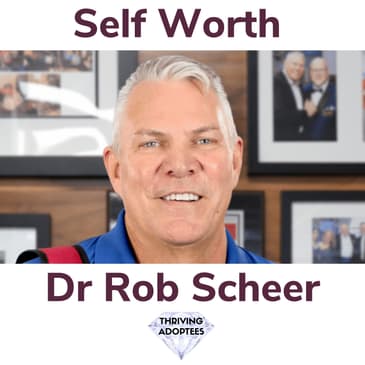
Could you do with higher self worth? Do you put yourself down? Do you see yourself as bad? Good enough? Rob aged out of foster care homeless at 18. He struggled to see his self worth. Listen in as he shares his learnings on seeing our essential goodness.
At any given time, there are more than 330,000 youth in foster care in the United States. An estimated 700 children enter the system each day, and most arrive with little more than the clothes on their backs. Those who do have belongings are often given a trash bag in which to pack up and carry their life’s treasures.
Rob Scheer experienced this indignity firsthand. Over forty years ago, he entered foster care and walked up to his foster home carrying a tattered and torn trash bag. He aged out of foster care at the age of 18, became homeless, and again carried his possessions in a trash bag.
After graduating high school (while still homeless), serving in the military and moving on to have a successful career as a banker, Rob, along with his husband Reece, decided to grow their family by adopting from the foster care system. When his children arrived on his doorstep with their belongings in trash bags. Rob was floored. How, after forty years, were children in the foster care system still carrying their things in a bag used for trash?
Rob and his family decided it was time to change this practice and the idea for Comfort Cases was born. With the vision of assembling backpacks filled with comfort and personal care items to deliver to local DCFS, the Scheer family invited their community to pack some cases. The first Packing Party was held in December of 2013 and shortly thereafter Comfort Cases was established as an official 501(c)3.
To date, more than 300,000 Comfort Cases® and Comfort XL duffel bags have been distributed to children in foster care in all 50 states, the District of Columbia, Puerto Rico and now in the United Kingdom, with Comfort CasesUK launched in 2022. Rob’s ultimate goal is for every youth to receive a Comfort Case® upon entering foster care.
Celebrating its 10th anniversary this year, Comfort Cases has been featured on The Ellen Show, The Today Show, The View, and NBC Nightly News with Lester Holt, just to name a few. In 2017, an Upworthy video featuring Comfort Cases received over 150 million views and in 2018 Rob Scheer was named one of CNN’s Heroes. Rob and Reece Scheer are also featured in Bryce Dallas Howard’s documentary film Dads on AppleTV+.
Rob is the host of Fostering Change, a weekly audio and video podcast that brings in guests of prominence who discuss issues regarding foster care, adoption, LGBTQ+ and other timely and topical issues. Now in its 7th season, Fostering Change has been ranked the #1 Podcast for Adoption and Foster Care issues two consecutive years.
The author of A Forever Family: Fostering Change One Child at a Time, Rob’s memoir tells the inspiring story of his journey from foster care to foster parent and his drive to rebuild a broken system.
In May, 2022, Rob received an Honorary Doctoral Degree, a Doctorate of Humane Letters, from Lynn University, where he also delivered the commencement speech.
Rob lives in Maryland with his husband Reece, their five children and multiple pets including dogs, goats, chickens and a pig named Penelope.
https://www.instagram.com/rob_scheer
https://www.facebook.com/comfortcases/
https://www.facebook.com/robscheer6
https://www.linkedin.com/in/rob-scheer-27482653/
Guests and the host are not (unless mentioned) licensed pscyho-therapists and speak from their own opinion only. Seek qualified advice if you need help.
Want to learn more about thriving for you, your kids, your families or your colleagues? Pick a time to talk here
[00:00:02] Hello everybody, welcome to another episode of the Thriving Adoptees podcast today. I'm delighted to be joined by Rob, Dr Rob Scheer. Looking forward to our conversation today. It's been too long Rob, it's been too long. It surely has my friend, it surely has. So listeners, if you don't know Rob, Rob is the real deal. He's an ex foster kid, you aged out a foster kid at 18 didn't you? He is now an adoptive dad with a
[00:00:32] with his husband, five kids and he's also the CEO of Comfort Cases which does some awesome work in making that transition way more bearable, that transition that is in foster care. So yeah, looking
[00:00:53] forward to the chat. So Rob, Thriving, what does Thriving mean to you as a human being, as a dad, as a leader? You know, first of all Simon, I want to say thank you so much. Thank you for, you know, giving me this platform. You know, it's, you know, having this opportunity is something that I never thought I'd
[00:01:19] have before. And so Thriving for me is waking up every day, making today better than it was yesterday. Yeah. And what does that? What, what, what makes, what makes today better than yesterday for you? You know, for me, you know, making today better than it was yesterday is educating one more person learning about kids who are in our foster care system. You know, I made a decision 14 years ago
[00:01:49] when we started Comfort Cases to no longer have a job within my community, but to truly have a purpose. And that purpose is to go around and educate people about kids like me, you know, that we are not bad kids. And so that for me is my thrive, making today better than I did yesterday. One more person learning about us. Yeah. Did you think you were a bad kid? You know, I actually did. That's strange because that's the first time anybody's ever asked me that question. Um,
[00:02:19] I actually did think I was a bad kid. And I think the reason I thought I was a bad kid is because, um, I didn't get all the benefits of all the good kids that, you know, when they were good, they'd get new clothes, they go on great trips, they do all this. And I didn't have any of that. So if you were to look back and say, yes, was I bad? I thought I was, even though I never got in trouble. Um, I didn't hang out in the smoking area and I never got detention or things like that. And my grades are
[00:02:48] always good, but I thought I was bad. Yeah. So he, he looks a clean living. I mean, listeners this, yeah, uh, this is a podcast, right? But, uh, Rob has, it looks a very clean living, lad, very clean living. By the way, thank you for that. But I will tell you, this has not always been my life. So, you know, when I aged out of the system, I had so many demons, um, demons that I was,
[00:03:12] were very scared to face. You know, I'd been drug addicted. I write about it in my memoir, a forever family. Um, I was addicted to drugs. I was addicted to bad decisions. Um, so this has taken a lot of work, but thank you, Simon, it's taken a lot of work to get to where I'm at today. Yeah. Was there a turning point on the, it was, it was, and it's been many turning points. So let's just
[00:03:38] understand it hasn't, it wasn't just one turning point for me. So it was a turning point when I was in my twenties and, you know, I had my last attempted suicide attempt, um, realizing that drugs was not masking all the problems. So I had to forgive and then face my problems. And then again, by the way, when I was in my thirties, I had to face that again by making bad decisions on relationships.
[00:04:02] You know, I, you know, you asked me the questions, was I, did I think I was bad? Um, you know, besides thinking I was bad, I felt I also deserved less than. And so I would always pick those people that would make me feel less than. Um, so it was in my thirties when I met my husband and realized that, you know, I met somebody who realized that I deserved the best. And so, and then shocking in
[00:04:26] my fifties, I once again had to realize that my addiction of, um, I have an addicting personality. So I tend to gravitate and I realized I had done that again. And so again, it's a constant, when you're a kid from the system, you are constantly having to figure out what's triggering you, what can you make sure that doesn't bring you down? It's a lot of hard work, but Simon,
[00:04:53] I want people to understand it is worth it. It is worth it. It is worth it. Um, and it's incredible how those layers come up, right? Those layers come up and we make the, we make the connection that we've not made before. So this is, I really don't expect you to say yes to this, this, this question, but, um, I'm going to try it anyway, cause I haven't mentioned him for a while.
[00:05:18] So have you heard of, uh, an author, British author called Ben, Ben Timberlake? You know what I think? No. So Ben was a, an adrenaline junkie that became a junkie junkie. And, uh, he decided, and, and he became a, uh, he came an addict or developed addiction, you know, um, on, on the back of a
[00:05:45] really strange decision. So he, he, he decided to try heroin for two weeks to see what it was like coming off. Hmm. And five years later, he, he had, he, he hit the, he hit the bottom and, uh, and, and, and, and bounced and started the bouncing back. So listening to his book, I think it's called high risk.
[00:06:10] Um, listen to his book. There's just one sentence that marks the turning point. And he said, I realized that I was bigger than my addiction. I realized that I was bigger than my addiction. And that's all, uh, and that's all he says really in terms of the turning point.
[00:06:31] Yeah. Um, and you know, I, I was talking to, uh, I haven't, yeah, I was, I was interviewing a lady called, uh, Cher, Hofstadol, um, last year, the year before. Cher, Cher died recently of cancer. Um, and she was very dear, dear to me. I was talking, yeah, I was talking to her about that, that this story. And,
[00:07:01] and, and, and she, she said, we're bigger than addiction. We're bigger than our addiction. We're bigger than our trauma. We're bigger than our trauma. So it's not in charge of us. We're bigger than it. When we have that realization, and unless we have a year until we have that
[00:07:27] realization. So the realize that the reason that I'm sharing that, uh, about, uh, about you is because I think that is one of the most profound things that I've heard. We are bigger than our addictions. We are bigger than our trauma because trauma and addiction. Hand in hand, hand in hand, hand in hand. And you know, I think so much of us though, Simon,
[00:07:54] to be able to accept that, do you even give us that power to make us even think that we're bigger than our trauma or bigger than our addiction. Um, and I love that, that analogy on that. Um, because truthfully we are, we are bigger than our trauma and bigger than our addiction. The problem is, is that we, especially those of us that are, you know, what I call alumni from the, the system, um,
[00:08:20] we have such less confident in us that we don't consider ourselves bigger. So it takes so much to do that. Yeah. Yeah. It, it takes, it takes something really bad for that. And sometimes it takes something really bad for that insight to, to happen. I was interviewing a fantastic, uh, foster, uh, foster mom. She has also adopted a couple of months back and she, she often, uh, she often interviews,
[00:08:48] sorry, she often adopts foster, sorry, fosters, uh, older, older teens, girls. And, and she said, I lay out on the line to them, right? This isn't the first thing she says to them, but I lay out to the line into the, in the fact that she is not going to deny that trauma. She knows, she knows that
[00:09:13] trauma she's had her own. She was almost killed by her first husband, 13 years. She, he was addicted to booze and she was addicted to him until she, she broke free, but she says, I'm gonna, I'm not gonna, I'm not gonna deny your trauma. I've had my trauma. You know, I've had my trauma that, but there's a choice here, right? Are you going to succumb to the trauma or, or are you going to
[00:09:37] rise above that? And I'm thinking this just blows me away that laying the choice out because so many of us don't have, don't have the insight that we're bigger than our addiction, don't have the insight that we're bigger than our trauma and don't realize that we have a choice. You know, we've gone through life, we've gone through life thinking there's something wrong with this, that we're, we're bad,
[00:10:03] that we're bad kids. Um, and, and, but how powerful to, for that, to, to, to set that out as, uh, as, as, as a, as an option. So sorry listeners, if you've heard me talking about that, but, but I just can't stop talking about it because it's so clear. It is. It's so clear. It's so clear, but they have to, we have to see that choice for ourselves. Of course. And you know, a matter of fact, that's something that
[00:10:32] you said that I actually was having a call this morning with someone, and we were talking about another youth who's aged out of the system and some of the choices this youth is making. And, you know, I actually said to this, this person who's been mentoring this young person is that, you know, we all can sit back for those of us that have the experience and we can sit here and say to someone, listen, this, this, this, but until they have felt it until they have gotten to that point.
[00:10:59] Yeah. We're, we're literally blowing hot air to the wind and I get it more than anyone. They can, it's that old saying, you can lead a horse to water, but you can't make them drink. The same thing with those of us that have dealt with that type of trauma or that type of addiction. Yeah. Yeah. Do you remember the, do you remember a point at which you realized that you're not a bad kid?
[00:11:27] Yes. Yes. I do remember that. And by the way, oh my gosh. Um, that's so crazy because you would think that I would have gotten that in an earlier age and actually I didn't. Um, I was when I met my husband and, um, um, when I met Reese, um, I was making some bad choices again, making, you know, and it was Reese who had said to me something in the lines of why are you trying to act like the bad boy?
[00:11:56] And I was like, what? And that was that moment. And he was like, you're not that guy. You're just, you know, and so that was the moment that, you know, remember talking with my therapist and by the way, everybody therapy is been the key for my success. Um, and I love that. And you know, and not all the times are my conversations the best with my therapist, but you know what? I need to have them.
[00:12:21] And so, yeah, that was the moment in my forties. Yeah. Yeah. And by the way, that still happens though. It still happens for some, you know, for me, you know, I've come so far and, you know, even things like, you know, last year I filmed an HBO documentary and I remember saying to the recent, the kid, I can't believe this is my life. How did I, you know, do I, did I deserve this?
[00:12:46] And so still you think that because you didn't have for so long, you think, you know, and by the way, real quick, the other thing that I, you know, talking about the older kids is we've talked, I had, we adopted an older youth. Yes. Um, after adopting four kids and raising them, we ended up meeting our fifth child. And you know, when he came to us at the age of 18, and he'd been in the system since he was five, he had, whoo, um, you know, rough, rough, rough upbringing.
[00:13:15] And I look at this young man now, he's 25 years old. We've legally adopted him, but I see so much of myself and I see the things that he's doing, but you know, I tell him, listen, your pops did that, but I can't, he, he's got to learn it himself. So I want people to know. We do. And he's not bad, but he came to us thinking he was bad. And you know, I think I'm probably, I'm probably oversimplifying it by saying it's one instance.
[00:13:45] I think it's the same insight again and again and again. Well, the first one is the one that we remember, but then we get the same, uh, I, I have this saying, I don't know where I got it from, where, where, where, where I made it myself, some pennies, some pennies keep dropping.
[00:14:07] Okay. Yeah. See, I always talked about it to those little acts of kindness that I've noticed throughout my life. You know, people ask me like, you know, when I was homeless, you know, I remember there was a teacher who always would bring extra food. Um, and by the way, I met her, I saw her years and years and years later after I was on a book tour and, um, she was like in her
[00:14:34] seventies. She was my teacher when I was a senior in high school. And I remember, um, she said to me, she said, you know, she said, we always, we all knew that you were the token homeless kid. Um, but yeah, yeah. And they were like, but we didn't know what to do. Um, so she said, I brought food. And so she did, she would bring food and, and, um, and by the way, um,
[00:14:59] my senior year of high school in, in the United States, you're only, if you've done all what you should do, you only should have to take two classes your senior year and then be able to leave and work. Well, I was a homeless kid. I needed school. So I took my two mandatory classes and then I took four electives and those four electives was all the same teacher because she was the one who allowed me to hang out in her class and she would bring food. And so, yeah, but yeah, she, she, yeah,
[00:15:29] that little acts of kindness. Yeah. So it's just the little nibbling away. The pennies. Yeah. The pennies dropping. The pennies dropping. Yeah. By the way, we don't even make pennies in the United States anymore. So, um, yeah. So you're on dimes now. Is that it? Yeah. We're on dimes. I love that. I don't remember that, but no, it is. I think that if we all look back, you know,
[00:15:57] you said the one, yeah, you're right. It's not, wasn't one. It was also not one act of kindness. You know, when I was getting ready to, I, I had had enough money. I was running. I graduated high school, been in the Navy, out of the Navy. Now I'm like almost getting ready to be homeless again. And it was the act of kindness that some gentleman gave me a job where I wasn't qualified, by the way. Um, which allowed me to get my own apartment. It was that act of kindness. So,
[00:16:26] yeah, I think we all have that if we look back. Yeah. What did you learn about yourself in the, in the Navy? What did I learn about myself in the Navy that I, you know, I am able to adapt to anything. Um, that blew my mind. You know, I, you know, again, grew up with nothing, you know, I didn't do sports cause they didn't allow you to do sports when you were in foster
[00:16:55] care. Nobody would afford it or pay for it. So to be able to, I, by the way, I graduated as the honor man and bootcamp that. So for those of you who doesn't understand them, so in the military, when you join the military and you go to bootcamp, you go through six, eight, 12 weeks of hell. Um, but then at the end, all of the recruits vote on one person that was outstanding during those,
[00:17:20] for me, it was 12 weeks and they voted for me. Yeah. Me, the homeless kid, the kid who carried a trash bag, the kid who didn't have parents, the kid who nobody showed up for my graduations. They voted for me. I'll never, I mean, that was unbelievable. That was a game changer for me when I was, and by the way, none of those other kids, they didn't know that I was Robert, you know,
[00:17:48] who had been in foster care homeless. Because when I walked into the Navy, I left all of that behind. And when I walked onto that base in Great Lakes, Illinois in 1985, I became Rob, Rob, not Robert. I was Rob. And when people would say to me, so let's talk about your past. I'd be like, oh, come on, we all have one. Let's talk about our future. So what do you tell people about my past?
[00:18:14] Oh, so. So it was a clean, clean slate. Clean slate. So, but getting, getting the, getting the honor. Honor man. That, that is a game changer, but it still didn't stop you thinking that you were a bad boy. No, it is. As I say all the time, it put a bandaid on for that scar, but another scar was still there. So it's the levels then, isn't it? Is it, is it the levels of stuff
[00:18:44] coming up? Yes. The levels, the levels of stuff. And, you know, and again, you know, as I said before, it's the little acts of kindness. I mean, those, those recruits, I mean, they didn't realize that what they were doing for this young person. But that was a game changer for me. I mean, you know, I could have left the military and been a statistic like so many other kids from the system,
[00:19:08] but not for me. Um, I decided at that moment, the system was not going to define me and I wasn't going to blame the system. I was going to change it. And so that was always back in the back of my mind. It wasn't until I met my kids 17 and a half years ago that I realized that I had truly failed the system by not talking about it and not telling people. And, you know, and so for me, I did more of
[00:19:34] a disservice, I think. So I'm trying to make up for all of those years that I was embarrassed of the system when I should not have been. No. What sort of dad do you think you would have? Oh, well, let me go back a bit. Do you think you would have been a dad if you'd still thought that you were a bad, bad boy? No, no, I don't think so. And by the way, when I met Reese, that was the very first question 21 years ago. I said to him, I said, do you want to be a dad? And he was like, what?
[00:20:03] I was like, do you want to be a dad? And he was like, I'm in the middle of getting my master's. And, you know, and I was like, listen, I'm not talking about tomorrow. I'm just like, have you ever thought you want to be? He was like, yeah. It's like, you know, and that's, I said, that's the reason we had a second date. Because I always wanted to be a dad. The problem is, I didn't know how to be a dad. I had never had a role model. I'd never. So I use like things I saw on TV. And then when I met my
[00:20:28] father-in-law, my, what an incredible human he was. And so I remember when they handed Reese, our first, we, our first two kids arrived, our son, Makai, when they handed him to Makai, I saw him look at Makai and I was so jealous, Simon, because I saw that connection. I saw that dad, son, and I didn't know how to do that. And so it, so I even told this, I talked about this.
[00:20:53] I was resentful to Reese because he had that immediate. So yeah, you know, I, I've had to learn how to be a dad. And every day it's a learning thing. By the way, I haven't gotten it all right all the time, but you know, I'm amazed at our five kids because they have given me grace through this journey all the time. Yeah. What have they taught you?
[00:21:17] They taught me to, to be patient with myself. They taught me that perfection is not required. It's what I asked for. Okay. Which is something I should never ask for, by the way. Um, they, my son Makai taught me how to see the world upside down. Um, our son Tristan taught me. What do you
[00:21:46] know? And, um, we basically were told he was never going to probably talk. And we, are we sure we wanted to adopt this one as if he was a piece of clothing? Our son has truly shown that children are, are resilient. Our son not only graduated from high school, but he also received a scholarship. He's also, you know, has done his first public speaking, um, of close to 300 people. Um, yeah, gosh,
[00:22:12] they've taught me so much, Simon, so much. And they still teach me every day. As a matter of fact, I'm getting ready to do, um, I'm ending my eighth season of my podcast, fostering change. And my last guest of the season is our 17 year old son, Tristan. And it's his first time to ever be in on my podcast. So it's going to be exciting to interview him. One of the best moments I've had
[00:22:37] on a podcast is I was talking to a mom, she's got two, two bio kids and, uh, and then a, a younger adoptee daughter. I think the daughter was about nine when I interviewed this lady and we were talking about self-worth and she was talking about her daughter's self-worth and something, I don't know,
[00:23:03] asked some question. I don't know quite what happened, but she had the insight, right? She, and the insight that she had was that she needed to see her own self-worth to have a chance at, at pointing her daughter to her, to her self-worth.
[00:23:26] I love that. I love that. And, you know, that makes me think of my son, Alex, you know, um, because again, I want people to understand adopting kids is not easy. Um, especially kids who come from foster care. Um, but it's so rewarding at, you know, but also I, I look at our older son and, you know, he's going through a lot of the things right now that he wasn't able to go through when he was younger
[00:23:55] because he was in that fight or flight mode. And, and now, you know, he's able to experience all the emotions and not having to worry that he's going to be kicked out of a family or not have to worry about, you know, he's not going to have somewhere to go if he makes the wrong decision. Those are the things we as youth want. We want consistency, not perfection. Okay. And that's something our kids have taught me. They want consistency, not perfection. Yeah.
[00:24:23] Can you talk a little bit more about your take on self worth? Yeah. Your self worth? I mean, we've kind of talked about it, uh, but also the, the, the kids and their self worth and what you've learned around that, because, uh, that low self worth is one of those things that tends to be the
[00:24:49] remnants of, uh, of close, close adoption. Definitely. Definitely. No, you know, um, wow. Um, I think my self worth so much for me is, you know, wow. God, knowing that I was worthy,
[00:25:09] um, when I aged out of foster care, um, knowing that I'm also worthy if I help one kid or the close to 400,000 kids in foster care. And that's something that's been hard for me to have to do, but it's also something that I've had to teach my kids is to, again, as I said this to you a minute ago, it's not about
[00:25:32] perfection. You're worthy for all that you give, even if it's the smallest thing. Um, so for me, it's a lot of that self worth. And by the way, let's also understand, I didn't feel that self worth as a 12 year old little boy who come in the system. I didn't feel that self worth when I aged out and was homeless. I didn't feel that self worth. Even when my children arrived, it is taking years
[00:25:55] to say, wow, I am worthy and I do deserve this life. And it's okay to, you know, bast in all my success because I've worked so hard, by the way, you know, I don't even know the difference between there, there and there. And for you to call me Dr. Rob Shear, I earned that doctor. And so Simon, real quick. So I got my honorary doctorate close to almost five years ago. Okay.
[00:26:24] It was given to me, um, from a university that I had had a very deep relationship with. We have packed close to 10,000 comfort cases at this university in the last 10 years. And when they asked me to give the keynote speech and to receive an honorary doctorate, I was floored. And then to receive an honorary doctorate in human letters, which is rare in our country. So I received this honorary
[00:26:53] doctorate. I spoke to close to 8,000 people. I walked away from that event, totally feeling worthy, you know, and I took that honorary doctorate and I stuck it in a drawer and I never looked back. And about six months ago, I was on the phone with the Dean from this university. And the Dean was like, by the way, um, I got an email. I noticed you don't use your doctor. I said, Oh no. I was like,
[00:27:18] come on. I was like, you just, he was like, Rob, you earned that. He's like, you earned it and you are worthy to have it. So, I mean, I have to tell you, I had to do some soul searching and I realized I did earn it and I am worthy to have it. And that's why you see it. So yeah, I'm worthy.
[00:27:39] Yeah. How, how much of your own stuff do you share with your kids and how has that changed over the years? All, everything. There is nothing I have not done in my life that my kids are not, you know, they are not familiar with. Let me tell you the reason why. I am one of these people who
[00:28:06] I can't sit, my husband's a great, Reese is a great example. Reese grew up totally opposite than me. He, parents been married 50 some years. He's well-educated, has several degrees, masters, all of that. Our kids have grown up differently. They, they're, they're, they're, you know, life books started out differently. Um, and so it's been so interesting because we have been very open with our kids
[00:28:34] because I want my kids to learn from my mistakes, but also I want our kids to know that everything that they're thinking did, um, their dads have probably thought it and did. And you know what, just because I thought it and did it don't mean I made the right choice in it. And I want them to make that, but I also want them to understand is that I love them unconditionally, Simon. There is nothing my kids could ever do that I'd stop loving them. Understand, I don't like them all the time,
[00:29:03] but they don't like me all the time either, but I love them. And so that to me is something that we have taught our kids is how do you truly have a relationship with somebody unconditional? unconditional. Think about that. We don't have that in society. So many times it's always a condition. I don't care whether you're in foster care, trauma, no matter, it's always something we do
[00:29:28] differently at the shears. We love unconditionally. So I have had kids who have busted windows out of my house. I've had a kid beat me up. Did I love them any less? Hell no. I love them even more. You know, did I like them at that moment? Hell no. But we got through it. And so now our kids are 17 to 25 and there's been ups and there's been downs. But one thing there has never been is the lack of
[00:29:52] unconditional love. And talk to me more about that and the feeling it, right? So there's the idea. Is it the idea? No, it's not the idea. It is the feeling. It is the feeling. And feelings like, you know, we have this thing in our family. We call it the family forum. When the kids were growing up,
[00:30:19] we would all gather. We'd try to do it at least once a week. And it was where the kids were able to really say everything they wanted to say and with no consequences. Um, and what we were trying to instill in our kids is to one, um, we want you to own your choices, own your choices, but also at the same time, be able to come with your choices and talk about the rights and the wrongs. So my kids would come to race and I and say, you know what? I don't like
[00:30:48] the way you grounded us. You know, I don't like the way you spoke to us. Or they'll say to a sibling, I don't like the way you came into my room and took my shit and didn't even ask me, excuse my language, skip my stuff and didn't even ask me. It giving that open dialogue to say, I don't like this, but guess what? I love you. And so we would, they would end it with, you know, yeah, but you're my brother. I love you. You're my dad. I love you. You're my son. I love you. So I think growing the
[00:31:15] kids with that, showing that unconditionalness is something that we've always had. And by the way, we've had issues where some kids have been mad at other kids because of things that they've done that has affected our family. And, and, and I say to our kids all the time, it is okay for them to be upset. It's okay for them to be mad, but it's never okay for them not to love us and love you and
[00:31:41] love each other. Yeah. So, wow. Wow. So the, the openness works both ways. Of course. And by the way, you have to be open with that as a, as a parent, just because we're adults does not mean that we make right choices. And my kids respect us as adults, but at the same time, I respect my kids
[00:32:08] because they are humans. And I think that sometimes we forget that, you know, I have said this and I think it's how I've, I've tried to live my life for the longest time. I wouldn't allow when I was back in the corporate world. And by the way, I was a banker for 28 years. And for the longest time, I wouldn't allow titles on my business cards. And, and I remember my business partners would be like, what the hell? And I would be like, why do I need a title? I'm no different than
[00:32:34] anybody else. I can make coffee just like anyone else. And I can also have a board meeting. And so I always had that mentality of, you know, we're all, you know, and it's okay to have that. But at the same time, you also have to realize there is a chain of command. You also have to realize there is a pecking order. There always have to realize you have to have a captain of a ship and also have to have, you know, the crewmen. And so even though you might be the captain does not mean you have the
[00:33:00] ability to disrespect your crew people and your crew people are valuable and their opinions are valuable. Yeah. So it's the same. It's the same as the, as the, the, the household, right? The, you want, you, you want the, the, the, the, um, the crew to share openly. You want your kids to share openly
[00:33:24] and you lead by example. Yes. And you know what? I think that we've seen is we have, we have a lot of kids who have really found themselves. And, and as our daughter, she's 21, she can be 22 in a couple. Oh my gosh, she can be 22 in about 15 days. She said to me the other day, we were talking about something and all, by the way, Simon, all my kids still live at home too.
[00:33:53] Um, and so our daughter said the other day, she was talking about our bio mother and something that had happened. And she looked at me and she said, you know, dad, she said, aren't you glad I broke the cycle? And I said, what do you mean? And she said, I'm 20, almost 22. I have no desire to have any kids anytime soon. I'm career foot. And I looked at her and I thought to myself, wow, she got it. I reason I never have said to our kids, break the cycle. Don't be like them.
[00:34:22] You know, don't be a product of, you know, never has that accident our mouth never. And to see my daughter say that to me, she got it. She got it. She realized what I said. And this is what I say to all of your listeners. We are all a product of our choices, not our environment. And I think that we must understand is that life is about choices and those choices are not always easy, but it's
[00:34:50] about choices. And people used to say my mother was a product of her environment, married six times, 10 kids, all given out and given up. No, my mother was not a product of her environment. My mother was a product of her bad choices. Okay. And that we must understand a product of bad choices. I want my kids to make the right choice, but I also want them to understand and know when they make the bad choice, it's okay. We're going to learn from it. I'm going to love you.
[00:35:19] Reese is going to love you and we're going to move on. One of the things I did time and time again, parenting. I don't know. It's not. I might say it often, but I've only heard it. A couple of times. And so me and my wife haven't got any kids, right? So what I heard that really landed for me was kids do what we do, not what we say. So therein, you've got that kind of role
[00:35:48] model, leadership, necessity, urgency, intentionality, that sort of stuff. What can you share with the listeners about that? You know, I go back to my 17-year-old. You know, last week he was being interviewed and somebody asked him a question. They said, explain to us what it's like to be having your dads, you know?
[00:36:13] And my son arrived when he was six months old. He had been in foster care since he was three months. He'd been in a couple of different homes. His mother was 13. And to hear my son being interviewed and he said, you know, my dads, my life is different. But my dads, they actually gave us the opportunity to be everything we wanted to be, say what we wanted to say, do what we needed to do.
[00:36:40] And I think at the end of the day, that has so much to do with, that has so much to do with giving them the voice to talk. So I hope that answered your question, Simon. Yeah. It's back to that openness and then the- Openness. Openness. And let me tell you, and this is from parents. I find this so crazy. Woo! So the thing is, is that kids are going to say things to us that we don't want them to say,
[00:37:09] but it's okay. It's okay. You know, pick your nose up from the ground. It's okay. You know, so. Yeah. So let's get on to comfort cases. So what, in case people haven't heard about it, tell us about comfort cases, Ron. Oh gosh, tell you about comfort cases. So, you know, Simon, in the United States and also in
[00:37:35] the UK, because we have comfort cases UK, kids are given a trash bag or they are given a rubbish bag as you call them. I know it firsthand. That bag was handed to me in the seventies and then again in the eighties. And then when I saw our children arrive, they all carried a trash bag. And, you know, it just weighed heavy on my heart for so long. And then I started to do all the things I shouldn't
[00:38:01] have done. I wanted to give my kids everything because I didn't have it. I put my kids in private schools, designer clothes, um, traveled the world. Um, and I realized is that recent, I forgot to teach our kids two of the most important thing. Number one, empathy. Empathy is not in our DNA. It's taught. And I realized it wasn't being taught throughout our schools and everywhere we needed to
[00:38:26] be taught. And by the way, it's our responsibility as parents to start that teaching of empathy. And then our legacy. See, your legacy is what you give and not what you take. And with that, I grabbed that trash bag out of my desk drawer and by the, I could open my desk drawer right now and it's there. Um, and I said to Reese, we're going to eliminate these in DC foster care. And he was like, you're as crazy. I said, I know that's why you married me. And so we ended up gathering members
[00:38:55] of our church, some politicians. And I shared the story about me entering foster care with a bag and my kids and not having just the simple things as a toothbrush. Um, and with that, we grabbed that backpack. We put all the essential items for a child on their first night, pajamas, toiletries, a blankie, a stuffy. Ooh, a little would I know that we have delivered over 320,000 of these backpacks.
[00:39:22] We have delivered them to all 50 States, DC and Puerto Rico. Um, and in 2021, we opened in the UK. So comfort cases is what we call picking the low hanging fruit from the tree. Because when you pick the low hanging fruit from the tree, your tree grows taller. Yeah. Love it. And what have you learned about thriving from, from comfort cases? You know, I have learned all of the questions that
[00:39:52] you asked me. I have learned that I'm not a bad kid. I am learned that I am loved by my community. And for so many years, as healing as I thought I had been, I was still very angry with my community. Um, they didn't clap for me when I graduated high school. They allowed me to be homeless. But what I learned through this journey, Simon is I'm not angry with my community. See, my community wasn't
[00:40:19] educated about me. And so what I've done now is I've gone back and I've educated them and now they've learned and they're making the right choices. And that's what it's about is making the right choices. Um, so that's what I've learned and I'm beyond grateful. Yeah. How do we, how do we stop trauma making the choices for us? Simon, let's be real. Trauma is always going to
[00:40:48] exist. It's going to exist whether we are in foster care or we're just laymen. Trauma is there. The thing that I think that we have to understand is not about how we prevent trauma because we've been trying that forever. What we need to figure out how to do is how to cope with trauma. Cope with trauma. How, because I'm 59, I'm going to be 60 this year. Are you thinking that not one time
[00:41:15] since, you know, I've had my quote awakening that I haven't felt trauma triggered? I had trauma triggered just on Thursday. Um, I had a meeting this morning talking with one of my board members and was talking about something that happened that triggered me. And you know, so that's going to happen throughout our, how do we cope with it?
[00:41:40] Well, yeah, I love that. So for me thriving for me, my thrive, making one step in front of the other, going out and getting one more case delivered, going out and starting to see statistics change. Look in our country, we're seeing a drop in foster care. Why? Because we're seeing an increase in kinship care, which is something I have pushed forever. I've said this before, if a child enters foster care, we already failed, you know? So we need to prevent the child. So those are all the
[00:42:10] things that thriving, that continuing to dealing, making tomorrow better than it is today. That's where we started. That's where we're going to finish up. Love it. Simon, I want to say thank you. Thank you for giving this platform again. Thank you for the years of friendship. We met many years ago and stayed in touch through LinkedIn. And I just want to say thank you for all the voices that you've lifted up through your podcast. And just thank you
[00:42:38] for being a good human. Yeah. Thank you, Ron. That lands my friend. Speak to you soon, listeners. Take care. Goodbye. Bye-bye. Bye-bye. Bye-bye.