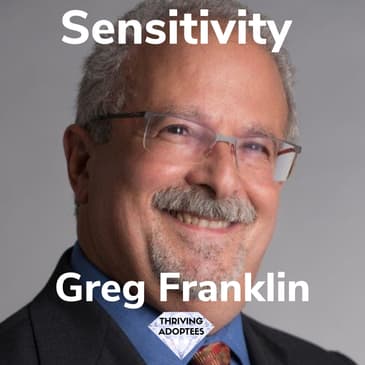
Sensitivity oils relationships like nothing else. Listen in as adoptive dad and adoption lawyer Greg and I dive deep into sensitivity, compassion and communication so we cal all thrive.
Adoptions and assisted fertility make up 90% of Greg's legal practice. An adoptive parent himself, Greg Franklin understands the challenges and joys of adopting a child. Adoptions involve a highly emotional area of law in which any legal misstep can cause devastating effects. With more than 25 years of adoption experience, Greg's goal is to develop a legally secure plan that serves the best interests of the child and respects the wishes and interests of both the adoptive or intended parents and the birth parents or gestational carriers. Greg works extensively with LGBT clients, and has represented clients in cases which have broken new ground in this area. Greg is passionate about adoptions — he is a frequent lecturer and author on ethics and adoption-related topics and he works tirelessly to achieve a positive result for adoption families.
In his representation of birth parents, Greg will assist in locating adoptive parents, negotiating open adoption and post-adoption contact agreements, and coordinating the process with the hospital and the adoptive parents.
Greg has considerable experience in the developing area of assisted fertility, including surrogacy and gestational carrier agreements, donor embryos and eggs, and in obtaining parentage and pre-birth orders.
Greg also helps to create permanent families through stepparent and co-parent adoptions, grandparent adoptions, extended-family custody agreements, foster care and international adoptions. He will assist in selecting the right avenue for achieving adoption goals, including the decision about whether to pursue domestic or international adoption, the choice between agency and private adoptions, selecting home study resources, managing subsidy and Adoption Tax Credit issues, and locating post-adoption services.
Find out more about Greg here:
Guests and the host are not (unless mentioned) licensed pscyho-therapists and speak from their own opinion only. Seek qualified advice if you need help.
Want to learn more about thriving for you, your kids, your families or your colleagues? Pick a time to talk here
[00:00:02] Hello everybody, welcome to another episode of the Thriving Adoptees Podcast. So today I'm delighted to be joined by Greg Franklin from New York, but an Anglophile in a way, right? Because she spent some time over here in London. So listeners, Greg is an adoption lawyer, adoption attorney and adoptive dad. And we had a great conversation when we spoke about a month or so back, I think it was.
[00:00:32] So I'm really looking forward to our conversation today. Welcome to Thriving Adoptees. I'm looking forward to it as well. And I am a bit of an Anglophile. I lived in London for three years back in the last century. And I'm having a Cornish pasty for lunch. So definitely an Anglophile. Right. Yeah. A Cornish pasty. So how would you describe that, a Cornish pasty to a non-Brit?
[00:01:00] Oh, an empanata without the cumin, I suppose. Okay. And it was carrots and whatnot in it. Yeah. That's pretty precise. Minced, like mince of some sort, maybe. Exactly. Yeah. And do you know the origins of, so it's wrapped in pastry, listeners, right? So do you know the origins of the Cornish pasty? I do not. Okay.
[00:01:26] So Cornwall is a, well, you call it a state, we call it a county. And there was a lot in the back post-industrial area, in the industrial area, there was a lot of mining done, a lot of tin, tin mining, I think. I don't know. Anyway, the Cornish pasty was invented for the miners to keep their meat clean with this wrap, right?
[00:01:55] So that's why it's like a crimped pastry. And whether, I guess, whether they ate the pastry or not, if they're really hungry, but you know, there's lots of salt down the mine and it kind of protected the meat. That's, I think that's the alleged. I remember that now. I remember hearing that story. I guess it was all before the Earl of Sandwich invented the sandwich. So it was just a precursor. Yeah. Yeah. And this was for the common man rather than the aristocracy. Yeah.
[00:02:27] So, thriving. What does thriving mean to you, Greg? You know, I was looking over the questions that you had sent me over the weekend and again this morning and thinking about how to answer that question.
[00:02:43] And I guess it's a combination of continuing a path of reasonable health and intellectual and social stimulation. Yeah. That's about the best I could come up with. Reasonable health, intellectual and what?
[00:03:12] Social stimulation. Social stimulation. Yeah. So, you're not putting anything there about emotional health. So is this a kind of like a lawyer, a detached lawyer kind of vibe? No, I think emotional and physical and spiritual health are also important elements in the package. Yeah.
[00:03:41] So, let's go for the one, let's go for the road less traveled, right? Perhaps the spiritual part of that. What does that mean to you, the spiritual part of training? I think, I think spirituality in any of these things is different for any individual. I'm not a religious person.
[00:04:05] I don't know that I would call myself particularly spiritual, but I think it is a sense of morality and decency and compassion and being open to criticism and change. And just intellectual honesty, perhaps. Yeah. Yeah.
[00:04:32] One of the things that is a theme for me, I think over 600 odd episodes that I've done is that the spiritual part is probably bigger than the psychological part for many of us in terms of our thriving and healing. And that, that's, it's very easy for religious people to kind of put that into words.
[00:04:59] But for, because I wouldn't count myself as a religious person either, but for non-religious people that spiritual bit is perhaps a little bit trickier to profess, to discuss. Well, I think in religion, you're part of a community.
[00:05:21] In life, you're part of a community and your community can be your spiritual underpinning and background and force that helps you keep going. Yeah. Yeah. So the social stimulation. Yeah. The, the, the, the, the sense, the sense of the group, the sense of a lot, you know, the loss of the, the loss of the separate self there.
[00:05:49] Oh, I don't know. Um, I don't know why one loses one separate self. One separate self is part of a community and you can't subsume your individuality to a group, or at least I couldn't. Yeah. And still remain true to myself. I wouldn't think. Yeah.
[00:06:16] Um, I'm, I'm going to go, you're into music. You were telling me before, uh, base. Do you, do you lose yourself in your music? Oh, absolutely. Yeah. So that, that's, that's what I mean about, that's the self that I mean that we've lost, you know, um, rather than we're carried away. We're, we're, we're carried away by our music.
[00:06:42] Uh, we've got the soccer world cup on, you know, like I'm, I'm not a massive soccer fan. I've been to a few matches. I've. And it's okay. You can call it football. Yeah, I can call it football. Um, but I have lost, I do lose myself, um, at rugby matches when they sing the national anthem, despite the fact that, you know, like I'm, I'm watching. I'm going to watch Scotland versus France play.
[00:07:12] I'm not Scottish. I'm not French. And yet I am lost. Mm hmm. I am, I'm lost in that, in, in, in, in the moment. Um, a, uh, the guitarist and singer, and one of the bands I play in is English and it's a, a Celtic trio we play in. Uh, and he used to be a professional football player, uh, back, back in the day. And he injured himself rather badly a couple of years ago when he was, uh, watching a football match and he was working out on the treadmill at the same time.
[00:07:42] And he just naturally dived out of the way to try to get a ball. Unfortunately, he was on the treadmill at the time and, and, uh, it did not go well, but yeah, he lost himself and I lose myself in music when I'm, there's a joy and a, um, a satisfaction in playing music with other people. That is unlike any other joy and satisfaction in life. Yeah. Yeah. So that's the, that's the social stimulation.
[00:08:13] Right. Well, I'm, I'm lucky to have several different communities. I have a, my legal community, uh, of, I remember the Academy of Adoption and Assisted Reproduction Technology Attorneys. Awful name. It used to be the American Academy of Adoption Attorneys, but we, that we dropped the American because we have, uh, members all over the world. Um, and I have my support community in that group.
[00:08:42] Uh, and it's, uh, some of my best friends are adoption and surrogacy attorneys. I have my musical community. Uh, I play in several bands and there is, uh, the, the Celtic, um, community is just the most warm and welcoming. And loving group of people. And, and I'm so touched to have been, um, welcomed into the fold.
[00:09:07] Uh, and, uh, then I have my, my, my family, my wife and, uh, my extended family. And that is, uh, another community and all of them are, um, they envelop me at, uh, some, uh, individually or sometimes, uh, in combination. Yeah. Yeah. Yeah. If I put the word adoptees after thriving, what does, what does that mean to you?
[00:09:35] What does thriving adoptees mean to you? I think thriving adoptees would be an adoptee would thrive the same way anybody else would thrive.
[00:09:46] But I think an adoptee has an additional little bit of baggage that may make thriving a little bit more complicated, or they have to work a little bit harder at it because they are in many cases overcoming the, the loss and separation that led to their being adopted. Yeah. And what have you, what have you learned over the years?
[00:10:15] Cause you've been involved in thousands of. I have. I, I, I, I lost count years ago, but it's easily 3000 or more at this point. Uh, where I've represented either adoptive parents or birth parents, um, in adoptions. Uh, I'm sorry. Uh, I'm sorry. What was the question? Yeah. What, what, what have you learned about what helps adoptees thrive?
[00:10:44] I think one thing that helps maybe rather than saying helps them thrive, it's maybe easier to look at it as to what can be a, an impediment to thriving, um, unsympathetic or, um, unaware. Where.
[00:11:06] Friends, parents, teachers, um, anybody else who are not sensitive to the additional. Um, additional emotional aspect or sometimes physical or psychological aspects of, of being an adoptee. I, I had a phone call last week from, um, an attorney friend of mine in New York, who was asking some questions about a court that he's involved in closer to me upstate New York.
[00:11:34] Um, and he was talking about a, an, uh, he needed to finalize an adoption of a child who had been born in, I think it was Bangladesh. The kid is 11 years old and he was struggling with how do we get the court or the social worker who's doing the home study to not mention adoption because the child does not know that he's adopted at 11.
[00:12:01] And I, I kind of lit into my friend and said, I, I, I wouldn't be representing them. I will, I will not represent somebody who is going to lie to a child. And this nonsense of, well, you know, we'll tell them when he's, when he's old enough and he's ready. It's like, that's, that's nonsense.
[00:12:19] And I think it's a situation like that, that can prevent or impede thriving as compared for an adoptee, as compared to a situation where a child always knows that they were adopted. And it doesn't mean they're not going to have baggage and emotional loss and everything else that goes along with that.
[00:12:43] But the additional kick in the teeth of, uh, not being told the truth as you're growing up is even worse. Yeah. There's, there's a jargon for this, right? It's called L LDA. Have you late, late, late discovery adoptee? No, I didn't know that. That's, that's the jargon for, um, for, for, for somebody that finds out later in life. And I've, I've interviewed a few of them and it's like the rug has been pulled from underneath. Yeah.
[00:13:13] A number of clients and frequently it's step-parent adoptions where a child has been raised with biological mother or father and then their spouse. And they've always known this other person as being their parent, but nobody ever made clear to them. More often than not, the kid kind of says, you know, I sort of knew that I, oh yeah, of course.
[00:13:35] And, you know, the thing I would say to clients is, well, so would, would you rather that you tell your, your son or daughter that they were, that, you know, you were not their biological parent? Or would you rather that some, uh, uh, you know, some cousin at a Thanksgiving dinner or something says, did you know that your mom isn't really your mom? Yeah. Yeah. Which would you rather?
[00:13:59] Um, so I, I, it just, it astonishes me that people will impose their baggage on the child. So I think what it comes down to. Yeah. Because they're insecure themselves. Sorry. I don't know if they're insecure or they're embarrassed or in their minds, there's no difference, but their minds and the mind of the child, I think are two very, very different things. Yeah. Yeah.
[00:14:32] So how do we overcome, I mean, the, the, the, the answer to that question is, is one of, to that particular situation is, is one of, um, honesty, but how do we, how do we overcome the other impedant impediments as in, how do we grow our own sensitivity to what's going on for the, for the adoptees? I think it's, it's education.
[00:15:02] It's conversations like this. It is putting yourself in the place of the child and thinking about what something looks like from the child's perspective, as opposed to your perspective. The, uh, this friend in New York city who I was talking about a moment ago said, well, you know, it's a cultural thing. Um, and adoption is not a, um, a thing in, if it was Bangladesh, Bangladesh.
[00:15:29] And I don't know if that's true or not, but that is what my friend told me. He said, so there's no, you know, cultural nexus to adoption for this child. It's like, well, okay. That may be true, but the child is growing up in America. The child is going to be a U S citizen. If he isn't already. And. You know, which, which cultural norms do you want to, uh, do you want to operate under?
[00:15:55] Or do you want to operate under the cultural norms of his parents place of, uh, of birth or the cultural norms of where he's living and where he's growing up? And to answer your question, how do you overcome it? I think. Sensitivity and intelligence. That's, that's my prejudice. So what about the advocacy piece?
[00:16:19] Because you, you, you talked about, um, the, the broader, you know, beyond the parents, the, the teachers, for example. Um, what, what have you learned about, uh, that and their, uh, lack of knowledge or, or insensitivity?
[00:16:40] Um, well, from an advocacy standpoint, I mean, in, in the States, uh, someone who's a lawyer is an attorney and a counselor at law and wearing the counselor hat. And that's where I can say to my client, adoptive parents who are perhaps reluctant about sharing the, uh, the truth with their child.
[00:17:04] Give them the benefit of my experience and what I believe that, uh, a social worker or a judge would, would say. And counseling them and trying to get them to, to be realistic. And I've come across this surprising number of times. And. Invariably.
[00:17:26] When I have insisted to people that they do have to tell the kids, otherwise in every adoption, there's a social worker who comes over and has to write up a report that says that the adoption is in the child's best interest. And then we go to court to finalize the adoption. And, you know, what are we going to do? We're all going to go to court and the judge is going to say, well, I'm delighted to have you all here this afternoon for no apparent reason at all. Uh, as opposed to, we are here to, here to celebrate the making this step parent adoption permanent and forever.
[00:17:55] And the person who has raised you as your father and who you've always regarded as your father is now going to become legally your father. And, you know, and most of the time, I actually, I can't think of any instance when a client has come back to me and said it was awful. Uh, I wish I'd never had that conversation. They've all said, you know, it wasn't as bad as I thought it was. And I'm glad you forced the issue. Yeah.
[00:18:20] So empathy, honesty, integrity kind of goes back to the moral part that you said at the outset of the conversation when we were defining thriving.
[00:18:35] Um, one of the things that is increasingly clear to me as I speak to more and more people for the podcast, especially Adopted Plants, is for the child or the teen or to be thriving, the parent has to be, or parents have to be thriving too. How do you see that interplay?
[00:19:03] Um, interesting question. I don't know. I think in a lot of cases, the parents were not thriving or depends how you define thrive.
[00:19:19] Um, I mean, in many cases with step parent adoptions, for example, uh, an original biological parent has passed away or there is a very, very unpleasant relationship with, uh, an ex wife or ex husband or something like that. So they may be getting by, but are they thriving? I don't know.
[00:19:43] But I, I guess I agree that you can't, a child isn't going to thrive if his or her parents are not also thriving or at least giving the child the tools to be able to thrive. Yeah. Yeah. But, but we can't share what we don't have, right? Um, I don't know if you can't share it, but you can at least shine a light on where things ought to be.
[00:20:13] Yeah. Yeah. It's a tricky, it's a tricky area. It's a tricky area. Um, you know, you, you talked about the baggage that they, the emotional baggage. Uh, so one thing that, uh, that, that stuck with me from like one of the first 50 interviews I did was, uh, with a lady, a doctor mom. Um, she's got nine kids. She also runs a, an agency, uh, agency in Texas out of Texas and she's called Holly Ann Petri.
[00:20:43] And she said, uh, Simon, um, uh, raising adoptive children is about unpacking our own emotional baggage as adoptive parents. And I thought that that was big and incredible, incredible for her to, to see that, that, that self-awareness. Yeah. Yeah. Peace.
[00:21:10] Well, you know, as you were just talking about, you know, as an adoptee, adoptive parents self-awareness, I was thinking about the emotional impact on a birth mother in placing a child for adoption and how difficult a decision, even if a birth mother knows it's the right thing and she can't raise a child herself or her family's situation is not one that lends itself to having another child or whatever reasons. She's making an adoption plan.
[00:21:40] Um, it still is an incredibly emotional and devastating decision to make and to, and to carry out. And, and I wonder how much of the birth mother's pain and emotional trauma herself is passed along to her unborn child.
[00:22:01] And if a child in the womb and I'm speculating, I have no idea if there's any science to back any of this up, but whether that emotional trauma is passed along to the unborn child and whether the child comes out with that sense of fraud and, and, um, and dismay. Yeah. I'm not sure how you do a study about that.
[00:22:25] No, um, there, there are studies, um, that I don't think they are studies of babies that have been, uh, being adopted. I think it's a problem. It'd be tough to get a control group. Yeah. Well, that's it. Yeah. It's tough to get a control group. Um, so, you know, for me, it, it, it, there's, there's layers, there's layers of trauma. Right. So I see trauma like a layer cake.
[00:22:55] So you've got some generational trauma. So that might be, that, that might be to do with your, we touched upon religion. That might be, we touched upon religion earlier on. So that might be like the, the, uh, the, uh, the, the, the, the trauma that's been passed through the, the generations in terms of the, the Jewish, uh, the, the Jewish race. Do they call them race?
[00:23:22] The, the, the, the Jewish religion, Jewish people, um, that might be trauma to do with, uh, you know, African Americans or black, black English people that have. Been through that slavery stuff. Right. So you've got the generation. Slavery and prejudice.
[00:23:42] And, and it was just, um, Juneteenth in the, uh, last Friday, which is the day that, uh, in tech, it celebrates the day that in Texas in 18, I don't remember when, um, the slaves were officially freed. And we now celebrate that as, as Juneteenth or not everyone celebrates it. Uh, our, our current president has managed to pretend it doesn't exist.
[00:24:05] Um, but it, there is a legacy of trauma and racism and disadvantage and a perpetuation of that. And it is astonishing to me that people will, um, you know, continue to, to perpetuate that nonsense.
[00:24:23] And imagine what it's like to be, um, a black child, uh, being raised by a white family who is, you know, doesn't have the cultural history and possibly not the sensitivity. Um, so, uh, uh, a black adoptee in a white family is going to have two different, uh, things to be over. Two different things, yeah.
[00:24:47] Or, or Chinese, you know, oriental child being raised by a white family or, um, a white child being raised by an oriental family. It's any number of things out there. That's another one of the layers, right? So, you know, I, I see this layer is the, the generational trauma. Then there's the in utero trauma, which we've, that we've, you've alluded to. Then there's the trauma to the, uh, any trauma that happens within the birth family before the, the child leaves that birth family.
[00:25:17] Then there's the, then there's a relinquishment, the placement trauma, uh, uh, the so-called primal wound. And then you've got, you've got other layers of trauma, like, so that transracial adoption piece. So all the other traumas that everybody goes through in life. Um, I, I forgot to bring my homework to school trauma and, uh, there's a bully in school trauma, or I have allergies or digestive issue trauma, or we're all. All those things. Yeah.
[00:25:45] I mean, it's like there's this swarm of traumas that are swirling around us at all times. Indeed. And the, the hopeful part of, of the way I see it, because otherwise that, that swarm can look pretty dark and, and bleak is, is the fact that if this, if trauma is a layer cake, where the cake stand, not the cake.
[00:26:15] That's a good, that's a good, good analogy. I like that. That's a good, that's a good picture. Yeah. Um, and for, for me that we need more hope in this space. Right. Because it, it, it, it gets pretty bleak. It can get pretty bleak.
[00:26:32] And somebody who is being weighed down by the trauma needs to find the coping mechanism somewhere inside of themselves and externally to be able to deal with and hopefully overcome the trauma. Well, yeah. Sometimes you can't. Sometimes you can't. Well, yeah.
[00:26:52] I mean, the, one of the things that, that spiritual piece does for me is it, it's, it separates the trauma that we feel from the essence of who we are. Hmm. How does spirituality do that? Because spirituality is about identity rather than psychology. Ah, okay.
[00:27:23] Well, yeah. Or, or, or, or science even. Psychology is, is, is psychology called a science, social science? Yeah. We're not, we're not a psychology. How, how we think and feel. If psychology is how we think and feel, that, that's not who we essentially are. Isn't it though? How we think and feel, isn't that actually who we are?
[00:27:49] I mean, I, you know, you're talking about a bully or somebody like that and people say, oh, she's really not like that. Well, yes, she is. Cause she's, this is the way she's acting. How do you separate those? Well, it's, it's, it's an, it's an, it's an unlayering, right? It's a, yeah. So the way that, the way that I see it is that, for example, anger.
[00:28:18] So when I, when I became aware of my adoption trauma, when I became aware of that, there was anger there. Right. But anger comes and goes. Yes. So anything that comes and goes can't be the essence of who we are.
[00:28:43] It might be an aspect, it might be an aspect of our personality, but it's something that is triggered. Right. So you can, you can look at identity as personality. Identity is a money, many layered thing. It can be very, it can be seen as very complex. It can be seen as many, or it can be seen very, very simply if we, if we like a, like a, an unveiling. So what's not, so you haven't always been a lawyer.
[00:29:13] I haven't always been a podcaster. I haven't even always been an adoptee. Right. So for the first few weeks of my life. Yeah. So what we're looking at for identity, when we're looking at identity, we can look at it on these many layers or we can strip back those layers. So we can strip back our profession. We can strip back our, our relationship. Right. So I'm married, but I haven't always been married.
[00:29:39] We can strip back, you know, being a dad because you haven't always been a dad. We can strip, so it's, it's an unveiling. It's a stripping back of our, our family relationships, our psychology, our name. Right. So I, before I was Simon, before I was Simon Jonathan Ben, I was David Anthony Flower. Oh.
[00:30:06] So that, that could be very confusing or it could point as it did to me. I just thought, I thought, well, the truth of who we are, the truth of who I am never changes. So our, the names that other people give, give us, we might, they might appear on our identity card, but they're not the essence of who we are. If I can shift for a second. Sure.
[00:30:35] How did you feel when, how old were you when you found out that your adoptive parents had changed your name and how did that make you feel? Um, uh, how old was I when I found, well, I didn't think I had a, I didn't think I had. The short answer to your question is how old was when I found out? Uh, I was about 46, 47. Okay. Yeah. Yeah.
[00:31:03] Um, I, I had been exploring my, you know, try and try and try and try and try and try and try down my birth mother. And I, I got a piece of paper that said, like, it was a kind of a, some information off the original birth certificate. And it had her name on it. And it also had the name that she gave me. Yeah. On it. And, and that, and that, that said David Anthony flower.
[00:31:32] And I thought, Oh, I didn't know. I didn't know that she'd named me. Uh, um, that didn't have a, it didn't, it didn't have a, a big impact. Um, one of the things that I, I had a conversation I frequently have with adoptive parent clients or birth mothers for that matter is if the relationship between them is positive, uh,
[00:32:00] and hopefully it should be, um, to come up with a name together for the child. So that the child has the name that his adoptive parents wanted, and also a name that the birth mother had wanted because it there's, it helps with that continuity. Um, one of the things that I, I kind of regret in the adoption of my, uh, with my son was that we did what, uh, your adoptive parents did, which was to totally change his, uh, his name from his birth name to his adoptive name.
[00:32:30] And that's one of the things I would have done differently. I would have kept at least one of his birth names as a way to honor his, his past and his heritage and, and the decisions that his birth mother had made. And maybe that is my imposing my, um, rationale on, on the situation for him. And maybe it meant nothing to him, but it just seems to me that the more there can be,
[00:32:55] um, the, the birth parents and adoptive parents working together towards a common healthy goal is always going to be more positive than a situation where a child is removed by social services or abandoned or whatever else. Yeah. Um, one of the things that this, this name thing is, is very, it's very personal.
[00:33:21] Um, so I was chatting, chatting to an adoptee, uh, a few months ago who said, and he was, he'd been named after his adoptive father. So he was, I can't remember the chap's name. So say his dad was John Smith, the third. Yeah. He was John Smith, the fourth. And he, he saw that, uh, as he, he saw that as an honor.
[00:33:47] Um, so other people, other adoptees will feel that they've, you know, their name has been changed and it's, you know, it's eradicated their cultural, you know, or for me, it wasn't a, it wasn't a biggie. It led to me to think, well, I, so I'm, I'm not the label that somebody else has, has, has given me, you know, my identity, my name is my identity.
[00:34:15] So there's a, there's a, there's a whole spectrum of thoughts, feelings, beliefs, all associated with just that. Yeah. And how everybody deals with it and is influenced by it differently. Uh, it is different. That's one of the things about, about adoption that I find. So it makes my job interesting. It's never the same situation twice.
[00:34:42] It's always something a little bit different or a little bit out of the ordinary. And it, that way it always stays interesting for me as a, as a professional, but, um, you know, it, it just goes to show how there are no cookie cutters here. It's not adoptions are not assembly lines. It is always a different situation between birth parent situation, adoptive parent situation, adoptee situation. And then you can spread it out to the, uh, to the community.
[00:35:11] I mean, uh, one of the conversations I have with, uh, new adoptive parent clients, when they're talking about beginning the adoption process is have they thought about, um, what flavor child they are going to be adopting? And do, is it important for them to have a child of the same ethnicity as theirs or religion or anything else? And, um, I, I remember one client years ago who said, well, and then there was a Caucasian couple.
[00:35:40] And I said, well, we're not prejudiced, but we live in a very small town. There are no other people in town who are a different ethnicity than us. And by the way, my father is a dyed in the wool racist and he would never put up with a child of a different race. And, you know, that's something if these people adopt a child who is biracial, that's just going to be another or a completely different race. Uh, another bit of baggage, uh, and trauma that the child is going to have to live with
[00:36:08] or the adoptive parents and not having a relationship with a grandfather. There's so many different layers to this. Yeah. Yeah. I, I spoke to a lady called Lahir Cushman who leads families rising used to be the North American council for adopted children or something like that. Yeah. Yeah. Um, and, and her husband have adopted and they, they actually moved that.
[00:36:38] I don't know when, when their son was like seven or eight or something. I'm not sure the exact age that they moved so that there were more. Yeah. There are more, uh, people of the same ethnicity that he would see that mirrored.
[00:36:52] So that, that to me is, is a huge move and a, a very tangible, a very, very tangible proof of, of how seriously they're taking their child's. Yeah. Well-being because they've seen that, that, that, that needs to be, be the, be the case, you know?
[00:37:21] And, and, you know, an adoptee who is adopted by people of a different ethnicity, there is always going to be a visual difference. When you're walking down the street, holding hands with your kid, people are going to say, ah, you're black, your kid is white, or you're Oriental and your kid is Caucasian or whatever. And I mean, you know, for most people, you walk down the street, you hold hands with your kid and people say, oh, isn't that nice? Not, isn't that nice? And oh, look, they look different from each other. Yeah.
[00:37:51] And that's something else that an adoptee or adoptive parents have to, have to encounter. Yeah. Interesting one, because you, you, you spent that time in the, you spent that time in the UK. My, my kind of, my gut feel, and I'm going to ask you whether, you know, to, to, to what extent you think that this is true or not.
[00:38:13] My, my gut feel is that Americans are a little bit more free with their opinion on something like this. Right. And free to share it with the, the people who, about whom they're opining. Indeed. Yeah. To their face. Right. So, you know, where did your kid come from? Yeah, exactly. You know, back when international adoptions were so prevalent and unfortunately.
[00:38:43] Now they are not for a variety of reasons. But it was so common. I'd go to the supermarket and it was so common to see a Caucasian family with a little Korean kid in the shopping cart in the seat. And I remember going, going grocery shopping one day and seeing the, you know, the usual little Korean kids sitting in the, in the shopping cart. And I saw his parents and they were Korean too. It's like, wow, you don't see that every day.
[00:39:11] So I had exactly the opposite, the opposite reaction of what I normally did. But again, I was, it was a reaction based on ethnicity and the visual. But, but you, you knew, right? The ethnicity. But you're, you're, you're kind of like, you're accustomed because of your, because of being an adoption journey. You're, you're accustomed to this. So what, what do you, what do you think of this idea of mine that Americans are slightly
[00:39:41] more forthright in pointing something like that out? Because it's just my opinion, right? I'd welcome yours. You know, I don't know. When I lived in England, it was back, God, nearly 40 some odd years ago. And I don't know that I was that conscious of the ethnicity, certainly wasn't conscious of children raising or people being raised by people of different ethnicities.
[00:40:10] I watch a fair number of BritBox detective shows and things like that. And I've, I've noticed over the last couple of years that there are a lot more biracial couples portrayed in the TV series, whether that's indicative of the, the culture itself. I'll find out in a couple of weeks in a visiting England, but I think there is less of that in the States of biracial couples than there may be in other societies.
[00:40:43] So the, the trend that I see, that I, that I see is far more non-white people in, in, in advertising campaigns. Yes. That, that, that's a, that's been a big growth thing, just probably just over the last five years. And we've seen the same thing in the States as well, I guess, because the companies that are trying to market realize that not all of their potential customers are cost-effective occasion.
[00:41:13] And maybe we do need to broaden the scope a little bit. So people will identify us with people who are matched them. Yeah. So I want to take you back a bit in terms of, you said that every, there's no assembly line on, in this adoption space. Everyone is different. Every adoption is different. What are the most kind of, and that makes, keeps interesting for you. Right.
[00:41:38] So what, what have been the most significant or most surprising learnings that, that, that you've had across your career? Or even last five years, if you don't want to ask it. No, no, that's okay. Um, I guess.
[00:42:02] I was involved very early on back in the early 1990s with same-sex adoptions where one woman was adopting the biological child of her partner before same-sex couples were allowed to marry in the U S and clients of mine were the second, uh, couple in New York state to be able to, uh, to do a same-sex adoption.
[00:42:32] And we hit, um, roadblocks from, from courts, from, uh, social, uh, social workers, from agencies and agencies that would refuse to, to work with same-sex couples. And, um, that prejudice is still ongoing today, but there's a lot more acceptance of, um, non-heterosexual,
[00:42:57] uh, adoptive parents, uh, or biological parents for that matter than there were, uh, 20, 30 years ago. So I think that's a big change that I have seen over the years. Uh, you know, challenges and things for me, I think in trying to persuade courts that this is really okay. Even if the law doesn't specifically say it's okay, the law also doesn't say it's not okay. And if for some reason the law says it's not okay, why does it say that?
[00:43:27] And how can we change that? So getting judges to change their minds and look at a family as a family and not as a, a label. Um, I think it's one of the big, big differences. One of the challenges that we still see is getting courts to focus on the best interests of a child and not on ownership of a child by a, a parent or a foster parent or something like that.
[00:43:56] And children in the law are treated almost like personal property. It's almost like, well, you know, you can't take my truck away from me. Well, you can't take my child away from me. It's as opposed to the best interests of the truck. Yeah. Wow. Wow. Wow. If we go back. I was going to say, I'm dealing in a case right now where, uh, children have been in
[00:44:25] foster care for the better part of two and a half years. They've known no one other than their foster parents as parents. And there is a strong possibility that the court may say, no, they have, the children have to be removed and go to their, uh, intended, the initial intended parents. And there has been very little interest by the court, apparent interest by the court in
[00:44:53] the trauma that a child who is removed from the only home the child has ever known and placed with strangers and what that, uh, the impact of that's going to be for the child and getting people to understand that this is not like you, you pick up a, a, you know, a child moved to a new home and, oh, the love we give that child there, everything will be fine. They're not going to remember anything of what they, uh, uh, of that transition. Well, of course they're going to remember it, whether they remember it consciously or
[00:45:23] unconsciously, that is trauma. And even if there is a gentle transfer and a stage period of time, it's going to be traumatic and a kid is never going to overcome that. They may just learn to deal with that. So that's one of the frustrations. Yeah. Yeah. You were talking a lot earlier on about, I felt about sensitivity and, and empathy.
[00:45:49] Uh, and, and when I'm, I guess what we're getting around to is understanding the courts. What, what have you, what have you learned about how the courts, uh, you know, the courts operate that might be useful to the listeners? I think one of the things that surprised me years ago and frustrates me now is how every
[00:46:18] court, every state in the United States, every County in every state and every individual court in every County and state and whatever has a different perspective. And you can have a law that's supposed to govern everybody, but how a court interprets that law and applies the law to the particular facts of the case is different with every single judge.
[00:46:43] And it is so important to know the perspective of the judge and, and how they feel about things. There was a judge who in my area who retired some years ago, who had a reputation for returning children to abusive, abusive families, uh, because the judge believed that a child is always better with a biological family.
[00:47:10] Whereas there are other judges who would have looked at exactly the same situation and gone, Oh, for God's sake, of course not. That child should be removed from that home immediately and never returned. So that has been one of the, the frustrations of a family law adoption practice is knowing the judge and trying to either anticipate what the judge is going to do or, um, working around what the judge has been doing in the past to get the result that we're looking for. Yeah.
[00:47:39] As you've been talking about these tricky stuff, this, these tricky issues, um, you know, the idea that every, uh, every judge's opinion can be that, uh, the, the judge's opinion can be that significant is a frightening, is a frightening one for me and, uh, frightening. But it's the case, whether it's adoption or a commercial dispute, you have a contractual dispute with somebody.
[00:48:10] I would say the vast majority of judges make up their mind. They know what the result is that they want to come up with. And then they find the law to justify that as opposed to looking at things completely openly and saying, well, we'll see where all this takes us. To me, that's, that's the opposite of, of justice, right? Um, that, that, it's down to the opinion of the, of the judge. Um, but it depends how you define justice.
[00:48:37] And I mean, your opinion for how a case should work out is obviously a hundred percent or 50% different from what the other side believes. So who's justice? Yeah. Big question. Big question. Big question. As, as we've been talking about tricky, tricky stuff, uh, during the course of this conversation, I, I, I sense, uh, I think the word is equanimity.
[00:49:04] Is that equanimity or you, you, you, you seem to have an ability to rise above what's going on with, with, with tackling tricky stuff and, and you've, and you've got, and yet you've got a smile on your face. What, what, what, what? Yeah. Um, I, I, I, that makes me think of a question my mother asked my pediatrician when I was a very little kid.
[00:49:32] She, uh, she said, how do you, how can you possibly deal with the, the hurt and the trauma of, of, you know, dealing with these sick children day in and day out? How do you, how do you deal with that? And, and my pediatrician said to her something along the lines of you learn how to be above it. I mean, you have to give a professional evaluation and, and deal with this professionally, but you can't emotionally invest in your client's situations.
[00:50:00] I mean, you can't do an extent, but you, you can't, you can't wear the same coat they're wearing. Yeah. So it's, it's, it's detachment. Detachment to a sense. I mean, you still need to be empathetic to their situation, but I can't feel the same trauma that a birth mother is feeling when she's placing her child for adoption.
[00:50:27] I can begin to understand where she's coming from and appreciate the, the, the sacrifice that she's making in the trauma that it's causing her. But I can't be sobbing along with her about her loss. So it is, I think any professional, a psychologist or a psychiatrist or a doctor or, uh, anybody else who deals with emotions and personalities has to be able to separate themselves a bit from their clients. Yeah.
[00:50:56] Their clients, emotions and sense and situation. That's an interesting point and takes me back to what you said earlier on about birth mothers. And we're talking about this, um, uh, in utero trauma and the, the word that I was going to, or the phrase that I was going to use, um, which I've come across before is pickled in cortisol, pickled in cortisol, right?
[00:51:21] So it's a stress, um, which is, you know, and, but it's a scary thing, right? You know, it's just, it's a scary thing. And, you know, one of the, one of the issues I think for, for, um, for adoptees is that
[00:51:39] when we have this sense of stress, trauma, whatever, when, when we have this sense and even just change, even just change, even just change. And we can't put, we, we, we, we've got a blank, we've got a blank in terms of, we draw a blank when we, cause we can't remember it.
[00:52:07] Our imagination can make a mountain out of a molehill or a molehill out of a mountain. And we, we really don't know what the size, we don't know which one is which, right? And our, our, our, we can over, we can really overcook it. When I, when I think about the, the, the birth mother experience and the pickled in cortisol
[00:52:36] experience, you, you've alluded to mentioned a couple of times, birth, birth mother's stress, understanding her stress, uh, understanding her trauma helped me see that, uh, that she, that she loved me. Mm-hmm.
[00:53:06] So, it's all personal. Yeah. No, absolutely. And, you know, not to, not to contradict you, because your situation was that, but there are situations where a birth mother is pregnant and isn't thinking about the child with love, but rather this is just something that I can't deal with. I can't raise this child now.
[00:53:32] And I need to, uh, you know, place that baby for adoption because it's just not the right time of my life. Or a birth parent who is addicted, um, and is unable to, to raise a child or something like that. Or the county says you cannot have a child with you because of the, the addictions and all the other things. So there, there is love, there is desperation, there is, um, need, there is selfishness, there is, uh, selflessness.
[00:54:01] It's, I think for all of us in the adoption triad, there is an element of each of those. Yeah. And understanding our own birth mother's situation or, uh, and even understanding other birth mothers,
[00:54:23] uh, situation helps us as a, as I'm saying, as, as, as, as adoptees, it helps us to perhaps a different perspective. Even thinking of, you know, as an adoptive parent, I mean, when my wife and I adopted our son, we didn't, I remember people saying to us, oh, he's so lucky you've given him such a better life than he would have had in the country where he was born.
[00:54:50] And I'm not sure that it was true, but, um, we didn't adopt him to save him. We adopted a child because we wanted to be parents and we were just lucky enough that he was the kid who came along at the right time in the right place. Um, so there was selfishness on our part to, to be adoptive parents. It, it, I think worked out mutually beneficially or for all of us, but it is still, everybody
[00:55:20] had comes at it from a different perspective, I guess is what I'm trying to say. Yeah. And I, I, I agree with you a hundred percent. And if we didn't come at it with a different perspective, then I wouldn't have had 600 and odd episodes of this podcast because there would only be one perspective. So, you know, um, that's, that's the nice thing. Well, that goes back again to what I said at the very beginning, that every situation, every case is different.
[00:55:49] And that's what makes this and life interesting. Yeah. So as we come up on time, Greg, is there anything that you'd like to share that, um, that I've not actually had? The one thing that I was thinking about when we were talking a moment ago about, you know, how a child feels is I was thinking about what an international adoptee experiences.
[00:56:18] Um, a child who's been in foster care or whatever for a couple of months and whatever their home country is, is, and having been in utero with somebody, they've heard the sound of a person's voice is speaking their native language. They've, um, had food or water or milk or textures, uh, of blankets that are familiar to them in, um, where they've, uh, spent the first few months of their life or years.
[00:56:46] And then to come be picked up and flown halfway across the world and be, sorry, halfway across town for that matter, and be in a, um, a different environment. There are changes and differences that are so obvious to the person experiencing them, but so subtle and, um, unobservable to, uh, to an adoptive parent.
[00:57:10] And I think having adoptive parents and social workers be more cognizant of what a child is experiencing on so many different layers for that child, the tastes and the sounds and the textures and the language and the, the lilt of a voice. And, um, even the time of day and when it's light, when it's dark, any number of different things. There's so many differences, not to mention the difference of who is raising that child.
[00:57:38] And I think that much more sensitivity is strikes me as being important for adoptive parents and professionals to be aware of. And I mean, you can't do anything about it, but just to be aware of it and sensitive to what a child may be feeling. Yeah, totally. Thanks, Greg. And thank you listeners. We'll speak to you again very soon. Take care. Simon. Thank you. I've enjoyed this tremendously. You're a star. Bye. Bye listeners.