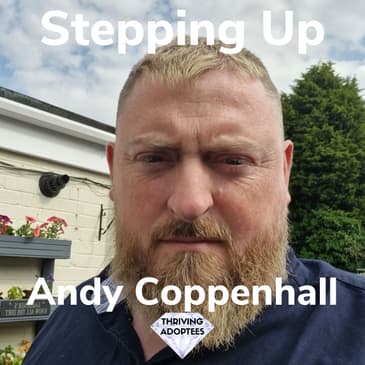
Where do we find the courage to step up? Listen in as birth father Andy shares where he found the courage to share his story to inspire others. Powerful. Be ready to be up-lifted.
Connect with Andy:
https://www.linkedin.com/in/andy-coppenhall-2a92b4156/
Guests and the host are not (unless mentioned) licensed pscyho-therapists and speak from their own opinion only. Seek qualified advice if you need help.
Want to learn more about thriving for you, your kids, your families or your colleagues? Pick a time to talk here
[00:00:02] Hello everybody, welcome to another episode of Thriving Adoptees Podcast. Today I'm delighted
[00:00:06] to be joined by Andy, Andy Coppenhall. Looking forward to our conversation Andy.
[00:00:12] So am I, I'm definitely looking forward to it.
[00:00:14] Yeah, so this is a first, listeners, we have a birth dad on the show. So these, they're
[00:00:24] elusive, you're elusive characters right in this world. There's not a lot of awareness
[00:00:29] right about birth fathers. So we're, this is a first, we're breaking, we're breaking
[00:00:35] cover. She's breaking, he's breaking cover.
[00:00:39] Wow. It's just one of them that we come across each other just over a week ago and we're here
[00:00:46] now.
[00:00:47] Yeah. So I was hosting a panel, lived experience panel at an adoption conference listeners and
[00:00:56] helping to bump into Andy and he was, he was on the panel as a birth dad. So there were
[00:01:01] there's a birth, birth dad with Andy, birth mom called Christy who was also coming on the
[00:01:07] show. And also two, two fellow adoptees. So I said, Tony, do you know, you're doing some
[00:01:15] great, you're doing some great stuff in terms of getting there and speaking. Do you want to
[00:01:19] fancy coming on the podcast? So, so here he is. Yeah. Brilliant stuff. Brilliant stuff.
[00:01:24] Thank you for having me.
[00:01:25] Yeah. And a fellow, fellow Brit and a fellow Northerner, right? He's from the wrong side of
[00:01:30] the North of England. What we say is the wrong side of the North of England. He thinks it's
[00:01:35] the right side, don't he?
[00:01:36] Well, apparently it's a nicer side.
[00:01:39] Ah, right. Okay. Okay. So it's, it's, it's Lancashire, right?
[00:01:45] No, Cheshire.
[00:01:46] Cheshire, right.
[00:01:47] Cheshire.
[00:01:47] Cheshire. So it's a bit south of, bit south of Lancashire?
[00:01:52] Yeah.
[00:01:53] Yeah.
[00:01:53] More northwest.
[00:01:54] More northwest, right.
[00:01:55] Yeah.
[00:01:58] So I normally ask the guests because normally adoptees, what does thriving adoptees mean to
[00:02:04] them? But clearly we're talking about you today. And so what, a broader question then.
[00:02:10] So what does, what does thriving mean to you, Andy?
[00:02:13] Um, thriving to me is, uh, me going to support groups and helping other birth parents, um,
[00:02:27] overcome the fears of adoption. Uh, something that I didn't have, uh, for a good seven years
[00:02:34] or so, um, until I come into contact with PAC UK. Um, so pretty much having that, um, support
[00:02:47] from PAC has given me that option and that confidence to go out and give others the belief
[00:02:57] that there is an afterlife after adoption. Um, we, we do usually get told, um, when we have to say goodbye
[00:03:07] to our, to our kids, um, that we have to grieve for them and it's not something that should be said.
[00:03:18] So I always say to them that they're still alive, that they're just in another part of the UK and there's always
[00:03:29] that chance. And to make sure that they are feeling that there is another chance further down the line,
[00:03:35] if it's a year two or 10, there's, there's that chance of, uh, a reunion.
[00:03:43] Yeah. So, um, let me, let me take you back to the kind of, um, the, the internal stuff.
[00:03:52] So there was some internal stuff going on for you. Presumably you talked about, you, you talked about fear
[00:03:57] and, and finding, finding the confidence, uh, within yourself to go out and start doing this volunteering.
[00:04:04] When, talk to me a little bit about that and how that happened.
[00:04:08] Well, when the, when the adoption happened back in, in, uh, 2012, um, I dug my head into the sand,
[00:04:16] sand, um, went to work, come home, um, and spent time with my family. Didn't really go out.
[00:04:24] Um, beforehand I was out all the time, friends doing all sorts of activities, including football.
[00:04:32] But after the adoption, I felt like I was going to get judged. So I dug myself into the sand.
[00:04:38] Um, there was no support. Um, up until about 2019, uh, I contacted the, the adoption agency that I'm under.
[00:04:51] Um, they then said that there was a support group, um, that are in my area, which had just come to the area,
[00:05:00] which, um, was a massive shock, bit reluctant because of, um, the background of things and how,
[00:05:11] how, how stuff had gone on in the past. But I was, uh, contacted by PAC, um, Lauren, um, car from PAC.
[00:05:24] And she came, sat down with me, uh, asked about my story, asked about what I wanted.
[00:05:33] And I felt more relaxed. I was asked if I'd come to, uh, birth, uh, parent groups, um, to experience other, uh, birth parents.
[00:05:47] And then COVID struck, which was a massive dent in, in the plans, but I stuck with it.
[00:05:58] Um, spent a lot of time with, um, my wife and my kids that are at home.
[00:06:02] And then in 2022, I got a phone call from PAC asking if I'll go to, um, London to speak in front of our panel, um,
[00:06:16] for, uh, children's education and talk about my experiences of adoption.
[00:06:26] Yeah.
[00:06:26] Yeah. At the House of Lords, um, which was a really big shock.
[00:06:31] Yeah.
[00:06:32] Um, yeah.
[00:06:34] Yeah.
[00:06:35] So from that, um, I, I didn't have a lot of confidence at the time because it would be the first time that I was speaking in front of a small group
[00:06:42] and a lot of people that I don't know.
[00:06:46] Um, I think that day was a really tough day because, um, a chap on the, on the train,
[00:06:55] spilt his coffee all over me.
[00:06:57] So I had a coffee stain on my shirt, which I had to hide.
[00:07:02] And then I sat in there, spoke about my experiences to have, um, one of the MPs ask me to explain a little bit more to him afterwards,
[00:07:15] which I did, which then gave me a little bit more enthusiasm to open up about my experiences.
[00:07:22] And then from that, 2022, I did a recording for National Adoption Week, um, with PAC.
[00:07:32] And I'm here today after doing quite a lot of other things as well, including the panel meeting in Liverpool on the 19th.
[00:07:43] Yeah.
[00:07:44] So when you've, you've talked about being, you know, uh, out, out and about and then kind of, uh, an outgoing sort of guy and then kind of going,
[00:07:55] going within after the, after this, uh, adoption and then coming back out of the other side.
[00:08:02] Yeah.
[00:08:02] Yeah.
[00:08:03] So what, what's, where's that strength and courage come from?
[00:08:11] Um, feeling not alone.
[00:08:17] That I'm not the only person out there that has gone through it.
[00:08:22] Um, going seven years without any support or anybody talking to me regarding it, um, was a major impact in me, um, staying at home all the time.
[00:08:39] It was tough.
[00:08:41] It was very tough.
[00:08:43] And getting in contact, well, PAC getting in contact with me, um, really helped me.
[00:08:52] Um, they give me a sign of, I'm not the only one.
[00:08:58] There is more out there that I can relate to.
[00:09:06] And that's what, um, that's what I did.
[00:09:10] I was a bit skeptical at first going to the groups, um, still took me a lot of time to go to them.
[00:09:16] But once I did, um, my confidence has just grown and grown and grown.
[00:09:23] And I sit there with other birth parents, um, which started off as birth mums.
[00:09:30] Um, so I was, I was the only one out sat there and I'm thinking to myself, I'll just sit here nice and quietly and listen to everybody's stories.
[00:09:38] If they ask me a question, they ask me a question, I'll answer it.
[00:09:42] And that's what I, I like to do.
[00:09:45] I listen to people's stories and then when they ask me things, I'll, I'll let them know.
[00:09:53] Um, and over the, the last year or so, we've had five or six more birth dads join the groups.
[00:10:02] Um, and I do talk to one of the birth dads out of the group who struggles to come to the group.
[00:10:09] Um, so yeah, it's, it's given me the, the confidence to help and support other people as well.
[00:10:15] Yeah.
[00:10:17] So what do you think is going on for this, this, this guy that, um, is staying out, out of the group?
[00:10:25] It's more to the point of his anxiety.
[00:10:32] Um, he wants to come and talk and use the group as, um, a support, um, like a counselling session,
[00:10:43] which is perfectly fine with what we do.
[00:10:46] Uh, we all have our good say about what, what's on our minds, what's causing us problems.
[00:10:53] Um, but honestly, I think it's the arts and crafts that he doesn't like.
[00:10:58] So sometimes you don't, you don't like doing arts and crafts.
[00:11:02] I'll, I'll have a bit of a dabble at it.
[00:11:05] Um, but sometimes I just won't, I won't get involved.
[00:11:09] I'll, I'll be an ear to someone and let them talk to me and, um, have a conversation.
[00:11:16] And that's all it takes sometimes.
[00:11:18] But these, these arts and crafts or these activities that we do is something that your mind's concentrating on,
[00:11:28] but you're also able to talk about what's going on while doing what you're doing.
[00:11:34] Um, and I think that's just something that he needs to get something to reflect on.
[00:11:41] So something that's interesting him, um, down the lines of his hobbies that he can do.
[00:11:50] Um, and that's what we've been doing outside, just having a bit of a chat about, um,
[00:11:57] about his experiences and I've helped him out with his letterbox and stuff.
[00:12:02] So cool.
[00:12:03] So the, uh, for people outside the UK letterbox is the system that we have here in the UK,
[00:12:09] or maybe it's just England.
[00:12:11] I'm not sure.
[00:12:11] It's about, um, it's, it's about a communication, a letterbox system between, um, between birth
[00:12:18] parents and, and, uh, and kids, uh, run, run through an intermediary.
[00:12:24] So it's a letterbox service.
[00:12:25] They're not in direct contact with each other.
[00:12:27] Um, the other thing I just, uh, uh, add into, um, uh, and as mentioned this name, uh,
[00:12:34] back UK a couple of times, they were actually the ones that helped me get, uh, get my adoption
[00:12:40] records.
[00:12:41] So that's, they, they dug out my, my file from where it was dusty and stuck in wherever it
[00:12:48] was.
[00:12:48] Uh, uh, and that was a transformational for, for me in terms of understanding the background
[00:12:53] of my adoption and, uh, reading letters from my birth mum and, uh, that sort of stuff.
[00:12:58] And the letters from my parents back and forth.
[00:13:00] Yeah.
[00:13:00] So, um, uh, UK, uh, big shout out to them.
[00:13:05] And if you're in the UK, so they're, they're a big post-adoption that they're one of our
[00:13:11] biggest post-adoption resources for people here in, uh, in, yeah, I'm saying England,
[00:13:17] I'm saying England.
[00:13:18] Leeds.
[00:13:19] Sorry?
[00:13:20] In Leeds.
[00:13:21] In Leeds.
[00:13:21] Yeah.
[00:13:22] Yeah.
[00:13:22] In Leeds.
[00:13:23] All right.
[00:13:24] I thought they had maybe an office in the Northwest as well.
[00:13:26] No, it's all done out of Leeds, isn't it?
[00:13:28] Yeah.
[00:13:28] They've got an office in Leeds and an office in London.
[00:13:30] All right.
[00:13:31] Okay.
[00:13:31] Yeah.
[00:13:32] It's England, it's England focused rather than Scotland and North Ireland as well.
[00:13:36] Yeah.
[00:13:36] Um, so for you then, um, driving is, seems to be about, uh, confidence and, uh, being,
[00:13:47] uh, and, uh, and, uh, and, uh, and, uh, and, uh, and, uh, and, uh, and, uh, and sharing your
[00:13:51] story and having more, uh, being, being a bit more outgoing.
[00:13:58] And then somewhere along the way, you've, you've, you've figured that really you want to, you want
[00:14:03] to give back and you want to, you've learned some stuff and you've had, there's been a transition,
[00:14:09] uh, in your life and you want to help the, sort of, sort of, got, uh, light the way for
[00:14:14] other people.
[00:14:15] Right.
[00:14:15] So, um, this is, this is great.
[00:14:20] Yeah.
[00:14:21] This is great.
[00:14:22] Um, so, uh, when we, when we spoke, uh, when you spoke at the, the, the CVA conference in
[00:14:31] Liverpool, you talked about some of the, uh, some of the challenges that you've, that you've
[00:14:36] had and you continue to have in terms of, uh, in terms of communication with your, um, with
[00:14:44] your birth daughter. Can you share a little bit about that?
[00:14:48] Yeah. Um, as I've explained, um, about Letterboxd, um, I have Letterboxd twice a year and that's
[00:15:00] been since 2012. The adopters were happy to meet me, um, when, uh, the adoption was, uh,
[00:15:13] placed, which was something that I wanted to do for the reasons of, um, I wanted the adopters
[00:15:20] to see me who I am and also to let them know that, um, my, my daughter, my birth daughter
[00:15:30] is, uh, got sibling, um, a younger brother. Um, from that I've had the Letterboxd twice a
[00:15:42] year and I think over the, over the last 12 years I've, I've missed two Letterboxd's. Um,
[00:15:55] one because of my, my health because I, I suffered a heart attack and the second one because my son
[00:16:03] was, um, rushed into surgery for life, life saving, um, operation, um, for four different things, which,
[00:16:15] um, a diaphragmatic hernia, congestion, um, bowel loops and his appendix, um, which lasted over seven
[00:16:26] hours. So I couldn't find the words to write back to, to the letter. I, um, pretty much replied back
[00:16:34] saying I can't write a letter this time around, please accept my apologies and explained that I'll
[00:16:42] explain everything in the, in the next letter. Um, it returned to two, two times a year, um,
[00:16:53] back and forth up until 2023 where I only received one letter. I didn't, I didn't get angry about it
[00:17:04] because obviously I've, I've missed myself. Um, and then I decided that I'd like to look at reviews,
[00:17:15] um, with having two children at home and having a child at the time of the adoption as well.
[00:17:22] Um, um, shows that I'm not a risk and contact should have been looked at earlier on in, in the process of,
[00:17:33] uh, um, the adoption that a review should be looked into to bring contact forward. Um, but I kept on
[00:17:43] getting told that it's not in the contract and, um, um, I've also recently had, um, information that
[00:17:53] the adopters aren't ready, um, which is a shame, but I do understand as well because my daughter's,
[00:18:00] uh, going to be sitting her GCSEs, um, very soon. So it's understandable. Um,
[00:18:08] um, but I think the main thing for me is a bond between myself and the adopters because when the
[00:18:22] time of a reunion comes, if there's not a bond there between me and them, um, it could cause quite
[00:18:31] a lot of awkwardness where if we've got a bit more of a friendship than, uh, um, as I would say pen pal,
[00:18:42] um, cause that's, that's how a letterbox comes across is that you're pen pal, you're right to each
[00:18:47] other. Um, and it's been knocked back at the moment, but I'm just taking it as it, as it comes. I'm not
[00:18:57] going to force it. Um, but yeah, it's, it's been challenging because it's my kids that are living
[00:19:07] at home that I'm worried about as well because, um, they're seeing photographs of my birth daughter
[00:19:15] as a three year old while two and a half come to three years old and they're not seeing any other
[00:19:23] pictures other than that. And they're growing up, which she is not. Um, so explaining everything to
[00:19:29] them at the first instance was my main priority. And that's what is something that working with the
[00:19:37] adopters, um, I was hoping that it might ease not just my side, but also their side.
[00:19:46] Um, with, uh, the transition of what, of that, the union, uh, the reunion, should I say.
[00:19:57] Are they, uh, this, these pictures, um, are they saying that that's not in the contract? Is that,
[00:20:03] is that part of the challenge as well?
[00:20:05] Yeah, there's no, the only thing that's in, in the contract that, um, I came out of court with is I
[00:20:11] get letterbox twice a year. There's no, there's no form of a review. There's no pictures, which was
[00:20:19] something that I asked, um, on a few occasions, if I could have a picture, not to keep up to go into,
[00:20:29] um, the offices anywhere, uh, needed to go and view these. I was quite happy to hand my mobile phone
[00:20:36] over any devices that could technically take a photograph and sit there with my family and look
[00:20:43] at a photograph of my daughter, uh, as, as she is. So I want to do everything by the book. Um, I don't
[00:20:51] want to, don't want to go behind anybody's back or anything. Um, these options could be
[00:21:00] given, um, under the circumstances of siblings being at home, um, at the time of, of the adoption,
[00:21:09] but it just was never, well, my son at the time was never thought about.
[00:21:14] Yeah. Uh, so here in England, uh, listeners, there's some stuff going on. Um, well, first off,
[00:21:23] you mentioned GCSEs, your daughter doing GCSEs. So GCSEs are public exams that kids take when they're
[00:21:28] about 16 and it's quite a, it's quite a stressful time for, for them and for the schools. Um, so that's
[00:21:36] why Andy's, uh, um, talking about it is like, like he is, uh, and the other thing that's happening
[00:21:44] is there's some change. Um, there's some change on the way in terms of the communication between,
[00:21:52] um, between birth parents and, uh, and, uh, adopted kids. And, uh, my understanding is that
[00:21:59] there's quite a lot of detail on that that hasn't yet been sorted, sorted out. So hopefully
[00:22:06] it will, things will open up slightly and, and, and, and ease to allow, um, more of, um, yeah,
[00:22:16] more than just pen pal stuff or, but there's, there's a lot of, there's two very opposing sides in this,
[00:22:26] right? Yeah. Yeah. You've got the, you've got the birth parents who are wanting to have more
[00:22:34] contact with, um, with their birth child and then you've got the, the side of the adopters and,
[00:22:43] um, the local authorities who have to take the, um, risk factors and, um, taking the,
[00:22:58] the possibility of any scares that could happen. Um, and it's got to be done case by case
[00:23:09] and, uh, something that has got to be well thought about.
[00:23:14] Yeah. And, and bureaucracies air on caution, don't they?
[00:23:21] Yeah.
[00:23:22] Public sector, any, any large, any organization, large or public sector or private sector as,
[00:23:27] as on caution because it doesn't worry. Um, yeah. And they don't want to be,
[00:23:32] they don't want to be caught out. And so they will, uh, the individuals will ask for more and more.
[00:23:39] Yeah. Uh, guide guidelines and, and, uh, people. Yeah. And it, it just ends up, uh,
[00:23:48] increasingly frustrating, I think for, yeah, which is the reason why I think I review, uh, into,
[00:23:56] um, the birth parents, um, a few years down after the adoption to see how they're getting on. Um,
[00:24:06] which can be assessed by, um, like, uh, an organization like, uh, PAC UK, um,
[00:24:16] who could then pass this information over to the, um, the adoption agency to look at moving contact
[00:24:25] forward. Um, but it all does span down to, um, how willing adopters are willing to be. Um, and
[00:24:38] hopefully, yeah, more decide that they would like to involve birth parents.
[00:24:46] And, and, and they're likely to be scared.
[00:24:50] Very scared. Yeah. Well, they're going to be as scared as what we're scared because as much as we
[00:24:56] would like to have more contact with our, our birth children, it's more to the point of,
[00:25:02] we don't want to upset the adopters and we'd certainly don't want to upset our, uh, our birth
[00:25:08] children. So it's more like a way to help both sides.
[00:25:17] So everybody's scared really.
[00:25:19] Yeah, we are. We're all scared.
[00:25:21] The, the, the, the birth parents, the adopters and, uh, the organizations in the middle, there's a,
[00:25:27] there's fear and insecurity.
[00:25:29] Uh, yeah.
[00:25:30] In this one.
[00:25:31] Well, that's, that's the thing. And I think if, if it starts off as letterbox and then you have a
[00:25:37] review and then, um, the review then decides that you can, you can meet the adopters once a year on
[00:25:47] top of your two letterboxes face to face. So have a good chat, um, catch up about everything that's
[00:25:54] going on. Um, it, it would really help because what you can say to people is completely different
[00:26:03] to what you say in a letter and in a letter it can come across so many different ways. Um,
[00:26:10] and the one that I would like to try and get over to my adopters at this moment in time is,
[00:26:17] um, my daughter is being assessed for ADHD. Um, I've been told that I'm possible ADHD.
[00:26:31] So something that I've not thought about and try not think about now, but does it show that my
[00:26:42] birth daughter could possibly have ADHD as well?
[00:26:46] Um, and going off some of the letters that I received, um, the constant change in, um,
[00:26:58] interests. Um, what was it she was interested in March this year? She's no longer interested in
[00:27:04] now and she's moved on to so many different things. Um, and being told by the adopters that,
[00:27:12] um, she doesn't stay interested in something for too long. So that sort of tells me,
[00:27:24] is there something there herself? Um, so I know that I'm, I'm that way. I'm, I'm interested in
[00:27:33] something and then not interested in it. The only thing that I've been interested in and
[00:27:37] stay interested in is football. Um, because I love to play football and I love to watch football.
[00:27:44] Um, but other, other things I'm in and out of being interested in it. I sometimes go back to it,
[00:27:51] but not all the time. Yeah. Yeah. So how do you feel about what's going on?
[00:28:01] Um, um, distraught because, um, as a birth parent, you think to yourself,
[00:28:15] we are just like anybody else. We are the, we, we're as, as human as anybody else on, on the planet.
[00:28:26] Um, and we, we sometimes do feel like we are getting treated a little bit differently to what
[00:28:33] others do. Um, and as most people say, we, we, we are basically labeled, um, and it's not always the case.
[00:28:46] Um, not every adoption is the same. There's so many different types of reasons for the adoption.
[00:28:55] And I think adopters looking at adoption, um, I think it's one of them that
[00:29:08] take in the consideration of the birth parents and what they're going through at the time.
[00:29:14] Um, and that's for the local authority as well, because obviously we don't get support
[00:29:19] that we need during these processes. Um, so yeah, it's, it's really difficult, um, to, to take on board,
[00:29:30] but I have to do it, um, for the benefit of my birth daughter.
[00:29:35] Yeah. Yeah. And for your kids?
[00:29:40] Yeah. My kids as well. They can't see me feeling upset, um, not wanting to do anything. Um,
[00:29:51] it's showing them that I'm more of a person that I was at the time of the adoption and
[00:30:02] my kids love me for who I am. And they've asked me never to change. And they, they talk about what I do.
[00:30:10] Um, um, with PAC, uh, with everybody that they speak to. And if I'm away on a, um,
[00:30:19] for a conference, they tell people where I am and that's what I like.
[00:30:25] Yeah. Yeah. They're proud of you.
[00:30:31] They are. Well, they, well, they say they're proud. I don't know.
[00:30:34] I don't know if they quite understand it, but no, they, they are proud. They, they are happy to talk about what I do.
[00:30:40] And they, they talk freely about, um, their adopted sister. Um, my son is,
[00:30:50] amazing when it comes to that, uh, because people go, oh, you, you've just got a, a younger sister.
[00:30:56] Have you? And he goes, no, I've got an older sister, but she's adopted.
[00:31:00] So he'll always talk about, he'll never, he never, um, forgets about making sure people know that she's,
[00:31:10] she's around.
[00:31:11] Yeah. Maybe the adults can learn something from the kids on this one, right?
[00:31:16] Yeah, possible. You never know.
[00:31:19] Yeah. You never know. The, uh, my daughter has just gone through counseling, um, because she is
[00:31:28] really wanting to have contact with a, a, a big sister as, as girls do. They want a bigger sister to,
[00:31:36] um, share makeup with, share clothes with half the time. And she wants contact with her. And
[00:31:44] she's just had some counseling regarding that. And, um, um, she's wrote her a letter that's
[00:31:53] six or seven pages long.
[00:31:57] And I didn't think, um, as my daughter's being a diagnosed, uh, well, being assessed for ADHD,
[00:32:08] I didn't think she would be able to sit there and do that. But because she was in a counseling session
[00:32:13] where the, the, the concentration was on her, she was able to do that. Yeah.
[00:32:18] Um, but yeah, I think, I think.
[00:32:21] Is that good? Is that going to be able, are you going to be able to include that in the letterbox?
[00:32:26] I'm hoping so. And that's something that I'm going to be, um, what I'm asking about with the review as
[00:32:32] well is that my youngest daughter is able to contact her adopted sister. So, um, it's,
[00:32:42] it is one of them. I have, I have stated that I don't want it to happen now after the, um,
[00:32:50] after schools ended in, in July, I reckon once all exams are finished, um, then that's a possibility
[00:32:58] of that starting, but, um, it's all down to the adopters, um, if they agreed to it or not.
[00:33:05] Yeah. But I think, I think listening to, um, not just the adoptee, uh, like children or adopteens
[00:33:17] or adopted adults, um, children, siblings, I think as well, it can be a very powerful subject as well.
[00:33:27] Yeah. Yeah. Well, I know that I've got two half brothers and I could, I, if I wanted to, I could,
[00:33:34] I could get in touch with them. It would be a roundabout way. Yeah. Um, because I've been, uh,
[00:33:45] uh, told to, I spoke to my, I spoke to my birth dad completely out of, I rang him completely out of the
[00:33:54] blue, um, about a year ago. And he, he didn't want to, he didn't want to, he didn't want to talk.
[00:34:02] I didn't handle, I didn't do it. I've said, I didn't handle it very well. Um, I didn't,
[00:34:06] well, I didn't approach it very well in the first place, just ringing him out in the blue. Um, but,
[00:34:10] uh, I, I, I'm pretty, I'm pretty sure that even if I'd done it in a different way, he would still,
[00:34:17] uh, he would still, uh, blank me because he, because of the stuff that went on for him, you know,
[00:34:26] I found out that he was in and out of care because his, his mum had died when he was young.
[00:34:40] Uh, and his, his dad was away, uh, abroad on business and couldn't, and couldn't look after the
[00:34:50] kids and there was no other family that would look after his, my birth dad and his two siblings.
[00:34:57] So, you know, he'd had a, and, and, and a traumatic start to life as well, losing his mum when he was just
[00:35:06] young. And, and, and then, uh, and then, uh, whatever it was, whether it was an orphanage or foster
[00:35:11] care, we don't, I don't know quite what was going on, but yeah, it wasn't, it wasn't stable. So yeah, he's, um,
[00:35:22] yeah. And he's not told, he's clearly not told his, um, his wife. No, he said, that's why he said,
[00:35:32] don't, don't, he said, don't ring this number again. He said, don't ring, not, not, don't ring this
[00:35:38] number again. Cause obviously it's scared that I'm going to ring back and tell his wife, and then he's
[00:35:42] going to get found out and it's going to blow up. So I'm staying well away. Yeah. It's, it's,
[00:35:47] it's a difficult situation and someone who's held it in for so long, um, and not spoken about it.
[00:35:58] And at that time as well, probably not being told, um, that you'll get the chance to reunite in the future.
[00:36:10] Yeah. He, he signed, he signed his rights on a little piece of paper.
[00:36:15] That's what I mean. And having that, not being able to see him again and moving,
[00:36:24] moving on, moving forward and it's 57, 50 odd years ago, you know, different, different times.
[00:36:32] Yeah. Very different times. And it's, it's a difficult thing to, to have to endure, but
[00:36:40] we would never know if we don't try.
[00:36:43] Yeah. I saw it, I saw it as an experiment, right? And the fact that he didn't,
[00:36:52] when he told me not to call again, the fact that that didn't knock me sideways,
[00:36:59] I see as a, uh, as a sign of my progression or whatever, my, you know, my, my healing,
[00:37:09] my strength or whatever. Yeah. It didn't, it didn't, uh, trigger me as they say in, in today's patterns.
[00:37:21] Well, that talking about triggers, I've, I don't, I can't say that I've got any triggers.
[00:37:31] Um, I don't know. I used to have a lot of triggers every time I walked out, um,
[00:37:36] out the house, I had a lot of triggers, um, which is the reason why I stayed at home, but
[00:37:43] never had any triggers over the last four years. I've just been able to get on with things.
[00:37:52] I know that what I'm doing, um, keeping my letterbox up to date is showing that I'm here,
[00:38:03] I'm still here and I'm not going anywhere. Um, yeah, it's...
[00:38:08] So what's, what's changed for you, Andy?
[00:38:13] My, my, my two kids at home, um, nobody wants to see a parent, um, sitting around doing nothing,
[00:38:23] going to work, coming home, doing nothing, going to work, coming home, and then on,
[00:38:27] on your days off, not going anywhere. Um, my, my wife wanted them to see the person who I was
[00:38:41] when we first met. Um, even though we didn't get together at the time, um, it was a few years
[00:38:51] later she wanted them to see who I really was. Um, and for me it took me seven years, um, to,
[00:39:02] to start showing that. And I'm, I'm glad I have because they're going out, they're talking about
[00:39:10] everything that I do and... Yeah.
[00:39:14] And they, they support me. Yeah.
[00:39:17] As much as it, I support them.
[00:39:21] It's beautiful, man. Beautiful. So,
[00:39:28] what, what, um,
[00:39:31] is there anything that I've asked, I've not asked you about that you, that you want to share?
[00:39:36] I think when it, when it comes down to birth parents, um, obviously most of the, most of the time
[00:39:57] there's both parents around and I feel something that's been playing on my mind now for
[00:40:11] nearly two years, um, is that we're not always going to be around and I've suffered health scares.
[00:40:25] Um, I, I did nearly pass away in 2019 after kidney failure.
[00:40:34] Um, wow.
[00:40:36] But I'm, I'm more to the point of when a parent is no longer here.
[00:40:48] Um, because at the end of the day, even though I've moved on and I've had children with my,
[00:40:57] my now wife, um, there's still feelings there for the birth parent, the birth mother.
[00:41:08] Um, because she's obviously my, my daughter's mum and you want both parents to be there at the time of
[00:41:17] any possible reunions. And if that's not always the case, then I reviewed to bring
[00:41:31] like contact forward when there's only one birth parent alive should be considered.
[00:41:40] Right.
[00:41:42] Because there's going to be so many people out there, including myself, that has to explain to
[00:41:55] your child, your birth child, the reasons, and that's all coming back on us as well.
[00:42:06] Um, so yeah, I think I like to take into consideration regarding that.
[00:42:14] Um, with, with you saying that your birth, birth dad's mum passed away when he was young,
[00:42:21] it, it made me think that, yeah, actually I need to say this because at the end of the day,
[00:42:31] the support is needed. Um, from both sides. And I don't know how the adopters would take
[00:42:41] the information regarding the passing of a birth parent. Um,
[00:42:48] or even if they tell a child that a birth parent has passed away or not, I really don't know. And
[00:42:55] I don't want to divulge into that because it's, it's a complicated situation. So yeah, it's, it's one of them.
[00:43:04] Um, as soon as I found out, I made that call to make sure that the adoption agency knew all about it,
[00:43:12] which they did. Um, but it's one of them.
[00:43:21] Yeah. Cool. So I'm going to put a link to your LinkedIn in, in, in the, in the show notes,
[00:43:28] if that, that's all right with you and people.
[00:43:30] Yeah, that's fine by me.
[00:43:31] I'm sure you'd be pleased to hear from people. Um, um, we never know whether you're going to get a
[00:43:37] response or not. So thanks a lot. And, and, and, and, and, uh, it's been great to, to, to talk to you
[00:43:49] and get to know you a bit better than I did, uh, with the, over the panel in Liverpool.
[00:43:53] Yeah. It was a very, uh, busy day that day.
[00:43:56] It was a busy day.
[00:43:57] Very busy day.
[00:43:58] And it's good response though, right?
[00:44:01] Very good response. And still getting responses now.
[00:44:05] I'm doing research with, um, Sheffield University and, um, going to be working with, uh, Bernard
[00:44:13] I was down in, um, in Kent. So yeah.
[00:44:18] Brilliant.
[00:44:19] Yeah.
[00:44:21] Very informative that day was.
[00:44:23] Yeah. Good on you.
[00:44:24] Thanks a lot.
[00:44:25] Thank you very much for having me.
[00:44:26] Yeah. You're welcome, mate. You're welcome.
[00:44:27] Thanks listeners. And, uh, hope you enjoyed something a little bit different, uh, for this, uh,
[00:44:32] from this episode. We'll speak to you again very soon.
[00:44:34] Take care. Bye bye.