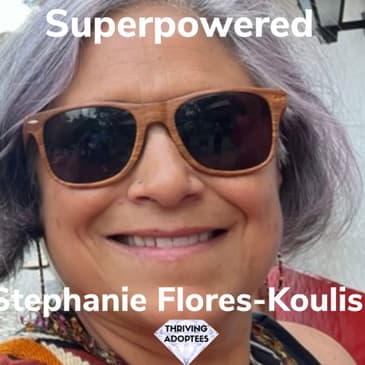
Changing the narrative requires changing the narrators. What narrative would empower you? What if being adopted has given you superpowers? How would that perspective power you? Listen in as Stephanie shares her thoughts about becoming superpowered and other healing insights.
More about Stephanie at:
https://www.loyola.edu/school-education/academics/graduate/curriculum-instruction/
https://www.linkedin.com/in/stephanie-flores-koulish-5792919/
Guests and the host are not (unless mentioned) licensed pscyho-therapists and speak from their own opinion only. Seek qualified advice if you need help.
Want to learn more about thriving for you, your kids, your families or your colleagues? Pick a time to talk here
[00:00:00] Yes Hello everybody welcome to another episode of the Thriving Adoptees podcast today I'm delighted to be joined by Stephanie Flores-Koulish looking forward to our conversation Thank you for the patience with the technology Looking forward to this conversation
[00:00:16] Yes me too. Thank you so much Simon. It's good to be here. It's good to be it's good to see you smiling face on a Monday So so to what extent does this healing word to what extent does that? Resonate with you Stephanie
[00:00:32] Sure, yeah, so you know I reflected on this a few weeks back and then you know I'm gonna start out by kind of you know Talking through what I had originally kind of reflected upon but then we'll see like where we go from here because
[00:00:50] You know eat and part of this idea of healing is that Every day is a different day right and so I feel that you know while my Reflections of a few weeks past might be
[00:01:02] Relevant generally universally for me. I also think that you know there are moments that you think healing means something different So I'll start by that kind of yeah, you know kind of pre pretext there But a few weeks back. I thought you know for me Healing comes
[00:01:21] No with time and discernment and reframing and self-acceptance So I thought about time in the ways that you know time helps to put a perspective on what transpired at least for me, you know my childhood because For me when I look back
[00:01:45] It was more of a sad time, you know in confusing time And so, you know, I can think back about you know My when I was a little girl and want to reach out and kind of hug her and that's kind of this moment of healing
[00:01:59] When I can get to that place of thinking about that, you know and again, it's not a constant but discernment is part of the Important component for healing as well and it's a reflection process that You know, I'm a
[00:02:19] faculty member in a Jesuit institution and we like to use the term discernment a lot because it's part of the The Jesuit way if you will but I do think there's a lot of value in that for us as adopted people
[00:02:32] To kind of consider the magnitude of the impact of adoption in general And then in addition, you know discernment for me personally has happened through the studying that I've done within adoption literature in adopt listening and and engaging with materials from other adopt adoptee professionals in the field
[00:02:57] And as well, you know, it's it's a consideration of my own circumstances that what's made me unique and how I can reframe Reframing my own circumstances to make sense of them in a new light And so the reframing then
[00:03:19] It takes place through the course of time. So going back to that time idea it but it for me it kind of like is a way to consider how I've realized that Um This time this concept of intersectionality of thinking about multiple intersecting identities and especially for
[00:03:45] Consideration of those who are in marginalized identities in the ways in which we can provide a unique perspective on viewing the world and And We can kind of think about it in a way that can flip maybe a general understanding of it being
[00:04:06] Less than or under, you know without the power That we may have on the other hand it can be flipped like I said to see ourselves from a unique position from a position of strength to be able to see how we can
[00:04:24] Really sort of coalesce with other people with marginalized identities to see the potential there So, you know some people in scholarship have maybe almost seen it as like a superpower type perspective That could be potentially A
[00:04:47] Discounted or disregarded but actually that can be unique and important and can be empowering and so this empowering idea is what can lead to self-acceptance and That ultimately is where healing can lie You know for me Existentially, you know I started out rootless like many of us and
[00:05:09] And you know as a teen and young adult You know that rootlessness for me led to a lot of years of self-deprecation Wild exploration and a lack of self-care, but you know as I've aged and matured I've tried to build a solid foundation for myself
[00:05:31] I've come to generally appreciate my uniqueness that has brought me to a particular way of viewing the world which for me is really kind of through humanistic lenses to kind of Correspond with other people who might have similar viewpoints and
[00:05:51] Fortunately, I feel like I've accounted a you know various mentors through my life where they've seen that in me and have kind of Underscorted uplifted it and and helped me appreciate that of myself. So that's
[00:06:06] Really kind of how I try to think about it or at least that was when I spent the time to really kind of think about your question I thought about the time discernment reframing and self-acceptance process. Yeah
[00:06:20] So this there's clearly a lot of thought as you say in that The the bit that really struck me as the emotionally soothing part, right was the stuff that you talked about and Parenting the the little girl who was who was sad, right hugging hugging the little
[00:06:44] Hugging the little girl that was sad and I thought of we often mentioned this and parts work IFS Therapy modality We often end up mentioning that on there on the on the calls on the interviews and you're nodding there and
[00:07:06] For me that the the books title is by Dick Schwartz is no bad parts and it's it's the the kind of thing that We're giving ourselves with we're self parenting. We're being the parent
[00:07:23] for the the little parts of us that feel lost and alone and we are really Reparenting them in a sense as adults and we're giving ourselves The parent that perhaps we didn't think that we had when we were growing up and
[00:07:45] That and so it's never too late to have a new childhood we we are soothing rather than being Angry about our angry parts or worried about our worry parts or insecure about our insecure parts we are
[00:08:08] Hugging hugging them in we're bringing them close rather than trying to push them away and That was the most The strongest kind of emotion emotional stuff that came out came for me when
[00:08:27] When you shared shared that because obviously you shared so much for me to dive into and I'm wondering to what extent is is is that Is that the emotional side to what extent does that recommend that represent the emotional side as well as this
[00:08:45] Healing the calming the nurturing the The the well the accepting side of it rather than this small Cognitive kind of think you stuff Yeah, yeah, that's a great question. You know my therapist asked me that all the time
[00:09:06] Because I'm good at I'm good at hiding behind that, you know, especially as someone who is a You know his PhD and does this for a living Does thinking for a living that is? I
[00:09:21] Done and just you know, I think also probably combining that with growing up in an environment, you know grew up in a working class community Where it was important, you know my father who adopted me was a 20 year military man had been before They adopted me but
[00:09:43] You know so there was a lot of toughness that You know, I had to Adopt if you will right yeah and and and then and you know kind of entering into this career That have been in in the last 25 years Has really only sort of amplified
[00:10:07] That idea that I can kind of just think through things, you know So the feeling part that's a great question, you know because while I wrote that I don't know that I'm as Cognizant or see there you go again
[00:10:22] I'm it's always part of my thinking but I tell you I think about like the last couple days It's really just been a little bit different from, you know, even a couple weeks ago when we were gonna initially discuss this because I'm
[00:10:36] Tomorrow's my birthday. So, you know, that's always a trigger day and so I'm feeling the feels and In addition and this is probably a bigger feeling the feels is next week We take my youngest my third child and last child to college to university
[00:10:53] about five hours away and You know, that's a transition point and You know, I think about You know with the with regard to like the feelings piece, you know, how much I've poured so much into being a good mother to my kids
[00:11:12] over the last 22 years or whatever, you know and 21 years and It's been a lot and then to have that pivot happen it could be that now is where I have to do more of fit for me and And
[00:11:32] You know, so some of this is still like in process in terms of the feeling and the healing because I Don't know what lies ahead. I don't exactly know and with regard to Where I'll be without having that opportunity to put my
[00:11:52] Feelings towards my children to offer them what I never had Which was to be there as best as I can emotionally because that's a big piece that I laughed was that I didn't have parents who Had any emotional intelligence whatsoever and so I
[00:12:10] Tried to kind of prioritize that as well as just being there to hear and listen to them Another thing that I know that my parents didn't have for me They just didn't they didn't have the space or time or
[00:12:22] Again emotional intelligence to be able to provide me what I needed to listen to listen to who I was, you know so I've done that as best as I could over the last 21 years and it's about to change and that's
[00:12:38] So it's an interesting time that you know, we're speaking right now Yeah I I was trying to Come on the podcast years ago like probably three years ago this morning Um, and I was saying that I I've heard this phrase lifelong learning about 35 years ago
[00:13:00] but I think I've only really understood it in the last couple of months and Although I would say that I've been doing Doing it I've been doing it for at least 17 years and and it's openness right It's open open to learning new stuff and we are
[00:13:31] In the same way as we're we're conditioned we brought up Many of us to stuff our feelings right and to go for this To stick stick into this at this thinking area to stick in the thinking area
[00:13:47] Especially in the military, you know, I'm sure that you know, you can't That there's there's no space for feeling, you know like I Could go on and on about that We're brought we're brought up to be afraid of the unknown
[00:14:07] Right. So if somebody says so and I you know Don't you know no, I don't know well what you're gonna do, you know, like We're brought we're brought up to Respect certainty to respect knowing to want to know to like It's It seems to be a cultural thing
[00:14:32] and and If and if we've had as adoptees we've had all these questions that we don't know the answer to and And that feels scary And does that add to our fear of the does that add off others? sorry add to our fear of of the unknown and
[00:14:58] Maybe when we bring back that fear up into the light of Awareness then maybe that fear eases the best on yeah, maybe I mean in some ways I feel like I haven't been afraid as much, you know through the years. I really kind of
[00:15:20] Been a bit of a risk taker in a lot of ways but in other ways I see what you mean, you know in terms of just sort of complacency and allowing for like
[00:15:33] Like life to sort of happen to us as opposed to us kind of taking the reins, you know Yeah, and feeling is Healing is feeling less afraid isn't it? Mm-hmm Sure. Yeah Yeah, I
[00:15:57] You know, it's again, I think it's a little odd to be talking to you today because I don't feel as like kind of great like
[00:16:08] Enthusiastic is maybe at another time, right? So I think again, I think that's an important acknowledgement is that there are times and days where We just have to give in in a sense, you know Yeah, I saw a great graphic on Facebook the other day and it said
[00:16:30] feelings fluctuate and It did it in graphics. You know, so a little like a little pie chart thing or graph So it's feelings fluctuate and then worth doesn't like so you could see these feelings going up and down and And then the the worth being a constant
[00:16:55] along along the bottom and I know again, I think another thing that we adopted or not right and Our culture in the West is one of a
[00:17:13] Motophobia, right? So we have what did was it reasonable that said we're the only thing we have to fear is fear itself like how many like 70 years ago whatever it that he said it so we've become We've been we've been become scared of our
[00:17:30] we've been come scared of our feelings and You know, what's what's wrong? You know like so People people are all over us if there's something Wrong if what I'm not feeling so good All right. Well, let's get to work and let's change that you know rather than a
[00:17:53] more accepting More accepting take on our own feelings because if If we're okay with not feeling okay, we're always okay Yeah, it's become but with is this a notephobic, you know and And
[00:18:20] Then you've got that you've got the parenting layer on as well there right, you know, so you We're we're concerned about our kids Concerned about we're concerned about our own feelings. We're concerned about our kids feelings and before we know it we're into a
[00:18:37] an overthinking phase we're into a Like a vortex how am I gonna how am I gonna get out of these feelings where We've had those feelings of sadness and we've felt that we're gonna drown in them
[00:18:58] And and we become and we've become scared. That's why we stuff them. That's why we Deny and whatever And I've had the same thing from a therapist eight years ago as you and she gave me that I did a few sessions with it and then she
[00:19:20] We kind of got it seemed like we got to the end of where we she could help and she gave me she gave me her notes And it said something like Simon evades Tough feelings by
[00:19:36] By moving to a safer cognitive space or something like that she'd written it down to herself It's always good to see the Background notes, right? Yeah and but she I She typed them up for me and some of them made sense
[00:20:00] But none of it went to my worth Right, none of it went to my worth None of it went to my value none of it went to my Self none of it went to my essence It all went it was all about my my emotions and
[00:20:25] It's the I think when we when we talk about healing often we're looking at our psychology and our And our feelings and we've got a narrow view on Healing it's it's broader than that. You know you mentioned working at a Jesuit college
[00:20:49] There's a there's something deeper than our feelings and our thoughts And and and we're you know, I'm thinking about a metaphor here, you know that the that the surface the surface of the of the ocean Can be Raging and a force 10 Gale or it can be calm
[00:21:13] But right at the depths of the ocean It's always calm down there Mm-hmm And we're bothered about the waves on the top rather than right Taking a deep dive right taking a deep dive to something that to what's more essential for us
[00:21:40] Right. I mean and that to me is kind of Part of that timepiece that I talked about that, you know, we can always kind of ground ourselves in this Self-acceptance like okay, so sometimes I'm not acknowledging my feelings like I should or another's feelings
[00:21:59] I can continue to work on that And it doesn't like you said change our self-worth our self-value and I think You know as far as like some of the fears go I Have something
[00:22:20] Just exploring new ideas and things and I still helps us to kind of understand who we Could have been you know, and I think that's an important thing too is just to sort of Go out and try some new activity or a new New
[00:22:42] Thing in your life new things to see like what could have been What might have been and then it just sort of adds it adds the fun part Which is also a feeling that's important right to kind of enjoy
[00:22:56] And so I think kind of trying to find those spaces for places for joy Is in that calm part they were talking about that? It's really like a should be a base that we strive for Yeah The the self-acceptance For me is that
[00:23:23] You know when I think about when I think about Richard Schwartz's book this was his book no bad parts No bad parts and self-acceptance seem To be saying the same thing right so if you if you what's the opposite of?
[00:23:41] No bad parts would be some bad parts and we would therefore be trying to with that so those we're not Accepting we're not set accepting those parts and and this word And but this word set self is is where you know, we use it self-acceptance or self-esteem and
[00:24:05] self-appreciation Self-appreciation self knowledge Self-awareness we use it in a in a gazillion ways don't we that the the self word self word What what does self mean to to you? Yeah, that's a really great question because you know our development of self was disrupted and And
[00:24:34] And so I I think self is what we make of it in a way that no one else non-adopted people Have that opportunity, you know, I mean, I guess it's again kind of maybe the flip side of you know
[00:24:47] The parental phrase of the adopted parental phrase of you know other people got stuck with their kids And we got to choose you And on the one hand I can see that phrase just you know
[00:25:00] Noise the hell out of many of us me included because that's what I heard and on the other hand That idea of being stuck that we have freedom from is kind of a cool idea
[00:25:17] Because you know, many of us are with the non-adopted in our lives, right? We work with them We love them. We And befriend them and they all have such plagues often times from you know what their self was established to become as a result of their families
[00:25:40] You know, I mean some where we encounter Have that Lucky experience, you know, but a lot of times it's kind of a burden It's a burden oftentimes to sort of live up to or meet with and and for us There's more of a freedom I feel of self
[00:26:01] That we could have stopped we could establish And so again, I think that's why that reframing piece is really important because it's about reframing it in a way That is healing to say gosh, you know, I
[00:26:14] Could be anything because there was nothing there to there was no mold that I knew about There was nothing no expectations It was more open, you know, so to kind of come from
[00:26:27] You know the people who didn't graduate high school and to now have a PhD that I got on my own through a long journey that was rough and complicated, it's like a That's a good feeling of self
[00:26:42] for me and I know it follows a lot of stereotypes of the you know the The bootstrap kind of mentality of you know, I've gone and I pulled myself up but you know, it's He established in myself, you know, and so that's like yeah pretty cool. Yeah
[00:27:03] so if I would if you if so if you were talking to an American Woman now she would say something like you go girl or something like that But I'm a stiff upper Brits I can't say things like that. That would be far too. Yeah far too American
[00:27:23] What are there any particular healing moments come to mind for you Stephanie Sure, yeah Fleeting moments of just the other day I had my my first born was here visiting from college and I was
[00:27:43] participating in a poetry a virtual poetry workshop that I do once a month with Military women veterans because I went to into the Air Force after high school. So There's a group that I found a couple of a year or so ago
[00:28:01] that is a virtual monthly poetry group and my kid that was visiting is Doing a lot of poetry in college and university and so I said hey come listen in and It was such a cool thing afterward for for us to like
[00:28:23] Swap readings of what we had written and so that was a moment of joy especially because I found myself being drawn to writing about them and And so I read it to them and then they were reading me
[00:28:37] Poetry that they had written both at that moment and then a couple of things they wrote during their class They're they're non-binary sets. Why I'm using day but That was a real cool moment of joy Cool moment of joy, I think it's moments of joy, right?
[00:28:56] It's just moments that you want to cherish a moment was finishing up a book over the weekend that was written by the the football Soccer coach that my son is about to have in universities going to play a division three soccer
[00:29:16] In a small school in New York State and The book is about the way that this coach Has a way of viewing the world and he transfers on to the pitch, but it's this eyes up and about being attuned to perception and planning and
[00:29:35] persistence in these ideas and again, maybe it sounds very non-brit like you know But it's it was something that just to me gave me joy to think I'm handing my my precious child over to him and He also talked about how his ideas resonate with this university
[00:29:54] And so I feel like that's a joyous moment while it's sad that I'm losing my son to He's not gonna live at home anymore for who knows if ever but that he's gonna be in this environment That'll be uplifting that'll be encouraging these wonderful
[00:30:09] important components of self that He needs to find out about on his own beyond us That brought me joy and I wrote to the coach. I read him an email and just said how how excited I am
[00:30:23] You know sad, but excited that he's gonna have that opportunity to be in this environment It was joy for me and healing when I was spent three weeks in Colombia this year with in June with so last month with my
[00:30:40] First family that I only met a decade ago. And so that was total joy and healing And just loving every minute of it. So This is just three recent ones. Yeah Have you listened to any of the?
[00:30:58] Yeah, listen he listened to the podcast who did with a neuro anatomist Whose name? Jill Jill Balti Taylor. Have we talked about I don't think so no no I didn't that one
[00:31:10] So Jill Balti Taylor and she had a stroke she had a she had a left brain stroke and and the left brain is the language center and and they hope that was completely shut down and the
[00:31:26] The the right brain is where all the is is the bit that we touch With the creativity, right? when we're when we're when we're open when we're open to New things when we're open to a new poem when we're open to a new idea
[00:31:46] It's all kind of right. It's all right brain stuff Just the right brain has has no language We but it can but it's it's the creative. It's the creative center. It's the stuff where something comes from nothing And
[00:32:08] Just an aside on the football soccer thing have you watched the Ted lasso on Ted lasso See that's that's an American guy work in a Brits a London soccer club and that idea should not work His his whole philosophy
[00:32:30] Should not work in an English environment and yet it does the program works because of that Have you Have you done any if you're in a poetry around Adoption I have yeah, yeah, it's more it's less like Collished because I've never published anything but I definitely have like
[00:33:02] Free-associated I'll put it that way free associated some writing Through these guided opportunities that I've been in participating in at least this year and yeah I think actually to be honest with you. I do have one of my scholarly pieces
[00:33:19] Sorry, I'm not gonna remember the name of it has at the beginning of it a little bit of Some of what I've written and so Yon, I I do I thought about that before
[00:33:33] When we were preparing for this and I was like could I do something could I read something? So I could if you want to yeah some rock stuff Yeah, because I tell you I love the way that the person who does this I'll give you a little background
[00:33:46] She's a poet the person who runs these groups that I participate in and She started her work at our military our major military hospital Walter Reed in Washington DC working with returning veterans with PTSD and
[00:34:05] Has been able to expand the work and then through COVID turned it online But it's just such a wonderful process She has with working with people to draw out their deepest sentiments, but yeah, so I did mark a couple pages So here's something again not polished audience And
[00:34:24] It's based on another poem because this is which you know you break off from other people called permission granted by I Can't remember Sullivan somebody, but I didn't write there the full name and This isn't handwriting by the way You do not have to be a
[00:34:43] Perfect daughter to two mothers One mother who started at six weeks Simply was not well equipped for life's many twists and turns Vacation to the beach to Europe to New England anywhere She tried to prepare me to fear the neighbors the sand airplanes and subways instead
[00:35:07] My restless searching self found the other mother who fulfilled her job from conception to day two 48 years later The two dozen roses and invitation To be in her last will and testament proved too much Too fast too late. I
[00:35:26] Failed twice as a daughter because the synchronicity never existed within either mother So that's that's one and then Yeah, I don't can you unpack a bit of our forest Well, yeah, I mean You know it can be painful if our mother
[00:35:51] Whoever they might be couldn't really be a mother to us and I got unlucky twice so You know that's kind of what it's about is that you know my mother who adopted me just really couldn't be a mother
[00:36:08] She's just just emotionally stunted and then when I met my birth mother Who never ended up having any other children? It was just like she just came Russian like a tidal wave at me and then never really listened and so
[00:36:25] Literally she wanted to put me in her will within the first month of meeting her and I'll and she didn't really have anything But it was just the idea of whoa whoa whoa whoa lady. I already have another mother
[00:36:36] It's difficult to take care of you know and so So then then you're left with this God. I'm a really shitty daughter Aren't I like, you know, I don't really like either one of them And so that's kind of a hard feeling to sort of exist with and
[00:36:54] Yet it's not me It's not me And I'm aware of that, you know So although I can say I failed twice as a daughter because the synchronicity never existed I didn't have that with either of them, but it's not my fault so
[00:37:13] It's okay to kind of say these things that are kind of shitty But it is what it is in a sense. It's sad and yet It's not my fault Yeah So that They're permission granted granted. Yeah, that's great. Um so You you said early on earlier on that
[00:37:40] You know time heals time is one of the things What do you say? You said you said time discernment rewriting and acceptance and and it strikes me that that Over time things change Mm-hmm. So we have realizations So you realized that it wasn't it wasn't your fault so
[00:38:13] Rather it yeah, it's actually first time and I had to realize that they were shitty You know, and I think that's something that is hard for us to acknowledge sometimes that If something, you know, I don't know that that's the case for a lot of other adopted people
[00:38:30] But you know, it was like a first sort of experience with some therapy in my Early mid 20s when someone said you were emotionally abused and I was like You know, I can just hit me with a ton of praise like oh my god
[00:38:47] And I've been trying so hard all of my 20-something years to like Get them to love me like I thought I needed to be and deserve to be and that's why it wasn't my fault
[00:39:00] Yeah, I didn't have to put on a that dog in pony show so much fuck that Just you know, this is not gonna meant be meant to be yeah But it you it goes you talk about you mentioned this word existential earlier on and
[00:39:18] And I heard this phrase that stuck with me a couple of months ago And this was not this was not in an adoptee these were this phrase did not come out of an adoptee's mouth And yeah, it's it speaks volumes to me and
[00:39:38] To us right and the word the phrase was existential wrongness Existential wrongness and We're you know where We're not born believing that Are we we're not born with any beliefs? I'm saying this quite a lot at the moment because I think it's so strong and so strong and
[00:40:07] So go for Mati, and I'm not a big fan of his I keep on saying this but maybe I will be a fan of his I'm a fan of his for this. Let's just let's reframe this talk about I'm a fan of him for this one gem
[00:40:20] One gem I've had from it, right? couple of couple of months ago he said Feeling not enough is not a feeling It's a belief. It's a belief that we're not enough so We're we're feeling that we're not enough, but that is actually
[00:40:42] Coming from a belief that that's indisible. It's been there so long That we're that we're not enough and it's a belief in existential wrongness so what what's healing is Moments when that belief gets totally blown out Totally blown out of the water, right?
[00:41:13] So we've been doing great we've been going 30 40 minutes and it hasn't blip and now it's same Internet connection is unstable Did you hear what I was talking about the belief and the I did yeah the the sound was fine. You just froze visually, but yes absolutely, yeah um
[00:41:32] Yeah, this it's We we we don't we we don't feel we're enough But that that isn't actually a feeling it's a belief And so for it sounds to me what happened and I don't know I mean let me let's me ask that rather than put it on you
[00:41:53] um, is that what happened in the In in the therapy session where the the therapist said you've been you've been emotionally abused and you realize It's not me. It's not me It's them exactly Yeah, and that was like such a profound Beginning and you know so many
[00:42:20] Things kind of clicked for me in that time of my life It was in my mid 20s and I had you know again kind of been somewhat self-destructive up to that point in time and um, and you know not a healthy relationship and just kind of
[00:42:37] This I felt like I was always running trying to perform and And Make people happy and all of that and and and then that kind of enlightenment that happened through that um acknowledgement was just so
[00:42:54] Soothing, you know, I was so just sort of like I don't have to do this and It was like a Time to start to believe in I was the beginning of the time to start to believe in myself
[00:43:07] And what I could bring to the world and why for who knows why I ended up kind of still walking the earth But for whatever reason I did and so Let's make the best of it, you know You said
[00:43:23] You said acceptance earlier on did you say self acceptance? I didn't screw it. I did yeah, so This is an interesting thing and There's a difference, but like so we you say self acceptance And we use the word like self-expect acceptance and we also use this word self
[00:43:47] um Self-destructive did you say just that I've yeah, I think I said something like that. Yeah So it these seem to me to be different selves Right
[00:44:00] And I can see that I can see that I had a different self up until that time in my mid 20s. That was a different self and and you know, it's still you know a little It is still a little painful when I think to like
[00:44:17] The self that I was trying to become when I was an adolescent and and I was um you know Engaging with some of that self-destructive behavior, but I was also Starting to build a sense of self through friendships that I had and yet
[00:44:35] I haven't really maintained those friendships too much because I feel that Once I hit that time in my mid 20s, and I started to realize that I Didn't have to be the entertainer in order to Be loved or what have you
[00:44:53] That was part of who I was at that time in my adolescence and so I started to sort of see the ways in which I was departing from who those people Were in relation to me and that's still a little painful to think about because you know
[00:45:11] Okay, so the general idea is that a lot of people that I went to high school with a lot of these You know good girlfriends. I had a group of good tight girlfriends at a all girls catholic high school. Um They're very conservative here
[00:45:24] At this point in time and I'm not And so um, so it's a strange kind of feeling of Knowing, you know, I started to even get the birthday wishes from them by mistake today Um
[00:45:37] Through through a text. We're all in a group text and yet I can't really be a I don't feel as comfortable being around them because I am a different person than I was then So That's an example of like seeing myself as different selves um
[00:45:55] And still kind of reconciling and struggling with some of that, you know Do the um Oh, I have another poem that I can read. Yeah It kind of relates to I'm looking at the first line. I mean it kind of relates to that
[00:46:09] So let me read this one and then we can finish up fucking, you know um And this might have been related to a um offshoot of another poem called the layers Um by stanley cunits, I think Um, but anyway I have walked through many lives
[00:46:26] Because when I came out of your womb you handed me to strangers and I'm not who I was supposed to be Yet it is now I Who pity you because of all that you missed while you drank tequila danced salsa and doubted your choice
[00:46:43] While I played debussy and scott joppelin at land over mall And crowds applauded little brown me as I tore up those ivories Until I realized you weren't there to give me my map and I felt so empty and sad So I placed a sack on a stick
[00:47:01] held tight And hitchhiked from lackland air force space to west berlin Heck we may have even rubbed shoulders at the uh, texas bar with the bucking bronco And you just missed me in in that today show crowd scene in west berlin when the wall fell
[00:47:19] Which brought me back to the books and odd jobs at blockbuster video In the san josei children's discovery museum And I still doubted myself Until poetry started to unlock the layers left in that delivery room Wow many selves
[00:47:42] You know and and and back to kind of what you said about the creative piece it's true Synchronicity to When I saw that therapist and I don't remember exactly what year it was exactly how old I was but it was when I was living in california
[00:47:58] And I was finishing up my undergraduate degree at a slightly older age because I had gone into the air force after I was majoring in something called creative arts
[00:48:06] Which was um at the time it was something that was going to head me towards becoming an elementary school teacher That was my first aspiration and um
[00:48:16] But because they weren't doing like that kind of a program there. So I did creative arts and I ended up taking all of these awesome classes that had me writing poetry and thinking about things from a really
[00:48:29] Like existential point of view and reading theory and reading post modernism and you know There was an a class assignment in a small class I took it was a performance art class And we it was small handful of us there were three adopted people in this class
[00:48:48] Random and so we put together a presentation Um, where all three of us talked about our circumstances as adopted people in in one presentation with one person who had Encountered her first mother. She had a tape
[00:49:04] Back in those days. It was an uh, you know an audio tape that was the phone call the first phone call Uh, another person had a conversation with about how she was treated in her family
[00:49:15] And then I had these photos but the idea that that happened all of that happened. It was a self expression period of time for me in my mid 20s your creativity it just unlocked such uh, a flood of emotions through
[00:49:33] Expression and then I was reminded that I was expressing myself a lot when I was playing the piano as a kid too And that was just non-verbal expression. You know, yeah, so That's healing. Yeah um I'm I don't if you know, I'm a bit of a metaphor nerd
[00:49:57] um Did did you come up with any metaphors for for trauma or healing in your creative Spaces Um, not any particular ones, but I think you know again when I was um A growing person in high school
[00:50:19] This idea of being a chameleon and kind of blending into other spaces was often used and I've I both like it and it also works because there was you know at that time. Um, there were less like
[00:50:34] Let uh, Latinx people in the media and so when people would see me I was very ambiguous. Um, and so There was something about that that I also really liked and appreciated so I still kind of like that idea on the one hand on the other hand It
[00:50:58] It's a bit of an escape from trying to understand A solid color a solid self so I'm not sure. I mean obviously the butterfly Works really well, right? Uh birds flying this idea of freedom and being free to be who we want to
[00:51:19] You know, so I don't know. I have a tattoo of a of a salamander and I have one of a of a bird here So it's You know that idea maybe those are good metaphors of animal I I uh Haven't shared this one for a while. So I
[00:51:40] I love it. You know, you built In in your class you've done in your poetry class. You've done some building your own poetry off other peoples like yes, I I don't know if you're
[00:51:52] That sounded like I was being a bit. I don't think you didn't use the word building but You didn't The main thing is you didn't take advance, right? Um, so what I think is um I like I like building on metaphors. So the idea is
[00:52:13] Well, the first question is so we come out of the fog What what do we see next? Oh, I think initially we're gonna see some redness, you know, we're gonna see some anger. We're gonna see some being Just yeah
[00:52:29] And metaphorically, what would that be if you were staying with a weather meteorological Oh Oh with weather. Yeah, I mean sure like a hurricane you know um a storm yeah and And what's healing then? Knowing that the the storm will pass. I mean it's that it's just
[00:52:58] And that and that's the piece about time and and it makes me feel so old to kind of see that sometimes because You know, I was telling one of my kids the other day, you know, oh, well, you know experiences do help
[00:53:09] You know, because of course they think they know everything in their early 20s. Um, but It's true though sometimes, you know, you have to kind of see these cycles of Some dark days and dark times and angry times to know that the sun will rise again the the
[00:53:27] little We will have moments of lightness and brightness Yeah I saw this I saw the same um So that out of you gave a few different ones, but I saw I saw one of the things are similar
[00:53:45] So we come out of the fog which means we can see clearly Right when our vision is not impaired by the fog anymore What what do we see? Well, we see the start. We see the dark storm clouds because online um, we see we see the dark
[00:54:07] shadows of storm clouds Right and so What do we see next after that? Sometimes the rainbow Sometimes the rainbow Yeah, when I was kid, um, the you know the you know the muppets the yeah Yeah, they were they were pretty big, you know
[00:54:28] And it was in the States and uh Kermit sang that song and I played it on the piano the rainbow connection, you know And I always loved that song. There was something about it that just so resonated within me
[00:54:42] You know, there were a few of these little moments of hope that somehow I discovered as a child And I have no idea where that came from but it was these like little Very clear memories for me of these glimmers of hope. Yeah
[00:54:56] I thought you were going to say halfway up the stairs Yeah, Kermit Kermit Uh, the kermit singing halfway up the stairs is the stair where I said it's not in the middle. It's not at all and um
[00:55:11] But uh, yeah the rainbows, um, and we heard we've heard a lot about rainbows right from the adoption agency, you know the rainbows and the unicorns and rainbows. Yeah Uh, that's what they got so uh, what I
[00:55:27] What I saw next in terms of me continuing the metaphor was that the the storm clouds Go the storm passes to use your word the storm passes uh and then Uh, the then we see or yeah Then somebody points out to us that we are the sky No
[00:55:55] It's cool Which is a buddhist thing, right? And and for me that That that means that we are We're putting a gap between The trauma that we feel and it is a feeling thing right rage Anger Um insecurity sadness We're we're putting a gap between the clouds
[00:56:24] And the sky and and and we're free of our trauma bound identity because we're not identity we're not self identifying self divine self identifying as the trauma mm-hmm Yeah, I think there's a lot to be said about that. Um And yet we can
[00:56:46] Have moments where we just can't help it comes back It grabs us, you know, yeah birthday and we're less scared Once we've seen the storm pass once we're less scared when we see it again That's true. That's right. Then we're back to the emotophobia thing right
[00:57:07] Motophobia is is basically being upset about the weather And like in the uk That is a thing You know like Yeah, how are you the weather's terrible? Yeah, but what about you? Well, no the weather's terrible
[00:57:25] Yeah, I've got you know, they've got that there's the thing isn't that they call it a thing the diagnosis, you know Sees sad seasonal effective disorder Yes, that's right. That happens and this it's weather induced and and we're brought up believing this stuff
[00:57:42] We're indoctrinated in this into this world where the weather determines our mood and here it's funny because We're oftentimes just saying everything's great. Everything's fine. So that's our way of oh, yeah escaping the realities that are Yeah, in distance especially with climate change. Yeah
[00:58:05] We're doing this with trauma deniers. We're trying to guys with climate change denies. Yeah. Yeah Brilliant fantastic Stephanie Is there anything else that you'd like to share that? um, no, I think you know, I just want to make sure that for the your audience that um
[00:58:27] People are where they are at their moments in their lives and you know, I certainly don't See myself as someone that would You know expect anyone to have similar kind of sentiments is my own. We all are different. We all have our own experiences our own
[00:58:45] adopted families that have Been unique and uniquely shaping of us And I think that's really important to acknowledge, you know, um and And some people don't want to connect with their first families, but I'm glad as hell I was able to connect with mine and
[00:59:09] You know my birth mother first mother Was complicated. Um But the relatives that she has Are fabulous. So for me that's been great, but it's not always that case for for other people, you know, so I think it's important to just say that okay where you are and
[00:59:32] I wish everyone to seek health and peace within themselves. However that manifests Beautiful Thanks, Stephanie and happy birthday for tomorrow Things a lot so I'm gonna appreciate it. Yeah, glad to have you here, Kat Thanks. Bye bye. Bye. This is speech you say take care